
news
Computational Cognition Conference Showcases Georgia Tech's Advancements in Research Related to the Mind
Primary tabs
Artificial intelligence isn't just changing the way we think about human intelligence — it's changing the way we study the mind. "In recent years," says School of Psychology Assistant Professor Ratan Murty, "it has become very apparent to us that we have new ways to study the brain."
Those new methods were top of mind as over 100 researchers from across Atlanta gathered for this year’s Computational Cognition Conference (CoCo Con). Hosted by Georgia Tech’s Center of Excellence in Computational Cognition (CoCo) on March 13, the conference allowed researchers from Georgia Tech and beyond working at the intersection of the mind and advanced computing to gain insights into both human cognition and artificial intelligence.
CoCo itself is “a hub for research, education, and community” housed within the Georgia Tech School of Psychology says Robert Wilson, associate professor in Psychology and director of CoCo. Launched in 2023, the center is home to more than 50 affiliate faculty and 100 trainees across Georgia Tech, Atlanta, and beyond using computational methods to study the mind. Through chalk talks, educational programs, and conferences like CoCo Con, the center aims to rethink how we approach the study of the mind.
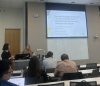
The conference featured multidisciplinary talks spanning the full breadth of computation cognition — from exploration and avoidance in anxiety, what makes music memorable, the theory of mind in humans and machines, dynamic drift diffusion modeling, and the structure of memory for narratives — overall highlighting the interdisciplinary nature of the field.
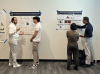
Additionally, the day featured a robust poster session highlighting work by the eight inaugural CoCo Pilot Grant recipients as well as other postdoctoral scholars, graduate students, and undergraduates doing computational cognition research at Atlanta-based institutions. In total, there were 20 posters ranging from the physics of cognition to naturalistic decision making and beyond.
A running theme throughout the conference was the growing influence of cutting-edge technologies like artificial intelligence — and how researchers are preparing for the ethical, social and practical challenges that they bring. “The next operating system won’t run on your phone,” said DeBrae Kennedy-Mayo, senior academic professional in the Scheller College of Business and one of the conference speakers. “It will run on your brain.” With such rapidly advancing technology and the growing reach of computational cognition research, institutions like CoCo are looking to rethink the current practices of studying brain data in a modern light.
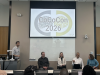
Ending the conference was a panel discussion with researchers from across psychology, anthropology, and related fields to reflect on the future of brain research. Together, they explored what it means to do computational cognition research through the central question: What should be in the CoCo canon?
The discussion emphasized that understanding what we are studying — and how we study it — is particularly important in an interdisciplinary field. While the narrative or canon of a field is defined by shared knowledge, skills, and history, computational cognition blurs those boundaries. Ultimately, as posed by Emory Department Chair and Professor of Anthropology Dietrich Stout, the field is “an interdisciplinary space trying to become a disciplinary space” within the vast array of sciences, technology, mathematics, and engineering.
With or without a defined canon, the day underscored the importance of computational cognition for understanding not just how the mind works, but the future of cutting-edge technologies that shape how we approach the study of the mind.
Media

Summary
A running theme throughout the conference was the growing influence of cutting-edge technologies like artificial intelligence — and how researchers are preparing for the ethical, social and practical challenges that they bring.
Status
- Workflow status: Published
- Created by: hashcraft6
- Created: 04/07/2026
- Modified By: lvidal7
- Modified: 06/30/2026
Categories
Keywords
User Data