
news
Sheepdogs Reveal a Better Way to Guide Robot Swarms
Primary tabs
Sheepdogs, bred to control large groups of sheep in open fields, have demonstrated their skills in competitions dating back to the 1870s.
In these contests, a handler directs a trained dog with whistle signals to guide a small group of sheep across a field and sometimes split the flock cleanly into two groups. But sheep do not always cooperate.
Researchers at the Georgia Institute of Technology studied how handler–dog teams manage these unpredictable flocks in sheepdog trials and found principles that extend beyond livestock herding.
In a study published in Science Advances as the cover feature, the researchers applied those insights to computer simulations showing how similar strategies could improve the control of robot swarms, autonomous vehicles, AI agents, and other networked systems where many machines must coordinate their actions despite uncertain conditions.
Group Movement Dynamics
“Birds, bugs, fish, sheep, and many other organisms move in groups because it benefits individuals, including protection from predators,” said Saad Bhamla, an associate professor in Georgia Tech’s School of Chemical and Biomolecular Engineering. “The puzzle is that the ‘group’ is not a single organism. It is built from many individuals, each making local, imperfect decisions.”
When a predator threatens a herd of sheep, individuals near the edge often move toward the center to reduce their own risk, Bhamla explained. “This is ‘selfish herd’ behavior,” he said. “Shepherds exploit that instinct using trained dogs.”
From examining hours of contest footage, the researchers found that controlling small groups of sheep can be harder than managing large ones. A larger group, with more sheep protected in the center, may behave more coherently than a small group as the animals constantly shift between two instincts: “follow the group” and “flee the dog.”
“That switching behavior makes the group unpredictable,” said Tuhin Chakrabortty, a former postdoctoral researcher in the Bhamla Lab who co-led the study.
Looking closely at how dogs and their handlers guide small groups, the researchers found that unpredictability in the flock’s behavior does not always make control harder. “Under the right conditions, that ‘noisy’ behavior might actually be a benefit,” Bhamla said.
Successful Sheep Herding
Sheepdog handlers categorize sheep by how strongly they respond to a dog’s threatening pressure. Some very responsive sheep might panic under too much pressure, while others might ignore mild pressure and require stronger positioning by the dog.
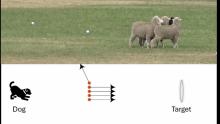
The researchers observed that successful control often followed a two-step pattern. First, the dog subtly influenced the sheep’s orientation while the animals were mostly standing still. Once the flock was aligned in the desired direction, the dog increased pressure to trigger movement. The timing of those actions was critical, because alignment within a small group could disappear quickly as individuals switched between instincts.
“In our simulations, increasing pressure makes the flock reach the desired orientation faster, but how long the flock stays aligned is set mainly by noise,” Chakrabortty said. “In essence, dogs can steer the direction, but they can’t hold that decision indefinitely, so timing matters.”
Developing Computer Models
To understand the broader implications of that behavior, the team developed computer models that captured how sheep respond both to the dog and to one another. The models allowed the researchers to test different strategies for guiding groups whose members make independent decisions under uncertainty.
They then applied those ideas to simulations of robotic swarms. Engineers often design such systems so that each robot blends signals from all nearby robots before deciding how to move. While that approach works well when signals are clear, it can break down when information is noisy or conflicting, Bhamla explained.
To explain why that switching strategy can work under noisy conditions, the researchers used an analogy of a smoke-filled room where only one person can see the exit, and no one knows who that person is. If everyone polls everyone else and averages the guesses, the one correct signal can get diluted by many noisy ones.
“That’s the counterintuitive part. When only one person has the right information, averaging can wash out the signal. But if you follow one person at a time, and keep switching who that is, the right information can spread through the crowd,” Bhamla said.
Building on that idea, the researchers tested a strategy inspired by the switching behavior they observed in sheep. In the simulations, each robot paid attention to just one source at a time (either a guiding signal or a neighboring robot) and switched that source from one step to the next.
Under noisy conditions, this switching strategy required less effort to keep the group moving along a desired path than either averaging-based strategies or fixed leader-follower strategies.
The researchers call their approach the Indecisive Swarm Algorithm. The name reflects a counterintuitive insight: allowing influence to shift among individuals over time can make groups easier to guide when conditions are uncertain.
“Our findings suggest that the same dynamics that make small animal groups unpredictable may also offer new ways to control complex engineered systems,” Bhamla said.
CITATION: Tuhin Chakrabortty and Saad Bhamla, “Controlling noisy herds: Temporal network restructuring improves control of indecisive collectives,” Science Advances, 2026
This research was funded in part by Schmidt Sciences as part of a Schmidt Polymath grant to Saad Bhamla.
Media



Summary
Georgia Tech researchers studying sheepdog trials found new principles for guiding unpredictable groups and used them to develop computer models that could improve coordination in robot swarms, autonomous vehicles, and other networked systems.
Status
- Workflow status: Published
- Created by: Brad Dixon
- Created: 03/11/2026
- Modified By: Brad Dixon
- Modified: 03/12/2026
Categories
Keywords
User Data