
news
A Winter Beach Read for Supply Chain Minds: Why "The Thinking Machine" Is Worth Your Time
Primary tabs
By Chris Gaffney, Managing Director, Georgia Tech Supply Chain and Logistics Institute | Supply Chain Advisor | Former Executive at Frito-Lay, AJC International, and Coca-Cola
People often ask me a simple question: “You always recommend a good book to read; what have you read lately?”
I usually give them my version of a money-back guarantee. I haven’t had to pay up yet!
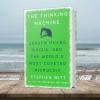
The Thinking Machine, Stephen Witt’s book on Jensen Huang and NVIDIA, is one of those recommendations.
It’s a fast, engaging read that packs a lot of insight into a book you can finish in just a couple of days. It’s also one of the most interesting books I’ve read this past year out of a stack of twenty or thirty. Most importantly for my world, it’s a book from which supply chain students, young professionals, and senior leaders can all take something different.
What many supply chain readers may not realize is that NVIDIA’s story is, at its core, a case study in supply chain design, constraint management, and long-horizon system building played out on a global stage.
This book matters to me because it pulls back the curtain on the largest technology shift impacting supply chains this century. It shows it not just as a technology story, but as a supply chain, leadership, and ethics story hiding in plain sight.
More Than a Tech Book
On the surface, this is a story about GPUs, artificial intelligence, and one of the most important technology companies in the world. But underneath, it’s really a story about context: how ideas evolve, how industries form, and how long-term decisions compound over decades.
You don’t need to be an engineer to enjoy it. By the time you’re done, you’ll have a much better grasp of:
- why chips matter,
- why AI depends on physical infrastructure,
- and why supply chains quietly shape what’s possible.
That combination makes the book especially relevant for anyone building a career in supply chain, operations, or industrial leadership.
The Immigrant Story — Still Worth Protecting
One of the most powerful threads running through the book is Jensen Huang’s immigrant story.
His family worked hard to come to the United States. He grew up in modest circumstances, and through persistence, opportunity, and relentless effort, he helped build a company with global impact.
For many of our ancestors, this story feels familiar. For many who come to the U.S. today, it still represents hope. The book serves as a quiet reminder that this pathway from modest beginnings to meaningful contribution is not accidental; it is something that needs to be protected.
The United States is far from perfect, but it remains a remarkable place to innovate and to start businesses. Supply chains are both a driver of that innovation and a beneficiary of the new ideas that emerge.
A Startup Story With Real Twists and Turns
The founding of NVIDIA is not a clean, linear success story.
The original big idea wasn’t necessarily the one that ultimately “won,” and the initial target market wasn’t always the right one. The company faced near-death moments, pivots, resets, and more than a few reasons to walk away.
For students and young professionals considering startups, whether founding one or joining one, this book offers a realistic picture of what that path looks like. It reinforces a few hard truths:
- the probability of failure is high,
- the work ethic required is enormous,
- and the rewards, if they come, often come much later.
I often describe this as a “one scoop now, two scoops later” dynamic. Early effort is rarely rewarded proportionally; patience matters more than hype.
Innovation Is a Team Sport
While Jensen Huang is clearly the centerpiece of the book, one of its strengths is that it avoids treating innovation as a solo act.
Many other players, sometimes knowingly and sometimes unwittingly, contributed research, ideas, and decisions that ultimately shaped where we sit today. The book does a good job showing how progress builds through layers of contribution, often across institutions and generations.
This matters, especially for students and early-career professionals. Breakthroughs rarely come from a single moment or a single person; they come from systems that allow ideas to accumulate and translate into real-world application.
From Basic Engineering to Neural Networks
Several chapters walk through the literal evolution of the technology, and this is where the book is both accessible and impressive.
Even if you can only “just barely hang on” technically, the narrative is clear: today’s AI capabilities are the result of layered progress. Hardware advances built on earlier hardware, software abstractions built on earlier software, and research findings translated into application over time.
Many of the contributors moved fluidly between academia and industry, reinforcing a core lesson: foundational science and engineering still matter. For those of us who remember an analog world, it’s fascinating to see how decades of incremental progress led to the current state and potential of AI.
A Supply Chain Story Hiding in Plain Sight
From a supply chain perspective, The Thinking Machine reads like a case study hiding in plain sight.
NVIDIA is an American innovation success story that is, at the same time, deeply dependent on global supply chains. Its relationship with TSMC in Taiwan, the scarcity of advanced manufacturing capacity, the national security implications of certain chips, and the need to serve global markets all create a complex and fragile operating reality.
One of the quieter but most powerful lessons in the book is how much supply chain design matters. Product success here isn’t just about better ideas; it’s about how effectively those ideas are translated into scalable, resilient, global systems.
AI may feel digital, but its limits are profoundly physical.
Leadership Results — and a Real Paradox
The book also forces an uncomfortable but important leadership conversation.
Jensen Huang is demanding, intense, and uncompromising. While the results are undeniable, I don’t advocate for many aspects of his leadership style. I believe similar outcomes could be achieved without subjecting employees to public humiliation.
Results matter, but how we get them matters too.
Reading this book reminded me that some of the most valuable leadership lessons I’ve learned came from watching both how to lead and how not to lead. I’ve had bosses who modeled the kind of leader I wanted to become, and a few who taught me just as much by showing me what I wanted to avoid. Both experiences have been valuable.
That tension is worth sitting with, especially for those mentoring the next generation of leaders.
Computer Vision, GPUs, and Adaptability
Computer vision plays a supporting role in the story: not the headline act, but an important early driver. Graphics and vision workloads helped shape GPU architectures long before today’s generative AI boom.
Over time, those architectures generalized to support a wide range of parallel computation, including neural networks. It’s a reminder that technologies often succeed not because of a single application, but because they are flexible enough to evolve.
Ethics, Uncertainty, and Responsibility
Finally, the book leaves us with unresolved questions, and that may be its most honest contribution.
AI is resource-intensive, it will reshape work and livelihoods, and it raises real ethical concerns. Opinions vary widely on whether this moment resembles past industrial revolutions or represents something fundamentally different.
I teach and advocate for the application of AI, but I personally struggle with these ethical dilemmas. Rather than avoid them, I try to address them head-on by highlighting the risks and encouraging students to stay informed so they can be voices for responsible, positive use.
In today’s global and regulatory environment, it’s unrealistic to expect a pause in research or application. Education, not avoidance, may be the most practical form of governance we have.
We can’t guarantee how this plays out over the next decade, but we can prepare.
Why I Keep Recommending This Book
If you’re a supply chain student looking for context, a young professional navigating career choices, or a senior leader trying to understand how AI, supply chains, leadership, and ethics intersect, this is a book worth your time.
It’s engaging, timely, and surprisingly human.
And when someone asks me, “What are you reading?”
This is the book I’ll keep recommending.
The Thinking Machine succeeds because it reminds us that behind AI are people, supply chains, and long-term decisions, all operating under real constraints. That’s a lesson worth revisiting as we set the pace for the months ahead.
A Closing Question
This book highlights traditional supply chain constraints that NVIDIA faced in its growth journey, such as single source supply, perceived lead times, capacity at key suppliers, demand volatility, and talent gaps. Where have you seen or faced these, and how have you and your company navigated them?

Summary
Recommended for supply chain professionals and leaders seeking insight into the real-world impact of technology and strategic decision-making, the book examines how NVIDIA’s ascent under Jensen Huang revolutionized both technology and supply chain management through a focus on parallel computing and robust global networks. It delves into the convergence of AI, supply chain strategy, leadership, and ethics, illustrating how long-term vision and adaptability positioned NVIDIA at the forefront of artificial intelligence and industry transformation.
Groups
Status
- Workflow status: Published
- Created by: Andy Haleblian
- Created: 01/22/2026
- Modified By: Andy Haleblian
- Modified: 01/24/2026
Categories
User Data