
news
Science for Public Good: Introducing the Community Engagement Graduate Fellows
Primary tabs
Four graduate students from the College of Sciences were recently selected for the new Community Engagement Graduate Fellowship, made possible through a gift from Google. This one-year research opportunity awards up to $5,000 for each fellow to develop a project with local partners that aims to build stronger communities.
“It has been a pleasure for the Center for Programs to Increase Engagement in the Sciences (C-PIES) to collaborate with Google and the College of Sciences Advisory Board to bring this fellowship, which will positively impact our community and highlight how science can align with public good,” says Lewis A. Wheaton, professor in the School of Biological Sciences and director of C-PIES.
In the year ahead, the fellows will work with C-PIES and community partners on campus and in the metro Atlanta area to develop projects in one of three priority areas: civic and policy engagement, community-engaged research, and K-12 research outreach.
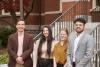
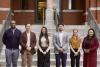
The fellowship was open to all graduate students in the College of Sciences, and four inaugural fellows — Aniruddh Bakshi, Katherine Slenker, Miriam Simma, and Nikolai Simonov — were named based on their exciting, yet feasible applications.
Fellow Aniruddh Bakshi: Strengthening trust in science
Ph.D. student Aniruddh Bakshi studies the problem of drug delivery at the intersections of organic chemistry, biochemistry, and immunology. As mRNA vaccines are closely related to his area of research, he sees the need for a grassroots outreach movement from young academics to help bolster public confidence in rigorous scientific methodology.
In collaboration with local hospitals and nonprofits, his proposed project is to start a social media content series, titled “A Day in the Life of a Ph.D. Student,” to show the realities of graduate school for those interested in this career path while connecting his research to broader public issues.
“Science has the power to solve urgent problems, but only if people understand and trust it,” says Bakshi. “Through this fellowship, I will use my research and outreach efforts to help strengthen that trust — showing how discoveries in drug delivery and vaccine design can make a real difference in people’s lives.”
Fellow Katherine Slenker: Creating a biodiversity data network
Atlanta is often referred to as “the city in a forest,” but according to Ph.D. student Katherine Slenker, wildlife has a difficult time navigating across roads and housing developments, often resulting in human-wildlife conflict.
“Conservation ecologists have long recommended that the movement of wildlife could be eased through the creation of ‘ecological corridors,’ which connect greenspaces and wildlife populations,” she explains. “Determining the movement patterns of wildlife, and where such corridors may be best situated, requires that we first understand what species reside in the metro Atlanta area as well as how they are expected to disperse.”
As a fellow, Slenker plans to build a biodiversity data network by comparing wildlife monitoring at Davidson-Arabia Mountain Nature Preserve and Stone Mountain Park and increasing the coalition of metro Atlanta researchers. This data can be used in the development of ecological corridors to reduce clashing between humans and wildlife, notably animals struck by vehicles, and improve ecosystem health at these parks.
Fellow Miriam Simma: Making structural biology research more accessible
The study of crystallography is vital in academia, industry, and medicine because it enables researchers to decipher the atomic structures of proteins, but it is scarcely taught outside of graduate school. Ph.D. student Miriam Simma wants to change that.
Her proposed project is to introduce protein crystallography to K-12 students and teachers through hands-on activities in local high school classrooms and to the public during the Atlanta Science Festival at Georgia Tech.
“My vision is to make structural biology research accessible, so everyone can engage with cutting-edge scientific research — fostering curiosity and interest in STEM careers,” says Simma. “Long term, I will synthesize these activities into a chemical education article that introduces K-12 students to protein structure and function.”
Fellow Nikolai Simonov: Mentoring middle school scientists
Last year, Ph.D. student Nikolai Simonov became involved in the GoSTEM Club at Lilburn Middle School — leading student activities and recruiting other graduate student volunteers. In partnership with Georgia Tech’s Center for Education Integrating Science, Mathematics and Computing, the club is a weekly afterschool program for students, many of whom come from underserved backgrounds, to grow their scientific curiosity.
“I assembled a team of 10 Tech graduate students who could explain complex scientific concepts in approachable ways for middle school students. Through this fellowship, we are excited to enrich the GoSTEM Club with an ongoing mentorship program and materials for more ambitious science fair projects,” shares Simonov.
As part of the program, club members can meet one-on-one with Georgia Tech mentors to discuss their educational and career goals. “By sharing their stories and connecting scientific ideas to real-world applications, our mentors aim to show students that STEM is not only accessible but a path toward a fulfilling life,” he adds.
Summary
Four graduate students from the College of Sciences were selected for the new Community Engagement Graduate Fellowship, made possible through a gift from Google, to develop projects that positively impact the metro Atlanta area and highlight how science can align with public good.
Status
- Workflow status: Published
- Created by: Annette Filliat
- Created: 01/15/2026
- Modified By: Annette Filliat
- Modified: 01/15/2026
Categories
Keywords
User Data