
news
From Student Inventors to School Safety Startup: How Georgia Tech’s K-12 InVenture Prize Sparked a Journey of a Lifetime
Primary tabs
By Randy Trammell, College of Lifetime Learning Communications
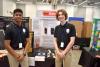
When Rohan Kumar and William Susskind first began working on their comprehensive school safety platform QuickSecure (then called Door Bully), they were not trying to build a company. They were trying to save lives and make their own high school safer.
An Idea Born from Need
After a student allegedly attempted to 3D-print parts for a weapon at school, the two Paul Duke STEM High School juniors were shaken. They decided to act and began exploring ways to make classrooms more secure. They built a system with a digital lock for classroom doors during emergency lockdown situations that also uses AI technology to help responders locate perpetrators. What started as a student project soon attracted the attention of educators who saw something bigger.
"We were trying to build something so that we could feel safer in our own school," said Kumar.
Encouraged by CEISMC’s Jeff Rosen and their engineering teacher and mentor John Mobley, the students entered the K-12 InVenture Prize, a decision that would change the trajectory of their lives.
"We owe everything to the K-12 InVenture Prize," Kumar said. “I think it led us to where we are today."
Learning to Think Like Entrepreneurs
The K-12 InVenture Prize is an invention and entrepreneurship program and competition within the College of Lifetime Learning that challenges students to identify real-world problems and design novel solutions through analysis, creativity, and the scientific method.
K-12 InVenture Prize Director Danyelle Larkin said that being a part of the foundation of Susskind and Kumar’s amazing journey has been both humbling and inspiring, particularly based on what their success demonstrates to other young inventors and dreamers.
“Rohan and William embody the spirit of innovation and entrepreneurship — young people exploring being makers and creators,” she said. “That’s the kind of thing our program and our college supports. That’s why we are here.”
According to Susskind, the competition helped the young inventors really understand the entrepreneurship side of the equation — realizing that innovation is about more than building a pr oduct. Innovation is about communicating an idea, understanding customer needs and refining a solution through feedback, he said.
“We never would have had the opportunity to pitch it to so many people, or the platform to actually grow it ... along with the support from both administrators, teachers, staff at Georgia Tech, and then also people at the Henry Ford.”
Following their success at Invention Convention U.S. Nationals — where they placed third in their grade level and received the Patent Application Specialty Award — Kumar and Susskind worked to pursue and ultimately received a full patent for their technology while also working to get their invention in several local schools.
They both enrolled at Georgia Tech and in their freshman year they were approached by producers of the television show “Shark Tank,” who had been tracking their success since their junior year in high school. Though they ultimately withdrew during the casting process to pursue other investment opportunities, Kumar said the experience taught them how to commercialize their product while being immersed in the startup world.
“We realized that there's really an opportunity for us to build something that was big and something that we really cared about here,” he said.
Taking the Next Step
Motivated by all they had learned, Kumar and Susskind took a leap of faith and rented an office in New York for the summer. “We just went heads down on building a product that we thought customers would really like and signed our first customer that July. And then it's been a crazy whirlwind ever since,” Kumar said.
Their next big break came when the duo landed a spot in Elbow Grease, an accelerator program run by Gutter Capital in New York. During the 10-week program, Susskind and Kumar closed their largest contract to date, grew their engineering team, and built a strong pipeline of school districts that have since closed deals with the startup.
The pair moved to New York in January and began building up the company. They hired their first two employees and are now in the process of scaling the business, splitting their time between their New York and Atlanta offices.
For now, the pair are taking a leave of absence from classes, Susskind said, while they scale and grow their business. But neither sees stepping away from the classroom as the end of their education.
“Georgia Tech is always there. So, if something was to change in our path and we want to go back to school, I think that option is still available, he said.
For Sussking, returning to Georgia Tech reflects the role education can play as careers and companies evolve.
“And we know education will always be there, which is why Georgia Tech is so unique. I totally see the value in kind of going back in the future, especially if it's online classes and just a little bit more education to kind of better ourselves,” Susskind said.
These days Rohan and Susskind lead busy lives with little sleep, but the two company founders are happy.
“Making a cost-effective and efficient method of saving lives and keeping the future of innovation and creativity alive was something where I felt, ‘We have to do this,’” said Susskind, QuickSecure CTO. “We have to expand this and keep on working on it no matter what.”
CEO Kumar said that QuickSecure now covers the full range of what a school needs to stay safe and run smoothly, from active shooter response to the daily operational work of asset management, like flagging a door that needs repair. He calls it software built to work at every level of severity.
The company has now raised two rounds of funding and is expanding its engineering team as it expands. For Kumar, this stage makes the path from high school invention to growing organization truly remarkable.
“William and I are very fortunate that we were able to raise two successful rounds of fundraising, which is an extremely amazing opportunity for an early-stage company," he said. "It's a really exciting thing of getting the people around the product and getting the feet under the company so we can get running.”
It's an impressive journey that began with two high school students trying to solve a problem they saw, and with a program that gave them a place to test their idea and tell its story. Imagine how far it can go.


Summary
Groups
Status
- Workflow status: Published
- Created by: James-Addis Hill
- Created: 10/09/2026
- Modified By: James-Addis Hill
- Modified: 10/09/2026
Keywords
User Data