
news
Zoo Atlanta Elephants Embrace New GT-Designed Interactive Enrichment Wall
Primary tabs
Titan, Msholo, Kelly, and Tara are just like any other African elephants — intelligent creatures that require mental stimulation in their everyday lives.
They would normally get this in their natural habitats while foraging for food and staying alert to predators that might target calves.
However, the four elephants reside at Zoo Atlanta, so they don’t have to worry about these things.
That’s why zoo caretakers are always on the lookout for better ways to help their elephants exercise their brains.
The caretakers at Zoo Atlanta found one when they met Arianna Mastali, a Ph.D. student in Georgia Tech’s School of Interactive Computing. Mastali designed an audio enrichment wall to help stimulate Zoo Atlanta’s elephants.
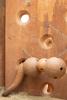
Many zoos build concrete enrichment walls to foster elephant problem-solving and critical thinking. The walls usually have holes for the elephants to reach through with their trunks as they search for food, treats, or playful objects on the other side.
Mastali enhanced Zoo Atlanta’s enrichment wall by adding an interactive audio component. A nearby speaker system emits distinctive low-frequency tones when an elephant sticks its trunk into a hole.
“They’re intelligent creatures that require a lot of complexity in their habitat,” Mastali said. “We wanted to add to that complexity while giving them more control.”
Experimenting in the Wild
Mastali’s system uses cameras and computer vision to detect when an elephant’s trunk is inside a hole and then sends a signal to the speakers to play a sound.
Mastali is a member of the Georgia Tech Animal Lab, directed by School of IC professor Melody Jackson. The lab often uses sensing technology to enhance animal wellness.
Mastali said she tried incorporating sensing devices into her project several times. She constructed an insert made of PVC pipe and attached a sensor to its base that used infrared beams to detect the elephant’s trunk.
However, she said it was difficult to account for the elephants’ strength. Their trunks would break the insert after a day or two.
She pivoted toward computer vision to remove the risk of damage and keep the enrichment wall as close to natural as possible.
“A big lesson we learned was that using existing materials the elephants are already familiar with was the best way to do things, and it simplified our design process,” she said.
Shane Rosse, a student in Georgia Tech’s Online Master of Science in Computer Science (OMSCS) program, assisted Mastali with the computer vision component.
Enhancing Environmental Enrichment
Mastali observed the elephants’ behavior at the wall seven days before and seven days after the installation of the audio enrichment system.
The number of times the elephants approached the wall after installation increased by 176%, and time spent at the wall increased by 71%
“We weren’t sure at first if they would care that much, so it was great to see how much time they spent at the wall, especially our less dominant females,” said Kirby Miller, senior elephant caretaker at Zoo Atlanta. “They seem to like it the most.”
Miller said the elephants used to only approach the wall when they knew there was food behind it. That started to change after the audio enrichment system was installed.
“We would be off somewhere else, and we’d hear the speaker playing the sounds, and we knew there wasn’t any food back there,” Miller said. “Tara had her trunk in one of the holes, just listening to the sound. That let us know they do like it, and they’re very curious about it.”
Miller said because elephants have sharp memories and acute senses of hearing and smell, their habitats must be designed with that in mind.
Zoo Atlanta’s African Savanna elephant habitat was redesigned in 2019. In addition to the enrichment wall, it includes a bathing pond, two waterfalls, and swing boom devices that hold hay for elephants to eat as they would in the wild.
Miller said elephants sheltered at any zoo or conservation would benefit from enrichment devices enhanced by technology.
“I think anything they can participate in that gives them choice and control is great for all zoo elephants,” she said. “It depends on the elephants, but with our elephants, they can hear much higher frequencies than we can. That noise isn’t that loud for us, but for them, they’re feeling that noise, and they can hear much more, which makes it more stimulating for them.”
Media




Summary
Georgia Tech Ph.D. student Arianna Mastali designed an interactive audio enrichment wall for Zoo Atlanta's four African elephants. A speaker system plays low-frequency tones when an elephant inserts its trunk into one of the wall's holes, deteced by computer vision.
Status
- Workflow status: Published
- Created by: Nathan Deen
- Created: 04/22/2026
- Modified By: Kristen Bailey
- Modified: 04/27/2026
Keywords
User Data