
news
Proving the Hypothesis: Kendreze Holland Becomes First Project ENGAGES Scholar to Earn Doctorate
Primary tabs
Abstract
“It was a hypothesis. I was the experiment, and the hypothesis was proven true.”
Can an inner-city student who grew up below the poverty line earn a Ph.D. and make a career in research? In theory, yes.
The barriers are many. But literature suggests that early exposure to STEM and research opportunities can increase the odds for students in need.
For Kendreze Holland, the idea of making it to college and earning an advanced degree was a hypothesis. Sure, theoretically it could be done — but in his own home, not everyone had even made it past high school.
Often, the first question on the way to scientific discovery is: What if? What if a student like Holland received the right help at the right time? What if he was guided along the way by mentors who were leaders in their fields? What if he was given the opportunity to develop professional skills and make valuable connections?
Holland asked himself: What if he could be the one to prove the hypothesis true?
Introduction
Holland grew up in northwest Atlanta, one of seven children raised by a single mother. Being one of so many children, most would struggle to stand out. But Holland always sought to be different.
“My perpetual intention was to be less of a burden to my mother,” he said. “Since my mother’s education limited her abilities to help with my schoolwork, I went above the call of duty to stand out in academics.”
His mother’s education was cut short in ninth grade so she could raise her first child, Holland’s older sister, and no one in his family had gone to college. In his mind, he had three career paths to choose from: football, hip hop, or retail.
“Standing at a solid 5 foot 8, the first would have been difficult,” he joked. “And the latter two were not my calling.”
Just like his mother, the course of his life changed in his ninth-grade year. For Holland, it began an academic journey he never expected.
In 2012, he was attending B.E.S.T. Academy, an all-boys public school for grades six through 12 focused on business and STEM. Biology class was just another hour waiting to pass for the 15-year-old Holland, until the day two guest speakers from Georgia Tech walked into the room with “some weird apparatuses and mechanical chopsticks.”
The two guests used the equipment — gel electrophoresis systems and pipettes — to show the boys what research can look like in real life.
“This experience sparked within me a drive for science, and it was the first time I realized that I wanted to, and could, attain an advanced scientific degree,” Holland said.
The two speakers were Manu Platt, a professor in the Wallace H. Coulter Department of Biomedical Engineering at Georgia Tech and Emory University, and Jerald Dumas, a postdoctoral researcher. Platt and Dumas were there to recruit students for a new program called Project ENGAGES within the Parker H. Petit Institute for Bioengineering and Bioscience (IBB).
The program was co-founded by Platt and the late Robert M. Nerem, IBB’s founding executive director, to give students like Holland an opportunity to participate in real research projects that would hopefully plant a seed in the next generation of scientists.
Students come from one of eight partner schools in Atlanta. Once accepted, they are connected to a Georgia Tech graduate student who mentors them and supervises their work, and they get paid to work in their assigned lab for one year.
Project ENGAGES does more than expose students to STEM concepts and ideas. It equips them with the skills and knowledge to carry out their own independent research projects. They also have opportunities to establish connections with university faculty and industry representatives who can provide career guidance and support.
Methods
Though Holland didn’t meet the program’s age requirement in 2012, he applied again the next year and was accepted. During his junior and senior years of high school, he worked in Platt’s lab, where he aided with projects involving proteins, cell cultures, and antibodies.
“Over the course of those two years, the growth I saw scientifically, professionally, and in maturity, all corroborated my belief that Kendreze was going far, and able to push past whatever goals and obstacles he comes up against,” said Platt, now the director of the Center for Biomedical Engineering Technology Acceleration housed within the National Institute of Biomedical Imaging and Bioengineering.
Holland's experience sparked a love for science and a career-long connection with Georgia Tech. After high school, he graduated summa cum laude with a degree in chemistry from Georgia State University. As an undergraduate, he stayed connected with Tech and with IBB as a Petit Scholar, a yearlong mentorship program and research experience for top students around Atlanta.
“I really wanted to stay close to home, and I felt like everything was in my backyard,” he said. “There are many people who come here from other places to Tech because of the great science that is going on. There’s something special about Atlanta, and I’m just getting the best of what I can from it.”
He credits his time in Project ENGAGES with giving him the confidence and resilience to continue toward his goals. Like many others in the program, he was a first-generation college student with little to no guidance for his academic career. The holistic approach of Project ENGAGES provided professional development opportunities and standardized test preparation to ready him for life in college and beyond.
“I knew I wanted to go to grad school, but I didn’t know I was going to do all these things,” he said. “Having that one goal sprouted a lot of side quests that just grew into something bigger.”
After graduating from Georgia State in 2020, Holland was accepted into Georgia Tech’s Bioengineering Graduate Program as a doctoral student. In December 2025, he became the first Project ENGAGES alumnus to successfully defend his dissertation, and he is expected to graduate this spring.
Lakeita Servance, assistant director of Outreach Initiatives at IBB, was the program manager for Project ENGAGES when Holland was accepted and cheered him on more than 10 years later as he presented his doctoral research.
“As I sat in that room while he was defending his dissertation and sharing his research with all of us, I still reflected on that boy I saw at 16 years old,” she said. “It was this full circle moment to see him make it all the way back here. The investment we made over a decade ago has paid off in such a large way.”
Results
In addition to being the first in his family to go to college and earn an advanced degree, Holland received financial support from the National Science Foundation’s Graduate Research Fellowship Program; was awarded multiple prestigious fellowships, including FORD, GEM, and Herbert P. Haley; landed an internship with 3M Corporate Research Materials Laboratory; and served as a mentor in the Nakatani Research and International Experience for Students. He has published papers, led panel discussions, applied for patents, and presented his research at national conferences.
“All that stemmed from Project ENGAGES,” he said. “And more importantly, I applied to be a mentor for the ENGAGES program.”
Holland said some of his most meaningful experiences have come from being able to give back. He has served as a mentor, both formally and informally, to more than half a dozen students, some who come from backgrounds much like his own.
“I wanted to give back to the program because it poured so much into me. They were able to get me all the way to the Ph.D. level, so I knew that I could use my grind to help other students.”
Conclusion
Having proved the hypothesis true, Holland is turning his focus to the future, considering his options in academia and corporate research while he continues to work as a postdoc at Georgia Tech.
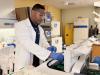
His research in John Blazeck’s lab focuses on cellular engineering using CRISPR gene editing technology to regulate gene profiles, meaning he and other researchers can turn certain genes up and others down to affect the way cells respond. Though he is currently working with yeast cells, he hopes that his research will translate into mammalian cells that could have more clinical applications.
“In terms of diseases and disorders, you can use it to tune genes to help someone experiencing cancer by helping immune cells or stopping cancer cells from dividing rapidly,” he said. “You can also help other cells to survive longer, and longer cell viability means potentially a patient can survive longer.”
What began as a presentation in a high school science class has led Holland to a future he never expected. Tequila Harris, professor in the George W. Woodruff School of Mechanical Engineering and co-director of Project ENGAGES, said his story shows others that they can do the same.
“I believe his achievements will inspire and motivate generations of students to pursue dreams that they may not have known they had. Kendreze Holland has fundamentally shown others that there are multiple pathways to engage in STEM and that opportunities and access to advanced degrees can be attained by those willing to do the work.”
Holland's story is symbolic of the ultimate goal for Project ENGAGES: to change the lives of talented young people who may never have had the opportunity to succeed.
“That’s why I was so adamant about getting my Ph.D.,” he said, “to show that one could potentially overcome what they were going through to do something extraordinary.”
Project ENGAGES is possible thanks to philanthropic support from our generous community: Donate here.
Media
Summary
For Kendreze Holland, the idea of making it to college and earning an advanced degree was a hypothesis. Holland asked himself: What if he could be the one to prove the hypothesis true?
What began as a presentation in a high school science class has led Holland to a future he never expected – planning to graduate from Georgia Tech with a Ph.D. in bioengineering this spring. His story is symbolic of the ultimate goal for the Project ENGAGES program: to change the lives of talented young people who may never have had the opportunity to succeed.
Status
- Workflow status: Published
- Created by: abowman41
- Created: 02/25/2026
- Modified By: abowman41
- Modified: 03/09/2026
Keywords
User Data