
news
New ADC XR Makerspace Opens Doors to Extended Reality
Primary tabs
Curious students, faculty, and staff gathered on the first floor of the ISyE Main Building to celebrate the opening of a new interdisciplinary hub for immersive technologies in research, education, and human-centered engineering. On January 23, the Allen-Davidson-Coleman (ADC) XR Makerspace opened its doors with a mission to expand access to a wide range of extended reality (XR) tools for the ISyE community.
The Makerspace offers a wide range of equipment to support XR projects and experimentation, including Apple and Meta headsets, augmented reality glasses, haptic gloves, motion-tracking cameras, and 3D printers, enabling student and faculty research and exploration in extended reality.
XR is an umbrella term encompassing everything that merges physical and virtual worlds. It includes augmented reality (where digital objects are added to the physical world), mixed reality (where digital elements can interact with the physical world), and virtual reality (which uses a completely virtual environment). Steven Yoo, graduate student and XR Captain who leads a team of five other student crew members who will operate the Makerspace, said that exploring XR in an industrial engineering context enables a more human-centered approach, allowing engineers to better understand how real people interact with their design solutions.
“Being focused on optimization, mathematics, and operations research is great, and that can be proven in the theoretical world. But we wanted to emphasize and cover the application and see if our model actually succeeds whatever the case is that industry needs,” Yoo said.
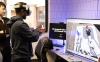
To mark the opening, PhD students led an open-house showcase featuring XR projects that encouraged attendees to try on headsets, interact with immersive environments, and experience the virtual worlds they had built.
Shae Cole, a Nuclear Engineering graduate student, shared a mixed-reality application he and his teammates made in the makerspace. In the application, the user could pick up a virtual wand and use it to locate an unknown radiation source by following where the wand produced the highest readings on a Geiger counter. Cole said that his application could be adapted for use in training or research, to assist those who work with radiation.
Robotics graduate student, Chuizheng Kong, utilized motion-tracking capabilities with virtual reality headsets. He was able to track a human's motion and transfer it to a humanoid robot, overcoming the challenge of manually controlling each of the dozens of robot motors.
While many of the projects displayed were proof-of-concepts for more robust use cases in industry, it underscored Yoo’s sentiment of interdisciplinary and real-world applications.
“I think that what ISyE does really well is looking at the application base. You saw [projects], between robotics, healthcare, and assembly. And I think that's where part of an interdisciplinary field that we're in this department specifically,” Yoo said.
Going forward, Yoo shared that the ultimate goal is to push XR into new realms and cement the idea that Georgia Tech is the place to do research and work in XR. He hopes the space will provide a space for people to invent, see their theoretical models come to life, and provide a leading community of XR creators.
Designed for curiosity, collaboration, and creativity, the ADC XR Makerspace is open to anyone for classwork, research, or exploration. Guided by experienced student leaders and supported by faculty leadership from Mohsen Moghaddam (director), Alan Erera (strategic advisor), and faculty advisors Frederick Benaben and Benoit Montreuil, the space is built to encourage curiosity and collaboration.
To learn more about the ADC XR Makerspace, click here.


Summary
At the opening, ISyE students, faculty and researchers brought the space to life with an open-house showcase of XR projects, inviting attendees to slip on headsets and step directly into virtual worlds they had created.
Status
- Workflow status: Published
- Created by: ebrown386
- Created: 02/02/2026
- Modified By: ebrown386
- Modified: 02/04/2026
Categories
Keywords
User Data