
news
Outside the Box: The Adaptation of Georgia Tech’s Beekeeper in Residence From Advertising to Apiaries
Primary tabs
During her years working in the advertising and marketing industry, Deb DeWitt became increasingly intrigued by beekeeping. The timing, however, was never quite right.
Busy with her career and family, DeWitt tucked the idea away — until she stepped back from the professional world and knew it was time to pursue keeping bees. She enrolled in a one-day beekeeping class that was offered by the Metro Atlanta Beekeepers Association. From there, DeWitt learned the fundamentals, purchased her first honey bees, and began the fascinating — and sometimes mystifying — work of caring for them in her backyard.
Like many new beekeepers, she faced steep challenges: sick bees, failing colonies, secondary pests, and ensuring her hives had enough resources to survive winter. But DeWitt says that she also discovered how remarkably generous and supportive the beekeeping community is. She connected with mentors and attended local bee club meetings and state conferences where researchers shared their latest findings. Beekeeping became meaningful in ways she had never anticipated.
“I fell in love with honey bees and all things related. There is an innate spirituality in keeping bees,” she says. “Once I put the veil on, life slows to a standstill and becomes a walking meditation into a delicately complex and endlessly fascinating world.”
Her marketing background came full circle too. “Like any creative endeavor, beekeepers must be keenly observant,” DeWitt explains. “We have to think outside the box, pivot quickly, anticipate problems, and plan ahead.”
As her colony numbers grew, so did her reach. DeWitt established apiaries at several metro Atlanta schools and at sites in Chattahoochee Hills, Grant Park, Brookhaven, Arabia Mountain, and Brevard, North Carolina. Along the way, she earned her Master Beekeeper certification from Cornell University, served as the central regional director for the Georgia Beekeepers Association, taught beekeeping to incarcerated individuals through the Georgia Department of Corrections, and partnered with tree companies to rescue wild honey bee colonies living in trees slated for removal.
Serving as the Beekeeper in Residence
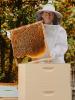
This breadth of experience prepared her for a unique opportunity: becoming Georgia Tech’s 2025 Beekeeper in Residence with the Urban Honey Bee Project. The one-year residency, DeWitt says, offered “a rare opportunity to be part of the Georgia Tech community,” allowing her to explore new ideas in beekeeping while tending to and expanding the rooftop hives at The Kendeda Building for Innovative Sustainable Design.
The Urban Honey Bee Project, an interdisciplinary initiative of Georgia Tech’s College of Sciences and Office of Sustainability, established the Beekeeper in Residence program to maintain colonies at The Kendeda Building and in the EcoCommons, mentor student beekeepers, and enrich the program with diverse expertise.
“Deb did so much this year — working closely with the Beekeeping Club, keeping our hives healthy, and even rehoming a wild hive from a dead tree on campus,” says Jennifer Leavey, assistant dean for faculty mentoring in the College of Sciences and director of the Urban Honey Bee Project. “Most importantly, Deb showed our students how an expert beekeeper approaches hive care. She took every opportunity to include them, and it made a real impact.”
Georgia Tech undergraduate Alyssa Zhang agrees. “The Beekeeping Club loved working with Deb. She was always happy to teach us — whether it was managing Varroa mites last summer, when she helped reduce counts from 17% to below 1%, or preparing the hives for winter.”
Protecting intelligent pollinators
The Varroa mite is one of many pressures beekeepers face. “The biggest challenges affecting honey bees — as well as native bees and other pollinators — are climate change, habitat loss, pesticide use, pests, and pathogens,” DeWitt explains. “These factors contributed to U.S. commercial beekeepers losing a devastating average of 62% of their colonies last year.”
Honey bees play a critical role in pollinating food crops and producing honey and beeswax. These threats fuel DeWitt’s passion for education, mentorship, and advocacy at the local, state, and national levels. Yet, the most meaningful rewards are personal.
“Honey bee colonies are superorganisms — tens of thousands of individuals working together for the good of the hive,” she adds. “Bees are intelligent, endlessly fascinating creatures, and I never stop learning from them. Beekeeping has made me a better gardener, horticulturist, ecologist, conservationist, carpenter, biologist, scientist, student, teacher, problem solver… you name it.”
Recognized across Georgia
Her passion for the craft is unmistakable. In 2025, DeWitt received one of the state’s highest honors: Georgia Beekeepers Association’s Beekeeper of the Year Award.
“I am profoundly grateful to the state’s beekeeping community for recognizing my efforts over the past eight years,” says DeWitt. “This award reflects the mentorship I’ve received from some truly exceptional beekeepers.”
Media


Summary
Marketer-turned-beekeeper Deb DeWitt serves as Georgia Tech's Beekeeper in Residence and receives the Georgia Beekeepers Association’s Beekeeper of the Year Award.
Status
- Workflow status: Published
- Created by: Annette Filliat
- Created: 12/16/2025
- Modified By: ls67
- Modified: 12/17/2025
Categories
Keywords
User Data