
news
IMS Launches Series on Interdisciplinary Innovation with AI Computing Panel
Primary tabs
The Institute for Matter and Systems (IMS) hosted the inaugural Boundaries and Breakthroughs panel on Nov. 11, setting the stage for a new era of interdisciplinary dialogue at Georgia Tech. The event, held in the Marcus Nanotechnology building, brought together experts in electrical engineering, computer architecture, and computer systems design to tackle one of today’s pressing challenges: artificial intelligence (AI) scalability and sustainable high-performance computing.
As one of Georgia Tech’s 11 interdisciplinary research institutes, IMS is designed to break down silos between traditional academic units. By operating core user facilities and fostering collaborative research, IMS creates a unique ecosystem where device-level innovation meets systems-level design. This event personified that mission by connecting researchers who typically work on different ends of the stack.
“We’re looking for opportunities to bring people together to have discussions that are both informative and potentially create a little bit of friction in the best possible way around trending topics in science and engineering,” said Mike Filler, IMS deputy director, during opening remarks.
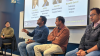
The panel was moderated by Divya Mahajan, assistant professor in the School of Electrical and Computer Engineering, and featured Moinuddin Qureshi, professor of computer science; Anand Iyer, assistant professor of computer science; and Asif Khan, associate professor in electrical and computer engineering.
The discussion explored the dynamics between compute abundance and energy constraints. As AI models scale up, power consumption has become a societal issue, driving up energy demands and even influencing political conversations. The panelists agreed that the bottleneck isn’t compute — a computer’s ability to process and execute tasks — but data movement. Moving data uses 100 to 1,000 times more energy than computation, making memory systems the critical frontier.
The conversation highlighted how breakthroughs in compute must occur at every layer — from individual devices to full computer systems. At the device level, Khan mentioned emerging memory technologies and “beyond CMOS” approaches such as embedding compute within memory and exploring bio-inspired architectures.
From a computer architecture level, Qureshi advocated rethinking interfaces and creating designs optimized for the future of computing. AI needs regular patterns to work optimally, and current patterns are not set up for that.
“If you want efficiency, design systems that make sense for AI,” Qureshi said. “Develop new interfaces, develop new modules, architectures, and organization that make for a specific pattern.”
At the systems level, Iyer stressed practical strategies like near-memory compute and energy-aware scheduling while acknowledging the need for co-design between hardware and software.
“Now in terms of brains or bio-inspired computing, my conjecture is that there is currently no hardware that is capable of doing it,” Khan said. He also noted that right now, there is no computer or algorithm that has the scale of computing comparable to human brain power.
The panelists didn’t shy away from provocative ideas — such as whether graphic processing units are the final solution for AI and whether matrix multiplication alone can lead to artificial general intelligence. While opinions varied, all agreed that organizations like IMS are key to bringing together diverse expertise to tackle these questions collaboratively.
The Boundaries and Breakthroughs series continues in January with a panel on bioelectronics and medical technologies, reinforcing IMS’s commitment to fostering dialogue that spans the full spectrum of innovation.
Media
Summary
The Boundaries and Breakthroughs panel explored how interdisciplinary collaboration can drive solutions for the future of artificial intelligence.
Status
- Workflow status: Published
- Created by: aneumeister3
- Created: 12/01/2025
- Modified By: aneumeister3
- Modified: 12/01/2025
Categories
Keywords
User Data