
news
Smart Factories Aren't Coming. They're Here.
Primary tabs
The U.S. has seen its printed circuit board market share plummet to 4% while becoming dangerously dependent on foreign rare earth processing. Now, with global supply chains fracturing, defense industrial capacity under pressure, and adversaries looking to dominate advanced production, the country is in a race to rebuild — and to rebuild smarter.
Two converging trends are shaping what that looks like on the factory floor. The first is the rise of the lighthouse factory, where AI-driven systems, autonomous mobile robots, and centralized digital control work with a skilled human workforce rather than replacing it. The second is physical AI, in which machine learning moves off the server rack and into the manufacturing process itself, making real-time decisions at the machine level that no human operator could match at scale. Together, these shifts are rewriting the economics and the security calculus of American production.
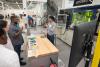
At the forefront of both is the Georgia Tech Manufacturing Institute (GTMI) and its Advanced Manufacturing Pilot Facility (AMPF), a first-of-its-kind, shared-use facility at a research university that is already doing what federal agencies are only beginning to fund. The AMPF is the proving ground where new manufacturing solutions are stress-tested before they reach the shop floor — where a scrap rate that plagued a major automobile supplier was cut in half in 45 days, and where capabilities are being realized faster than ever thought possible.
"The expectation was that building a capability like this would take decades," said Steven Ferguson, principal research scientist and GTMI deputy director. "Instead, we've compressed that timeline dramatically and are already applying these technologies to solve real manufacturing challenges."
The future Ferguson describes has already displaced the old “lights‑out” myth of fully dark, fully automated factories. What modern smart manufacturing demands is tighter integration between machines and the people who define what those machines should accomplish.
Georgia is well positioned to lead that charge. According to the Georgia Association of Manufacturing, the state supports more than 426,000 manufacturing jobs with average earnings of $86,372, contributing $77.1 billion to the state's gross regional product. Projected employment growth of 8% between 2024 and 2029 reflects not just expansion but transformation; the sector needs a different kind of worker, and a different kind of research partner than it did a generation ago.
GTMI and the AMPF have staked out a national leadership position in exactly those capabilities. The facility is pioneering the deployment of physical AI in a university R&D and demonstration environment, using machine learning to monitor and adjust manufacturing processes in real time. When printing a component from a $30,000 barrel of specialty powder or a newly developed superalloy, a process failure is not acceptable. AI-driven systems continuously analyze thousands of optical, thermal, acoustic, and process signals to identify patterns, optimize performance, and detect anomalies.
"In an R&D facility, you program it once, and it changes a million times," Ferguson said. "We're using AI and mobile robots to intelligently coordinate production scheduling, material movement, and manufacturing processes, all while humans define the experiments and interpret the results."
The facility also connects the full innovation chain from materials discovery through manufacturing process to quality assurance, demonstrating in one space what others are still planning.
Smart Manufacturing as a National Security Imperative
The stakes extend well beyond production efficiency. Ferguson points to pandemic-era chip shortages that left tens of thousands of finished vehicles waiting on a single component and to current constraints on the critical minerals and chips needed to build AI data centers and defense systems.
"Our ability to manufacture at scale underpins both our economic competitiveness and our national security," he said. "If we can't build what we need when we need it, we're at a strategic disadvantage."
From the Shop Floor: IAC Group
For Tom Boney, chief operating officer for the Americas at IAC Group, the question wasn’t whether to modernize; it was who could help the company move fast enough to keep plants competitive and workers employed. Georgia Tech, he said, offered something IAC couldn’t build on its own.
“Georgia Tech brings the brains and computing power we don’t have,” Boney said. “You’ve got some of the smartest people in the world on that campus, plugged into world-class infrastructure, and we put them side by side with our operators on the shop floor.”
An automotive interior components manufacturer with plants across the U.S., Mexico, and beyond, IAC is competing daily with facilities in lower-cost regions. “For us, smart manufacturing and AI are really about job and plant future security,” Boney said. “We’re competing every day with plants in China, Mexico, and the U.S., and we already have tons of production data, but we can’t analyze it fast enough on our own.”
IAC’s first project with GTMI focused on a complex adhesive manufacturing process at a plant in Vance, Alabama. The facility had rich production data but lacked computational power and AI modeling to act on it in real time. GTMI students and researchers connected Georgia Tech’s systems directly to the plant’s equipment, working with line operators. The result was a 50% reduction in scrap in roughly 45 days, with those gains then extended to other IAC locations.
The pace of the partnership was another sign that this wasn’t a typical university engagement. A framework agreement that usually takes 12 to 15 months was executed in 35 days, enabling the two organizations to move through new project cycles quickly. IAC now runs five active projects with GTMI, each advancing in turn or making way for the next initiative, a cadence Boney sees as essential to staying competitive on the factory floor.
Building the Workforce of Tomorrow
IAC’s success with GTMI underscores a hard truth: technology can unlock new performance, but only if there’s a workforce ready to run it. Technology alone cannot sustain a manufacturing renaissance. Ferguson is candid about the workforce challenge posed by automation, particularly the erosion of entry-level roles that once served as the first rung of a career ladder.
"The industry has an image problem. People still picture dark, dirty, and dangerous, when the reality is safer, cleaner, and far more interesting," Ferguson said. "Now we're trying to convince kids, 'You don't have to, you get to.' We don't need button pushers. We need thinkers and creators working alongside robots."
GTMI's response runs from K-12 engagement through technical college partnerships to university engineering programs at Georgia Tech, UGA, Georgia Southern, Kennesaw State, and others. For example, UGA partnered with the Russell Innovation Center for Entrepreneurs (RICE) to launch the Georgia AIM Mobile Studio. This traveling advanced-technology lab visits K-12 schools across the state to give students hands-on experience with interactive engineering vignettes and robotics. Teacher boot camps bring high school educators to campus for hands-on training in CAD design, CNC milling, and additive manufacturing, equipping them to return to their classrooms as informed advocates. Dual-enrollment pathways through Georgia's Technical College System give students an on-ramp well before they graduate from high school.
This workforce strategy extends beyond traditional education. Through programs such as Advanced Manufacturing Pathways, teacher professional development, dual-enrollment partnerships, undergraduate research experiences, graduate research opportunities, and industry-sponsored projects, GTMI is helping develop the technicians, engineers, researchers, and manufacturing leaders needed to support the nation's next generation of smart factories.
But the workforce pipeline is only one strand of a much larger web. The AMPF is also where partners pressure-test how AI, automation, and new materials behave under real-world constraints like cost, quality, uptime, safety, and security. At GTMI, AI-driven process control, autonomous material handling, critical-mineral research, and cyber-physical security work in concert to create trusted, resilient production capacity that can scale when it counts, whether that means building lightweight components for vehicles, accelerating drone production to meet national needs, or hardening the critical infrastructure that underpins defense and the economy.
In that context, smart manufacturing is no longer a niche technical initiative. It is the connective tissue between research labs, industry partners, and national readiness, and a platform for new kinds of careers. GTMI’s role is to ensure that those connections are real, tested, and ready to perform under pressure, while opening doors for students, teachers, and workers who will run the next generation of factories. In Georgia, that ecosystem is already taking shape on the ground.
Summary
From physical AI to cybersecure factory design, Georgia Tech's Manufacturing Institute is setting the pace for the next era of American production.
Status
- Workflow status: Published
- Created by: ychernet3
- Created: 08/13/2026
- Modified By: ychernet3
- Modified: 08/14/2026
Categories
Keywords
User Data