
news
Personal Resilience as a Path to Meaningful Sustainability Work
Primary tabs
People engaged in purpose-driven work can get worn down. At Georgia Tech’s 2026 Sustainability Showcase, three faculty leaders urged attendees to stop trying to do everything and instead focus on the convergence where their strengths, satisfaction, and the most urgent climate needs intersect.
That idea anchored “Finding Joy and Building Resilience in Climate Action,” an interactive session on day two of the showcase, hosted Feb. 9 – 10 by the Brook Byers Institute for Sustainable Systems (BBISS). Each spring, the event brings together Georgia Tech researchers, students, staff, and partners to share their work with the sustainability community. This session turned the spotlight inward, asking how people doing sustainability work can sustain themselves over the long haul. Facilitated by Rebecca Watts Hull, the session drew on an April 2022 TED Talk by marine biologist and policy expert Ayana Elizabeth Johnson, who lays out a practical way to “lean into your superpowers” for being effective in purpose-driven work.
Watts Hull, assistant director of Faculty Development for Sustainability Education Initiatives in Georgia Tech’s Center for Teaching and Learning, opened the discussion by explaining why she proposed the session. Many showcase events, she noted, focused on social, community, and ecological resilience. This one examined individual capacity — how people stay engaged in work that can feel frustrating, slow-moving, and emotionally draining.
Johnson’s TED Talk framed the problem, describing the climate challenge as “gargantuan,” spanning energy, transportation, agriculture, buildings, industry, ecosystems, and culture. Rather than dwelling on dire projections, she urges people to pivot to solutions and to contribute not just as generic volunteers, but by using their particular talents.
Her tool is a Venn diagram that asks three questions:
- What are you good at — your skills, expertise, resources, and networks?
- What work needs doing — high-impact sustainability solutions, especially at the systems level?
- What brings you joy or satisfaction — work that energizes rather than depletes you?
Johnson warns against choosing work that leads to burnout and against merely validating what one is already doing, pushing instead for a fresh look at where each person can have the greatest impact. She also emphasizes implementation and argues for a “leaderful” movement in which many people step into leadership in different ways.
Matthew Realff, professor and David I.J. Wang Faculty Fellow in the School of Chemical and Biomolecular Engineering, connected Johnson’s framework to resilience and his 33 years at Georgia Tech. He traced the word “resilience” back to its Latin root, meaning “to bounce back,” and defined it as the ability to absorb shocks and return to an original or improved state.
For Realff, that ability depends heavily on relationships. “I think of personal resiliency as coming from the networks of people I interact with — the social bonds that stretch and are strained,” he said, and “help me bring myself back to my center when I'm finding that life is difficult with respect to things like sustainability.”
He then walked through his own Venn diagram across teaching, research, and service. In teaching, he uses senior design courses to give engineering students real-world sustainability problems, from hydrogen liquefaction to biofuels and biochemicals. “Watching students grapple with those challenges brings me joy,” he said.
In research, he focuses on carbon capture, including capturing CO₂ from flue gases and from the air. In service, he has stepped into roles he didn’t initially seek, such as board chair of GreenBlue, the nonprofit behind the “How2Recycle” label found on consumer packaging, and chair of standards committees that shape the environmental profile of electronics purchased by major institutions. Those roles, he acknowledged, pulled him out of his comfort zone but delivered tangible, systems-level impact.
Christie Stewart, senior academic professional in the School of Biological Sciences, added a perspective grounded in well-being and resilience education. She oversees Georgia Tech’s undergraduate wellness requirement and teaches a class called Flourishing: Strategies for Well-Being and Resilience. For years, her students designed wellness and sustainability projects, but rarely had time to carry them out within a semester.
That frustration pushed her toward community-based service learning, linking personal wellness to broader community resilience. Stewart highlighted three strengths she brings to her own Venn diagram: using well-being frameworks; taking a strengths-based approach that helps students identify what they do best; and creating psychologically safe environments where students can discuss values, disagreements, and the emotional strain of large-scale problems like climate change.
For her, the work that needs doing includes building capacity for community partners and helping students recognize that they must protect their own mental and physical health if they want to stay in the work. Her greatest satisfaction comes from seeing students discover a sense of purpose and begin to imagine themselves as future leaders who can “change culture and advocate” for sustainability.
Watts Hull described how Johnson’s Venn diagram helped her reconcile what she wasn’t doing with what she could do best. A sociologist by training who studies social movements and change, she supports the integration of sustainability across the curriculum and teaches one course each year. In her personal life, she attends climate demonstrations, but as an introvert who dislikes large crowds, she rarely stays long and feels guilty about not doing more public-facing activism.
Completing the diagram, she said, gave her permission to focus on teaching and movement-building — her core strengths and sources of joy. She recently led a four-week climate action course at her church and used Johnson’s Venn diagram as an exercise.
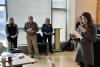
Watts Hull closed the session by asking participants to sketch their own diagrams, reflect quietly for several minutes, and then share with others at their tables — a step toward aligning Georgia Tech’s diverse sustainability community around the personal “superpowers” that can sustain climate action over a lifetime.
“This is an opportunity to get away from what I call self-immersion,” said audience member Jay Bassett, a 1985 Georgia Tech graduate and retired EPA Opportunity Zone and Smart Sector Advisor. “We have a tendency to get so isolated in what we do,” and “this offers an opportunity to think beyond that and get past those boundaries and see opportunities that we don’t see before because we’re so self-immersed. That’s an actual skill that we all ought to learn — to see the bigger picture because it may be the best part of the path forward.”
Summary
People engaged in purpose-driven work can get worn down. At Georgia Tech’s 2026 Sustainability Showcase, three faculty leaders urged attendees to stop trying to do everything and instead focus on the convergence where their strengths, satisfaction, and the most urgent needs intersect.
Status
- Workflow status: Published
- Created by: Brent Verrill
- Created: 03/06/2026
- Modified By: Brent Verrill
- Modified: 03/09/2026
Categories
Keywords
User Data