
news
The Future of Healing: Smart Bandage Could Transform Diabetic Wound Care and Beyond
Primary tabs
While most people don’t think twice about a cut or scrape, for those with diabetes, every wound is a potential threat that requires vigilant care.
Diabetic foot ulcers, for example, are slow to heal and can increase the risk of infection, hospitalization, and even amputation.
To address this critical challenge, researchers at the Georgia Institute of Technology (Georgia Tech) and the Georgia Tech Research Institute (GTRI) have developed a sensor designed to monitor chronic wounds in real-time. Embedded directly into a bandage, this flexible, low-cost device could transform wound management for diabetic patients and other critical applications — such as providing direct treatment to soldiers on the battlefield or managing chronic wounds in elderly populations and patients with limited healthcare access — by reducing invasive bandage changes and ensuring timely medical intervention.
“For diabetic patients with foot ulcers, long-term monitoring and care are essential,” said GTRI Principal Research Engineer and Project Lead Judy Song. “We were inspired by the success of wearable glucose monitors to develop a compact, affordable sensor tailored to wound care.”
This project was supported by GTRI’s Independent Research and Development (IRAD) program between 2022-2025 and reflects the strength of interdisciplinary collaboration across Georgia Tech. Researchers from three out of GTRI’s eight laboratories developed the sensor with experts from the George W. Woodruff School of Mechanical Engineering, the H. Milton Stewart School of Industrial and Systems Engineering and the Wallace H. Coulter Department of Biomedical Engineering at Tech and Emory University.
About one in four people with diabetes will develop a foot ulcer at some point in their lives, making it one of the leading causes of foot amputations. For these patients, nerve damage and poor blood flow hinder the body’s natural healing process and allow wounds to linger and worsen.
During the initial phases of their research, the team noted that nitric oxide (NO) had been previously identified as a key biomarker for wound health due to its central role in the healing process. Nitric oxide improves blood flow, reduces inflammation, promotes tissue growth and fights infection. By tracking nitric oxide levels in wounds, clinicians could determine whether a wound is improving or detect early signs of trouble.
"Nitric oxide plays a fascinating, almost paradoxical, role in wound healing,” said GTRI Senior Research Engineer Victoria Razin, who is co-leading the project. “It’s essential for processes like blood flow and tissue repair, but can also signal when something is going wrong.”
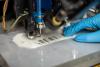
At the core of the smart bandage is a flexible sensor powered by a three-electrode system capable of detecting changes in nitric oxide. The team used advanced Aerosol Jet® printing techniques to fabricate the sensor, significantly reducing production costs from thousands of dollars to just a few dollars per unit and making the design more affordable and scalable.
“Typically, prototyping these sensors can cost thousands of dollars, but our approach brought costs down dramatically,” said Chuck Zhang, the Eugene C. Gwaltney, Jr. Chair and Professor in ISYE and a program director at the National Science Foundation (NSF), who oversaw sensor fabrication for this project. “Lower costs let us iterate quickly and deliver something that could have real healthcare impact.”
To test the sensor’s accuracy, the team conducted extensive laboratory studies in both biological and simulated wound conditions.
In one set of experiments, endothelial cell cultures were used to create “wounds” by scraping the cell layers. As the cells migrated to repair the gap, nitric oxide production increased, and the sensor successfully tracked these changes in real-time. Additional fluid tests using blood plasma and red blood cells demonstrated that the sensor could reliably detect nitric oxide in a variety of conditions that closely mimic real-world wound environments.
These experiments confirmed that the sensor can identify the fluctuations in nitric oxide associated with different phases of wound healing.
Lab testing was led by Dr. Wilbur Lam, a professor in the Department of Biomedical Engineering and at Emory University School of Medicine, with support from Kirby Fibben, a biomedical engineering Ph.D. student at Tech.
"There’s a significant clinical need for real time, minimally invasive sensor technologies that detect nitric oxide,” said Dr. Lam. “While we’re starting with wound healing, there’s multiple other applications for vascular, hematologic, and pulmonary diseases as well.”
The next step in the project is integrating the sensor into a functional wearable device. The team is combining the sensor with a miniaturized potentiostat (MicroPS) – a small electronic device that measures chemical signals – along with flexible electronic components and a system to transmit data to a mobile app.
The MicroPS, designed by the GTRI research team, led by GTRI Research Engineer Curtis Mulady, enables compact electrochemical measurements and the wireless platform transmits nitric oxide readings from the bandage to a mobile app via Bluetooth. The app uploads the data to a cloud platform, giving clinicians the ability to remotely monitor wound progress in real time. This system could reduce the need for frequent in-person checkups, enabling earlier interventions and improving outcomes for patients.
Future iterations of the bandage aim to include “closed-loop” systems capable of both monitoring and treating wounds, said GTRI’s Song. For example, sensors could trigger a response, like releasing therapeutic agents or antimicrobials directly to the wound, when abnormalities are detected.
The researchers are also exploring commercialization pathways, including partnerships with medical device companies or the formation of a startup.
“This sensor meets a real need for early detection of infection and to evaluate wound healing, and I believe it could have significant commercial success,” said Peter Hesketh, a professor in the School of Mechanical Engineering who led sensor design and performance testing.
Other contributors to this project from GTRI include Mulady, Cora Weidner, Maxwell Blanchard, Rachel Erbrick and Christopher Heist. Zhaonan “Zeke” Liu, a postdoctoral fellow in ISYE, assisted with sensor fabrication, while Rizky Ilhamsyah, a graduate research assistant in the School of Mechanical Engineering, contributed to sensor design and performance testing.
Writer: Anna Akins
Photos: Sean McNeil
GTRI Communications
Georgia Tech Research Institute
Atlanta, Georgia USA
For more information, please contact gtri.media@gtri.gatech.edu.
To learn more about GTRI, visit: Georgia Tech Research Institute | GTRI
Media

Summary
GTRI and Georgia Tech have developed a smart bandage that could transform wound care for diabetic patients, battlefield soldiers, and others by enabling real-time insights and reducing invasive bandage changes for timely treatment.
Status
- Workflow status: Published
- Created by: Anna Akins
- Created: 02/18/2026
- Modified By: Anna Akins
- Modified: 02/18/2026
Categories
Keywords
User Data