
news
Finding His Path Through Undergraduate Research
Primary tabs
When Sam Lucas arrived at Georgia Tech in the summer of 2018 for the NNCI Research Experience for Undergraduates (REU), he didn’t know that it would set the course for the next seven years of his academic and personal life.
At the time, he was an undergraduate at Mississippi State University (MSU) studying chemical engineering. He was fresh off a series of research opportunities, but was still unsure of what doing research full-time would look like or what he wanted to do post-undergraduate.
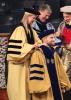
Now, Lucas has earned a Ph.D. in biomedical engineering from Georgia Tech with a focus on nanomaterial drug delivery for cancer immunotherapy. And according to him, the path from undergraduate to Ph.D. can be traced directly back to his REU.
Previously, Lucas had worked in labs in high school and his early college career, but those roles were mostly task-based.
“I'd started working in a lab at the University of Southern Mississippi my senior year of high school,” he said. “I was doing polymer coatings for corrosion resistance. Then I did some miscellaneous stuff at MSU. But the REU was interesting because it was in some ways the most structured research experience that I'd had to that point.”
During that summer, Lucas worked with Kim Curtis’ group in the Georgia Tech School of Civil and Environmental Engineering. He worked to understand how incorporating titanium oxide particles into cement can absorb pollutants when exposed to sunlight. It was his first hands-on, interdisciplinary research experience.
“That summer was significant both in starting to make sense what research could actually look like on a full-time day-to-day basis and also what being at Tech might be like.”
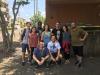
Beyond the research, Lucas discovered that being on Georgia Tech’s campus was just as formative. Surrounded by peers who were similarly driven, and often similarly unsure about their paths, he began to see himself as a “real” researcher. Meetups with fellow REU students, sessions on research communication, and structured mentorship all gave him confidence.
The impact of Lucas’ REU experience didn’t end there. It helped him earn a spot in Cornell’s international research experience program (iREU) the following year. There, he worked on nanomaterials for cancer vaccine applications. The transition from cement technologies to vaccine applications became the bridge to his eventual Ph.D. focus.
“The REU truly became a launchpad for Sam's career, as it has for others who have come through our program,” said Leslie O’Neill, education outreach manager. “Several of our former participants have returned to Georgia Tech for their Ph.D., and it’s because the experience gives them clarity about research and opens doors they didn’t even realize existed."
In 2020, Lucas arrived back on campus, where he enrolled in the Wallace H. Coulter Department of Biomedical Engineering’s Joint Ph.D. in Biomedical Engineering program. As part of Susan Thomas’ lab, his research focused on nanomaterial drug delivery for cancer immunotherapy. He spent the next five and a half years working on immune system engineering and drug delivery systems.
Although he had once imagined a career in oil and gas — a common trajectory for Mississippi State engineers — his REU experience pointed him in a new direction.
After defending his dissertation in 2025, Lucas is now continuing as a postdoctoral researcher in the Thomas Lab, contributing to nanomedicine projects while preparing for a future career in biotech or pharmaceuticals.
He credits the REU with giving him the clarity and confidence to pursue research at the highest level. His advice to undergraduates considering the program is simple: Go for it.
“If you apply for it and get an offer, just go ahead and do it,” said Lucas. “There’s not really a downside.”


Summary
Sam Lucas’ journey from a summer undergraduate research program to a Ph.D. in biomedical engineering highlights how early research experiences can shape long-term academic and career paths
Status
- Workflow status: Published
- Created by: aneumeister3
- Created: 02/16/2026
- Modified By: Laurie Haigh
- Modified: 02/18/2026
Categories
Keywords
User Data