
news
The Rogues Gallery Brings Cutting‑Edge Computing to Georgia Tech
Primary tabs
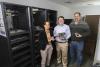
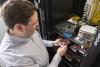
Hidden deep within Georgia Tech is a laboratory filled with some of the most advanced and experimental computers in the world. Known as the Rogues Gallery, this collection of early-stage, novel, and prototype computing systems allows students, faculty, and industry partners to explore and shape the future of computing — from large-scale artificial intelligence (AI) to emerging quantum technologies.
Launched in 2017 by the Center for Novel Computing Hierarchies (CRNCH), the Rogues Gallery serves as a test bed for companies seeking first users of new hardware and researchers looking to experiment at the leading edge of computing innovation. The gallery has hosted groundbreaking systems, including next-generation NVIDIA hardware and the first-of-its-kind Lucata Emu architecture.
“The Rogues Gallery gives Georgia Tech a strategic advantage,” said Jeff Young, gallery director and principal research scientist in the Partnership for Advanced Computing Environments (PACE). “Georgia Tech has this opportunity to engage a larger audience with access to these test beds.”
Growing a Global Research Resource
Now approaching its 10th year, the Rogues Gallery has supported hundreds of users across Georgia Tech and around the world. With its remote-first design, the test bed has served more than 400 unique internal and external users, including over 80 partner researchers from more than 30 academic institutions, national laboratories, and industry organizations across four continents.
The gallery has attracted significant public and private investment, including National Science Foundation grants and Department of Energy funding. A key feature is ongoing partnerships with industry leaders such as NVIDIA, Intel, HPE, and AMD. Current systems include Intel’s Gaudi 3 hardware for large language model AI and the Sapphire Rapids Max Series for data center processing. Researchers also have access to NVIDIA’s Grace Hopper superchip platform, enabling high-performance computing and large-scale AI experimentation.
Even local partners like thermal interface solutions provider Carbice have been able to research their product deployed at scale in a real data center environment, thanks to collaborating with the Rogues Gallery. The company knew it needed greater access to live IT hardware in a real production environment, but had limited opportunity to test at scale before the partnership.
“Deploying our material in a live data center environment was a milestone, but the real power was in the data: Observing existing thermal variance across the CRNCH Rogues Gallery validated our internal findings,” said Craig Green, Carbice’s chief technology officer. “We’re grateful to the Georgia Tech team for helping us see how aging thermal materials can cause temperature differences from server to server in real data centers — and how Carbice can eliminate that variation at scale. This level of collaboration is truly unique to the Georgia Tech community.”
The research has been nationally recognized. The Rogues Gallery has supported the publication of more than 30 research papers, and the hosting center for the test bed, CRNCH, also organizes an annual summit. The center and test bed have conducted 30 seminars, tutorials, and workshops since 2020 to showcase research and expand community engagement.
Expanding Student Research Opportunities
One of the gallery’s most significant impacts is on student learning and professional development. The gallery serves as a hub for Georgia Tech’s Vertically Integrated Projects (VIP) program, which allows students to participate in multi-semester, faculty-led research.
Fourth-year computer science major Jeremy Wang joined the Rogues Gallery VIP team during his first year at Georgia Tech. Although he was initially only vaguely familiar with hardware, he discovered an interest in computer architecture through hands-on experience with the test beds.
“VIP exposed me to the world of research earlier than I would have in the classroom,” Wang said. “When I finally reached my foundational classes, they brought me up to speed on advanced concepts I had already encountered in the Rogues Gallery. That was a huge moment where I felt like everything was clicking.”
Wang has now spent five semesters in the program and plans to pursue a master’s degree in computer science with a focus on computer architecture. His experience reflects a broader trend: Rogues Gallery projects have introduced students to fields where they can build a career.
“We have this opportunity that if we build a specific test bed — like software tools for quantum computing — we can expose that area to a larger audience and really impact students,” Young said.
Early on, several students took advantage of the gallery’s quantum computing software simulation and testing capabilities and encouraged Young to include it as a topic in the VIP class. This opportunity has led to the creation of a GT quantum computing student club, which collaborates with Department of Energy researchers. VIP students can now pursue quantum computing Ph.D. programs or positions in quantum-focused companies.
Strengthening Campuswide Computing Infrastructure
Once novel computing technologies are tested and evaluated through the Rogues Gallery, emerging technologies may transition into PACE’s Institute-wide system to support research across Georgia Tech. This focus on evaluating and deploying novel technologies as part of CRNCH provides a key complement to existing, large-scale collaborative efforts hosted by PACE, such as the AI Makerspace and the upcoming Nexus supercomputer.
“I get excited about what hardware can do and how it can improve computing,” said Aaron Jezghani, PACE’s architecture and platform lead and a longtime collaborator with the gallery. “These machines can help solve computing challenges we experience at PACE, or they can provide new capabilities to enable other research around campus.”
Even as the Rogues Gallery continues to grow, its mission remains the same: to enable discovery, accelerate innovation, and prepare the next generation of computing leaders.
“The Rogues Gallery is an exceptional resource, not just at Georgia Tech but around the world,” Jezghani said. “I don't think there's anywhere else that has this much variety in hardware for research and instruction in one system.”
Summary
This research test bed has given students and faculty early access to next-generation hardware for nearly a decade.
Groups
Status
- Workflow status: Published
- Created by: Tess Malone
- Created: 02/12/2026
- Modified By: Tess Malone
- Modified: 02/12/2026
Categories
Keywords
User Data