
news
Students Making a Difference: EMTs Juggle Schoolwork and Emergency Medicine
Primary tabs
Many Georgia Tech students spend their free time studying, relaxing, or working part-time jobs. But for students who work as emergency medical technicians (EMTs), their time outside the classroom includes responding to medical emergencies — and helping patients when every minute counts.
“It’s literally life or death sometimes,” says Brandon Brigner, a fall 2025 biochemistry graduate now pursuing a master’s in chemistry.
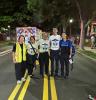
Four Georgia Tech students share their experiences on the front lines of medicine as EMTs, including Brigner; Lianna Homrich, a fourth-year biology major; Daeun “Esther” Lee, a third-year biomedical engineering major; and Krishna Monroe, a third-year neuroscience major. Brigner, Homrich, and Monroe work as EMTs on ambulances while Lee serves as a technician at Emory University Hospital Midtown. Each plans a career in medicine and serves on the leadership team for EMS at Tech, a student organization dedicated to expanding access to and knowledge of emergency medical services on campus.
Why become an EMT?
All four agree that EMT work offers unmatched medical experience.
“You can show up on someone’s worst day and immediately make a difference,” says Lee.
Homrich started exploring EMT work after realizing she needed clinical hours for the pre-health track. “The adrenaline and lifesaving aspect appealed to me. I knew I’d learn so much from living the hands-on side of medicine.”
Brigner began working as an EMT in high school. “I wanted to get started on my pre-med journey,” he explains. “Becoming an EMT is one of the most powerful medical experiences you can have — and it’s definitely solidified my decision to pursue medicine as a career.”
What’s the job like?
Monroe first joined an ambulance crew with American Medical Response in DeKalb County and now works for Grady Health System. “At a basic level, our job is to stabilize patients and get them to the hospital safely,” says Monroe.
Brigner explains that most ambulance EMTs split time between emergency calls, special events, and transfers. “It can be intense,” he says. “When everything goes well, you can seriously change someone’s life trajectory.”
Monroe adds that there is no typical shift on an ambulance. “We’ve had anything from people shot in the chest to someone struggling to breathe to someone experiencing abdominal pain because they are hungry. You respond where the public needs you.”
What do you like best about being an EMT?
Homrich appreciates the people. “You’re on a truck for 12 hours with career paramedics who spend their lives saving others. Many are former military; I learn something new every shift. They’re heroes.”
Lee values the teamwork she finds at the hospital. “Usually when something very high acuity comes in, like a cardiac arrest, you have everyone in the emergency room acting as a team. We’re doing chest compressions, checking in with each other, and switching out when needed. Everyone is there in this very stressful time, working together to save someone’s life.”
How does EMT work prepare you for careers in medicine?
EMT work offers solid medical experience and critical soft skills. “You’re making decisions about real patients,” says Monroe. “You have your own patient, sometimes with no help for 30-45 minutes, depending on how long it takes to get to the hospital. It’s the best clinical experience you can get.”
Lee adds, “It teaches creativity, problem solving, and composure under pressure — skills you can’t learn from a textbook. You learn to stay composed in chaos.”
How do you balance school and work?
All four agree that it takes a lot of organization and discipline. “Having a good calendar system is key, and strategically scheduling classes really helps,” says Homrich. “I’ve definitely fallen into traps where I get really into EMS — picking up cool events or overnight shifts for bonuses — but I’ve learned to make schoolwork a priority. Academics come first.”
Lee primarily works weekends to accommodate her school schedule. “I work 7 a.m. to 7 p.m. on Saturdays and Sundays,” she says. “I get most of my studying done during the week.”
What kind of training does it take to become an EMT?
Monroe is an Advanced EMT while Brigner, Homrich, and Lee hold the EMT Basic designation. Training includes coursework, skills testing, and clinical ride-alongs. To become an EMT, students must complete training, earn National Registry EMT certification, and apply for a state license.
“The real learning happens during clinicals or ‘third rides,’ where you ride along as the third person on the truck,” says Homrich.
Monroe estimates that he has spent more than 600 hours studying and training to earn both certifications.
Can you describe a meaningful moment in your EMT career?
Beyond the life-saving thrills, these students encounter moments that stay with them forever.
Brigdon remembers an incident from his very first day as an EMT:
“We were transporting a patient up from the depths of the D.C. subway. After putting him on the gurney, we took the escalator instead of the elevator. The fire crew saw us and immediately let us know that wasn’t the right move. Listening to their angry feedback put into perspective how serious this job is and the life-changing implications of doing it right. That moment taught me that every decision matters.”
Homrich remembers leading an “honor walk,” a ceremony to honor organ donors and support their families, for a deceased teenage patient being transferred for organ donation:
“At 19 years old, I wheeled a son away from his mother for the last time, knowing she’d never see him again. It was heavy but also meaningful because his sacrifice would create so much life. That moment reminded me how much trust people place in us — and the importance of what we do.”
What is Emergency Medical Services at Tech (EMS at Tech)?
A student organization dedicated to improving emergency medical care on campus, the club partners with Grady EMS and the Georgia Tech Police Department to respond to medical emergencies, lead CPR and first aid classes, and provide clinical opportunities for members.
“EMS at Tech is a community where you can nerd out and share your passion for emergency medicine,” says Homrich, the club’s vice president. “When you’re with friends at lunch, no one wants to hear about applying a tourniquet for an arterial bleed. But at EMS at Tech, everyone is an emergency medicine enthusiast who wants to share experiences.”
Last semester, the group trained more than 160 students, faculty, and staff in CPR/AED and supported campus events like Homecoming and Halloween. EMS at Tech also guides students pursuing EMS certifications and helps administer the Todd Family Fund EMS Scholarship, which covers tuition for Grady EMS Academy classes.
Media

Summary
Four Georgia Tech students share what it’s like to balance rigorous coursework with the high-stakes world of emergency medicine.
Groups
Status
- Workflow status: Published
- Created by: ls67
- Created: 01/26/2026
- Modified By: ls67
- Modified: 02/03/2026
Categories
Keywords
User Data