
news
Rusty Roberts Receives Top Test and Evaluation Award
Primary tabs
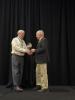
Russell L. (Rusty) Roberts, director of the Georgia Tech Research Institute's (GTRI) Aerospace, Transportation and Advanced Systems (ATAS) Laboratory, was awarded the International Test and Evaluation Association's (ITEA) 2025 Allen R. Matthews Award, the association's highest honor for lifetime achievement in test and evaluation (T&E).
Named for ITEA's founder, the Allen R. Matthews Award recognizes individuals whose careers have produced lasting and significant contributions to the T&E community. It is reserved for those whose impact is measured not only in technical achievements, but also in sustained leadership and service to the profession.
Roberts is a nationally recognized expert in T&E. He has spent decades helping the Department of Defense modernize how it evaluates complex systems. This includes work in electronic warfare and threat radar environments. He leads ATAS at GTRI, where he has launched and continues to guide a cross-Institute T&E initiative that brings together GTRI's technical resources to support the Office of the Secretary of Defense's Test Resource Management Center and the network of Department of Defense test and training ranges.
Under Roberts' leadership, GTRI has delivered multiple high-impact test assets. These include sophisticated threat radar systems that allow United States forces to evaluate sensors and electronic countermeasures against realistic representations of adversary surface-to-air missile threats.
Roberts began his path into T&E in the United States Army. A graduate of the United States Military Academy at West Point with a degree in electrical engineering, he served as a Signal Corps officer with assignments at Fort Gordon, Georgia, and in Kaiserslautern, Germany. As a platoon leader and company commander, he led an operational test of the Tactical Automated Switching System. This was his first exposure to formal operational testing and the realities of fielding new communications technology for soldiers.
The Army later sent Roberts to graduate school at Georgia Tech for advanced study in electrical engineering. This was followed by a teaching tour at West Point. As an Associate Professor and later course director for a senior-level two-semester electronics sequence, he strengthened both his technical depth and his ability to communicate complex concepts to the next generation of Army officers.
When his active-duty commitment ended, Roberts transitioned to the Army Reserve. He attended a Georgia Tech alumni job fair in Atlanta. That event led him to GTRI, where he joined as an associate project director on what was then the largest project ever awarded to the Institute. This project involved a threat radar system intended as a test asset for the T&E community. The role immersed him in the operations and needs of major ranges such as China Lake, the Nevada Test and Training Range, and Eglin Air Force Base. It also set the course for a career spent designing and delivering advanced test capabilities.
Roberts helped guide a broader shift in how threat systems are developed for T&E. Early in his GTRI career, teams focused on highly specialized single-threat "point solutions" that were extremely accurate but time-consuming and expensive to build. Today, he advocates and leads work toward modular and open architecture radar systems. These can be reconfigured to emulate multiple threats using shared hardware and powerful software-defined back ends. This approach improves agility and helps keep pace with rapid advances in adversary systems.
Beyond his technical leadership, Roberts has been a central figure in ITEA. He is a past president of the association and has been actively involved since the early 1990s. Over the decades, he has championed the importance of professional societies in helping T&E practitioners share lessons learned, grow their networks, and advance their careers. He has also been a vocal advocate for bringing more early-career engineers and scientists into the T&E profession. He continues to encourage embedding systems engineering and T&E thinking throughout the system development lifecycle.
In its statement on the award, ITEA said “With nearly five decades of dedicated service to our Nation, including over 30 years of continuous and influential involvement in test and evaluation, Rusty Roberts stands as a national asset to the T&E profession and a treasured member of the ITEA family.”
Roberts' career highlights Georgia Tech and GTRI's long-standing role in advancing the science and practice of test and evaluation.
Writer: Christopher Weems
GTRI Communications
Georgia Tech Research Institute
Atlanta, Georgia
About the Georgia Tech Research Institute (GTRI)
The Georgia Tech Research Institute (GTRI) is the nonprofit, applied research division of the Georgia Institute of Technology (Georgia Tech). Founded in 1934 as the Engineering Experiment Station, GTRI has grown to more than 3,000 employees, supporting eight laboratories in over 20 locations around the country and performing more than $919 million of problem-solving research annually for government and industry. GTRI's renowned researchers combine science, engineering, economics, policy, and technical expertise to solve complex problems for the U.S. federal government, state, and industry.
Summary
Russell L. (Rusty) Roberts, director of the Georgia Tech Research Institute's (GTRI) Aerospace, Transportation and Advanced Systems (ATAS) Laboratory, was awarded the International Test and Evaluation Association's (ITEA) 2025 Allen R. Matthews Award, the association's highest honor for lifetime achievement in test and evaluation (T&E).
Status
- Workflow status: Published
- Created by: cweems8
- Created: 01/15/2026
- Modified By: cweems8
- Modified: 01/15/2026
Categories
Keywords
User Data