
event
EAS Planetary & Astrobiology Seminar - Dr. Floyd Nichols
Primary tabs
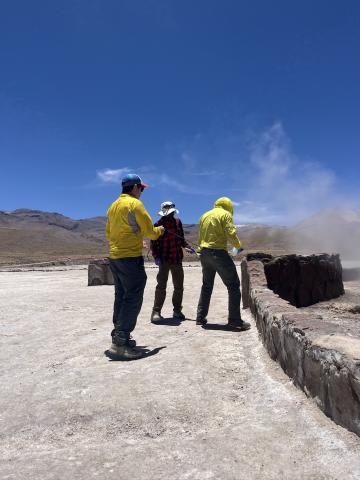
Modern and ancient brines have been identified across the solar system such as on Mars and icy moons. There is evidence to suggest that Mars hosted hypersaline systems with a variety of chemistries prior to the loss of its atmosphere. Although the modern surface of Mars no longer hosts liquid water, Mars is a prime astrobiological target since it lost its atmosphere around the onset of life on Earth. This begs the question: can life have arisen on Mars at the same time? To probe these questions, environments that are similar (analogs) to ancient Martian brines (or other planetary bodies) are required to understand fundamentals such as which chemistries are more conducive to the production and/or preservation of life signatures. Terrestrial hypersaline environments are promising locations to probe for the potential for life beyond Earth due to many of their chemistries resembling ancient Martian brines and icy moons. My primary work seeks to better understand these environments and their potential biosignatures including lipid biomarkers, organic carbon, and stable isotopes. Additionally, I aim to improve life detection efforts by bridging the gap between organic geochemistry, astrobiology, and data science to unravel hidden patterns and features in complex environmental datasets. In this presentation, I will broadly discuss how I combine the astrobiology, organic geochemistry, and data science disciplines to help characterize and inform the habitability of planetary analog hypersaline environments and how we can use that information to aid in current and future planetary missions.

Summary
Modern and ancient brines have been identified across the solar system such as on Mars and icy moons. There is evidence to suggest that Mars hosted hypersaline systems with a variety of chemistries prior to the loss of its atmosphere. Although the modern surface of Mars no longer hosts liquid water, Mars is a prime astrobiological target since it lost its atmosphere around the onset of life on Earth. This begs the question: can life have arisen on Mars at the same time? To probe these questions, environments that are similar (analogs) to ancient Martian brines (or other planetary bodies) are required to understand fundamentals such as which chemistries are more conducive to the production and/or preservation of life signatures. Terrestrial hypersaline environments are promising locations to probe for the potential for life beyond Earth due to many of their chemistries resembling ancient Martian brines and icy moons. My primary work seeks to better understand these environments and their potential biosignatures including lipid biomarkers, organic carbon, and stable isotopes. Additionally, I aim to improve life detection efforts by bridging the gap between organic geochemistry, astrobiology, and data science to unravel hidden patterns and features in complex environmental datasets. In this presentation, I will broadly discuss how I combine the astrobiology, organic geochemistry, and data science disciplines to help characterize and inform the habitability of planetary analog hypersaline environments and how we can use that information to aid in current and future planetary missions.
Status
- Workflow status: Published
- Created by: tbuchanan9
- Created: 01/12/2026
- Modified By: tbuchanan9
- Modified: 01/16/2026
Categories
Keywords
User Data