
event
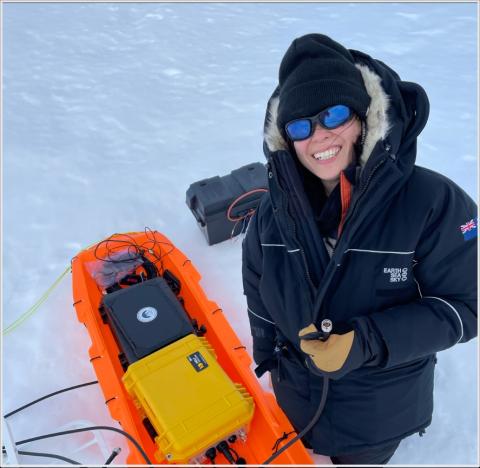
EAS Specially Invited Speaker - Dr. Winnie Chu
Primary tabs
The instability of the Greenland and Antarctic ice sheets represents the largest uncertainty in future sea-level rise projections. While surface processes are increasingly well-observed, the "hidden half" of these systems (e.g., the subglacial water networks and basal thermal states that lubricate ice flow) remains critically under-constrained. In this talk, I will demonstrate how my research group, the Polar Geophysics Simulation Lab (PGSL), is closing this gap by bridging the historical divide between observational geophysics and numerical modeling.
I will first present results from our "Frozen Legacies" program, where we have utilized historical and modern radar sounding data to map basal freeze-on and ice shelf basal channels across Antarctica. I will highlight recent findings from the Amundsen Sea Embayment, where our integration of radar attenuation with ice-flow models has revealed that frozen beds upstream of Thwaites Glacier are poised to thaw under moderate acceleration, producing a feedback mechanism with urgent implications for ice sheet stability.
Moving beyond observation, I will outline the future trajectory of my program, enabled by recent NSF CAREER and Heising-Simons Foundation awards. I will discuss our development of physics-informed AI frameworks that assimilate multi-scale radar observations into hydrologic models, allowing us to infer basal conditions at resolutions previously impossible. By moving from static mapping to dynamic, AI-enabled forecasting, we aim to bridge the gap between observation and prediction, providing the constraints needed to reduce uncertainty in the next generation of ice sheet models.
*Refreshments: 10:30 - 11:00 AM (Atrium)
Media
Summary
The instability of the Greenland and Antarctic ice sheets represents the largest uncertainty in future sea-level rise projections. While surface processes are increasingly well-observed, the "hidden half" of these systems (e.g., the subglacial water networks and basal thermal states that lubricate ice flow) remains critically under-constrained. In this talk, I will demonstrate how my research group, the Polar Geophysics Simulation Lab (PGSL), is closing this gap by bridging the historical divide between observational geophysics and numerical modeling.
I will first present results from our "Frozen Legacies" program, where we have utilized historical and modern radar sounding data to map basal freeze-on and ice shelf basal channels across Antarctica. I will highlight recent findings from the Amundsen Sea Embayment, where our integration of radar attenuation with ice-flow models has revealed that frozen beds upstream of Thwaites Glacier are poised to thaw under moderate acceleration, producing a feedback mechanism with urgent implications for ice sheet stability.
Moving beyond observation, I will outline the future trajectory of my program, enabled by recent NSF CAREER and Heising-Simons Foundation awards. I will discuss our development of physics-informed AI frameworks that assimilate multi-scale radar observations into hydrologic models, allowing us to infer basal conditions at resolutions previously impossible. By moving from static mapping to dynamic, AI-enabled forecasting, we aim to bridge the gap between observation and prediction, providing the constraints needed to reduce uncertainty in the next generation of ice sheet models.
*Refreshments: 10:30 - 11:00 AM (Atrium)
Status
- Workflow status: Published
- Created by: tbuchanan9
- Created: 01/12/2026
- Modified By: tbuchanan9
- Modified: 01/12/2026
Categories
Keywords
User Data