<![CDATA[Logistics in Transition: What to Know, What to Watch, and How to Keep Moving]]>27233By Chris Gaffney, Managing Director of the Georgia Tech Supply Chain and Logistics Institute and a former Vice President of Global Strategic Supply Chain at The Coca-Cola Company.
In this article:
Why the relentlessness of change in logistics is a legitimate concern — not a complaint
Structural shifts reshaping the competitive floor
Predictions most leaders are still underweighting
What staying current actually requires of individuals and teams
The Weight of Constant Curveballs
A few months ago, I caught up with a former colleague at an industry event. He is a senior leader at a large global company with a well-regarded supply chain organization. His team had been through a lot since we last talked. Port closures. Tariff escalations. Freight volatility. Inventory repositioning. The kinds of disruptions that used to arrive once in a cycle had become an avalanche, and this was before Hormuz!
His people had responded well. They had adapted. But now he was thinking about something harder to solve: what it would take to keep them in the game longer term. The experience his team had gained came at a cost and he worried some would look for roles that were not on the “firing line”. He also wondered whether he could still attract the best and brightest in the next generation of talent who would be looking at this field and asking whether the complexity was worth it.
That conversation has stayed with me. Supply chain and logistics has always been a field of cycles — demanding, but navigable. What has changed is that the field has moved from cyclical difficulty to something more structural: a persistent state of volatility where the curveballs do not stop coming.
That conversation was in the back of my mind as I developed a recent talk on logistics trends from 2026 to 2030 for GT SCL Industry Partner Manhattan’s annual Momentum conference. The brief was to look ahead and be a bit provocative. What follows builds on that talk, but with a broader point in view: if the curveballs keep coming, leaders need a clearer sense of which shifts matter most and what they should do about them.
The New Operating Environment
Logistics has entered a structurally more volatile era, not a groundbreaking insight given the last four years. Several things changed at roughly the same time, and they have not changed back:
Several shifts hit the industry at once, and none of them have meaningfully reversed. Geopolitics is now a supply chain design variable, not something to catch up on in a podcast. Strategic decoupling between China and the United States, instability in the Middle East, and the long shadow of the Russia-Ukraine conflict have pushed energy, sourcing, and network design into the same conversation. What once sat in the news feed now needs to be in the nominal scenario during business planning.
At the same time, customer expectations have permanently shifted. Amazon reset the standard for visibility, precision, and speed, and that standard now applies even more as Amazon is emerging as an open source 3PL. Labor and energy costs have also changed the economics of physical logistics in ways that will not self-correct. Demographic pressure, wage inflation, and energy volatility have altered the baseline cost structure calling into question existing network locations.
Meanwhile, AI and automation have moved out of the experimental category and into the realm of near-term value creation. The tools are real, and organizations that understand where to apply them are making materially better decisions than those that do not. That matters because networks now have to optimize for two things at once: cost and recovery. Efficiency still matters, but a network that performs well in steady state and fails under disruption no longer meets the standard.
There is also a macro pattern worth calling out: the industry is in a longer-duration rebalancing cycle than many executives expected. We examined the Hormuz disruption and its downstream effects in a recent SCL Spotlight piece. The short version is that energy pass-through effects, freight volatility, and extended planning uncertainty will impact costs and capacity well into 2027. Executives planning around a near-term return to normal are making a strategic error.
The next decade will reward adaptable logistics networks more than simply optimized ones.
The Benchmark Has Changed — For Everyone
Amazon's logistics operation is not just something to amaze us as packages arrive at our doorstep consistently with compressed lead times. It is a capability demonstration that has redefined what customers consider normal — same-day expectations, ETA precision, real-time visibility, low-friction returns. The important implication is not that every organization needs to replicate Amazon's infrastructure. It is that Amazon-shaped expectations are now the standard against which every supply chain is measured, whether or not Amazon is a direct competitor. Amazon’s recent announcement that it is making its capabilities available to all only raises the bar.
Organizations that understand this have shifted their strategic question from "how do we improve our operations" to "where will we compete, where will we leverage others' capabilities, and where will we differentiate on something Amazon cannot replicate." The benchmark is no longer functional excellence alone. It is well oiled end-to-end execution.
The Real Automation Story: Error-Proofing Over Spectacle
There is a version of the automation conversation that focuses on “wow” demos — autonomous vehicles, lights-out warehouses, robotics showcases. That version makes for compelling conference content. It is also not where most of the real value is being created today.
The highest-value wins tend to be quieter: fewer errors, fewer touches, fewer injuries, fewer claims. Computer vision that catches a loading error before a truck leaves the dock. Sensor verification that eliminates a reconciliation step. An alert from a Machine Learning model that prevents a cascading service failure. These are error-proofing stories, and they are compelling because the ROI is measurable in terms operations leaders understand.
The reason automation is scaling in these areas is not novelty — it is because the math finally works, driven by labor scarcity, safety pressure, and the compounding cost of variability. My own view informed by industry contacts and academic researchers is that computer vision may become one of the most quietly transformative technologies of this decade, not because it is the most advanced, but because it applies to so many high-variability, human-intensive touchpoints across logistics operations.
That said, a high percentage of large-scale automation efforts still fail. Many of the reasons are well known and tackling this issue is critical for those who do not yet have a model for success.
The next margin pool may come more from consistency and reliability than from flashy robotics demonstrations.
This theme generated significant discussion at the Manhattan Associates' Momentum conference this spring — enough that we are dedicating our July SCL webinar to it directly. If your organization is navigating automation decisions, the session is worth your time.
Autonomy: Watch the Middle Mile Before the Long Haul
Autonomous vehicle technology has generated significant hype and its share of missed timelines. A more realistic view is emerging. Autonomy scales first where variability is lowest, economics are clearest, and environments are most constrained — yard operations, middle-mile freight on repetitive lanes, internal shuttles, port drayage, and warehouse orchestration. This amounts to millions of miles and load counts that are increasing daily.
The organizations watching this most carefully are not asking when full autonomy will arrive. They are asking which specific lanes and operations have the cost structure where autonomy pays out today. One dynamic worth watching: the scaling of urban robotaxi operations is building safety data, insurance frameworks, and regulatory precedent that may indirectly accelerate confidence in middle-mile freight and warehouse applications.
The shift that matters is not from no autonomy to full autonomy. It is from technology demonstrations to lane economics — and that is the transition that creates real operating decisions for logistics leaders.
AI Is Real — But Workflow Discipline Matters More Than Tool Selection
The common reality in most logistics organizations today includes AI copilots, workflow assistance tools, exception management support, improved ETA prediction, and document automation. These are useful. They are also early. What is still uncommon: autonomous execution, fully integrated AI decisioning across functions, self-optimizing networks, and end-to-end agentic orchestration. Those capabilities exist in pilots and in forward-leaning early adopters. They are not yet standard operating practice in most organizations.
The framing that I keep coming back to is this: start with a broken logistics workflow, then apply the lightest AI capable of clearing a hard ROI threshold. I got a text from a mentee today that showed a picture of a Microsoft Co-pilot Studio agent he built that automates a daily inventory check on a critical SKU. Organizations that start by selecting the most impressive tool and then look for a process to apply it to are making the investment in the wrong order.
There is another structural shift worth highlighting. The industry has moved out of data scarcity and is living in decision overload. The challenge is not access to information — it is building the discipline to convert that information into insight and informed decisions at the right time to impact action.
Logistics first, AI second. Start with the broken workflow. Then apply the lightest tool that clears a hard ROI threshold.
The Rising Value of Human Judgment
Back to the conversation I opened with. The concern was not that my friend’s team lacked technical skills — it was sustaining engagement and attracting talent to a field that had become genuinely exhausting. That challenge is real, and it is connected to something missed in the automation conversation.
As AI automates more routine work — reporting, documentation, tracking, reconciliation — the work that remains becomes more demanding in different ways. The value shifts toward judgment: escalation management, cross-functional orchestration, interpreting second-order consequences, maintaining trust when the data is ambiguous. The organizations that will attract and retain the strongest professionals are not necessarily those with the most advanced tools. They are the ones that create conditions where smart people make consequential decisions and continue to grow.
As AI capabilities become more democratized across the industry, the differentiating capabilities will increasingly be leadership, communication, collaboration, and the kind of critical thinking that no tool can fully replicate.
Predictions Leaders Should Keep an Eye On
These are the shifts I believe deserve more attention than they are getting in most leadership conversations:
The Next Major Logistics Disruption May Come From Energy, Not Freight Grid strain, electrification demand, AI compute infrastructure buildout, and charging capacity constraints are converging in ways that could reshape logistics economics faster than expected. Power availability is not yet a front-burner strategic issue for most logistics leaders. It should be.
Amazon, Walmart, and Chinese Platforms May Become Competing Logistics Operating Systems Competition is shifting from retailer vs. retailer to ecosystem vs. ecosystem. The organizations that do not think clearly about which ecosystems they are part of, and on what terms, may find themselves structurally disadvantaged.
Cyber Attacks on Physical Supply Chains Will Become a Defining Executive Risk As logistics networks become more connected, more automated, and more AI-dependent, your exposure grows. The distinction between cyber risk and operational risk is collapsing. This belongs on the executive agenda as a strategic issue, not just an IT issue.
Trusted Operational Data May Become the Most Valuable Logistics Asset Organizations with clean, well-governed operational data will be able to move fast on AI adoption. Organizations with fragmented, inconsistent data will face a structural disadvantage that no AI investment can overcome. Data discipline is a strategic investment, not a cleanup project.
Insurance Companies May Quietly Become Gatekeepers of Automation Adoption Scaling autonomy and connected logistics infrastructure depends as much on insurability, liability frameworks, and safety validation as on technical capability. Insurance market dynamics will shape the adoption curve for autonomous operations in ways that are not yet widely discussed in logistics circles.
The Industry May Shift From "Lowest Cost" to "Fastest Recovery" as the Defining Competitive Dimension Pure cost optimization as a primary network design principle may increasingly underperform against resilience and recovery speed as the basis of competition. The organizations that have already internalized this are building different networks than those still optimizing for cost alone.
What Staying Current Actually Requires
I want to close by coming back to my colleague's concern — and to the question he was really asking: how do we help our people process all of this and remain effective?
Here is my honest answer. The field is not going to slow down. What staying current requires is not reading every article or attending every conference. It requires developing a point of view on the shifts that matter most for your specific context, and then actively deciding how you will act and adjust. Passive awareness is not enough. The question is not whether you know what is changing. It is what you have decided to do about it.
For organizations, that means investing in conditions that allow talented people to keep learning. For individuals, it means resisting the temptation to treat busyness as a substitute for development. The professionals who remain most valuable will be those who continue to understand what is changing and develop the judgment to translate that understanding into better decisions.
You cannot sit still. The question is not whether you know what is changing. It is what you have decided to do about it.
The Opportunity on the Other Side
I want to end where I began — with empathy for everyone in this field who is carrying a lot right now. Fatigue is real. The complexity is real. The ongoing intensity is real.
And so is the opportunity.
Logistics is no longer just moving product. It is becoming a resilience system, a customer experience system, a technology system, an energy system, and a real-time decision system simultaneously. The professionals who learn to navigate that complexity — who develop both technical fluency and human judgment — will be among the most valuable people in any organization.
The future arrives not as one dramatic breakthrough, but as a sequence of operational readthroughs: decisions made well, workflows redesigned thoughtfully, capabilities built deliberately. That is hard work. It is also genuinely exciting work. And I believe the best of it is still ahead.
Related Upcoming SCL Webinar 7/2/2026
Why Do So Many Automation Projects Fail? Automation in logistics is accelerating — but so is the gap between what is promised and what is delivered. Systems get sized on optimistic assumptions. Hidden dependencies become single points of failure. Technology that shines in the demo struggles under real operating conditions.
Leaders from Georgia Tech's Supply Chain and Logistics Institute join industry practitioners to dig into the root causes of automation underperformance — and the design, evaluation, and implementation practices that build more resilient, effective operations.
]]> Andy Haleblian117821640252026-06-22 21:33:4517822175432026-06-23 12:25:4300newsLogistics isn't just changing — it’s being redefined by constant disruption, rising expectations, and new technology. This SCL Spotlight breaks down the biggest shifts shaping the next decade and what leaders must do to stay ahead. Discover the insights that can help you adapt, build resilience, and keep your organization moving.]]>2026-06-23T00:00:00-04:002026-06-23T00:00:00-04:002026-06-23 00:00:00680492674087680492image<![CDATA[Logistics in Transition]]>image/jpeg17821637252026-06-22 21:28:4517821637252026-06-22 21:28:45674087image<![CDATA[Chris Gaffney]]> Chris Gaffney]]> image/jpeg17170679032024-05-30 11:18:2317718833752026-02-23 21:49:35<![CDATA[Related SCL webinar 7/2/2026 "Why Do So Many Automation Projects Fail?"]]><![CDATA[View past SCL newsletters and join our mailing list]]><![CDATA[Georgia Tech Supply Chain and Logistics Institute]]><![CDATA[From Classroom to Manufacturing Floor: Teachers Build Real-World Manufacturing Skills at Georgia Tech]]>35874 For three days in June, a dozen middle and high school teachers from rural Georgia traded their classrooms for Georgia Tech’s Montgomery Machining Mall, a machine shop where students and researchers design and build custom parts. Instead of grading papers, they cut metal on bandsaws, lathes, and milling machines while learning skills they’ll take back to their students this fall.
The workshop is part of Georgia Tech’s Advanced Manufacturing Pathways (AMP) program, a collaboration between the Georgia Tech Manufacturing Institute (GTMI) and Georgia Tech Research Institute (GTRI), which connects rural educators with hands-on manufacturing training. This particular training was delivered through a partnership between GTMI, STEM@GTRI — GTRI’s K-12 outreach program — and the George W. Woodruff School of Mechanical Engineering, leveraging the facilities and expertise of the Montgomery Machining Mall to provide teachers with direct experience in modern manufacturing. Building on GTRI’s Rural Computer Science Initiative, the program expands access to high-skill, high-wage career pathways across rural communities. The initiative is supported through state funding.
The workshop comes at a time when demand for skilled manufacturing workers continues to grow nationwide, particularly in roles requiring precision, technical expertise, and problem-solving.
Inside the Machine Shop
The training took place June 3 – 5 in the Montgomery Machining Mall, where staff provided access to facilities, equipment, and technical expertise that made the immersive learning experience possible.
Teachers designed and manufactured a metal meat tenderizer and a metal coaster etched with both the Georgia Tech logo and their name. For many, this was their first exposure to advanced manufacturing tools and processes, and a glimpse into high-skill, high-wage careers within reach for their students.
“Many of these teachers have never been exposed to any advanced manufacturing,” said Sean Mulvanity, a program manager for STEM@GTRI and project lead for this workshop. “By the time they walk out of here, they’ve actually created and manufactured physical items they can take back to their students.” Unlike traditional professional development, the workshop places teachers directly in the machine shop, working on heavy equipment.
For AMP program leaders, this pilot was a way to build momentum for school districts that may add advanced manufacturing courses and to make the machine shop feel less intimidating in the process.
“One of the biggest misconceptions about modern manufacturing is that it is inaccessible or limited to specialized factory environments,” said GTMI Deputy Director Steven Ferguson. “Today’s manufacturing combines hands-on skills, digital technologies, AI, and problem-solving in ways that are relevant to students across many career pathways. By giving teachers direct experience in the machine shop, we help them bring that excitement back to their classrooms and show students that they can design, build, and innovate in their own communities.”
From the Shop Floor to the Classroom
One of the workshop participants is James Beveridge, who teaches computer science for grades 6-12 in the Chattahoochee County School District, a small, rural district south of Columbus. He has participated in multiple Georgia Tech-led training programs, and he runs a full computer science pathway for 450 middle and high school students. This fall will mark his third year in the Rural Computer Science Initiative and teaching computer science after two decades in industry.
Beveridge had some informal experience with tools growing up — his father taught him basic carpentry and welding — but he had never done formal machining work before the AMP workshop.
“Working with metal is different than working with wood, obviously, but it’s been really interesting to see the precision involved,” he said. “With wood, you can be off by a sixteenth of an inch, and nobody cares. When you’re machining metal parts, it has to be very, very precise. Learning to use the precision measuring tools has been eye-opening.”
For Beveridge, one of the biggest benefits of his ongoing work with Georgia Tech through the Rural Computer Science Initiative and related programs is that he never leaves empty-handed.
“Every time I come up here to learn something new, they send me home with the equipment to teach it with,” he said. “The first time, I left with a classroom set of robots so my students could learn to program. Another time, it was a more advanced humanoid robot with artificial intelligence. Now, I’m going back with new skills in machining and a physical project I can show my students.”
Another participant, Juone Brown, teaches high school computer science and AI to students at Dooly County High School in Vienna, Georgia. This is her second year in the rural computer science partnership and her fourth year teaching at Dooly. Previously, Brown was a professor for 25 years at Fort Valley State University.
Like Beveridge, Brown has no formal machining background but said the way workshop instructors broke down each step — especially the math behind the cuts — made the work feel approachable.
“It has been fantastic and really well-paced,” she said. “We all come from different backgrounds, but the way they present the information makes it click. We know the math, but when you’re on the machine, and they show you easier ways to get the cut you need, it’s very encouraging.”
She’s already thinking about how to translate that feeling for her students, many of whom prefer building things to writing code. “I’m always telling them that skills pay the bills,” Brown said. “A lot of my students are hands-on. Now I can connect what we’re doing in class to real parts and jobs.”
Bringing Advanced Manufacturing to More Georgia Classrooms
After the workshop, teachers are expected to integrate machining concepts into existing courses or help build new manufacturing pathways at their schools.
AMP program leaders intentionally kept this pilot cohort small. The team plans to repeat the workshop several times over the coming year, expanding to more schools and districts across Georgia, building local champions who can help launch advanced manufacturing programs in their communities.
About the Georgia Tech Manufacturing Institute (GTMI)
The Georgia Tech Manufacturing Institute (GTMI) convenes industry leaders, government partners, and top researchers to collaborate on the grand challenges facing manufacturing today: accelerating technology development and deployment; creating, maintaining, and filling quality jobs; ensuring global competitiveness; and advancing economic and environmental stability. Our vision is to ensure rapid innovation that secures U.S. dominance in advanced manufacturing. Through the design and development of artificial intelligence systems, secure digital manufacturing, additive and subtractive processes, and large-scale production enterprises, GTMI stands at the forefront of manufacturing innovation — leveraging state-of-the-art facilities, including the Advanced Manufacturing Pilot Facility, to turn research breakthroughs into market-ready solutions.
About the Georgia Tech Research Institute (GTRI)
The Georgia Tech Research Institute (GTRI) is the nonprofit, applied research division of the Georgia Institute of Technology (Georgia Tech). Founded in 1934 as the Engineering Experiment Station, GTRI has grown to more than 3,000 employees, supporting eight laboratories across more than 20 locations nationwide and performing more than $919 million in problem-solving research annually for government and industry. GTRI's renowned researchers combine science, engineering, economics, policy, and technical expertise to solve complex problems for the U.S. federal government, state, and industry.
]]> Anna Akins117821365892026-06-22 13:56:2917821385002026-06-22 14:28:2000newsRural Georgia teachers gain practical machine shop training at Georgia Tech, bringing advanced manufacturing skills back to their classrooms.]]>2026-06-22T00:00:00-04:002026-06-22T00:00:00-04:002026-06-22 00:00:00Writer: Anna Akins Media Contact: Jennifer Martin | jennifer.martin@research.gatech.edu Photos: Sean McNeil Copyediting: Stacy Braukman
]]>680485680488680487680486680485image<![CDATA[2026_0603_image_STEM-GTRI_machine-bootcamp_07.JPG]]> Juone Brown (left), a teacher at Dooly County High School in Vienna, Georgia, called the bootcamp well-paced and plans to bring what she learned back to her students this fall, many of whom prefer hands-on learning. ]]> image/jpeg17821327692026-06-22 12:52:4917821327692026-06-22 12:52:49680488image<![CDATA[2026_0603_image_STEM-GTRI_machine-bootcamp_28.JPG]]> Rural Georgia teachers pose with the metal meat tenderizers they made during a machining workshop hosted by the Georgia Tech Manufacturing Institute (GTMI) and Georgia Tech Research Institute (GTRI) at the Montgomery Machining Mall.]]> image/jpeg17821327692026-06-22 12:52:4917821327692026-06-22 12:52:49680487image<![CDATA[2026_0603_image_STEM-GTRI_machine-bootcamp_23.JPG]]> James Beveridge, a computer science teacher in the Chattahoochee County School District, said he is excited to take back new machining skills and physical items back to share with his students. ]]> image/jpeg17821327692026-06-22 12:52:4917821327692026-06-22 12:52:49680486image<![CDATA[2026_0603_image_STEM-GTRI_machine-bootcamp_16.JPG]]> A metal meat tenderizer created by participants during the workshop. ]]> image/jpeg17821327692026-06-22 12:52:4917821327692026-06-22 12:52:49<![CDATA[Accenture Managing Director Conrad Grajczak Joins SCL Industry Advisory Board]]>27233 SCL is pleased to announce the appointment of Conrad Grajczak to its Industry Advisory Board. Grajczak brings nearly 15 years of deep expertise at the intersection of procurement, supply chain logistics, and private equity value creation to the role.
Grajczak currently serves as a Managing Director in Accenture's Supply Chain & Engineering practice. He is a leader in the firm's Private Equity practice, where he advises operating partners on developing and executing high-impact value creation plans across their investment portfolios.
"We are thrilled to welcome Conrad to our Industry Advisory Board," said SCL Managing Director Chris Gaffney. "His extensive background as a management consultant specializing in margin improvement and cost reduction for private equity-backed companies will be invaluable. We look forward to leveraging his insights to drive our strategic initiatives forward."
A Proven Track Record in Value Creation
Throughout his career, Grajczak has partnered closely with Private Equity Operating Partners to deliver bottom-line value through strategic sourcing. He routinely leads pre-purchase and post-acquisition initiatives to establish a value creation roadmap and implement transformative cost programs across Consumer, Industrial, and Healthcare clients.
Prior to Accenture, Grajczak was part of Insight Sourcing for 11 years and promoted to Partner. Insight Sourcing was a boutique procurement consulting firm where he focused on Private Equity. Insight Sourcing was acquired by Accenture in 2024.
Before consulting, Grajczak started his career out at Merck & Co. in Vaccine Manufacturing Science and Commercialization.
Academic Credentials
A proud Georgia Tech alumnus, Grajczak earned his B.S. in Chemical and Biomolecular Engineering with a minor in Business through the Technology & Management Program. He also holds an MBA from Emory University’s Goizueta Business School.
]]> Andy Haleblian117803447292026-06-01 20:12:0917806624452026-06-05 12:27:2500newsMr. Grajczak brings nearly 15 years of deep expertise at the intersection of procurement, supply chain logistics, and private equity value creation to the role.]]>2026-06-05T00:00:00-04:002026-06-05T00:00:00-04:002026-06-05 00:00:00680397680397image<![CDATA[Conrad Grajczak]]>image/jpeg17803454642026-06-01 20:24:2417803454642026-06-01 20:24:24<![CDATA[SCL Industry Advisory Board Members]]><![CDATA[View past SCL newsletters and join our mailing list]]><![CDATA[Steven Ferguson Builds Better On-Ramps to Georgia Manufacturing, Education]]>36413 For Steven Ferguson, deputy director of the Georgia Tech Manufacturing Institute and executive director of the Georgia Tech Manufacturing 4.0 Consortium, advancing Georgia’s manufacturing industry and its workforce is personal.
It was Ferguson’s own first manufacturing industry job at Glidden Paint in high school that tipped a row of dominoes, clearing his way out of poverty. Following next in the Hall County native’s favor was his receiving the Pell Grant and HOPE Grant, which led to his associate’s degree and first job in education.
Since then, Ferguson has spent the better part of three decades advancing workforce preparation and education access in Georgia, first as chief information officer for the Technical College System of Georgia, and now through his current roles at Tech.
“Access to higher education changed the trajectory of my life. The question now is how we build systems that create those same opportunities for others — whether someone starts their career right out of high school, earns credentials while working, or returns later to pursue advanced technical education or engineering. We need to create flexible pathways that develop talent at every stage of life.”
Steven Ferguson
Forged in Manufacturing
Ferguson was born into a family of “makers,” who got by on odd jobs and money from their small bait and tackle shop on Lake Lanier and later peddling a variety of goods. At a young age, Ferguson learned salesmanship and picked up the tinkering spirit.
“My dad was always entrepreneurial, and I think you might even consider us manufacturers, always making fishing equipment or other things,” said Ferguson. “From a very young age, I was out making jig heads, tying flies, and bagging hooks or sinkers. It was definitely in my blood.”
When he was in 10th grade, a teacher nominated Ferguson for a new youth apprenticeship program. That opportunity ultimately led to his role as an information technology apprentice at Glidden Paint, which became Ferguson’s first job in the manufacturing industry. The job was a perfect fit for Ferguson, who enjoyed learning more about the manufacturing process and the practical outlet for his computing knowledge.
He continued working there until he began studying computer science at North Georgia College and State University. Later, he transferred to Gainesville College (GC) to participate in a joint enrollment program designed to lead to eventual enrollment for a bachelor’s degree at Tech.
However, before Ferguson completed his time at GC, he had an associate’s degree and, more importantly, a job offer. GC wanted him to train others for careers in information technology.
It was Ferguson’s own first manufacturing industry job at Glidden Paint in high school that tipped a row of dominoes, clearing his way out of poverty. Following next in the Hall County native’s favor was his receiving the Pell Grant and HOPE Grant, which led to his associate’s degree and first job in education.
Since then, Ferguson has spent the better part of three decades advancing workforce preparation and education access in Georgia, first as chief information officer for the Technical College System of Georgia, and now through his current roles at Tech.
]]>2026-05-27T00:00:00-04:002026-05-27T00:00:00-04:002026-05-27 00:00:00Amanda Budd]]>680416680416image<![CDATA[StevenFerguson-IMG_5862.jpg]]> Steven Ferguson, deputy director of the Georgia Tech Manufacturing Institute and executive director of the Georgia Tech Manufacturing 4.0 Consortium]]> image/jpeg17805826722026-06-04 14:17:5217805827132026-06-04 14:18:33<![CDATA[Full Story on the Enrollment Management News Page]]><![CDATA[Advanced Manufacturing Takes Off in Georgia Classrooms]]>35575 Smart manufacturing, data-driven design, and artificial intelligence aren’t just buzzwords — they are fields that are creating high-paying, high-tech careers across the country. In rural communities across Georgia, these advanced manufacturing roles are growing, but the talent pipeline isn’t keeping pace.
“It’s not just about creating jobs, it’s about filling them,” says Tom Kurfess, Regents’ Professor in mechanical engineering and executive director of the Georgia Tech Manufacturing Institute (GTMI). “To do that, we need to show students how exciting and innovative manufacturing can be. Manufacturing has really changed over the past few years. Today, going from an idea to a physical part is much easier to do. It is fun and exciting to bring ideas to life and to actually hold the results in your hands.”
GTMI is working to reignite student interest in the art and science of making through its new K–12 initiative: the Advanced Manufacturing Pathways (AMP) Program. Modeled after Georgia Tech’s Rural CS Initiative, AMP empowers schools with faculty expertise, cutting-edge equipment, and a hands-on curriculum to give students early exposure to the tools, technologies, and creativity behind modern manufacturing while building a pipeline of future talent ready to thrive in high-tech careers.
Funded by the Southwest Georgia Regional Commission (SWGRC), AMP is kicking off in three school districts this fall — Decatur County, Thomas County, and the city of Thomasville — with plans to expand to additional schools in the spring of 2026. The program will start by engaging more than 200 students through hands-on learning, virtual instruction, and in-person lab experiences led by Georgia Tech researchers and faculty.
“Here in Southwest Georgia, we believe that opportunities like this are vital for integrated learning in schools and for growing our future workforce,” says Beka Shiver, economic development and transportation planner for SWGRC. “Workforce development and K-12 integration are at the heart of our Southwest Georgia Ecosystem Building Project, and we are so pleased to be able to provide funding for this program.”
The launch of the AMP Program is centered around Design, Build, Race, a course putting a modern spin on the classic pinewood derby. Students will use digital design, 3D printing, and machining to build and race custom cars, while also learning how to collect and analyze performance data to improve their designs and predict outcomes. The course blends engineering with data science, sparking curiosity and showing students how modern manufacturing is powered by both technical skills and smart data.
“This program delivers real-world industry experience to students while strengthening the talent pipeline that drives innovation, competitiveness, and resilience in advanced manufacturing”, says Steven Ferguson, interim director of operations at GTMI and one of the project’s leaders. “After more than 20 years of driving education and workforce development innovation, I’m more energized than ever to help launch the AMP program to open doors for students and advance U.S. manufacturing leadership.”
Building the Blueprint
Before it evolved into the AMP Program, Design, Build, Race was a course developed by GTMI research engineer Kyle Saleeby in 2023. Originating in GTMI’s Advanced Manufacturing Pilot Facility (AMPF), the course was designed to introduce Morehouse and Georgia Tech students to the possibilities of modern manufacturing through digital design, 3D printing, machining, and competitive creativity.
“Even after the first week, it was powerful to watch students discover how exciting it is to design and manufacture a competition-ready car in a matter of hours,” said Saleeby. “That’s when I knew we were onto something special.”
Saleeby teamed up with Ferguson to transform the course into a broader initiative. The duo engaged colleagues from STEM@GTRI and secured funding from SWGRC to modify the curriculum and scale the course for a high school audience.
“We are thrilled that we have been able to take the lessons learned during the development of the Rural Computer Science Initiative and expand opportunities for students in Southwest Georgia,” says Sean Mulvanity, a senior research associate in the Georgia Tech Research Institute. Mulvanity is one of the founders of the initiative and has been a key contributor to the AMP Program. “We hope this program can grow and expose students across the state to the field of advanced manufacturing.”
To bring AMP into classrooms, Southern Regional Technical College helped set up labs and provide technical support, ensuring schools were ready to launch.
“At all levels, the community has rallied around this program,” says Saleeby. “Providing students with a unique experience learning advanced manufacturing technologies will open countless career opportunities. I cannot wait to see where they go.”
]]> adavidson38117586523502025-09-23 18:32:3017805140182026-06-03 19:13:3800newsLaunched this fall, Georgia Tech’s Advanced Manufacturing Pathways Program works to spark interest in high-tech careers and strengthen Georgia’s talent pipeline.]]>2025-09-23T00:00:00-04:002025-09-23T00:00:00-04:002025-09-23 00:00:00Audra Davidson Research Communications Program Manager Georgia Tech Manufacturing Institute]]>678139678140678141678139image<![CDATA[GT-Pinewood-Derby-Cars.png]]> Students across Georgia are designing and 3D printing pinewood derby cars as part of a new hands-on advanced manufacturing initiative.]]> image/png17588110312025-09-25 14:37:1117588110312025-09-25 14:37:11678140image<![CDATA[Saleeby-setting-up-equipment.jpeg]]> Kyle Saleeby (left) works side-by-side with a teacher to set up precision milling equipment, a key part of the AMP Program’s hands-on curriculum.]]> image/jpeg17588112332025-09-25 14:40:3317588112332025-09-25 14:40:33678141image<![CDATA[Steven-Ferguson.jpeg]]> With more than two decades of workforce development experience, Steven Ferguson is helping launch a new era of hands-on learning through the AMP Program.]]> image/jpeg17588113942025-09-25 14:43:1417588113942025-09-25 14:43:14<![CDATA[Georgia Tech Taps Military Talent to Boost Manufacturing Workforce]]><![CDATA[Manufacturing the Workforce of the Future]]><![CDATA[How a Veteran Gained Invaluable Skills in AI Manufacturing at Georgia Tech]]><![CDATA[Southwest Georgia Students Put New Manufacturing Skills to the Test in Tri‑District Race]]>27255 Students from three Southwest Georgia high schools put their engineering skills to the test at the Advanced Manufacturing Program’s first tri‑district race, showcasing custom cars they designed and built. With strong support from educators, industry partners, and local leaders, the program is fostering homegrown technical talent. As AMP expands to six schools, communities are beginning to imagine new possibilities for their future workforce.
]]> Josie Giles117703147222026-02-05 18:05:2217805136972026-06-03 19:08:1700newsStudents from three Southwest Georgia high schools put their engineering skills to the test at the Advanced Manufacturing Program’s first tri‑district race, showcasing custom cars they designed and built. With strong support from educators, industry partners, and local leaders, the program is fostering homegrown technical talent. As AMP expands to six schools, communities are beginning to imagine new possibilities for their future workforce.]]>2026-02-05T00:00:00-05:002026-02-05T00:00:00-05:002026-02-05 00:00:00679198679197679198image<![CDATA[Tri-District-Advanded-Manufacturing-Pathways-Race-003.JPG]]> Students from three Southwest Georgia high schools put their engineering skills to the test at the Advanced Manufacturing Program’s first tri‑district race, showcasing custom cars they designed and built. With strong support from educators, industry partners, and local leaders, the program is fostering homegrown technical talent. ]]> image/jpeg17703149662026-02-05 18:09:2617703149662026-02-05 18:09:26679197image<![CDATA[Tri-District-Advanded-Manufacturing-Pathways-Race-070.JPG]]> Each car on the track represents hours of programming, 3D printing, machining, and iterative design completed by students in the AMP program.]]> image/jpeg17703147372026-02-05 18:05:3717703147372026-02-05 18:05:37<![CDATA[How a Race Car Project Is Transforming Rural STEM Education]]>27255 Students in rural Georgia are discovering new possibilities through Georgia Tech’s new Advanced Manufacturing Pathways program, where they design, build, and race custom cars while learning real manufacturing skills. With local educators and industry partners behind it, AMP is reshaping how communities imagine their future workforce.
]]> Josie Giles117678032832026-01-07 16:28:0317805133382026-06-03 19:02:1800newsStudents in rural Georgia are discovering new possibilities through Georgia Tech’s new Advanced Manufacturing Pathways program, where they design, build, and race custom cars while learning real manufacturing skills. With local educators and industry partners behind it, AMP is reshaping how communities imagine their future workforce.]]>2026-01-07T00:00:00-05:002026-01-07T00:00:00-05:002026-01-07 00:00:00679063679063image<![CDATA[AMP Students]]> Bainbridge High School students in the AMP program gathered in October 2025 to race their cars and put their manufacturing skills to the test.]]> image/png17691065642026-01-22 18:29:2417691065642026-01-22 18:29:24<![CDATA[Scaling Innovation: Georgia Tech Manufacturing 4.0 Consortium Builds for the Future ]]>27255 Moving a new idea from a research lab to production remains one of industry’s toughest challenges. But at the Georgia Tech Manufacturing Institute (GTMI), which leads the nation in translating research into technologies that shape the future of U.S. manufacturing, that gap is being closed by design. This effort was on full display during AMPF Week, a two-day celebration marking the official opening of the newly renovated Georgia Tech Advanced Manufacturing Pilot Facility (AMPF).
]]> Josie Giles117794570592026-05-22 13:37:3917794572312026-05-22 13:40:3100newsGeorgia Tech’s Manufacturing 4.0 Consortium is bridging the gap between research and real-world production by using AI, automation, and industry partnerships to accelerate advanced manufacturing. Showcased during AMPF Week, the newly upgraded facility highlights intelligent, connected systems and a “self-driving” lab that enables real-time testing, innovation, and workforce development.]]>2026-05-22T00:00:00-04:002026-05-22T00:00:00-04:002026-05-22 00:00:00680332680332image<![CDATA[ampf-week-thumb.jpg]]> A student demonstrates human-robot interaction using virtual reality controls and collaborative robotics technology at the AMPF.]]> image/jpeg17794571832026-05-22 13:39:4317794571832026-05-22 13:39:43<![CDATA[HHL Conference announces Keynote speaker Rick Brennan, Director of Emergency Operations at World Health Organization (WHO)]]>27858WHEN: June 7-9, 2017
WHERE: UN City, Copenhagen
WHAT: Panels and interactive sessions focusing on topics such as:
*As the 2017 conference will be hosted at the United Nations City, it will be free of charge. All attendees must be registered online prior to the event and must present an official form of government-issued photo ID to enter the UN City conference venue.
OVERVIEW:
The HHL Conference is pleased to announce the opening Keynote address from Dr. Richard Brennan, Director of Emergency Operations, Emergencies Programme, World Health Organization (WHO) in geneva, who led the Ebola Response from October 2014 to January 2016 as the Director at the WHO HQ. Dr. Brennan now oversees WHO’s response to health emergencies globally as part of the new Emergencies Programme which brings together several departments to streamline WHO’s role in emergencies globally, from prevention and preparedness to response, and from humanitarian emergencies to disease outbreaks. See full bio here.
Each year the Conference on Health & Humanitarian Logistics (HHL) provides an open forum for the discussion of challenges and new solutions in disaster preparedness and response, long-term development and humanitarian aid, and global health delivery. This neutral platform encourages learning and collaboration within and across institutions; promotes system-wide improvements in organizations and the sector as a whole; identifies important research issues; and establishes priorities in terms of strategies, policies and investments.
Speakers and participants in the event come from across global health and humanitarian sectors, from governments, NGOs, foundations, private industry, and academia, and share diverse perspectives in health and humanitarian challenges. The agenda features keynote addresses, panel discussions, focused interactive workshops, oral presentations, lunchtime group discussions, and interactive poster sessions covering a broad set of research topics and applications.
Submissions were accepted for 3 categories this year: interactive workshops, oral presentations, and posters, which explore challenges and solutions for building efficient and effective supply chains for health and humanitarian challenges. Particular topics of interest include public private partnerships, innovative uses of data or technology, and creating sustainable supply chain systems.More information about these sessions is available here. The final list of presentation, workshop sessions, and posters will be online at the links here as they are confirmed.
Luk Van Wassenhove, Humanitarian Research Group, INSEAD
2017 Speakers and presenters include representatives from:
Bill & Melinda Gates Foundation, Centers for Disease Control & Prevention, (CDC), Central Medical Stores Trust of Malawi, Chemonics International, DHL, Earthquake Reconstruction & Rehabilitation Authority (ERRA) Pakistan, GS1 Nigeria, Global Scientific Solutions for health, Imperial Health Sciences, John Snow Inc., Laerdal Global Health, Logistimo India, Medecins Sans Frontieres, National Medical Stores Uganda, National Primary Health Care Development Agency of Nigeria, Nexleaf Analytics, North Star Alliance, Partnership for Supply Chain Management, UCLA, Vienna University of Economics and Business, UNICEF Supply Division, UN World Food Programme, UPS, World Health Organization, USAID, and more.
]]> Meghan Smithgall114933200902017-04-27 19:08:1017793851342026-05-21 17:38:5400newsThe 9th annual Health & Humanitarian Logistics Conference draws practitioners from across various sectors to discuss supply chain, logistics, and systems design for global health and humanitarian response / long-term development.]]>2017-04-27T00:00:00-04:002017-04-27T00:00:00-04:002017-04-27 00:00:00Meghan Smithgall Center for Health & Humanitarian Systems (CHHS)]]>591033591034591038591035591033image<![CDATA[Rick Brennan]]>image/png14933208092017-04-27 19:20:0914933208092017-04-27 19:20:09591034image<![CDATA[2017 HHL Conference]]>image/png14933209162017-04-27 19:21:5614933209162017-04-27 19:21:56591038image<![CDATA[UN City Copenhagen]]>image/jpeg14933210462017-04-27 19:24:0614933210462017-04-27 19:24:06591035image<![CDATA[Conf flyer image]]>image/jpeg14933209802017-04-27 19:23:0014933209802017-04-27 19:23:00<![CDATA[Registration for HHL Conference ]]><![CDATA[GT Events Calendar Listing]]><![CDATA[What the Public Discussion on Hormuz Is Still Getting Wrong]]>27233The energy shock is already widely understood. What is not yet widely understood is what comes after it — and why a diplomatic deal, when it comes, will not be the end of the story.
By Chris Gaffney, Managing Director of the Georgia Tech Supply Chain and Logistics Institute and a former Vice President of Global Strategic Supply Chain at The Coca-Cola Company.
Three weeks ago, I started hearing from contacts in my network. Senior supply chain executives, people who have managed through COVID and the Suez Canal blockage, were expressing concern. The kind of concern that doesn’t make it into earnings calls or press releases. The kind that shows up in private conversations between people who actually move goods around the world for a living.
Their worry wasn't about crude oil prices. Crude oil prices are now widely discussed. Their worry was about what happens after crude oil prices. About the plastic in your water bottle, the fertilizer going into this year's corn crop, the engine oil in your car, the polyester in your running shoes.
Those conversations sent me back to the data. The geopolitical crisis and the energy shock are now well-documented in mainstream reporting. What is less discussed and what my conversations with experienced practitioners suggested was being systematically underestimated is the operational cascade downstream of that energy shock. I wanted to answer a specific question: given that the Strait has been effectively closed since February 28, what aspects of the downstream impact are already locked in regardless of a diplomatic solution, and what is still unfolding? Could I use publicly available data, straightforward analytical tools, and accessible modeling to produce a defensible, quantified view of that question?
The answer, after several weeks of work, is yes. And what the analysis shows is more operationally significant than most of the public commentary has yet captured.
Start with what is already true.
The International Energy Agency (IEA) has characterized this as what it describes as one of the largest supply disruption in the history of the global oil market. Flows through the Strait fell from roughly 20 million barrels per day before the conflict to low single-digit levels in March and early April. Asian crude stocks dropped 31 million barrels in March alone, with further declines expected through April. Global refinery runs in Asia were cut by around 6 million barrels per day. Middle distillate prices in Singapore hit all-time highs.
But energy prices, as alarming as they are, are the visible part of this problem. The less visible part is what those commodities become.
Naphtha, a petroleum derivative most people have never heard of, is the feedstock for the polyester in your clothing, the polyethylene terephthalate (PET) in your water bottle, the polypropylene in your food packaging, the polyvinyl chloride (PVC) in your plumbing. Roughly 80 percent of the naphtha imported into Asia comes from the Middle East. South Korean petrochemical plants were running at 60 to 70 percent of capacity by late April. Japanese crackers at 65 to 75 percent. The IEA confirmed it in plain language: Asian petrochemical plants curtailed operating rates as feedstock supply dried up.
Liquefied petroleum gas (LPG) is the cooking gas that 60 percent of Indian households depend on for daily meals and was the first fuel to be rationed. Queues formed as deliveries were delayed. This reflected physical supply constraints alongside severe price pressure.
Fertilizer prices hit 49 percent above last year's levels by April, according to DTN data. Corn planting intentions dropped 3.5 percent. The math on that is straightforward: the food prices that result from this spring’s planting decisions will show up at the grocery store in 2027. The disruption has a long tail, and most of that tail is still ahead of us.
The question isn’t whether this will affect what you pay for everyday goods. It already is. The question is how far the cascade goes and how long it lasts.
Here is what the modeling shows.
Working from publicly available IEA, U.S. Energy Information Administration (EIA), and commodity price data, I built a scenario model that tracks 12 commodity-region pairs through a 300-day simulation horizon. I then ran that model over 1,500 times with slightly varying assumptions to produce a range of outcomes rather than a single point estimate. That range is more honest than a single number, because the genuine uncertainty in this situation deserves to be represented.
Three findings stand out.
First: a diplomatic deal today would be unlikely to quickly reverse what has already happened. This is the finding that surprised me most, and it held across almost every simulation. The high-import-dependency commodities have already depleted enough inventory that functional shortage is already embedded in the near-term outlook regardless of when the Strait reopens. The diplomatic question determines how long the pain lasts and how severe the recovery will be. For consumers, this means the effects may show up long after the headlines fade through higher prices, product shortages, and delays in everything from clothing and packaging to fertilizer-dependent food production.
Second: Europe's most visible supply chain story, airlines canceling flights, is a price story, not a physical shortage story. The IEA documents approximately six weeks of European jet fuel supply. Airlines are grounding aircraft because fuel has doubled in price, not because airports are running dry. Meanwhile, Asian petrochemical plants are curtailing because feedstock physically stopped arriving. These two situations look similar in the headlines. They require completely different responses. For consumers, the difference matters because one problem mainly makes travel and goods more expensive, while the other can interrupt the actual production of the products modern life depends on.
Third: the recovery will be harder and longer than most public commentary assumes. S&P Global estimates five weeks to seven months for full supply normalization after a reopening, depending on infrastructure damage. Mine clearance alone requires 60 to 90 days of sustained operations before commercial vessels can transit safely. Insurance premiums will not normalize until underwriters see months of safe transit. And when supply does restart, suppressed demand returns simultaneously with a supply base that is still rebuilding. The EIA's 2027 demand forecast of 1.6 million barrels per day growth (nearly three times the depressed 2026 rate) makes this concrete. We have seen this pattern before. COVID demonstrated it at scale. The bullwhip effect, applied to a supply-side energy shock, produces a second dislocation on the back side of the crisis.
What this means for your grocery bill, your gas tank, and your business.
The analysis maps 36 supply chain pathways from raw commodity to consumer shelf across 15 product categories. Here are three examples that are or will be visible to you.
Take construction materials. PVC pipe, insulation, and window profiles all begin with petrochemical feedstocks moving through the Gulf region. PVC resin prices in India rose nearly 80 percent in March. Since PVC pipe is largely PVC resin, the pass-through to construction costs is immediate and difficult to absorb. The result is likely to show up in higher prices for building materials, repairs, and infrastructure projects long before most consumers connect the cause.
The same pattern is unfolding in synthetic motor oil. Shell's Pearl Gas-to-Liquid facility in Qatar — one of the world's most important sources of premium Group III base oil — was taken offline by missile strikes. Producers in Bahrain and the UAE have declared force majeure. Roughly 40 percent of global Group III supply is now offline or unable to ship. For consumers, that eventually means higher oil-change costs, more expensive industrial lubricants, and added operating costs moving quietly through trucking, aviation, manufacturing, and delivery networks.
Food arrives later, but it arrives. Fertilizer prices are already sharply elevated, and planting decisions are being made right now under those conditions. The agricultural calendar creates a lag most consumers do not see. Disruptions this spring can become higher grocery prices many months from now. That is not speculation. It is simply how agricultural supply chains work.
We tend to underestimate the breadth and duration of these events while they are happening, and overestimate how quickly things return to normal after they appear to resolve.
What we did, and why it matters how we did it.
Every number in this analysis traces to a cited source. Where data was insufficient and judgment was required, those judgment calls are labeled as such. The model is not a black box. It is a documented, reproducible simulation that any researcher can run independently.
I also used AI — specifically Claude by Anthropic — as a partner to help analyze and build this work. While I provided the analytical framework, the practitioner judgments, and the validation of assumptions, the AI assisted with drafting, building models, computation, and data synthesis. This collaboration is fully detailed in the paper.
This represents a new way of performing analytical work. The results are significant: a quantified, sourced, and reproducible analysis of a complex disruption in the actual world. What usually takes a traditional research team months was completed in weeks. That speed is vital when a situation is still unfolding.
The larger point.
Sixty-seven days in, the global supply chain community is navigating a disruption that has no precise historical parallel. The 1973 OAPEC embargo lasted months and produced lasting structural change in how the world consumes energy. The 1990 Gulf War shock was brief enough that it produced relatively mild downstream consequences. The 2022 European energy crisis showed us what happens when industrial feedstock costs become uneconomic for months at a time: capacity comes offline, and some of it does not come back for a long time.
The 2026 Hormuz closure is now 72 days old. It has already lasted longer than the 1990 Gulf War shock. It is approaching the territory where the worse historical outcomes become the more relevant comparators. Every additional week of closure moves the probability distribution toward the scenarios that produced lasting structural damage.
Both public and private entities may be underestimating the magnitude of what recovery will require. Restoring normal supply chain function after an event of this scale and duration is not a matter of reopening a waterway. It is a matter of rebuilding inventory buffers, restarting industrial capacity, normalizing insurance markets, reestablishing commercial relationships, and managing the demand surge that hits simultaneously with the supply restart. The organizations that are planning for that recovery now will be materially better positioned than those that wait.
The people I talked to three weeks ago were right to be concerned. Their concern was based on experience and instinct and what they were seeing in their own business. Our work over the past weeks validates their perspective.
An enduring diplomatic solution is the essential precondition for any of this to improve. Without it, the cascade continues. With it, the hard work of recovery begins. Either way, the time to understand the full scope of what is in motion is now and not after the headlines move on.
Editor’s note: View the related report: technical analysis, scenario modeling, Monte Carlo simulation methodology, consumer impact assessment.
]]> Andy Haleblian117785185052026-05-11 16:55:0517786248722026-05-12 22:27:5200newsThe energy shock is already widely understood. What is not yet widely understood is what comes after it — and why a diplomatic deal, when it comes, will not be the end of the story.]]>2026-05-11T00:00:00-04:002026-05-11T00:00:00-04:002026-05-11 00:00:00680256674087680256image<![CDATA[The Hormuz Supply Shock: What Happens Next to Your Supply Chain]]>image/png17785260622026-05-11 19:01:0217785260622026-05-11 19:01:02674087image<![CDATA[Chris Gaffney]]> Chris Gaffney]]> image/jpeg17170679032024-05-30 11:18:2317718833752026-02-23 21:49:35<![CDATA[Why the Strait of Hormuz Is More Than an Energy Crisis]]><![CDATA[View past SCL newsletters and join our mailing list]]><![CDATA[Georgia Tech Supply Chain and Logistics Institute]]><![CDATA[The Blind Spot in Modern Supply Chain Analytics: Where Did Critical Thinking Go?]]>27233By Chris Gaffney, Managing Director of the Georgia Tech Supply Chain and Logistics Institute, Supply Chain Advisor, and former executive at Frito‑Lay, AJC International, and Coca‑Cola.
In this issue:
The real blind spot in analytics teams
Three failures where the model was “right” and the decision was wrong
A five-question checklist to run before anything goes to leadership.
A Subtle but Growing Concern
Over the past several months, I have had conversations with senior leaders at several large, well-established supply chain organizations with strong teams responsible for Integrated Business Planning (IBP) and supply chain network design and optimization.
These teams are technically strong. They know how to build models. They are comfortable with large data sets. Many are now incorporating AI tools into their workflows.
But the same concern keeps surfacing across those conversations:
The analytical capability is improving—but the decision-making discipline around it is not keeping pace.
Analysts move quickly to building models without fully defining the business problem. Assumptions are not always surfaced or challenged. Outputs are evaluated mathematically, not operationally. And recommendations are not always translated into real-world implications.
Leaders are concerned about this and are looking for ways to address. I share their concern because I have been in their shoes.
What the Experience Taught Us
Earlier in my career, across different roles at Coca-Cola, we did not formally teach critical thinking. We learned it through experience and often through mistakes. Three situations shaped how I think about this today.
Powerade: When the Model Works but the Thinking Doesn’t
While working with optimization groups at Coca-Cola North America, we overbuilt capacity for Powerade. The model did exactly what it was supposed to do. The problem was upstream of the model.
We took the demand forecast at face value. At the time, we deferred to the brand teams without interrogating their assumptions. We never asked what was driving the projected volume—whether the competitive dynamics supported it, whether the channel assumptions were realistic, whether pricing and distribution plans were grounded, whether overall market growth would materialize as projected.
The consequence was idle capacity, production lines that were purchased and never installed, write-offs, and a fundamental change to our process. Going forward, brand and supply chain teams were both required to sign off on future business cases. The model was technically correct. The thinking around the model had not been.
Little Rock: When Feasibility Isn’t Reality
Later, within Coca-Cola Supply, we made a network decision to close a plant in Little Rock. On paper, the remaining system had the capacity to absorb the volume. The model said so.
What the model assessed was production capacity based on rated line speeds. What it did not account for was dock and storage capacity at peak, or the practical limitations of standing up a new shift at the receiving plants. Those constraints were real. They were also invisible in the model.
In the short term, we had to source sub optimally from other plants—which directly undermined the business case we had built to justify the closure. The math was right. The operational validation was incomplete.
Mini Cans: When the Thinking Matches the Model
By the time I led the National Product Support Group, we had evolved. Decisions like the launch of mini cans required cross-functional alignment, scenario-based thinking, and a clear understanding of how demand would actually be generated across channels and routes to market.
We got that one right, not because the model was more sophisticated, but because the discipline around the model was stronger. We had learned, the hard way, to ask the questions the model could not ask for itself.
Most of the Work Is Outside the Model
There is a line I first heard from Chris Janke: "Most of the work is outside the model." He may have learned it from someone else; I don’t know the original source, but it is the framing that has stayed with me. With the advances in data and machine learning we have seen over the past decade, that proportion may be closer to 75 percent today.
We are better than ever at collecting and cleansing large data sets, processing high volumes of information, and identifying mathematical errors. But the most important work still happens outside the model: defining the right business question, building meaningful scenarios, interpreting outputs in real-world terms, and stress-testing the assumptions that drive the recommendation.
Janke captured this precisely in documenting his own experience with a modeling error that illustrated the point. An analyst had validated the math on a labor cost model—everything checked out numerically. But when the output was translated into real-world terms, it implied production workers earning roughly $300,000 per year while working approximately 60 hours total annually. The math was internally consistent. The result was operationally impossible. The question that should have been asked early: does this make sense in the context of how the business actually operates? It was not asked until after the analysis was complete.
The discipline to ask that question is not modeling skill. It is a critical thinking skill.
Where the Breakdown Happens
Before the Model: Skipping the Hard Questions
A common pattern today is that analysts move quickly to building the model. The harder and more important step of defining the business decision before the model is built gets compressed or skipped entirely. The questions that require that step are not complicated, but they take time and engagement to answer well:
What business decision are we actually trying to make?
What scenarios matter, and why?
What does success look like—not mathematically, but operationally?
What constraints are real versus assumed?
These questions are not as clean as coding a model. They require conversations with people who understand the constraints, not just the data. That is part of why they get skipped.
After the Model: Mistaking Mathematical Accuracy for Business Validity
This is where more serious errors occur. Model issues can usually be fixed with more time. Misinterpretation of output leads to bad decisions that are much harder to unwind.
The Powerade and Little Rock situations both illustrate this. In each case, the model was not wrong in any technical sense. What was missing was the translation layer— where someone asks, “what changes on a Tuesday night shift, at Plant B, when demand spikes 12 percent?”
That translation layer does not happen automatically. It has to be built into how teams work. And it is exactly the discipline that gets squeezed when organizations reward speed and analytical sophistication above everything else.
What Critical Thinking Actually Means in Supply Chain
Critical thinking in supply chain is not skepticism for its own sake, and it is not a soft skill that sits alongside the analytical work. It is a discipline applied to decisions and not just to models. The word itself points to what we mean: kritikos, the Greek root, means skilled in judging, able to discern*. That is the right definition for our purposes.
It means asking whether the right question is being answered before investing in answering it well. It means making the assumptions that drive a recommendation visible and testable. It means translating analytical output into operational consequence: what actually changes, for whom, at what cost, and under what conditions the answer flips.
That discipline shows up or breaks down at four specific moments:
Before the model is built: Is the business question defined precisely enough to model?
While the model is running: Are the assumptions embedded in the data realistic and challenged?
When the output is ready: Does this result make sense in how the business actually operates?
Before the recommendation goes forward: Have we planned for how this will be received, and by whom?
When these moments are skipped because of time pressure, overconfidence in tools, or a culture that rewards analytical speed over decision rigor the gap between analysis and action grows. The Powerade and Little Rock situations were both failures at these moments, not failures of the models themselves.
*DeCesare, M. (2009). Casting a critical glance at teaching “critical thinking.” Pedagogy and the Human Sciences, 1(1), 73–77.
A Five-Question Diagnostic
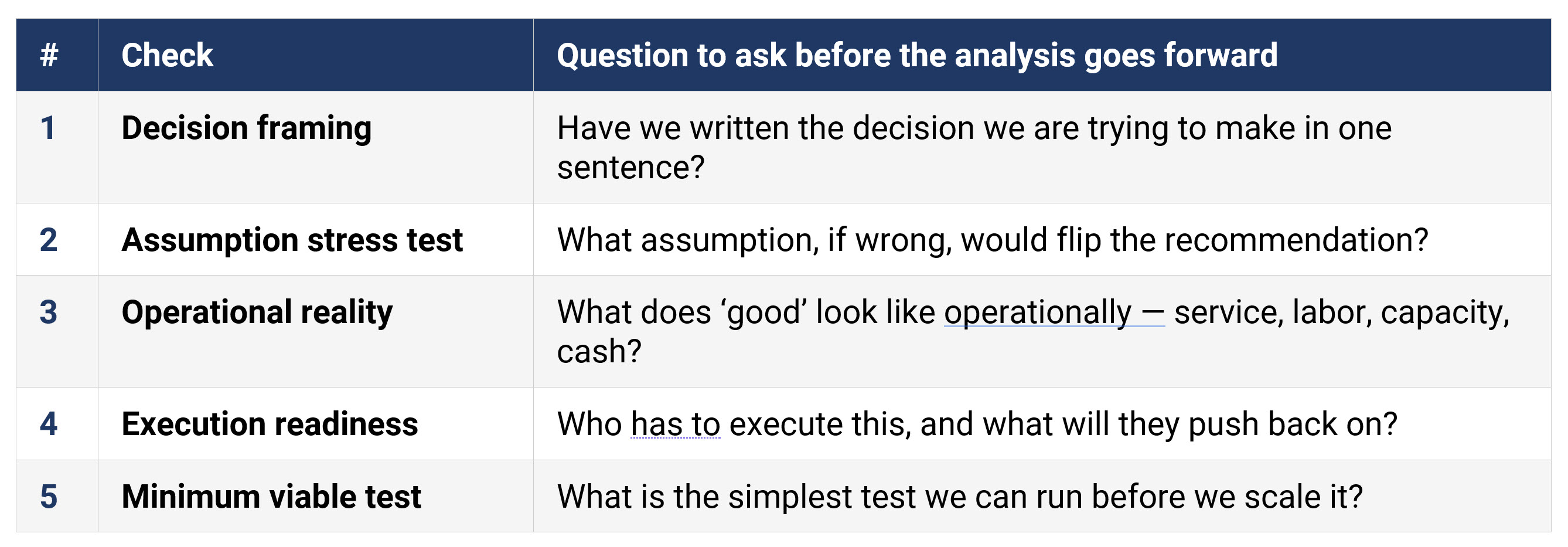
Before an analysis or recommendation moves forward, teams should be able to answer five questions clearly. If any of them cannot be answered, the analysis is not ready—regardless of how strong the model is.
These are questions that should have specific, grounded answers before a recommendation reaches leadership. If the team cannot answer question two (what assumption would flip the result) then the recommendation rests on unexamined ground. If question four cannot be answered, the change management work has not started yet.
In the Powerade situation, questions one and two were the misses. In Little Rock, it was question three. The models were not the problem. The diagnostic would have surfaced both gaps before the decisions were made.
This Gap Is Well Documented
What I am describing from my own experience is consistent with what the research shows.
A long-running finding in operations research is that many models are built and comparatively few actually drive decisions, and the breakdown is organizational, not technical. A widely cited review in the European Journal of Operational Research frames this as an implementation problem rooted in how models are connected (or not connected) to the people and processes that own the decision.
Professional credentialing bodies have recognized the same gap. The INFORMS Certified Analytics Professional blueprint explicitly lists business problem framing, stakeholder analysis, and business case development as core analytics competencies—not optional additions. The signal is clear: being analytically strong is necessary but not sufficient.
On the training side, a field study published in the European Journal of Operational Research tested the effects of structured decision training across roughly 1,000 decision makers and analysts. The results showed measurable improvement in proactive decision-making skills and decision satisfaction. The gap is real, and it is addressable. It is a training and design issue, not a talent issue.
The 4 C’s: A Decision-Focused Framework
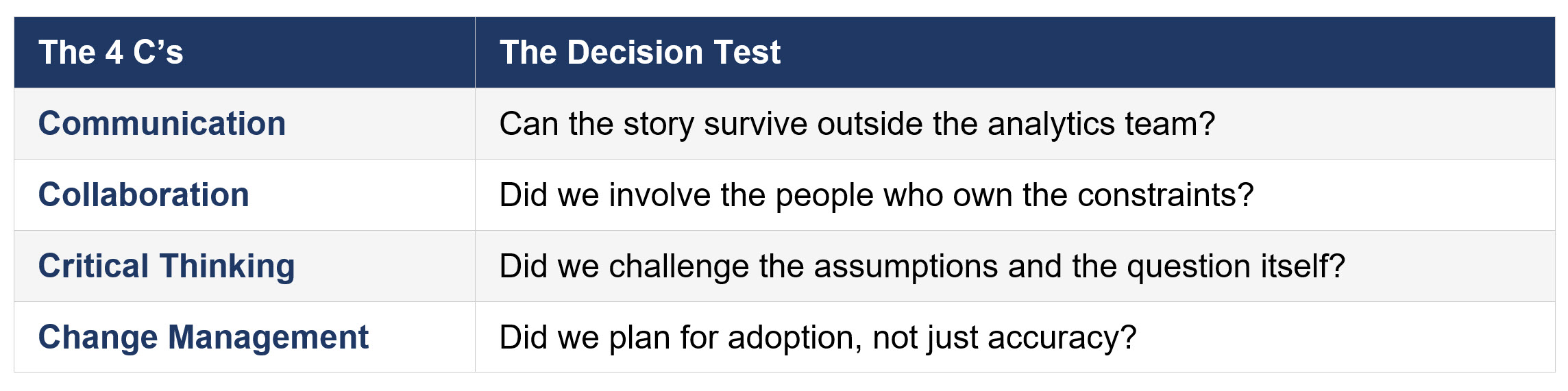
At Georgia Tech SCL, we organize this thinking around what we call the 4 C’s. These soft skills play a key role in the decision process. Each one asks a specific question about whether the decision, not just the analysis, was made well.
Notice what this framework does not include: model accuracy, data quality, or visualization quality. Those matter, and they are inputs to the decision. But a team can have a perfect model, a clean dataset, and a compelling dashboard and still fail all four of these tests.
The Powerade situation failed the Collaboration test The supply chain team did not sufficiently interrogate the brand team’s assumptions. Little Rock failed the Critical Thinking test: the right question was not asked about what the model was not capturing. In both cases, the Communication and Change Management failures followed directly from those upstream gaps.
When all four are present, analysis becomes a decision. When one or more is missing, the analysis and translation to a solid recommendation are at risk.
Where to Start
This topic keeps coming up in conversations with companies, in work with practitioners, and in what we hear from students as they move into industry roles.
The tools are not the problem. AI-assisted analytics, optimization models, and advanced forecasting are real assets. But tools amplify the thinking behind them. Weak decision discipline and better tools is a faster path to the wrong answer.
If this shows up in your org, try the five-question diagnostic on your next recommendation before it hits leadership. If it surfaces gaps you cannot close quickly, SCL can help. We are building workshops and courseware on decision-focused critical thinking, and we will cover this in our June Lunch and Learn.
]]> Andy Haleblian117774638062026-04-29 11:56:4617775698422026-04-30 17:24:0200newsDespite the rapid advancement of AI and data modeling in supply chain management, many organizations face a growing "blind spot" where sophisticated mathematical outputs are not adequately challenged by human intuition or operational reality. Drawing on experience, author Chris Gaffney illustrates how neglecting to stress-test assumptions can lead to costly mistakes even when the data itself is accurate. To bridge this gap, the article introduces a strategic diagnostic framework designed to help leaders move beyond technical validation and toward more holistic, cross-functional decision discipline.]]>2026-04-30T00:00:00-04:002026-04-30T00:00:00-04:002026-04-30 00:00:00680113674087680113image<![CDATA[The Blind Spot in Modern Supply Chain Analytics: Where Did Critical Thinking Go?]]>image/jpeg17774897672026-04-29 19:09:2717774900582026-04-29 19:14:18674087image<![CDATA[Chris Gaffney]]> Chris Gaffney]]> image/jpeg17170679032024-05-30 11:18:2317718833752026-02-23 21:49:35<![CDATA[View past SCL newsletters and join our mailing list]]><![CDATA[Georgia Tech Supply Chain and Logistics Institute]]><![CDATA[Aaron Stebner named associate director of Georgia Tech Manufacturing Institute]]>36757 The Georgia Tech Manufacturing Institute (GTMI) has selected Aaron P. Stebner as its new associate director, expanding the institute’s leadership as it scales advanced manufacturing research, infrastructure, and industry engagement.
In his role as associate director, Stebner will lead operations, engagement and continued growth of the Advanced Manufacturing Pilot Facility (AMPF), a cornerstone of Georgia Tech’s manufacturing ecosystem. The facility brings together artificial intelligence, automation, robotics, and digital manufacturing to accelerate materials discovery and manufacturing innovation at pilot scale.
The AMPF is evolving into what Georgia Tech leaders describe as a national first: a university-based, self-driving manufacturing facility that allows new technologies to be invented, tested and de-risked before they reach full-scale production. Backed by more than $80 million in federal, state, and private investment, the facility serves as a shared-use platform for industry, startups, researchers, and government partners.
“AMPF is a national user facility and a blended industry-academia, human-AI environment where new manufacturing discoveries are made ready for industry adoption,” Stebner said. “By integrating AI-enabled systems, real-time automation and pilot-scale validation, we’re helping shorten the timeline from discovery to deployment.”
Stebner’s research and leadership sit at the intersection of artificial intelligence, manufacturing, materials, and mechanics, with an emphasis on intelligent and adaptive manufacturing systems. His work spans advanced alloys, additive manufacturing, autonomous experimentation, and data-driven process design, with applications across aerospace, automotive, biomedical, energy and industrial sectors.
Under his leadership, the AMPF is expected to continue expanding as a national collaboration hub for academia, industry, and government. The facility supports pilot-scale testing of emerging technologies, workforce development and applied research aimed at strengthening U.S. manufacturing competitiveness and economic resilience.
Stebner’s appointment also strengthens the alignment between GTMI, Georgia AIM and Georgia Tech’s broader research enterprise, integrating AI-driven research, translational infrastructure, and industry partnerships into a cohesive model for manufacturing innovation.
“With Aaron’s experience building forward-looking manufacturing programs and leading large, interdisciplinary teams, GTMI is well positioned to accelerate the impact of the AMPF and related initiatives,” said Tom Kurfess, executive director of GTMI.
]]> ychernet3117774706752026-04-29 13:51:1517774740822026-04-29 14:48:0200newsThe Georgia Tech Manufacturing Institute (GTMI) has selected Aaron P. Stebner as its new associate director, expanding the institute’s leadership as it scales advanced manufacturing research, infrastructure, and industry engagement.]]>2026-04-29T00:00:00-04:002026-04-29T00:00:00-04:002026-04-29 00:00:00Yanet Chernet Communications Officer]]>680098680098image<![CDATA[headshot-aaron-2.jpg]]>image/jpeg17774740572026-04-29 14:47:3717774740572026-04-29 14:47:37<![CDATA[Manufacturing Consortium Helps Industry Close the Finish Gap]]>35575
From fighter jets to medical devices, today’s most advanced machines depend on parts as intricate as their missions. These components aren’t just geometrically complex — they’re made from specialized metals engineered to withstand extreme heat, friction, and wear. But that strength comes with a challenge. How do you shape metals tough enough to survive the heat of a jet engine?
One solution is to start with a more moldable form of these super-metals: powder. In a specialized form of additive manufacturing (like 3D printing), manufacturers start with fine metal powders and fuse them, layer by layer, using focused energy. Known as powder bed fusion (PBF), this method enables highly complex shapes and reduces the amount of finishing work needed. Still, when a micron of extra material can make or break the final product, even near-perfect parts require precise finishing touches.
“The introduction of new, exotic materials produced through additive manufacturing has brought unique challenges, especially for applications in space and missile systems,” says David Antonuccio, business development director at Halocarbon, a Georgia-based company producing advanced chemical solutions used in manufacturing and other fields. “While these materials offer distinct properties, they are notoriously difficult to machine.”
That’s where the Georgia Tech Manufacturing Institute (GTMI) comes in. Through its Manufacturing 4.0 Consortium, GTMI connects industry manufacturers like Halocarbon with researchers and innovators to tackle real production challenges like this. Membership includes access to GTMI’s Advanced Manufacturing Pilot Facility (AMPF), where companies can test ideas and collaborate on new solutions.
Halocarbon recently teamed up with Freemelt, a leader in producing PBF systems and a fellow consortium member, to address this bottleneck. Their goal: to determine whether Halocarbon’s specialized metalworking fluids could enhance the finishing process for PBF-manufactured parts made from tungsten and molybdenum, two high-temperature, hard-to-machine metals.
“The future of manufacturing depends on how well we integrate talent, technology, and collaboration,” says Steven Ferguson, interim director of Research Operations at GTMI and managing director of the consortium. “By bringing companies together around shared challenges, we’re closing critical gaps and strengthening the nation’s advanced manufacturing capability.”
Solving the Post-Processing Bottleneck
Even with advanced methods like electron beam powder bed fusion (E-PBF), which uses an electron beam to fuse metal powders inside a vacuum chamber, finishing remains a critical hurdle. “Surface finish in powder bed fusion is fundamentally tied to the particle size of the metal powder,” says Ian Crawford, a materials and application engineer at Freemelt. “Post-processing will almost always be part of the equation for high-performance components.”
In traditional machining, coolants and cutting fluids used in these finishing steps are often overlooked, and the methods haven’t changed much in decades. Halocarbon’s metalworking fluid aims to bring these fluids into a new era, using innovative polymer chemistry to extend tool life, improve surface quality, and boost efficiency when machining these challenging alloys.
The two companies initiated their joint project during their free AMPF equipment use time, which comes with the full level of consortium membership. From there, GTMI designed and executed controlled studies comparing the use of Halocarbon’s fluids to two standard finishing methods, dry machining and EDM-based finishing. The results showed a 6% improvement in side milling and a 26% improvement in end milling versus dry machining, with even greater gains over EDM. These improvements translate into higher-quality parts, tighter specifications, lower scrap rates, extended tool life, and reduced downstream costs — exactly what aerospace and defense suppliers need to meet stringent requirements.
The findings were shared at the 2025 National Space & Missile Materials Symposium, reinforcing the value of industry-academic collaboration.
“Industry keeps pushing materials to handle more heat and stress, but that makes post-processing harder,” says Matt Carroll, one of the GTMI researchers on the project. “By bringing equipment makers and chemistry innovators into the same experiment, we were able to prove where the gains really are and give manufacturers data they can act on.”
“No single manufacturing method solves every challenge,” says Crawford. “To achieve the performance and cost targets that aerospace and defense applications demand, we need to bring together the right combination of technologies, and collaborations like this show what's possible when we do.”
]]> adavidson38117654795942025-12-11 18:59:5417774722662026-04-29 14:17:4600newsCollaborative research at GTMI is helping manufacturers overcome critical challenges in finishing advanced materials for aerospace and defense applications.]]>2025-12-15T00:00:00-05:002025-12-15T00:00:00-05:002025-12-15 00:00:00Writer: Audra Davidson Research Communications Program Manager Georgia Tech Manufacturing Institute
Contact: Belinda Vogel Research Engagement Manager Georgia Tech Manufacturing Institute
]]>680093680094680093image<![CDATA[gap-1.jpg]]> High-performance parts used in aerospace and defense systems need to be precise and durable, even with complex geometries. Advanced manufacturing methods enable the production of complicated parts that traditional machining can't achieve, like those seen here at GTMI's Advanced Manufacturing Pilot Facility. (Photo by Georgia Tech)]]> image/jpeg17774721812026-04-29 14:16:2117774721812026-04-29 14:16:21680094image<![CDATA[gap-2.jpg]]> Collaborative research at the Georgia Tech Manufacturing Institute teamed is working to improve the finishing processes for hard to machine metals like tungsten. (Photo via Halocarbon)]]> image/jpeg17774722312026-04-29 14:17:1117774722312026-04-29 14:17:11<![CDATA[More about GTMI's Manufacturing 4.0 Consortium]]><![CDATA[Georgia Tech Manufacturing Institute]]><![CDATA[Georgia AIM Receives Research Program Impact Award from Georgia Tech]]>36757 Georgia Artificial Intelligence in Manufacturing, or Georgia AIM, has received one of the highest research awards at the Georgia Institute of Technology, the Outstanding Achievement in Research Program Impact.
The award was announced March 25, 2026 and is one of six Institute Research Awards given by Georgia Tech’s Office of the Executive Vice President for Research. The portfolio of awards honors achievements in research engagement, innovation, faculty advising, and impact.
Georgia AIM is a statewide coalition led by the Georgia Tech Enterprise Innovation Institute (EI2) and the Georgia Tech Manufacturing Institute (GTMI) to develop and deploy AI talent and innovation in manufacturing. The Georgia AIM coalition includes dozens of universities, technical colleges, nonprofits, and economic development organizations.
“It is an incredible experience to collaborate with technology and economic development leaders around the state to lead the nation and the world in AI for manufacturing,” said Aaron Stebner, Georgia AIM co-director and the Eugene C. Gwaltney Jr. Chair in Manufacturing at Georgia Tech.
“We are truly honored to receive this recognition from our peers at Georgia Tech,” said Tom Kurfess, GTMI Executive Director and HUSCO/Ramirez Distinguished Chair in Fluid Power and Motion Control.
Georgia AIM was initiated in 2021 by Stebner, EI2 Vice President David Bridges, Kurfess, Georgia AIM managing director and GTMI deputy director Steven Ferguson, and Georgia Tech executive director for strategic partnerships George White. The coalition received an initial $500,000 planning grant from the U.S. Economic Development Administration (EDA), which was followed by $65 million in additional grants from EDA and with additional federal, state, and private sector support now totals more than $100 million to enact projects across the state.
The Georgia AIM coalition counts many achievements on and off campus, including:
Supporting collaborations for more than thirty-five faculty, fifty research faculty and professionals, ten post docs, eighty graduate research assistants, one hundred and fifty undergraduate research assistants, and dozens of staff at Georgia Tech.
Transforming the Georgia Tech Advanced Manufacturing Pilot Facility into a national user facility for research and development to invent, test, derisk, and mature AI manufacturing and materials technologies.
Building a manufacturing commercialization pipeline that links faculty research, student innovation, startups, and corporate partners to introduce AI manufacturing innovations to regional and national economies.
Launching workforce development programs that provide new opportunities and career paths thousands of students spanning K-12 engagement, technical apprenticeships and credentials, and professional education.
Providing STEM experiences including AI coding camps, robotics competitions, and advanced manufacturing competitions to thousands of students across Georgia.
21 peer reviewed journal articles, 5 peer reviewed conference proceedings, 5 National Academies workshop presentations, 5 keynote/plenary presentations, more than 200 conference presentations and posters, 13 invention disclosures, 7 provisional patents, 2 full patents filed to date with dozens more in process.
“Georgia AIM proves that innovation scales when built alongside workforce,” said Ferguson. “We built a seamless pipeline from education to industry, ensuring talent is ready to deploy AI in real manufacturing environments on day one.”
“The impact of Georgia AIM is grounded in collaboration — universities, industry, nonprofits and communities working together to shape the future of advanced manufacturing in Georgia,” said Bridges. “This recognition underscores what a coordinated statewide effort can accomplish.”
Because research covers a range of activities — from research and development to commercialization and public impacts — the annual awards recognize the many facets of work in this area. The peer-driven nomination process emphasizes measurable contributions and leadership across disciplines.
“The strength of Georgia Tech’s research enterprise begins with the talented people who push discovery forward every day,” said Tim Lieuwen, executive vice president for Research. “Congratulations to this year’s honorees, who demonstrate what it means to turn bold ideas into real-world impact, advancing knowledge from fundamental science to commercial and community applications. With these awards, we celebrate their leadership, creativity, and dedication to serving the public good.”
]]> ychernet3117772430632026-04-26 22:37:4317774022032026-04-28 18:50:0300newsGeorgia Artificial Intelligence in Manufacturing, or Georgia AIM, has received one of the highest research awards at the Georgia Institute of Technology, the Outstanding Achievement in Research Program Impact.]]>2026-04-26T00:00:00-04:002026-04-26T00:00:00-04:002026-04-26 00:00:00Yanet Chernet Communications Officer]]>680086680087680086image<![CDATA[Image--1--1.jpeg]]> From left: Aaron Stebner, David Bridges, Donna Ennis, Thomas Kurfess, Steven Ferguson]]> image/jpeg17774017082026-04-28 18:41:4817774017082026-04-28 18:41:48680087image<![CDATA[image--7-.jpeg]]>
]]> image/jpeg17774020172026-04-28 18:46:5717774020172026-04-28 18:46:57<![CDATA[Vision AI Models Improve Decision Making in Manufacturing, Energy, and Finance]]>36319 Generative artificial intelligence (AI) is best known for creating images and text. Now, it is helping industries make better planning decisions.
Georgia Tech researchers have created a new AI model for decision-focused learning (DFL), called Diffusion-DFL. Recent tests showed it makes more accurate decisions than current approaches.
Along with optimizing industrial output, Diffusion-DFL lowers costs and reduces risk. Experiments also showed it performs across different fields.
Diffusion-DFL doesn’t just surpass current methods; it also predicts more accurately as problem sizes grow. The model requires less computing power despite these high-performance marks, making it more accessible to smaller enterprises.
Diffusion-DFL runs on diffusion models, the same technology that powers DALL-E and other AI image generators. It is the first DFL framework based on diffusion models.
“Anyone who makes high-stakes decisions under uncertainty, including supply chain managers, energy operators, and financial planners, benefits from Diffusion-DFL,” said Zihao Zhao, a Georgia Tech Ph.D. student who led the project.
“Instead of optimizing around a single forecast, the model evaluates many possible scenarios, so decisions account for real-world risk and become more robust.”
To test Diffusion-DFL, the team ran experiments based on real-world settings, including:
Factory manufacturing to meet product demand
Power grid scheduling to meet energy demand
Stock market portfolio optimization
In each case, Diffusion-DFL made more accurate decisions than current methods. It also performed better as problems became larger and more complex. These results confirm the model’s ability to make important decisions in real-world scenarios with noisy data and uncertainty.
The experiments also show that Diffusion-DFL is practical, not just accurate. Training diffusion models is expensive, so the team developed a way to reduce memory use. This cut training costs by more than 99.7%. As a result, Diffusion-DFL can reach more researchers and practitioners.
“Our score-function estimator cuts GPU memory from over 60 gigabytes to 0.13 with almost no loss in decision quality, reducing the requirement for massive computing resources,” Zhao said. “I hope this expands Diffusion-DFL into other domains, like healthcare, where decisions must be made quickly under complex uncertainty."
Beyond decision-making applications, Diffusion-DFL marks a shift in DFL techniques and in the broader use of generative AI models.
In supply chain management, planners estimate future demand before deciding how much product to stock. In this DFL problem, engineers align ML models with predetermined decision objectives, like minimizing risk or reducing costs.
One flaw of DFL methods is that they optimize around a single, deterministic prediction in an uncertain future.
Diffusion-DFL takes a different approach. Instead of making a single guess, it determines a range of possible outcomes. This leads to decisions based on many likely scenarios, rather than on a single assumed future.
To do this, the framework uses diffusion models. These generative AI models create high-quality data from images, text, and audio.
The forward diffusion process involves adding noise to data until it becomes pure noise. Models trained via forward diffusion can reverse diffusion. This means they can start with noisy data and then produce meaningful insights from training examples.
Real-world data is often noisy and uncertain. Traditional DFL methods struggle in these conditions, but diffusion models are designed to handle them.
Because of this, Diffusion-DFL can explore many possible outcomes and choose better actions. Like image-generation AI, the model works well with complex data from different sources. This enables its use across different industries.
“Diffusion models have achieved significant success in generative AI and image synthesis, but our work shows their potential extends far beyond that,” said Kai Wang, an assistant professor in the School of Computational Science and Engineering (CSE).
“What makes Diffusion-DFL unique is that the specific downstream application guides how the model learns to handle uncertainty.
“Whether we are scheduling energy for power grids, balancing risk in financial portfolios, or developing early warning systems in healthcare, we can explicitly train these highly expressive models to navigate the unique complexities of each domain.”
Zhao and Wang collaborated with Caltech Ph.D. candidate Christopher Yeh and Harvard University postdoctoral fellow Lingkai Kong on Diffusion-DFL. Kong earned his Ph.D. in CSE from Georgia Tech in 2024.
Wang will present Diffusion-DFL on behalf of the group at the upcoming International Conference on Learning Representations (ICLR 2026). Occurring April 23-27 in Rio de Janeiro, ICLR is one of the world’s most prestigious conferences dedicated to artificial intelligence research.
“ICLR is the perfect stage for Diffusion-DFL because it brings together the exact community that needs to see the bridge between generative modeling and high-stakes decision-making for real-world applications,” Wang said.
“Presenting Diffusion-DFL allows us to challenge the traditional training framework of diffusion models. It’s about sparking a broader conversation on how we can align the training objectives of generative AI directly with actual, downstream decision-making needs.”
]]> Bryant Wine117767929242026-04-21 17:35:2417767932392026-04-21 17:40:3900newsGenerative artificial intelligence (AI) is best known for creating images and text. Now, it is helping industries make better planning decisions.
Georgia Tech researchers have created a new AI model for decision-focused learning (DFL), called Diffusion-DFL. Recent tests showed it makes more accurate decisions than current approaches.
Along with optimizing industrial output, Diffusion-DFL lowers costs and reduces risk. Experiments also showed it performs across different fields.
Diffusion-DFL doesn’t just surpass current methods; it also predicts more accurately as problem sizes grow. The model requires less computing power despite these high-performance marks, making it more accessible to smaller enterprises.
Diffusion-DFL runs on diffusion models, the same technology that powers DALL-E and other AI image generators. It is the first DFL framework based on diffusion models.
]]>2026-04-15T00:00:00-04:002026-04-15T00:00:00-04:002026-04-15 00:00:00Bryant Wine, Communications Officer bryant.wine@cc.gatech.edu]]>680015680015image<![CDATA[Diffusion-DFL-Head-Image.jpg]]>image/jpeg17767929362026-04-21 17:35:3617767929362026-04-21 17:35:36<![CDATA[Vision AI Models Improve Decision Making in Manufacturing, Energy, and Finance]]><![CDATA[Georgia Tech Research Shows East Coast Gateway Best Choice For Atlanta, Memphis And Nashville]]>27233 A new study conducted by researchers with the Georgia Tech Supply Chain and Logistics Institute shows that the Port of Savannah is the most cost-effective and reliable gateway for cargo destined for Atlanta, Memphis, and Nashville. According to the research, shippers can save more than $1,000 per container by routing freight through Savannah instead of West Coast ports, when evaluating full end-to-end supply chain costs and transit reliability.
The study emphasizes that gateway decisions should not be based solely on ocean rates or sailing time. While trans-Pacific routes to the West Coast are shorter at sea, researchers found that congestion, cargo rehandling, and inland transportation complexity often introduce delays and variability. In contrast, Savannah's efficient port operations, on-terminal rail service, and direct interstate access help offset longer ocean voyages with faster inland movement and greater predictability.
Researchers analyzed vessel and inland transportation data from ten Asian ports to the three Southeastern markets. Their findings showed that Savannah's reliable port processing and inland logistics significantly reduce congestion exposure and transit variability, making it a more dependable gateway for shippers seeking consistent delivery performance.
The study was conducted by Georgia Tech faculty and PhD students at the Institute's Physical Internet Center and reinforces previous Atlanta-focused research demonstrating similar benefits of East Coast routing. The findings support the growing role of the Port of Savannah as a strategic gateway for U.S. supply chains serving inland Southeast markets.
]]> Andy Haleblian117761897502026-04-14 18:02:3017761902652026-04-14 18:11:0500newsGeorgia Tech researchers have found that routing cargo through the Port of Savannah offers significant cost savings and more reliable transit for shipments bound for Atlanta, Memphis, and Nashville, outperforming traditional West Coast gateways in total landed cost and consistency.]]>2026-04-09T00:00:00-04:002026-04-09T00:00:00-04:002026-04-09 00:00:00info@scl.gatech.edu]]>679945679945image<![CDATA[Georgia Tech Research Shows East Coast Gateway Best Choice For Atlanta, Memphis And Nashville]]>image/jpeg17761888772026-04-14 17:47:5717761891002026-04-14 17:51:40<![CDATA[SCL Study Shows Savannah Beats West Coast on Cost, Reliability for Atlanta Cargo]]><![CDATA[SCL Managing Director Chris Gaffney Featured in Atlanta News First on Rising Fuel and Supply Chain Costs]]>27233 Chris Gaffney, Managing Director of the Georgia Tech Supply Chain and Logistics Institute (SCL), was featured in a recent Atlanta News First segment examining how a potential conflict involving Iran could impact fuel prices and broader transportation costs.
Drawing on his expertise in supply chain economics and transportation systems, Gaffney discussed how disruptions in global energy markets can ripple through logistics networks, ultimately affecting consumers and businesses across Georgia and the Southeast.
]]> Andy Haleblian117758256662026-04-10 12:54:2617758268722026-04-10 13:14:3200newsSCL Managing Director Chris Gaffney provides expert insight on how geopolitical tensions could affect fuel prices and supply chains in Georgia and beyond.]]>2026-04-10T00:00:00-04:002026-04-10T00:00:00-04:002026-04-10 00:00:00info@scl.gatech.edu]]>679910679910image<![CDATA[Chris Gaffney Featured in Atlanta News First on Rising Fuel and Supply Chain Costs]]>image/jpeg17758265862026-04-10 13:09:4617758267242026-04-10 13:12:04<![CDATA[Read the related article at Atlanta News First]]><![CDATA[The Future of AI‑Powered Manufacturing]]>36736 Manufacturing is undergoing a significant transformation as artificial intelligence reshapes how industrial systems operate, adapt, and scale. The H. Milton Stewart School of Industrial and Systems Engineering (ISyE) has launched its Manufacturing and AI Initiative, which brings together faculty expertise in statistics, optimization, data science, and systems engineering to address emerging challenges and opportunities in modern manufacturing.
ISyE researchers are applying AI to complex manufacturing environments, including multistage production systems, asset management, quality improvement, and human‑centered manufacturing. Faculty leaders emphasize the importance of contextualizing large volumes of manufacturing data so AI can support reliable decision‑making, efficient operations, and sustainable outcomes. At the same time, the initiative acknowledges challenges such as data integration, system complexity, and the need to balance automation with human involvement. Together, these efforts position ISyE at the forefront of shaping AI‑powered manufacturing systems that are innovative, resilient, and socially responsible.
]]> ebrown386117750555562026-04-01 14:59:1617750562112026-04-01 15:10:1100newsISyE is launching its Manufacturing and AI Initiative to unite pioneering researchers with interdisciplinary partners in the development of research and education programs that address issues of industrial, societal, and global concern.]]>2026-04-01T00:00:00-04:002026-04-01T00:00:00-04:002026-04-01 00:00:00Annette Filliat, ISyE Communications Writer ]]>679812679812image<![CDATA[The Future of AI-Powered Manufacturing.jpg]]>image/jpeg17750555642026-04-01 14:59:2417750555642026-04-01 14:59:24<![CDATA[Researchers Find Training Gaps Impacting Maritime Cybersecurity Readiness]]>36253 Whether it’s a fire or a flood, a ship’s crew can only rely on itself and its training in emergencies at sea. The same is true for crews facing digital threats on oil tankers, cargo ships, and other commercial vessels.
New cybersecurity research from the Georgia Institute of Technology, however, revealed that crews aboard commercial vessels were often not adequately prepared to manage cyberattacks effectively due to systemic training gaps.
The findings are based on interviews conducted by researchers with more than 20 officer-level mariners to assess the maritime industry’s readiness to handle cybersecurity attacks at sea.
"Historically, cybersecurity research has focused heavily on cyber-physical systems like cars, factories, and industrial plants, but ships have largely been overlooked,” said Anna Raymaker, Ph.D. student and lead researcher.
“That gap is concerning when more than 90% of the world’s goods travel by sea. Recent incidents, from GPS spoofing to ships linked to subsea cable disruptions, show that maritime systems are increasingly part of the global cyber threat landscape.”
Many of those interviewed for the study described current cybersecurity training as “boilerplate” — generic modules that don’t reflect real shipboard risks.
Researchers recommend:
Role-specific instruction: Navigation officers should learn to detect and identify GPS spoofing. Engineers should focus on vulnerabilities in remotely monitored systems.
Bridging IT and Operational Technology: Crews need to understand how attacks on IT systems can trigger physical consequences in operational technology — including collisions, groundings, or explosions.
Hands-on delivery: Replace passive PowerPoints with drills and in-person exercises that build muscle memory.
Accessible standards: Training must account for the wide range of educational backgrounds across crews and be standardized across ranks.
2. Move Beyond “Call IT”
At sea, crews can’t simply escalate a cyber incident to a shore-based IT department and wait. Operational resilience requires onboard readiness.
Researchers recommend:
Vessel-specific response plans: Ships need clear, actionable protocols for threats such as AIS jamming or radar manipulation.
Military-style drills: Adopting MCON (Emission Control) exercises — used by the U.S. Military Sealift Command — can train crews to operate safely without electronic systems.
Stronger connectivity controls: High-bandwidth satellite systems like Starlink introduce new risks. Clear policies and network segregation are essential to prevent new entry points for attackers.
Maritime cybersecurity regulations are often reactive and fragmented. Researchers argue the industry needs a cohesive, domain-specific framework.
Key recommendations include:
A unified global model: Like the energy sector’s NERC CIP standards, a maritime framework could mandate baseline controls such as encryption, network segmentation, and anonymous incident reporting.
Rules built for real crews: Regulations designed for large naval operations don’t translate well to smaller merchant or research vessels. Standards must reflect actual shipboard conditions.
Future-proofing requirements: Autonomous ships and remotely operated vessels expand the cyber-physical attack surface. Regulations must proactively address these emerging technologies.
4. Invest in Maritime-Specific Cyber Research
Finally, the researchers stress that long-term resilience requires deeper technical research focused on maritime systems.
Priority areas include:
Real-time intrusion detection systems tailored to shipboard protocols.
Proactive security risk assessments of interconnected onboard systems.
Cyber-physical modeling to better understand cascading failures in complex maritime environments.
The Bottom Line
Cyber threats at sea are no longer hypothetical. Mariners report real-world incidents ranging from GPS spoofing to ransomware that disrupts global trade.
“Through our interviews with mariners, I saw firsthand how much dedication and pride they take in their work,” said Raymaker. “Our goal is for this research to serve as a call to action for researchers, policymakers, and industry to invest more attention in maritime cybersecurity and support the people who risk their lives every day to keep global trade, food, and energy moving."
A Sea of Cyber Threats: Maritime Cybersecurity from the Perspective of Marinerswas presented at CCS 2025. It was written by Raymaker and her colleagues, Ph.D. students Akshaya Kumar, Miuyin Yong Wong, and Ryan Pickren; Research Scientist Animesh Chhotaray, Associate Professor Frank Li, Associate Professor Saman Zonouz, and Georgia Tech Provost and Executive Vice President for Academic Affairs Raheem Beyah.
]]> John Popham117744572402026-03-25 16:47:2017744616902026-03-25 18:01:3000newsResearch from the Georgia Institute of Technology shows that commercial ship crews are often unprepared for cyberattacks due to inadequate, generic training, despite rising threats like GPS spoofing and ransomware. Because ships must handle incidents independently at sea, researchers recommend more practical, maritime-specific training, stronger onboard response plans, unified global cybersecurity regulations, and increased investment in ship-focused cyber research. These steps are critical to protecting maritime operations, which carry over 90% of global trade.]]>2026-03-25T00:00:00-04:002026-03-25T00:00:00-04:002026-03-25 00:00:00John Popham
Communications Officer II School of Cybersecurity and Privacy
]]>679738679738image<![CDATA[Cyber Navy]]>image/jpeg17744612402026-03-25 17:54:0017744612402026-03-25 17:54:00<![CDATA[Georgia Tech Recognizes Excellence with 2026 Institute Research Awards]]>27255 Georgia Tech has announced the recipients of the 2026 Institute Research Awards, honoring faculty, staff, and research teams whose work has made significant scientific, technological, and societal impact. Presented by the Office of the Executive Vice President for Research, the awards recognize excellence across six categories spanning innovation, mentorship, collaboration, engagement, and research program development and impact. This year’s honorees reflect the breadth of Georgia Tech’s research enterprise — from foundational discovery to commercialization and community partnerships — and will be recognized at the Faculty and Staff Honors Luncheon on April 24.
]]> Josie Giles117744477642026-03-25 14:09:2417744601982026-03-25 17:36:3800newsGeorgia Tech has announced the recipients of the 2026 Institute Research Awards, recognizing faculty, staff, and research teams for excellence in innovation, mentorship, collaboration, and research impact across the Institute.]]>2026-03-25T00:00:00-04:002026-03-25T00:00:00-04:002026-03-25 00:00:00679734679734image<![CDATA[research-awards-2026-thumb.png]]> 2026 Institute Research Award Winners]]> image/png17744477792026-03-25 14:09:3917744477792026-03-25 14:09:39<![CDATA[The Future of Brand in an AI-Driven World: A Supply Chain Perspective]]>27233By Chris Gaffney, Managing Director of the Georgia Tech Supply Chain and Logistics Institute, Supply Chain Advisor, and former executive at Frito‑Lay, AJC International, and Coca‑Cola
We recently wrapped our semi‑annual industry advisory board meeting, where a core element of the agenda is a set of "hot topics" sourced in advance from our member companies, curated, and facilitated to reflect what is most top of mind in the field. This cycle, one of those topics focused on the impact of AI on supply chain technology investment.
What began as a discussion on technology quickly surfaced a broader issue:
AI is not just changing supply chains—it is raising the standard for execution, and in doing so, redefining what it takes to sustain a brand.
When Capability Becomes Cheap
Within that discussion, a simple example sparked debate. Most of us would trust a platform like DocuSign without hesitation. It has earned that trust through reliability, security, and consistent performance.
But what if a new entrant—call it “FredSign”—offered similar functionality, powered by AI, at lower cost and with comparable features? Would you use it?
The room split. Some argued that established brands are durable because of the trust they have built over time. Others pushed back, suggesting that AI‑enabled challengers could close that gap faster than expected, making brand less relevant.
The discussion quickly moved beyond software to a broader question:
In a world where AI lowers the cost of building capability, does trust shift from brand to performance—or does brand become even more important?
Brand as a Promise
From a supply chain perspective, this is no longer theoretical. It is already happening.
At its core, a brand is a promise. For product companies, that promise is built on quality, consistency, and the experience of using the product over time. For supply chain technology and service providers, it is grounded in reliability, security, and confidence in execution.
Historically, brand has been reinforced by performance—but also protected by time, scale, and familiarity.
AI is changing that balance.
Lower Barriers, Higher Expectations
On one hand, AI lowers barriers to entry. New entrants can replicate functionality faster, improve user experiences, and target specific gaps in incumbent offerings.
In supply chain technology, this is particularly relevant. Many organizations have made significant, long‑term investments in systems that have not always delivered as expected. That creates an opening for AI‑enabled providers to enter through narrow use cases, solve specific problems better, and establish a foothold. Over time, they build credibility.
But there is a second dimension that is more immediate—and more consequential.
AI Raises the Execution Standard
One way to frame this is simple: data is a terrible thing to waste.
For years, supply chains have generated vast amounts of data across planning systems, transportation networks, warehouses, and customer interactions. Much of that data has been underutilized—captured, stored, but not fully leveraged to anticipate risk or improve outcomes.
That is changing.
The capability now exists—and is rapidly maturing—to sense, interpret, and act on that data in ways that were not previously practical. Risks can be identified earlier. Disruptions can be predicted. Corrective actions can be taken before the customer ever feels the impact.
From Disruption to Preventability
Over the past week, in the span of just six days and four unrelated conversations with members of my network, I heard a series of examples that all pointed to this shift.
A global food company managing risk tied to a critical supplier whose quality issues could impact multiple major brands—raising the question of whether AI could have surfaced a near sole‑source dependency earlier.
An e‑commerce retailer using machine learning to reduce theft and damage in its fulfillment network, improving the customer experience.
An organization proactively shifting its fulfillment partner mix based on AI‑driven insights into which nodes can and cannot handle surge capacity.
A high‑end clothing shipment arriving wet due to a fulfillment breakdown—where the loss was not just the product, but a time‑sensitive moment that could not be recovered.
A consumer receiving an empty box after successfully purchasing a limited‑release product that could not be replaced.
These are not isolated anecdotes. The common thread is not disruption—it is preventability.
As AI enables earlier detection of risk, better prediction of disruptions, and faster response to exceptions, the tolerance for failure is declining. Companies are no longer judged simply on whether something went wrong. They are judged on whether it should have been avoided.
Brand Is the Delivered Experience
From a brand perspective, that is a fundamental shift.
A product brand may invest heavily in innovation and customer engagement. But if the product arrives damaged, late, or not at all, the customer does not distinguish between the brand owner and the supply chain behind it.
There is only one experience—and therefore only one brand.
In an AI‑enabled supply chain, failure is no longer just a risk—it is increasingly a choice.
The Weakest Node Defines the Brand
A brand is now only as strong as its weakest node.
That node may be a supplier, a logistics provider, a fulfillment partner, or a technology platform. Many sit outside the direct control of the brand owner, yet their performance is inseparable from the customer’s perception of the brand.
AI makes it possible to identify and address these weak points—but it also makes it more apparent when companies fail to do so.
Implications for the Supply Chain Ecosystem
This dynamic extends directly to platform and software providers. In an AI‑enabled environment, it is no longer sufficient for supply chain technology to be stable or functionally adequate. It must evolve—continuously—to sense risk earlier, enable better decisions, and improve execution outcomes. If it does not, its limitations will be exposed quickly, and alternatives will emerge.
Technology providers are not insulated by their brand; they are judged by the outcomes they enable. Their brand will strengthen if their platforms improve execution—and erode if they do not.
Product companies must use AI to protect the customer experience end‑to‑end. Logistics providers must adopt AI to remain credible partners. Technology providers must evolve their platforms to meet a higher execution standard.
If one part of the system advances while another does not, the gap will be visible—and acted upon quickly.
Winners and losers are being judged daily.
What This Means for Leaders
None of this suggests that brand is no longer important. In high‑trust, high‑risk environments—contracts, financial transactions, healthcare, and other sensitive use cases—brand remains critical.
Even in this environment, trust must be continuously reinforced through performance. Leaders must clearly understand what underpins their brand. Brand is not an asset to be protected; it is the result of consistently delivering on a promise. Any performance gaps must be addressed before others move in. AI‑enabled challengers will not challenge strengths—they will target weaknesses.
Finally, leaders must elevate their ecosystem. Brand performance is now inseparable from partner performance. That requires greater visibility, tighter integration, and higher expectations—not only internally, but across suppliers, logistics providers, and technology partners.
One Question to Answer Now
This execution dimension is only one part of how AI is reshaping brand—but it is already decisive.
A great product can still win. A strong brand can still endure. But in an AI‑driven world, where disruptions can be anticipated and failures mitigated, the margin for error is disappearing.
And in many cases—especially where the purchase is infrequent or the moment is critical—you only get one shot. At the conclusion of our discussion, one participant framed it simply:
What is our secret sauce—and what are we doing to build on it?
That is the question every supply chain leader should be answering now.
Because in an AI‑enabled world, your brand will be defined by what your system consistently delivers.
]]> Andy Haleblian117743642452026-03-24 14:57:2517743788462026-03-24 19:00:4600newsAI is transforming supply chains by lowering the cost of building capability and raising execution standards, which forces brands to rely more on consistent performance rather than just historical trust. In this new landscape, a brand’s promise is inseparable from its supply chain's reliability, as AI-driven data makes operational failures increasingly preventable and less tolerable for customers.]]>2026-03-24T00:00:00-04:002026-03-24T00:00:00-04:002026-03-24 00:00:00679724674087679724image<![CDATA[The Future of Brand in an AI-Driven World: A Supply Chain Perspective]]>image/jpeg17743728892026-03-24 17:21:2917743728892026-03-24 17:21:29674087image<![CDATA[Chris Gaffney]]> Chris Gaffney]]> image/jpeg17170679032024-05-30 11:18:2317718833752026-02-23 21:49:35<![CDATA[View past SCL newsletters and join our mailing list]]><![CDATA[Georgia Tech Supply Chain and Logistics Institute]]><![CDATA[Engineers Week Brings Georgia Tech Research to Classrooms Across the State]]>36757
More than 6,200 high school students across Georgia tuned in for Engineers Week 2026. Through a series of online talks, Georgia Tech researchers shared a glimpse of the technologies shaping the future.
A national initiative held February 23–27, the event highlighted research spanning cybersecurity, aerospace engineering, robotics, infrastructure, and advanced manufacturing. The program virtually brought engineers into classrooms statewide, who offered online learning experiences centered on inquiry, problem solving, and design.
“This is a great collaborative effort between the College of Engineering, the Georgia Tech Manufacturing Institute (GTMI), and the Georgia Tech Research Institute (GTRI),” said Sean Mulvanity, program lead at STEM@GTRI. “We provided students from across the state the opportunity to interact with leaders in a variety of engineering fields.”
Each day featured a different engineer discussing the real-world challenges driving their work. Cybersecurity professor Saman Zonouz began the week with a talk on protecting critical digital systems that power modern life. Aerospace engineer professor Adam Steinberg followed with insights into developing faster, cleaner engines for next-generation supersonic aircraft. Juergen Rauleder, also an aerospace engineer professor, then introduced students to aerodynamics research conducted in Georgia Tech's wind tunnel — one of the largest in the United States.
Later sessions expanded the conversation across disciplines. Civil and environmental engineering professor Lauren Stewart discussed designing buildings and infrastructure capable of withstanding extreme loads, while mechanical engineer professor Aaron Stebner closed the week with his talk, “3D Printing Titanium: Realizing the Superhero Powers of Ironman,” exploring advances in additive manufacturing.
“These talks show engineering isn’t just theory,” said Steven Ferguson, GTMI principal research scientist. “Students are hearing directly about the kinds of problems people are working on right now.”
One session featured Aparna Srinidhi Jagannathan, a third-year biomedical engineering student and undergraduate researcher at Georgia Tech, who spoke about her research in the Exoskeleton and Prosthetic Intelligent Controls (EPIC) Lab. Jagannathan is developing a wearable biofeedback system designed to help patients with gait disordersimprove balance and coordination while walking.
“One of the things I value about being an engineer is the ability to turn abstract ideas and theories into tangible devices and technologies through research and design,” Jagannathan said. “Engineers Week empowers students with the knowledge that they, too, can meaningfully contribute to engineering. It reminds them that they can lead projects that benefit the communities around them.”
]]> ychernet3117727477512026-03-05 21:55:5117733470832026-03-12 20:24:4300newsMore than 6,200 high school students across Georgia tuned in for Engineers Week 2026, joining a series of online talks hosted by Georgia Tech that offered a glimpse into the technologies shaping the future. ]]>2026-03-05T00:00:00-05:002026-03-05T00:00:00-05:002026-03-05 00:00:00Yanet Chernet Communications Officer I Georgia Tech]]><![CDATA[Georgia Tech Renews Memorandum of Understanding With Sandia]]>34541 Since 2020, Georgia Tech has partnered with Sandia National Laboratories, a federally funded research and development center focused on national security. In February, the two institutions renewed their collaboration with a new Memorandum of Understanding (MOU), reaffirming a relationship that has already strengthened research capabilities on both sides.
The partnership has driven progress in areas ranging from hypersonics to bioscience, while also deepening institutional ties beyond research. Joint faculty appointments — such as Anirban Mazumdar, who holds roles at both Sandia and the George W. Woodruff School of Mechanical Engineering — demonstrate how closely the organizations work together. The collaboration has also expanded student talent pipelines, providing more avenues for Georgia Tech students to pursue careers at the national lab.
“At its core, this partnership is about people,” said Tim Lieuwen, executive vice president for Research at Georgia Tech. “Sandia and Georgia Tech share a commitment to discovery and developing the talent, creativity, and collaboration our nation needs.”
The renewed MOU, he said, “strengthens connections between our researchers, opens new doors for our students, and builds meaningful career pathways into national service. When our communities work together to address national priorities, we not only accelerate technological advances — we expand opportunities for the people who will shape the future of our nation’s security.”
Under the new MOU, Sandia and Georgia Tech will focus on integrated research across key national security‑aligned areas, including secure artificial intelligence and computing, quantum technologies, critical minerals, advanced manufacturing, energy and grid resilience, and hypersonics. The partnership emphasizes connecting manufacturing, computation, and systems approaches directly to national security applications.
“Together, we have been solving new and unprecedented challenges in science and engineering, and now we have a great opportunity to develop this partnership,” said Dan Sinars, Sandia’s deputy chief research officer. “Our research benefits both national security and national prosperity, and keeps the country at the forefront of the world.”
With this strengthened connection, the partners aim to grow their shared research footprint through increased funding, publications, and faculty-led startups. Over the long term, Georgia Tech intends to become one of Sandia’s top hiring pipelines, ensuring that talent developed through joint research continues into national security careers.
History of the Partnership
The Institute’s collaboration with Sandia began in the mid‑2010s, when the labs selected Georgia Tech as one of its partner institutions. The first MOU, signed in 2015, formalized the relationship and outlined initial technical focus areas.
In 2018, George White, executive director of strategic partnerships, and Olof Westerstahl, senior director strategic initiatives in the Office of Corporate Engagement, helped expand the partnership. They launched “Sandia Day,” an event designed to introduce Georgia Tech faculty to Sandia researchers and spark new collaborations. By 2020, the organizations signed a second MOU that expanded the partnership’s technical focus areas to include energy and grid security, materials and nanotechnology, advanced electronics, advanced manufacturing, advanced computing, cyber and information security, bioscience, hypersonics, quantum information science, and engineering sciences.
The results have been substantial. Since 2018, Sandia has sponsored $35 million in research collaborations with Georgia Tech. Researchers from both institutions have co-authored 450 publications since 2016. Research activity continues to accelerate, with $1.6 million in new contracts in the past year alone. As of August 2025, Sandia employs 325 Georgia Tech alumni — a testament to the impact of the growing talent pipeline.
“We view our work with Sandia as the model for engagement with other national labs,” said White. “With the new MOU, we will continue to grow the Sandia partnership. I would like to see our footprint double in scope in the next five years.”
]]> Tess Malone117733319912026-03-12 16:13:1117733396442026-03-12 18:20:4400newsThe Sandia partnership will expand research impact, talent pipelines, and national security innovation.]]>2026-03-12T00:00:00-04:002026-03-12T00:00:00-04:002026-03-12 00:00:00Tess Malone, Senior Research Writer/Editor
tess.malone@gatech.edu
]]>679602679602image<![CDATA[Georgia-Tech-Signing-10.jpg]]> Photo by Alicia Bustillos from Sandia National Laboratories]]> image/jpeg17733320182026-03-12 16:13:3817733320182026-03-12 16:13:38<![CDATA[If I Were Starting My Supply Chain Career Today, Here’s How I’d Learn GenAI]]>27233By Chris Gaffney, Managing Director, Georgia Tech Supply Chain and Logistics Institute | Supply Chain Advisor | Former Executive at Frito-Lay, AJC International, and Coca-Cola
Introduction
This year has felt like a lifetime in the Generative AI (GenAI) world. Tools, capabilities, and best practices are shifting monthly, sometimes weekly. For supply chain professionals, the message is clear: ongoing development is not optional. Like lean, analytics, or S&OP in prior decades, GenAI proficiency is quickly becoming a differentiator. The question is not if you’ll integrate GenAI into your workflow, but how quickly and effectively.
The Evolution of GenAI in 2025
When we look back to January, it’s striking how much progress has been made in less than a year. Early in 2025, the conversation centered on agentic AI and larger models. GPT-5 and Claude 4 improved reasoning and context windows, while OpenAI introduced ChatGPT Agent in preview, able to carry out bounded multi-step tasks like retrieving files, browsing the web, and drafting structured outputs. In supply chain, this translated into early experiments with automating shipment steps or running contract reviews in a single query — tasks that were pilot-level at best in January.
By mid-year, multimodal capabilities and enterprise copilots began shifting from concept to daily use. Users could combine text, image, and voice inputs to detect defects or summarize complex documents, and copilots became embedded inside SAP, Oracle, Microsoft, and Google platforms. For the first time, GenAI wasn’t just a tool "off to the side" but something integrated directly into the systems supply chain professionals rely on.
In the second half of the year, new capabilities started layering on: memory, specialized small models, and synthetic data with digital twins. Memory allowed copilots to recall context from prior chats or S&OP cycles, reducing rework. Domain-tuned models made GenAI lighter, cheaper, and faster for logistics, procurement, and planning tasks. And digital twin integration allowed organizations to stress-test networks under disruption scenarios, from weather to labor shortages.
Enterprises also moved closer to operations with AI at the edge, using IoT data for predictive maintenance or real-time routing. At the same time, guardrails and compliance became a central topic, with more organizations creating clear "green/yellow/red" tiers for safe use. And in Q4, collaboration AI and hybrid architectures came to the forefront — copilots that can negotiate contracts in multiple languages, and architectures that blend closed and open-source models to balance sovereignty, cost, and security.
For mainstream individual users, the picture is simpler but still powerful. Anyone with ChatGPT Plus or Copilot today can take advantage of:
Memory and custom instructions to save preferences and formats across sessions.
Project-only memory (rolling out) to organize work by context.
Agent previews like Operator to see how automation might work on bounded tasks.
Connectors and file uploads to bring internal data into conversations.
For leaders, the focus is on policy, safe pilots, and scaling. They are:
Sponsoring agent experiments in low-risk domains (like supplier alerts).
Embedding copilots in enterprise systems for daily planning and reporting.
Formalizing AI use policies so employees know what’s encouraged, conditional, and off-limits.
The net result: what started in January as experimentation has, by October, become a layered landscape. Individual users now have practical tools to reclaim time, while leaders are piloting more ambitious integrations and building the governance to make adoption sustainable.
1. Action Planning is Critical
The pace of change makes a one-and-done training activity insufficient. Think of GenAI skills like fitness: it requires steady reps over time. Professionals who set quarterly development goals — experimenting with new tools, building prompt libraries, testing workflows — will not only stay current but pull ahead.
💡 Try This Quarter:
Build a custom prompt library for routine tasks (e.g., supplier follow-ups, KPI summaries).
Test one open-source tool such as LangChain or Haystack.
Use AI to summarize two recent meetings and validate output with your notes.
2. Prompt Maturity is the New Literacy
I’ve personally learned the most about prompting by asking ChatGPT to critique my style against a 12-step framework. The feedback gave me a process improvement plan I still use today. Prompt maturity isn’t abstract — it’s a measurable, improvable skill.
💡 Applied step: Rewrite one work prompt per week by climbing the ladder.
3. Unlocking Personal Productivity
One of the fastest returns from GenAI comes from personal productivity. In our short courses this year, I’ve seen learners gain comfort and lower stress as they practice more with the tools. Many reclaimed time by using GenAI for emails, presentations, meeting notes, and data prep.
While the list of GenAI time-saving strategies is broad, some uses are already mainstream and validated by thousands of professionals. The table below organizes these strategies into categories, provides guidance on how to accomplish them, and highlights common watch-outs to ensure they deliver value without risk.
💡 Try this week: Track one workflow where AI saved time and estimate the hours reclaimed.
4. Critical Thinking: Ironically More Important than Ever
We wrote about critical thinking and added it to our curriculum after studies raised concerns about overreliance on AI. The smarter the tools become, the more important it is to validate their outputs.
💡 Applied step: Take one AI output this week and run it through the checklist — you’ll see both strengths and blind spots.
5. Advocating for Strategy and Guardrails
We’ve seen firsthand how AI policies can evolve. One major retailer shifted in less than a year from a rigid “only data scientists experiment” model to encouraging all employees to try safe versions of multiple LLMs. This shift shows why professionals should advocate for strategy and guardrails that evolve with the technology.
💡 Ask your manager: Which of our daily tasks fall into green, yellow, and red today?
6. Agents: Early but Essential
Many industry partners are actively testing agents. Our software partners are hitting singles and doubles now, with bigger “home run” opportunities still developing. Agents aren’t fully reliable yet, but they are advancing quickly and will increasingly appear in ERP, TMS, and WMS platforms.
In practice, most organizations today sit between Level 1 (Exploratory) and Level 2 (Task-Specific Agents), with early pilots pushing into Level 3 (Augmented Workflows). Tech-forward enterprises — particularly in retail, e-commerce, and global manufacturing — are building domain-specific agents for forecasting, procurement support, and transportation planning, often embedded inside ERP or planning platforms. These companies are experimenting with multi-agent coordination but keep humans firmly in the loop. By contrast, mainstream companies are still largely in the exploratory stage: individuals using general copilots for drafting documents or ad hoc analysis, without enterprise integration, security controls, or governance. The gap is widening — forward-leaning firms are developing playbooks for orchestrated workflows, while many organizations are just beginning to set policies and figure out where AI fits safely into their operations.
Looking ahead, Level 4 (Collaborative Automation) is where the near-term breakthroughs will happen. In the next 3–5 years, we can expect multi-agent orchestration to become a practical tool for managing recurring disruptions — think transportation rerouting during weather events or automated supplier alerts when delivery milestones are missed. Early adoption will occur in large, tech-forward enterprises with strong governance and secure infrastructure. Level 5 (Autonomous Resilience) remains aspirational: while the vision of end-to-end supply chain automation is compelling, regulatory hurdles, trust, and explainability challenges mean human oversight will remain essential. The more realistic trajectory is that enterprises will selectively automate narrow disruption scenarios while maintaining tight human control, with broader autonomy coming only as governance, standards, and trust mechanisms mature.
💡 Applied step: Identify one repetitive process in your work that could be a candidate for an agent.
7. Human in the Loop: Non-Negotiable
Competition has improved model quality this year — but hallucinations and memory issues remain. That’s why “human in the loop” is not just a principle; it’s operational reality. AI is still an assistant, not a replacement.
💡 Applied step: Write down one checkpoint you always apply before sharing AI outputs.
Conclusion
These observations — from teaching courses, updating curriculum, and watching partners experiment — motivated this article. GenAI is evolving at extraordinary speed, and our profession must evolve with it. Build your plan, refine your prompts, reclaim time, apply critical thinking, advocate for strategy, explore agents, and always keep the human in the loop. Those who do will thrive in 2026 and beyond.
]]> Andy Haleblian117587198692025-09-24 13:17:4917722056052026-02-27 15:20:0500newsThis year has felt like a lifetime in the Generative AI (GenAI) world. Tools, capabilities, and best practices are shifting monthly, sometimes weekly. For supply chain professionals, the message is clear: ongoing development is not optional. Like lean, analytics, or S&OP in prior decades, GenAI proficiency is quickly becoming a differentiator. The question is not if you’ll integrate GenAI into your workflow, but how quickly and effectively. ]]>2025-09-25T00:00:00-04:002025-09-25T00:00:00-04:002025-09-25 00:00:00679472674087679472image<![CDATA[If I Were Starting My Supply Chain Career Today, Here’s How I’d Learn GenAI]]>image/jpeg17722054932026-02-27 15:18:1317722055792026-02-27 15:19:39674087image<![CDATA[Chris Gaffney]]> Chris Gaffney]]> image/jpeg17170679032024-05-30 11:18:2317718833752026-02-23 21:49:35<![CDATA[Generative AI Application for Supply Chain Professionals course]]><![CDATA[View past SCL newsletters and join our mailing list]]><![CDATA[Georgia Tech Supply Chain and Logistics Institute]]><![CDATA[Putting Points on the Board with AI in Supply Chain]]>27233By Chris Gaffney, Managing Director of the Georgia Tech Supply Chain and Logistics Institute, Supply Chain Advisor, and former executive at Frito‑Lay, AJC International, and Coca‑Cola, and Michael Barnett, Founder and Principal of Synaptic SC, former global leader of Supply Chain AI at BCG, and former executive at Aera Technology and Koch Industries.
Entering 2026, one thing is clear: staying on the sidelines is no longer a viable option. We both agree that 2025 was the last year when being “behind” on AI adoption could be rationalized. In 2026, leaders cannot stay in the foxhole. They need to move forward, doing so in a way that reduces the risk of failure.
The past two years have been full of promise for AI in supply chain: we have seen impressive pilots, compelling research findings, and no shortage of claims about what agents and large language models can do. At the same time, many supply chain leaders are frustrated; there has been significant activity and investment in centralized capabilities without meaningful results in the supply chain. Too many efforts stall. Too many pilots never scale. Many organizations feel they have kissed a lot of frogs and are still waiting for something that works reliably.
The question for 2026 is no longer whether to engage with AI, but how to do so in a way that consistently delivers results. This is the year to put points on the board through disciplined, repeatable progress rather than moonshots.
Two Principles Separate Progress from Experimentation
Across our work and conversations with supply chain leaders, organizations that are driving tangible results tend to follow two principles, sometimes explicitly, sometimes intuitively:
1. Leverage GenAI Where It Adds Differential Value
Large language models are exceptionally strong at working with language. They summarize, explain, code, and translate intent into logic. This makes them powerful tools for accelerating development, analysis, and communication.
Much of supply chain execution, however, depends on precision. Planning rates, forecasts, production schedules, routing logic, and inventory policies rely on structured data, mathematical relationships, and deterministic logic. In these environments, hallucinations or probabilistic answers are not just inconvenient. They can be operationally disruptive.
Many early failures stem from applying LLMs where deterministic logic is required, rather than using them to support the creation, maintenance, and monitoring of that logic. In practice, GenAI is most effective upstream, helping teams build analytics faster, surface issues earlier, and lower the friction of development and maintenance.
2. Design with People in the Loop
This is not only a philosophical stance. It reflects technical reality. While recent research shows that collections of agents can outperform humans in controlled settings, production supply chains are not laboratories. They are complex, interconnected processes and organizations that operate in a dynamic, ever-changing environment. In contrast to AI that augments workers, fully autonomous systems introduce risks—technical, organizational, and reputational—that erode the incremental value relative to the increased costs to develop and maintain them.
Human-in-the-loop is not a concession. It is a design principle.
From Ideation to Error-Proofed Execution
Most supply chain organizations are not short on AI use cases. What they lack are clear, high‑probability paths to value creation.
A familiar pattern plays out: organizations rush into pilots without a clear view of where AI adds value. Results are mixed and hard to interpret. When early efforts disappoint, leaders become more cautious, not because they doubt AI’s potential, but because they are wary of repeating visible failures.
One executive described this dynamic as being "tired of kissing frogs." After aggressively leaning into new technologies early, the organization became skeptical, insisting on external proof and peer validation before investing further.
The more productive question is no longer "What is the most advanced thing we can try?" but instead: "What can we do today that has a high probability of working, scaling, and building our capabilities?"
How to Put Points on the Board in 2026
Across our experimentation and advisory work, two areas consistently emerge where GenAI is already delivering value.
Enterprise Productivity: The Safest On-Ramp
The most reliable progress comes from improving everyday productivity.
Most organizations take a restrictive approach, limiting AI access to a small group or tightly controlled pilots led by centralized technical teams, only to realize they were slowing learning and adoption across the enterprise. In one large retailer, leadership initially centralized AI use due to security and governance concerns. Over time, they shifted to enterprise licensing that centralized risk management while allowing broader employee access within guardrails.
The result was not chaos or "shadow IT." It was productivity: meeting summaries, analysis support, presentation development, and faster access to internal knowledge.
These gains may sound modest, but they matter. Giving people five to ten hours per week back changes how employees experience AI. It becomes a tool that helps them do their jobs better, not a signal that their jobs are being automated away.
For leaders, this means actively enabling access to approved tools, supporting skill development, and encouraging experimentation within clear boundaries. This is one of the most straightforward ways to quickly and visibly put points on the board.
Decision Intelligence: Rewiring the Operating Model
Advanced analytics, optimization, and planning systems predate GenAI. What is new is not the math, but rather the speed, accessibility, and maintainability of building and sustaining advanced analytics solutions.
GenAI acts as an accelerator. It reduces the friction of writing code, standing up, monitoring logic, and explaining results. It brings advanced capabilities closer to the business, rather than confining them to a small central team.
A concrete example comes from production planning. Planned production rates are often set during commissioning or early ramp up and then reused for long periods. Over time, changes in labor mix, maintenance practices, or product complexity cause actual throughput to drift. Plans continue to run, but they quietly degrade.
In effective implementations, GenAI does not update the planning system autonomously. Instead, it operates adjacent to it. It helps teams build monitoring logic that compares planned versus actual performance, surfaces statistically meaningful drift, and generates candidate adjustments with supporting context. Planners review and approve changes before they are re-ingested into the APS.
The system of record remains intact. Human accountability is preserved. What improves is the speed, frequency, and quality of assumption hygiene, enabling earlier detection of problems before they cascade into service, cost, or inventory issues.
Avoid Kissing Frogs: Technology and Organizational Choices
Many organizations “kiss frogs” not because the new technology is flawed, but because they are not ready to adopt it.
To avoid this fate, successful efforts often include the following elements:
Leverage existing, approved AI platforms rather than onboarding new technologies
Accelerates time to value
Helps define the true limitations of your current technology stack to guide future platform selection
Maximize the value of current systems (e.g., APS, production scheduling software) instead of chasing new applications
Existing, complex supply chain software often under-delivers on its promised value
AI agents and workflows are highly effective at improving master data quality and ensuring planning parameters are accurate
Foster ideation and solution development with internal teams, while using third parties to accelerate capability building—not to replace it
Make progress visible by sharing early wins, curating employee-driven experiments, and scaling what works
Change management is not an option; it must be designed into every aspect of an AI program from the start. When organizations invest heavily in advanced capabilities at the top while doing little to equip everyday employees, the message received is often, "This is happening to you, not for you." That perception creates resistance, fear, and organizational drag.
Effective leaders communicate a clear vision for how new capabilities will augment, not replace, their teams, so that scarce human intellect is applied where it adds the most value.
Key Actions to Win in 2026
The principles are clear. The opportunity is real. The question now is execution.
If 2026 is the year to put points on the board, supply chain leaders must move from experimentation to engineered progress. That begins with clarity.
1. Define a Multi-Year AI Value Vision
Develop a concrete view of how AI will create value in your organization over the next several years. Not a collection of pilots. Not a list of tools. A clear articulation of where and how AI will improve productivity, strengthen decision quality, and increase operational reliability.
That vision should:
Clarify where AI will augment human decision-making versus automate tasks
Identify the business outcomes you expect to improve (service, cost, inventory, resilience, productivity)
Guide decisions on organizational design, platform selection, governance, and partnerships
Establish sequencing - what you will enable now versus what must wait
Without a defined direction, AI efforts default to software deployment. With it, technology becomes a lever for measurable operational improvement.
2. Enable Broad, Responsible Access
Capability development accelerates when access is not unnecessarily constrained. Ensure that team members at every level - from executives to frontline planners - have access to approved enterprise AI tools and agent-building capabilities, along with practical training tied to real workflows.
Effective enablement includes:
Enterprise licensing and governance that remove friction while protecting data
Hands-on guidance tied directly to day-to-day supply chain work - reporting, master data cleanup, production monitoring, inventory analysis, schedule validation
Clear operating guardrails that define appropriate data use and boundaries
Leadership support for responsible experimentation
Restricting access may feel prudent. In practice, it slows learning and reinforces dependency on centralized teams. Broad enablement builds capability across the organization.
3. Create Local Ideation and Scaling Mechanisms
Durable progress does not originate only from centralized programs. It often begins at the front line. Leaders should create simple, visible mechanisms for individuals and teams to experiment within defined guardrails and to share what they are building.
This includes:
Recurring forums or showcases where teams present working solutions
Curated libraries of effective prompts, workflows, and agents
Clear channels for submitting ideas and documenting results
Most importantly, organizations must be able to move from local experimentation to scaled adoption. That requires:
Identifying the strongest minimum viable solutions emerging from the field
Refining and hardening them into repeatable workflows
Productizing and scaling what demonstrably improves performance
The objective is not activity. It is building capability that compounds over time.
These steps are straightforward. They require intention and follow-through. That is what separates durable capability from scattered experimentation.
It is not too late to lead. The last several years have provided lessons - technical, organizational, and cultural. Leaders who absorb those lessons and design deliberately for scale will build AI capabilities that strengthen over time.
That kind of progress is not flashy. It does not depend on moonshots or fully autonomous systems operating in isolation. It depends on clarity, access, discipline, and accountability.
In 2026, novelty will attract attention. Durability will create an advantage.
The organizations that win will not be the ones with the most pilots. They will be the ones who consistently translate AI into measurable operational improvement.
This is the year to move from experimentation to engineered results.
Put points on the board.
]]> Andy Haleblian117714352052026-02-18 17:20:0517718912762026-02-24 00:01:1600newsIn 2026, supply chain leaders must move beyond experimentation with AI to achieve consistent, measurable results by focusing on practical, scalable applications that augment human decision-making and improve productivity.]]>2026-02-24T00:00:00-05:002026-02-24T00:00:00-05:002026-02-24 00:00:00679399674087679403679399image<![CDATA[AI-Driven Decision Intelligence Across the Supply Chain]]>image/jpeg17718778032026-02-23 20:16:4317724577972026-03-02 13:23:17674087image<![CDATA[Chris Gaffney]]> Chris Gaffney]]> image/jpeg17170679032024-05-30 11:18:2317718833752026-02-23 21:49:35679403image<![CDATA[Michael Barnett]]>image/jpeg17718834082026-02-23 21:50:0817718834082026-02-23 21:50:08<![CDATA[View past SCL newsletters and join our mailing list]]><![CDATA[Georgia Tech Supply Chain and Logistics Institute]]><![CDATA[The Future of Healing: Smart Bandage Could Transform Diabetic Wound Care and Beyond]]>35874 While most people don’t think twice about a cut or scrape, for those with diabetes, every wound is a potential threat that requires vigilant care.
Diabetic foot ulcers, for example, are slow to heal and can increase the risk of infection, hospitalization, and even amputation.
To address this critical challenge, researchers at the Georgia Institute of Technology (Georgia Tech) and the Georgia Tech Research Institute (GTRI) have developed a sensor designed to monitor chronic wounds in real-time. Embedded directly into a bandage, this flexible, low-cost device could transform wound management for diabetic patients and other critical applications — such as providing direct treatment to soldiers on the battlefield or managing chronic wounds in elderly populations and patients with limited healthcare access — by reducing invasive bandage changes and ensuring timely medical intervention.
“For diabetic patients with foot ulcers, long-term monitoring and care are essential,” said GTRI Principal Research Engineer and Project Lead Judy Song. “We were inspired by the success of wearable glucose monitors to develop a compact, affordable sensor tailored to wound care.”
This project was supported by GTRI’s Independent Research and Development (IRAD) program between 2022-2025 and reflects the strength of interdisciplinary collaboration across Georgia Tech. Researchers from three out of GTRI’s eight laboratories developed the sensor with experts from the George W. Woodruff School of Mechanical Engineering, the H. Milton Stewart School of Industrial and Systems Engineering and the Wallace H. Coulter Department of Biomedical Engineering at Tech and Emory University.
About one in four people with diabetes will develop a foot ulcer at some point in their lives, making it one of the leading causes of foot amputations. For these patients, nerve damage and poor blood flow hinder the body’s natural healing process and allow wounds to linger and worsen.
During the initial phases of their research, the team noted that nitric oxide (NO) had been previously identified as a key biomarker for wound health due to its central role in the healing process. Nitric oxide improves blood flow, reduces inflammation, promotes tissue growth and fights infection. By tracking nitric oxide levels in wounds, clinicians could determine whether a wound is improving or detect early signs of trouble.
"Nitric oxide plays a fascinating, almost paradoxical, role in wound healing,” said GTRI Senior Research Engineer Victoria Razin, who is co-leading the project. “It’s essential for processes like blood flow and tissue repair, but can also signal when something is going wrong.”
At the core of the smart bandage is a flexible sensor powered by a three-electrode system capable of detecting changes in nitric oxide. The team used advanced Aerosol Jet® printing techniques to fabricate the sensor, significantly reducing production costs from thousands of dollars to just a few dollars per unit and making the design more affordable and scalable.
“Typically, prototyping these sensors can cost thousands of dollars, but our approach brought costs down dramatically,” said Chuck Zhang, the Eugene C. Gwaltney, Jr. Chair and Professor in ISYE and a program director at the National Science Foundation (NSF), who oversaw sensor fabrication for this project. “Lower costs let us iterate quickly and deliver something that could have real healthcare impact.”
To test the sensor’s accuracy, the team conducted extensive laboratory studies in both biological and simulated wound conditions.
In one set of experiments, endothelial cell cultures were used to create “wounds” by scraping the cell layers. As the cells migrated to repair the gap, nitric oxide production increased, and the sensor successfully tracked these changes in real-time. Additional fluid tests using blood plasma and red blood cells demonstrated that the sensor could reliably detect nitric oxide in a variety of conditions that closely mimic real-world wound environments.
These experiments confirmed that the sensor can identify the fluctuations in nitric oxide associated with different phases of wound healing.
Lab testing was led by Dr. Wilbur Lam, a professor in the Department of Biomedical Engineering and at Emory University School of Medicine, with support from Kirby Fibben, a biomedical engineering Ph.D. student at Tech.
"There’s a significant clinical need for real time, minimally invasive sensor technologies that detect nitric oxide,” said Dr. Lam. “While we’re starting with wound healing, there’s multiple other applications for vascular, hematologic, and pulmonary diseases as well.”
The next step in the project is integrating the sensor into a functional wearable device. The team is combining the sensor with a miniaturized potentiostat (MicroPS) – a small electronic device that measures chemical signals – along with flexible electronic components and a system to transmit data to a mobile app.
The MicroPS, designed by the GTRI research team, led by GTRI Research Engineer Curtis Mulady, enables compact electrochemical measurements and the wireless platform transmits nitric oxide readings from the bandage to a mobile app via Bluetooth. The app uploads the data to a cloud platform, giving clinicians the ability to remotely monitor wound progress in real time. This system could reduce the need for frequent in-person checkups, enabling earlier interventions and improving outcomes for patients.
Future iterations of the bandage aim to include “closed-loop” systems capable of both monitoring and treating wounds, said GTRI’s Song. For example, sensors could trigger a response, like releasing therapeutic agents or antimicrobials directly to the wound, when abnormalities are detected.
The researchers are also exploring commercialization pathways, including partnerships with medical device companies or the formation of a startup.
“This sensor meets a real need for early detection of infection and to evaluate wound healing, and I believe it could have significant commercial success,” said Peter Hesketh, a professor in the School of Mechanical Engineering who led sensor design and performance testing.
Other contributors to this project from GTRI include Mulady, Cora Weidner, Maxwell Blanchard, Rachel Erbrick and Christopher Heist. Zhaonan “Zeke” Liu, a postdoctoral fellow in ISYE, assisted with sensor fabrication, while Rizky Ilhamsyah, a graduate research assistant in the School of Mechanical Engineering, contributed to sensor design and performance testing.
Writer: Anna Akins Photos: Sean McNeil GTRI Communications Georgia Tech Research Institute Atlanta, Georgia USA
]]> Anna Akins117714415812026-02-18 19:06:2117714423052026-02-18 19:18:2500newsGTRI and Georgia Tech have developed a smart bandage that could transform wound care for diabetic patients, battlefield soldiers, and others by enabling real-time insights and reducing invasive bandage changes for timely treatment.]]>2026-02-18T00:00:00-05:002026-02-18T00:00:00-05:002026-02-18 00:00:00For more information, please contact gtri.media@gtri.gatech.edu Writer: Anna Akins (anna.akins@gtri.gatech.edu). ]]>679351679350679348679347679351image<![CDATA[2026_0108_image_ATAS_wound-healing-sensor_23.JPG]]>image/jpeg17714398062026-02-18 18:36:4617714398062026-02-18 18:36:46679350image<![CDATA[2026_0108_image_ATAS_wound-healing-sensor_30.JPG]]>image/jpeg17714396362026-02-18 18:33:5617714396362026-02-18 18:33:56679348image<![CDATA[2026_0108_image_ATAS_wound-healing-sensor_13.JPG]]>image/jpeg17714393732026-02-18 18:29:3317714393732026-02-18 18:29:33679347image<![CDATA[2026_0108_image_ATAS_wound-healing-sensor_04.JPG]]> GTRI and Georgia Tech's smart bandage could revolutionize wound care by enabling real-time insights on healing and reducing invasive bandage changes. ]]> image/jpeg17714392442026-02-18 18:27:2417714392442026-02-18 18:27:24<![CDATA[A Winter Beach Read for Supply Chain Minds: Why "The Thinking Machine" Is Worth Your Time]]>27233By Chris Gaffney, Managing Director, Georgia Tech Supply Chain and Logistics Institute | Supply Chain Advisor | Former Executive at Frito-Lay, AJC International, and Coca-Cola
People often ask me a simple question: “You always recommend a good book to read; what have you read lately?”
I usually give them my version of a money-back guarantee. I haven’t had to pay up yet!
The Thinking Machine, Stephen Witt’s book on Jensen Huang and NVIDIA, is one of those recommendations.
It’s a fast, engaging read that packs a lot of insight into a book you can finish in just a couple of days. It’s also one of the most interesting books I’ve read this past year out of a stack of twenty or thirty. Most importantly for my world, it’s a book from which supply chain students, young professionals, and senior leaders can all take something different.
What many supply chain readers may not realize is that NVIDIA’s story is, at its core, a case study in supply chain design, constraint management, and long-horizon system building played out on a global stage.
This book matters to me because it pulls back the curtain on the largest technology shift impacting supply chains this century. It shows it not just as a technology story, but as a supply chain, leadership, and ethics story hiding in plain sight.
More Than a Tech Book
On the surface, this is a story about GPUs, artificial intelligence, and one of the most important technology companies in the world. But underneath, it’s really a story about context: how ideas evolve, how industries form, and how long-term decisions compound over decades.
You don’t need to be an engineer to enjoy it. By the time you’re done, you’ll have a much better grasp of:
why chips matter,
why AI depends on physical infrastructure,
and why supply chains quietly shape what’s possible.
That combination makes the book especially relevant for anyone building a career in supply chain, operations, or industrial leadership.
The Immigrant Story — Still Worth Protecting
One of the most powerful threads running through the book is Jensen Huang’s immigrant story.
His family worked hard to come to the United States. He grew up in modest circumstances, and through persistence, opportunity, and relentless effort, he helped build a company with global impact.
For many of our ancestors, this story feels familiar. For many who come to the U.S. today, it still represents hope. The book serves as a quiet reminder that this pathway from modest beginnings to meaningful contribution is not accidental; it is something that needs to be protected.
The United States is far from perfect, but it remains a remarkable place to innovate and to start businesses. Supply chains are both a driver of that innovation and a beneficiary of the new ideas that emerge.
A Startup Story With Real Twists and Turns
The founding of NVIDIA is not a clean, linear success story.
The original big idea wasn’t necessarily the one that ultimately “won,” and the initial target market wasn’t always the right one. The company faced near-death moments, pivots, resets, and more than a few reasons to walk away.
For students and young professionals considering startups, whether founding one or joining one, this book offers a realistic picture of what that path looks like. It reinforces a few hard truths:
the probability of failure is high,
the work ethic required is enormous,
and the rewards, if they come, often come much later.
I often describe this as a “one scoop now, two scoops later” dynamic. Early effort is rarely rewarded proportionally; patience matters more than hype.
Innovation Is a Team Sport
While Jensen Huang is clearly the centerpiece of the book, one of its strengths is that it avoids treating innovation as a solo act.
Many other players, sometimes knowingly and sometimes unwittingly, contributed research, ideas, and decisions that ultimately shaped where we sit today. The book does a good job showing how progress builds through layers of contribution, often across institutions and generations.
This matters, especially for students and early-career professionals. Breakthroughs rarely come from a single moment or a single person; they come from systems that allow ideas to accumulate and translate into real-world application.
From Basic Engineering to Neural Networks
Several chapters walk through the literal evolution of the technology, and this is where the book is both accessible and impressive.
Even if you can only “just barely hang on” technically, the narrative is clear: today’s AI capabilities are the result of layered progress. Hardware advances built on earlier hardware, software abstractions built on earlier software, and research findings translated into application over time.
Many of the contributors moved fluidly between academia and industry, reinforcing a core lesson: foundational science and engineering still matter. For those of us who remember an analog world, it’s fascinating to see how decades of incremental progress led to the current state and potential of AI.
A Supply Chain Story Hiding in Plain Sight
From a supply chain perspective, The Thinking Machine reads like a case study hiding in plain sight.
NVIDIA is an American innovation success story that is, at the same time, deeply dependent on global supply chains. Its relationship with TSMC in Taiwan, the scarcity of advanced manufacturing capacity, the national security implications of certain chips, and the need to serve global markets all create a complex and fragile operating reality.
One of the quieter but most powerful lessons in the book is how much supply chain design matters. Product success here isn’t just about better ideas; it’s about how effectively those ideas are translated into scalable, resilient, global systems.
AI may feel digital, but its limits are profoundly physical.
Leadership Results — and a Real Paradox
The book also forces an uncomfortable but important leadership conversation.
Jensen Huang is demanding, intense, and uncompromising. While the results are undeniable, I don’t advocate for many aspects of his leadership style. I believe similar outcomes could be achieved without subjecting employees to public humiliation.
Results matter, but how we get them matters too.
Reading this book reminded me that some of the most valuable leadership lessons I’ve learned came from watching both how to lead and how not to lead. I’ve had bosses who modeled the kind of leader I wanted to become, and a few who taught me just as much by showing me what I wanted to avoid. Both experiences have been valuable.
That tension is worth sitting with, especially for those mentoring the next generation of leaders.
Computer Vision, GPUs, and Adaptability
Computer vision plays a supporting role in the story: not the headline act, but an important early driver. Graphics and vision workloads helped shape GPU architectures long before today’s generative AI boom.
Over time, those architectures generalized to support a wide range of parallel computation, including neural networks. It’s a reminder that technologies often succeed not because of a single application, but because they are flexible enough to evolve.
Ethics, Uncertainty, and Responsibility
Finally, the book leaves us with unresolved questions, and that may be its most honest contribution.
AI is resource-intensive, it will reshape work and livelihoods, and it raises real ethical concerns. Opinions vary widely on whether this moment resembles past industrial revolutions or represents something fundamentally different.
I teach and advocate for the application of AI, but I personally struggle with these ethical dilemmas. Rather than avoid them, I try to address them head-on by highlighting the risks and encouraging students to stay informed so they can be voices for responsible, positive use.
In today’s global and regulatory environment, it’s unrealistic to expect a pause in research or application. Education, not avoidance, may be the most practical form of governance we have.
We can’t guarantee how this plays out over the next decade, but we can prepare.
Why I Keep Recommending This Book
If you’re a supply chain student looking for context, a young professional navigating career choices, or a senior leader trying to understand how AI, supply chains, leadership, and ethics intersect, this is a book worth your time.
It’s engaging, timely, and surprisingly human.
And when someone asks me, “What are you reading?”
This is the book I’ll keep recommending.
The Thinking Machine succeeds because it reminds us that behind AI are people, supply chains, and long-term decisions, all operating under real constraints. That’s a lesson worth revisiting as we set the pace for the months ahead.
A Closing Question
This book highlights traditional supply chain constraints that NVIDIA faced in its growth journey, such as single source supply, perceived lead times, capacity at key suppliers, demand volatility, and talent gaps. Where have you seen or faced these, and how have you and your company navigated them?
]]> Andy Haleblian117691018752026-01-22 17:11:1517692616412026-01-24 13:34:0100newsRecommended for supply chain professionals and leaders seeking insight into the real-world impact of technology and strategic decision-making, the book examines how NVIDIA’s ascent under Jensen Huang revolutionized both technology and supply chain management through a focus on parallel computing and robust global networks. It delves into the convergence of AI, supply chain strategy, leadership, and ethics, illustrating how long-term vision and adaptability positioned NVIDIA at the forefront of artificial intelligence and industry transformation.]]>2026-01-23T00:00:00-05:002026-01-23T00:00:00-05:002026-01-23 00:00:00679064674087679064image<![CDATA[Why "The Thinking Machine" Is Worth Your Time]]>image/jpeg17691097102026-01-22 19:21:5017691097102026-01-22 19:21:50674087image<![CDATA[Chris Gaffney]]> Chris Gaffney]]> image/jpeg17170679032024-05-30 11:18:2317718833752026-02-23 21:49:35<![CDATA[View past SCL newsletters and join our mailing list]]><![CDATA[Georgia Tech Supply Chain and Logistics Institute]]><![CDATA[Cybersecurity for the Physical World]]>27863 Robotic systems are currently deployed in sectors ranging from industrial manufacturing to healthcare to agriculture, adding benefits in production times, patient outcomes, and yields. This trend towards greater automation and human robot collaborative work environments, while providing great opportunities, also highlights a critical gap in cybersecurity research. These systems rely on network communication to coordinate movement, meaning that security breaches could result in the robot acting in ways that may endanger people and property.
Current cybersecurity approaches have been shown to be insufficient in blocking sophisticated attacks aimed at networked robotic motion-control systems.
To address this gap, Jun Ueda, Professor and ASME Fellow in the George W. Woodruff School of Mechanical Engineering at Georgia Tech, has been awarded approximately $700,000 by the National Science Foundation to establish methods to enhance cybersecurity for networked motion-control system. The research will focus on the unique geometric vulnerabilities in networked robotic systems and stealthy false data injection attacks that exploit geometric coordinate transformations to maintain mathematical consistency in robotic dynamics while altering physical world behavior.
Using an interdisciplinary approach that will combine research methodology from system dynamics, control, communication, differential geometry and cybersecurity engineering, Ueda hopes to establish new mathematical tools for analyzing robotic security and develop safer networked robotic systems that successfully repel system intrusion, manipulation attacks, and attacks that mislead operators.
Christa M. Ernst
Research Communications Program Manager
Klaus Advance Computing Building 1120E | 266 Ferst Drive | Atlanta GA | 30332
Topic Expertise: Robotics | Data Sciences | Semiconductor Design & Fab
christa.ernst@research.gatech.edu
This article refers to NSF Program Foundational Research in Robotics (FRR) Award # 2112793 A Geometric Approach for Generalized Encrypted Control of Networked Dynamical Systems
]]> Christa Ernst117576930922025-09-12 16:04:5217684028122026-01-14 15:00:1200newsJun Ueda, Professor and ASME Fellow in the George W. Woodruff School of Mechanical Engineering at Georgia Tech, has been awarded approximately $700,000 by the National Science Foundation to establish methods to enhance cybersecurity for networked motion-control system. ]]>2025-09-12T00:00:00-04:002025-09-12T00:00:00-04:002025-09-12 00:00:00Christa M. Ernst
Research Communications Program Manager
Klaus Advance Computing Building 1120E | 266 Ferst Drive | Atlanta GA | 30332
Topic Expertise: Robotics | Data Sciences | Semiconductor Design & Fab
christa.ernst@research.gatech.edu
]]>677988677988image<![CDATA[Jun Ueda for NSF News]]> Professor Jun Ueda with a student in his lab]]> image/png17576890962025-09-12 14:58:1617576892312025-09-12 15:00:31<![CDATA[How Georgia Tech Is Transforming Advanced Manufacturing]]>27255 Georgia Tech’s hybrid manufacturing breakthroughs are reshaping how industries — from the U.S. Navy to aerospace and rail — repair and build critical parts. Fast, precise, and scalable, GTMI’s innovations turn complex problems into real world solutions, showcasing how cutting edge research becomes game changing impact.
]]> Josie Giles117679074192026-01-08 21:23:3917679656102026-01-09 13:33:3000newsGeorgia Tech’s hybrid manufacturing breakthroughs are reshaping how industries — from the U.S. Navy to aerospace and rail — repair and build critical parts. Fast, precise, and scalable, GTMI’s innovations turn complex problems into real world solutions, showcasing how cutting edge research becomes game changing impact.]]>2026-01-08T00:00:00-05:002026-01-08T00:00:00-05:002026-01-08 00:00:00678945678945image<![CDATA[mazak-machine-people.jpg]]> GTMI researchers work beside a Mazak machine inside Georgia Tech’s Advanced Manufacturing Pilot Facility, continuing a partnership with Mazak that has advanced hybrid manufacturing innovation for more than a decade.]]> image/jpeg17679074372026-01-08 21:23:5717679074372026-01-08 21:23:57<![CDATA[Georgia Tech Climbs to No. 2 University in Federally Sponsored Research Expenditures]]>27561
University research drives U.S. innovation, and Georgia Institute of Technology is leading the way.
The latest Higher Education Research and Development (HERD) Survey from the National Science Foundation (NSF) places Georgia Tech as No. 2 nationally for federally sponsored research expenditures in 2024. This is Georgia Tech’s highest-ever ranking from the NSF HERD survey and a 70% increase over the Institute's 2019 numbers.
In total expenditures from all externally funded dollars (including the federal government, foundations, industry, etc.), Georgia Tech is ranked at No. 6.
Tech remains ranked No. 1 among universities without a medical school — a major accomplishment, as medical schools account for a quarter of all research expenditures nationally.
“Georgia Tech’s rise to No. 2 in federally sponsored research expenditures reflects the extraordinary talent and commitment of our faculty, staff, students, and partners. This achievement demonstrates the confidence federal agencies have in our ability to deliver transformative research that addresses the nation’s most critical challenges,” said Tim Lieuwen, executive vice president for Research.
Overall, the state of Georgia maintained its No. 8 position in university research and development, and for the first time, the state topped the $4 billion mark in research expenditures. Georgia Tech provides $1.5 billion, the largest state university contribution. In the last five years, federal funding for higher education research in the state of Georgia has grown an astounding 46% — 10 points higher than the U.S. rate.
Lieuwen said, “Georgia Tech is proud to lead the state in research contributions, helping Georgia surpass the $4 billion mark for the first time. Our work doesn’t just advance knowledge — it saves lives, creates jobs, and strengthens national security. This growth reflects our commitment to drive innovation that benefits Georgia, our country, and the world.”
About the NSF HERD Survey
The NSF HERD Survey is an annual census of U.S. colleges and universities that expended at least $150,000 in separately accounted for research and development (R&D) in the fiscal year. The survey collects information on R&D expenditures by field of research and source of funds and also gathers information on types of research, expenses, and headcounts of R&D personnel.
About Georgia Tech's Research Enterprise
The research enterprise at Georgia Tech is led by the Executive Vice President for Research, Tim Lieuwen, and directs a portfolio of research, development, and sponsored activities. This includes leadership of the Georgia Tech Research Institute (GTRI), the Enterprise Innovation Institute, 11 interdisciplinary research institutes (IRIs), Office of Commercialization, Office of Corporate Engagement, plus research centers, and related research administrative support units. Georgia Tech routinely ranks among the top U.S. universities in volume of research conducted.
]]> Angela Ayers117673671232026-01-02 15:18:4317679055692026-01-08 20:52:4900newsUniversity research drives U.S. innovation, and Georgia Institute of Technology is leading the way. ]]>2026-01-05T00:00:00-05:002026-01-05T00:00:00-05:002026-01-05 00:00:00Angela Ayers Assistant Vice President of Research Communications Georgia Tech]]>678906678906image<![CDATA[20250911_IBB_ChipLung-08.jpg]]>image/jpeg17673671312026-01-02 15:18:5117673671312026-01-02 15:18:51<![CDATA[Army Awards Tech-Led Project $20M to Develop Aluminum Manufacturing for Hydrogen Energy Production]]>36123 Aluminum scrap is one of the most common materials found on military bases and aircraft carriers worldwide. Now, the U.S. Army has tapped Georgia Tech to help turn that waste into power that can be generated off the grid and on demand.
The Army Research Office awarded Georgia Tech and its partners $20 million to develop scalable, efficient methods for transforming aluminum into hydrogen energy. The project could lead to a new, low-cost, clean, and efficient energy source powered by discarded materials.
In addition to several team members from Georgia Tech and the Georgia Tech Research Institute, the project includes researchers from Fort Valley State University, the 21st Century Partnership, MatSys, and Drexel University.
“Aluminum already reacts with water — even wastewater and floodwater — to create hydrogen gas, power, and thermal energy,” McWhorter said. “If aluminum can be efficiently upcycled into stored energy, it could be a game-changer.”
The team’s goal is to experiment with aluminum’s material properties so it can be inexpensively manufactured to create a highly effective reaction that produces low-cost, clean hydrogen.
Several years ago, the Army Research Lab discovered and patented the basic technology for recycling aluminum to produce hydrogen gas. However, current manufacturing methods require too much energy for the amount of hydrogen energy produced.
To make the technology viable and effective, Stebner and his colleagues will research alternate manufacturing processes and then develop automated methods for safely producing and storing stable aluminum. They also plan to optimize these processes using digital twin technologies.
Currently, manufacturers use large machines to grind up and tumble the aluminum in very controlled environments, because stray aluminum powder can be explosive. These methods are very costly.
Stebner and the team are looking into small, modular technologies that could allow for convenient, onsite energy generation. According to Stebner, they are interested in determining how these smaller machines could be so efficient that they could be powered using solar panels.
Stebner envisions that a field of solar panels could power the aluminum-processing modules — the aluminum recycling could be done while the sun shines and produce power 24/7.
Sustainable Impact
Once they have developed the manufacturing techniques and processes, the team plans to test their efficacy by generating power for rural Georgia communities. Success here would prove the technology could be viable for military deployments and other off-grid scenarios.
“The Deep South — especially middle and southern Georgia, Alabama, Mississippi, and Louisiana — often has enormous energy disruptions during hurricanes or power outages due to flooding and severe rains,” Stebner said. “Manufacturers can be hesitant to build big plants there, because the grids aren’t as stable. This same technology that the Army plans to use for remote military bases could be a game-changer in rural Georgia.”
If power is unexpectedly cut in those areas, floodwater could then be used to make hydrogen gas. While hydrogen has not yet had its day in the sun, it has great potential as an alternative to fossil fuels, Stebner says.
“From a sustainability perspective, any time you can take something that’s already waste — like scrap aluminum and wastewater — and turn it into a high-value product that can be used to power communities, that is a huge win.”
Funding: Army Research Office
]]> Catherine Barzler117491398272025-06-05 16:10:2717672029352025-12-31 17:42:1500newsThe Army Research Office awarded Georgia Tech and its partners $20 million to develop scalable, efficient methods for transforming aluminum into hydrogen energy. The project could lead to a new, low-cost, clean, and efficient energy source powered by discarded materials. ]]>2025-06-05T00:00:00-04:002025-06-05T00:00:00-04:002025-06-05 00:00:00Catherine Barzler, Senior Research Writer/Editor
]]>677196677194677195677196image<![CDATA[aluminum powder.jpg]]> Scientists at the Army Research Laboratory found that an aluminum-based powder prompts hydrogen to split from water. Now, a Georgia Tech-led partnership will carry that research forward. Credit: US Army]]> image/jpeg17491398372025-06-05 16:10:3717491398372025-06-05 16:10:37677194image<![CDATA[Aaron Stebner.jpeg]]> Aaron Stebner]]> image/jpeg17491398372025-06-05 16:10:3717491398372025-06-05 16:10:37677195image<![CDATA[Photo-McWhorter-Christopher.jpg]]> Scott McWhorter]]> image/jpeg17491398372025-06-05 16:10:3717491398372025-06-05 16:10:37<![CDATA[Growth Without Hiring: The Last Pendulum Swing]]>27233By Chris Gaffney, Managing Director, Georgia Tech Supply Chain and Logistics Institute | Supply Chain Advisor | Former Executive at Frito-Lay, AJC International, and Coca-Cola
Introduction
The supply chain labor market has been through one of the most dramatic swings in modern history. During the COVID-19 era disruption, talent shortages were acute, and the pendulum swung decisively toward employees. Companies paid top dollar, offered unprecedented flexibility, and competed fiercely for planners, warehouse leaders, S&OP talent, logistics managers, strategic sourcing leaders, and procurement specialists.
But the pendulum swung back in the opposite direction, from whence it came: in favor of the employers.
The past 18–24 months have seen hiring across supply chain cooling. Many large companies are now signaling they intend to grow revenue without necessarily increasing headcount. At the same time, AI and automation have gotten to the point where employers can get more productivity from existing teams. The result is not necessarily indicative of a recessionary job market but a “Great Hiring Pause”: low hiring, low firing, and a clear tilt of bargaining power back toward employers.
The key question now is whether this moment represents a temporary pause or the new normal. Additionally, what does this mean for both hiring managers and early to mid-career supply chain professionals who want to stay competitive in the workplace?
We’ll explore what this means for all stakeholders as we wrap up the year, looking at how the supply chain job market evolved in 2025 and what we expect to see in 2026.
The Pendulum has Swung from Employee Power to Employer Advantage
If you had as little as 5 years of supply chain experience in late 2020–2022, you may have found yourself with competing job offers. Compensation packages offered were lucrative and filled with relocation fees or even 100% remote job offers.
Without a doubt, this shaped the next 2–3 years of the supply chain labor force. Office space sat empty. Employees moved out of the city into the suburbs. Work-life balance improved for everyone. Employers fretted over rents and mortgages on office space and whether their highly compensated employees were actually working. Threats of a pending recession loomed but never materialized. (fingers crossed, knock on wood). Employers ran a bit lean but then found themselves needing more people to keep up with demand.
And now here we are. The prevailing mindset as we close out a volatile 2025, where AI and tariffs took center stage, is for growth without as much hiring. So what does that mean for 2026 for employers and employees, or aspiring employees?
Growth Without Hiring: Why Companies are Staying Lean Across Supply Chain and Logistics
Executives are treating hiring as a last resort and not a first resort. JP Morgan Chase’s CFO reportedly said the firm has a “strong bias” against reflexively hiring new people. Walmart, Inc. has signaled plans to grow revenue without increasing employee numbers, instead relying more on automation/AI and efficiency improvements.
As mentioned above, market indicators have become increasingly unreliable. Recent Black Friday consumer spending data indicate that people are financing their purchases on credit and using buy-now, pay-later plans. This means less cash injected into the economy in the short term, along with increased interest payments for 95% of the purchases made on Black Friday. Retailers rely heavily on consumer spending and demand, which dictate their growth or lack thereof.
Businesses have also decided to engage in what some are calling “The Great Freeze”, which is not to hire but also to not fire—holding steady on headcount until they can get a better feel for what 2026 will offer from a demand and affordability sense. High inflation affects everyone, which is why many employers are riding it out for a while.
The Risks of Going Too Lean: Burnout, Fragility, and a Shrinking Talent Pipeline
For supply chain organizations, running lean means pressure to improve throughput, reduce waste, and automate more tasks. While the rapid emergence of AI and automation has greatly improved efficiencies, you still need people to understand the best use cases for all of these tools. They can certainly be enhancements, but will backfire if they are seen to be wholesale replacements for full-time employees. This backlash is being felt and mentioned a lot more consistently. AI shouldn’t replace humans, but rather, make them superhuman.
Firms may invest in upskilling existing staff rather than hiring large numbers of junior or mid-level staff. This could help manage costs in a turbulent economy. This is a tricky game, though. Keeping headcount flat while demands increase can lead to burnout, skill gaps, or degraded service if not managed carefully. Productivity gains might be possible, but at what cost? Change management, culture shift, lack of future talent pipeline, and succession planning can place your supply chain at great risk. Think about it: What will you do about career progression, worker loyalty, and organizational capability in 5–10 years? Yes, AI and automation are force multipliers, but not force replacers.
The people who succeed are those who take a measured approach to talent decisions. It is a refrain that has been emphasized for years. Overly lean operations become fragile, just as banking talent balloons your costs. The goal is to strike a balance between the two.
Will the Pendulum Swing Again?
The short answer: not anytime soon. Today’s flat hiring environment is not just a reaction to inflation or a temporary post-COVID correction or regression to the mean. It is influenced by other structural forces like AI maturity, demographic shifts (including the aging of the workforce), productivity pressure, and a corporate mindset increasingly comfortable with “growth without headcount.”
So what now? Employees should pay attention to these moves and make themselves more valuable by staying proactive. Do not wait for a chance to improve your position. Seek it out.
Find collaborative opportunities with your peers outside of your specific silo. Cross-functional literacy takes center stage to increase one’s value. There has been career acceleration among mid-level supply chain professionals who can work across the organization and become proficient in a multitude of functions. Increase your functional knowledge base and increase your organizational value at the same time.
This is not the time to be complacent or average. Employers still need people with elite soft skills such as leadership, personnel management, communication, and initiative. Visible contributions are essential and will separate those who thrive from those who are content to endure.
There is also hope on the horizon. An elite supply chain institution recently reported that more than 85% of their spring graduates received high-level roles. Another hopeful metric is the rise in offers coming to every supply chain graduate. These numbers are all trending up, which means that the supply chain is strong and in need of a robust talent pipeline.
Employees must demonstrate they can become experienced—if not fluent—with AI tools that make individuals more productive. Use them to lift your value. Differentiation is the name of the game in a field where the top 10–15 percent of talent still commands a premium.
This was explored further in an article written for Georgia Tech this summer. AI is not the end, it is the beginning:
I firmly believe professionals—especially early in their careers—should spend 3 to 5 years in front-line roles. No AI tool can replicate the kind of intuition you build by seeing how things work, where they break, and how people respond in real time. That foundation lasts an entire career.
There will always be a place where the human edge is necessary. The goal is to find where you fit and how you can use AI to your advantage while honing and refining your soft skills. Do not be afraid to make mistakes, either. It is one of the best ways to learn.
Conclusion: Planning for Stability in an Unstable Market
The supply chain talent pendulum has clearly swung back toward employers, and the forces keeping it there are unlikely to fade any time soon. AI maturity, demographic stagnation, post-COVID overcorrections, and a corporate appetite for “growth without hiring” all point to a labor market that may remain employer-favored through 2027 or 2028. But the story does not end there. The pendulum can shift again, and it will if several conditions align: steady consumer demand, renewed business investment, lower interest rates, stable inflation, and a labor market that stays tight enough to force companies to compete for talent rather than squeeze more productivity out of smaller teams.
For employees, waiting for that moment is a recipe for disaster and is not a strategy for success. This is the time to skill up, stand out, and become visibly indispensable. Become more proficient with AI tools, expand your cross-functional range, and build the soft skills that technology cannot replace. Your competition now becomes yourself. There is no better time to be a “self-starter” than now.
For employers, running lean perpetually will not provide a bulletproof bottom line. There is risk to succession planning and employee morale through burnout and stagnation. Continue strategically building internal pipelines. The job market has plenty of talent at a premium right now, so find people who can help you maintain operations and grow into more senior roles as the economy rebounds. Workforce resilience cannot be built overnight, and organizations that fail to adequately invest now will struggle later.
“Steady-Eddie” remains the preferred path. Do not overhire or overfire. Aim for a sweet spot that maintains growth, protects margins, and creates a small cushion of resilience for the labor pool. The companies that invest smartly and the employees who stay adaptable, proactive, and highly visible have the chance to define the next era of supply chain leadership, no matter where the pendulum lands.
Call to Action: What This Means for You—and What to Do Next
If these dynamics feel familiar—or unsettling—you are not alone. Moments like this are precisely when intentional investment in skills, talent pipelines, and professional networks matters most.
For students and early-career professionals
This is the time to differentiate, not wait. Employers are hiring selectively, and they are looking for candidates who combine foundational supply chain experience with strong communication, cross-functional literacy, and practical fluency with analytics and AI-enabled tools. Georgia Tech’s Supply Chain and Logistics Institute (SCL) offers professional education courses designed to build exactly these capabilities—grounded in real-world application, not theory alone.
For working professionals
If you are navigating growth-without-hiring realities, reskilling and upskilling are no longer optional. SCL programs help professionals sharpen decision-making, leadership, and applied technical skills that increase both individual and organizational resilience—especially in environments where headcount is constrained but expectations are rising.
For hiring managers and employers
Even in a cautious hiring market, the competition for top-tier supply chain talent has not disappeared—it has become more targeted. Engaging early with Georgia Tech SCL allows you to connect with high-caliber students, support a durable talent pipeline, and partner on developing skills that align with where supply chains are headed, not where they have been.
Readers are also encouraged to explore SCM-focused podcasts and practitioner conversations—including leadership, career-path, and “day-in-the-life” perspectives—that help translate these labor market shifts into practical guidance. These voices complement formal education by offering lived experience and real-world context during periods of uncertainty.
For those wondering how to navigate what comes next, staying connected with Georgia Tech SCL can be valuable. In a January 2026 webinar, the team will preview an emerging trend expected to materially shape supply chain roles, workforce expectations, and talent strategies over the next 3–5 years—particularly at the intersection of AI enablement, front-line experience, and leadership readiness.
This moment favors those who engage early, build capability deliberately, and stay connected to credible institutions shaping the future of supply chain practice.
This content was developed in collaboration with SCM Talent Group, a supply chain recruiting and executive search firm.
Resources
Associated Press — “US hiring stalls with employers reluctant to expand...” (reports just ~22,000 jobs in a month). AP News
CBS News — Supporting story on same 22,000-job report / labor-market cooldown. CBS News
PBS NewsHour — Analysis of U.S. hiring stall and its implications. PBS
Business Insider — Coverage of weak August 2025 jobs report and growing caution in labor markets. Business Insider
The Wall Street Journal — “Jobs Report Shows Hiring Slowed in August 2025” (subscription-gated). The Wall Street Journal
Bloomberg — Reporting that job openings and hiring have decoupled despite rising corporate capital expenditures; signals firms are investing without matching headcount growth. Bloomberg
Walmart / Newsweek — Recent article on Walmart celebrating automation and signaling flat headcount even as business grows. Newsweek
]]> Andy Haleblian117665002342025-12-23 14:30:3417665082882025-12-23 16:44:4800newsSupply chain employers are increasingly targeting “growth without hiring,” using AI, automation, and lean teams instead of expanding headcount. This shift raises risks of burnout and fragile pipelines, making proactive skill-building and long-term talent development essential for both companies and professionals.]]>2025-12-23T00:00:00-05:002025-12-23T00:00:00-05:002025-12-23 00:00:00678898674087678898image<![CDATA[Growth Without Hiring: The Last Pendulum Swing]]>image/jpeg17665040762025-12-23 15:34:3617665088272025-12-23 16:53:47674087image<![CDATA[Chris Gaffney]]> Chris Gaffney]]> image/jpeg17170679032024-05-30 11:18:2317718833752026-02-23 21:49:35<![CDATA[View past SCL newsletters and join our mailing list]]><![CDATA[Georgia Tech Supply Chain and Logistics Institute]]><![CDATA[Manufacturing’s Future Is High Tech ]]>35798
For decades, manufacturing has been synonymous with job creation, a pillar of economic growth and stability. Today, the industry is evolving into something far more dynamic: a hub for innovation, sustainability, and purpose-driven careers. Experts say this transformation is reshaping not only what manufacturing looks like but why it matters.
Beyond the Assembly Line: A High-Tech Reality
“People still picture manufacturing as the assembly lines of the early 20th century,” says Thomas Kurfess, executive director of the Georgia Tech Manufacturing Institute. “The reality is very different. Modern plants are among the most advanced environments you’ll find, packed with robotics, automation, and data-driven systems. In fact, if you want to see the largest number of robots in one location, it will be at an automotive assembly plant.”
That disconnect between perception and reality is one reason manufacturers struggle to fill roles despite record demand. Kurfess notes that students often overlook manufacturing careers because they assume the work is low tech. “We need to expose educators, parents, and students to what manufacturing truly looks like,” he says. Facility tours and partnerships with technical colleges can help shift the narrative.
Pinar Keskinocak, H. Milton and Carolyn J. Stewart School Chair in the School of Industrial and Systems Engineering, agrees: “Showcasing innovations like AI-driven automation, 3D printing, and smart factories is key to changing perceptions.”
Green Tech and Digital Transformation
The rise of electric vehicles, batteries, and renewable energy is accelerating this shift. “Green technology presents a transformative opportunity for U.S. manufacturing,” Kurfess explains. “It is not just about sustainability; it is about national security and global competitiveness.”
These sectors are inherently digital, says Nagi Gebraeel, Georgia Power Term Professor in the College of Engineering. “Green tech manufacturing is being built in an era when advanced digital technologies are mature and widely accessible. Factories are designed from the ground up with automation and sensing embedded, creating highly interconnected systems.”
This evolution demands new skills. The labor force must navigate environments where operational technology and information technology converge. Gebraeel predicts that by 2035, manufacturing leaders will increasingly come from operations and data-driven backgrounds rather than traditional IT.
The Workforce Challenge
Despite the promise of high-tech careers, talent pipelines remain thin. Manpreet Hora, senior associate dean in the Scheller College of Business, points to a “demand-supply mismatch” driven by rapidly changing skill requirements. “Manufacturing now needs workers who combine technical, digital, and soft skills,” he says. “Meanwhile, younger workers often gravitate toward service industries for perceived growth and tech exposure. The manufacturing sector will collectively need to reposition themselves as employers of choice by making their digital tools visible, highlighting career progression, and offering flexible learning pathways.”
Experts agree that education must adapt. Kurfess advocates for a systemwide approach starting in elementary school, while Gebraeel emphasizes integrating AI into curricula and offering modular micro-credentials for upskilling. Hora adds that hands-on training should reflect realities like AI-enabled operations and sustainability-focused processes.
Purpose and Innovation
For younger professionals seeking meaningful work, manufacturing offers more than a paycheck. “These are high-tech, high-impact roles where workers build products that move the world, from aircraft and medical devices to renewable energy systems,” Kurfess says.
To position the industry as an innovation hub, leaders must embrace technologies that enhance efficiency and quality while fostering collaboration across schools, businesses, and government. “Modernizing the image of manufacturing demands aligned messaging and shared investment,” he adds.
Looking Ahead
By 2035, experts envision a workforce fluent in AI, committed to lifelong learning, and working in environments where cyber and physical systems are seamlessly integrated. Manufacturing will remain a cornerstone of economic strength, but its true value will lie in its ability to innovate, adapt, and deliver purpose-driven careers.
]]> Ayana Isles117647725042025-12-03 14:35:0417647764252025-12-03 15:40:2500newsManufacturing is undergoing a major transformation, evolving from traditional assembly lines into high-tech, purpose-driven hubs of innovation and sustainability. Modern factories now feature robotics, AI-driven automation, and smart systems, creating dynamic career opportunities in areas like green technology and digital manufacturing. Experts emphasize the need to change outdated perceptions, address workforce challenges, and integrate advanced skills training to meet growing demand. As industries embrace electric vehicles, renewable energy, and interconnected systems, manufacturing is positioned as a cornerstone of economic growth and global competitiveness—offering meaningful, future-ready careers.]]>2025-12-03T00:00:00-05:002025-12-03T00:00:00-05:002025-12-03 00:00:00
]]>678750678750image<![CDATA[Manufacturing’s Future Is High Tech]]>image/jpeg17647756442025-12-03 15:27:2417647756442025-12-03 15:27:24<![CDATA[Georgia Tech Researchers Named Finalists for Prestigious Blavatnik Science Awards ]]>36410 Two Georgia Tech researchers in the College of Engineering have been named finalists for the 2025 Blavatnik National Awards for Young Scientists. Their discoveries, which could create cleaner industrial processes and safer, more reliable batteries, have important potential impacts for daily life.
The Blavatnik Awards are presented by the Blavatnik Family Foundation and are administered by the New York Academy of Sciences. They honor the most promising early-career researchers in the U.S., across life sciences, chemistry, and physical sciences, and engineering. The awards are among the most prestigious and competitive in science.
This dual recognition underscores Georgia Tech’s growing national leadership in high-impact, interdisciplinary research.
Ryan Lively, Thomas C. DeLoach Jr. Endowed Professor in the School of Chemical and Biomolecular Engineering, is recognized in the Chemical Sciences category for pioneering scalable technologies that will reduce industrial carbon emissions and energy use. He develops new materials that can capture carbon and separate chemicals, using much less energy than conventional methods. His innovations could make industry cleaner and play a key role in addressing climate change.
Matthew McDowell, Carter N. Paden Jr. Distinguished Chair in the George W. Woodruff School of Mechanical Engineering holds a joint appointment in the School of Materials Science and Engineering. Recognized in the Physical Sciences and Engineering category for groundbreaking battery research, he and his team develop new materials to make batteries last longer and store more energy. He has discovered ways to visualize how battery materials change during use — insights that help improve the performance and safety of future energy technologies.
This year’s 18 finalists were selected from 310 nominees. On Oct. 7, 2025, three laureates will be announced at a gala at New York City’s American Museum of Natural History. Each laureate will receive $250,000, the largest unrestricted scientific prize for early-career researchers in the U.S.
Two Georgia Tech researchers, Ryan Lively and Matthew McDowell, have been named finalists for the 2025 Blavatnik National Awards for Young Scientists, one of the nation’s most prestigious honors for early career researchers. Lively is recognized for developing scalable chemical engineering technologies that reduce carbon emissions and energy use, while McDowell is honored for pioneering advanced battery materials that improve safety, lifespan, and energy storage. Their dual recognition highlights Georgia Tech’s growing national leadership in high-impact, interdisciplinary research with broad implications for climate and energy.
]]>2025-09-09T00:00:00-04:002025-09-09T00:00:00-04:002025-09-09 00:00:00Shelley Wunder-Smith shelley.wunder-smith@research.gatech.edu]]>677949677949image<![CDATA[Matthew McDowell and Ryan Lively]]> Headshots of Michael McDowell and Ryan Lively]]> image/png17574273432025-09-09 14:15:4317574297802025-09-09 14:56:20<![CDATA[Amazon's Scott King Joins the SCL Industry Advisory Board]]>27233 Scott King is the Director of Strategic Planning for One MHS (Material Handling System) at Amazon. In this role, Scott is supporting the transformation of Amazon's material handling systems to an integrated ecosystem of purpose-built equipment and intelligent software.
Prior to joining One MHS, Scott was Director of Worldwide Design and Engineering for Retail Core Fulfillment/Transportation at Amazon, where he was responsible for the design and development of global supply chain capability to support business growth across Amazon's vast network. He led critical design reviews with senior executives, effectively communicating vision, technology development roadmaps, and solutions to make compelling business cases at the VP, SVP, and CEO levels.
His expertise covers the full spectrum of Amazon's supply chain operations, including first mile facilities (transload facilities, import processing centers, and inbound cross docks), production on demand (books, disks, custom merchandise), fulfillment centers (both Amazon Robotics and traditional facilities supporting conveyable and non-conveyable products across diverse merchandise categories), air and ground transportation (ground hubs, sort centers, air hubs and air gateways), and seasonal/specialty operations (quick-deploy, returns processing, and reverse logistics).
Since joining Amazon in 2015, Scott has been influential in technological breakthroughs in robotics and AI, enabling new opportunities to broaden the types of deployable systems by using computer vision and machine learning to unlock new capabilities. He leads the development of integrated systems-of-systems that balance process optimization and intentional automation to ensure humans and technology work together safely and efficiently. During his tenure Amazon has achieved the largest deployment of industrial robotics and mechatronics on earth.
Prior to Amazon, Scott served as Project Manager and Lead Engineer for Direct Fulfillment Supply Chain at The Home Depot from 2011 to 2014, where he developed comprehensive omni-channel supply chain architecture and was recognized as Supply Chain "Leader of the Month" for his work on e-commerce facility network design and startup. Earlier in his career, he spent six years at Office Depot as Senior Manager for Engineering, Continuous Improvement, and Supply Chain, where he received the Global Innovation Award for implementing lean principles to achieve 57% cycle time reductions across the fulfillment network.
Scott holds both Bachelor's and Master's degrees from the Georgia Institute of Technology — a Bachelor of Science in Industrial Engineering (2004) and a Master of Science in Systems Engineering (2011). His graduate work included analyzing future cargo aircraft and automotive designs, supply chain network simulations, advanced supply chain robotics, and autonomous robotics integration with human systems.
As an Industrial and Systems Engineer with over 20 years of industry experience, Scott brings expertise in strategic business planning, logistics network analysis and design, automation and robotics, statistical modeling, continuous process improvement, and team leadership.
SCL appreciates Scott's participation and will leverage his extensive expertise in global supply chain design, automation, robotics, and systems engineering to help shape our strategic initiatives and provide valuable insights to our research and educational programs.
]]> Andy Haleblian117637433952025-11-21 16:43:1517640986602025-11-25 19:24:2000newsMr. King brings over 20 years of expertise in global supply chain design, automation, and robotics to the SCL Advisory Board. At Amazon, Scott leads initiatives to transform material handling systems into an integrated ecosystem of advanced equipment and intelligent software, driving breakthroughs in robotics and AI. His career spans leadership roles in supply chain design and engineering at Amazon, The Home Depot, and Office Depot, where he earned recognition for innovation and operational excellence. A Georgia Tech alumnus with degrees in Industrial and Systems Engineering, Scott brings deep expertise in automation, logistics network design, and strategic planning to support SCL’s research and educational mission.]]>2025-11-18T00:00:00-05:002025-11-18T00:00:00-05:002025-11-18 00:00:00678698678721678698image<![CDATA[Scott King, Director of Strategic Planning for One MHS (Material Handling System) at Amazon]]>image/png17637503662025-11-21 18:39:2617637506092025-11-21 18:43:29678721image<![CDATA[One MHS (Material Handling System): Addressing one of Amazon’s biggest operational challenges—standardizing equipment, controls, and processes across facilities.]]>image/jpeg17640985322025-11-25 19:22:1217640994302025-11-25 19:37:10<![CDATA[SCL Industry Advisory Board Members]]><![CDATA[View past SCL newsletters and join our mailing list]]><![CDATA[Why Change Management Remains the “Says Easy, Does Hard” Skill Every Supply Chain Leader Must Master]]>27233By Chris Gaffney, Managing Director, Georgia Tech Supply Chain and Logistics Institute | Supply Chain Advisor | Former Executive at Frito-Lay, AJC International, and Coca-Cola
In today's supply chain environment, the pace and scale of change are no longer episodic — they are constant. Network redesigns, automation investments, digital transformation, new product and business models, shifting customer expectations, cost pressure, and talent dynamics all converge at once.
Here is the most direct insight I can offer — and one I have come to believe deeply through experience:
“If you want your organization, automation, or Digital/AI investments to pay off, change management is not optional. It is the highest-leverage point of failure or success.”
Despite decades of innovation, the uncomfortable truth is that most large-scale supply chain transformations still fall short. According to a recent Bain survey, 70% of major transformations fail to meet their objectives — a number that has remained stubbornly consistent over time. The reasons vary, but the most common root cause is not the technology — it’s the people side of the change.
This is why change management must be treated as a leadership discipline at the center of supply chain excellence. And it is why this topic continues to rise in conversations I have with industry partners, consulting clients, and the students entering the field.
Where I First Learned the Power of Change Leadership
This isn’t an abstract subject for me — it is something I experienced in my career. When I worked at The Coca-Cola Company, the business went through multiple waves of transformation over a 10–15 year period: acquisitions and integrations, major information-system deployments, shifts in the beverage portfolio, and cultural changes as carbonated soft drink growth slowed.
As the company diversified into new beverage categories, the economics shifted and productivity expectations rose. The technical challenges were significant, but what stood out to me was this:
“The difference between transformations that succeeded and those that stalled was how effectively people were brought into the change — how well they understood it, aligned with it, and adapted to it.”
Strong technical designs struggled if people weren’t aligned. But “good enough” solutions thrived when the organization invested in communication, role clarity, and capability-building.
Later in my career, during my time as President of Coca-Cola Supply, we made one of the most durable leadership investments I’ve ever seen: certifying the entire organization in the Coca-Cola change model. Many of those leaders still apply the same principles today — 15 to 20 years later — because the skills became part of how they led, not something they had to remember.
That experience shaped how I see change leadership today.
What Today’s Supply Chain Landscape Is Telling Us
Across industries — and especially across complex supply chains — the same patterns repeat.
WMS and automation vendors now budget change management into implementation plans. They’ve learned that even well-designed systems fail if associates fear job loss or can’t visualize the “after” state of their work.
Consulting firms see adoption challenges as the biggest barrier to client success. A firm we taught recently added change management to their executive education curriculum because their teams saw change gaps in almost every engagement. Months later, that module remains the highest-value part of the course.
Network design firms observe cultural resistance across geographies. Even optimized solutions don’t transfer cleanly from one region to another. Culture, norms, and expectations matter — often more than the math.
Robotics and automation projects fail for people reasons, not engineering reasons. At the recent RoboGeorgia Forum, the keynote emphasized that a surprising percentage of large automation investments fail because of unclear roles, resistance, weak communication, and fear — not limitations in the technology.
AI adoption mirrors these challenges. According to a recent McKinsey Global AI survey, only one-third say they are scaling AI enterprise-wide, and just 39% report measurable EBIT impact. The survey reinforces that even when technology works, the real barrier is organizational readiness — leadership alignment, redesigned processes, clear governance, and a reskilled workforce — not model performance.
There is also strong evidence showing that when change leadership is done well, project outcomes dramatically improve. In a benchmarking study of more than 2,600 initiatives, Prosci found that 88% of projects with excellent change management met or exceeded their objectives, compared with only 13% of those with poor change management. Projects with excellent change management were also 5 times more likely to stay on or ahead of schedule and 1.5 times more likely to stay on or under budget. These findings reinforce a simple truth: effective change leadership is directly correlated with higher performance, better adoption, and faster time to value.
Put simply:
“Technical innovation moves faster than organizational adoption — and the gap costs time, money, and credibility.”
Why We Still Struggle With Change, Even Though We “Know Better”
Here's where a critical-thinking lens helps:
We have 50 years of research on how change works.
We have widely used models.
We have entire consulting practices devoted to change.
And most leaders have lived through multiple transformations.
So why does the gap persist?
Leaders confuse technical readiness with organizational readiness. A strong design doesn’t guarantee strong adoption.
Self-interest is underestimated. Logic rarely moves people. Personal impact does.
Urgency pressures force shortcuts. Go-live dates push leaders to cut corners on communication, training, and role clarity — the exact things that prevent failure.
Leaders assume operations teams “will adjust.” This is the most common miscalculation. Operational excellence does not automatically translate to change readiness.
These points explain the paradox: even experienced leaders underestimate the work of leading people through change.
The Two Leading Change Management Models: Kotter and ADKAR
Dozens of frameworks exist, but two stand clearly above the rest in terms of use, validation, and practical effectiveness in modern supply chain and technology environments: Kotter’s 8-Step Process and the Prosci ADKAR model.
Frameworks like Kotter and ADKAR are powerful, but they don't replace judgment. Real change leadership requires applying these tools with situational awareness, not following them mechanically.
Kotter’s 8 Steps focus on organization-wide transformation:
Create a sense of urgency: Show why change is necessary and the potential consequences of not changing.
Build a guiding coalition: Assemble a team with enough power and influence to lead the change effort and encourage teamwork.
Form a strategic vision: Develop a clear vision for the future and strategies to achieve it, making it clear how things will be different.
Communicate the change vision: Widely and often communicate the vision to get buy-in and inspire action from others.
Empower broad-based action: Remove obstacles and barriers, such as outdated processes or resistant individuals, to enable employees to act on the vision.
Generate short-term wins: Plan for and celebrate early successes to build momentum and prove that progress is being made.
Consolidate gains and build on the change: Use the credibility from initial wins to tackle larger, more complex changes, and don't declare victory too early.
Anchor new approaches in the culture: Reinforce the new behaviors, processes, and practices until they become a permanent part of the organization's culture.
ADKAR focuses on individual adoption:
Awareness – Of the need for change
Desire – To Participate and support the change
Knowledge – On how to change
Ability – To implement required skills and behaviors
Reinforcement – To sustain the change
The synthesis: Kotter shows leaders how to orchestrate change. ADKAR shows leaders how to scale it through people. Supply chain leaders benefit from understanding both.
What Supply Chain Leaders Can Do on Monday
A practical call to action for building your own change leadership muscle:
1. Run a 15-minute clarity check with your team.
Ask:
What change is coming?
Why is it happening?
Who will feel it most?
What might they fear losing?
2. Identify the two individuals most affected by the change.
Ask:
What will their new day actually look like?
What one action can support them?
3. Choose one communication habit and make it consistent.
Options include:
A Friday “What’s coming next” email
A weekly dashboard
A Monday 10-minute huddle
4. Map one current project against Kotter or ADKAR.
Pick a project already underway.
Identify the missing step.
Strengthen it.
5. Model the behaviors you want to see.
Be the first adopter.
Be transparent.
Be steady.
A Personal Reflection (Full Circle)
Looking back at my time at Coca-Cola Supply, the decision to certify the entire organization in change leadership stands out as one of the smartest investments we made. It gave us a shared language and a shared discipline for supporting people through transformation.
Fifteen to twenty years later, I still see those leaders applying those principles instinctively. That’s what happens when change management becomes part of a leadership culture — a natural reflex, not a task.
My hope is that every supply chain professional, whether student or senior leader, will build this capability. Because:
“Technology will keep evolving. People will remain the center of every transformation.”
Final Thought: “Says Easy, Does Hard” — But Always Worth It
Supply chains do not succeed because of perfect plans or flawless systems. They succeed because the people who operate them understand the change, believe in it, and are supported through it.
This is a muscle worth building. And it’s one that lasts.
If You Need Support — We’re Here to Help
If your organization is navigating a transformation and wants support building these capabilities, please reach out to us at the Georgia Tech Supply Chain and Logistics Institute (SCL). We are actively working with companies across Georgia and beyond, sharing what we’ve learned and offering short, practical workshops on change leadership for supply chain teams. We’re always happy to help organizations strengthen this essential muscle.
]]> Andy Haleblian117633952282025-11-17 16:00:2817637403972025-11-21 15:53:1700newsChange management is identified as the most critical skill for supply chain leaders to master, especially amid constant transformations driven by automation, digitalization, and evolving business models. Despite technological advances, 70% of major supply chain transformations fail, primarily due to challenges on the people side rather than technology itself. Effective change leadership significantly improves project success rates, adoption, and time to value.]]>2025-11-21T00:00:00-05:002025-11-21T00:00:00-05:002025-11-21 00:00:00678695674087678695image<![CDATA[Why Change Management Remains the “Says Easy, Does Hard” Skill Every Supply Chain Leader Must Master]]>image/jpeg17637389512025-11-21 15:29:1117637409132025-11-21 16:01:53674087image<![CDATA[Chris Gaffney]]> Chris Gaffney]]> image/jpeg17170679032024-05-30 11:18:2317718833752026-02-23 21:49:35<![CDATA[View past SCL newsletters and join our mailing list]]><![CDATA[Georgia Tech Supply Chain and Logistics Institute]]><![CDATA[Georgia Tech Ranked No. 7 Globally in Interdisciplinary Science Rankings]]>27561
Georgia Institute of Technology has been ranked 7th in the world in the 2026 Times Higher Education Interdisciplinary Science Rankings, in association with Schmidt Science Fellows. This designation underscores Georgia Tech’s leadership in research that solves global challenges.
“Interdisciplinary research is at the heart of Georgia Tech’s mission,” said Tim Lieuwen, executive vice president for Research. “Our faculty, students, and research teams work across disciplines to create transformative solutions in areas such as healthcare, energy, advanced manufacturing, and artificial intelligence. This ranking reflects the strength of our collaborative culture and the impact of our research on society.”
As a top R1 research university, Georgia Tech is shaping the future of basic and applied research by pursuing inventive solutions to the world’s most pressing problems. Whether discovering cancer treatments or developing new methods to power our communities, work at the Institute focuses on improving the human condition.
Teams from all seven Georgia Tech colleges, 11 interdisciplinary research institutes, the Georgia Tech Research Institute, Enterprise Innovation Institute, and hundreds of research labs and centers work together to transform ideas into real results.
]]> Angela Ayers117635566262025-11-19 12:50:2617636476582025-11-20 14:07:3800newsGeorgia Institute of Technology has been ranked 7th in the world in the 2026 Times Higher Education Interdisciplinary Science Rankings, in association with Schmidt Science Fellows. This designation underscores Georgia Tech’s leadership in research that solves global challenges. ]]>2025-11-20T00:00:00-05:002025-11-20T00:00:00-05:002025-11-20 00:00:00Angela Ayers]]>678686678686image<![CDATA[cancer-researchers.jpg]]>image/jpeg17635911272025-11-19 22:25:2717635911272025-11-19 22:25:27<![CDATA[Less Is More: Communication as the Quiet Differentiator in Supply Chain Leadership ]]>27233By Chris Gaffney, Managing Director, Georgia Tech Supply Chain and Logistics Institute | Supply Chain Advisor | Former Executive at Frito-Lay, AJC International, and Coca-Cola
The Moment That Changed How I Listen
When I chaired the National Product Supply Group at Coca-Cola, one of our most respected board members was Jeff Edwards. Jeff had decades of experience and commanded respect without ever seeking attention. In a four-hour meeting, Jeff might speak two or three times—never more. But when he did, everyone stopped to listen.
What made Jeff so impactful wasn’t the number of words he used—it was the care behind them. He listened intently, gathered information, built context, and added value only when his perspective would move the conversation forward. His real skill was not speaking—it was listening with purpose.
That experience stayed with me, especially because earlier in my own career, I had a very different experience. While working at AJC International, I attended a leadership program at the Center for Creative Leadership. Early in the program, a cohort of about twenty of us sat in a facilitated discussion. What we didn’t know was that we were being filmed.
Later that day, each of us reviewed our videos one-on-one with an instructor. Watching myself was humbling. I saw a young professional trying too hard to prove himself—talking far too much, jumping in before others, and dominating the conversation. It was uncomfortable to watch, but invaluable. It forced me to face how insecurity can manifest as over-talking and how much more powerful restraint and self-awareness can be. I’ve been on a "less is more" journey ever since.
Why Communication Is a Supply Chain Differentiator
We often talk about supply chain as end-to-end, but that phrase means something deeper than process visibility—it implies constant collaboration. Supply chain professionals must connect with suppliers, customers, and internal stakeholders across every function.
That means communication is the connective tissue of our profession.
Upstream and downstream, we are translators—interpreting complex data, system logic, and network realities for people who make decisions.
Inside organizations, we act as bridges between technical teams and commercial leaders.
Across tiers, we negotiate, influence, and build trust with partners who don’t see what we see every day.
Even as automation expands, supply chains remain messy, human, and physical. Systems can handle the routine, but edge cases, disruptions, and exceptions still rely on judgment—and judgment relies on communication. The ability to see, listen, and convey context in real time is what keeps operations resilient when variability strikes.
In our earlier SCL articles, we wrote that skills that survive AI are the ones that emphasize human discernment—and that critical thinking is about interpreting and questioning rather than accepting data at face value. Communication is where these two intersect. It is how human understanding flows across the supply chain network.
When Communication Breaks Down
I once worked with a technically gifted colleague—let’s call him Forrest—who had deep analytical capability but struggled to speak up in group settings. His insights were sharp, but his inability to communicate them left him isolated. Eventually, he left the organization. It was a tough reminder that technical strength without communication is unrealized potential.
In a global supply chain, it’s not enough to know the answer. You have to make others understand why it’s the answer—and what to do with it. Communication is how insight becomes action.
The Many Dimensions of Communication
We tend to equate communication with speaking, but it’s much broader. Great communicators master four dimensions:
Speaking – Conveying information clearly, concisely, and confidently.
Writing – Capturing ideas and decisions in a way that travels across teams and time zones.
Listening – Absorbing context before contributing, and letting others be heard.
Observing – Seeing what others miss and using that insight to guide action.
The fourth one—observing—is often overlooked.
Recently, while reading with my granddaughter, she picked out a children’s book titled Bud Finds Her Gift. It’s about discovering one's special ability, and Bud's gift turned out to be observation—simply noticing things others missed. Watching her read that story reminded me how powerful observation really is.
I thought of my former colleague, Tim Harville, with whom I worked at Coregistics. Tim often walked the warehouse with new supervisors, teaching them to "see the operation"—to notice what looks good, what's out of place, and where waste or opportunity hides in plain sight. His goal wasn't to test them—it was to train their eyes. Observation, in that sense, is a key communication skill. You can't describe, explain, or improve what you haven't first seen clearly.
Can Communication Be Taught? Absolutely.
I’ve seen it done.
At Frito-Lay, we invested in communication training for new managers—everything from eliminating filler words to using purposeful body language and structuring messages with intent. At Coca-Cola, Toastmasters chapters gave leaders a safe space to practice public speaking, storytelling, and feedback.
And beyond formal training, there's practice in the everyday moments—taking notes in meetings, volunteering to summarize a discussion, representing a project team, or offering to speak at a class or event. Every repetition builds comfort and clarity.
My own Center for Creative Leadership experience was the beginning of that practice for me. Decades later, I still catch myself needing to slow down, listen, and wait for the right moment. The lesson never stops.
Painting the Picture: When It Works and When It’s Missing
When communication works, credibility follows. Jeff Edwards didn’t have to compete for airtime; his credibility made his words count. When it's missing, even talented people like Forrest can struggle to influence or grow.
Both extremes teach the same lesson: communication isn't about more or less—it's about meaning. It's knowing when to speak, what to say, and how to connect it to the needs of others.
Practical Ways to Build Communication Strength
Listen to learn. Take notes, paraphrase what you've heard, and confirm understanding
Translate technical into practical. Explain what data means for the business, not just what it shows.
Observe before you act. Practice "seeing" your operation or process with fresh eyes.
Simplify your writing. Clarity beats cleverness every time.
Seek feedback. Ask trusted peers to tell you how your communication lands.
Prepare with intent. Know your audience, outcome, and key message before you speak.
Reflection Questions
Where in my current role does communication make or break outcomes?
When was the last time I adjusted how I communicate to fit my audience?
Do I listen more than I speak—and what might I learn if I did?
How can I model communication that builds understanding rather than winning airtime?
Closing Thought
Technical skills and analytics may earn you a seat at the table, but communication determines whether your ideas move the organization forward.
In a world of AI, automation, and constant change, the ability to listen, observe, and translate context into action remains our most human—and most valuable—differentiator.
]]> Andy Haleblian117612430602025-10-23 18:11:0017615906982025-10-27 18:44:5800newsEffective communication is a critical differentiator in supply chain leadership, blending listening, observation, and clear messaging to transform insights into action. This skill is essential for collaboration across complex networks and remains invaluable despite advances in automation and AI.]]>2025-10-27T00:00:00-04:002025-10-27T00:00:00-04:002025-10-27 00:00:00678459674087678459image<![CDATA[Less Is More: Communication as the Quiet Differentiator in Supply Chain Leadership]]>image/jpeg17615896552025-10-27 18:27:3517615904692025-10-27 18:41:09674087image<![CDATA[Chris Gaffney]]> Chris Gaffney]]> image/jpeg17170679032024-05-30 11:18:2317718833752026-02-23 21:49:35<![CDATA[View past SCL newsletters and join our mailing list]]><![CDATA[Georgia Tech Supply Chain and Logistics Institute]]><![CDATA[ChBE Professor Leads Team Awarded $9.2M NSF Grant to Build “Plug-and-Play” Biotechnology]]>27271
Imagine if building new medicines or sustainable materials were as straightforward as snapping together LEGO® bricks. That’s the goal of a new project led by the Georgia Institute of Technology that could help transform the future of biomanufacturing.
The project, headed by Professor Mark Styczynski in Georgia Tech’s School of Chemical and Biomolecular Engineering (ChBE@GT), recently received a $9.2 million grant from the National Science Foundation Directorate for Technology, Innovation and Partnerships (NSF TIP) to accelerate the adoption of cell-free systems in biomanufacturing.
Promising Technology
Biotechnology has largely relied on living cells for production of products such as medicines, fragrances, or renewable fuels. But working with living cells can be complex and expensive.
Cell-free systems, by contrast, strip biology down to its essential parts, the enzymes and molecules that carry out life’s chemical reactions. This can simplify and speed up biomanufacturing, making it easier to scale.
The challenge, Styczynski explained, is that most cell-free projects still require custom-built setups. “Right now, engineering biology is like reinventing the wheel for every application,” he said. “You have to figure out how all the parts fit together each time. We want to change that by making ready-to-use modules that work right out of the box.”
Styczynski’s project, called Meta-PURE (PUrified Recombinant Elements), will create eight standardized modules, each designed for a key function in cell-free systems, such as generating energy, producing proteins, or assembling complex molecules.
“Like interchangeable puzzle pieces, these modules can be mixed and matched to support different applications,” Styczynski said.
Demonstrating Uses
His team will demonstrate the system’s versatility by producing santalene (a plant-derived fragrance used widely in consumer products), GamS protein (a tool that can improve cell-free processes), and a bacteriophage (a virus that can be safely used in research and the development of new therapeutic treatments).
These examples highlight the technology’s potential across industries ranging from pharmaceuticals and agriculture to chemicals and sustainable materials.
“We want to make these tools so that someone in industry can create their molecule or product more quickly and efficiently, and get it out the door,” Styczynski said.
“Right now, cell-free systems are mostly limited to high-value products because the cost is too high. The goal is to drive costs down and productivity up, so we can move closer to commodity chemicals like biofuels or monomers for polymers, not just niche applications. One of our partners recently developed a butanol process that shows where this can go,” he said.
NSF Initiative
Styczynski’s team is one of four recently awarded an inaugural investment of $32.4 million to help grow the U.S. bioeconomy. The initiative is called the NSF Advancing Cell-Free Systems Toward Increased Range of Use-Inspired Applications (NSF CFIRE).
“NSF is resolute in our commitment to advancing breakthroughs in biotechnology, advanced manufacturing, and other key technologies of significance to the U.S. economy,” said Erwin Gianchandani, assistant director for NSF TIP. “The novel approaches from these four CFIRE teams will speed up and expand the adoption of cell-free systems across a variety of industries and ensure America’s competitive position in the global bioeconomy.”
Collaborative Effort
While ChBE@GT is the lead, Meta-PURE is a broad collaboration with partners across academia, industry, and government. Co-principal investigators include Paul Opgenorth, co-founder and vice president of development at the biotech firm eXoZymes; Nicholas R. Sandoval, associate professor of Tulane University’s Department of Chemical and Biomolecular Engineering; and Anton Jackson-Smith, founder of the biotech startup b.next.
Meta-PURE will also train graduate students and postdocs in partnership with industry, government, and other universities, helping prepare trainees to be the future of a highly interdisciplinary U.S. bioeconomy. The team will also engage the scientific community on the implementation of metrics and standards in cell-free biotechnology to better facilitate broad adoption and interoperability of not just the results of the Meta-PURE project, but of cell-free efforts more broadly.
]]> Brad Dixon117598628102025-10-07 18:46:5017611455772025-10-22 15:06:1700newsImagine if building new medicines or sustainable materials were as straightforward as snapping together LEGO® bricks. That’s the goal of a new project led by the Georgia Institute of Technology that could help transform the future of biomanufacturing. The project, headed by Professor Mark Styczynski in Georgia Tech’s School of Chemical and Biomolecular Engineering (ChBE@GT), recently received a $9.2 million grant from the National Science Foundation Directorate for Technology, Innovation and Partnerships (NSF TIP) to accelerate the adoption of cell-free systems in biomanufacturing.]]>2025-10-07T00:00:00-04:002025-10-07T00:00:00-04:002025-10-07 00:00:00Brad Dixon, braddixon@gatech.edu]]>678296678296image<![CDATA[Mark-Styczynski-Alexandra-Patterson-Protein-Biosensor-0279-h.jpg]]>image/jpeg17598628482025-10-07 18:47:2817598628482025-10-07 18:47:28<![CDATA[Postdoctoral Researcher Jiaqi Wang Earns 2025 TSL Best Paper Award]]>27233 Congratulations to postdoctoral researcher Jiaqi Wang, recipient of a prestigious 2025 Best Paper Award from the Freight Transportation and Logistics Special Interest Group of the INFORMS Transportation Science & Logistics Society, for his paper titled “D-Optimal Orienteering for Post-Earthquake Reconnaissance Planning.” Wang is working under the supervision of Georgia Tech Supply Chain and Logistics Institute affiliated faculty member Professor Weijun Xie.
Award Recognition
This year, the committee received 39 exceptional submissions, resulting in a highly competitive selection process. After two rigorous rounds of voting, only three papers were selected to receive awards, highlighting the exceptional quality of Wang's research.
Groundbreaking Research Impact
The focus of the research tackles a critical real-world problem: how emergency response teams can efficiently assess earthquake damage when resources are limited. In the chaotic aftermath of a major earthquake, inspection teams must quickly determine which buildings are safe and which pose risks to public safety.
The authors transformed this challenge into an innovative vehicle routing optimization problem. Unlike traditional routing that simply moves vehicles from point to point, their approach strategically deploys inspection teams to collect the highest-quality damage assessment data possible.
Technical Innovation
The team developed advanced mathematical methods that measure data quality using sophisticated criteria, ensuring every inspection contributes maximum value to emergency response planning. They validated their methodology through realistic case studies using cutting-edge earthquake simulation technology, proving their system can significantly improve disaster response efficiency.
]]> Andy Haleblian117588116432025-09-25 14:47:2317588966302025-09-26 14:23:5000newsCongratulations to postdoctoral researcher Jiaqi Wang, recipient of a prestigious 2025 Best Paper Award from the Freight Transportation and Logistics Special Interest Group of the INFORMS Transportation Science & Logistics Society, for his paper titled “D-Optimal Orienteering for Post-Earthquake Reconnaissance Planning.”]]>2025-09-20T00:00:00-04:002025-09-20T00:00:00-04:002025-09-20 00:00:00678145678143678145image<![CDATA[Postdoctoral Researcher Jiaqi Wang]]>image/jpeg17588162152025-09-25 16:03:3517588969272025-09-26 14:28:47678143image<![CDATA[D-Optimal Orienteering for Post-Earthquake Reconnaissance Planning]]>image/jpeg17588126052025-09-25 15:03:2517588127452025-09-25 15:05:45<![CDATA[Read D-Optimal Orienteering for Post-Earthquake Reconnaissance Planning]]><![CDATA[Unlocking GenAI in the Supply Chain: Georgia Tech’s Lifetime Learning Approach]]>36756 The question raises a sense of caution and thrill for most of us: how is Artificial Intelligence (AI) changing your workplace, and how can you harness this potential? Nowhere is this more real than in the field of logistics and supply chain management. At Georgia Tech’s Savannah campus, a component of the College of Lifetime Learning, the September 4 seminar “Unlocking GenAI in the Supply Chain: From Curiosity to Capability” brought together industry leaders and other community members to address these issues.
“Saving 10 hours a week with GenAI tools and techniques? That attracts leaders in this field,” said Chris Gaffney, Managing Director of the Supply Chain and Logistics Institute (SCL) and presenter of the seminar. “But they also seek deeper expertise that addresses what leaders need to know now about AI, including prompting as a strategic skill, AI policy implications for both students and companies, and real examples of how GenAI can move the needle on decision speed and quality.”
Gaffney is also the Edenfield Executive-in-Residence and a Professor of the Practice in Georgia Tech’s H. Milton Stewart School of Industrial and Systems Engineering.
The free seminar was part of a regular “Learners and Leaders” series, which usually meets before work over breakfast. The interactive session began by defining confusing terms in AI and the significance of its rapid development, then focused on use cases and strategies. It presented emerging trends and a new Advanced Analytics Learning Ladder, an actionable guide to training teams in AI.
It is also home to the region's Enterprise Innovation Institute's office for the Advanced Technology Development Center (ATDC), the Georgia Tech Manufacturing Extension Partnership (GaMEP), and Georgia Tech’s regional presence for Apex Accelerator.
In a recent applied research partnership, the Georgia Ports Authority along with Georgia Tech experts from the GT Supply Chain and Logistics Institute (led by Gaffney) showed through research that routing Asia cargo through the Port of Savannah delivers lower costs, greater reliability, and comparable transit times versus West Coast ports.
This Learners and Leaders seminar series responds to regional needs and offers practical strategies and solutions to workplace or educational challenges. This includes the supply and logistics sector, predominant in the Savannah region, but also extends to other topics like K-12 education, safety and health, workforce demands, etc. Among more than 110 attendees in September (face-to-face and online) were representatives of the largest regional companies, the Georgia Ports Authority, local universities, and local economic development authorities.
Georgia Tech-Savannah plays a vital role in the College of Lifetime Learning efforts to address the needs of learners in timely and meaningful ways that help the workforce remain agile, capable, and engaged.
]]> jalderman3117588208392025-09-25 17:20:3917588385302025-09-25 22:15:3000newsAt Georgia Tech-Savannah, a recent Learners and Leaders seminar brought together over 100 professionals to explore how Generative AI is changing the landscape of supply chain and logistics. Led by Chris Gaffney of the Supply Chain and Logistics Institute, the session offered practical insights on prompting, AI policy, and applied use cases. As part of Georgia Tech’s College of Lifetime Learning, the Savannah campus continues to deliver relevant, workforce-focused education that helps leaders turn AI curiosity into capability.]]>2025-09-25T00:00:00-04:002025-09-25T00:00:00-04:002025-09-25 00:00:00Kerry Jarvis]]>678146678146image<![CDATA[Savannah-Skyline.PNG]]>image/png17588209752025-09-25 17:22:5517588209752025-09-25 17:22:55<![CDATA[Geotab funds $223K Traffic Data Research Project at Georgia Tech]]>27233Geotab Inc. (“Geotab”), a global leader in connected vehicle solutions and asset management, today announced a significant research investment of up to $223,000 (USD) to support a doctoral project at Georgia Tech. This funding will specifically enable PhD students to work alongside Geotab staff, tackling real-world challenges in understanding traffic patterns and improving road safety, by leveraging Geotab’s advanced data and AI capabilities.
Geotab and Georgia Tech have formalized their collaboration through a Master Agreement, facilitating joint research initiatives between Geotab teams and Georgia Tech faculty and their students. This strategic partnership emphasizes knowledge transfer and practical outcomes.
]]> Andy Haleblian117587292162025-09-24 15:53:3617587302262025-09-24 16:10:2600newsGeotab Inc., a global leader in connected vehicle solutions and asset management, today announced a significant research investment of up to $223,000 (USD) to support a doctoral project at Georgia Tech.]]>2025-09-15T00:00:00-04:002025-09-15T00:00:00-04:002025-09-15 00:00:00678125678125image<![CDATA[Geotab Day at Georgia Tech]]>image/jpeg17587300282025-09-24 16:07:0817587300282025-09-24 16:07:08<![CDATA[Read the article in its entirety within the Geotab website.]]><![CDATA[Georgia Tech Taps Military Talent to Boost Manufacturing Workforce]]>35575 As the U.S. works to strengthen its industrial base and reshore critical manufacturing capabilities, workforce development has emerged as a central challenge — and opportunity.
The Georgia Tech Manufacturing Institute (GTMI) recently welcomed its first Hiring Our Heroes (HOH) Fellow to help address this growing need. Lukas Berg, a retiring U.S. Army officer, will be working with GTMI to support new education and training programs aimed at preparing Georgians for careers in advanced manufacturing.
“Lukas Berg brings a unique blend of operational experience, academic insight, and a deep commitment to service,” said Thomas Kurfess, executive director of GTMI. “His perspective will be invaluable as we work to build stronger connections between Georgia’s communities and the advanced manufacturing sector.”
Hiring Our Heroes is a nationwide initiative led by the U.S. Chamber of Commerce Foundation that helps veterans and military spouses transition into civilian careers through short-term fellowships. Since 2021, Georgia Tech has hosted more than two dozen HOH fellows, beginning with U.S. Army veteran Erik Andersen, who now serves as interim deputy director for the Research, Electronics, Optics, and Systems Directorate at the Georgia Tech Research Institute (GTRI), where he also helps lead the HOH program.
Berg is the first fellow to be placed outside of GTRI, a sign of the program’s growing reach across campus and its potential to support a broader range of workforce development efforts.
“It’s been exciting to see how the Hiring Our Heroes program has grown at Georgia Tech,” said Andersen. “Berg’s placement at GTMI reflects the Institute’s commitment to connecting military talent with real-world innovation and workforce development. Veterans bring a unique perspective and skill set to these challenges, and I’m proud to see the program expanding to new parts of campus.”
Berg’s military career includes aviation command roles, teaching positions at West Point and the Joint Special Operations University, and deployments across multiple regions. At GTMI, he will be contributing to a new initiative that partners with rural school districts to introduce students to hands-on learning in advanced manufacturing, an effort designed to spark interest in high-potential career paths and support long-term workforce readiness.
With personal ties to Georgia Tech and a strong sense of purpose, Berg sees this fellowship as a meaningful next step. We spoke with him to learn more about what brought him to GTMI and how he views the role of manufacturing and workforce development in shaping the country’s future.
What inspired you to pursue a fellowship at the Georgia Tech Manufacturing Institute after your military service?
Last year, I visited Georgia Tech with many of the junior officers and pilots assigned to my helicopter battalion in Savannah. Our agenda included stops at the Georgia Tech Manufacturing Institute and the Advanced Manufacturing Pilot Facility, both of which struck me as being absolutely vital to maintaining the technological edge required to fight and win on the modern battlefield. Pursuing a fellowship at GTMI felt like a natural extension of my military service, and I suspected that it would put me back at the intersection of thinkers and doers (where I have always felt most at home).
You mentioned your grandmother taught at Georgia Tech for over 30 years — how has her legacy influenced your academic and professional journey?
My grandmother, Maria Venable, was the first woman to serve as a full-time faculty member in Georgia Tech’s School of Modern Languages. She poured herself into both her family and her students, and I was lucky to count myself in both populations, as she agreed to tutor me for the AP German exam in high school (but only if I behaved as well as her students at Tech). Her example inspired me to pursue a teaching assignment at West Point halfway through my Army career, and I experienced the same joy in teaching that she did. It’s something that I will continue to do for the rest of my life, whether in a formal or informal capacity.
Can you share more about the specific initiatives you'll be working on at GTMI related to advanced manufacturing education?
Most immediately, I am joining a new GTMI initiative that partners with rural school districts to deliver several weeks’ worth of curriculum and hands-on practice in advanced manufacturing. We just kicked off a pilot program with Bainbridge High School in Decatur, and it’s exciting to see their students leveraging sophisticated systems to design and build Pinewood Derby cars that would make Cub Scouts across the country green with envy. Beyond this initiative, I hope to contribute to other efforts that get young people excited about careers in manufacturing and that assist adult learners in re-skilling and up-skilling for this high-potential industry.
What are you most looking forward to as you begin your fellowship at GTMI?
Georgia Tech feels like a physical and intellectual crossroads of modern civilization. I’m excited to not only contribute as a member of GTMI but also to learn about the countless other departments, institutes, and programs that are convening talent to solve the world’s thorniest problems.
What skills or insights are you hoping to gain during your time at GTMI that will support your next career chapter?
As an Army officer, I’ve been stationed across the country and deployed around the world, but Georgia has always been home. (Gladys Knight’s “Midnight Train to Georgia” has been a fixture on my playlist since I left for West Point at the age of 17.) Now back with my family, I look forward to using my time at GTMI to learn about my home state and identify ways that I can contribute to its near and long-term prosperity, whether through roles in academia, government, or private industry. I also look forward to expanding my network in all these communities, as no single one has a monopoly on problem-solving.
Why do you believe rebuilding America’s industrial base and manufacturing workforce is critical to national security today?
As a career aviator, much of my professional life was spent agonizing over the availability of parts to repair my helicopters. It seemed like there were never enough, and they always took too long to get to me. This experience, coupled with lessons learned from our support of Ukraine’s self-defense, contrasted starkly with my recent study of America’s 20th-century role as the “arsenal of democracy.” I’m convinced that we need to regain that reputation, and I would like to see Georgia at the forefront of associated design, manufacturing, and education initiatives.
How do you see veterans playing a unique role in strengthening the U.S. manufacturing workforce?
I think veterans are the most natural candidates in the world for roles in the manufacturing workforce. They possess the knowledge, skills, and abilities to be successful in most endeavors, but most are looking for ways to extend their service beyond their time in uniform. What better way than to contribute to a field that is so vital to our national security and prosperity?
What does “Progress and Service” mean to you, and what does it mean to you personally to be contributing to that mission?
I love Tech’s motto. I grew up in a family and community that reinforced at every turn the idea that our highest potential as human beings is realized when we serve others. This motivated my choice to serve in the military for the past 20 years, and it remains my North Star for this next chapter. I also love the idea of technological progress being the vehicle by which Georgia Tech collectively serves others, and I hope to accelerate this progress during my time at GTMI.
If you could give one piece of advice to other service members considering a fellowship like this, what would it be?
Inventory your passions and define your purpose. Then start reaching out to people in related fields. I have been amazed at how generous people have been with their time and how eager they have been to help me find my second calling and related opportunities.
]]> adavidson38117580458962025-09-16 18:04:5617581198952025-09-17 14:38:1500newsGeorgia Tech’s partnership with the Hiring Our Heroes program grows with a new fellowship placement focused on rural outreach and manufacturing workforce readiness.]]>2025-09-16T00:00:00-04:002025-09-16T00:00:00-04:002025-09-16 00:00:00Audra Davidson Research Communications Program Manager Georgia Tech Manufacturing Institute]]>678018678019678020678021678018image<![CDATA[497731223_1107871948051058_460928682481553540_n.jpg]]> Lukas Berg (right), who flew several variants of the UH-60 Blackhawk over the course of his career, celebrated his final flight before joining the Georgia Tech Manufacturing Institute in August.]]> image/jpeg17580459052025-09-16 18:05:0517580459052025-09-16 18:05:05678019image<![CDATA[Lukas-Berg-GTMI.jpg]]> Berg will be working with GTMI for the course of his fellowship with the Hiring Our Heroes program.]]> image/jpeg17580461082025-09-16 18:08:2817580461082025-09-16 18:08:28678020image<![CDATA[Maria-Venable.jpg]]> Maria Venable, Berg's grandmother, joined the Georgia Tech faculty in 1963 as a 28-year-old native German speaker.]]> image/jpeg17580461932025-09-16 18:09:5317580461932025-09-16 18:09:53678021image<![CDATA[Berg-Final-Flight-Family.jpg]]> Berg and his family stand next to the model of helicopter frequently flown during his career.]]> image/jpeg17580462552025-09-16 18:10:5517580462552025-09-16 18:10:55<![CDATA[Georgia Tech AI Tool Cuts Supply Chain Planning from Hours to Minutes]]>36348 Researchers at Georgia Tech have developed a new artificial intelligence tool that dramatically improves how companies plan their supply chains, cutting down the time and cost it takes to generate complex production and inventory schedules.
The tool, known as PROPEL, combines machine learning with optimization techniques to help manufacturers make better decisions in less time. It was created by researchers at the NSF AI Institute for Advances in Optimization, or AI4OPT, based at Georgia Tech under Tech AI (the AI Hub at Georgia Tech).
The technology is already being tested on real-world supply chain data provided by Kinaxis, a Canada-based company that supplies planning software to global manufacturers in industries ranging from automotive to consumer goods.
Vahid Eghbal Akhlaghi, senior research scientist at Kinaxis and former postdoctoral fellow at AI4OPT and the H. Milton Stewart School of Industrial and Systems Engineering (ISyE) at Georgia Tech, said, “Our industry partner has been instrumental in shaping PROPEL’s capabilities. By validating the approach with real operational data, we ensured it addresses true bottlenecks in supply chain planning.”
"PROPEL represents a leap forward in how we tackle massive, complex planning problems," said Pascal Van Hentenryck, lead researcher, the director of Tech AI and the NSF AI4OPT Institute, and the A. Russell Chandler III Chair and Professor at Georgia Tech with appointments in the colleges of engineering and computing. "By combining supervised and reinforcement learning, we can make near-optimal industrial-scale decisions, an order of magnitude faster."
Traditional supply chain planning problems are typically solved using mathematical models that require immense computing power—often too much to meet real-time business needs. PROPEL, short for Predict-Relax-Optimize using LEarning, reduces this burden by teaching the AI model to first eliminate irrelevant decisions and then fine-tune the solution to meet quality standards.
Reza Zandehshahvar, one of the paper’s co-authors and postdoctoral fellow with the NSF AI4OPT and the H. Milton Stewart School of Industrial and Systems Engineering (ISyE) at Georgia Tech, said the breakthrough lies not just in the AI algorithms but in how they're trained and deployed at scale.
“Many AI models struggle when applied to problems with millions of variables. PROPEL was built from the ground up to handle industrial complexity, not just academic examples,” Zandehshahvar said. “We’re seeing real improvements in both solution speed and quality.”
In trials using Kinaxis’ historical industrial data, PROPEL achieved an 88% reduction in the time needed to find a high-quality plan and improved solution accuracy by more than 60% compared to conventional methods.
While many AI methods in supply chain rely on simulated data or simplified models, PROPEL’s performance has been validated using real-world scenarios, ensuring its reliability in high-stakes operational settings.
The Georgia Tech team says PROPEL could benefit industries that manage large, multi-tiered production networks, including pharmaceuticals, electronics, and heavy manufacturing. The researchers are now exploring partnerships with additional companies to deploy PROPEL in live environments.
]]> Breon Martin117521583502025-07-10 14:39:1017564785622025-08-29 14:42:4200newsResearchers at Georgia Tech have developed a new artificial intelligence tool that dramatically improves how companies plan their supply chains, cutting down the time and cost it takes to generate complex production and inventory schedules.]]>2025-07-10T00:00:00-04:002025-07-10T00:00:00-04:002025-07-10 00:00:00Breon Martin
AI Marketing Communications Manager
]]>677380677380image<![CDATA[Georgia Tech AI Tool Cuts Supply Chain Planning from Hours to Minutes Article Image]]>image/png17521583732025-07-10 14:39:3317521583732025-07-10 14:39:33<![CDATA[Srinivas Peeta Named Co-Editor-in-Chief of Transportation Research Part B: Methodological]]>27233Srinivas Peeta, the Frederick R. Dickerson Chair in Transportation Systems at Georgia Tech’s School of Civil and Environmental Engineering, has been appointed Co-Editor-in-Chief of Transportation Research Part B: Methodological. This prestigious journal focuses on the mathematical and analytical foundations of transportation systems, addressing critical challenges in areas such as traffic flow, network design, control and scheduling, optimization, queuing theory, logistics, and behavioral modeling.
Transportation Research Part B complements other journals in the series—Part A (Policy and Practice), Part C (Emerging Technologies), and Part D (Transport and Environment)—forming a comprehensive suite of publications that collectively represent the forefront of transportation science. The journal serves a diverse and specialized audience, including operations researchers, logisticians, economists, econometricians, mathematical modelers, transportation engineers, geographers, and planners.
Professor Peeta brings decades of experience to this role. His research spans dynamic traffic assignment, congestion mitigation, and the development of resilient transportation networks. His association with Transportation Research Part B began in the early 1990s as a reviewer, and he has since published approximately 25 papers in the journal. Since 2019, he has served as an Associate Editor, playing a key role in managing the editorial process and upholding the journal’s high standards.
Please join us in congratulating Professor Peeta for this well-earned recognition. We are confident he will continue to guide Transportation Research Part B with excellence and vision, shaping the future of transportation research.
]]> Andy Haleblian117563884692025-08-28 13:41:0917564053162025-08-28 18:21:5600newsThe appointment recognizes Professor Peeta’s longstanding contributions to transportation research and his leadership in advancing methodological innovation within the field.]]>2025-08-28T00:00:00-04:002025-08-28T00:00:00-04:002025-08-28 00:00:00info@scl.gatech.edu]]>677834677837677834image<![CDATA[Professor Srinivas Peeta]]>image/jpeg17563884782025-08-28 13:41:1817563884782025-08-28 13:41:18677837image<![CDATA[Transportation Research Part B: Methodological]]> The general theme of the journal is the development and solution of problems that are adequately motivated to deal with important aspects of the design and/or analysis of transportation systems.]]> image/jpeg17563887502025-08-28 13:45:5017563887502025-08-28 13:45:50<![CDATA[Transportation Research Part B: Methodological]]><![CDATA[Don’t Get Left Behind: Climbing the AI Ladder in Your Supply Chain Career]]>27233By Chris Gaffney, Managing Director, Georgia Tech Supply Chain and Logistics Institute | Supply Chain Advisor | Former Executive at Frito-Lay, AJC International, and Coca-Cola
Introduction
Artificial intelligence has entrenched itself in almost every aspect of the professional world. From copywriting tools to search engine optimization and image generation, professionals and laypeople alike use this new technology to streamline daily activities. But, before AI, there was high-level analytics and machine learning in supply chain. Analysts across the supply chain used machine learning to interpret high volumes of data and turn it into predictive algorithms for inventory planning, demand planning, and more. Now, AI is generating these analytics at a much faster, real-time pace.
This shift raises important questions. What does this mean for technology professionals in the supply chain world who once made a living doing these jobs? And what can we expect for aspiring supply chain pros or mid-career professionals who want to increase their value to the team in an age of accelerated technological advances?
The fact of the matter is that AI is now everybody’s job. Standing still will ensure that you get left behind by your peers or the talent pipeline from colleges and universities. The question then becomes, how can I upskill and use what I already know to add value to my role and ensure that my AI competencies allow me to compete in today’s supply chain workforce?
We’ll look at the ladder as a series of increasing levels of complexity and AI activity—what we’ll call ‘maturity levels’: descriptive, diagnostic, predictive, prescriptive, cognitive/autonomous, and integrated enterprise.
Some things to bear in mind as we progress through this topic:
Everybody is somewhere on the ladder, so everyone has the opportunity to climb the ladder.
Analytics are no longer just for specialists. AI allows analytics to be an access point to the ladder. You no longer have to rely on someone else higher up on the ladder, and it’s in your best interest to climb higher, regardless of your job description.
There are lots of resources freely available to allow you to climb the ladder. But in most companies, you can find a mentor who is further along on a ladder, and perhaps they can help you up-skill your operational knowledge and help you advance your capabilities to ascend the ladder.
We’re here to discuss to what degree you should so you can optimize your career opportunities and not be left behind.
How Did We Get Here?
In the field of supply chain we’ve always been ahead of the curve when it comes to these types of innovations. Before AI, we were using machine learning and predictive analytics to enhance our understanding of real-time supply issues. We worked a lot on optimizations at Coke and started utilizing machine learning tactics almost 10 years ago. While I wasn’t the hands-on user of the technology, I took it upon myself to try and understand exactly what was happening and how it was working.
That was a large corporate machine–one of the biggest brands in the world–utilizing the latest in predictive analytics technology. And now we have a democratization of this technology being spread across industries. You no longer need to be part of such a high-powered team to make use of these tools.
We have now entered into an era where artificial intelligence has become omnipresent across almost every supply chain practice and industry, or any other career discipline. The key is understanding best practices is making use of AI in your field, and how you can add value and incorporate it into your everyday work-life.
Descriptive Level: From Rearview Mirror to Forward Thinking Decisions
“If you have some proficiency in Excel, then you’re on the ladder.” - Chris Gaffney
The lowest rung on the AI ladder is the descriptive level. Excel knowledge and experience resides here and can be the access point for most people. This level helps us describe what is happening with numbers and data. Reporting dashboards can be crafted here, and we can run trend analysis using basic inference to see what is happening and where to make adjustments, if necessary.
Excel tells us what did happen - not what could happen. These are important functions, to be sure. However, they only look behind us. They tell us what and why. Today’s supply chain landscape requires tools that allow us to make decisions based on what could happen in the future. We don’t have the power to make proactive decisions or to navigate uncertainty and factor in variables of change.
Our competitive edge is sharpened by having the capability to shape the future, not just explain the past. In order to do so, we need to move up into predictive and prescriptive AI territory.
Up until very recently, this descriptive capability was enough. Analysts, planners, and buyers were all able to produce data that helped others to understand what was happening. The data then required synthesis and analysis. The whys and so whats were human functions performed by different team members and used to measure the efficacy of various inputs and outputs throughout the supply chain. As one moves up the chain of command, so to speak, the ability to interpret the data and findings becomes even more important. However, the numbers crunching and analytics were more siloed.
And now, everyone has access to AI’s ability to synthesize and analyze raw data. But very few “off-the-shelf tools” can answer the why, let alone the ‘what should we do about it’ questions. Planners and managers need to upskill and ensure that they are up to speed on the capabilities and deficiencies of these platforms and insert themselves and their skillsets to close those gaps.
Demand planners tracking forecast accuracy from the last quarter
Working in hindsight by monitoring and measuring data is important, albeit limiting. This looking backward in the world of supply chain decision making at a time when forward thinking is essential for future proofing your supply chain organization. Staying here too long limits your ability to prevent problems before they escalate.
What to do next?
Learn Power BI or Tableau for interactive dashboards
Get comfortable using large data sets from your ERP or WMS
Start asking, “why” and “so what”
Diagnostic Level - Information into Insight
“This is where you start to become more valuable because now you can help the team avoid repeat issues.”
So you’ve now measured what happened. The next logical question is why? Here’s where many companies fall short by relying on only internal historical data. The real learning happens when you bring in external variables like weather, economy, labor, or competitive actions. Diagnostics help uncover root causes and patterns across time and systems. What does this mean for you and the AI ladder?
This could mean combining two different datasets using SQL to pull deeper reports or identifying correlations between variables. You need to be able to get inside of your supply chain to see what’s really going on, much like a physician will draw blood or perform various scans to get a more vivid and comprehensive picture of what’s happening.
Examples from the field:
A demand planner diagnosing why forecasts were consistently off by adding external factors outside your control.
A transportation analyst finding route disruptions correlated with labor strikes and weather trends - kinda like WAZE.
What you can do
Add layers of internal and external factors
Use Power BI or Excel to show the impacts of external events
Start to track leading indicators, not just lagging ones.
Predictive - Seeing What’s Coming
“Most of the tools we have heavily leverage your own history. But your ability to sell a product next year is different because you don’t control everything.”
Predictive analytics enables supply chain professionals to see trends, forecast disruptions and plan proactively.
As we mentioned earlier, most forecasting tools rely too much on internal history. Predictive power comes from adding things like economic trends, labor availability, weather, etc., to your forecasting models.
My first exposure to the broader umbrella of machine learning, falling under AI, was while working at Coke. Every night, our machines processed enormous volumes of data to track how much of each type—across countless product combinations—was being used. This data was being used to predict when the fountain machines would fail so that we could prepare a replacement without losing time or operational capacity. Basically, this meant we could allocate maintenance resources proactively instead of reactively.
This machine learning doesn’t have to be intimidating. In fact, machine learning was the #1 skill in supply chain job postings in 2024. Python and machine learning are much more accessible tools than they once were, and many professionals are teaching themselves the basics using online resources that are much more prevalent than they once were. Again, the democratization of AI tools means everyone can level up a lot faster.
Roles Seeing This Shift
Demand planners and sourcing managers are combining historical sales information with things like inflation, trade wars, and taste evolutions.
Transportation teams are integrating weather trends and traffic data to reroute loads
What Can You Do:
Learn the basics of Python’s forecasting libraries
Pull in a single external variable, like weather or labor availability, into your demand forecast.
Track model accuracy over time to see where it succeeds and, most importantly, fails.
Prescriptive: Deciding What to Do About It
"We don’t want analytics experts. We want people who are applied analytics or applied AI experts.”
It’s not just identifying the risk. The key is choosing a more effective path forward. And this requires modeling scenarios in a way that lets you take action rather than just be an observer. A lot of companies stop at prediction. The ones that get ahead of the pack are those that are able to simulate outcomes and use this logic in daily decisions. Just remember that context is everything. Those with very impressive technical skills can sometimes miss the mark because they didn’t understand the business. There are also supply chain planners with moderate technical skills who can make major contributions because they knew what mattered and where to apply it.
The supply chain AI ladder is crucial, but only as effective as the depth of the supply chain knowledge base.
Cognitive and Integrated is When AI Starts to Work With You
This is the very top of the ladder or the tip of the AI ladder iceberg, if you will. This is the realm of AI agents that are learning and acting in an intelligent and sometimes autonomous manner. The cognitive tier blends into the integrated enterprise, where systems and data are connected. Warehouses talk to the forecast, which communicates with sourcing, which can adjust production. This is kind of futuristic, but based on how AI has evolved, it will likely be ubiquitous within a couple of years.
How to Apply Cognitive and Integrated AI:
Learn how to build a basic GenAI or logic-based agent using online tutorials or sandbox tools
Make sure the AI Agent’s work is sound before turning it loose on our business. The human element is still crucial in these cases.
Role of Leadership in Deploying the Supply Chain AI Ladder
“This can’t be a black box to you.”
Leaders need to know just enough about AI to advocate for it. If you’ve hired the right people, then you trust them to do the job that you hired them to do. If they’re telling you that AI tools will help them do their jobs better, then listen to them. Find out what your team needs and get them to explain to you how AI can unlock more benefits for your business.
Encourage them to pursue professional development courses and to experiment in a safe environment until they feel confident integrating the tools into regular operation.
Conclusion: Don’t Stand Still and Be Left Behind
The supply chain AI ladder is real, and it’s climbable. You are not too late to get on board and begin using AI to increase your personal value at your company. It doesn’t matter how old you are - whether you’re an entry-level professional with an MBA, a mid-career professional, or a seasoned C-suite executive. There is a place on the ladder for you.
The most valuable assets that employees can bring to bear right now in this tech immersion context. Those who have been in the workforce for a few years are able to mix their experiential knowledge with the tools and assets available through AI to translate technology into real-world wins for your supply chain teams. Your value increases significantly if you pair your knowledge with proactive learning tools.
Take the time to self-assess and figure out where you are on the ladder.
Don’t try to jump too high up on the level. Take it one rung at a time. Then reassess.
Commit to the 70/20/10 rule. 70% on-the-job learning, 20% learning from peers and mentors, and 10% formal training.
Apply what you’ve learned and stay curious. Just don’t get complacent. This is not the time to rest on your laurels because someone who is hungry for knowledge will be on your heels.
This content was developed in collaboration with SCM Talent Group, a supply chain recruiting and executive search firm.
]]> Andy Haleblian117558903702025-08-22 19:19:3017561258832025-08-25 12:44:4300newsAI has evolved from earlier machine learning in supply chains to now driving real-time analytics across industries, streamlining tasks from content creation to demand planning.]]>2025-08-25T00:00:00-04:002025-08-25T00:00:00-04:002025-08-25 00:00:00677775677773677774674087677775image<![CDATA[Climbing the AI Career Ladder]]>image/png17559554392025-08-23 13:23:5917559554392025-08-23 13:23:59677773image<![CDATA[Supply Chain AI & Analytics Maturity Ladder - Development Pathways]]>image/png17558949942025-08-22 20:36:3417558963942025-08-22 20:59:54677774video<![CDATA[Don't Get Left Behind By AI | Climbing The AI Ladder in Your Supply Chain Career]]> In this special episode, guest host Brian Kennedy sits down with Chris Gaffney to explore how supply chain professionals can take control of their careers by embracing artificial intelligence. Chris introduces the “AI Maturity Ladder,” a step-by-step roadmap that helps individuals and teams evolve from foundational tools like Excel to advanced capabilities like predictive analytics, machine learning, and AI agents.]]> 17558975162025-08-22 21:18:3617558975162025-08-22 21:18:36674087image<![CDATA[Chris Gaffney]]> Chris Gaffney]]> image/jpeg17170679032024-05-30 11:18:2317718833752026-02-23 21:49:35<![CDATA[Listen to the related podcast hosted by SCM Talent Group, a supply chain recruiting and executive search firm.]]><![CDATA[View past SCL newsletters and join our mailing list]]><![CDATA[Georgia Tech Supply Chain and Logistics Institute]]><![CDATA[A Summer Read for Supply Chain Learners: 'Better' by Atul Gawande]]>27233 In the world of supply chain management, we spend much of our time searching for ways to make things better — more reliable, more efficient, more resilient. It’s a pursuit that can feel endless because improvement rarely comes from one grand move; instead, it is found in hundreds of small, thoughtful actions over time.
That’s why I’m recommending a summer read that, while not a traditional supply chain book, speaks directly to this spirit of continuous improvement: Better by Atul Gawande.
Gawande, a practicing surgeon and bestselling author, focuses much of his writing on the challenges of delivering better outcomes in medicine. But as you read Better, it becomes clear that the insights he shares transcend healthcare. In fact, many of them connect deeply to the work we do in supply chain. Health care, after all, is a complex supply chain in itself — one that must manage the flow of goods (medicines, equipment) and services (diagnosis, surgery, therapy) under conditions of great uncertainty and high stakes.
Gawande’s work reminds us that the principles that drive improvement in medicine are the same ones that drive improvement in supply chains, manufacturing, transportation, and just about every field where people are trying to do things better every day.
Three Takeaways for Supply Chain Professionals
1. The Relentless Pursuit of Better is Everyone’s Job
One of Gawande’s central points is that better performance is not reserved for “geniuses” or “experts” alone. In medicine, small, consistent improvements — asking an extra question, double-checking a dosage, washing hands properly — save lives. The same is true in supply chain.
In our world, whether it’s taking a second look at an inventory replenishment setting or spending a few extra minutes mapping supplier risks, the incremental pursuit of better outcomes can mean the difference between success and failure. There’s no standing still. Better is a moving target, and everyone on the team has a role in aiming for it.
2. Systems Matter as Much as Skill
Gawande makes a strong case that even the most skilled individuals can fail if the systems around them are poorly designed. A world-class surgeon operating in a broken hospital supply chain still faces high risks of failure.
Supply chains work the same way. Even great people can’t overcome a bad process or poor system design for long. When we evaluate our operations, it’s important to look beyond individual performance and address the structural barriers that prevent consistent execution. Strong systems allow talent to flourish; weak systems exhaust it.
3. Always Ask One More Question
One of my favorite insights from Better is the idea that sometimes, the most powerful thing you can do is simply ask one more question.
Gawande shares examples where small moments of curiosity or concern — asking a patient one more question about their symptoms, or a nurse asking why a process was skipped — led to major improvements or saved lives.
In supply chain, asking one more question can reveal unseen risks, highlight hidden opportunities, and help avoid costly mistakes. When considering a new supplier, a logistics routing change, or a forecasting adjustment, taking the time to dig a little deeper often makes the difference between a smooth operation and a big problem.
As supply chain learners and leaders, developing the habit of curiosity — and the courage to ask that extra question — is one of the simplest and most powerful habits we can cultivate.
Why Better is a Worthwhile Summer Read
What makes Better a great summer read is not just the quality of Gawande’s storytelling, but how accessible and applicable his lessons are. You don’t have to be a doctor to appreciate the challenges he describes, and you don’t have to be in a hospital to face similar decisions about quality, safety, and improvement.
Supply chains, like healthcare systems, are messy, imperfect, and always evolving. Gawande’s stories are a reminder that we improve not by finding perfect solutions, but by persistently chasing better ones — day after day, decision after decision.
If you’re looking for a book that will inspire you to think a little differently about your work, challenge you to ask better questions, and recharge your commitment to doing things better — Better is a worthy addition to your summer reading list.
I hope you’ll find it as insightful and motivating as I did. And as you turn its pages, I encourage you to keep a simple question in mind: What’s one thing I could do a little better today?
]]> Andy Haleblian117460262562025-04-30 15:17:3617558966932025-08-22 21:04:5300newsIn supply chain management, continuous improvement is achieved through numerous small, thoughtful actions, making Better by Atul Gawande a recommended summer read for its insights on this relentless pursuit.]]>2025-04-30T00:00:00-04:002025-04-30T00:00:00-04:002025-04-30 00:00:00info@scl.gatech.edu]]>677002674087677002image<![CDATA[A Summer Read for Supply Chain Learners: 'Better' by Atul Gawande]]>image/png17460270802025-04-30 15:31:2017460271462025-04-30 15:32:26674087image<![CDATA[Chris Gaffney]]> Chris Gaffney]]> image/jpeg17170679032024-05-30 11:18:2317718833752026-02-23 21:49:35<![CDATA[View past SCL newsletters and join our mailing list]]><![CDATA[A Summer Read for Supply Chain Learners: 'How the World Ran Out of Everything' by Peter Goodman]]>27233 I want to recommend a book that I think is especially timely for anyone working in, studying, or simply trying to understand today’s supply chain landscape. Peter Goodman’s How the World Ran Out of Everything takes you inside the global disruption we all lived through — but it also challenges some of the assumptions we've made about how supply chains are supposed to work.
This isn’t a technical manual. It’s a well-researched, human story — with frontline accounts from truckers, factory workers, port operators, and business leaders — and it puts real names and faces behind the headlines. For those of us who’ve been in this field for a while, many of the companies and consultants referenced will be familiar. I’ve worked in and with those same types of organizations, and I’ll say this plainly: so much of what happens in supply chains comes down to incentives. And that’s a thread this book pulls on again and again.
Why I Think It’s Worth Reading Now
It lays bare the tension between short-term profitability and long-term resilience.
That balance is hard — even for well-run companies. This book doesn’t offer easy answers, but it helps you see the tradeoffs more clearly.
It’s realistic about reshoring and nearshoring.
Yes, they’re happening. But unless you’re Walmart or a top-tier buyer, they’re not easy plays. The book does a good job showing why that’s true.
It tackles the complexity of working with China.
Like many of you, I’ve been in conversations where we talk about moving away from China — and then realize how difficult (and costly) that would be. This book captures that paradox well: we can’t live with them, but we can’t live without them either.
It reminds us that behind every system are people.
This part resonated with me. From seafarers stuck at sea to small businesses trying to stay afloat, it brings the human side of supply chain to the forefront.
Who Might Enjoy This
Practitioners thinking about how to build more resilient systems
Early-career professionals who want to see how theory meets practice
Anyone who wants a thoughtful, readable entry point into the “why” behind the supply chain headlines
As we explore new solutions — whether AI, circular supply chains, or new sourcing strategies — it's worth pausing to ask: what were we solving for before? And are the incentives any different now?
This is a good summer read to help frame that discussion.
]]> Andy Haleblian117507075702025-06-23 19:39:3017558966842025-08-22 21:04:4400newsA grounded look at what happens when supply chains break — and what it teaches us about how we build them.]]>2025-06-23T00:00:00-04:002025-06-23T00:00:00-04:002025-06-23 00:00:00info@scl.gatech.edu]]>677261674087677261image<![CDATA[How the World Ran Out of Everything: Inside the Global Supply Chain]]>image/png17507091982025-06-23 20:06:3817507091982025-06-23 20:06:38674087image<![CDATA[Chris Gaffney]]> Chris Gaffney]]> image/jpeg17170679032024-05-30 11:18:2317718833752026-02-23 21:49:35<![CDATA[View past SCL newsletters and join our mailing list]]><![CDATA[The Human Edge in the Age of AI: What Technology Can’t Replace—And How to Build Your Advantage]]>36698By Chris Gaffney, Managing Director, Georgia Tech Supply Chain and Logistics Institute | Supply Chain Advisor | Former Executive at Frito-Lay, AJC International, and Coca-Cola
Every few weeks these days, a new AI breakthrough makes headlines. Models get sharper and more capable. Language tools get more fluent. Claims of agent breakthroughs and embedded autonomy in tools are everywhere.
And each time, the question resurfaces: What’s left for people to do as this wave progresses?
It’s a fair question. But from what I’ve seen throughout my career—from managing logistics in a Frito-Lay regional DC to transportation and distribution operations at AJC International and Coca-Cola, and now through executive education, consulting, and applied research at Georgia Tech—I believe we’re asking the wrong question.
Instead of asking what AI can do, we should be asking: Where is the human edge—and how do we keep it sharp?
1. Collaboration Across Boundaries Still Wins the Day
Whether in manufacturing, logistics, commercial and customer teams, or strategy, success still hinges on people working together—often across silos, systems, or supply chains. At Coca-Cola, some of the most impactful progress we made didn’t come from technology upgrades. It came from aligning teams that didn’t naturally collaborate—finance with planning, supply chain with sales, bottlers with company.
From what I see in my advisory work and interviews with supply chain leaders, that hasn’t changed. AI can improve visibility. It can suggest decisions. But it doesn’t build consensus, resolve conflicts, or create shared understanding. That’s human work—and it often makes the difference between potential and progress.
2. When the Plan Breaks, People Step Up
During my time in global logistics at AJC International, unexpected events were the norm: shipping delays, capacity shortages, regulatory changes. AI may help flag risks, but when the plan breaks, it’s still people who step in, prioritize under pressure, and find creative solutions.
This same theme came up in a recent SCM Talent podcast conversation. When I asked a senior supply chain leader what traits define her most effective team members, she didn’t hesitate:
“A drive for results. Problem solving. The ability to work in teams. And the ability to influence others.”
Those aren’t going out of style. They’re still what carries teams forward when the data model breaks or the shipment gets stuck.
The professionals I see excelling—especially in moments of disruption—aren’t just technical experts. They’re problem solvers who own the outcome and stay focused when others get stuck.
Drive, persistence, and adaptability aren’t things you automate. They’re human qualities that remain essential.
3. Hands-On Context Isn’t a Field Trip—It’s a Foundation
At Frito-Lay, I worked in a regional distribution center and breakbulk operation managing warehouse activities and dispatching drivers. Later, I spent a full year as an operations manager at one of our plants, where I led drivers and worked with plant warehouse teams and schedulers to ensure load readiness and on-time dispatch to local DCs.
Those weren’t just jobs—they were formative experiences. They taught me how decisions affect execution in the real world, and how the rhythm of operations shapes everything else in the supply chain.
That’s why I firmly believe professionals—especially early in their careers—should spend 3 to 5 years in front-line roles. No AI tool can replicate the kind of intuition you build by seeing how things work, where they break, and how people respond in real time. That foundation lasts an entire career.
4. Communication and Leadership Will Always Matter
In every role I’ve had—from the plant floor to corporate teams to Georgia Tech—I’ve seen that clear communication and authentic leadership are force multipliers. They carry more weight now, not less.
AI might help with drafting, summarizing, or visualizing, but it doesn’t earn trust. It doesn’t mentor a new team member or guide a group through a difficult change. That takes listening, emotional intelligence, and personal credibility.
Those leading change in today’s organizations—whether rolling out a new system or rebuilding after disruption—are the ones who can communicate with clarity and lead with steadiness. That’s not something AI can learn.
5. The Edge Is Where Humans Live
There’s a space at the boundary of every operation—the “edge”—where plans meet real-world variability. And that’s where humans remain essential.
Whether it’s spotting an issue before it escalates, reading between the lines of a conversation, or connecting seemingly unrelated problems across functions, that kind of judgment is rooted in experience. It can’t be downloaded or inferred from data alone.
In my work at Georgia Tech, across executive education, consulting, and applied research, I regularly see the difference it makes when decision-makers bring not just technical knowledge, but lived context from the field. That human edge is where resilience is built—and where strategy becomes reality.
6. Humans and AI: Better Together
To be clear: this isn’t about rejecting AI. The smartest teams I work with aren’t afraid of it—they’re learning how to use it. AI tools can improve productivity, identify trends, and help people make better decisions. But they need to be paired with human insight.
AI suggests. People choose. AI speeds up planning. People keep it grounded. The professionals who combine digital fluency with interpersonal skill, operational awareness, and strategic judgment? Those are the ones who will lead in the next era.
So What Should You Do?
If you want to build a career that endures—and evolves—with AI, here are seven things I recommend:
Invest in the front line. Not just a tour. Spend 3–5 years in a real operations or customer-facing role. It will shape how you lead for decades.
Build bridges. Learn how sales thinks. Understand finance’s constraints. Connect systems, teams, and people.
Volunteer when the extra project comes up. These stretch roles are often tied to strategic initiatives and senior leadership. Saying yes can accelerate learning and visibility—especially when others hesitate.
Take roles at the intersections—not the cul-de-sacs. Look for positions that connect functions, partners, or ecosystems. Exposure to diverse perspectives sharpens insight and multiplies your value.
Sharpen your communication. Speak with intent. Write with clarity. Listen deeply. These skills amplify everything else.
Evolve with AI—or fall behind. You don’t need to code, but you do need to understand how AI is changing your domain. Through continuing education, hands-on learning, or professional development, stay curious and current.
Never stop learning. At Georgia Tech, I see firsthand how ongoing learning—through executive education, research engagement, or new assignments—helps professionals lead through change. Keep asking: what haven’t I seen yet? Who could I learn from?
Final Thoughts
The future of work isn’t about humans vs. machines. It’s about people who can lead, decide, and connect—with AI as their force multiplier.
We may automate tasks. But judgment, trust, and empathy? Those are human domains. And in times of uncertainty, it’s the people who can navigate complexity, rally teams, and adapt with integrity who make the difference.
So yes, learn the tools. Embrace the change. But never underestimate the power of experience, context, and connection.
As AI transforms the workplace, lasting success will belong to those who sharpen the human edge—judgment, collaboration, adaptability, and leadership—while embracing technology as a partner, not a replacement.
]]>2025-07-14T00:00:00-04:002025-07-14T00:00:00-04:002025-07-14 00:00:00677414674087677414image<![CDATA[The Human Edge in the Age of AI]]>image/jpeg17525268272025-07-14 21:00:2717525268492025-07-14 21:00:49674087image<![CDATA[Chris Gaffney]]> Chris Gaffney]]> image/jpeg17170679032024-05-30 11:18:2317718833752026-02-23 21:49:35<![CDATA[Georgia Tech Supply Chain and Logistics Institute]]><![CDATA[View past SCL newsletters and join our mailing list]]><![CDATA[Don’t Outsource Your Thinking: Critical Thinking in the Age of AI and Supply Chain Complexity]]>27233By Chris Gaffney, Managing Director, Georgia Tech Supply Chain and Logistics Institute | Supply Chain Advisor | Former Executive at Frito-Lay, AJC International, and Coca-Cola
A Personal Wake-Up Call
I’ve always considered myself a reasonably strong critical thinker—someone who asks good questions, challenges assumptions, and doesn’t adopt a viewpoint just because it’s popular. But a recent experience humbled me. I took an open-source critical thinking test and didn’t do nearly as well as I expected.
This led me down a deeper path of inquiry. I was already concerned about how two decades of social media have shaped the way we consume and respond to information—short, sensational content delivered by algorithm. And now, with the rapid rise of generative AI, I worry we may be trading our thinking for speed and scale.
I use AI tools daily, and I advocate for their use—especially in supply chain applications. But I’ve also come to believe this: if we’re not careful, we risk outsourcing the very thinking that makes us human and effective decision-makers.
Why Critical Thinking Matters More Than Ever—Especially in Supply Chain
Critical thinking isn’t just a defense mechanism—it’s a differentiator. In a world where AI can generate answers instantly, the professionals who ask the right questions will stand out.
Supply chain professionals operate in environments where second and third-order consequences matter. We are called on to make decisions under uncertainty, weigh risks, balance competing priorities, and understand interdependencies.
Judgment—tempered by experience, structured analysis, and humility—is the edge. Tools can help you scale, but they cannot replace the human responsibility to challenge, reflect, and adjust.
What Is Critical Thinking?
Critical thinking is the ability to think clearly and rationally about what to do or believe. It involves:
Questioning assumptions
Evaluating evidence
Recognizing biases (ours and others’)
Drawing reasoned conclusions
Reflecting on one’s own thought process
Said simply, it’s self-awareness of your thinking style—how you form your views, test them, and revise them when new evidence emerges.
It requires effort. It requires slowing down. It requires, at times, being wrong.
Facione, in his Delphi Report, defines it as "purposeful, self-regulatory judgment."
Kahneman reminds us that our brains are wired for shortcuts—“System 1” thinking is fast and efficient but often error-prone. True critical thinking requires “System 2” effort: slow, reflective, and disciplined.
Are We Losing It?
There’s growing evidence we are.
Social media echo chambers reduce exposure to opposing views. Short-form content conditions us to expect fast answers. And according to the MIT Media Lab (Kosmyna et al., 2024), students using ChatGPT retained less, showed reduced cognitive effort, and had lower originality.
“When ChatGPT was used, cognitive effort declined.”
And yet—this is not a moment for despair. It’s a call to discipline. Because critical thinking, practiced intentionally, can become a personal and professional superpower.
Applying Critical Thinking in Supply Chain Decisions
Supply chain professionals face complexity daily—inventory tradeoffs, supplier uncertainty, resource constraints, policy risk. Many of these decisions can’t be answered by tools alone—they require judgment. Critical thinking lives in that judgment.
Whether you're building a forecast, evaluating a supplier, responding to a disruption, or modeling risk exposure, structured thinking provides a path. The steps are familiar:
Define the problem clearly
Clarify what information is available—and what’s missing
Analyze root causes or future implications
Generate multiple options
Establish decision criteria
Choose a path—and test it before launch
Monitor and adjust as feedback arrives
This process resembles A3 thinking or supply chain analytics. But what makes it powerful is doing it intentionally—even under pressure.
The best professionals I’ve worked with practice it on small decisions as well as large ones. They don’t confuse speed with clarity.
Practicing Critical Thinking When Using Generative AI
AI tools are powerful—but without deliberate use, they can dull our thinking. Here's how to make AI work with your brain—not instead of it:
Document your assumptions before prompting
Journal your intent: What are you trying to decide or explore?
Ask AI to provide counterarguments or alternative views as well as sources for you to research and draw your own conclusions
Look for what’s missing or oversimplified
Summarize AI output in your own words
Track and reflect on how AI influenced your decisions
Treat AI like a research assistant—not a strategist. Use it to extend your reach, not replace your reasoning.
Final Thought and Your Next Steps
Critical thinking is no longer optional. Not in business. Not in education. Not in leadership.
It is a skill. A discipline. And a mindset that pays dividends over a lifetime.
If you’ve read this far, take this challenge seriously:
Write out how you form your opinions—on paper.
Practice structured thinking on small problems weekly.
Use AI with intention—never outsource your judgment.
Teach someone else how you reached a conclusion.
Be humble. Ask yourself: what if I’m wrong?
Keep a thinking journal for 30 days.
The goal isn’t to be right all the time. It’s to be reflective, rigorous, open to challenge, and consistent over time. That’s what the world needs more of. That’s the edge AI can’t replicate.
So think before you automate.
And never stop questioning.
]]> Andy Haleblian117543085582025-08-04 11:55:5817558966662025-08-22 21:04:2600newsIn an era dominated by AI and rapid information delivery, critical thinking is more essential than ever—especially for supply chain professionals. While AI tools offer speed and scale, they must be used intentionally to avoid dulling human judgment.]]>2025-08-04T00:00:00-04:002025-08-04T00:00:00-04:002025-08-04 00:00:00677560677561674087677560image<![CDATA[Don’t Outsource Your Thinking: Critical Thinking in the Age of AI and Supply Chain Complexity]]>image/jpeg17543298882025-08-04 17:51:2817543303002025-08-04 17:58:20677561image<![CDATA[A Daily and Weekly Critical Thinking Workout]]>image/jpeg17543301452025-08-04 17:55:4517543302672025-08-04 17:57:47674087image<![CDATA[Chris Gaffney]]> Chris Gaffney]]> image/jpeg17170679032024-05-30 11:18:2317718833752026-02-23 21:49:35<![CDATA[Georgia Tech Supply Chain and Logistics Institute]]><![CDATA[View past SCL newsletters and join our mailing list]]><![CDATA[Dematic's Sowmya Ananthachary Joins the SCL Industry Advisory Board]]>27233 Sowmya Ananthachary is Vice President of Software for the Americas region at Dematic. In this role, Sowmya leads Dematic’s software strategy, overseeing the development, implementation, and optimization of software solutions. Working closely with cross-functional teams and key partners, Sowmya ensures Dematic’s software strategy aligns with business objectives, market demands, and customer needs.
Ms. Ananthachary brings a wealth of experience in enterprise software and cloud technologies to the SCL Advisory Board. She has a proven track record of building and mentoring high-performing global engineering teams and driving large-scale strategic initiatives. Her leadership has played a key role in delivering transformative, cloud-based enterprise applications and advancing digital solutions in the supply chain space.
“I’m honored to join Georgia Tech’s SCL Industry Advisory Board,” said Ms. Ananthachary. “As someone deeply passionate about the future of supply chains, I’m inspired by the SCL team’s commitment to innovation, education, and impact. I look forward to learning, contributing, and collaborating with this exceptional community.”
Ms. Ananthachary holds an MBA from Georgia State University and a Bachelor of Science from the National Institute of Technology Jamshedpur. She brings both technical expertise and a strategic business perspective to her advisory role.
]]> Andy Haleblian117501664872025-06-17 13:21:2717558966552025-08-22 21:04:1500newsMs. Ananthachary brings a wealth of experience in enterprise software and cloud technologies to the SCL Advisory Board. She has a proven track record of building and mentoring high-performing global engineering teams and driving large-scale strategic initiatives. Her leadership has played a key role in delivering transformative, cloud-based enterprise applications and advancing digital solutions in the supply chain space.]]>2025-06-17T00:00:00-04:002025-06-17T00:00:00-04:002025-06-17 00:00:00677241677241image<![CDATA[Sowmya Ananthachary]]>image/jpeg17501664942025-06-17 13:21:3417501674342025-06-17 13:37:14<![CDATA[SCL Industry Advisory Board Members]]><![CDATA[View past SCL newsletters and join our mailing list]]><![CDATA[Advancing Critical Mineral Supply: GEMS-3 and GRACE Workshop Spurs Innovation]]>27233 Last month, I had the opportunity to represent Georgia Tech SCL at the joint GEMs-GRACE workshop in Macon, hosted by partners from Georgia Tech, the Georgia Mining Association, and the Middle Georgia Regional Commission. The event brought together 70 participants from 36 organizations across economic development, academia, national labs, non-profits, and industry—underscoring the importance and growing momentum around critical mineral development in our region.
The agenda featured a strong lineup of speakers covering use-inspired R&D, workforce development, translation and commercialization, and ecosystem sustainability. Highlights included insights from leaders at the Strategic Energy Institute, Georgia Cleantech Innovation Hub, Savannah River National Lab, Southern Company, and others. I contributed a perspective on the critical role of supply chain design in optimizing the development of any new critical mineral supply chain—ensuring we design networks from the start that are scalable, resilient, and efficient.
Perhaps the most valuable elements of the day were the breakout sessions and informal networking, where participants explored how we can collectively advance resource development with greater speed, innovation, and shared benefit. The level of engagement and openness to collaboration was impressive.
We’re now turning our attention to shaping a full proposal to support this initiative, and I’m encouraged by the alignment and energy coming out of this session. Many thanks to Dr. Yuanzhi Tang and the organizing team for bringing this community together in such a purposeful way.
Chris Gaffney Managing Director, Georgia Tech Supply Chain and Logistics Institute
]]> Andy Haleblian117479181312025-05-22 12:48:5117558966292025-08-22 21:03:4900newsOn April 29, nearly 70 attendees representing 36 organizations from industry, government, academia, and nonprofits gathered at the Middle Georgia Regional Commission for the third Georgia Partnerships for Essential Minerals (GEMs) Workshop, held jointly with the Growing Resilience for America’s Critical Mineral Economy (GRACE) Engine initiative. The workshop marked a pivotal step in the region’s critical mineral strategy, bringing together leaders across sectors to align priorities and accelerate ecosystem development.]]>2025-05-12T00:00:00-04:002025-05-12T00:00:00-04:002025-05-12 00:00:00info@scl.gatech.edu]]>677112677113677112image<![CDATA[Chris Gaffney speaking to GEMS-3 and GRACE Workshop participants in Macon, GA]]>image/jpeg17479192502025-05-22 13:07:3017479195262025-05-22 13:12:06677113video<![CDATA[Critical Materials 101: What’s so Critical about Critical Materials?]]> Critical Materials 101, a video series breaking down the building blocks of our clean energy future courtesy of the U.S. Department of Energy.]]> 17479196382025-05-22 13:13:5817479197072025-05-22 13:15:07<![CDATA[Georgia Tech-Hosted Workshop Spurs Critical Mineral Production and Economic Development]]><![CDATA[How the US can mine its own critical minerals − without digging new holes]]><![CDATA[YouTube "Critical Materials 101" video | courtesy of the U.S. Department of Energy]]><![CDATA[View past SCL newsletters and join our mailing list]]><![CDATA[Valerie Thomas Honored with Class of 1934 Outstanding Interdisciplinary Activities Award]]>27338 Anderson Interface Professor of Natural Systems, Valerie Thomas has been awarded the Class of 1934 Outstanding Interdisciplinary Activities Award by the Faculty Honors Committee. The award was established to recognize Georgia Tech faculty who have made significant interdisciplinary contributions to teaching and research. Professor Thomas has been active in a wide variety of research areas including nuclear arms control, energy policy, high-energy physics, environmental sustainability, and technology assessment. Her collaborations are equally varied, including colleagues from academia, and the public and private sectors. The nature of her collaborations and diverse subject expertise has resulted in research that engages the public and has had meaningful impacts in policy making. The award will be presented at the annual Georgia Tech Faculty and Staff Honors Luncheon to be held on Wednesday, April 11, 2018.
Professor Thomas holds a joint appointment in the H. Milton Stewart School of Industrial & Systems Engineering and in the School of Public Policy at Georgia Tech. Dr. Thomas's research interests include energy systems, sustainability, industrial ecology, technology assessment, international security, and science and technology policy. Her current research projects include the environmental impacts of biofuels and electricity system policy and planning. Dr. Thomas is a member of the USDA/DOE Biomass Research and Development Technical Advisory Committee. In 2004-2005, she was the American Physical Society Congressional Science Fellow. Dr. Thomas is a Fellow of the American Association for the Advancement of Science, and of the American Physical Society, and has been a Member of the U.S. EPA Science Advisory Board. She is currently a member of the board of the Southeast Energy Efficiency Alliance and a member of the Federation of American Scientists Board of Experts. She has previously worked at the Department of Engineering and Public Policy at Carnegie Mellon University, and at Princeton University’s Environmental Institute. Dr. Thomas received a B.A. in physics from Swarthmore College and a Ph.D. in theoretical physics from Cornell University.
]]> Brent Verrill115208641832018-03-12 14:16:2317502634892025-06-18 16:18:0900newsAnderson Interface Professor of Natural Systems, Valerie Thomas has been awarded the Class of 1934 Outstanding Interdisciplinary Activities Award by the Faculty Honors Committee. The award was established to recognize Georgia Tech faculty who have made significant interdisciplinary contributions to teaching and research. Professor Thomas has been active in a wide variety of research areas including nuclear arms control, energy policy, high-energy physics, environmental sustainability, and technology assessment. Her collaborations are equally varied, including colleagues from academia, and the public and private sectors. The nature of her collaborations and diverse subject expertise has resulted in research that engages the public and has had meaningful impacts in policy making. The award will be presented at the annual Georgia Tech Faculty and Staff Honors Luncheon to be held on Wednesday, April 11, 2018.
]]>2018-03-12T00:00:00-04:002018-03-12T00:00:00-04:002018-03-12 00:00:00Brent Verrill, Communications Manager, BBISS]]>603617603617image<![CDATA[Valerie Thomas Portrait]]>image/jpeg15208625622018-03-12 13:49:2215208625622018-03-12 13:49:22<![CDATA[2018 Faculty & Staff Honors Luncheon]]><![CDATA[Valerie Thomas' ISYE Profile]]><![CDATA[Valerie Thomas' School of Public Policy Profile]]><![CDATA[Brook Byers Professor Brown Among Four GT Faculty Elected to National Academy of Engineering]]>27338 Four Georgia Institute of Technology faculty members have been elected as new members of the National Academy of Engineering (NAE). Marilyn Brown, Thomas Kurfess, Susan Margulies, and Alexander Shapiro join 83 other new NAE members for 2020 when they are formally inducted during a ceremony at the academy’s annual meeting on Oct. 4 in Washington, D.C.
Election of new NAE members, the culmination of a yearlong process, recognizes individuals who have made outstanding contributions to "engineering research, practice, or education, including, where appropriate, significant contributions to the engineering literature" and to "the pioneering of new and developing fields of technology, making major advancements in traditional fields of engineering, or developing/implementing innovative approaches to engineering education."
“It’s the honor of a lifetime to be recognized by the National Academy of Engineering for the impact we’ve have on understanding lung injuries in the critical care unit and traumatic brain injuries in children,” said Margulies, chair of the Wallace H. Coulter Department of Biomedical Engineering at Georgia Tech and Emory University and, with Brown, one of just three women on the Georgia Tech faculty accorded NAE membership – one of the highest professional distinctions an engineer can receive.
“Our work is deeply collaborative, and I am grateful to the engineers, scientists, physicians, and patients who are partners in our journey,” Margulies added.
Margulies, a researcher in the Petit Institute for Bioengineering and Bioscience at Tech and a Georgia Research Alliance Eminent Scholar in Injury Biomechanics at Emory, was elected, “for elaborating the traumatic injury thresholds of brain and lung in terms of structure-function mechanisms,” according to the NAE announcement.
Using an integrated biomechanics approach, Margulies’ research program spans the micro-to-macro scales in two distinct areas, traumatic brain injury and ventilator-induced lung injury. Her work has generated new knowledge about the structural and functional responses of the brain and lungs to their mechanical environment. Margulies came to Georgia Tech in 2017 from the University of Pennsylvania, where she’d been a professor of bioengineering, and had earned her Master of Science in Engineering and Ph.D. in Bioengineering.
Brown, a Regents and Brook Byers Professor of Sustainable Systems in the School of Public Policy, was co-recipient of the Nobel Peace Prize in 2007 (for co-authorship of the Intergovernmental Panel on Climate Change Working Group III Assessment Report on Mitigation of Climate Change, Chapter 6).
She joined Georgia Tech in 2006 after a career at the U.S. Department of Energy's Oak Ridge National Laboratory, where she led several national climate change mitigation studies and became a leader in the analysis and interpretation of energy futures in the United States. Her research at Tech focuses on the design and impact of policies aimed at accelerating the development and deployment of sustainable energy technologies, emphasizing the electric utility industry. She was elected to NAE “for bridging engineering, social and behavioral sciences, and policy studies to achieve cleaner electric energy.”
Brown, who earned her Ph.D. at the Ohio State University, co-founded and chaired the Southeast Energy Efficiency Alliance, served two terms as a presidential appointee on the board of the Tennessee Valley Authority – the nation’s largest public power provider – and also served two terms on the U.S. Department of Energy’s Electricity Advisory Committee, where she led the Smart Grid Subcommittee.
“The most rewarding feature of my career has been working toward solutions with colleagues across disciplines,” Brown said.
Shapiro is the Russell Chandler III Chair and professor in the H. Milton Stewart School of Industrial and Systems Engineering, where his research is focused on stochastic programming, risk analysis, simulation-based optimization, and multivariate statistical analysis.
In 2013, he was awarded the INFORMS Khachiyan Prize for lifetime achievements in optimization. He received the 2018 Dantzig Prize from the Mathematical Optimization Society and the Society for Industrial and Applied Mathematics.
Since earning his Ph.D. in applied mathematics-statistics from Israel’s Ben-Gurion University of the Negev in 1981, Shapiro has made substantial contributions to the fields of optimization and large-scale, stochastic programming, and he was elected to NAE “for contributions to the theory, computation, and application of stochastic programming.”
Kurfess is professor and HUSCO/Ramirez Distinguished Chair in Fluid Power and Motion Control in the George W. Woodruff School of Mechanical Engineering, where he has helped guide the evolution of technology as a pioneer in the digital transformation of manufacturing.
Improving manufacturing technology is a pursuit that has roots in his childhood. “I grew up in my father’s machine shop,” said Kurfess, who has a special fondness for mom-and-pop operations. He was elected by the NAE “for development and implementation of innovative digital manufacturing technologies and system architectures.”
“I’m proud that the work we do has a positive impact on small and medium-sized enterprises, which are about 99% of the manufacturing operations, as well as large operations,” said Kurfess, who earned all of his degrees at MIT. “Our work targets people who are implementing the digital thread in manufacturing, and what the digital thread will do is make sure those smaller enterprises, those mom and pops, can have access to the latest and greatest technologies.”
Research News Georgia Institute of Technology 177 North Avenue Atlanta, Georgia 30332-0181 USA
Media Relations Contact: John Toon (404-894-6986) (jtoon@gatech.edu).
Writer: Jerry Grillo
]]> Brent Verrill115814371632020-02-11 16:06:0317502597272025-06-18 15:15:2700newsFour Georgia Institute of Technology faculty members have been elected as new members of the National Academy of Engineering (NAE). Marilyn Brown, Thomas Kurfess, Susan Margulies, and Alexander Shapiro join 83 other new NAE members for 2020 when they are formally inducted during a ceremony at the academy’s annual meeting on Oct. 4 in Washington, D.C.
]]>617552632281617552image<![CDATA[Marilyn Brown]]>image/png15496546072019-02-08 19:36:4715496546072019-02-08 19:36:47632281image<![CDATA[Georgia Tech's 2020 NAE Members]]>image/jpeg15813861912020-02-11 01:56:3115813861912020-02-11 01:56:31<![CDATA[GT Prof. Atalay Atasu Co-Authors Harvard Business Review Article]]>27338 Dunn Family Professor and Professor of Operations Management at Scheller College of Business, Atalay Atasu, has co-authored an article in the Harvard Business Review discussing the opportunities and barriers for companies to participate in the circular economy. Recent passage of the European Union's Circular Economy Package will mandate the reuse of products in many different categories. This article outlines the three major strategies that have proven successful for companies which have already implemented circular economy business models. Three brief case studies are also provided.]]> Brent Verrill115373876502018-09-19 20:07:3017502579282025-06-18 14:45:2800newsHarvard Business Review article, "Rethinking Sustainability in Light of the EU’s New Circular Economy Policy," available on the HBR website.]]>2018-09-19T00:00:00-04:002018-09-19T00:00:00-04:002018-09-19 00:00:00Prof. Atalay Atasu, Dunn Family Professor, Scheller College of Business]]>611696611696image<![CDATA[Atalay Atasu Portrait]]>image/jpeg15373877502018-09-19 20:09:1015373877502018-09-19 20:09:10<![CDATA[Georgia Tech Partnerships Bridge the Skills Gap for Georgia Manufacturers]]>35575 Thomasville, Georgia, is a hub of training and talent for local manufacturers. But Mason Miller could tell there was something missing.
“We didn't have any training for advanced manufacturing in our area,” said Miller, vice president of Academic Affairs at Southern Regional Technical College (SRTC), which offers education and training programs in technical and manufacturing fields. “Companies had to go out and recruit people from Michigan to run their machines. That's when we said, ‘We don’t want that to happen — we need to be doing that right here.’”
Miller said at first, he was skeptical. “When GTMI said they wanted to be partners, I thought, ‘OK, this is another situation where we're going to talk for a minute, everybody says things and then goes away — and that’s it,’” said Miller. “That's not how it's been at all.”
Rather, it’s been a true partnership driven by SRTC, with curriculum focused on automation and robotics developed by the Technical College System of Georgia and GTMI. The curriculum is also shaped by local industry input to directly address workforce gaps in the region’s manufacturing sector.
“As a state institution, we're here to serve you,” said Steven Sheffield, senior assistant director of Research Operations at GTMI and a point person of the partnership.“Tell us the problem, and we will work hard to try to solve it with you.”
Filling the Workforce Gap
Miller was committed to giving SRTC students the advanced manufacturing skills needed to stand out in the workforce. Yet the evolving manufacturing landscape and the needs of local manufacturers revealed gaps in SRTC’s curriculum, particularly in AI, automation, and robotics.
With GTMI and Georgia AIM researchers contributing key expertise to the expanded smart manufacturing curriculum, Miller noted the partnership is “opening our eyes to what we can do with AI. We're going to start integrating that into our programs.”
Beyond AI and robotics, SRTC leadership identified a crucial gap in their program: training in precision machining, a skill that local manufacturers like Check-Mate Industries sorely needed.
“If we want to attract new business and industry to Georgia, we need to be able to show them we can provide a skilled workforce,” said Miller.
To address this missing piece, GTMI and Georgia AIM helped procure funding to acquire and refurbish precision-machining equipment from longtime partner Makino. Georgia AIM also supported the renovation and outfitting of two SRTC lab spaces with additional updated equipment.
Last fall, SRTC launched its new Precision Manufacturing & Engineering and Manufacturing Engineering Technology programs, with instructors trained by GTMI faculty in precision manufacturing. The new program at SRTC is one example of the ways GTMI experts are working with communities across the state to expand access to training and new technology.
“Not a lot of technical colleges have this type of machinery,” said Marvin Bannister, SRTC precision machining and manufacturing program chair. Instructors like Bannister received specialized training at GTMI’s Advanced Manufacturing Pilot Facility to ensure they felt confident teaching students how to operate the machinery. “Not only is it something else to add to my skill set, but the most important thing is that I'll be able to train other students who desire to learn on a machine like this.”
Because of SRTC’s expanded offerings, the technical college has strengthened partnerships and developed new internship programs with local manufacturers. “We all want the same thing,” said Miller, “which is to grow industry partnerships and to create a talent pipeline for our state.”
GTMI and Georgia AIM also support STEM programs with Thomasville area schools and internship programs for K-12 teachers with local manufacturers such as Check-Mate. These efforts deepen the connections between students and manufacturers, opening doors to future careers in the sector.
“We’re here to connect the dots and enable these types of partnerships,” says Steven Ferguson, a principal research scientist with GTMI and co-director of Georgia AIM. “When teams and their networks come together to solve a challenge for just one manufacturer, the impact can reach across an entire region.”
]]> adavidson38117484613262025-05-28 19:42:0617485310972025-05-29 15:04:5700newsThe programs are working with Southern Regional Technical College to equip students with advanced skills in smart manufacturing and robotics.]]>2025-05-28T00:00:00-04:002025-05-28T00:00:00-04:002025-05-28 00:00:00Audra Davidson Research Communications Program Manager Georgia Tech Manufacturing Institute]]>677151677151image<![CDATA[Marvin-Training-AMPF.png]]> As part of the partnership, Southern Regional Technical College Instructor Marvin Bannister (center) received hands-on training on advanced machining equipment to prepare for teaching Georgia’s next generation of manufacturers. Photo: Audra Davidson.]]> image/png17484617642025-05-28 19:49:2417484619972025-05-28 19:53:17<![CDATA[Manufacturing the Workforce of the Future]]><![CDATA[AI-Focused Grant Enhances Program for Veterans]]><![CDATA[Georgia Tech and Georgia Quick Start Partner to Improve Manufacturing Training]]><![CDATA[Georgia Center of Innovation Hosts 2025 Logistics Summit]]>27233 The Georgia Center of Innovation, a strategic arm of the Georgia Department of Economic Development (GDEcD), hosted hundreds of attendees at the 2025 Georgia Logistics Summit, where experts offered insights on the intersection of technology and logistics, updates on infrastructure investments, and how the state is preparing the future workforce to support growth. Established in 2009 as the first state-led event of its kind, the Georgia Logistics Summit is one of the Southeast’s key logistics and supply chain events, connecting industry professionals for networking and knowledge-sharing.
The economic impact of Georgia’s transportation and logistics industry was $107 billion in 2023, according to an economic impact study by the University of Georgia’s Selig Center for Economic Growth. These industries supported more than 578,000 Georgia jobs, or one in nine jobs in the state. From 2010 to 2023, transportation and logistics jobs in Georgia grew by 68%, outpacing the national growth rate of 52%. Additionally, in 2023 and 2024 alone, new logistics and distribution sector investments, including cold storage and ecommerce fulfillment centers, totaled $3.8 billion and created over 9,000 new jobs.
“Georgia’s unmatched global connectivity is one of the driving forces behind our economic success. Decades of strategic investment in our logistics and supply chain infrastructure – from our ports and rail lines to our highways and air cargo capabilities – have led to record-breaking economic investments and trade,” said Georgia Department of Economic Development Commissioner Pat Wilson. “The Logistics Summit brings together private sector, government, and education leaders to learn from experts, exchange best practices, and explore opportunities in the rapidly evolving logistics landscape to maximize opportunities. Events like this strengthen collaboration and spark new ideas that keep Georgia businesses competitive on a global scale.”
Georgia Department of Transportation Commissioner Russell R. McMurry highlighted Georgia’s strategic investments and how the Georgia Department of Transportation (GDOT) is leveraging technology to improve freight flow. He cited the leadership of Governor Brian P. Kemp and support from the General Assembly to allocate $1 billion to the newly created Georgia Freight Program over the past two years. Additional investments in transportation infrastructure are advancing the timing for key planned transportation projects that will maintain and improve Georgia’s interstate highway system, roads, and bridges. Georgia’s multimodal transportation network carried nearly half a billion tons of freight in 2019, valued at $673 trillion. Projections show that freight volume is expected to nearly double to 900 million in tonnage and freight value to more than double today’s value by 2050. Working with partners that include the Center of Innovation and the Georgia Institute of Technology, GDOT is focusing on enhancing safety and efficiency, including projects to add 50% more truck parking and installing fiber internet on Georgia interstates.
Georgia Ports Authority Vice President of Operations Susan Gardner provided updates on strategic investments to expand capacity at the ports, and how Georgia Ports Authority (GPA) is leveraging live data to improve safety, track vessel productivity and containers, and eliminate congestion. Gardner emphasized building a technological culture and prioritizing hiring creative employees, as well as harnessing data insights to boost efficiency. GPA is investing in $4.5 billion in improvements over the next decade as part of its port master plan to expand cargo handling capabilities and support future supply chain requirements.
This year’s feature panel, “AI and Beyond: Embracing Digital Transformation in Logistics,” included leadership from The Home Depot, Havertys Furniture, and TOTO USA, as well as research perspectives from the Georgia Institute of Technology. Panelists highlighted the ways digital technologies are reshaping supply chains, including a three- to five-year outlook for the industry, and provided insights attendees can use to shape their strategies to move more efficiently as AI and automation transform the industry.
“Digital technologies are reshaping supply chains in various ways, and Georgia is working to stay ahead of the curve,” said Center of Innovation Executive Director David Nuckolls. “The Center of Innovation and our specialized logistics team work alongside this dynamic industry, helping to position businesses for growth. The annual Georgia Logistics Summit is a powerful opportunity to build connections and equip businesses with crucial knowledge and resources.”
Educating the needed talent was the focus of the event’s final panel, with University System of Georgia Chancellor Sonny Perdue and Technical College System of Georgia Commissioner Greg Dozier providing updates on how the state’s post-secondary institutions are developing a globally competitive workforce. Discussion focused on how these institutions are ensuring the skills they are teaching match the jobs logistics companies are looking for, including creative problem-solving and effective use of new AI and automation tools. The breadth of Georgia’s technical college programs was also discussed, including the High Demand Career Initiatives program and a pilot program called “Dual Achievement” that enrolls students who withdrew from high school in a technical college program, enabling them to earn a high school diploma alongside a technical college certificate, diploma, or degree. Panelists focused on the importance of helping students get where they want to go faster, upskilling the existing workforce, and how connections between industry leaders and educators can help foster greater outcomes.
The Center of Innovation’s Logistics Industry Advisory Board also recognized the winners of the inaugural Future Innovators in Supply Chain competition. The competition invited college students to create videos about supply chain careers, reflecting the Center’s commitment to developing future logistics leaders. Led by professor Parisa Pooyan, student team “The Masters of Logistinomics” from Kennesaw State University won first prize and a $3,000 grant for the university. Eli Hampton, Angeline Harris, Joe Johnson, and Dana Pazhouhesh created the winning video, which can be viewed here.
For additional information on the 2025 Georgia Logistics Summit and to stay up-to-date on next year’s plans, visit galogisticssummit.com.
Participants in the 2025 Georgia Logistics Summit also included leaders from S&P Global Market Intelligence, Boost Phase Ventures, and M.D. Livingstone Consulting.
About the Georgia Center of Innovation Exclusive to Georgia, the Center of Innovation helps Georgia businesses of all types and sizes find inspired solutions to challenges and opportunities. The Center connects new and expanding businesses with a team of experts, external partners, and independent mentors to tap into the technical expertise and guidance they need. By encouraging collaboration across six key industries: Aerospace, AgTech, Energy Technology, Information Technology, Logistics, and Manufacturing, the Center helps Georgia prepare for growth in strategic industry ecosystems.
About GDEcD The Georgia Department of Economic Development (GDEcD) is the state’s sales and marketing arm. It is Georgia’s lead agency for attracting new business investment, encouraging the expansion of existing industry and small businesses, and locating new markets for Georgia products. As the state’s official destination marketing organization, it drives traveler visitation and promotes the state as a location for film and digital entertainment projects. GDEcD is responsible for planning and mobilizing state resources for economic development, fostering innovation and the arts to drive opportunity from the mountains to the coast.
]]> Andy Haleblian117459413502025-04-29 15:42:3017459511612025-04-29 18:26:0100newsThe Georgia Center of Innovation, a strategic arm of the Georgia Department of Economic Development (GDEcD), hosted hundreds of attendees at the 2025 Georgia Logistics Summit, where experts offered insights on the intersection of technology and logistics, updates on infrastructure investments, and how the state is preparing the future workforce to support growth.]]>2025-04-24T00:00:00-04:002025-04-24T00:00:00-04:002025-04-24 00:00:00Allie Dean, Communications Manager, Georgia Department of Economic Development | adean@georgia.org]]>676994676995676996676994image<![CDATA[Members of the Georgia Center of Innovation – Logistics Advisory Board gathered at the 2025 Georgia Logistics Summit]]> Members of the Georgia Center of Innovation – Logistics Advisory Board gathered at the 2025 Georgia Logistics Summit, where each received a personal note of recognition from Governor Brian Kemp for three years of dedicated service. Their collective efforts have advanced freight and logistics across Georgia—strengthening collaboration between industry, government, and academia to drive the state’s economic growth.]]> image/jpeg17459502162025-04-29 18:10:1617460229082025-04-30 14:21:48676995image<![CDATA[Chris Gaffney of Georgia Tech’s Supply Chain and Logistics Institute addresses the Georgia Logistics Summit]]> Chris Gaffney of Georgia Tech’s Supply Chain and Logistics Institute addresses the Georgia Logistics Summit, reflecting on the power of public-private collaboration. “It’s that bridge between dialogue and execution that makes this group so valuable. Together, we’re building the capabilities that help Georgia’s communities and businesses grow, thrive, and lead.”]]> image/jpeg17459502772025-04-29 18:11:1717460229172025-04-30 14:21:57676996image<![CDATA[Pascal Van Hentenryck speaking as part of AI and digital technologies panel discussion]]> Pascal Van Hentenryck participated in a panel discussion of how AI and digital technologies are reshaping supply chains, including future predictions and real-world examples of their impact on logistics. ]]> image/jpeg17459504332025-04-29 18:13:5317460229252025-04-30 14:22:05<![CDATA[Georgia Logistics Summit event website]]><![CDATA[Advancing the Microelectronics Workforce Through Specialized Training]]>35272 The most recent cohort of the Microelectronics and Nanomanufacturing Certificate Program (MNCP) have completed their training and are ready to dive into the workforce.
The spring 2025 cohort was comprised of three individuals with non-technical backgrounds. For 12 weeks, they split time between online lectures and hands-on training in the Georgia Tech Fabrication Cleanroom where they immersed themselves in advanced microelectronic fabrication techniques. Their training included thin film deposition, photolithography, etching, metrology, laser micro-machining, and additive manufacturing. They gained hands-on experience with industry-standard equipment, even creating their own custom designs on 4-inch silicon wafers.
“The program really helps people get their head start, especially for those who don’t really have the educational background,” said Lauren Walker, one student from the cohort. Walker applied for the program after hearing about it from a colleague and was able to get a job as a laboratory technician with help from the program resources.
“[The program] gave me everything I needed to know for new skills and things like that for the industry,” said Walker. “It helped me eventually get another job. I say it helped because of the workshops they had.”
Under the direction of Seung-Joon Paik, IMS teaching lab coordinator, the cohort spent two days a week in the IMS cleanroom working on research projects with IMS staff. Michelle Wu, a research scientist in IMS, served as lab instructor throughout the program and oversaw the training on cleanroom tools.
“As their lab instructor, I’ve been thoroughly impressed with their passion, patience, and unwavering dedication to this program,” said Wu.
The program is supported by the Advanced Technological Education program at the National Science Foundation and is free for all participants.
]]> aneumeister3117459298672025-04-29 12:31:0717459305742025-04-29 12:42:5400newsThe latest cohort of the Microelectronics and Nanomanufacturing Certificate Program has finished their training, gaining hands-on experience in advanced fabrication techniques.]]>2025-04-29T00:00:00-04:002025-04-29T00:00:00-04:002025-04-29 00:00:00Amelia Neumeister | Research Communications Program Manager]]>676980676981676982676983676980image<![CDATA[1744652603840.jpeg]]>image/jpeg17459303202025-04-29 12:38:4017459303202025-04-29 12:38:40676981image<![CDATA[1744652604180.jpeg]]>image/jpeg17459303202025-04-29 12:38:4017459303202025-04-29 12:38:40676982image<![CDATA[1744652605110.jpeg]]>image/jpeg17459303202025-04-29 12:38:4017459303202025-04-29 12:38:40676983image<![CDATA[1744652605920.jpeg]]>image/jpeg17459303202025-04-29 12:38:4017459303202025-04-29 12:38:40<![CDATA[Learn more about the Microelectronics and Nanomanufacturing Certificate Program]]><![CDATA[Shreyes Melkote to Lead Woodruff School as Interim Chair]]>35575
“I am deeply appreciative of Shreyes’ willingness to step into this role during our search process," said Raheem Beyah, dean of the College of Engineering and Southern Company Chair. "This appointment reflects his exceptional leadership on campus. Shreyes’ achievements and dedication to Georgia Tech make him the ideal person to guide us through this transition period, and I look forward to continuing our collaboration in this new capacity."
Melkote has been a Woodruff School faculty member since in 1995. His research focuses on subtractive and hybrid manufacturing, industrial robotics for manufacturing, and application of artificial intelligence and machine learning methods for automated manufacturing process planning.
He was awarded Georgia Tech’soutstanding achievement in research engagement and outreach award in 2024. The annual honor is presented by the Office of the Executive Vice President for Research.
Melkote is the associate director for the Georgia Tech Manufacturing Institute (GTMI), Georgia Tech's interdisciplinary research institute tackling the challenges facing manufacturers and helping to insure future global competitiveness. He also serves as executive director of the Novelis Innovation Hub.
“I am honored to serve the Woodruff School in an interim capacity. It is an opportunity to give back to the School and the Institute that have supported me in my professional growth during the past 30 years,” Melkote said. “I look forward to working with faculty, staff, and students until the next school chair is chosen to lead it.”
Melkote has published nearly 300 peer-reviewed papers in leading journals and conference proceedings. His honors include the American Society of Mechanical Engineers’ (ASME) Milton C. Shaw Manufacturing Research Medal and the Blackall Machine Tool and Gage Award. He also was awarded the Society of Manufacturing Engineer’s (SME) Gold Medal and Dell K. Allen Outstanding Young Manufacturing Engineer Award.
Melkote is an elected Fellow of ASME, SME, and CIRP, The International Academy for Production Engineering.
]]> adavidson38117458730352025-04-28 20:43:5517458730942025-04-28 20:44:5400newsMelkote to serve in role after departure of Devesh Ranjan.]]>2025-04-14T00:00:00-04:002025-04-14T00:00:00-04:002025-04-14 00:00:00Jason Maderer (maderer@gatech.edu)]]>676978676978image<![CDATA[Shreyes-Melkote-horizontal.png]]>Shreyes Melkote, the Morris M. Bryan, Jr. Professor for Advanced Manufacturing Systems, will serve as interim chair of the George W. Woodruff School of Mechanical Engineering beginning May 15. ]]> image/png17458730662025-04-28 20:44:2617458730662025-04-28 20:44:26<![CDATA[The Key to Competing in a Changing World: Talent Development in Supply Chain and Logistics]]>27233 In the dynamic world of supply chain and logistics, talent development has emerged as a critical differentiator for organizations seeking to stay competitive. As businesses navigate the complexities of global supply chains, disruptive technologies, and shifting market demands, having a skilled and adaptable workforce isn’t just an advantage—it’s a necessity. Moreover, investing in talent development isn’t only about building capability; it’s also a proven strategy for attracting and retaining top talent in a competitive job market.
At the Georgia Tech Supply Chain and Logistics Institute (SCL) and Georgia Tech Professional Education (GTPE), we understand the challenges organizations face in developing their teams. Whether you’re managing a workforce with a mix of new hires and seasoned professionals, undergoing a major organizational transformation, or striving to stay ahead, talent development must remain at the forefront of your strategy.
Why Organizations Choose Georgia Tech
Organizations turn to us for talent development solutions for several reasons:
A Balance of New and Experienced Professionals: Managing talent means addressing the needs of both emerging professionals who bring fresh energy and experienced workers who provide deep institutional knowledge. Our programs cater to this balance, offering foundational courses for newcomers and advanced training for seasoned leaders.
A Competitive Edge in Attraction and Retention: Offering world-class development opportunities signals to current and prospective employees that your organization values growth. This commitment is especially critical in today’s job market, where career development ranks high on employees’ priorities.
Practical, Immediately Applicable Training: Adult learners need training that works in tandem with their day-to-day responsibilities. Our modular programs are designed for immediate real-world application, ensuring learning outcomes translate directly into workplace improvements.
Scalable Solutions for All Organizations: For growing companies, introducing structure and formal training is often the next step in their evolution. For larger enterprises, we complement internal training programs with flexible, impactful learning options that align with organizational goals.
What Makes Our Offerings Unique
We deliver training solutions tailored to the realities of today’s supply chain and logistics landscape, setting us apart in the industry. Here’s how:
Flexible Delivery Options: From self-paced courses to live and virtual classes, public programs, and custom corporate training, we offer a variety of formats to meet your needs. For example, our hybrid Engineering the Warehouse course combines online lectures with in-person lab sessions to maximize convenience and impact.
Bite-Sized, Modular Learning: Our modular approach allows professionals to access content in manageable segments, enabling learning alongside work demands. For instance, our series on supply chain analytics is broken into short, focused modules that let learners immediately apply concepts like inventory optimization and demand forecasting.
Innovative and Relevant Content: We stay ahead of the curve by addressing emerging industry trends. Our new course on Generative AI in Supply Chain equips professionals to leverage advanced technologies for process optimization and strategic planning.
Industry-Informed Solutions: Collaboration with industry leaders ensures our content addresses real-world challenges. For example, our program on Supply Chain Risk and Resilience integrates insights from Fortune 500 companies to help businesses mitigate disruptions effectively.
Grounded in Research: Every program is informed by leading academic research and designed to reflect the best practices of adult learning, ensuring your team gains knowledge that is both current and actionable.
Preparing for 2025: A Competitive Advantage
As we approach 2025, talent development remains central to addressing the challenges of the supply chain industry. Large enterprises continue to seek solutions to skill gaps and organizational transformation, while small and mid-sized organizations increasingly recognize the need for formalized training. Georgia Tech’s offerings serve as a vital resource, ensuring professionals stay competitive, skilled, and current in an ever-evolving landscape.
Investing in your workforce today not only ensures your organization’s readiness for tomorrow’s challenges but also signals a commitment to your team’s growth and success. At Georgia Tech, we are proud to partner with companies of all sizes, providing a unique blend of flexibility, innovation, and industry relevance that drives results.
Whether you need a program to supplement your internal training, build a comprehensive development strategy, or prepare your team for the future, we’re here to help. Contact us at info@scl.gatech.edu to learn more about how we can support your talent development needs.
Let’s work together to ensure your supply chain workforce is ready to lead in 2025 and beyond.
]]> Andy Haleblian117331617062024-12-02 17:48:2617458730642025-04-28 20:44:2400newsIn the dynamic world of supply chain and logistics, talent development has emerged as a critical differentiator for organizations seeking to stay competitive. As businesses navigate the complexities of global supply chains, disruptive technologies, and shifting market demands, having a skilled and adaptable workforce isn’t just an advantage—it’s a necessity. Moreover, investing in talent development isn’t only about building capability; it’s also a proven strategy for attracting and retaining top talent in a competitive job market.]]>2024-12-02T00:00:00-05:002024-12-02T00:00:00-05:002024-12-02 00:00:00675763675763image<![CDATA[In the dynamic world of supply chain and logistics, talent development has emerged as a critical differentiator for organizations seeking to stay competitive.]]>image/jpeg17332478522024-12-03 17:44:1217333297142024-12-04 16:28:34<![CDATA[SCL 2025 Professional Education Courses]]><![CDATA[SCL Professional Education Offerings]]><![CDATA[SCL at GT Professional Education]]><![CDATA[ Intentional Development Planning for Supply Chain Professionals: A Quick Step Guide]]>36698 The new year provides a natural opportunity to refocus on professional growth. For busy supply chain professionals, development planning can often fall to the bottom of the priority list, especially amidst the daily challenges of managing operations and responding to disruption. Yet, this intentional focus on skill-building is more critical than ever.
As Managing Director of the Supply Chain and Logistics at Georgia Tech, I’ve seen firsthand how development planning can elevate individual careers, strengthen teams, and improve organizational resilience. However, the key to making it work lies in balancing the demands of day-to-day operations with actionable, targeted development efforts.
The Reality of Development Windows
The structure of the working calendar doesn’t make development planning easy. Between the end-of-year holiday season and summer vacation months, supply chain professionals face two primary windows for development:
Spring (February through May): Coming off the end-of-year slowdown, spring provides the first extended opportunity to focus on growth.
Fall (Mid-August through Mid-November): After summer, fall offers a second chance to refocus before the holiday rush begins.
For supply chain professionals, these windows represent critical periods to upskill and prepare for the evolving demands of the industry. The spring window is upon us, making now the perfect time to act with urgency and purpose.
The “Why” of Development Planning
In supply chain, the "why" behind development planning is straightforward: the industry is changing faster than ever. New technologies, shifting global trade patterns, and the increasing complexity of operations demand professionals who are both technically skilled and strategically agile.
The supply chain leaders of tomorrow must excel in areas like:
Data and Analytics: Understanding data and leveraging it for decision-making is no longer optional.
Automation and Technology: From warehouse robotics to AI-powered forecasting, supply chain professionals need to be tech-savvy to stay relevant.
Resilience and Risk Management: Building robust supply chains capable of withstanding disruption is now a core competency.
The “What” of Development Planning: Key Focus Areas
Development can be broken into two primary areas:
1. Core Competencies (In-House):
Communication: Clear, concise, and persuasive communication is critical for collaboration.
Problem-Solving: Supply chains are inherently complex, and professionals must excel at diagnosing and resolving issues.
Leadership and Teamwork: Even non-managers need strong leadership and collaboration skills to succeed in today’s cross-functional environments.
Here is a link to one of the best competency guides out there: FYI Resource Center
2. Technical and Operational Skills:
Advanced Analytics and Visualization: Skills in tools like Power BI, Tableau, or Python are becoming industry standards.
Supply Chain Systems and Automation: Understanding the functionality and implementation of WMS, TMS, and other critical systems is vital.
Sustainability and Compliance: Professionals need to navigate increasingly complex sustainability requirements and global regulations.
Beyond these newer technical areas, there remain significant gaps in the application of many core supply chain processes—gaps that cannot be overlooked:
Production and Inventory Planning: Effective planning processes are critical, yet many organizations struggle to optimize them to balance demand and capacity.
Warehouse Operations and Optimization: Opportunities remain to improve material flow, labor efficiency, and space utilization in warehouse environments.
Manufacturing Asset Reliability and Output: Ensuring consistent and reliable equipment performance is essential to maintaining throughput and meeting customer expectations.
Tradeoff Analysis for Purchasing Decisions: Striking the right balance between low cost, resilience, and sustainability is an increasingly complex challenge, especially in the face of rising customer and consumer pressure for speed and service.
A Quick Action Plan Using the 70/20/10 Model
For supply chain professionals with limited time and access to leading practices, the 70/20/10 model offers a practical framework for development:
70% Experiential Learning: Apply learning directly in your work.
20% Social Learning: Learn from others in your network or organization.
10% Formal Learning: Invest in structured learning opportunities.
Please see attached figure 1 for Development Plan Example to improve Warehouse Operations Capability
For busy professionals, the biggest hurdle to development planning is often finding the time. But a well-crafted development plan doesn’t have to take hours. Here's how you can get started in just 30 minutes:
Reflect on Your Growth Needs (10 Minutes): Where do I need to grow most?
Set Three Development Goals (10 Minutes): Identify experiential, social, and formal learning goals.
Identify Next Steps (10 Minutes): Write down one immediate action for each goal.
Schedule time with Manager to review proposed plan and schedule monthly check-ins
Development as a Competitive Advantage
The pace of change in supply chain operations is relentless, but professionals who make development a priority can turn that challenge into a competitive advantage. By leveraging the 70/20/10 model and focusing on intentional, actionable planning, you can position yourself—and your team—for success.
Don’t let this spring window pass without taking steps toward growth. Whether it’s mastering a new technology, improving core processes, or navigating tradeoff decisions, the time to act is now. If your growth plan includes professional education, consider how the Supply Chain and Logistics Institute and Georgia Tech Professional Education might benefit you!
]]> dramirez65117367976552025-01-13 19:47:3517458730432025-04-28 20:44:0300newsThe new year provides a natural opportunity to refocus on professional growth. For busy supply chain professionals, development planning can often fall to the bottom of the priority list, especially amidst the daily challenges of managing operations and responding to disruption. Yet, this intentional focus on skill-building is more critical than ever.]]>2025-01-13T00:00:00-05:002025-01-13T00:00:00-05:002025-01-13 00:00:00info@scl.gatech.edu]]>676009676012676014676009image<![CDATA[Intentional Development Planning for Supply Chain Professionals: A Quick Step Guide]]>image/jpeg17368604822025-01-14 13:14:4217368676332025-01-14 15:13:53676012image<![CDATA[Figure 1]]>image/jpeg17368609842025-01-14 13:23:0417368643882025-01-14 14:19:48676014image<![CDATA[Chris Gaffney, Managing Director, Georgia Tech Supply Chain and Logistics Institute]]>image/jpeg17368680922025-01-14 15:21:3217368681322025-01-14 15:22:12<![CDATA[Professional Education at the Georgia Tech Supply Chain and Logistics Institute]]><![CDATA[Georgia Tech Professional Education]]><![CDATA[Emerging Technologies in Supply Chain: A Wake-Up Call for Fast Followers]]>27233 Today's supply chain industry is undergoing a rapid transformation, driven by AI, robotics, and data analytics. These innovations are already delivering measurable efficiency gains, and fast followers – companies that quickly adopt proven technologies – must take action or risk falling behind. Using a "consequence thinking" approach, supply chain professionals and students must ask: What happens if I’m not keeping up with these trends? Those who proactively invest in emerging technologies and their own skills will be better positioned to compete, those who don’t take action in 2025 will struggle with inefficiencies and higher costs. Georgia Tech, a leader in supply chain research and education, is actively exploring these areas, reinforcing that these trends are not just hype but a critical reality.
AI Agents and Decision Intelligence
AI is moving beyond forecasting and analytics into autonomous decision-making. AI agents can rapidly process complex scenarios—such as supply disruptions—and generate optimal responses in real time. This shift reduces reliance on manual problem-solving and enables organizations to respond faster and with greater accuracy. These AI-driven systems also make insights more accessible, allowing non-technical professionals to interact with advanced analytics in natural language.
Georgia Tech’s Supply Chain and Logistics Institute is offering education in Generative AI for supply chain, helping professionals understand and apply these tools effectively. The key takeaway? AI isn’t just for data scientists—it’s becoming essential for all supply chain professionals. Investing in AI literacy and decision intelligence training will be critical to staying relevant in the field.
Physical Automation: AMRs Reshaping Warehouses
Automation in warehouses is no longer experimental—it’s here and delivering results. Autonomous mobile robots (AMRs) are replacing traditional automation solutions, offering greater flexibility and adaptability. Unlike AGVs, which rely on fixed paths, AMRs navigate dynamically using AI and real-time mapping, making them well-suited for evolving warehouse environments.
Companies deploying AMRs report increased throughput, reduced labor costs, and improved safety. These robots optimize workflows, assist human workers, and enable 24/7 operations. Georgia Tech researchers are developing human-collaborative robotics, reinforcing that the future is about augmenting—not replacing—workers. Supply chain professionals should focus on developing skills in automation management and AI-driven operations. Understanding how to integrate these technologies into workflows will be a key differentiator.
Data Management: The Foundation for AI and Automation
AI and automation depend on high-quality, well-integrated data, yet many organizations struggle with fragmented systems and poor data governance. Industry surveys consistently highlight that supply chain leaders cite data silos and quality issues as top barriers to digital transformation. Without a strong data foundation, even the best AI models and automation solutions will fail to deliver their full potential.
Modern supply chain visibility platforms and AI-powered analytics tools are helping companies consolidate data for better decision-making. Georgia Tech researchers are advancing digital twin models that simulate supply chain networks, but these rely on robust data integration. For professionals, this underscores the need to develop data literacy and analytical skills. Those who can navigate, interpret, and leverage data effectively will be indispensable in AI-powered supply chains.
Call to Action: Personal Development and Strategic Planning
Emerging technologies in supply chain—AI, automation, data analytics, and logistics AI—are no longer futuristic concepts. They are delivering tangible benefits now, and the gap between early adopters and laggards is widening. If these innovations are not on your radar, you need to take action.
Where to Start:
Invest in Personal Development: AI, automation, and data skills are becoming core competencies. Take relevant courses, attend industry events, and seek practical experience.
Assess Business Applications: Identify where these technologies can solve current challenges and improve efficiency in your supply chain.
Build Data Competency: Understanding how to structure and leverage data is foundational for AI and automation success.
Experiment with Emerging Tech: Pilot AI-driven decision tools, AMRs, or logistics optimization models to gain insights into their potential.
The future of supply chain management is being reshaped by these technologies, and those who prepare now will define the next era of supply chain excellence. The question is no longer if these tools will impact the industry—it’s how quickly you can learn to use them to your advantage.
]]> Andy Haleblian117422460902025-03-17 21:14:5017458730222025-04-28 20:43:4200newsToday’s supply chain industry is undergoing a rapid transformation, driven by AI, robotics, and data analytics. These innovations are already delivering measurable efficiency gains, and fast followers – companies that quickly adopt proven technologies – must take action or risk falling behind.]]>2025-03-17T00:00:00-04:002025-03-17T00:00:00-04:002025-03-17 00:00:00info@scl.gatech.edu]]>676580674087676580image<![CDATA[Emerging Technologies in Supply Chain: A Wake-Up Call for Fast Followers]]>image/jpeg17423259682025-03-18 19:26:0817423260412025-03-18 19:27:21674087image<![CDATA[Chris Gaffney]]> Chris Gaffney]]> image/jpeg17170679032024-05-30 11:18:2317718833752026-02-23 21:49:35<![CDATA[Georgia Tech Supply Chain and Logistics Institute]]><![CDATA[The Blind Spot in Big Decisions: Why Second-Order Consequences Deserve a Front Row Seat ]]>36698 In the world of strategic decision-making—whether in Supply Chain Management and Engineering or in policy—we tend to focus our energy on the immediate problem in front of us. That makes sense. Big decisions like acquisitions, divestitures, or product innovations are complex enough without adding more layers. But in my experience—especially during my time at Coca-Cola and across broader industry engagements—what often gets left out of the room are the second-order effects. These are the unintended consequences that don’t show up in the PowerPoint deck, but show up months or years later on your P&L, in your customer feedback, or in your team’s stress levels.
Some of these outcomes are manageable. Others are problematic. Occasionally, they’re game-changing—but not in the way we hoped.
The Core Challenge: Complexity Crowds Out Curiosity
In my time in industry, I’ve seen high-stakes decisions unfold under tight timelines. The rigor is there: financial models, market analysis, legal due diligence. But the same pressure that brings focus often narrows the field of vision. Once the strategic goal is clear, the push becomes “get the recommendation ready” or “get the deal done.” Often, the team disbands before the ripple effects have even begun to appear.
In fact, studies of managerial behavior find that decision-makers often prioritize short-term outcomes over long-term implications, making it easy to overlook those downstream impacts.
We rarely paused to ask:
What happens to our partners, our systems, or our people two or three steps down the line?
Are we shifting bottlenecks or creating future misalignments?
Could this solution lock us into a path that becomes hard to reverse?
Will we be happy with this decision in 5 years?
Not asking these questions isn’t negligence. It’s often a result of how we structure decision processes: focused, time-bound, and oriented toward closure.
When Good Decisions Still Cause Trouble
Let's make this real. I've seen:
Procurement strategies that focused on driving down cost but over time forced suppliers to reduce investment in quality and continuous improvement resources—eventually leading to a significant quality issue for a key customer.
Multiple outsourcing efforts that reduced future capital requirements but also reduced flexibility in scheduling and responsiveness to rapid demand shifts or new product innovation.
Plant closures that optimized total network cost on paper but not in reality, because the remaining plants were not actually equipped to take on more volume and increased complexity.
A new warehouse management system implementation that promised efficiency gains but created chaos in distribution—not because the software was flawed, but due to unforeseen complexities during implementation.
In each of these, the first-order decision was sound. But the downstream effects caught teams off guard, requiring backtracking, remediation, and even reputational repair.
Even recently, retailers trying to fix 2021 product shortages by ordering more stock found themselves “overwhelmed with inventory” in 2022 when demand eased—a textbook second-order surprise. Likewise, logistics executives admitted they “didn’t anticipate” that 2020’s e-commerce boom would spark a warehouse labor crunch—a side effect that underscores how easily ripple effects can catch us off guard.
Why This Matters—and Why It's Often Skipped
Let’s be honest. Most leaders are moving fast. The idea of adding more process—or imagining abstract future problems—can feel like a luxury. Typical objections sound like:
"We don't have time for hypotheticals."
"That's someone else's job—let's just move."
"We'll deal with it if it becomes a problem."
But here’s the catch: in a complex system like a global supply chain or a tightly coupled stakeholder network, second-order effects are not edge cases—they're part of the landscape.
In fact, recent research in supply chain management finds that such second-order effects are likely ubiquitous and must be anticipated rather than ignored. Ignoring them doesn’t make them go away. It just delays the pain—and multiplies the cost.
Where This Applies in Supply Chain
These second-order thinking practices are especially useful in supply chain decisions where complexity and interdependencies are high. Think about:
Network redesigns or footprint consolidation
Sourcing shifts or dual sourcing strategies
Technology implementations like a new TMS or WMS
Inventory policy changes that affect fulfillment, customer service, or working capital
Sustainability initiatives that touch suppliers, packaging, and compliance
Each of these decisions may seem straightforward at first glance, but often carry ripple effects that only surface months later—making this kind of foresight not just useful, but essential.
A Pragmatic Playbook: Small Steps, Big Impact
To embed this thinking into your organization’s DNA, you don’t need to launch a task force. You need lightweight, repeatable tools that shift how teams think. Here are a few that punch above their weight:
✅ Pre-Mortem Workshop
Time: 60–90 minutes
What It Is: Imagine the decision failed spectacularly. Ask: what went wrong?
Value: Surfaces hidden risks early and creates a safe space for dissent.
"This is an insurance policy, not red tape.”
✅ Ripple Mapping
Time: 1–2 hours
What It Is: Visually chart the impact of a decision across systems, partners, and people.
Value: Turns abstract consequences into visible risks and opportunities.
"Helps teams see around corners—and ask better questions.”
✅ Mini FMEA (Failure Modes and Effects Analysis)
Time: 60 minutes
What It Is: Identify how key decision elements could fail and what to do about it.
Value: Helps prioritize monitoring and mitigation during rollout.
"Adapt it from engineering—it works just as well for strategic moves.”
✅ Early Warning Indicators
Time: Minimal setup, integrated into standard dashboards
What It Is: Define and track metrics tied to second-order risks (e.g., employee attrition, service delays).
Value: Helps you course-correct before small issues become systemic.
"It's not just about making the right decision—but making the decision work.”
Culture Shift: From Transaction to Trajectory
The real unlock comes when we shift the definition of a successful decision. It’s not just about getting a green light. It’s about ensuring the decision holds up over time—operationally, culturally, and reputationally.
To institutionalize this mindset:
Add a "second-order checkpoint" to strategic review decks or governance templates
Ask for a "consequence map" alongside the business case
Celebrate teams who surface risks early, not just those who execute quickly
Conduct post-mortems (not just pre-mortems) to harvest lessons
"Strategic foresight is not about predicting everything. It's about avoiding the predictable surprises.”
Backed by Big Thinkers
This isn't just operational wisdom—it's grounded in thoughtful literature:
Peter Senge, in The Fifth Discipline, emphasizes how organizations struggle when they fail to see the system-wide consequences of localized actions.
Nassim Nicholas Taleb, in Antifragile, argues that systems become more vulnerable when decisions are made without consideration for stress-testing and adaptive feedback loops.
Atul Gawande, in his book Better and in his commencement address at Stanford, shared how the habit of asking "just one more question" often uncovered crucial, overlooked insights—just like the disheveled detective Columbo. That final question, the one nobody else asks, frequently makes the difference between surface-level understanding and meaningful action.
Sometimes the last question is the best one. The more complex our systems become, the more important it is to keep asking until we find what we didn’t know we were missing.
Closing Thought: Be the Person Who Asks One More Question
As supply chains become more interconnected and policy environments more volatile, decision quality will increasingly depend on ripple-awareness. You don’t need perfect foresight. But you do need a culture that pauses—briefly—to ask: what might happen next?
Those few extra minutes may be the difference between a great decision—and a regrettable one.
]]> dramirez65117440492152025-04-07 18:06:5517458730012025-04-28 20:43:2100newsIn the world of strategic decision-making—whether in Supply Chain Management and Engineering or in policy—we tend to focus our energy on the immediate problem in front of us. But in my experience—especially during my time at Coca-Cola and across broader industry engagements—what often gets left out of the room are the second-order effects. These are the unintended consequences that don’t show up in the PowerPoint deck, but show up months or years later on your P&L, in your customer feedback, or in your team’s stress levels.]]>2025-04-14T00:00:00-04:002025-04-14T00:00:00-04:002025-04-14 00:00:00info@scl.gatech.edu]]>676832674087676832image<![CDATA[The Blind Spot in Big Decisions: Why Second-Order Consequences Deserve a Front Row Seat]]>image/jpeg17446481122025-04-14 16:28:3217446493922025-04-14 16:49:52674087image<![CDATA[Chris Gaffney]]> Chris Gaffney]]> image/jpeg17170679032024-05-30 11:18:2317718833752026-02-23 21:49:35<![CDATA[Georgia Tech Supply Chain and Logistics Institute]]><![CDATA[Python vs. R: Choosing the Right Tool for Supply Chain Analytics and Business Intelligence]]>36698 In today's data-driven world, supply chain professionals and business leaders are increasingly required to leverage analytics to drive decision-making. As companies invest in building data capabilities, one critical question emerges: Which programming language is best for supply chain analytics—Python or R?
Both Python and R have strong footholds in the analytics space, each with unique advantages. However, industry trends suggest a growing shift toward Python as the dominant tool for data science, machine learning, and enterprise applications. While R remains valuable in specific statistical and academic contexts, businesses must carefully assess which language aligns best with their analytics goals and workforce development strategies.
This article explores the strengths of each language and provides guidance for industry professionals looking to make informed decisions about which to prioritize for their teams.
Why Python Is Gaining Industry-Wide Adoption
1. Versatility and Scalability for Business Applications
Python has evolved into a comprehensive tool that extends beyond traditional analytics into automation, optimization, artificial intelligence, and supply chain modeling. Its key advantages include:
Scalability: Python handles large-scale data processing and integrates seamlessly with cloud computing environments.
Machine Learning and AI: Python’s ecosystem includes powerful machine learning libraries like scikit-learn, TensorFlow, and PyTorch.
Integration Capabilities: Python works well with databases, APIs, and ERP systems, embedding analytics into operational workflows.
2. Workforce Readiness and Talent Development
From a talent perspective, Python is becoming the preferred programming language for data science and analytics roles. Surveys indicate that Python is used in 67% to 90% of analytics-related jobs, making it a crucial skill for professionals. Employers benefit from:
A larger talent pool of Python-proficient professionals.
A lower barrier to entry for new employees learning data analytics.
The ability to streamline analytics processes across different functions.
3. Industry Adoption in Supply Chain Analytics
Python is widely adopted in logistics, manufacturing, and supply chain optimization due to its ability to handle:
Demand forecasting and inventory optimization.
Network modeling and simulation.
Automation of data pipelines and reporting.
Predictive maintenance and anomaly detection.
Why R Still Has a Place in Analytics
Despite Python’s widespread adoption, R remains a valuable tool in certain business contexts, particularly in statistical modeling and research applications. R’s strengths include:
Advanced Statistical Analysis: R was designed for statisticians and remains a leader in econometrics and experimental design.
Robust Visualization Capabilities: Packages like ggplot2 and Shiny make R a preferred choice for creating high-quality visualizations.
Adoption in Public Sector and Academic Research: Many government agencies and research institutions continue to rely on R.
Strategic Considerations: Choosing Between Python and R
1. Business Needs and Analytics Maturity
For companies focused on predictive analytics, automation, and AI, Python is the best choice.
For organizations conducting deep statistical research or working with legacy R code, maintaining some R capabilities may be necessary.
2. Workforce Training and Skill Development
Companies investing in analytics training should prioritize Python to align with industry trends.
If statistical expertise is a core requirement, R may still play a supporting role in niche applications.
3. Tool and System Integration
Python integrates more seamlessly with enterprise software, making it easier to operationalize analytics.
R is often more specialized and may require additional effort to connect with business intelligence platforms.
4. Future Trends and Technology Evolution
Python’s rapid growth suggests it will continue to dominate in analytics and AI.
While R remains relevant, its role is becoming more specialized.
Final Thoughts: A Pragmatic Approach to Analytics Development
For most organizations, Python represents the future of analytics, offering the broadest capabilities, strongest industry adoption, and easiest integration into enterprise systems. However, R remains useful in specialized statistical applications and legacy environments.
A balanced approach might involve training teams in Python as the primary analytics language while maintaining an awareness of R for niche use cases. The key takeaway for business leaders is not just about choosing a programming language but ensuring their teams develop strong analytical problem-solving skills that transcend specific tools.
By strategically aligning analytics capabilities with business goals, organizations can build a more data-driven, adaptable, and future-ready workforce.
]]> dramirez65117400579172025-02-20 13:25:1717458729622025-04-28 20:42:4200newsIn today's data-driven world, supply chain professionals and business leaders are increasingly required to leverage analytics to drive decision-making. As companies invest in building data capabilities, one critical question emerges: Which programming language is best for supply chain analytics—Python or R?]]>2025-02-26T00:00:00-05:002025-02-26T00:00:00-05:002025-02-26 00:00:00676395674087676395image<![CDATA[Python vs. R: Choosing the Right Tool for Supply Chain Analytics and Business Intelligence]]>image/jpeg17405846132025-02-26 15:43:3317405846352025-02-26 15:43:55674087image<![CDATA[Chris Gaffney]]> Chris Gaffney]]> image/jpeg17170679032024-05-30 11:18:2317718833752026-02-23 21:49:35<![CDATA[Georgia Tech Supply Chain and Logistics Institute]]><![CDATA[Supply Chain Analytics Professional (SCA) Certificate offered by Georgia Tech Professional Education]]><![CDATA[How Tariffs May Reshape Global Trade and Supply Chains]]>27233 Years ago, I wrote a short and very simplistic post that can help explain why a country (or for that matter, any group of people) can run a trade deficit with another country (or again, any other group of people) and still grow their welfare (economy, wealth, etc.) faster than the other country. You can find it here. The post makes a number of basic points using a simple example. I’ll also repeat here that, these years later, I’m still not an economist and I’m not otherwise an expert on certain aspects of international trade. However, I am someone who thinks quite a bit about supply chains and thus, given the configuration of the modern global economy, I do think about international trade and transportation and the potential impact of various import tariffs on supply chains.
First, here is an update on the scale of international trade and its role within the US economy. I’ll use official trade statistics provided by the US Census Bureau. If we look at the trade of physical goods which is the first thing that most people think about when it comes to trade, the US imported US$3.112 trillion worth of goods in FY2023. That is simply a lot of stuff. Note that imported goods can be finished products that are distributed (eventually) through various retail channels to end consumers. But they can also be various inputs to production: supplies, components, or work-in-progress inventory that feeds US manufacturing enterprises. A very good example along these lines is Canadian heavy crude oil, shipped to US petroleum refineries as the key input to the production of refined petrochemicals like gasoline, jet fuel, and other products. You can read elsewhere why the US currently imports heavy crude from Canada when it (already) produces more crude oil than it consumes each year and is thus (already) a net exporter.
Most US consumers understand that large parts of our economy rely on imported goods. Fewer might think about the sheer scale of the US goods export economy. Looking again at FY2023, the US exported US$2.051 trillion worth of goods (includng some of that aforementioned US-drilled crude oil). Wow, again, that is a lot of stuff. But it is true that the balance of trade here currently favors imports over exports. Since we import more goods value than we export, we ran a goods trade deficit with the rest of the world of US$1.061 trillion in FY2023.
A large part of the US economy today is the provision of services and not goods. There are all sorts of services: food service, financial services, educational services, transportation services, consulting services, and so on. And the US does trade in services as well, both importing services from foreign providers while exporting services to foreign customers. In fact, the US ran a trade surplus in services of US$288 billion which reduced the overall net trade deficit to US$773 billion in FY2023.
Now let’s discuss tariffs for a bit, and let’s consider duties on imported goods. If the US places a 10% tariff on a bundle of goods (perhaps a specific category of goods from a specific set of countries), then importers of those goods must pay a customs duty on the declared goods before they can be moved into the US (so-called customs-clearing). As many have noted already, these importers-of-record are firms doing business in the US (or individuals) that have arranged for the importation. Examples of such importers include retailers like Walmart and producers like Ford and ExxonMobil. Customs duties collected go into the US Treasury, similar to personal income taxes, social security and Medicare taxes, and corporate income taxes. However, the fraction of US government revenue raised by tariffs has been very small for a long period of time. In FY2023, the total collected customs duties by the US Treasury was about US$80 billion. In fact, FY2023 trade was down a bit from FY2022 when total goods imports were US$3.35 trillion and total collected duties were US$112 billion, or an average duty of about 3.3%.
So, how much revenue could be raised by new tariffs? Let’s imagine a strange world where new US import duties did not distort the economy in any way: the same value of goods is assumed to be imported even though both demand for those goods would likely adjust and the purchasing power of each US$ might increase. If the average duty were increased to 10%, the total revenue produced to the US Treasury in FY2023 would have been US$311 billion. How about a 25% average tariff? Well, of course, US$778 billion. For comparison, the US Treasury received US$2.43 trillion in personal and US$530 billion in corporate income taxes in FY2023, an amount nearly equivalent to a universal 100% tariff on the imported goods value basis for all imported goods. The tiny yellow sliver in the figure below shows how little total customs duty revenue has been collected over time and how little changed it has been compared to other revenue sources.
Like any other tax, a tariff can be useful to governments as they seek to design mechanisms to fund (important) government activities while distorting economic activity to favor or disfavor various groups of people, businesses, investors, industries, nations, regions etc. It’s also safe to say that, like any other tax, it can be difficult to determine how economic activity will be specifically distorted by any specific tariffs. In fact, it may be more difficult with tariffs for a few reasons. The first is that unlike a sales tax, a tariff on imported goods occurs upstream of the point-of-sale. Instead, tariffs create increases in supply chain costs for importers, and the impact of tariffs on consumers depends on what happens as a result of these cost increases.
First, it should be noted that some supply chain cost increases cannot be borne at all and can lead to the elimination of some products in the marketplace. Why? A cost increase can lead a producer to decide that a product cannot be profitably produced and marketed, and this is true even if a replacement supply source with a lower (tariff-inclusive) cost of supply can be identified. A retailer may make a similar decision for an imported product. If producers or retailers continue to keep a product in the market, they could decide to lower its quality in some way or to pass on portions of the cost increase directly to its customers. But the supply chain cost persists; perhaps a different supplier could be identified not subject to the tariff, but if that supplier were already providing the same input at the same quality for a lower price they would be used already. Since profitability is likely to be impacted, owners and investors as well as employees of the importer will also likely to be impacted. These interactions are all naturally somewhat complex and the outcome is difficult to predict.
I’ll finish with a thought. If a government wishes to use new tariffs to yield a political outcome beyond simply raising revenue, they will likely need to be designed to produce a significant (and noticeable) distortion to some portion of the economy. If the distortion is mild, no change of behavior seems likely to occur. It seems as if the US is about to attempt some new experimentation with tariffs to both influence the behavior of trade partner nations and to create a significant government revenue source. We will likely get to see firsthand what kind of economic distortion they induce.
]]> Andy Haleblian117399783462025-02-19 15:19:0617458719542025-04-28 20:25:5400newsProfessor Alan Erera provides insight into the impact of tariffs on global trade and supply chains by expanding on his earlier article and emphasizing the current challenges faced by businesses adapting to new trade policies.]]>2025-02-19T00:00:00-05:002025-02-19T00:00:00-05:002025-02-19 00:00:00info@scl.gatech.edu]]>676344676337676336676344image<![CDATA[How Tariffs May Reshape Global Trade and Supply Chains]]>image/jpeg17399874252025-02-19 17:50:2517400575592025-02-20 13:19:19676337image<![CDATA[Figure - Federal Revenue Trends Over Time 2015-2024]]> Federal Revenue Trends Over Time 2015-2024]]> image/jpeg17399810852025-02-19 16:04:4517399879392025-02-19 17:58:59676336image<![CDATA[Alan Erera, Manhattan Associates/Dabbiere Chair and Professor and Associate Chair for Research]]>image/jpeg17399809832025-02-19 16:03:0317399810542025-02-19 16:04:14<![CDATA[About Dr. Alan Erera]]><![CDATA[Embracing the Future of Supply Chain Management: A Framework for Resilience, Innovation, and Sustainability ]]>36606
Our SCL Industry Advisory Board has asked our team to invest in providing a future perspective on the evolution of Supply Chains and where we think the turns, peaks, and valleys will lie. We will begin an effort to offer a credible future perspective, but it will take some time. In the meantime, we will share some perspective and thoughts on pieces we see that are worth a good read. We will also offer some advice for those who need guidance or an additional data point on their action plans to lead their Supply Chain. The referenced article is a good one. Please scan our summary and if it piques your interest, the article is a good 15-minute read. Here are our thoughts:
In today's rapidly evolving global landscape, supply chain leaders must adopt a forward-thinking approach to ensure resilience, innovation, and sustainability. As disruption becomes a constant, assessing supply chains from a risk and resiliency perspective is no longer optional—it is essential. This article explores key themes for future-proofing supply chains, offering a self-assessment framework and insights into what leaders are doing to stay ahead.
Disruption is now a permanent fixture in supply chains, driven by factors such as geopolitical tensions, climate change, and technological advancements. To navigate this new reality, companies must develop a risk and resiliency capability that informs long-term infrastructure, supplier, and sourcing strategies, as well as supply chain planning. This proactive approach is critical to maintaining operational continuity and competitive advantage in an increasingly unpredictable world.
Implementing changes such as nearshoring or reshoring is a complex and costly endeavor that requires a long-term commitment. While these strategies can mitigate risks and enhance supply chain resilience, they involve significant investment and time. Leaders must be pragmatic about the costs and benefits, ensuring that investments align with long-term strategic goals and risk reduction priorities.
Artificial intelligence (AI) and digital technologies hold immense promise for enhancing supply chain efficiency and agility. However, managing expectations and maintaining discipline around the problems to be solved is crucial. Organizations must realistically assess their current readiness and capability to adopt these technologies, balancing short-term realities with long-term potential benefits. Successful digital transformation requires a clear strategy, substantial investment, and a culture willing to embrace change.
Demographic shifts and skill gaps necessitate a strategic approach to talent management in supply chains. Organizations must be intentional about understanding their current workforce realities and planning for the future. This involves investing in continuous upskilling and reskilling programs to ensure that employees are equipped with the skills needed to navigate the complexities of modern supply chains. Building a diverse and inclusive talent pipeline is also critical for fostering innovation and resilience.
Sustainability must be embedded in supply chain strategies to create long-term value for businesses and society. While the journey toward sustainability can be challenging and requires a balanced approach, it is essential for future competitiveness. Organizations must objectively assess what is beneficial for both the business and the environment, balancing short-term operational needs with the long-term interests of future generations. This involves setting clear sustainability targets, investing in sustainable technologies, and engaging stakeholders across the supply chain.
In a competitive marketplace, focusing on a clear and evolving value proposition for customers is crucial. Companies cannot simply cut costs to achieve success; they must continually redefine their value proposition to differentiate themselves from competitors and meet changing consumer demands. This requires a deep understanding of customer needs, continuous innovation, and the ability to swiftly adapt to market changes.
To evaluate your organization's readiness for the future of supply chain management, consider the following questions: How robust is your risk management strategy? Are you proactive in identifying potential disruptions and developing contingency plans? Do you have a clear long-term plan for initiatives like nearshoring, and are you realistic about the costs and benefits? What is your current level of digital maturity, and are you clear about the specific problems AI can solve for you? Are you investing sufficiently in upskilling and reskilling your workforce, and how are you addressing demographic shifts and skill gaps? Do you have measurable sustainability goals, and how do you balance short-term business needs with long-term environmental goals? Finally, how well do you understand your customers' evolving needs, and are you innovating to maintain a competitive edge?
Leading organizations are already taking significant steps to address these challenges. In the realm of risk and resiliency, they are developing comprehensive risk management frameworks and investing in technologies that enhance supply chain visibility and agility. For change management, they are committing to long-term strategic initiatives like nearshoring while being pragmatic about the associated costs and timelines. In the area of AI and digital readiness, companies are implementing AI-driven solutions for demand forecasting and inventory management while continuously refining their digital strategies. Regarding talent strategy, they are creating robust upskilling programs and fostering a culture of continuous learning and adaptability. In sustainability, they are setting ambitious targets and collaborating with suppliers to achieve them. And in terms of customer value, they are leveraging data analytics to gain deeper insights into customer preferences and tailoring their offerings accordingly.
We welcome your reaction and thoughts on this article and if you would like to talk about it, let us know and we’ll set up some time.
Thanks, Chris and the SCL team
]]> akroon3117164753642024-05-23 14:42:4417458719032025-04-28 20:25:0300newsThe SCL Industry Advisory Board has asked our team to provide a future perspective on Supply Chain evolution, emphasizing the importance of resilience, innovation, and sustainability. Key points include the necessity of resilience and risk management, the strategic implementation of nearshoring, the potential of AI and digital technologies, the importance of talent management, and the integration of sustainability into supply chain strategies. ]]>2024-05-23T00:00:00-04:002024-05-23T00:00:00-04:002024-05-23 00:00:00info@scl.gatech.edu]]>675382674087675382image<![CDATA[WEF From Disruption to Opportunity 2024]]>image/jpeg17295377722024-10-21 19:09:3217295377722024-10-21 19:09:32674087image<![CDATA[Chris Gaffney]]> Chris Gaffney]]> image/jpeg17170679032024-05-30 11:18:2317718833752026-02-23 21:49:35<![CDATA[WEF From Disruption to Opportunity 2024]]><![CDATA[Staying Current in the World of Supply Chain: My Go-To Resources]]>27233 People often ask me how I stay up to date with the latest trends and developments in the dynamic world of supply chain management. Given the rapid pace of change in our field, it's essential to leverage a variety of resources to maintain a comprehensive and current understanding. Here, I’d like to share some of the resources I find most effective. These include weekly newsletters, podcasts, and key LinkedIn follows. The combination of these resources provides a broad spectrum of insights, covering supply chain, transportation, fulfillment, technology, and the economy.
Why the Economy Matters
While supply chain, transportation, and technology are obvious areas to focus on, the inclusion of economic insights might seem less intuitive. However, understanding the economy is critical. Supply chains are fundamentally about balancing supply and demand, justifying investments, and fostering business growth. Many inputs are global, the employment market drives wages and employment quality, and macroeconomic factors like growth and interest rates influence numerous aspects of supply chains. Hence, keeping an eye on economic trends is indispensable for any supply chain professional.
One of my top choices for supply chain news is Bloomberg’s Supply Lines. This multi-weekly newsletter offers concise, high quality updates on global supply chain developments. It’s a free resource from a reputable source, making it an accessible way to stay informed about major trends and events affecting our industry.
Another excellent resource is Dynamo Ventures’ Monday newsletter. This newsletter aggregates a wealth of information on current supply chain issues, with a particular focus on supply chain technology and venture capital (VC) and investor interest in the field. It’s an invaluable tool for understanding the intersection of innovation and investment in supply chains.
For those who prefer podcasts, "Freightvine" hosted by Chris Caplice is a must listen. Caplice is a legend in the world of transportation, and his podcast covers all the key topics in the industry. From transportation management to logistics challenges, Freightvine provides deep insights and expert perspectives.
If global freight movement is your area of interest, "What Is Going On in Shipping?" on YouTube offers an inside scoop on macro issues in global port and freight flow. The channel provides timely and in-depth analyses of the challenges and trends affecting global shipping, making it an excellent resource for those focused on international logistics.
I like this one because it goes deep into how the Fed makes decisions on economic policy and actions and includes linkage to business conditions and the macro economy.
For fulfillment and ecommerce insights, I recommend following Brittain Ladd on LinkedIn. Although I don’t always agree with all of his views, Brittain provides detailed and thought provoking opinions on all aspects of fulfillment. His posts are well researched and cover a wide range of topics, offering valuable perspectives for anyone involved in ecommerce and order fulfillment.
Lastly, for the intersection of supply chain and economics, Bloomberg’s "Odd Lots" podcast is unparalleled. During the pandemic, the podcast delved deep into supply chain issues, and it continues to feature great guests who provide actionable insights on everything from procurement strategies to retail pricing. The discussions on macroeconomic issues are particularly relevant, offering a broader context that helps in understanding the economic forces shaping supply chains.
Conclusion
In conclusion, staying current in the supply chain field requires a multifaceted approach. By leveraging newsletters like Bloomberg’s Supply Lines and Dynamo Ventures, listening to podcasts like Freightvine and Odd Lots, and following industry influencers on LinkedIn, you can gain a comprehensive understanding of the trends and issues shaping our industry. Each of these resources brings a unique perspective, helping to ensure that you are well informed and prepared to navigate the complexities of modern supply chains.
I also consume many other resources and apologize if I didn’t include your site. I won't hype my own work, but it is out there to consume. How do you stay current in the world of supply chain? We'd love to hear from you about your go to sources and will do a follow up based on crowdsourcing the audience's best resources to stay current in all things supply chain. Please email me at info@scl.gatech.edu with your Go Tos and we’ll create a better list together.
By combining these resources, you can stay ahead of the curve, continuously enhancing your knowledge and skills in this ever evolving field.
Chris Gaffney, SCL Managing Director
]]> Andy Haleblian117222795052024-07-29 18:58:2517458718802025-04-28 20:24:4000newsPeople often ask me how I stay up to date with the latest trends and developments in the dynamic world of supply chain management. Given the rapid pace of change in our field, it's essential to leverage a variety of resources to maintain a comprehensive and current understanding. Here, I’d like to share some of the resources I find most effective.]]>2024-07-29T00:00:00-04:002024-07-29T00:00:00-04:002024-07-29 00:00:00info@scl.gatech.edu]]>675383674087675383image<![CDATA[Abstract Illustration of Resources to Stay Current in the World of Supply Chain]]>image/jpeg17295392612024-10-21 19:34:2117295392612024-10-21 19:34:21674087image<![CDATA[Chris Gaffney]]> Chris Gaffney]]> image/jpeg17170679032024-05-30 11:18:2317718833752026-02-23 21:49:35<![CDATA[Predicting the Future of Supply Chains: Learning from the Past to Navigate Uncertainty]]>27233In a rapidly evolving global landscape, predicting the future of supply chains is akin to trying to catch lightning in a bottle. By examining past trends and disruptions, we can glean invaluable insights into what the future might hold and how to navigate it effectively. This article, drawing from Chris Gaffney's extensive experience in the beverage industry, explores the inherent challenges of forecasting supply chain trends, reflects on past predictions that didn't pan out, and suggests proactive strategies to stay ahead of the curve.
Introduction
Predicting the future of supply chains has always been a challenging endeavor. As someone who has spent more than 25 years in the beverage industry, I’ve witnessed firsthand how even the most well thought out predictions can miss the mark. Yet, understanding where we went wrong in the past can equip us with the tools to better anticipate and adapt to future challenges.
In this article, I want to explore the complexities of forecasting in the supply chain realm, reflect on some past predictions that didn’t quite hit the target, and suggest actionable strategies that can help us navigate the uncertainties ahead.
The Challenge of Predicting Supply Chain Trends
The supply chain, particularly in the beverage industry, is a complex web of interdependencies. As we push for innovation—from new ingredients to advanced packaging—our supply chains often struggle to keep pace. Historically, the challenges of maintaining quality, managing costs, and ensuring timely delivery have been compounded by global disruptions, technological advancements, and evolving consumer expectations.
In the 1990s, for example, the advent of RFID technology was hailed as a gamechanger, promising unparalleled visibility and efficiency. While RFID has undoubtedly transformed many aspects of supply chain management, its adoption has been slower and less impactful than originally anticipated. Similarly, the introduction of Enterprise Resource Planning (ERP) systems was expected to revolutionize the way businesses managed their operations. Yet, the promised seamless integration and real time data accuracy have often fallen short, leading to frustrations and costly implementations.
These examples highlight a critical lesson: while technological advancements hold great promise, their real-world application can be fraught with challenges that delay or dilute their impact.
Lessons from Past Predictions
One of the most striking examples of a prediction that didn’t pan out as expected is the Just in Time (JIT) manufacturing model. Initially, JIT was celebrated for its potential to minimize waste and reduce inventory costs. However, the COVID-19 pandemic exposed the vulnerabilities of this approach. As supply chains were disrupted worldwide, many companies found themselves unable to meet demand due to the lack of buffer stock. This has led to a reevaluation of the JIT model, with many businesses now looking to build more resilience into their supply chains by maintaining higher levels of inventory.
Another lesson comes from the early 2000s, when global sourcing was predicted to be the ultimate cost saving strategy. While it did lead to significant cost reductions, it also introduced new risks—ranging from quality control issues to geopolitical tensions—that have since prompted companies to reconsider the balance between cost savings and supply chain security.
The Inherent Risks of Relying on Predictions
One of the inherent risks in predicting supply chain trends is that it often leads to an overreliance on certain strategies or technologies. For instance, the push towards automation and robotics, while offering substantial benefits in terms of efficiency and cost savings, has also led to significant challenges. The initial costs, integration difficulties, and the need for upskilling workers have often been underestimated, leading to delays and unfulfilled promises.
Moreover, as we’ve seen with technologies like blockchain and AI, the hype often outpaces the reality. While these technologies have immense potential to transform supply chain management, their implementation has been slower and more complex than initially expected. This lag can create a false sense of security, leading companies to delay the adoption of alternative strategies or to underinvest in more immediately impactful areas.
Strategies for Navigating the Uncertainty
Given the inherent challenges of predicting the future, how can companies better prepare for what lies ahead? Here are a few strategies that can help:
Embrace Flexibility and Resilience: Instead of betting on a single prediction or technology, companies should build flexibility into their supply chains. This might involve diversifying suppliers, maintaining higher inventory levels, or investing in modular production systems that can be quickly adapted to changing circumstances.
Invest in Predictive Analytics: While past predictions have often fallen short, advances in AI and machine learning are making it possible to better anticipate supply chain disruptions and demand fluctuations. By investing in predictive analytics, companies can gain more accurate insights into future trends and make more informed decisions.
Foster Stronger Relationships with Partners: As supply chains become more complex and globalized, the importance of strong relationships with suppliers and partners cannot be overstated. By working closely with partners, companies can ensure better alignment of goals, improved quality control, and more effective collaboration in the face of disruptions.
Prioritize Sustainability: As consumer expectations shift towards more sustainable products, companies that prioritize sustainability in their supply chains will be better positioned to meet future demand. This might involve investing in sustainable sourcing practices, reducing waste, or adopting circular economy principles.
Continual Learning and Adaptation: Finally, companies should foster a culture of continual learning and adaptation. By staying informed about the latest trends, technologies, and best practices, businesses can more effectively navigate the uncertainties of the future and seize new opportunities as they arise.
Conclusion
Predicting the future of supply chains is a daunting task, but it’s one that we must continually strive to master. By learning from past mistakes and adopting a proactive, flexible approach, we can better navigate the challenges ahead and turn potential disruptions into opportunities for growth and innovation. As we look to the future, let’s remember that while predictions can guide us, it’s our ability to adapt and respond to the unexpected that will ultimately determine our success.
FAQ
What are the biggest challenges in predicting supply chain trends?
The biggest challenges include the complexity of global supply chains, the rapid pace of technological change, and the unpredictable nature of global disruptions. These factors make it difficult to accurately forecast future trends and adapt to new developments.
How can companies build more resilient supply chains?
Companies can build more resilient supply chains by diversifying their suppliers, maintaining higher inventory levels, investing in flexible production systems, and fostering strong relationships with partners. Additionally, leveraging predictive analytics can help companies anticipate disruptions and respond more effectively.
What role does technology play in modern supply chains?
Technology plays a critical role in modern supply chains, offering tools for real-time tracking, predictive analytics, and automation. However, the implementation of new technologies often comes with challenges, such as high costs and integration difficulties, which must be carefully managed.
Why is sustainability important in supply chain management?
Sustainability is increasingly important as consumers demand more environmentally friendly products. Companies that prioritize sustainability in their supply chains can reduce waste, improve efficiency, and better meet the expectations of consumers and regulators.
How can companies stay ahead of future supply chain challenges?
To stay ahead, companies should embrace flexibility, invest in new technologies, foster strong partnerships, prioritize sustainability, and continually adapt to new developments. Staying informed about industry trends and best practices is also crucial.
What lessons can be learned from past supply chain disruptions?
Past disruptions, such as the COVID-19 pandemic, have highlighted the importance of resilience, flexibility, and strong partnerships. Companies that learn from these events and adapt their strategies accordingly will be better positioned to navigate future challenges.
Chris Gaffney, SCL Managing Director
]]> Andy Haleblian117242465522024-08-21 13:22:3217458718532025-04-28 20:24:1300newsIn a rapidly evolving global landscape, predicting the future of supply chains is akin to trying to catch lightning in a bottle. By examining past trends and disruptions, we can glean invaluable insights into what the future might hold and how to navigate it effectively. This article, drawing from Chris Gaffney's extensive experience in the beverage industry, explores the inherent challenges of forecasting supply chain trends, reflects on past predictions that didn't pan out, and suggests proactive strategies to stay ahead of the curve.]]>2024-08-21T00:00:00-04:002024-08-21T00:00:00-04:002024-08-21 00:00:00674662674087674662image<![CDATA[Predicting the Future of Supply Chain]]>image/jpeg17242459252024-08-21 13:12:0517242459532024-08-21 13:12:33674087image<![CDATA[Chris Gaffney]]> Chris Gaffney]]> image/jpeg17170679032024-05-30 11:18:2317718833752026-02-23 21:49:35<![CDATA[Georgia Tech Supply Chain and Logistics Institute]]><![CDATA[Risk and Resiliency: Practical Steps for Supply Chain Professionals, Businesses, and Individuals]]>27233 In today's increasingly volatile world, the frequency of disruptions—whether due to natural disasters, geopolitical events, or supply chain interruptions—has grown. Recent challenges such as hurricanes, port strikes, wildfires, and global disruptions like the Suez Canal blockage, Panama Canal delays, and Red Sea freight issues have proven that the risk of major interruptions to business and personal life is no longer hypothetical. With the probability of a disruption higher than ever, the key question becomes: What prudent, no-regrets steps can individuals, families, and businesses take to assess and mitigate risk?
Assessing Risk: The First Step
A critical starting point for risk management is assessing the risks specific to you or your business. For individuals and small businesses, this process doesn’t have to be exhaustive. Rapid risk assessments can identify the most significant vulnerabilities with minimal effort, like assessing how a hurricane or supply chain disruption might impact access to essentials such as power or food. Larger businesses or municipalities might benefit from more systematic assessments, which can be conducted as part of an annual review.
Appetite for Risk vs. Potential Impact
Once risks are identified, it's important to balance your appetite for risk with the potential impact. An individual might be able to weather a short-term power outage, but a logistics provider or hospital must maintain continuous operations. For businesses, supply chain vulnerabilities—especially single-source suppliers—present a significant risk. By understanding where dependencies lie and preparing contingency plans, businesses can significantly reduce potential disruptions.
Low or No-Regrets Actions
The next logical step is to focus on low or no-regrets actions. These are relatively simple actions that provide immediate benefits with little downside. For individuals and families, this can be as straightforward as ensuring access to working flashlights, batteries, and emergency staples like water, rice, and beans to last at least a week. Developing communication plans with family or neighbors is another critical preparedness step that costs very little but can be lifesaving.
For businesses, conducting an annual risk review is a no-regrets action that can identify critical risks and supply chain weaknesses. For single source suppliers, it may not be easy or practical to find a second supplier. If not, go deep on that supplier and understand their upstream risks and ensure they are focused on risk mitigation. Small businesses can often a risk review in just a few hours, while larger organizations may need a more comprehensive review. Understanding infrastructure risks—such as power, water, and data reliability—is essential for businesses of all sizes. With each major disruption, such as wildfires or hurricanes, we see large companies caught off guard, often due to inadequate preparation for these well-known risks.
Tools and Resources for Deeper Risk Management
1. Failure Modes and Effects Analysis (FMEA)
FMEA is a widely used tool that helps businesses identify where and how processes might fail. It evaluates the severity, likelihood, and detectability of different failure points, allowing businesses to prioritize actions. In supply chains, FMEA is invaluable for identifying single-source suppliers or fragile logistical routes that could break down under pressure.
2. Business Impact Analysis (BIA)
BIA assesses the potential effects of a disruption on business processes. By identifying critical functions that must continue during an emergency, BIA helps businesses prioritize resources and plan for worst-case scenarios. This is especially useful for small businesses with limited resources, as it pinpoints where to focus recovery efforts during a crisis.
3. Risk Heat Maps
A risk heat map offers a visual way to assess risk by plotting the likelihood and potential impact of various disruptions. By color-coding risks, businesses can quickly see which areas require immediate attention. These maps are especially useful when making quick decisions in the face of a crisis, such as prioritizing responses to supply chain issues or extreme weather events.
4. Scenario Planning
For businesses with complex supply chains or operations, scenario planning helps explore different risk scenarios and develop flexible response strategies. This approach allows businesses to stay agile, with contingency plans ready for natural disasters, industrial actions, or global supply chain disruptions.
Structured Actions: Resources and Support
For those looking to dive deeper into risk management, there are several resources and programs available:
Executive Education Programs: For supply chain professionals, attending executive education programs such as those offered by Georgia Tech’s Supply Chain & Logistics Institute can provide in-depth knowledge and strategies for managing risk. These programs often cover real-world case studies and actionable risk management strategies.
Federal and State Resources: Agencies like the CDC provide accessible resources for disaster preparedness, such as the Zombie Survival Guide, a lighthearted yet effective framework for emergency planning. FEMA also offers guides for Business Continuity Planning (BCP), helping organizations design robust continuity strategies.
State Economic Development Agencies: Many state agencies, chambers of commerce, or small business associations provide business continuity support tailored to specific regions. For example, states prone to hurricanes or wildfires often provide detailed guides on how to prepare for natural disasters and mitigate infrastructure risks.
Building a Resilient Future
The key takeaway for both individuals and businesses is that resilience starts with proactive action. For individuals, preparedness may be as simple as having an emergency kit and communication plan in place. For businesses, risk management should be part of a structured, ongoing process. Annual reviews, risk assessments, and low-regrets actions can protect against significant disruptions, ensuring continuity even in the face of unpredictable events. By incorporating readily available tools and resources, we can all build a more resilient future, whether in supply chain operations, daily life, or community preparedness.
]]> Andy Haleblian117290921312024-10-16 15:22:1117458718302025-04-28 20:23:5000newsIn today's increasingly volatile world, the frequency of disruptions—whether due to natural disasters, geopolitical events, or supply chain interruptions—has grown. Recent challenges such as hurricanes, port strikes, wildfires, and global disruptions like the Suez Canal blockage, Panama Canal delays, and Red Sea freight issues have proven that the risk of major interruptions to business and personal life is no longer hypothetical. With the probability of a disruption higher than ever, the key question becomes: What prudent, no-regrets steps can individuals, families, and businesses take to assess and mitigate risk?]]>2024-10-16T00:00:00-04:002024-10-16T00:00:00-04:002024-10-16 00:00:00info@scl.gatech.edu]]>675354674087675354image<![CDATA[Severe weather effecting port activities]]>image/jpeg17291974112024-10-17 20:36:5117295399242024-10-21 19:45:24674087image<![CDATA[Chris Gaffney]]> Chris Gaffney]]> image/jpeg17170679032024-05-30 11:18:2317718833752026-02-23 21:49:35<![CDATA[Health & Humanitarian Supply Chain Management Certificate Series]]><![CDATA[FEMA Disaster Resource Center]]><![CDATA[CDC Emergency Preparedness and Response]]><![CDATA[Fellowship Adds New Dimension to Manufacturing Career Path]]>35575 Reagan Cook stood at a career crossroads when her undergraduate degree in mechanical engineering intersected with her recent master’s in data analytics.
She wanted to connect her experience in manufacturing with her burgeoning interest in data science but wasn’t sure which way to turn. Then, she stumbled upon a job opportunity that brought both into one path forward: A fellowship focused on artificial intelligence in manufacturing through the Partnership for Inclusive Innovation, or PIN.
“I happened upon this fellowship and the vertical I landed on was AI in manufacturing, which was a good marriage of the two disciplines,” said Cook, who began the one-year paid position over the summer. The PIN fellowship, part of Georgia Institute of Technology’s Enterprise Innovation Institute, places early career professionals into public and private opportunities.
The fellowship is made possible through support from Georgia Artificial Intelligence in Manufacturing, or Georgia AIM. Georgia AIM supports several PIN fellows each year through the AI in Manufacturing vertical. Participants spend six months working on a research project through the Georgia Tech Manufacturing Institute (GTMI) and then six months with a partner company where they focus on a project that enhances the use of smart technologies.
Cook recently completed her first six-month rotation as a researcher with the Melkote Advanced Manufacturing Research Group at Georgia Tech, working with GTMI Associate Director Shreyes Melkote. She is now in her next role at Carbice, an Atlanta semiconductor manufacturer.
That’s the interesting part of the PIN fellowship: those accepted into the program gain experience in both the public and private sectors. Upon completing the program, fellows enter the workforce with a unique, innovative skillset that contributes to the emerging roles AI is creating in manufacturing.
The PIN program also helps address a gap in the workforce. There is a growing need for professionals who understand AI and smart technologies, and the program’s public/private partnership provides useful training and experience to early career professionals who are eager to solve these challenges.
In Cook’s case, her first job after college was with a small manufacturer doing engineering design and CAD work. Her role expanded a bit to accommodate her data analytics background while working on her master’s degree practicum project. But due to the size of the company, her work returned to strictly engineering after she graduated. In contrast, through the PIN fellowship, Cook is working on developing machine learning models that can be used to search for parts in a database of CAD designs. This would allow manufacturers looking for CAD drawings or 3D models to find similar parts with designs already created, saving time by giving engineers a starting point. This research allows her to leverage both her analytics and engineering knowledge.
"I feel like I am learning a lot,” said Cook. The research position allows her to apply theoretical knowledge from her master’s degree in a research environment. “That’s been very interesting and eye-opening. I’m still early in my career and my only experience is fairly traditional corporate jobs, so working in the realm of the unknown is a different situation. With research, you’re just exploring and have no assurances that what you’re doing is going to work. ”
Moving to Carbice for the second half of her fellowship adds another layer of learning, she added, because it’s one thing to test out a theory in a lab; it’s different when you are working for a company that needs to see results.
“Working in the private sector allows you to identify and reality-check the needs of actual workplaces,” she added. “Because sometimes you have a compelling idea and interesting research, but in a corporate setting, first, is it useful, and second, if it is useful, is it even something the industry wants or is willing to adopt?”
This is a paradox Cook will face not only during the second half of her fellowship, but also going forward in her career. The foundational experiences attained through the PIN fellowship will give Cook an edge as she moves into her next role. Many manufacturers are interested in adopting AI and smart technologies, but the challenge is in identifying problems to solve.
Cook said she is confident the fellowship will give her new insights that can be beneficial to future employers. The program also offers networking opportunities and connections with respected professionals that will be beneficial in years to come, she added.
“It’s really good to have both the public and private perspectives. And because I’ve worked in a couple different manufacturing environments, I’m interested in how different my manufacturing rotation will be and if I can identify patterns, similar issues, or inefficiencies. And all that is useful knowledge to have,” she said. “For me specifically, the content of this work is going to be very helpful in tying my whole resume together.”
For more details on the AI and Manufacturing-focused PIN fellowship supported by Georgia AIM, visit the PIN website.
]]> adavidson38117453510092025-04-22 19:43:2917453514042025-04-22 19:50:0400newsReagan Cook's fellowship with the Partnership for Inclusive Innovation merges her mechanical engineering background with her passion for data analytics, offering unique insights into AI in manufacturing.]]>2025-03-08T00:00:00-05:002025-03-08T00:00:00-05:002025-03-08 00:00:00Kristen Morales]]>676908676908image<![CDATA[reagan-cook-headshot.jpeg]]> Raegan Cook]]> image/jpeg17453510362025-04-22 19:43:5617453510362025-04-22 19:43:56<![CDATA[Georgia AIM Wins Tech for Good Award from the Technology Association of Georgia]]><![CDATA[Georgia Tech and Georgia Quick Start Partner to Improve Manufacturing Training]]><![CDATA[Manufacturing the Workforce of the Future]]><![CDATA[Georgia Tech and Georgia Quick Start Partner to Improve Manufacturing Training]]>35575 In a significant move to bolster Georgia's workforce, Georgia Tech has partnered with Georgia Quick Start to advance manufacturing training and skill development. This collaboration, formalized by the signing of a Memorandum of Understanding on April 8, aims to elevate the quality and efficiency of manufacturing workforce training across the state.
“At Georgia Tech, innovation isn’t just about discovery — it’s about solving real-world challenges,” said Executive Vice President for Research Tim Lieuwen. “Georgia Quick Start ensures that cutting-edge research in advanced manufacturing translates into practical training solutions. Together, we are equipping Georgia’s workforce with the skills needed to drive economic growth and industry advancement.”
As manufacturing technologies and artificial intelligence continue to evolve, U.S. manufacturers increasingly require skilled workers experienced in advanced manufacturing. For decades, Georgia Quick Start, administered by the Technical College System of Georgia, has been addressing this need and has been recognized as the country’s top workforce training program for 15 years.
Now, researchers at Georgia Tech will collaborate with Georgia Quick Start to enhance these efforts by developing Extended Reality (XR) training programs, providing a scalable and experiential solution to meet the growing demand for training.
“We have been so successful for so many years because we stay focused on relevance, flexibility, and responsiveness,” said Scott McMurray, deputy commissioner for Georgia Quick Start. “This partnership is an example of how Quick Start is able to develop and deliver effective training even for companies working on the leading edge of advanced manufacturing technologies.”
Extended Reality, Scaled Training
XR technologies use a combination of virtual and augmented reality to create immersive, interactive experiences. By simulating real-world manufacturing environments and processes, XR has the potential to allow trainees to practice and refine their skills in a controlled, risk-free setting through standardized training experiences. This not only enhances the learning experience but also ensures consistency in training quality across a large workforce.
“Virtual reality scales training by gamifying complex tasks and removing the need for costly or hazardous physical equipment. Augmented reality scales on-the-job training by providing adaptive, context-aware guidance exactly when and where it’s needed, reducing the need for expert supervision,” said manufacturing XR researcher Mohsen Moghaddam, Gary C. Butler Family associate professor in the H. Milton Stewart School of Industrial and Systems Engineering and the George W. Woodruff School of Mechanical Engineering. “Together, they make training more consistent, up-to-date, accessible, and safe, especially for workers who may hesitate to ask for assistance from peers or supervisors out of fear of judgment.”
The collaboration will leverage Moghaddam’s research and the AR/VR training space within the expanded Advanced Manufacturing Pilot Facility, providing a state-of-the-art environment for developing and deploying XR training technologies. Researchers from the Georgia Tech Manufacturing Institute (GTMI) and Georgia AIM(Artificial Intelligence in Manufacturing) will also play pivotal roles in the development of these training programs.
“Partnerships like these highlight the power of the integrated University of Georgia and Technical College System of Georgia’s workforce development ecosystem,” said Thomas Kurfess, Regents’ Professor and GTMI executive director. “Our country not only needs the creation of new jobs but also the skilled workforce to fill them. At Georgia Tech and GTMI, we are serving as an enabler of innovation in that workforce development.”
]]> adavidson38117442935522025-04-10 13:59:1217446427422025-04-14 14:59:0200newsIn a bid to support job creation and retention, the new partnership will work to develop scalable extended reality training programs for Georgia's manufacturing sector.]]>2025-04-10T00:00:00-04:002025-04-10T00:00:00-04:002025-04-10 00:00:00Writer:Audra Davidson Research Communications Program Manager Georgia Tech Manufacturing Institute]]>676804676805676806676804image<![CDATA[GTVR_MOU_040825_0016.jpg]]> Georgia Quick Start Deputy Commissioner Scott McMurray (center left) and Georgia Tech Executive Vice President for Research Tim Lieuwen (center right) gathered with members of the Georgia Tech Manufacturing Institute, Georgia AIM, and more to officially commemorate the partnership on April 8.]]> image/jpeg17442935562025-04-10 13:59:1617442935562025-04-10 13:59:16676805image<![CDATA[MoU-Signing-GTMI.jpeg]]> McMurray and Lieuwen signed a Memorandum of Understanding to mark the collaboration.]]> image/jpeg17442937062025-04-10 14:01:4617442944942025-04-10 14:14:54676806image<![CDATA[manufacturing-innovation.JPG]]> Georgia Tech researchers will work with Georgia Quick Start to develop extended reality training programs for manufacturing workers to make training more consistent and efficient.]]> image/jpeg17442938842025-04-10 14:04:4417442938842025-04-10 14:04:44<![CDATA[Manufacturing the Workforce of the Future]]><![CDATA[AI and Automation Converge in Expansion of Georgia Tech’s Advanced Manufacturing Pilot Facility]]><![CDATA[Georgia Tech Partners with Korean Institutes to Drive Manufacturing Innovation]]><![CDATA[Kinaxis and AI4OPT at Georgia Tech Announce Co-Innovation Partnership to Advance Scalable AI in Supply Chain Orchestration]]>36348
Kinaxis, a global leader in supply chain orchestration, and the NSF AI Institute for Advances in Optimization (AI4OPT) at Georgia Tech today announced a new co-innovation partnership. This partnership will focus on developing scalable artificial intelligence (AI) and optimization solutions to address the growing complexity of global supply chains. AI4OPT operates under Tech AI, Georgia Tech’s AI hub, bringing together interdisciplinary expertise to advance real-world AI applications.
This particular collaboration builds on a multi-year relationship between Kinaxis and Georgia Tech, strengthening their shared commitment to turn academic innovation into real-world supply chain impact. The collaboration will span joint research, real-world applications, thought leadership, guest lectures, and student internships.
“In collaboration with AI4OPT, Kinaxis is exploring how the fusion of machine learning and optimization may bring a step change in capabilities for the next generation of supply chain management systems,” said Pascal Van Hentenryck, the A. Russell Chandler III Chair and professor at Georgia Tech, and director of AI4OPT and Tech AI at Georgia Tech.
Kinaxis’ AI-infused supply chain orchestration platform, Maestro™, combines proprietary technologies and techniques to deliver real-time transparency, agility, and decision-making across the entire supply chain — from multi-year strategic orchestration to last-mile delivery. As global supply chains face increasing disruptions from tariffs, pandemics, extreme weather, and geopolitical events, the Kinaxis–AI4OPT partnership will focus on developing AI-driven strategies to enhance companies’ responsiveness and resilience.
“At Kinaxis, we recognize the vital role that academic research plays in shaping the future of supply chain orchestration,” said Chief Technology Officer Gelu Ticala. “By partnering with world-class institutions like Georgia Tech, we’re closing the gap between AI innovation and implementation, bringing cutting-edge ideas into practice to solve the industry’s most pressing challenges.”
With more than 40 years of supply chain leadership, Kinaxis supports some of the world’s most complex industries, including high-tech, life sciences, industrial, mobility, consumer products, chemical, and oil and gas. Its customers include Unilever, P&G, Ford, Subaru, Lockheed Martin, Raytheon, Ipsen, and Santen.
About Kinaxis Kinaxis is a global leader in modern supply chain orchestration, powering complex global supply chains and supporting the people who manage them, in service of humanity. Our powerful, AI-infused supply chain orchestration platform, Maestro™, combines proprietary technologies and techniques that provide full transparency and agility across the entire supply chain — from multi-year strategic planning to last-mile delivery. We are trusted by renowned global brands to provide the agility and predictability needed to navigate today’s volatility and disruption. For more news and information, please visit kinaxis.com or follow us on LinkedIn.
About AI4OPT The NSF AI Institute for Advances in Optimization (AI4OPT) is one of the 27 National Artificial Intelligence Research Institutes set up by the National Science Foundation to conduct use-inspired research and realize the potential of AI. The AI Institute for Advances in Optimization (AI4OPT) is focused on AI for Engineering and is conducting cutting-edge research at the intersection of learning, optimization, and generative AI to transform decision making at massive scales, driven by applications in supply chains, energy systems, chip design and manufacturing, and sustainable food systems. AI4OPT brings together over 80 faculty and students from Georgia Tech, UC Berkeley, University of Southern California, UC San Diego, Clark Atlanta University, and the University of Texas at Arlington, working together with industrial partners that include Intel, Google, UPS, Ryder, Keysight, Southern Company, and Los Alamos National Laboratory. To learn more, visit ai4opt.org.
About Tech AI Tech AI is Georgia Tech's hub for artificial intelligence research, education, and responsible deployment. With over $120 million in active AI research funding, including more than $60 million in NSF support for five AI Research Institutes, Tech AI drives innovation through cutting-edge research, industry partnerships, and real-world applications. With over 370 papers published at top AI conferences and workshops, Tech AI is a leader in advancing AI-driven engineering, mobility, and enterprise solutions. Through strategic collaborations, Tech AI bridges the gap between AI research and industry, optimizing supply chains, enhancing cybersecurity, advancing autonomous systems, and transforming healthcare and manufacturing. Committed to workforce development, Tech AI provides AI education across all levels, from K-12 outreach to undergraduate and graduate programs, as well as specialized certifications. These initiatives equip students with hands-on experience, industry exposure, and the technical expertise needed to lead in AI-driven industries. Bringing AI to the world through innovation, collaboration, and partnerships. Visit tech.ai.gatech.edu.
This collaboration between Kinaxis NSF AI4OPT at Georgia Tech builds on a multi-year relationship between Kinaxis and Georgia Tech, strengthening their shared commitment to turn academic innovation into real-world supply chain impact. The collaboration will span joint research, real-world applications, thought leadership, guest lectures, and student internships.
]]>2025-04-02T00:00:00-04:002025-04-02T00:00:00-04:002025-04-02 00:00:00Angela Barajas Prendiville | Director of Media Relations aprendiville@gatech.edu]]>676736676736image<![CDATA[kinaxis-ai4opt-georgia-tech-image.png]]>image/png17436031912025-04-02 14:13:1117436031912025-04-02 14:13:11<![CDATA[Georgia Tech Joins National Semiconductor Technology Center to Advance U.S. Leadership in Semiconductor Innovation]]>35272 The Georgia Institute of Technology recently joined the National Semiconductor Technology Center (NSTC), a public-private consortium dedicated to supporting and extending U.S. leadership in semiconductor research, design, engineering, and advanced manufacturing. This collaboration aligns with Georgia Tech's commitment to fostering innovation and driving economic growth through cutting-edge research and development.
"Joining the NSTC is a significant milestone for Georgia Tech," said George White, senior director for strategic partnerships. "This partnership will enable us to collaborate with leading experts in the semiconductor field, drive groundbreaking research, and contribute to the advancement of semiconductor technology in the U.S."
The NSTC is operated by Natcast (National Center for the Advancement of Semiconductor Technology) and supported by the Department of Commerce through the CHIPS and Science Act. NSTC brings together key stakeholders from academia, industry, and government to create a robust semiconductor ecosystem. As a member, Georgia Tech will have access to a wide range of benefits, including research grant opportunities, participation in NSTC-led research projects, and access to state-of-the-art facilities and resources.
Georgia Tech's involvement in the NSTC will focus on several key areas, including workforce development, research and development initiatives, and fostering collaboration between academia and industry. By participating in the NSTC, Georgia Tech aims to enhance its research capabilities, support the growth of the semiconductor industry, and contribute to national economic and security goals.
Learn more about CHIPS initiatives at Georgia Tech:
]]> aneumeister3117423965582025-03-19 15:02:3817425725282025-03-21 15:55:2800newsGeorgia Tech recently joined the National Semiconductor Technology Center (NSTC), a public-private consortium dedicated to supporting and extending U.S. leadership in semiconductor research, design, engineering, and advanced manufacturing.]]>2025-03-19T00:00:00-04:002025-03-19T00:00:00-04:002025-03-19 00:00:00Amelia Neumeister | Research Communications Program Manager]]>676603676603image<![CDATA[14C10042-P1-005-Web-Use---1-000px-Wide.jpg]]>image/jpeg17423965672025-03-19 15:02:4717423965672025-03-19 15:02:47<![CDATA[Mechanical Engineers Turn Classroom Project Into Promising Health Tech Company]]>36436 Bradford “Brad” Greer (bottom) and Kevin Ge (top), both 2023 graduates from the George W. Woodruff School of Mechanical Engineering, have taken their startup, CADMUS Health Analytics, from a classroom project to a promising health tech company. In 2023, CADMUS was accepted into the CREATE-X Startup Launch program. Over the 12-week accelerator, CADMUS made significant strides, and program mentors provided expert guidance, helping the team focus their direction based on real-world needs. Their partnership with Northeast Georgia Health System (NGHS) was a direct result of connections made at Startup Launch’s Demo Day.
How did you first hear about CREATE-X?
We did the CREATE-X Capstone with an initial team of seven people, later transitioning to Startup Launch in the summer. Capstone required a hardware product, but for several reasons, we pivoted to software. By that point, we already had a grasp on the problem that we were working on but didn't have the resources to start working on a large hardware product.
Why did you decide to pursue your startup?
One of our close buddies was an emergency medical technician (EMT), and we also had family connections to EMTs. When we were doing our customer interviews, we found out that Emergency Medical Services (EMS) had multiple problems that we thought we'd like to work on and that were more accessible than the broader medical technology industry.
What was Startup Launch like for you?
Startup Launch seemed to transition pretty seamlessly from the Capstone course. We came to understand our customer base and technical development better, and the program also led us through the process of starting and running a company. I found it very interesting and learned a whole lot.
What was the most difficult challenge in Startup Launch?
Definitely customer interviews. We spent a lot of time on that in the Startup Launch classes. It's a difficult thing to have a good takeaway from a customer interview without getting the conversation confused and being misled. We didn't mention the product, or we tried to wait as long as possible before mentioning the product, so as to not bias or elicit general, positive messaging from interviewees.
We're working in EMS, and the products we are building affect healthcare. EMS is a little informal and a little rough around the edges. Many times, people don't want to admit how bad their practices are, which can easily lead to us collecting bad data.
What affected you the most from Startup Launch?
The resources at our fingertips. When we were running around, it was nice to be able to consult with our mentor. It's great having someone around with the know-how and who's been through it themselves. I revisit concepts a lot.
How did the partnership with NGHS come about?
During Demo Day, we met a Georgia state representative. He put us in touch with NGHS. They were looking for companies to work with through their venture arm, Northeast Georgia Health Ventures(NGHV), so we pitched our product to them. They liked it, and then we spent a long time banging out the details. We worked with John Lanza, who's a friend of CREATE-X. He helped us find a corporate lawyer to read over the stuff we were signing. It took a little back and forth to get everything in place, but in September of last year, we finally kicked it off.
What’s the partnership like?
We provide them a license to our product, have weekly meetings where experts give feedback on the performance of the system, and then we make incremental changes to align the product with customer needs.
While we're in this developmental phase, we're kind of keeping it under wraps until we make sure it’s fully ready. Our focus is primarily on emergent capabilities that NGHS and other EMS agencies are really looking for. Right now, the pilot is set to be a year long, so we're aiming to be ready for a full rollout by the end of the year.
How did you pivot into this other avenue for your product?
EMS does not have many resources. That makes it not a popular space as far as applying emerging technologies. There's only competition in this very one specific vein, which is this central type of software that we plug into, so we're not competing directly with anyone.
EMS agencies, EMTs, and paramedics - the care that they give has to be enabled by a medical doctor. There has to be a doctor linked to the practices that they engage in and the procedures that they do. With the product that we're making now, we want to provide a low-cost, plug-and-play product that'll do everything they need it to do to enable the improvement of patient care.
How are you supporting yourself during this period?
I was paying myself last year, but we're out of money for that, so we're not currently paying for any labor. It's all equity now, but our burn rate outside of that is very low. The revenue we have now easily covers the cost of operating our system. I'm also working part-time as an EMT now. This helps cover my own costs while also deepening my understanding of the problems we are working on.
How are you balancing your work?
It's hard to balance. There's always stuff to do. I just do what I can, and the pace of development is good enough for the pilot. Every week, and then every month, Kevin and I sit down and analyze the rate at which we're working and developing. Then we project out. We're confident that we're developing at a rate that'll have us in a good spot by September when the pilot ends.
What’s a short-term goal for your startup?
Kevin and I are trying to reach back out and see if there's anyone interested in joining and playing a major role. The timing would be such that they start working a little bit after the spring semester ends. I think most Georgia Tech students would meet the role requirements, but generally, JavaScript and Node experience as well as a diverse background would be good.
Where do you want your startup to be in the next five years?
I want to have a very well-designed system. Despite all the vectors I’m talking about for our products, everything should be part of the same system in place at EMS agencies anywhere. I just want it to be a resource that EMS can use broadly.
Another issue in EMS is standards. Even the standards that are in place now aren’t broadly accessible. I think that these new AI tools can do a lot to bridge the lack of understanding of documentation, measures, and standards and make all of that more accessible for the layperson.
What advice would you give students interested in entrepreneurship?
Make sure the idea that you're working on, and the business model, is something you enjoy outside of its immediate viability. I think that's really what's helped me persevere. It's my enjoyment of the project that's allowed me to continue and be motivated. So, start there and then work your way forward.
Are there any books, podcasts, or resources you would recommend to budding entrepreneurs?
I’d recommend Influence to prepare for marketing. I have no background in marketing at all. Influence is a nice science-based primer for marketing.
I reread How to Win Friends and Influence People. I am not sure how well I'm implementing the concepts day-to-day, but I think most of the main points of that book are solid.
I also read The Mom Test. It's a good reference, a short text on customer interviews.
Want to build your own startup?
Georgia Tech students, faculty, researchers, and alumni interested in developing their own startups are encouraged to apply to CREATE-X's Startup Launch, which provides $5,000 in optional seed funding and $150,000 in in-kind services, mentorship, entrepreneurial workshops, networking events, and resources to help build and scale startups. The program culminates in Demo Day, where teams present their startups to potential investors. The deadline to apply for Startup Launch is Monday, March 17. Spots are limited. Apply now.
]]> bdurham31117404343642025-02-24 21:59:2417411849592025-03-05 14:29:1900newsBradford Greer and Kevin Ge, 2023 graduates from Georgia Tech's School of Mechanical Engineering, transformed their classroom project into CADMUS Health Analytics, a promising health tech startup. Through CREATE-X's Startup Launch program, they secured a pivotal partnership with Northeast Georgia Health System. This partnership has enabled them to refine their product, which aims to improve EMS services through data analysis and AI. Greer shares insights on their entrepreneurial journey, the challenges they faced, and their plans for the future.]]>2025-02-24T00:00:00-05:002025-02-24T00:00:00-05:002025-02-24 00:00:00Breanna Durham
Marketing Strategist
]]>676383676383image<![CDATA[CADMUS Health Analytics]]> Bradford “Brad” Greer (bottom) and Kevin Ge (top), both 2023 graduates from the George W. Woodruff School of Mechanical Engineering, and founders of CADMUS Health Analytics. Left, Greer loading a stretcher after dropping a patient off.]]> image/png17404345472025-02-24 22:02:2717404346232025-02-24 22:03:43<![CDATA[Apply to Startup Launch]]><![CDATA[Manufacturing the Workforce of the Future]]>34541 When Air Force veteran Michael Trigger began looking for a new career in 2022, he became fascinated by artificial intelligence (AI). Trigger, who left the military in 1989 and then worked in telecommunications, corrections, and professional trucking, learned about an AI-enhanced robotics manufacturing program at the VECTR Center. This training facility in Warner Robins, Georgia, helps veterans transition into new careers. In 2024, he enrolled and learned how to program and operate robots.
As part of the class, Trigger made several trips to the Georgia Tech Manufacturing Institute (GTMI). When the faculty asked if anyone wanted an internship, Trigger raised his hand.
“Coming to Georgia Tech allowed me to clarify what I wanted to do,” he said. “I’ve always been in service-based jobs, but I was interested in additive manufacturing,” or 3D printing.
For five months every weekday, Trigger drove from his home in Macon to Georgia Tech’s campus for his internship. The paid internship took place at Tech’s Advanced Manufacturing Pilot Facility (AMPF). This 20,000-square-foot, reconfigurable facility serves as the research and development arm of GTMI, functioning as a teaching laboratory, technology test bed, and workforce development space for manufacturing innovations.
During his time there, Trigger focused on computer-aided manufacturing and met with faculty and students to learn about their research. The internship wasn’t convenient, but it was worth it.
“From our campus visits, I understood the mission of AMPF, so the fact they offered me this opportunity was huge for me,” he said. “The internship had a big impact on my life in terms of the technical and soft skills I gained.”
Building the Workforce
Launching new careers is just one of AMPF’s goals in testing new manufacturing and growing the future U.S. workforce. Since 2022, AMPF has improved the manufacturing process at all parts of the talent pipeline — from giving corporate researchers space to test and adopt AI automation technologies to training and upskilling their employees. Collectively, GTMI and AMPF’s efforts have led to a stronger, bigger network of manufacturers that other companies and the U.S. government can rely on.
“We are going to need to manufacture more in the U.S. — from computer chips to cars — so we want to create jobs and fill them,” said Tom Kurfess, GTMI’s executive director. “We need more people working in the manufacturing sector, and we've got to make these jobs better and make people more efficient in them.”
AI is one way to boost efficiency, but artificial intelligence won’t cut humans out of the process entirely. Rather, people will be integral to monitoring the systems and advancing them. As AI becomes more widely adopted, a college degree won’t necessarily be required to work in the AI field.
“Our workforce is going to need the next generation of employees to be amenable to retraining as the technology updates,” said Aaron Stebner, a co-director of the Georgia Artificial Intelligence Manufacturing program (AIM). A statewide program, Georgia AIM helps fund AMPF and sponsored Trigger’s internship. “Education is going to be more of a lifelong learning process, and Georgia Tech can be at the forefront of that.”
While GTMI already integrates AI into many processes, it remains committed to staying ahead of the curve with the latest technologies that could boost manufacturing. The facility is in the process of an expansion that will nearly triple its size and make AMPF the leading facility for demonstrating what a hyperconnected and AI-driven manufacturing enterprise looks like. This will enable GTMI to build and sustain these educational pipelines, which is key to its work.
“We’re developing the workforce for the future, not of the future,” explained Donna Ennis, a co-director of Georgia AIM. “It’s AI today, but it could be something else five years from now. We are focused on creating a highly skilled, resilient workforce.”
Part of Georgia AIM’s role is creating the pipelines that people like Trigger can follow. From bringing a mobile lab to technical colleges to hosting robotics competitions at schools, these efforts span the state of Georgia and touch populations from “K to gray.”
“Kids don’t say they want to be a manufacturer when they grow up, but that’s because they don’t know it’s a viable career path,” Ennis said. “We’re making manufacturing cool again.”
Creating Corporate Connection
To create these job opportunities, GTMI is also partnering with corporations. Companies can join a consortium to access the AMPF research facilities and collaborate with researchers. Any size or type of company can take advantage of AMPF facilities — from corporations including AT&T and Siemens to small startups like Alegna, which licenses and commercializes Navy research.
“The ability to manufacture domestically is critical, not only for national security purposes, but also to keep the U.S. economically competitive,” said Steven Ferguson, a principal research scientist and executive director for the GT Manufacturing 4.0 Consortium. “Having the AMPF puts Georgia Tech within the innovation epicenter for these areas and will help us reshore manufacturing.”
The benefit of such an arrangement is twofold. Companies can work with the newest manufacturing technologies and make their own advances, and Georgia Tech builds a network of manufacturers across the state and world that students can work with. For example, AT&T uses the AMPF to test sensors for expanding personal 5G networks, and George W. Woodruff School of Mechanical Engineering Professor Carolyn Seepersad has Ph.D. students funded by a Siemens partnership through AMPF.
Trigger was able to connect and collaborate with some of these corporations and researchers during his internship. “I told them about my interest in machine learning because I wanted to see how they were integrating machine learning into their research projects,” he said. “All of them invited me to come by to observe and be part of the research.”
Starting a New Path
Because of his research collaborations during his AMPF internship, Trigger now has a new focus. “The internship clarified for me that AI is where everybody is going,” he explained. He wants to be at the forefront of AI manufacturing and hopes to pursue a certificate in machine learning next.
While he knows he still has much to learn, AMPF gave Trigger a foot in the door and confidence about the future. He — and other veterans like him — will help build the workforce that propels America forward in manufacturing.
]]> Tess Malone117398929032025-02-18 15:35:0317398931562025-02-18 15:39:1600newsGeorgia Tech’s Advanced Manufacturing Pilot Facility is opening doors to new manufacturing careers.]]>2025-02-18T00:00:00-05:002025-02-18T00:00:00-05:002025-02-18 00:00:00Tess Malone, Senior Research Writer/Editor
tess.malone@gatech.edu
]]>676319676319image<![CDATA[53043004606_427110f737_5k.jpg]]> AMPF facility]]> image/jpeg17398931252025-02-18 15:38:4517398931252025-02-18 15:38:45<![CDATA[GTMI Executive Director Finalists: Vision Presentations]]>27513 Finalists for the position of executive director of the Georgia Tech Manufacturing Institute (GTMI) will be delivering vision presentations during the week of May 9. The candidates have been asked to present their vision for GTMI, perspectives on how to build a strong GTMI community that supports and develops its staff and researchers from across the Institute, and to take questions from the Georgia Tech community. The schedule for these sessions is shown below along with the in-person location, Microsoft Teams link for the virtual option. Biographical information for the candidates is provided below. A post-presentation survey link was sent internally via email to portions of the GT community.
Wednesday, May 11 at 12:00p Tom Kurfess - Callaway building, 813 Ferst Drive, NW, Room 114 or link here for virtual participation
Thursday, May 12 at 2:00p Chuck Zhang – Callaway building, 813 Ferst Drive, NW, Room 114 or link here for virtual participation
- - - - - - Short Bios - - - - -
Tom Kurfess Wednesday, May 11 at 12:00p Callaway building, 813 Ferst Drive, NW, Room 114 Virtual option - link here
Thomas R. Kurfess is the HUSCO/Ramirez Distinguished Chair in Fluid Power and Motion Control and Professor of Mechanical Engineering at Georgia Tech. He received his S.B., S.M. and Ph.D. degrees in mechanical engineering from M.I.T. in 1986, 1987 and 1989, respectively. He also received an S.M. degree from M.I.T. in electrical engineering and computer science in 1988. During 2019-2021 he was on leave serving as the Chief Manufacturing Officer at Oak Ridge National Laboratory (ORNL), where he was responsible for strategic planning for ORNL in advanced manufacturing. He was also and was the Founding Director for the Manufacturing Science Division at ORNL. During 2012-2013 he served as the Assistant Director for Advanced Manufacturing at the Office of Science and Technology Policy in the Executive Office of the President of the United States of America, where he was responsible for coordinating Federal advanced manufacturing R&D. He was President of SME in 2018, and currently serves on the Board of Governors of the ASME. His research focuses on the design and development of advanced manufacturing systems targeting secure digital manufacturing, additive and subtractive processes, and large-scale production enterprises. He is a member of the National Academy of Engineering and is a Fellow of ASME, AAAS, and SME.
Chuck Zhang Thursday, May 12 at 2:00p Callaway building, 813 Ferst Drive, NW, Room 114 Virtual option link here
Dr. Chuck Zhang is a Harold E. Smalley Professor in the H. Milton Stewart School of Industrial & Systems Engineering at Georgia Tech. He is also an affiliated faculty member with Georgia Tech Manufacturing Institute (GTMI). He serves as the Director of the newly established Center for Composite and Hybrid Materials Interfacing (CHMI) which is a three-university NSF Industry/University Cooperative Research Center (IUCRC) headquartered in GTMI. Dr. Zhang’s current research interests include advanced composite/nanocomposite structures manufacturing and maintenance, additive manufacturing, bio-manufacturing, and manufacturing cybersecurity. As PI and Co-PI, he has led or conducted over 50 research projects sponsored by numerous federal agencies including Department of Defense, Department of Veterans Affairs, Food and Drug Administration, National Institute of Standards and Technology and National Science Foundation, as well as industrial companies such as ATK, Cummins, Delta Air Lines, and Lockheed Martin. He currently serves as a Co-lead of the “Soft Robotics Technology Working Group” for NextFlex, one of the Manufacturing USA Network Institutes. Dr. Zhang is a fellow of Institute of Industrial and Systems Engineers (IISE). He has published over 220 refereed journal articles and 230 conference papers. He also holds 26 U.S. patents.
]]> Walter Rich116516915432022-05-04 19:12:2317380089732025-01-27 20:16:1300newsFinalists for the position of executive director of the Georgia Tech Manufacturing Institute (GTMI) will be delivering vision presentations during the week of May 9. ]]>2022-05-04T00:00:00-04:002022-05-04T00:00:00-04:002022-05-04 00:00:00Walter Rich]]>657967657967image<![CDATA[Tom Kurfess and Chuck Zhang]]>image/jpeg16516911182022-05-04 19:05:1816516914842022-05-04 19:11:24<![CDATA[Georgia Tech Manufacturing Institute Hosts 10th Annual Internet of Things for Manufacturing Symposium ]]>35575
In the rapidly evolving world of manufacturing, embracing digital connectivity and artificial intelligence is crucial for optimizing operations, improving efficiency, and driving innovation. Internet of Things (IoT) is a key pillar of that process, enabling seamless communication and data exchange across the manufacturing process by connecting sensors, equipment, and applications through internet protocols.
The Georgia Tech Manufacturing Institute (GTMI) recently hosted the 10th annual Internet of Things for Manufacturing (IoTfM) Symposium, a flagship event that continues to set the standard for innovation and collaboration in the manufacturing sector. Held on Nov. 13, the symposium brought together industry leaders, researchers, and practitioners to explore the latest advancements and applications of IoT in manufacturing.
"The purpose is to bring the voice of manufacturers directly to the university community," explained Andrew Dugenske, a principal research engineer and director of the Factory Information Systems Center at GTMI. "It's about learning from industry to guide our research, education, and knowledge base, which is inherent to Georgia Tech."
Initiated over a decade ago, the IoTfM Symposium has grown into a premier event that highlights Georgia Tech's commitment to advancing manufacturing technologies.
"This symposium provides a unique platform to share and learn from cutting-edge advancements in IoT and now AI for manufacturing,” said Dago Mata, regional director of business development at Tata Consultancy Services (TCS) and one of the event’s speakers. “The opportunity to engage with industry leaders and showcase practical, real-world implementations was highly motivating."
This year’s symposium welcomed over 100 attendees from across the country. Speakers from TCS, Amazon Web Services, Southwire, and more shared insights on the latest advancements, use cases, current challenges, and future directions for IoT in manufacturing processes.
“My favorite aspect was the case studies presented by major manufacturers, highlighting successful IoT and AI implementations," said Mata, who has attended the symposium since 2018. "These provided actionable takeaways and inspiration for driving similar innovation in my projects — the blend of exclusive learning from real-world applications and the presence of diverse experts made it a truly practical and inspiring event."
A distinctive feature of the IoTfM Symposium is its commitment to providing a platform for industry partners to voice their perspectives on powerful manufacturing research, says Dugenske. "We ask our industry partners to tell us about their experiences, challenges, and future predictions. This way, we can guide our research with the real-world needs of the manufacturing sector to form stronger collaborations and better prepare our students."
This unique format not only enhances the relevance of the symposium but also fosters a collaborative environment where industry leaders can learn from each other and from Georgia Tech's academic community.
As GTMI looks to the future, the symposium will continue to evolve, incorporating new elements and expanding its reach. Dugenske envisions even greater integration with other GTMI initiatives and broader industry engagement.
"Our goal is to create an event that highlights our capabilities and builds deeper connections within the manufacturing community.”
]]> adavidson38117361964012025-01-06 20:46:4117361969082025-01-06 20:55:0800newsThe event brought together industry leaders to explore IoT advancements in manufacturing, providing a platform for industry partners to share their perspectives and guide important research.]]>2025-01-06T00:00:00-05:002025-01-06T00:00:00-05:002025-01-06 00:00:00Audra Davidson Research Communications Program Manager Georgia Tech Manufacturing Institute]]>675950675951675952675950image<![CDATA[IMG_0526.jpeg]]> Andrew Dugenske, a principal research engineer at GTMI and symposium organizer, delivering a talk at the symposium's tenth annual gathering.]]> image/jpeg17361966842025-01-06 20:51:2417361966842025-01-06 20:51:24675951image<![CDATA[IMG_0669 2.jpeg]]> Dago Mata, regional director of business development at Tata Consultancy Services (TCS) and one of the event’s speakers.]]> image/jpeg17361967702025-01-06 20:52:5017361967702025-01-06 20:52:50675952image<![CDATA[IMG_0616.jpeg]]> The event was held in the Callaway Research Building on November 13, 2024.]]> image/jpeg17361967962025-01-06 20:53:1617361967962025-01-06 20:53:16<![CDATA[Internet of Things for Manufacturing (IoTfM) Symposium 2024]]><![CDATA[Fostering Industry Innovation: Manufacturing 4.0 Consortium Celebrates First Year of Operation]]><![CDATA[Georgia AIM Week: Making Manufacturing Cool]]>35575 Gold and white pompoms fluttered while Buzz, the official mascot of the Georgia Institute of Technology, danced to marching band music. But the celebration wasn’t before a football or basketball game — instead, the cheers marked the official launch of Georgia AIM Week, a series of events and a new mobile lab designed to bring technology to all parts of Georgia
Organized by Georgia Artificial Intelligence in Manufacturing (Georgia AIM), Georgia AIM Week kicked off September 30 with a celebration on the Georgia Institute of Technology campus and culminated with another celebration on Friday at the University of Georgia in Athens and aligned with National Manufacturing Day.
In between, the Georgia AIM Mobile Studio made stops at schools and community organizations to showcase a range of technology rooted in AI and smart technology.
“Georgia AIM Week was a statewide opportunity for us to celebrate Manufacturing Day and to launch our Georgia AIM Mobile Studio,” said Donna Ennis, associate vice president, community-based engagement, for Georgia Tech’s Enterprise Innovation Institute and Georgia AIM co-director. “Georgia AIM projects planned events in cities around the state, starting here in Atlanta. Then we headed to Warner Robins, Southwest Georgia, and Athens. We’re excited about the opportunity to bring this technology to our communities and increase access and ideas related to smart technology.”
Georgia AIM is a collaboration across the state to provide the tools and knowledge to empower all communities, particularly those that have been underserved and overlooked in manufacturing. This includes rural communities, women, people of color, and veterans. Georgia AIM projects are located across the state and work within communities to create a diverse AI manufacturing workforce. The federally funded program is a collaborative project administered through Georgia Tech’s Enterprise Innovation Institute and the Georgia Tech Manufacturing Institute.
A cornerstone of Georgia AIM Week was the debut of the Georgia AIM Mobile Studio, a 53-foot custom trailer outfitted with technology that can be used in manufacturing — but also by anyone with an interest in learning about AI and smart technology. Visitors to the mobile studio can experience virtual reality, 3-D printing, drones, robots, sensors, computer vision, and circuits essential to running this new tech.
There’s even a dog — albeit a robotic one — named Nova.
The studio was designed to introduce students to the possibilities of careers in manufacturing and show small businesses some of the cost-effective ways they can incorporate 21st century technology into their manufacturing operations.
“We were awarded about $7.5 million to build this wonderful studio here,” said Kenya Asbill, who works at the Russell Innovation Center for Entrepreneurs (RICE) as the Economic Development Administration project manager for Georgia AIM. “We will be traveling around the state of Georgia to introduce artificial intelligence in manufacturing to our targeted communities, including underserved rural and urban residents.”
Some technology on the Georgia AIM Mobile Studio was designed in consultation with project partners Kitt Labs and Technologists of Color. An additional suite of “technology vignettes” were developed by students at the University of Georgia College of Engineering. RICE and UGA served as project leads for the mobile studio development, and RICE will oversee its deployment across the state in the coming months.
During Monday’s kickoff, the Georgia Tech cheerleaders and Buzz fired up the crowd before an event that featured remarks by Acting Assistant Secretary of the U.S. EDA Christina Killingsworth; Jay Bailey, president and CEO of RICE; Beshoy Morkos, associate professor of mechanical engineering at the University of Georgia; Aaron Stebner, co-director of Georgia AIM; David Bridges, vice president of Georgia Tech’s Enterprise Innovation Institute; and lightning presentations by Georgia AIM project leads from around the state.
Following the presentations, mobile studio tours were led by Jon Exume, president and executive director, and Mark Lawson, director of technology, for Technologists of Color. The organization works to create a cohesive and thriving community of African Americans in tech.
“I’m particularly excited to witness the launch of the Georgia AIM Mobile Studio. It really will help demystify AI and bring its promise to underserved rural areas across the state,” Killingsworth said. “AI is the defining technology of our generation. It’s transforming the global economy, and it will continue to have tremendous impact on the global workforce. And while AI has the potential to democratize access to information, enhance efficiency, and allow humans to focus on the more complex, creative, and meaningful aspects of work, it also has the power to exacerbate economic disparity. As such, we must work together to embrace the promise of AI while mitigating its risks.”
Other events during Georgia AIM week included the Middle Georgia Innovation Corridor Manufacturing Expo in Warner Robins, West Georgia Manufacturing Day – Student Career Expo in LaGrange, and a visit to Colquitt County High School in Moultrie. The week wrapped on Friday, Oct. 4, at the University of Georgia in Athens with a National Manufacturing Day celebration.
“We’re focused on growing our manufacturing economy,” Ennis said. “We’re also focused on the development and deployment of innovation and talent in the manufacturing industry as it relates to AI and other technologies. Manufacturing is cool. It is a changing industry. We want our students and younger people to understand that this is a career.”
]]> adavidson38117339534052024-12-11 21:43:2517339537322024-12-11 21:48:5200newsGeorgia AIM Week launched with events and a mobile lab to bring AI and smart technology to Georgia communities. The week included stops at schools and community organizations, showcasing technology like virtual reality and 3-D printing, and culminated with a celebration at the University of Georgia.]]>2024-10-14T00:00:00-04:002024-10-14T00:00:00-04:002024-10-14 00:00:00Karen Kirkpatrick]]>675836675836image<![CDATA[IMG_0010.jpg]]> Georgia AIM representatives talk with students on Georgia Tech's campus during the launch event for their new mobile labs.]]> image/jpeg17339534212024-12-11 21:43:4117339534212024-12-11 21:43:41<![CDATA[Georgia AIM Wins Tech for Good Award from the Technology Association of Georgia]]><![CDATA[Georgia AIM Showcased on Vice President’s Economic Development Tour]]><![CDATA[AI and Automation Converge in Expansion of Georgia Tech’s Advanced Manufacturing Pilot Facility]]><![CDATA[Innovation at Scale: Georgia Tech Unveils New Roll-to-Roll Manufacturing Pilot Facility]]>35575 Whether it’s developing new products, reducing costs, or increasing accessibility, innovations in manufacturing stand to improve the lives of companies and consumers alike. Georgia Tech recently took another step toward ensuring those innovations make it from lab to market with the launch of a Modular Pilot Scale Roll-to-Roll Manufacturing Facility.
“As researchers develop new materials, one of the key aspects we’re missing is how to make them at scale. This is a major oversight because if we can’t make them at scale, we can’t transition from basic research to commercialization,” said Tequila Harris, a professor in the George W. Woodruff School of Mechanical Engineering. “With this new facility, we can prove our discoveries beyond lab-scale studies — and can go from materials innovation to product development at scale.”
Led by Harris, the new facility is the result of a partnership between the Georgia Tech Manufacturing Institute(GTMI), the Strategic Energy Institute, and the Woodruff School. As a pilot facility, it will serve as a testbed for scaling up manufacturing research open for Georgia Tech researchers as well as academic, government, and industry partners around the world.
“The larger vision I see at Georgia Tech involves innovation in manufacturing for large-scale industries,” said Georgia Tech’s Interim Executive Vice President for Research Tim Lieuwen at the facility’s unveiling event on Sept. 19. “It’s crucial that we’re innovating in basic science and technology, but we also need to be innovating in large-scale manufacturing.”
Roll-to-roll (R2R) manufacturing transforms flexible rolls of substrate materials, such as paper, metal foils, and plastics, into more complex, transportable rolls upon coating the surface with one or more fluids, such as inks, suspensions, and solutions, which are subsequently dried or cured on the base substrate. Its high yield and efficiency make R2R an ideal method for the sustainable, large-scale production of components for solar cells, batteries, flexible electronics, and separations — all industries that have expanded in Georgia in recent years.
“As a state institution, we’re ultimately here to serve our state,” said Lieuwen, who is also Regents’ Professor and David S. Lewis Jr. Chair in the Daniel Guggenheim School of Aerospace Engineering. “We’re seeing Georgia emerge as the national leader in terms of recruiting corporate investments in this space and in industries that will be served by this facility.”
Roll-to-Roll Innovations
The R2R process is similar to the production of newspapers, where a large roll of blank paper goes through a series of rollers printing text and photos. “The roll-to-roll aspect is the process of using a specialized tool to force fluid onto a moving surface,” says Harris. It’s one of the fastest-growing methods for producing thin film materials — photovoltaics used in solar cells, transistors in flexible electronics, and micro-batteries, for example — at a large scale.
Harris’s group works to develop novel manufacturing tools, with a particular focus on understanding and improving the dynamics of thin film manufacturing to increase efficiency and minimize waste. Her group is particularly interested in slot die coating, an R2R technique where a liquid material is precisely deposited onto a substrate through a narrow slot. With the new pilot facility, researchers like Harris will be able to take their work to the next level.
“Slot die coating on a roll-to-roll can handle the broadest viscosity range of most coating methods. Therefore, you can process a lot of different materials very quickly and easily,” says Harris. “It’s one of the fastest-growing technologies in the U.S. — and currently, this is the most advanced modular pilot scale facility at an academic university in the United States.”
“Georgia Tech is way ahead of the curve in terms of our facilities,” says GTMI Executive Director and Regents’ Professor Thomas Kurfess. “This will grow our capability in the battery area, membranes, flexible electronics, and more to allow us to support the development of new technologies.”
“As technologies around cleantech continue to advance at an unprecedented pace, pilot manufacturing facilities provide a critical bridge between innovative benchtop research and commercial-scale production and manufacturing,” says Christine Conwell, interim executive director of the Strategic Energy Institute. “We are excited about the opportunities this R2R facility will provide to the Georgia Tech energy community and our industry partners.”
]]> adavidson38117278154502024-10-01 20:44:1017337658172024-12-09 17:36:5700newsOpen for use by academic, government, and industry partners alike, the facility will serve as a test bed for scaling up manufacturing innovations in areas like clean water, flexible electronics, and solar cell and battery production, bringing discoveries one step closer to market viability.]]>2024-10-03T00:00:00-04:002024-10-03T00:00:00-04:002024-10-03 00:00:00Audra Davidson Research Communications Program Manager Georgia Tech Manufacturing Institute]]>675207675205675206675207image<![CDATA[R2R-ribbon-cutting-large.jpg]]> Partners of the facility gathered for an official ribbon cutting ceremony. From left to right: Eric Vogel, Hightower Professor in MSE, and executive director for the Institute for Matter and Systems; Devesh Ranjan, Eugene C. Gwaltney, Jr. school chair and professor in the George W. Woodruff School of Mechanical Engineering; Julia Kubanek, Vice President of Interdisciplinary Research; Tequila Harris, professor in the Woodruff School and facility leader; Christine Conwell, interim executive director for the Strategic Energy Institute; Tim Liewen, interim executive vice president for Research; Thomas Kurfess, Regent's Professor in the Woodruff School and executive director of the Georgia Tech Manufacturing Institute; J. Carson Meredith, professor and James Preston Harris Faculty Fellow in the School of Chemical and Biomolecular Engineering, executive director of the Renewable Bioproducts Institute. Photo: Christopher McKenney.]]> image/jpeg17279583892024-10-03 12:26:2917279583892024-10-03 12:26:29675205image<![CDATA[Tequila-Harris-R2R-facility.jpeg]]> Tequila Harris, professor in the George W. Woodruff School of Mechanical Engineering, next to the modular R2R equipment. Photo: Christopher McKenney.]]> image/jpeg17279582292024-10-03 12:23:4917279582292024-10-03 12:23:49675206image<![CDATA[HARRiS-research-group.jpeg]]> The Highly Advanced Roll-to-Roll iManufacturing Systems (HARRiS) research group in the new R2R facility. Photo: Christopher McKenney.]]> image/jpeg17279582522024-10-03 12:24:1217279582522024-10-03 12:24:12<![CDATA[Highly Advanced Roll-to-Roll iManufacturing Systems (HARRiS) Group]]><![CDATA[Faces of Research - Meet Tequila A. L. Harris]]><![CDATA[Georgia AIM Wins Tech for Good Award from the Technology Association of Georgia]]>35575
Georgia AIM (Artificial Intelligence in Manufacturing) was recently awarded the 'Tech for Good' award from the Technology Association of Georgia (TAG), the state’s largest tech organization.
The accolade was presented at the annual TAG Technology Awards ceremony on Nov. 6 at Atlanta’s Fox Theatre. The TAG Technology Awards promote inclusive technology throughout Georgia, and any state company, organization, or leader is eligible to apply.
Tech for Good, one of TAG’s five award categories, honors a program or project that uses technology to promote inclusiveness and equity by serving Georgia communities and individuals who are underrepresented in the tech space.
Georgia AIM is comprised of 16 projects across the state that connect smart technology to manufacturing through K-12 education, workforce development, and manufacturer outreach. The federally funded program is a collaborative project administered through Georgia Tech’s Enterprise Innovation Institute and the Georgia Tech Manufacturing Institute.
TAG is a Georgia AIM partner and provides workforce development programs that train people and assist them in making successful transitions into tech careers.
Donna Ennis, Georgia AIM’s co-director, accepted the award on behalf of the organization.
“Georgia AIM’s mission is to equitably develop and deploy talent and innovation for AI in manufacturing, and the Tech for Good Award reinforces our focus on revolutionizing the manufacturing economy for Georgia and the entire country,” Ennis said in her acceptance speech.
She cited the organization’s many coalition members across the state: the Technical College System of Georgia; Spelman College; the Georgia AIM Mobile Studio team at the Russell Innovation Center for Entrepreneurs and the University of Georgia; the Southwest Georgia Regional Commission; the Georgia Cyber Innovation & Training Center; and TAG and Georgia AIM’s partners in the Middle Georgia Innovation corridor, including 21st Century Partnership and the Houston Development Authority.
Ennis also acknowledged the U.S. Economic Development Administration for funding the project and helping to bring it to fruition. “But most of all,” she said, “I want to thank our manufacturers and communities across Georgia who are at the forefront of creating a new economy through AI in manufacturing. It is a privilege to assist you on this journey of technology and discovery.”
]]> adavidson38117316191772024-11-14 21:19:3717337658172024-12-09 17:36:5700newsThe award honors a program or project that uses technology to promote inclusiveness and equity by serving Georgia communities and individuals who are underrepresented in the tech space.]]>2024-11-07T00:00:00-05:002024-11-07T00:00:00-05:002024-11-07 00:00:00Eve Tolpa]]>675644675644image<![CDATA[1730989292913.jpeg]]> Members of Georgia AIM’s governance team stand for a photo with Cassia Baker, a cybersecurity expert with the Georgia Manufacturing Extension Partnership (left), and David Bridges, executive vice president of Georgia Tech’s Enterprise Innovation Institute (second from right), which oversees the projects.]]> image/jpeg17316194632024-11-14 21:24:2317316194632024-11-14 21:24:23<![CDATA[Georgia AIM Week Kicks Off with Mobile Studio Launch]]><![CDATA[Georgia AIM Showcased on Vice President’s Economic Development Tour]]><![CDATA[US Secretary of the Navy Visits Georgia Tech]]>35575
The Georgia Tech Research Institute (GTRI) proudly hosted U.S. Secretary of the Navy Carlos Del Toro during his recent campus visit. Del Toro's visit underscored the critical role of innovation and technology in national security and highlighted Georgia Tech's significant contributions to this effort.
“Our Navy-Marine Corps Team remains at the center of global and national security — maintaining freedom of the seas, international security, and global stability,” he explained in his remarks at the John Lewis Student Center. “To win the fight of the future, we must embrace and implement emerging technologies.”
The Secretary provided an update on science and technology research to the Atlanta Region Naval Reserve Officer Training Corps unit, comprised of midshipmen from Georgia Tech, Georgia State University, Kennesaw State University, Morehouse College, Spelman College, and Clark Atlanta University. Del Toro has worked to establish a new Naval Science and Technology Strategy to address current and future challenges faced by the Navy and Marine Corps. The strategy serves as a global call to service and innovation for stakeholders in academia, industry, and government.
“The Georgia Tech Research Institute has answered this call,” he said.
A key pillar of the new strategy, says Del Toro, was the establishment of the Department of the Navy’s Science and Technology Board in 2023, “with the intent that the board provide independent advice and counsel to the department on matters and policies relating to scientific, technical, manufacturing, acquisition, logistics, medicine, and business management functions.”
The board, which includes Georgia Tech Manufacturing Institute (GTMI) Executive Director Thomas Kurfess, has conducted six studies in its inaugural year to identify new technologies for rapid adoption and provide near-term, practical recommendations for quick implementation by the Navy.
“I recently led the team for developing a strategy for integrating additive manufacturing into the Navy’s overall shipbuilding and repair strategy,” says Kurfess. “We just had final approval of our recommendations — we are making a significant impact on the Navy with respect to additive manufacturing.”
Del Toro's visit to Georgia Tech reaffirms the Institute's role as a leader in research and innovation, particularly in areas critical to national security. The collaboration between Georgia Tech and the Department of the Navy continues to drive advancements that ensure the safety and effectiveness of the nation's naval forces.
“Innovation is at the heart of our efforts at Georgia Tech and GTMI,” says Kurfess. “It is an honor to put that effort toward ensuring our country’s safety and national security in partnership with the U.S. Navy.”
“As our department continues to reimagine and refocus our innovation efforts,” said Del Toro, “I encourage all of you — our nation’s scientists, engineers, researchers, and inventors — to join us.”
]]> adavidson38117334290102024-12-05 20:03:3017334294052024-12-05 20:10:0500newsU.S. Secretary of the Navy Carlos Del Toro's visit to Georgia Tech highlighted the Institute's pivotal role in advancing innovation and technology crucial for national security.]]>2024-12-02T00:00:00-05:002024-12-02T00:00:00-05:002024-12-02 00:00:00Audra Davidson Research Communications Program Manager Georgia Tech Manufacturing Institute]]>675780675781675780image<![CDATA[1729781446073-2.jpeg]]> U.S. Secretary of the Navy Carlos Del Toro during his remarks at the John Lewis Student Center.]]> image/jpeg17334290162024-12-05 20:03:3617334290162024-12-05 20:03:36675781image<![CDATA[1729781445808-2.jpeg]]> The Secretary provided an update on science and technology research to the Atlanta Region Naval Reserve Officer Training Corps unit, comprised of midshipmen from Georgia Tech, Georgia State University, Kennesaw State University, Morehouse College, Spelman College, and Clark Atlanta University. ]]> image/jpeg17334290532024-12-05 20:04:1317334290532024-12-05 20:04:13<![CDATA[Thomas Kurfess Appointed to Navy Science and Technology Board]]><![CDATA[Georgia Tech Partners with Korean Institutes to Drive Manufacturing Innovation]]><![CDATA[Georgia AIM Showcased on Vice President’s Economic Development Tour]]><![CDATA[Georgia Tech and OPEN MIND Empower Staff and Students With Advanced Manufacturing Training]]>35575
As automation and AI continue to transform the manufacturing industry, the need for seamless integration across all production stages has reached an all-time high. By digitally designing products, controlling the machinery that builds them, and collecting precise data at each step, digital integration streamlines the entire manufacturing process — cutting down on waste materials, cost, and production time.
Recently, the Georgia Tech Manufacturing Institute (GTMI) teamed up with OPEN MIND Technologies to host an immersive, weeklong training session on hyperMILL, an advanced manufacturing software enabling this digital integration.
OPEN MIND, the developer of hyperMILL, has been a longtime supporter of research operations in Georgia Tech’s Advanced Manufacturing Pilot Facility (AMPF). “Our adoption of their software solutions has allowed us to explore the full potential of machines and to make sure we keep forging new paths,” said Steven Ferguson, a principal research scientist at GTMI.
Software like hyperMILL helps plan the most efficient and accurate way to cut, shape, or 3D print materials on different machines, making the process faster and easier. Hosted at the AMPF, the immersive training offered 10 staff members and students a hands-on platform to use the software while practicing machining and additive manufacturing techniques.
“The number of new features and tricks that the software has every year makes it advantageous to stay current and get a refresher course,” said Alan Burl, a Ph.D. student in the George W. Woodruff School of Mechanical Engineering who attended the training session. “More advanced users can learn new tips and tricks while simultaneously exposing new users to the power of a fully featured, computer-aided manufacturing software.”
OPEN MIND Technologies has partnered with Georgia Tech for over five years to support digital manufacturing research, offering biannual training in their latest software to faculty and students.
“Meeting the new graduate students each fall is something that I look forward to,” said Brad Rooks, an application engineer at OPEN MIND and one of the co-leaders of the training session. “This particular group posed questions that were intuitive and challenging to me as a trainer — their inquisitive nature drove me to look at our software from fresh perspectives.”
The company is also a member of GTMI’s Manufacturing 4.0 Consortium, a membership-based group that unites industry, academia, and government to develop and implement advanced manufacturing technologies and train the workforce for the market.
“The strong reputation of GTMI in the manufacturing industry, and more importantly, the reputation of the students, faculty, and researchers who support research within our facilities, enables us to forge strategic partnerships with companies like OPEN MIND,” says Ferguson, who also serves as executive director of the consortium. “These relationships are what makes working with and within GTMI so special.”
]]> adavidson38117334286192024-12-05 19:56:5917334287702024-12-05 19:59:3000newsIn partnership with the Georgia Tech Manufacturing Institute, OPEN MIND Technologies recently hosted a weeklong training session on advanced manufacturing software that helps connect and streamline all steps of the manufacturing process. ]]>2024-12-05T00:00:00-05:002024-12-05T00:00:00-05:002024-12-05 00:00:00Audra Davidson Research Communications Program Manager Georgia Tech Manufacturing Institute]]>675779675779image<![CDATA[IMG_5810.jpg]]> Georgia Tech students and staff members gathered at the Advanced Manufacturing Pilot Facility with members of OPEN MIND for the training.]]> image/jpeg17334286262024-12-05 19:57:0617334286262024-12-05 19:57:06<![CDATA[AI and Automation Converge in Expansion of Georgia Tech’s Advanced Manufacturing Pilot Facility]]><![CDATA[Fostering Industry Innovation: Manufacturing 4.0 Consortium Celebrates First Year of Operation]]><![CDATA[Innovation at Scale: Georgia Tech Unveils New Roll-to-Roll Manufacturing Pilot Facility]]><![CDATA[SEI Initiative Lead Profile: Tequila Harris]]>36413Tequila A.L. Harris, a professor in the George W. Woodruff School of Mechanical Engineering at Georgia Tech, leads energy and manufacturing initiatives at the Strategic Energy Institute. Her research explores the connectivity between the functionality of nano- to macro-level films, components, and systems based on their manufacture or design and their life expectancy, elucidating mechanisms by which performance or durability can be predicted. She uses both simulations and experimentation to better understand this connectivity.
By addressing complex, fundamental problems, Harris aims to make an impact on many industries, in particular energy (e.g., polymer electrolyte membrane fuel cells), flexible electronics (e.g., organic electronics), and clean energy (e.g., water), among others.
Harris has experience in developing systematic design and manufacturing methodologies for complex systems that directly involve material characterization, tooling design and analysis, computational and analytical modeling, experimentation, and system design and optimization. Currently, her research projects focus on investigating the fundamental science associated with fluid transport, materials processing, and design issues for energy/electronic/environmental systems. Below is a brief Q&A with Harris, where she discusses her research and how it influences the energy and manufacturing initiatives at Georgia Tech.
What is your field of expertise and at what point in your life did you first become interested in this area?
In graduate school, I aimed to become a roboticist but shifted my focus after realizing I was not passionate about coding. This led me to explore manufacturing, particularly scaled manufacturing processes that transform fluids into thin films for applications in energy systems. Subsequently, my expertise is in coating science and technology and manufacturing system development.
What questions or challenges sparked your current energy research? What are the big issues facing your research area right now?
We often ask how we can process materials more cost-effectively and create complex architectures that surpass current capabilities. In energy systems, particularly with fuel cells, reducing the number of manufacturing steps is crucial, as each additional step increases costs and complexity. As researchers, we focus on understanding the implications of minimizing these steps and how they affect the properties and performance of the final devices. My group studies these relationships to find innovative manufacturing solutions. A major challenge in the manufacture of materials lies in scaling efficiently while maintaining performance and keeping costs low enough for commercial adoption. This is a pressing issue, especially for enabling technologies such as batteries, fuel cells, and flexible electronics needed for electric vehicles, where the production volumes are on the order of billions per year.
What interests you the most in leading the research initiative on energy and manufacturing? Why is your initiative important to the development of Georgia Tech’s energy research strategy?
What interests me most is the inherent possibility of advancing energy technologies holistically, from materials sourcing and materials production to public policy. More specifically, my interests are in understanding how we can scale the manufacture of burgeoning technologies for a variety of areas (energy, food, pharmaceuticals, packaging, and flexible electronics, among others) while reducing cost and increasing production yield. In this regard, we aim to incorporate artificial intelligence and machine learning in addition to considering limitations surrounding the production lifecycle. The challenges that exist to meet these goals cannot be done in a silo but rather as part of interdisciplinary teams who converge on specific problems. Georgia Tech is uniquely positioned to make significant impacts in the energy and manufacturing ecosystem, thanks to our robust infrastructure and expertise. With many manufacturers relocating to Georgia, particularly in the "energy belt" for EVs, batteries, and recycling facilities, Georgia Tech can serve as a crucial partner in advancing these industries and their technologies.
What are the broader global and social benefits of the research you and your team conduct on energy and manufacturing?
The global impact of advancing manufacturing technologies is significant for processing at relevant economy of scales. To meet such demands, we cannot always rely on existing manufacturing know-how. The Harris group holds the intellectual property on innovative processes that allow for the faster fabrication of individual or multiple materials, and that exhibit higher yields and improved performance than existing methods. Improvements in manufacturing systems often result in reduced waste, which is beneficial to the overall materials development ecosystem. Another global and societal benefit is workforce development. The students on my team are well-trained in the manufacture of materials using tools that are amenable to the most advanced and scalable manufacturing platform, roll-to-roll manufacturing, with integrated coating and printing tools. This unique skill set equips our students to thrive and become leaders in their careers.
What are your plans for engaging a wider Georgia Tech faculty pool with the broader energy community?
By leveraging the new modular pilot-scale roll-to-roll manufacturing facility that integrates slot die coating, gravure/flexography printing, and inkjet printing, I plan to continue reaching out to faculty and industrial partners to find avenues for us to collaborate on a variety of interdisciplinary projects. The goal is to create groups that can help us advance materials development more rapidly by working as a collective from the beginning, versus considering scalable manufacturing pathways as an afterthought. By bringing interdisciplinary groups (chemists, materials scientists, engineers, etc.) together early, we can more efficiently and effectively overcome traditional delays in getting materials to market or, worse, the inability to push materials to market (which is commonly known as the valley of death). This can only be achieved by dismantling barriers that hinder early collaboration. This new facility aims to foster collaborative work among stakeholders, promoting the integrated development and characterization of various materials systems and technologies, and ultimately leading to more efficient manufacturing practices.
What are your hobbies?
I enjoy cooking and exploring my creativity in this space by combining national and international ingredients to make interesting and often delicious fusion cuisines. I also enjoy roller skating, cycling, and watching movies with my family and friends.
Who has influenced you the most?
From a professional standpoint, my research team influences me the most. After I present them with a problem, they are encouraged and expected to think beyond our initial starting point. This ability to freely think and conceive of novel solutions sparks many new ideas on which to build future ideas. The best cases have kept me up at night, inspiring me to think about how to approach new problems and funding opportunities. I carry their experiences and challenges with me. Their influence on me is profound and is fundamentally why I am a professor.
]]> pdevarajan3117332358612024-12-03 14:24:2117332363682024-12-03 14:32:4800newsThis is a brief Q&A with Prof. Tequila Harris, who leads the energy and manufacturing initiative at the Strategic Energy Institute. Harris discusses her research and how it influences the energy and manufacturing initiatives at Georgia Tech.]]>2024-12-02T00:00:00-05:002024-12-02T00:00:00-05:002024-12-02 00:00:00Priya Devarajan || SEI Communications Program Manager]]>675760675760image<![CDATA[Tequila_IMG_9836.jpg]]> Portrait of Tequila Harris]]> image/jpeg17332359402024-12-03 14:25:4017332359402024-12-03 14:25:40<![CDATA[Georgia Tech Partners with Korean Institutes to Drive Manufacturing Innovation ]]>35575
In a significant step towards fostering international collaboration and advancing cutting-edge technologies in manufacturing, Georgia Tech recently signed Memorandums of Understanding (MoUs) with the Korea Institute of Industrial Technology (KITECH) and the Korea Automotive Technology Institute (KATECH). Facilitated by the Georgia Tech Manufacturing Institute (GTMI), this landmark event underscores Georgia Tech’s commitment to global partnerships and innovation in manufacturing and automotive technologies.
“This is a great fit for the institute, the state of Georgia, and the United States, enhancing international cooperation,” said Thomas Kurfess, GTMI executive director and Regents’ Professor in the George W. Woodruff School of Mechanical Engineering (ME). “An MoU like this really gives us an opportunity to bring together a larger team to tackle international problems.”
“An MoU signing between Georgia Tech and entities like KITECH and KATECH signifies a formal agreement to pursue shared goals and explore collaborative opportunities, including joint research projects, academic exchanges, and technological advancements,” said Seung-Kyum Choi, an associate professor in ME and a major contributor in facilitating both partnerships. “Partnering with these influential institutions positions Georgia Tech to expand its global footprint and enhance its impact, particularly in areas like AI-driven manufacturing and automotive technologies.”
“These partnerships not only provide access to new resources and advanced technologies,” says Choi, “but create opportunities for joint innovation, furthering GTMI’s mission to drive transformative breakthroughs in manufacturing on a global scale.”
The MoUs with KITECH and KATECH are expected to facilitate a wide range of collaborative activities, including joint research projects that leverage the strengths of both institutions, academic exchanges that enrich the educational experiences of students and faculty, and technological advancements that push the boundaries of current manufacturing and automotive technologies.
“My hopes for the future of Georgia Tech’s partnerships with KITECH and KATECH are centered on fostering long-term, impactful collaborations that drive innovation in manufacturing and automotive technologies,” Choi noted. “These partnerships do not just expand our reach; they solidify our leadership in shaping the future of manufacturing, keeping Georgia Tech at the forefront of industry breakthroughs worldwide.”
Georgia Tech has a history of successful collaborations with Korean companies, including a multidecade partnership with Hyundai. Recently, the Institute joined forces with the Korea Institute for Advancement of Technology (KIAT) to establish the KIAT-Georgia Tech Semiconductor Electronics Center to advance semiconductor research, fostering sustainable partnerships between Korean companies and Georgia Tech researchers.
“Partnering with KATECH and KITECH goes beyond just technological innovation,” said Kurfess, “it really enhances international cooperation, strengthens local industry, drives job creation, and boosts Georgia’s economy.”
]]> adavidson38117322239432024-11-21 21:19:0317322247642024-11-21 21:32:4400newsFacilitated by the Georgia Tech Manufacturing Institute, Georgia Tech has signed Memorandums of Understanding with the Korea Institute of Industrial Technology and the Korea Automotive Technology Institute to foster international collaboration and advance innovative manufacturing.]]>2024-11-21T00:00:00-05:002024-11-21T00:00:00-05:002024-11-21 00:00:00Audra Davidson Research Communications Program Manager Georgia Tech Manufacturing Institute]]>675720675721675722675720image<![CDATA[MoU-Signing-KITECH.jpeg]]> Leadership at the Memorandum of Understanding signing with the Korea Institute of Industrial Technology (KITECH). From left to right: Sangpyo Suh, Consulate General of Korea in Atlanta; Chaouki Abdallah, former executive vice president of Research at Georgia Tech; Sang Mok Lee, president of KITECH; and Barton Lowrey, director of the Georgia Department of Economic Development.]]> image/jpeg17322247032024-11-21 21:31:4317322247032024-11-21 21:31:43675721image<![CDATA[MoU-signing-KATECH-Shreyes-Melkote.jpeg]]> Shreyes Melkote, associate director of the Georgia Tech Manufacturing Institute, signing the Memorandum of Understanding with the Korea Automotive Technology Institute.]]> image/jpeg17322247252024-11-21 21:32:0517322247252024-11-21 21:32:05675722image<![CDATA[MoU-Signing-KATECH.jpeg]]> Na-Seung Sik, president of the Korea Automotive Technology Institute, signing the Memorandum of Understanding with Georgia Tech at the Georgia Tech Manufacturing Institute.]]> image/jpeg17322247482024-11-21 21:32:2817322247482024-11-21 21:32:28<![CDATA[SCL Welcomes Martin Hubbard with The Coca-Cola Company to its Industry Advisory Board]]>27233 Martin Luther Hubbard is Vice President of Supply Chain Operations at The Coca-Cola Company. Martin is an accomplished Business Leader with over 25 years of progressive leadership roles in Supply Chain Operations, International Logistics Management and Financial Controllership. He has broad and comprehensive experiences supporting Fortune 200 companies in the Consumer Products Goods and Automotive Industries and is known as a transformational leader.
During his 20-year career at The Coca-Cola Company, Martin assumed several roles with increased responsibilities in Houston and Atlanta. In his current role as Vice President, Supply Chain Operations, he leads a team that focuses on delivering our innovation initiatives, driving strategic supply chain solutions, and delivering multi-year Design-to-Value/Sustainability savings.
Martin began his career at the Eaton Corporation in Atlanta, GA where he held several positions including, Plant Financial Controller, Plant Manager, and finally Global Supply Chain Lead. In those roles, he was able to improve manufacturing output, employee engagement and financial performance for the facility he managed.
Martin also provides supply chain and finance consulting as a board member for local non-profit organizations.
Martin is a native of Atlanta, GA. He obtained his bachelor’s degree in Accounting | Finance from Georgia State University and his Master’s Degree in International Business from Mercer University (GA). He is also a practicing CPA in the State of Georgia.
SCL appreciates Mr. Hubbard's participation in our Industry Advisory Board and his willingness to lend his expertise to help shape our strategic initiatives into 2025.
]]> Andy Haleblian117322098022024-11-21 17:23:2217322119342024-11-21 17:58:5400newsSCL will leverage Martin's extensive expertise in supply chain operations, international logistics, and financial management to enhance our strategic direction.]]>2024-11-21T00:00:00-05:002024-11-21T00:00:00-05:002024-11-21 00:00:00675708675708image<![CDATA[Martin Hubbard, Vice President of Supply Chain Operations at The Coca-Cola Company]]>image/jpeg17322115942024-11-21 17:53:1417322115942024-11-21 17:53:14<![CDATA[SCL Industry Advisory Board members]]><![CDATA[A New Carbon-Negative Method to Produce Essential Amino Acids]]>35599 Amino acids are essential for nearly every process in the human body. Often referred to as ‘the building blocks of life,’ they are also critical for commercial use in products ranging from pharmaceuticals and dietary supplements, to cosmetics, animal feed, and industrial chemicals.
And while our bodies naturally make amino acids, manufacturing them for commercial use can be costly — and that process often emits greenhouse gasses like carbon dioxide (CO2).
In a landmark study, a team of researchers has created a first-of-its kind methodology for synthesizing amino acids that uses more carbon than it emits. The research also makes strides toward making the system cost-effective and scalable for commercial use.
“To our knowledge, it’s the first time anyone has synthesized amino acids in a carbon-negative way using this type of biocatalyst,” says lead corresponding author Pamela Peralta-Yahya, who emphasizes that the system provides a win-win for industry and environment. “Carbon dioxide is readily available, so it is a low-cost feedstock — and the system has the added bonus of removing a powerful greenhouse gas from the atmosphere, making the synthesis of amino acids environmentally friendly, too.”
The Georgia Tech research contingent includesPeralta-Yahya, a professor with joint appointments in the School of Chemistry and Biochemistry and School of Chemical and Biomolecular Engineering (ChBE); first author Shaafique Chowdhury, a Ph.D. student in ChBE; Ray Westenberg, a Ph.D student in Bioengineering; and Georgia Tech alum Kimberly Wennerholm (B.S. ChBE ’23).
Costly chemicals
There are two key challenges to synthesizing amino acids on a large scale: the cost of materials, and the speed at which the system can generate amino acids.
While many living systems like cyanobacteria can synthesize amino acids from CO2, the rate at which they do it is too slow to be harnessed for industrial applications, and these systems can only synthesize a limited number of chemicals.
Currently, most commercial amino acids are made using bioengineered microbes. “These specially designed organisms convert sugar or plant biomass into fuel and chemicals,” explains first author Chowdhury, “but valuable food resources are consumed if sugar is used as the feedstock — and pre-processing plant biomass is costly.” These processes also release CO2 as a byproduct.
Chowdhury says the team was curious “if we could develop a commercially viable system that could use carbon dioxide as a feedstock. We wanted to build a system that could quickly and efficiently convert CO2 into critical amino acids, like glycine and serine.”
The team was particularly interested in what could be accomplished by a ‘cell-free’ system that leveraged some process of a cellular system — but didn’t actually involve living cells, Peralta-Yahya says, adding that systems using living cells need to use part of their CO2 to fuel their own metabolic processes, including cell growth, and have not yet produced sufficient quantities of amino acids.
“Part of what makes a cell-free system so efficient,” Westenberg explains, “is that it can use cellular enzymes without needing the cells themselves. By generating the enzymes and combining them in the lab, the system can directly convert carbon dioxide into the desired chemicals. Because there are no cells involved, it doesn’t need to use the carbon to support cell growth — which vastly increases the amount of amino acids the system can produce.”
A novel solution
While scientists have used cell-free systems before, one of the necessary chemicals, the cell lysate biocatalyst, is extremely costly. For a cell-free system to be economically viable at scale, the team needed to limit the amount of cell lysate the system needed.
After creating the ten enzymes necessary for the reaction, the team attempted to dilute the biocatalyst using a technique called ‘volumetric expansion.’ “We found that the biocatalyst we used was active even after being diluted 200-fold,” Peralta-Yahya explains. “This allows us to use significantly less of this high-cost material — while simultaneously increasing feedstock loading and amino acid output.”
It’s a novel application of a cell-free system, and one with the potential to transform both how amino acids are produced, and the industry’s impact on our changing climate.
“This research provides a pathway for making this method cost-effective and scalable,” Peralta-Yahya says. “This system might one day be used to make chemicals ranging from aromatics and terpenes, to alcohols and polymers, and all in a way that not only reduces our carbon footprint, but improves it.”
Funding: Advanced Research Project Agency-Energy (ARPA-E), U.S. Department of Energy and the U.S. Department of Energy, Office of Science, Biological and Environmental Research Program.
]]> sperrin6117315156382024-11-13 16:33:5817322084442024-11-21 17:00:4400newsIn a landmark study led by Georgia Tech, researchers demonstrate a first-of-its kind way to synthesize amino acids that uses more carbon than it emits. The research also makes strides toward making the system cost-effective and scalable for commercial use.]]>2024-11-21T00:00:00-05:002024-11-21T00:00:00-05:002024-11-21 00:00:00Written by Selena Langner]]>675623675620675622675621675647675623image<![CDATA[Glycine, one of the critical amino acids that the system coverts carbon dioxide into. (Image Credit: NASA)]]> Glycine, one of the critical amino acids that the system coverts carbon dioxide into. (Image Credit: NASA)]]> image/jpeg17315159292024-11-13 16:38:4917315159292024-11-13 16:38:49675620image<![CDATA[Professor Pamela Peralta-Yahya]]> Professor Pamela Peralta-Yahya]]> image/jpeg17315156912024-11-13 16:34:5117707541382026-02-10 20:08:58675622image<![CDATA[Ph.D. Student Shaafique Chowdhury, first author of the study.]]> Ph.D. Student Shaafique Chowdhury, first author of the study.]]> image/jpeg17315156912024-11-13 16:34:5117315156912024-11-13 16:34:51675621image<![CDATA[Ph.D. Student Ray Westerberg]]> Ph.D. Student Ray Westerberg]]> image/png17315156912024-11-13 16:34:5117315156912024-11-13 16:34:51675647image<![CDATA[“Part of what makes a cell-free system so efficient,” Westenberg says, “is that it can use cellular enzymes without needing the cells themselves. By generating the enzymes and combining them in the lab, the system can directly convert carbon dioxide into ]]> “Part of what makes a cell-free system so efficient,” Westenberg says, “is that it can use cellular enzymes without needing the cells themselves. By generating the enzymes and combining them in the lab, the system can directly convert carbon dioxide into the desired chemicals.”]]> image/jpeg17316804562024-11-15 14:20:5617316804562024-11-15 14:20:56<![CDATA[SCL Welcomes Alex Hamrick with The Home Depot to its Industry Advisory Board]]>27233 Alex Hamrick is the Vice President of Supply Chain Analytics, Channel Optimization, and PMO at The Home Depot. Alex and his team are responsible for end-to-end analytics, data science, data architecture, and project management functions for The Home Depot supply chain. This includes optimizing product flow path selection, product stocking location optimization, forecasting and capacity planning in the distribution centers, network optimization, cost and service optimization in our transportation and delivery operations, and SKU productivity in the supply chain network. Alex’s teams apply traditional analytical methods and are actively developing machine learning and AI use cases across the supply chain.
Over the last twelve years at The Home Depot, Alex has held roles of increasing responsibility in both operational and analytical functions in both The Home Depot's online and store businesses. Prior to joining The Home Depot, Alex worked for CHEP in a variety of supply chain roles including network optimization, demand forecasting, and inventory.
Alex holds a Master’s degree in Economics from the University of Virginia and Bachelor’s degrees in Applied Mathematics, Statistics, and Economics from the University of Central Florida. He grew up in Tampa, Florida and currently resides in Atlanta, Georgia with his wife and two daughters.
SCL appreciates Alex's participation and will leverage his expertise in supply chain analytics, data science, and project management to help shape our strategic initiatives into 2025.
]]> Andy Haleblian117295124532024-10-21 12:07:3317295220112024-10-21 14:46:5100newsSCL will harness Alex's expertise in supply chain analytics, data science, and project management to help shape our strategic initiatives through 2025.]]>2024-10-21T00:00:00-04:002024-10-21T00:00:00-04:002024-10-21 00:00:00675370675370image<![CDATA[Alex Hamrick, Vice President of Supply Chain Analytics, Channel Optimization, and PMO at The Home Depot]]>image/jpeg17295138862024-10-21 12:31:2617295138862024-10-21 12:31:26<![CDATA[SCL Industry Advisory Board members]]><![CDATA[Georgia Tech Cloud Hub Advances Generative AI Research with Microsoft Support]]>27863 The Cloud Hub, a key initiative of the Institute for Data Engineering and Science (IDEaS) at Georgia Tech, recently concluded a successful Call for Proposals focused on advancing the field of Generative Artificial Intelligence (GenAI). This initiative, made possible by a generous gift funding from Microsoft, aims to push the boundaries of GenAI research by supporting projects that explore both foundational aspects and innovative applications of this cutting-edge technology.
Call for Proposals: A Gateway to Innovation
Launched in early 2024, the Call for Proposals invited researchers from across Georgia Tech to submit their innovative ideas on GenAI. The scope was broad, encouraging proposals that spanned foundational research, system advancements, and novel applications in various disciplines, including arts, sciences, business, and engineering. A special emphasis was placed on projects that addressed responsible and ethical AI use.
The response from the Georgia Tech research community was overwhelming, with 76 proposals submitted by teams eager to explore this transformative technology. After a rigorous selection process, eight projects were selected for support. Each awarded team will also benefit from access to Microsoft’s Azure cloud resources..
Recognizing Microsoft’s Generous Contribution
This successful initiative was made possible through the generous support of Microsoft, whose contribution of research resources has empowered Georgia Tech researchers to explore new frontiers in GenAI. By providing access to Azure’s advanced tools and services, Microsoft has played a pivotal role in accelerating GenAI research at Georgia Tech, enabling researchers to tackle some of the most pressing challenges and opportunities in this rapidly evolving field.
Looking Ahead: Pioneering the Future of GenAI
The awarded projects, set to commence in Fall 2024, represent a diverse array of research directions, from improving the capabilities of large language models to innovative applications in data management and interdisciplinary collaborations. These projects are expected to make significant contributions to the body of knowledge in GenAI and are poised to have a lasting impact on the industry and beyond.
IDEaS and the Cloud Hub are committed to supporting these teams as they embark on their research journeys. The outcomes of these projects will be shared through publications and highlighted on the Cloud Hub web portal, ensuring visibility for the groundbreaking work enabled by this initiative.
Congratulations to the Fall 2024 Winners
Annalisa Bracco | EAS "Modeling the Dispersal and Connectivity of Marine Larvae with GenAI Agents" [proposal co-funded with support from the Brook Byers Institute for Sustainable Systems]
Yunan Luo | CSE “Designing New and Diverse Proteins with Generative AI”
Kartik Goyal | IC “Generative AI for Greco-Roman Architectural Reconstruction: From Partial Unstructured Archaeological Descriptions to Structured Architectural Plans”
Victor Fung | CSE “Intelligent LLM Agents for Materials Design and Automated Experimentation”
Noura Howell | LMC “Applying Generative AI for STEM Education: Supporting AI literacy and community engagement with marginalized youth”
Neha Kumar | IC “Towards Responsible Integration of Generative AI in Creative Game Development”
Maureen Linden | Design “Best Practices in Generative AI Used in the Creation of Accessible Alternative Formats for People with Disabilities”
Surya Kalidindi | ME & MSE “Accelerating Materials Development Through Generative AI Based Dimensionality Expansion Techniques”
Tuo Zhao | ISyE “Adaptive and Robust Alignment of LLMs with Complex Rewards”
]]> Christa Ernst117250345152024-08-30 16:15:1517285683702024-10-10 13:52:5000newsThis successful initiative was made possible through the generous support of Microsoft, whose contribution of research resources has empowered Georgia Tech researchers to explore new frontiers in GenAI. ]]>2024-08-30T00:00:00-04:002024-08-30T00:00:00-04:002024-08-30 00:00:00Christa M. Ernst - Research Communications Program Manager
christa.ernst@research.gatech.edu
]]>674775674775image<![CDATA[Azure Grant Award F2025]]> Graphic of a circuit board with a set of interconnects leading to a cloud]]> image/png17250337632024-08-30 16:02:4317250338862024-08-30 16:04:46<![CDATA[Chuck Easley Recognized for Building Better Regions Superstar Award]]>36481 A Georgia Institute of Technology faculty member was recently honored for his efforts connecting new supply chain technologies with rural and underserved communities across Georgia.
Charles Easley Jr., a professor in the Georgia Institute of Technology’s Supply Chain and Logistics Institute (SCL) and project lead for the Rural Supply Chain Resilience initiative through Georgia Artificial Intelligence in Manufacturing (Georgia AIM), received a Building Better Regions Superstar Award during a special event in Wichita, Kansas, marking two years of the Build Back Better federal grant program. Georgia AIM is among the recipients of a Build Back Better grant.
]]> nesparza7117266871502024-09-18 19:19:1017273156262024-09-26 01:53:4600newsA Georgia Institute of Technology faculty member was recently honored for his efforts connecting new supply chain technologies with rural and underserved communities across Georgia.]]>2024-09-18T00:00:00-04:002024-09-18T00:00:00-04:002024-09-18 00:00:00675024675024image<![CDATA[Chuck Easley]]>image/png17266879242024-09-18 19:32:0417295256332024-10-21 15:47:13<![CDATA[Fostering Industry Innovation: Manufacturing 4.0 Consortium Celebrates First Year of Operation]]>35575
Between revitalized investments in America’s manufacturing infrastructure and an increased focus on AI and automation, the U.S. is experiencing a manufacturing renaissance. A key focus of this resurgence lies in improving the resiliency of supply chains in the U.S., particularly in crucial sectors like defense.
“If we were to suddenly have a seismic shift in defense manufacturing needs,” asks Aaron Stebner, professor and Eugene C. Gwaltney Jr. Chair in Manufacturing in the George W. Woodruff School of Mechanical Engineering, “do we have the supply chain and manufacturers who could meet that sudden increase in demand? How do we do that in a way that’s sustainable for long periods of time as a nation if that need arises?”
The Georgia Tech Manufacturing Institute (GTMI) officially launched the Manufacturing 4.0 Consortium in 2023 to address that need. Designed to form a network of engaged manufacturers from across the country, the Consortium serves as a key connection point between Georgia Tech and industry partners — and as fertile ground for collaborative innovation.
“By bringing us all together,” says Stebner, who serves on the board of the Consortium, “we can do bigger, more meaningful things and find unique ways and opportunities to get money flowing back to the companies and Georgia Tech.”
With over 25 founding company members, the Consortium celebrated its first official year of operation in August.
Creating a Resilient Network
The Manufacturing 4.0 Consortium originally grew out of an 18-month pilot project funded by the Department of Defense Office of Local Community Cooperation aiming to increase defense supply chain resilience, assist Georgia manufacturers in adopting new technologies, and foster collaboration by connecting manufacturers across Georgia.
Those goals and more are tackled by the Consortium’s focus on “networking, engagement, and collaboration,” says Stebner. “It's not just a consortium for Georgia Tech to take money from industry and do stuff with their money — the goal is to create new resources that enable us to collaborate in bigger ways than we could otherwise.”
To join the Consortium, industry members pay up to $10,000 annually to access its network, intellectual property, and facilities. With a 10% membership discount for Georgia businesses and a 75% discount for small businesses, the Consortium especially aims to promote growth for small Georgia manufacturers.
“Memberships come with time at the Advanced Manufacturing Pilot Facility, which we’re expanding to be this test bed for autonomous maturation of research and development,” says Stebner. “The fact that we have what’s going to be an almost $60 million facility behind us as a mechanism and a playground for all these companies is unique.”
“Having a shared use facility that is fully equipped to solve manufacturing’s most interesting challenges is not only a perk of Consortium memberships,” said Executive Director Steven Ferguson, “but it also serves as a hub for innovation in manufacturing.”
Industry Innovation
Many consortiums founded by academic institutions are primarily focused on academic research.
“The Manufacturing 4.0 consortium has an industry focus,” said Branden Kappes, founder and president of Consortium member company Contextualize LLC. “It's more about how we take this capability that, at the moment, is trapped in a lab and transition from a wonderful concept into a wonderful product.”
The Consortium achieves that translation through shared intellectual property agreements, collaborative research initiatives, and an emphasis on creating an engaged and open network of members.
“I see camaraderie inside the Manufacturing 4.0 Consortium,” says Kappes. “I see companies that overlap and compete in some areas, are complementary in others, and are willing to build a bridge to advance the capabilities of both sides and the community as a whole. That type of mentality is very exciting.”
“This is one of the most highly engaged groups I have interacted with in a professional setting,” said John Flynn, vice president of Sales at Consortium member company Endeavor 3D. “It is an incredibly dynamic melting pot of all the different facets of industry 4.0 and digital manufacturing, bringing everyone together from that part of the supply chain to create what I know will be important and value-added projects, ultimately resulting in intellectual property.”
“We are able to connect Consortium members with subject matter experts at Georgia Tech and within the Consortium who have ‘been there and done that,’” said Ferguson. “At the same time, we are working with manufacturers to create novel solutions to complex problems through research engagements. Blending all of those activities into one organization is part of the magic that is the Consortium.”
]]> adavidson38117249449702024-08-29 15:22:5017249454052024-08-29 15:30:0500newsWith over 25 founding member companies brought on in its first year, the Consortium serves as a key connection point between the Georgia Tech Manufacturing Institute and industry partners — and as fertile ground for collaborative innovation.]]>2024-08-29T00:00:00-04:002024-08-29T00:00:00-04:002024-08-29 00:00:00Audra Davidson Communications Manager Georgia Tech Manufacturing Institute]]>674762674762image<![CDATA[Manufacturing-4.0-consortium-meeting-georgia-tech-manufacturing-institute.jpeg]]> Manufacturing 4.0 Consortium members gathered at the June quarterly meeting. Photo: Audra Davidson.]]> image/jpeg17249453642024-08-29 15:29:2417249453642024-08-29 15:29:24<![CDATA[AI and Automation Converge in Expansion of Georgia Tech’s Advanced Manufacturing Pilot Facility]]><![CDATA[Georgia Tech’s Manufacturing 4.0 Consortium Announces New Board Members]]><![CDATA[Georgia AIM welcomes new managing director for industry partnerships]]><![CDATA[GTRI Developing AI-Powered Disaster Management Hub for Southwest Georgia]]>35575 As artificial intelligence continues to transform countless areas of society, the Georgia Tech Research Institute (GTRI) is applying it to another critical area: disaster management.
GTRI is leading the development of an integrated artificial intelligence response hub for Southwest Georgia to help communities streamline disaster management and logistics. The hub aims to enhance resilience and response efficiency of these communities, potentially saving lives and reducing economic losses. GTRI is collaborating in this effort with the Southwest Georgia Regional Commission (SWGRC), a regional planning agency that serves 14 counties and 44 cities in Southwest Georgia. The SWGRC focuses on ecosystem building in the areas of manufacturing in food production, manufacturing start-ups, supply chain logistics and workforce development.
“This will be a centralized platform that key stakeholders in Southwest Georgia can use to manage various disruption scenarios,” said GTRI Senior Research Engineer Francisco Valdes, who is leading this project.
]]> adavidson38117247785742024-08-27 17:09:3417247788142024-08-27 17:13:3400newsIn partnership with the Georgia Artificial Intelligence in Manufacturing (AIM) — a project born out of the Georgia Tech Manufacturing Institute (GTMI) and co-led by affiliated faculty Aaron Stebner — GTRI is leading the development of an integrated artificial intelligence response hub for Southwest Georgia to help communities streamline disaster management and logistics.]]>2024-07-22T00:00:00-04:002024-07-22T00:00:00-04:002024-07-22 00:00:00Writer: Anna Akins Photos: Sean McNeil Media Inquiries: michelle.gowdy@gtri.gatech.edu]]>674737674737image<![CDATA[lightning.jpg]]> GTRI is leading the development of an integrated artificial intelligence response hub for Southwest Georgia to help communities streamline disaster management and logistics.]]> image/jpeg17247786052024-08-27 17:10:0517247786052024-08-27 17:10:05<![CDATA[GTMI Hosting Visiting Manufacturing Scholar]]>27513 Professor Horacio Ahuett Garza from the Tecnológico de Monterrey recently settled into the Georgia Tech Manufacturing Institute (GTMI) community as a visiting scholar. Ahuett is a leading faculty member in the Mechanical Engineering and Advanced Materials Department at Tecnológico de Monterrey located in Monterrey, Mexico. He earned his mechanical engineering masters and doctorate from Ohio State University more than 25 years ago. Ahuett will be interacting with Georgia Tech faculty to explore research areas in Smart Manufacturing and Industry 4.0.
“My home university has 30 campuses across Mexico with the main campus being in Monterrey—where I was born. I’ve known professor Tom Kurfess, executive director of GTMI, for more than 20 years. He has a faculty appointment at Tecnológico de Monterrey similar to a distinguished professor due to an agreement with Georgia Tech,” said Ahuett. “We’re both involved with advanced manufacturing but in different countries with similar processes. However, the facilities at Georgia Tech are far more advanced, such as the Advanced Manufacturing Pilot Facility (AMPF) operated by GTMI. Some of our graduate students periodically come to participate in research at Georgia Tech.”
Ahuett, who has ample manufacturing research experience, was extended an invitation to visit Georgia Tech this spring. He is using this visit as a sabbatical to further his understandings and learn more about new advanced manufacturing topic areas.
He recently attended The Hershey Company lecture at GTMI presented by Will Bonifant, vice president of the US and Canada supply chain, and Chris Myers, vice president of engineering at Hershey. The topic was modernizing a century-old, iconic snacks company leveraging Industry 4.0 digital and technology solutions.
“Today, Hershey provided a good understanding of smart manufacturing and how Hershey uses its fast access to data to make quick decisions that are implemented inside the factory and its processes,” said Ahuett. “They deployed smart manufacturing processes to use fewer resources, reduce waste, yet make factory equipment changes in a timely manner and safe manner to deliver targeted product quantities based on customer demand.”
Ahuett indicated that the proliferation of sensor technology and corresponding data can be used to benefit manufacturing by reducing waste, saving energy, and generally making companies more agile with better use of resources in factory settings. One example would be understanding performance parameters for tooling where you generally know the life cycle of a cutting tool and are able to measure the tool’s degradation in real time so that you can make plans to replace the tool at the best time to minimize your downtime of that tool versus waiting for it to break unexpectedly and shut down the process.
His strongest research interest during his GTMI visit is the topic of digital twins.
“The topic of digital twins is not new -- it has been around for at least 40 years. A good example is that during the Apollo moon missions NASA had digital twins. They had instruments on earth that replicated the instruments sent on the moon missions so they could simulate actions [using data] on earth that would occur on the actual spaceships,” said Ahuett.
“The concept of digital twins generates confusion. The first impulse is to think of a digital image as the twin of a physical entity. In principle, the digital twin simulates the behavior of the physical twin to model and make predictions. Not all processes can be modelled in real time, but some can which provides beneficial information in a timely manner given how fast computer processors are today. Today, we have more and better tools that use data to give us greater insights.”
Ahuett will be working with robots and co-robots in collaboration with Kyle Saleeby, research engineer at GTMI, to help automate accurate measuring during a manufacturing process. A piece of their research project will be building models so a part’s characteristic data can be tracked and stored in a digital twin that represents a specific instance of each part manufactured and which will also include external data associated with the manufacturing of the part.
“I’m hoping my sabbatical at Georgia Tech will help me develop new competencies, new skills, and new knowledge on critical topics. I want to move research further in some areas and part of being here is to figure out some things that I didn’t know before with the help of GTMI,” said Ahuett.
]]> Walter Rich117247703092024-08-27 14:51:4917247703362024-08-27 14:52:1600newsGTMI Hosting Visiting Manufacturing Scholar]]>2023-04-14T00:00:00-04:002023-04-14T00:00:00-04:002023-04-14 00:00:00Walter Rich]]>674731674731image<![CDATA[Professor Horacio Ahuett Garza from the Tecnológico de Monterrey]]> Professor Horacio Ahuett Garza from the Tecnológico de Monterrey]]> image/jpeg17247702272024-08-27 14:50:2717247702502024-08-27 14:50:50<![CDATA[Novelis/Georgia Tech AI Applications Workshop]]>27513 The Novelis Innovation Hub at Georgia Tech organized a "AI Applications Workshop" on June 8, 2023. This hybrid event took place on the Georgia Tech campus and brought together a diverse group of participants, including over 50 scientists and engineers from Novelis, as well as faculty members, scholars, and administrators from Georgia Tech. The main purpose of the workshop was to identify synergies between the areas of interest and needs within Novelis and the research and capabilities of Georgia Tech faculty in the fields of artificial intelligence (AI) and machine learning (ML). The aim was to explore how the two organizations could collaborate effectively in leveraging AI/ML technology. Through presentations and discussions, potential areas of interest aligned with Novelis's objectives were identified, focusing on machine learning for system modeling, diagnostics, and prognostics in manufacturing systems, materials informatics, digital engineering including digital twins, model-based system engineering, and the integration of AI/ML. The open discussion session focused on collaboration opportunities to accelerate discovery, development, and optimization of materials and manufacturing processes of relevance to Novelis. The desired outcomes of the event were to define follow-up actions, specifically focusing on developing collaborative proposals and statements of work (SOWs) between Novelis and Georgia Tech. By facilitating this collaborative environment, the workshop aimed to foster meaningful partnerships and to enable the exchange of industry needs and academic research expertise, ultimately paving the way for future collaborations and advancements in AI applications. More photos from the event >>.
]]> Walter Rich117247686542024-08-27 14:24:1417247687722024-08-27 14:26:1200newsThe Novelis Innovation Hub at Georgia Tech organized a "AI Applications Workshop" on June 8, 2023.]]>2023-06-26T00:00:00-04:002023-06-26T00:00:00-04:002023-06-26 00:00:00Walter Rich]]>674726674726image<![CDATA[Novelis scientists and engineers]]> Novelis scientists and engineers in the GTMI Advanced Manufacturing Pilot Facility. More than 50 scientists and engineers from Novelis attended the AI workshop. ]]> image/jpeg17247685902024-08-27 14:23:1017247686222024-08-27 14:23:42<![CDATA[Novelis and Georgia Tech Showcase Technical Leadership at International Aluminum Conference]]>35575 From airplanes to soda cans, aluminum is a crucial — not to mention, an incredibly sustainable — material in manufacturing. Since 2019, Georgia Tech has partnered with Novelis, a global leader in aluminum rolling and recycling, through the Novelis Innovation Hub to advance research and business opportunities in aluminum manufacturing.
Novelis and the Georgia Institute of Technology recently co-hosted the 19th International Conference on Aluminum Alloys (ICAA19). Held on Georgia Tech's campus, this event brought together the brightest minds in aluminum technology for four days of intensive learning and networking.
Since its inception in 1986, ICAA has been the premier global forum for aluminum manufacturing innovations. This year, the conference attracted over 300 participants from 19 countries, including representatives from academia, research organizations, and industry leaders.
ICAA19 featured 12 symposia topics and over 250 technical presentations, delving into critical themes such as sustainability, future mobility, and next-generation manufacturing. Keynote addresses from leaders at the Aluminum Association, Airbus, and Coca-Cola set the stage for insightful discussions. Novelis Chief Technology Officer Philippe Meyer and Georgia Tech Executive Vice President for Research Chaouki Abdallah headlined the event, underscoring the importance of Novelis’ partnership with Georgia Tech.
Marking the fifth anniversary of the Novelis Innovation Hub at Georgia Tech, Hub Executive Director Shreyes Melkote says that “ICAA19 represents a prime example of the close collaboration between Novelis and the Institute, enabled by the Novelis Innovation Hub.” Melkote, a professor in the George W. Woodruff School of Mechanical Engineering, also serves as the associate director of the Georgia Tech Manufacturing Institute.
“This unique center for research, development, and technology has been instrumental in advancing aluminum innovations, exemplifying the power of partnerships in driving industry progress,” says Meyer. “As we reflect on the success of ICAA19, we remain committed to strengthening our existing partnerships and forging new alliances to accelerate innovation. The collaborative spirit showcased at the conference is a testament to our dedication to leading the aluminum industry into a more sustainable future.”
]]> adavidson38117223662452024-07-30 19:04:0517223671522024-07-30 19:19:1200newsGlobal aluminum leader Novelis and the Georgia Institute of Technology recently co-hosted the 19thInternational Conference on Aluminum Alloys, highlighting advances in sustainability, future mobility, and next-generation manufacturing.]]>2024-07-30T00:00:00-04:002024-07-30T00:00:00-04:002024-07-30 00:00:00Audra Davidson Research Communications Program Manager Georgia Tech Manufacturing Institute]]>674458674454674455674456674457674458image<![CDATA[Novelis-Group-Photo-ICAA19.jpg]]> A group photo of several researchers at ICAA19.]]> image/jpeg17223671202024-07-30 19:18:4017223671202024-07-30 19:18:40674454image<![CDATA[Picture4.jpg]]> Attendees at ICAA19.]]> image/jpeg17223663732024-07-30 19:06:1317223663732024-07-30 19:06:13674455image<![CDATA[Picture5.jpg]]> ICAA19 also included a poster session.]]> image/jpeg17223663872024-07-30 19:06:2717223663872024-07-30 19:06:27674456image<![CDATA[Picture6.jpg]]> Novelis Chief Technology Officer Philippe Meyer.]]> image/jpeg17223665722024-07-30 19:09:3217223665722024-07-30 19:09:32674457image<![CDATA[Picture7.jpg]]> Georgia Tech Executive Vice President for Research Chaouki Abdallah.]]> image/jpeg17223666362024-07-30 19:10:3617223666362024-07-30 19:10:36<![CDATA[Novelis Innovation Hub at Georgia Tech]]><![CDATA[Researchers Receive ASME Achievement Awards]]><![CDATA[Shreyes Melkote Wins Research Engagement Award]]><![CDATA[AI and Automation Converge in Expansion of Georgia Tech’s Advanced Manufacturing Pilot Facility]]>35575 When it comes to manufacturing innovation, the “valley of death” — the gap between the lab and the industry floor where even the best discoveries often get lost — looms large.
“An individual faculty’s lab focuses on showing the innovation or the new science that they discovered,” said Aaron Stebner, professor and Eugene C. Gwaltney Jr. Chair in Manufacturing in the George W. Woodruff School of Mechanical Engineering. “At that point, the business case hasn't been made for the technology yet — there's no testing on an industrial system to know if it breaks or if it scales up. A lot of innovation and scientific discovery dies there.”
Now, GTMI is breaking ground on an extensive expansion to bring new capabilities in automation, artificial intelligence, and data management to the facility.
“This will be the first facility of this size that's being intentionally designed to enable AI to perform research and development in materials and manufacturing at the same time,” said Stebner, “setting up GTMI as not just a leader in Georgia, but a leader in automation and AI in manufacturing across the country.”
AMPF: A Catalyst for Collaboration
Located just north of Georgia Tech’s main campus, APMF is a 20,000-square-foot facility serving as a teaching laboratory, technology test bed, and workforce development space for manufacturing innovations.
“The pilot facility,” says Stebner, “is meant to be a place where stakeholders in academic research, government, industry, and workforce development can come together and develop both the workforce that is needed for future technologies, as well as mature, de-risk, and develop business cases for new technologies — proving them out to the point where it makes sense for industry to pick them up.”
In addition to serving as the flagship facility for GTMI research and the state’s Georgia AIM (Artificial Intelligence in Manufacturing) project, the AMPF is a user facility accessible to Georgia Tech’s industry partners as well as the Institute’s faculty, staff, and students.
“We have all kinds of great capabilities and technologies, plus staff that can train students, postdocs, and faculty on how to use them,” said Stebner, who also serves as co-director of the GTMI-affiliated Georgia AIM project. “It creates a unique asset for Georgia Tech faculty, staff, and students.”
Bringing AI and Automation to the Forefront
The renovation of APMF is a key component of the $65 million grant, awarded to Georgia Tech by the U.S. Department of Commerce’s Economic Development Administration in 2022, which gave rise to the Georgia AIM project. With over $23 million in support from Georgia AIM, the improved facility will feature new workforce training programs, personnel, and equipment.
Set to complete in Spring 2026, the Institute’s investment of $16 million supports construction that will roughly triple the size of the facility — and work to address a major roadblock for incorporating AI and automation into manufacturing practices: data.
“There’s a lot of work going on across the world in using machine learning in engineering problems, including manufacturing, but it's limited in scale-up and commercial adoption,” explained Stebner.
Machine learning algorithms have the potential to make manufacturing more efficient, but they need a lot of reliable, repeatable data about the processes and materials involved to be effective. Collecting that data manually is monotonous, costly, and time-consuming.
“The idea is to automate those functions that we need to enable AI and machine learning” in manufacturing, says Stebner. “Let it be a facility where you can imagine new things and push new boundaries and not just be stuck in demonstrating concepts over and over again.”
To make that possible, the expanded facility will couple AI and data management with robotic automation.
“We're going to be able to demonstrate automation from the very beginning of our process all the way through the entire ecosystem of manufacturing,” said Steven Sheffield, GTMI’s senior assistant director of research operations.
“This expansion — no one else has done anything like it,” added Steven Ferguson, principal research scientist with GTMI and managing director of Georgia AIM. “We will have the leading facility for demonstrating what a hyperconnected and AI-driven manufacturing enterprise looks like. We’re setting the stage for Georgia Tech to continue to lead in the manufacturing space for the next decade and beyond.”
]]> adavidson38117217545252024-07-23 17:08:4517217551412024-07-23 17:19:0100newsSince 2017, the Georgia Tech Manufacturing Institute’s pilot facility has bridged the gap between manufacturing research and industry. Now, the facility is set to expand not only its size, but its capabilities for AI, automation, and data innovation.]]>2024-07-23T00:00:00-04:002024-07-23T00:00:00-04:002024-07-23 00:00:00Audra Davidson Research Communications Program Manager Georgia Tech Manufacturing Institute]]>674410674411674410image<![CDATA[AIMPF_Interior-High-Bay-rendering.jpg]]> An early rendering of the main expanded research area at the Advanced Manufacturing Pilot Facility (Credit: Lord Aeck Sargent).]]> image/jpeg17217549342024-07-23 17:15:3417217549342024-07-23 17:15:34674411image<![CDATA[AIMPF_Interior-High-Bay-rendering_2_Page_1.jpg]]> An early rendering of the main expanded research area at the Advanced Manufacturing Pilot Facility (Credit: Lord Aeck Sargent).]]> image/jpeg17217550932024-07-23 17:18:1317217550932024-07-23 17:18:13<![CDATA[Learn more about AMPF]]><![CDATA[Learn more about Georgia AIM]]><![CDATA[Georgia Congressman Tours Georgia Tech’s Advanced Manufacturing Pilot Facility]]><![CDATA[Georgia AIM Showcased on Vice President’s Economic Development Tour]]>35575 Work done by Georgia AIM (Artificial Intelligence in Manufacturing) is translating into success stories across the state. Recently, these success stories framed another achievement: Helping to host Vice President Kamala Harris as she kicked off her Economic Opportunity Tour in Atlanta at the end of April.
The multi-state tour was designed to showcase ways the Biden-Harris administration has built economic opportunity, supported communities, and is investing in traditionally underserved areas. Georgia AIM is an example of this, as it helps to expand technology training, job opportunities and advances for manufacturing across the state. Along with Georgia AIM, the Georgia Minority Business Development Agency Business Center (Georgia MBC), and Southeast Business Hub, programs of Georgia Tech’s Enterprise Innovation Institute, also attended the event at the Georgia International Convention Center, near Hartsfield-Jackson Atlanta International Airport.
“This event was a great opportunity to introduce the vice president to the work of Georgia AIM,” said Donna Ennis, co-director of Georgia AIM, which works to drive adoption of AI in U.S. manufacturing. “We were founded as part of the federal government’s Build Back Better plan. It’s important for her to see how we are putting the grant to work to deliver equity in artificial intelligence for manufacturing in Georgia.”
Prior to the arrival of Vice President Harris, attendees could visit tables set up in the entry hall and learn about a number of organizations, from banks to nonprofits to governmental agencies, that are working to level the playing field for underserved Georgians. Attendees included representatives from the Environmental Protection Agency, Rise, and Brunswick Job Corps Center.
The Georgia AIM table, staffed by Ryan Scott, the community engagement manager, and Kyle Saleeby, research engineer with Georgia Tech Manufacturing Institute (GTMI), was a popular stop, thanks to the tabletop “cobot” showing how robotics can be used in manufacturing and an array of 3-D printed industrial materials.
The program featured a conversation with Harris and financial literacy and business advice podcasters Rashad Bilal and Troy Millings, from Earn Your Leisure. The podcast has an audience of about 2 million people, a majority of whom are Black. Harris spoke to the crowd of approximately 400 people about the administration’s focus on access to capital for minority small businesses and entrepreneurs.
“One of the compelling reasons for me to start this tour now,” Harris said, “is to ask all the leaders here for help in getting the word out about what is available to entrepreneurs and small businesses. Because we are in the process of putting a lot of money in the streets of America.”
Georgia senators Jon Ossoff and Raphael Warnock and Rep. Nikema Williams also spoke at the event. Prior to the event, they joined Harris at the Russell Innovation Center for Entrepreneurs(RICE), a partner project with Georgia AIM. RICE is developing a mobile lab with researchers at the University of Georgia College of Engineering that will showcase AI-based technologies to communities across the state.
“It was exciting to hear first-hand about the administration’s commitment to equity in small businesses and entrepreneurship,” Ennis said. “It dovetails perfectly with the commitment of the programs of the Enterprise Innovation Institute.”
]]> adavidson38117189889582024-06-21 16:55:5817189892022024-06-21 17:00:0200newsGeorgia AIM — a project born out of the Georgia Tech Manufacturing Institute working to bring equitable AI to Georgia's manufacturers — recently hosted Vice President Kamala Harris as she kicked off her Economic Opportunity Tour.]]>2024-05-31T00:00:00-04:002024-05-31T00:00:00-04:002024-05-31 00:00:00Kristen Morales Marketing Strategist Georgia AIM (Artificial Intelligence in Manufacturing)]]>674226674226image<![CDATA[Kyle Saleeby, a research engineer with the Georgia Tech Manufacturing Institute, shows visitors how robotics can be used in manufacturing and an array of 3-D printed industrial materials.]]> Kyle Saleeby, a research engineer with the Georgia Tech Manufacturing Institute, shows visitors how robotics can be used in manufacturing and an array of 3-D printed industrial materials.]]> image/jpeg17189890002024-06-21 16:56:4017189890002024-06-21 16:56:40<![CDATA[AI-Focused Grant Enhances Program for Veterans]]><![CDATA[Less Waste, More AI: Fellowship Offers Opportunity to Test Sustainable Solutions]]><![CDATA[Economic Development Administration Awards Georgia Tech $65 Million for AI Manufacturing Project]]><![CDATA[Less Waste, More AI: Fellowship Offers Opportunity to Test Sustainable Solutions]]>35575 Whether it’s typing an email or guiding travel from one destination to the next, artificial intelligence (AI) already plays a role in simplifying daily tasks.
But what if it could also help people live more efficiently — that is, more sustainably, with less waste?
It’s a concept that often runs through the mind of Iesha Baldwin, the inaugural Georgia AIM Fellow with the Partnership for Inclusive Innovation (PIN) at the Georgia Institute of Technology’s Enterprise Innovation Institute. Born out of the Georgia Tech Manufacturing Institute, the Georgia AIM (Artificial Intelligence in Manufacturing) project works with PIN fellows to advance the project's mission of equitably developing and deploying talent and innovation in AI for manufacturing throughout the state of Georgia.
When she accepted the PIN Fellowship for 2023, she saw an opportunity to learn more about the nexus of artificial intelligence, manufacturing, waste, and education. With a background in environmental studies and science, Baldwin studied methods for waste reduction, environmental protection, and science education.
“I took an interest in AI technology because I wanted to learn how it can be harnessed to solve the waste problem and create better science education opportunities for K-12 and higher education students,” said Baldwin.
This type of unique problem-solving is what defines the PIN Fellowship programs. Every year, a cohort of recent college graduates is selected, and each is paired with an industry that aligns with their expertise and career goals — specifically, cleantech, AI manufacturing, supply chain and logistics, and cybersecurity/information technology. Fellowships are one year, with fellows spending six months with a private company and then six months with a public organization.
Through the experience, fellows expand their professional network and drive connections between the public and private sectors. They also use the opportunity to work on special projects that involve using new technologies in their area of interest.
With a focus on artificial intelligence in manufacturing, Baldwin led an inventory management project at the Georgia manufacturer Freudenberg-NOK, where the objective was to create an inventory management system that reduced manufacturing downtime and, as a result, increased efficiency, and reduced waste.
She also worked in several capacities at Georgia Tech: supporting K-12 outreach programs at the Advanced Manufacturing Pilot Facility, assisting with energy research at the Marcus Nanotechnology Research Center, and auditing the infamous mechanical engineering course ME2110 to improve her design thinking and engineering skills.
“Learning about artificial intelligence is a process, and the knowledge gained was worth the academic adventure,” she said. “Because of the wonderful support at Georgia Tech, Freudenberg NOK, PIN, and Georgia AIM, I feel confident about connecting environmental sustainability and technology in a way that makes communities more resilient and sustainable.”
Since leaving the PIN Fellowship, Baldwin connected her love for education, science, and environmental sustainability through her new role as the inaugural sustainability coordinator for Spelman College, her alma mater. In this role, she is responsible for supporting campus sustainability initiatives.
]]> adavidson38117189180322024-06-20 21:13:5217189232702024-06-20 22:41:1000newsIesha Baldwin, the inaugural Georgia AIM Fellow with the Partnership for Inclusive Innovation, hopes to use artificial intelligence to cut down on manufacturing waste — and improve science education.]]>2024-06-04T00:00:00-04:002024-06-04T00:00:00-04:002024-06-04 00:00:00Kristen Morales Marketing Strategist Georgia Artificial Intelligence in Manufacturing]]>674217674217image<![CDATA[Using what she learned from her PIN fellowship, Iesha Baldwin now serves as the inaugural sustainability coordinator for Spelman College.]]> Using what she learned from her PIN fellowship, Iesha Baldwin now serves as the inaugural sustainability coordinator for Spelman College.]]> image/jpeg17189180402024-06-20 21:14:0017189180402024-06-20 21:14:00<![CDATA[AI-Focused Grant Enhances Program for Veterans]]><![CDATA[Georgia AIM welcomes new managing director for industry partnerships]]><![CDATA[Georgia AIM co-director speaks at White House Equity Event]]><![CDATA[AI-Focused Grant Enhances Program for Veterans]]>35575 Naiya Salinas and her instructor, Deryk Stoops, looked back and forth between the large screen on the wall and a hand-held monitor.
Tracing between the lines of code, Salinas made a discovery: A character was missing.
The lesson was an important, real-world example of the problem-solving skills required when working in robotics. Salinas is one of a half-dozen students enrolled in the new AI Enhanced Robotic Manufacturing program at the Georgia Veterans Education Career Transition Resource (VECTR) Center, which is setting a new standard for technology-focused careers.
The set-up of the lab was intentional, said Stoops, who designed the course modules and worked with local industry to determine their manufacturing needs. Then, with funding from the Georgia Tech Manufacturing Institute's (GTMI) Georgia Artificial Intelligence in Manufacturing (Georgia AIM) project, Stoops worked with administrators at Central Georgia Technical College to purchase robotics and other cutting-edge manufacturing tools.
As a result, the VECTR Center’s AI-Enhanced Robotic Manufacturing Studio trains veterans in industry-standard robotics, manufacturing modules, cameras, and network systems. This equipment gives students experience in a variety of robotics-based manufacturing applications. Graduates can also finish the 17-credit course with two certifications that carry some weight in the manufacturing world.
“After getting the Georgia AIM grant, we pulled together a roundtable with industry. And then we did site visits to see how they pulled AI and robotics into the space,” said Stoops. “All the equipment in here is the direct result of industry feedback.”
Statewide Strategic Effort
Funded by a $65 million grant from the federal Economic Development Administration, Georgia AIM is a network of projects across the state born out of GTMI and led by Georgia Tech’s Enterprise Innovation Institute. These projects work to connect the manufacturing community with smart technologies and a ready workforce. Central Georgia received around $4 million as part of the initiative to advance innovation, workforce development and STEM education in support of local manufacturing and Robins Air Force Base.
“This grant will help us turn our vision for both the Middle Georgia Innovation Project and the Middle Georgia STEM Alliance, along with our partners, into reality, advancing this region and supporting the future of Robins AFB,” said Brig. Gen. John Kubinec, USAF (ret.), president and chief executive officer of the 21st Century Partnership.
Georgia AIM funding for Central Georgia Technical College and Fort Valley State focused on enhancing technology and purchasing new components to assist in education. At Fort Valley State, a mobile lab will launch later this year to take AI-enhanced technologies to underserved parts of the state, while Central Georgia Tech invested in an AI-enhanced robotics manufacturing lab at the VECTR Center.
“This funding will help bring emerging technology throughout our service area and beyond, to our students, economy, and Robins Air Force Base,” said Dr. Ivan Allen, president of Central Georgia Technical College. “Thanks to the power of this partnership, our faculty and students will have the opportunity to work directly with modern manufacturing technology, giving our students the experience and education needed to transition from the classroom to the workforce in an in-demand industry.”
New Gateway for Vets
The VECTR Center’s AI-Enhanced Robotics Manufacturing Studio includes FANUC robotic systems, Rockwell Automation programmable logic controllers, Cognex AI-enabled machine vision systems, smart sensor networks, and a MiR autonomous mobile robot.
The studio graduated its first cohort of students in February and celebrated its ribbon-cutting ceremony on April 17 with a host of local officials and dignitaries. It was also an opportunity to celebrate the students, who are transitioning from a military career to civilian life.
The new technologies at the VECTR Center lab are opening new doors to a growing, cutting-edge field.
“From being in this class, you really start to see how the world is going toward AI. Not just Chat GPT, but everything — the world is going toward AI for sure now,” said Jordan Leonard, who worked in logistics and as a vehicle mechanic in the U.S. Army. Now, he’s upskilling into robotics and looking forward to using his new skills in maintenance. “What I want to do is go to school for instrumentation and electrical technician. But since a lot of industrial plants are trying to get more robots, for me this will be a step up from my coworkers by knowing these things.”
]]> adavidson38117189225372024-06-20 22:28:5717189232432024-06-20 22:40:4300newsGTMI's Georgia AIM project is working with the Georgia VECTR Center to train veterans in industry-standard robotics, manufacturing modules, cameras, and network systems using their new AI-Enhanced Robotic Manufacturing Studio.]]>2024-06-10T00:00:00-04:002024-06-10T00:00:00-04:002024-06-10 00:00:00Kristen Morales Marketing Strategist Georgia AIM (Artificial Intelligence in Manufacturing)]]>674218674218image<![CDATA[Naiya Salinas is one of a half-dozen students enrolled in the new AI Enhanced Robotic Manufacturing program at the Georgia Veterans Education Career Transition Resource (VECTR) Center, which is setting a new standard for technology-focused careers.]]> Naiya Salinas is one of a half-dozen students enrolled in the new AI Enhanced Robotic Manufacturing program at the Georgia Veterans Education Career Transition Resource (VECTR) Center, which is setting a new standard for technology-focused careers.]]> image/jpeg17189226022024-06-20 22:30:0217189226022024-06-20 22:30:02<![CDATA[Less Waste, More AI: Fellowship Offers Opportunity to Test Sustainable Solutions]]><![CDATA[Economic Development Administration Awards Georgia Tech $65 Million for AI Manufacturing Project]]><![CDATA[Georgia AIM welcomes new managing director for industry partnerships]]><![CDATA[2022 Spring Undergraduate Research Symposium]]>28156 By Frida Carrera
On Wednesday, April 13th 2022, the Undergraduate Research Opportunities Program (UROP) hosted the 16th annual Spring Undergraduate Research Symposium. UROP’s annual symposium is Georgia Tech’s largest undergraduate research colloquium and allows students to present their research and gain valuable skills and presentation experience. Each year the symposium also presents awards to the top poster and oral presentation from each college and honors the Outstanding Undergraduate Researcher (OUR) from each college. And with over 40 oral presentations and nearly 90 poster presentations, this year’s symposium proved to be another success for UROP and Georgia Tech.
This year the symposium was held in Exhibition Hall and opened with an introduction and keynote address to students, faculty, and other non-presenters. Shortly after, the event moved into the poster presentations segment where undergraduate students displayed their research to judges, faculty, and other attendees. The oral presentations followed soon after and gave student researchers the opportunity to go more in-depth with their research and findings and answer any questions the judges and attendees had. To end the event, sponsoring colleges and departments recognized Outstanding Undergraduate Researchers from their respective colleges. Additionally, the symposium judges were tasked with selecting the top student researchers having exceptional poster and oral presentations.
Any Georgia Tech undergraduate student interested in presenting their research is encouraged to apply for future symposiums and to build on research presentation skills, connect with other undergraduate researchers and faculty, and the chance to be recognized with awards by members of the Georgia Tech research community. UROP also hosts other research-related events and workshops throughout the school year to assist undergraduate students interested in research and build on their passions!
]]> Recha Reid116510993962022-04-27 22:43:1617180519452024-06-10 20:39:0500newsUndergraduate Research Opportunities Program (UROP) hosted the 16th annual Spring Undergraduate Research Symposium.]]>2022-04-13T00:00:00-04:002022-04-13T00:00:00-04:002022-04-13 00:00:00657713657714657715657713image<![CDATA[UROP Welcome Ceremony]]>image/jpeg16510974172022-04-27 22:10:1716510974172022-04-27 22:10:17657714image<![CDATA[UROP Poster presentation 1]]>image/jpeg16510974532022-04-27 22:10:5316510974532022-04-27 22:10:53657715image<![CDATA[UROP Poster presentation 2]]>image/jpeg16510975002022-04-27 22:11:4016510975002022-04-27 22:11:40<![CDATA[Researchers Receive ASME Achievement Awards]]>35575 Two faculty members in the George W. Woodruff School of Mechanical Engineering will receive achievement awards from the American Society of Mechanical Engineers (ASME). Shreyes Melkote, who holds the Morris M. Bryan, Jr. Professorship in Mechanical Engineering, will receive the 2024 Milton C. Shaw Manufacturing Research Medal, and Professor Jerry Qi will receive the 2024 Warner T. Koiter Medal.
The Milton C. Shaw Manufacturing Research Medal, established in 2009, recognizes significant fundamental contributions to the science and technology of manufacturing processes.
"I am honored to receive this prestigious award. Milton C. Shaw was a giant in the manufacturing field, and to be recognized by an award named after him is very humbling," said Melkote, who also serves as the associate director for the Georgia Tech Manufacturing Institute.
The Warner T. Koiter Medal was established in 1996 and recognizes distinguished contributions to the field of solid mechanics with special emphasis on the effective blending of theoretical and applied elements of the discipline, as well as leadership in the international solid mechanics community.
Qi expressed his appreciation for his team upon learning of the award. “This award is really for my current and former students and postdoctoral scholars. It recognizes their work and innovations in a very special way," he said.
Qi's research is focused on the mechanics and 3D printing of soft active materials to enable 4D printing methods and the recycling of thermosetting polymers. He has developed several material models to describe the multiphysics and chemomechanical behaviors of soft active materials. He also pioneered several multimaterial 3D printing approaches that allow the integration of different polymers and functional materials into one system.
Melkote's primary area of research is manufacturing, and his secondary area of research is tribology, specifically in the science of precision material removal processes, new manufacturing process development including novel surface modification methods, the application of artificial intelligence and machine learning to solve complex problems in manufacturing, and advanced industrial robotics for precision manufacturing.
Melkote also credited the efforts and support of his students and colleagues. "This recognition would not have been possible without the high level of creativity and outstanding efforts of my graduate students and postdoctoral scholars, the support of my colleagues and mentors at Georgia Tech and beyond, and the opportunities and resources provided to me by the Woodruff School. I am truly grateful to all of them."
Both will be presented with their awards at upcoming ASME events. Melkote will receive his award at the ASME Manufacturing Science and Engineering Conference, June 17-21, in Knoxville, TN, and Qi will receive his at the ASME International Mechanical Engineering Congress and Exposition, November 17-21, in Portland, OR.
]]> adavidson38117171798862024-05-31 18:24:4617171801312024-05-31 18:28:5100newsTwo Georgia Tech researchers — including GTMI's Shreyes Melkote — were selected to receive achievement awards by the American Society of Mechanical Engineers.]]>2024-05-31T00:00:00-04:002024-05-31T00:00:00-04:002024-05-31 00:00:00Chloe Arrington Communications Officer II George W. Woodruff School of Mechanical Engineering]]>674117674117image<![CDATA[Mechanical Engineering Professors Shreyes Melkote (left) and Jerry Qi.]]> Mechanical Engineering Professors Shreyes Melkote (left) and Jerry Qi.]]> image/jpeg17171799152024-05-31 18:25:1517171799152024-05-31 18:25:15<![CDATA[Shreyes Melkote Wins Research Engagement Award]]><![CDATA[Novelis/Georgia Tech AI Applications Workshop]]><![CDATA[Novelis Innovation Hub]]><![CDATA[Georgia Tech’s Manufacturing 4.0 Consortium Announces New Board Members]]>35575 Four industry leaders have been named to the new board of the Georgia Institute of Technology’s Manufacturing 4.0 Consortium, cementing the first full year of the organization that works to build industry and research partnerships.
The Georgia Tech Manufacturing 4.0 Consortium is a membership-based organization connecting manufacturers, academia and government institutions at the university’s Advanced Manufacturing Pilot Facility in Midtown Atlanta. Members have unique opportunities to conduct research, develop and pilot new manufacturing systems and collaborate with students and other consortium members.
Members of the consortium’s board, announced earlier this month, include:
Branden Kappes (founder and president, Contextualize)
Additionally, the board has formed an industry membership committee led by:
John Flynn (vice president of sales at Endeavor 3D, serving as Industry Membership chair)
John Arroues (vice president of marketing at TRAK Machine Tools, serving as Industry Membership co-chair)
Consortium board members assist in fostering business relationships among the organization’s members, develop short- and long-term plans to align projects with emerging industry needs, work to make connections across industries, and advocate for consortium members to ensure the organization is meeting their needs and aligning with industry trends.
“The addition of these board members to the Manufacturing 4.0 Consortium cements this organization as a premier industry-academic partnership,” said Steven Ferguson, managing director of Georgia Artificial Intelligence in Manufacturing (Georgia AIM). Georgia AIM, a 4-year, $65 million federal grant program, serves as a catalyst for the consortium.
The grant is supporting an expansion of the Advanced Manufacturing Pilot Facility into a fully formed smart manufacturing space. As the facility expands to include new manufacturing technologies, members of the Manufacturing 4.0 Consortium will be able to access and test these systems for their own manufacturing needs.
“This is an exciting time at the facility. The expansion of the manufacturing space allows us to expand research into new projects that incorporate artificial intelligence and smart technologies,” added Ferguson. “And, with our consortium board members in place, it increases our ability to serve the manufacturing community.”
Launched in 2023, the Georgia Tech Manufacturing 4.0 Consortium aims to develop and deploy manufacturing technologies and workforce development opportunities. Consortium members gain the opportunity to accelerate product development, adopt and deploy industry 4.0 technologies, train the future workforce ad become global leaders using i4.0 solutions.
For more information on memberships, research opportunities, and the smart technologies planned for Georgia Tech’s Advanced Manufacturing Pilot Facilities, visit ampf.research.gatech.edu or contact Ferguson at sferguson@gatech.edu.
]]> adavidson38117157162162024-05-14 19:50:1617157165422024-05-14 19:55:4200newsFour industry leaders have been named to the new board of the Georgia Tech Manufacturing Institute’s Manufacturing 4.0 Consortium, cementing the first full year of the organization that works to build industry and research partnerships.]]>2024-05-14T00:00:00-04:002024-05-14T00:00:00-04:002024-05-14 00:00:00Kristen Morales Marketing Strategist Georgia AIM (Artificial Intelligence in Manufacturing)]]>674006674006image<![CDATA[Welcome-Event-For-Manufacturing-Consortium-Board.jpg]]> Consortium affiliates gathering at the Georgia Tech Manufacturing Institute building.]]> image/jpeg17157162482024-05-14 19:50:4817157162482024-05-14 19:50:48<![CDATA[OPEN MIND Joins Georgia Tech Manufacturing 4.0 Consortium]]><![CDATA[Georgia AIM welcomes new managing director for industry partnerships]]><![CDATA[Georgia Congressman Tours Georgia Tech’s Advanced Manufacturing Pilot Facility]]><![CDATA[Americoldest’s Cool Coordination, Named Best ISyE Team at Capstone Design Expo ]]>36481
With a network of twenty-seven sites across the United States, Americold Logistics, was presented with a critical operational snag that threatened their level of efficiency: disparate labor planning systems.
This inconsistency meant potential bottlenecking and inefficiencies across the supply chain.
Armed with their technical prowess and problem-solving acumen, they set their sights on streamlining labor planning across sites, optimizing resource allocation and maximizing productivity.
“Our solution was to design a sophisticated model that monitors historical data alongside real-time labor metrics, subsequently channeled into an optimization algorithm. This algorithm minimizes labor hours per shift, empowering the organization to execute data-informed decision-making,” stated undergraduate student, Landon Ledford.
Guided by their client sponsor Will Byrd and faculty advisor Dr. Xin Chen, this project is being deployed across all sites and implemented internationally starting with Dublin, Ireland.
Capstone Design Expo at Georgia Tech is the ultimate test for undergraduate students.
Working in teams, they learn the ins-and-outs of engineering design, from ideation to solutions.
They tackle real-world challenges proposed by industry leaders or pursue their own entrepreneurial ventures to create solutions for unsolved problems.
As Director of Professional Practice, Dr. Dima Nazzal plays a pivotal role in shaping the trajectory of ISyE’s Senior Design course.
Supporting Nazzal in this endeavor is their dedicated Academic Program Manager, Daniela Estrada. Together, they form a dynamic team committed to ensuring that students receive comprehensive support and resources, empowering them to thrive from project inception to execution.
Honorable Mention: Pop-up Spaces
In the US, over 42,000 pop-up businesses struggle to find suitable locations and events, while retail businesses seek to boost foot-traffic and revenue.
Senior Design team, PopUp Spaces, developed a platform aimed at bridging the gap by connecting pop-up businesses with available retail spaces.
Selected for Honorable Mention, PopUp Spaces offers distinct features through popupspaces.io such as foot-traffic measurement and customizable square footage, fostering a symbiotic relationship between the two markets.
Congratulations to all participating teams for their outstanding presentations, showcasing. Each project showcased ingenuity and innovation, offering viable solutions poised to make tangible impacts in the ever-evolving landscape of industrial engineering.
Out of 204 teams from various schools and colleges across Georgia Tech, 24 teams comprised of 177 students represented the H. Milton Stewart School of Industrial and Systems Engineering (ISyE) during the Spring 2024 Senior Design Expo. The Americoldest was the top project.
"Engineering solutions should not only solve problems but also address the societal and environmental impacts they create," states Professor Sofia Perez-Guzman, emphasizing the holistic approach to engineering at Georgia Tech.
In her roles, she applies her comprehensive academic background to deepen the understanding of engineering’s broader implications, focusing on how these fields impact society and the environment.
During her Master's studies, she engaged in research focused on the economics of freight transportation and its role in food deserts. She developed an analytical model to understand the formation of areas underserved by food supply chains.
Her doctoral thesis centered on the realm of disaster response logistics, where she created humanitarian (beneficiary-oriented) analytical models for the distribution of relief goods in post-disaster scenarios.
Emphasizing her unwavering commitment to enhancing the robustness and sustainability of supply chains, Perez-Guzman aims to bridge the divide between traditional responses and visionary foresight.
Research and Teaching Pedagogy
Her current research explores the societal impact of supply chains, specifically through the lens of freight transportation.
This work seeks to develop decision-making support tools that address complex societal challenges where freight transportation plays a crucial role in either contributing to societal issues or helps in facilitating solutions.
In the classroom, Perez-Guzman translates these complex research themes into digestible, actionable lessons. She is currently instructing an undergraduate course dedicated to Multimodal Transportation and is set to introduce a new graduate course on Freight Transportation in the Spring semester.
"Our focus must be on developing research that is not only theoretically robust but also practical and implementable for those deploying these solutions in real-world scenarios. By understanding the needs of end-users and delivering tools that practitioners can readily employ, we move one step closer to making a tangible impact on the field."
Transitioning from theory to practice, she envisions her students as future leaders who’ll prioritize long-term sustainability and resilience in their professional endeavors, contributing to the creation of smarter, more adaptable transportation systems and supply chains systems globally.
Molding Holistic Supply Chain Leaders
Amidst these advanced theoretical and practical frameworks, Perez-Guzman encourages her students to further personalize their educational journey.
For students aiming to propel their career in Supply Chain management, Perez-Guzman encourages students to specialize and excel in a specific interest area.
"Dive deeper into your studies and seek out academic challenges beyond the syllabus. Engaging in competitions and embracing every learning opportunity your institution offers can equip you with a distinctive advantage. Remember, the aim is to distinguish yourself with specialized knowledge or skills.”
Additionally, Perez-Guzman emphasized a crucial blend of technical prowess and soft skills for students venturing into supply chain management.
"Georgia Tech students boast exceptional technical skills, a point that's well acknowledged. However, there's an increasing need for them to also focus on developing their soft skills, like communication, both oral and written. Modern companies seek more than just outstanding coders or data scientists; they require professionals who can translate complex theories, algorithms, and results into digestible content which is essential for decision-making. Therefore, it's crucial for our students to develop these soft skills to fully meet the interdisciplinary needs of the future."
Professor Sofia Perez-Guzman advocates for resilient and sustainable engineering through her innovative research and teaching. With a rich academic background spanning from Colombia to a Ph.D. from RPI, Professor Perez-Guzman equips her students with a blend of technical expertise and essential soft skills, preparing them to lead in creating adaptable, smart supply chain solutions.
]]>2024-04-26T00:00:00-04:002024-04-26T00:00:00-04:002024-04-26 00:00:00673866673866image<![CDATA[Sofia Perez-Guzman]]>image/png17141455482024-04-26 15:32:2817141455482024-04-26 15:32:28<![CDATA[SCL's Chris Gaffney Speaks at Recent The Home Depot / ATDC Portfolio Showcase]]>27233 On Tuesday, April 16th, Georgia Tech Supply Chain and Logistics Institute (SCL) Managing Director Chris Gaffney joined SVP Stephanie Smith and Director Gonzalo Cordova from The Home Depot along with Emilie Schario, Founder and CEO of Turbine, and Georgia Tech Advanced Technology Development Center (ATDC) Supply Chain Catalyst Alex Rhodeen for a dynamic panel discussion on the state of Supply Chain, the role of AI, and where we're headed next. As part of the discussion, the panel addressed issues on globalization, geopolitical tensions, sustainability concerns, and the impact of natural disasters on supply chains. The panelists also provided examples of how AI technologies such as machine learning, predictive analytics, and robotic process automation are being used to optimize various aspects of the supply chain, from demand forecasting to inventory management to logistics. The group stressed the role of AI and how it will be pivotal in shaping the future of supply chain management through fostering agility, sustainability, and competitive advantage. In addition to the panel, more than 20 ATDC companies participated in a showcase to present their solutions to the Georgia Tech startup ecosystem.
This event was part of ATDC's Supply Chain vertical, generously supported by The Home Depot. As a key component of this collaboration, Home Depot executives mentor program participants and offer guidance and expertise as they build, test, and bring new products and services to market. The initiative aims to drive innovation and nurture the growth of startups in the supply chain and logistics sector, leveraging the robust expertise and infrastructure available in Georgia. Given the evolving landscape of supply chain and logistics, partnerships with program participants are increasingly vital for early-stage companies, facilitating customer acquisition and business model development. The Supply Chain vertical is the sixth of its kind at ATDC, a globally recognized technology incubator, and follows other targeted programs in health, retail, and financial technologies. Through collaboration with SCL, ATDC fosters the innovation of Georgia-grown supply chain solutions.
ABOUT ATDC The Advanced Technology Development Center (ATDC), a program of the Georgia Institute of Technology, is the state of Georgia’s technology startup incubator. Founded in 1980 by the Georgia General Assembly which funds it each year, ATDC’s mission is to work with entrepreneurs in Georgia to help them learn, launch, scale, and succeed in the creation of viable, disruptive technology companies. Since its founding, ATDC has grown to become the longest running and one of the most successful university-affiliated incubators in the United States, with its graduate startup companies raising $3 billion in investment financing and generating more than $12 billion in revenue in the state of Georgia. ATDC brings a unique framework that combines its startup curriculum, coaching, connections, and community, as well as direct access to Georgia Tech resources, research expertise, and student talent, to help entrepreneurs learn, launch, scale, and succeed. In this effort, ATDC will offer programming, recruit and evaluate startups, and hire staff to manage the vertical. Learn more at atdc.org.
]]> Andy Haleblian117139745112024-04-24 16:01:5117140729152024-04-25 19:21:5500newsOn Tuesday, April 16th, SCL Managing Director Chris Gaffney joined SVP Stephanie Smith and Director Gonzalo Cordova from The Home Depot along with Emilie Schario, Founder and CEO of Turbine, and ATDC Supply Chain Catalyst Alex Rhodeen for a lively panel discussion on the state of Supply Chain, the role of AI, and where we're headed next.]]>2024-04-16T00:00:00-04:002024-04-16T00:00:00-04:002024-04-16 00:00:00673827673830673827image<![CDATA[The Home Depot / ATDC Panel on State of Supply Chain]]>image/jpeg17139745562024-04-24 16:02:3617139751552024-04-24 16:12:35673830image<![CDATA[The Home Depot / ATDC Panel on State of Supply Chain Event]]>image/jpeg17139770282024-04-24 16:43:4817139770782024-04-24 16:44:38<![CDATA[Advanced Technology Development Center (ATDC)]]><![CDATA[Georgia Tech Supply Chain and Logistics Institute (SCL)]]><![CDATA[Georgia Tech SCL Industry Advisory Board (IAB) Charts Future of Supply Chain Education and Research]]>27233 On April 12, 2024, Georgia Tech's Supply Chain and Logistics Institute (SCL) hosted a productive meeting of its Industry Advisory Board (IAB), bringing together key stakeholders from industry and academia to shape the future of supply chain education and research. The agenda commenced with a pre-meeting social, fostering networking opportunities among IAB members, faculty, and industry guests. Following a welcome by Professor Benoit Montreuil (SCL Executive Director), the SCL leadership team provided updates on the institute's progress and addressed common questions, setting the stage for dynamic discussions.
Representatives from leading companies joined the meeting, reflecting the broad industry interest in shaping the future of supply chain education and research. Attending companies included: Amazon, Americold, Cisco, Coca-Cola, Dematic, Georgia Center of Innovation in Logistics, Graphic Packaging International, The Home Depot, Georgia Ports Authority, Hartsfield-Jackson Atlanta International Airport, Michelin North America, MiTek, Newell Brands, Steelcase, UPS.
Professors Frederick Benaben and Chris Gaffney (SCL Managing Director) led a session on professional and lifelong supply chain education, seeking input on future strategies. Participants, including representatives from The Home Depot and Steelcase, emphasized the importance of practical application and cohesive program structures to maximize learning outcomes. This emphasis resonates with SCL's mission to bridge the gap between academia and industry, ensuring that educational offerings are not only rigorous but also relevant and applicable to real-world scenarios.
Infrastructure and logistics at a societal level took center stage, with discussions ranging from state-level initiatives in Georgia to novel ideas under ARPA-I. By exploring state-level initiatives, such as responses to the GA Senate Infrastructure Ask and collaborations with organizations like the Georgia Center of Innovation and the Atlanta Regional Commission, participants delved into how strategic partnerships and policy decisions can drive positive outcomes at scale.
Professor Alejandro Toriello (SCL Scientific Director) provided insights into ongoing research efforts, followed by faculty spotlights on AI and machine learning by Assistant Professor Tuo Zhao, shedding light on breakthroughs in natural language AI. Research students Dipayan Banerjee (Topic: Tactical Planning for Same-Day Delivery) and Lacy Greening (Topic: E-Commerce Fulfillment Network Planning) gave excellent presentations on innovative approaches to last-mile delivery and e-commerce network design, respectively, garnering interest from practitioners in attendance.
Chris Gaffney led discussions on the future of partnerships, seeking input on enhancing collaboration between academia and industry. Attendees emphasized the need for deeper engagement and a clearer understanding of the institute's capabilities. White space discussions highlighted areas for further exploration, including cybersecurity, sustainability, and diversity in the supply chain space. Attendee feedback underscored the importance of diverse perspectives and thought leadership in driving innovation.
The meeting concluded with plans for future engagement and reaffirming Georgia Tech's commitment to serving as a catalyst for industry advancements.
]]> Andy Haleblian117140485282024-04-25 12:35:2817140728872024-04-25 19:21:2700newsOn April 12, 2024, Georgia Tech's Supply Chain and Logistics Institute (SCL) hosted a pivotal meeting of its Industry Advisory Board (IAB), bringing together key stakeholders from industry and academia to shape the future of supply chain education and research]]>2024-04-12T00:00:00-04:002024-04-12T00:00:00-04:002024-04-12 00:00:00673846673847673846image<![CDATA[SCL Industry Advisory Board Meeting]]>image/jpeg17140480472024-04-25 12:27:2717140482422024-04-25 12:30:42673847image<![CDATA[Lacy Greening at SCL Industry Advisory Board meeting]]>image/jpeg17140482802024-04-25 12:31:2017140483502024-04-25 12:32:30<![CDATA[USG Honors Thomas Kurfess with Regents' Title]]>35575 The University System of Georgia (USG) Board of Regents honored 12 Georgia Tech faculty members across campus with Regents’ appointments at its April meeting.
Among those recognized is Georgia Tech Manufacturing Institute (GTMI) Executive Director Thomas Kurfess, who was named Regents' Professor. The highest distinction awarded by the USG, Regents' distinctions recognize faculty members for academic, innovation, and entrepreneurial excellence.
Kurfess researches advanced manufacturing systems, designing, developing, and optimizing new approaches for complex production systems. He helps lead a $65 million effort to use artificial intelligence in manufacturing and transform Georgia’s industrial economy. The Georgia AI Manufacturing (GA-AIM) Technology Corridor is creating and deploying new AI innovations across all manufacturing sectors while training the necessary talent and workforce.
In addition to his role as executive director of GTMI, Kurfess is the 2023-24 president of the American Society of Mechanical Engineers (ASME).
He served as chief manufacturing officer at Oak Ridge National Laboratory from 2019 to 2021, overseeing strategic planning in advanced manufacturing. Kurfess also previously led the advanced manufacturing team at the White House Office of Science and Technology Policy during the Obama administration from 2012 to 2013.
Kurfess is a member of the National Academy of Engineering and a fellow of the Society of Manufacturing Engineers, ASME, and the American Association for the Advancement of Science.
]]> adavidson38117135598872024-04-19 20:51:2717135601152024-04-19 20:55:1500newsGeorgia Tech Manufacturing Institute Executive Director Thomas Kurfess was recently named a Regents' Professor by the University System of Georgia Board of Regents.]]>2024-04-19T00:00:00-04:002024-04-19T00:00:00-04:002024-04-19 00:00:00Audra Davidson Research Communications Program Manager Institute Communications]]>673790673790image<![CDATA[Thomas Kurfess, executive director of the Georgia Tech Manufacturing Institute.]]> Thomas Kurfess, executive director of the Georgia Tech Manufacturing Institute.]]> image/jpeg17135600382024-04-19 20:53:5817135600382024-04-19 20:53:58<![CDATA[USG Honors 5 Engineering Professors with Regents’ Titles]]><![CDATA[Thomas Kurfess Elected ASME President]]><![CDATA[Economic Development Administration Awards Georgia Tech $65 Million for AI Manufacturing Project]]><![CDATA[Georgia Congressman Tours Georgia Tech’s Advanced Manufacturing Pilot Facility]]>35575 When U.S. Rep. Earl L. “Buddy” Carter from Georgia’s 1st District visited Atlanta recently, one of his top priorities was meeting with the experts at Georgia Tech’s 20,000-square-foot Advanced Manufacturing Pilot Facility (AMPF).
Carter was recently named the House Energy and Commerce Committee’s chair of the Environment, Manufacturing, and Critical Materials Subcommittee, a group that concerns itself primarily with contamination of soil, air, noise, and water, as well as emergency environmental response, whether physical or cybersecurity.
“Innovation is extremely important,” Carter said during his April 1 visit. “In order to handle some of our problems, we’ve got to have adaptation, mitigation, and innovation. I’ve always said that the greatest innovators, the greatest scientists in the world, are right here in the United States. I’m so proud of Georgia Tech and what they do for our state and for our nation.”
Ennis provided an overview of Georgia AIM, while Ferguson spoke on the Manufacturing 4.0 Consortium and Kurfess detailed the AMPF origin story, before introducing four live demonstrations.
The first of these featured Chuck Easley, Professor of the Practice in the Scheller College of Business, who elaborated on supply chain issues. Afterward, Alan Burl of EPICS: Enhanced Preparation for Intelligent Cybermanufacturing Systems and mechanical engineer Melissa Foley led a brief information session on hybrid turbine blade repair.
Finally, GaMEP project manager Michael Barker expounded on GaMEP’s cybersecurity services, and Deryk Stoops of Central Georgia Technical College detailed the Georgia AIM-sponsored AI robotics training program at the Georgia Veterans Education Career Transition Resource (VECTR) Center, which offers training and assistance to those making the transition from military to civilian life.
The topic of artificial intelligence, in all its subtlety and nuance, was of particular interest to Carter.
“AI is the buzz in Washington, D.C.,” he said. “Whether it be healthcare, energy, [or] science, we on the Energy and Commerce Committee look at it from a sense [that there’s] a very delicate balance, and we understand the responsibility. But we want to try to benefit from this as much as we can.”
“I heard something today I haven’t heard before," Carter continued, "and that is instead of calling it artificial intelligence, we refer to it as ‘augmented intelligence.’ I think that’s a great term, and certainly something I’m going to take back to Washington with me.”
“It was a pleasure to host Rep. Carter for a firsthand look at AMPF," shared Ennis, "which is uniquely positioned to offer businesses the opportunity to collaborate with Georgia Tech researchers and students and to hear about Georgia AIM.
“At Georgia AIM, we’re committed to making the state a leader in artificial intelligence-assisted manufacturing, and we’re grateful for Congressman Carter’s interest and support of our efforts."
]]> adavidson38117135562392024-04-19 19:50:3917135565382024-04-19 19:55:3800newsGeorgia Congressman Earl L. “Buddy” Carter recently visited Georgia Tech's Advanced Manufacturing Pilot Facility to hear the latest in cutting-edge manufacturing research, workforce development, and the incorporation of artificial intelligence.]]>2024-04-19T00:00:00-04:002024-04-19T00:00:00-04:002024-04-19 00:00:00Eve Tolpa Senior Writer/Editor Enterprise Innovation Institute (EI2)]]>673787673787image<![CDATA[Congressman Carter toured the facility on April 1, seeing live demonstrations and hearing presentations on the Institute's manufacturing research and workforce development projects.]]> Congressman Carter toured the facility on April 1, seeing live demonstrations and hearing presentations on the Institute's manufacturing research and workforce development projects.]]> image/jpeg17135562452024-04-19 19:50:4517135562452024-04-19 19:50:45<![CDATA[Economic Development Administration Awards Georgia Tech $65 Million for AI Manufacturing Project]]><![CDATA[Georgia AIM welcomes new managing director for industry partnerships]]><![CDATA[Georgia Tech Wins Commerce Department Grant to Develop AI Manufacturing Economic Corridor]]><![CDATA[IRIM Director Delivers Keynote at Hyundai Meta-Factory Conference]]>27863Hyundai Motor Group Innovation Center Singapore hosted the Meta-Factory Conference Jan. 23 – 24. It brought together academic leaders, industry experts, and manufacturing companies to discuss technology and the next generation of integrated manufacturing facilities.
Seth Hutchinson, executive director of the Institute for Robotics and Intelligent Machines at Georgia Tech, delivered a keynote lecture on “The Impacts of Today’s Robotics Innovation on the Relationship Between Robots and Their Human Co-Workers in Manufacturing Applications” — an overview of current state-of-the-art robotic technologies and future research trends for developing robotics aimed at interactions with human workers in manufacturing.
In addition to the keynote, Hutchinson also participated in the Hyundai Motor Group's Smart Factory Executive Technology Advisory Committee (E-TAC) panel on comprehensive future manufacturing directions and toured the new Hyundai Meta-Factory to observe how digital-twin technology is being applied in their human-robot collaborative manufacturing environment.
Hutchinson is a professor in the School of Interactive Computing. He received his Ph.D. from Purdue University in 1988, and in 1990 joined the University of Illinois Urbana-Champaign, where he was professor of electrical and computer engineering until 2017 and is currently professor emeritus. He has served on the Hyundai Motor Group's Smart Factory E-TAC since 2022.
Hyundai Motor Group Innovation Center Singapore is Hyundai Motor Group’s open innovation hub to support research and development of human-centered smart manufacturing processes using advanced technologies such as artificial intelligence, the Internet of Things, and robotics.
]]> Christa Ernst117095703792024-03-04 16:39:3917095713152024-03-04 16:55:1500newsSeth Hutchinson, executive director of the Institute for Robotics and Intelligent Machines at Georgia Tech, delivered a keynote lecture on “The Impacts of Today’s Robotics Innovation on the Relationship Between Robots and Their Human Co-Workers in Manufacturing Applications”]]>2024-03-04T00:00:00-05:002024-03-04T00:00:00-05:002024-03-04 00:00:00Christa M. Ernst - Research Communications Program Manager
christa.ernst@research.gatech.edu
]]>673288673289673288image<![CDATA[Seth Hutchinson at Hyundai Meta Factory Conference - Keynote]]> IRIM Director Seth Hutchinson at Hyundai Meta Factory Conference Delivering Keynote]]> image/jpeg17095698642024-03-04 16:31:0417095698632024-03-04 16:31:03673289image<![CDATA[Seth Hutchinson at Hyundai Meta Factory Conference - Panel]]> IRIM Director Seth Hutchinson at Hyundai Meta Factory Conference on Panel Discussion]]> image/jpeg17095700192024-03-04 16:33:3917095700182024-03-04 16:33:38<![CDATA[META Factory Conference 2024 Keynote Speakers]]><![CDATA[Hyundai Newsroom - META Factory Conference 2024 ]]><![CDATA[Celebrating the Achievement of PhD Candidate Ignacio Erazo]]>27233Ignacio Erazo recently defended his thesis titled "Efficient Two-Sample Bernoulli Confidence Intervals and Submodular Dispatching", earning his PhD in Operations Research with a minor in Machine Learning under the supervision of Professors David Goldsman and Alejandro Toriello. Erazo's research interests involve the development of efficient optimization algorithms and heuristics for intelligent decision-making as well as large-scale simulation-optimization procedures. Collaborating with Professor Goldsman, he worked on the efficient computation of Confidence Intervals (CIs) for the difference of probabilities between two populations, with applications in health care, last-mile distribution, and production scheduling. This work is useful for many practical problems such as testing new drugs, evaluating inventory policies, estimating contamination rates, or evaluating the difference in rate of adverse events between generic and brand-name drugs. What is notable about his approach is that it uses fewer observations and generates lower costs. With Professor Toriello, Ignacio focused on problems where orders or items arrive at different times and must be processed or delivered in batches (e.g., e-commerce, machine scheduling). By using mathematical models and proposing new algorithms, the team studied the fundamental trade-offs between waiting for orders and batching them, such as obtaining economies of scale, versus the idleness of resources generated by that strategy. This problem has multiple applications in same-day delivery, machine scheduling, and production environments. This work has been presented at scholarly seminars, at multiple INFORMS Annual Meetings, and at the Transportation Science and Logistics (TSL) Conference. Notably, Ignacio's work was recognized with the Best Applied Student Paper Award at Winter Simulation Conference in 2022.
Prior to his doctoral studies at Georgia Tech, Ignacio obtained his degree in industrial civil engineering from the University of Concepcion in 2019. From a very young age, he loved doing math to solve problems and enjoyed participating in math competitions. "Without even recognizing it, I would obsess over taking the 'best' or optimal approach for everything I could. When I took my first optimization class it was obvious to me that this subset of extremely applied math (optimization, but in a broader sense Operations Research) was what I wanted to do in the future, and possibly forever. Essentially, at that point I already knew I wanted to deepen my knowledge, which meant the best course of action was to do a PhD in a university with the best professors." Reflecting on his journey, Ignacio shares his admiration for Georgia Tech's leading position in Operations Research, highlighting the wealth of expertise available within the department. "While Georgia Tech is not as known as other schools in the rest of the world (i.e., Stanford, Harvard, MIT), Georgia Tech leads almost every ranking related to OR. The department is extremely large and there is a professor working in almost every topic. Specific to optimization, logistics, and supply chain, we have a very large number of researchers and professors. That is the reason why GT was one of the only four places I applied to. Knowing what I know today, GT would be second to none."
Erazo’s professional experience includes internships as an applied and research scientist at tech giants Amazon and Apple where he contributed to cutting-edge projects in supply chain management and inventory optimization. At Apple, he was part of the team that develops science-based solutions for its supply chain. In particular, he worked on inventory management for Apple Stores and on "real-time" carrier selection for Apple's supply chain. His projects involved building new methodologies to solve those problems and coding prototypes that could serve as a starting point for deployment and production.
Recently, Erazo joined Amazon Fulfillment Technologies & Robotics as a Research Scientist II. Amazon operates an extensive and intricate supply chain that constantly advances by integrating robotic tools to boost warehouse efficiency. Within this dynamic framework, the algorithmic tools that enable its warehouses to work at their best need to be continuously modified, improved, and enhanced with new capabilities and use cases. Ignacio will meet the challenge by helping create, pilot, and seamlessly deploy new performance and safety-driven algorithms for Amazon's robotic-assisted picking warehouses across its entire network.
Ignacio's dedication to problem-solving and his passion for optimization exemplify the spirit of inquiry and innovation that defines our academic community. We congratulate him on this achievement and look forward to witnessing his continued contributions to the field.
]]> Andy Haleblian117091410012024-02-28 17:23:2117092297162024-02-29 18:01:5600newsIgnacio Erazo recently defended his thesis titled "Efficient Two-Sample Bernoulli Confidence Intervals and Submodular Dispatching", earning his PhD in Operations Research with a minor in Machine Learning under the supervision of Professors David Goldsman and Alejandro Toriello. Erazo's research interests involve the development of efficient optimization algorithms and heuristics for intelligent decision-making as well as large scale simulation-optimization procedures.]]>2024-02-28T00:00:00-05:002024-02-28T00:00:00-05:002024-02-28 00:00:00info@scl.gatech.edu]]>673250673248673250image<![CDATA[Recent PhD recipient Ignacio Erazo]]>image/jpeg17091433672024-02-28 18:02:4717091433672024-02-28 18:02:47673248image<![CDATA[Ignacio Erazu with PhD Defense Committee]]>From left to right
Dr. Mohit Singh, Industrial and Systems Engineering, Georgia Institute of Technology
Dr. Alejandro Toriello, Industrial and Systems Engineering, Georgia Institute of Technology (co-advisor)
Dr. Jan Ehmke, Department of Business Decisions and Analytics, University of Vienna
Dr. David Goldsman, Industrial and Systems Engineering, Georgia Institute of Technology (co-advisor)
Dr. Yajun Mei, Industrial and Systems Engineering, Georgia Institute of Technology
]]> image/jpeg17091428182024-02-28 17:53:3817091428172024-02-28 17:53:37<![CDATA[Georgia Tech Welcomes Back Chris Gaffney: A Story of Leadership and Commitment]]>27233 As we tap into the new year, alumnus Chris Gaffney (BSIE ’85, MSIE ’86) steps into his role as the Managing Director of the Supply Chain and Logistics Institute (SCL) and the Academic Program Director for Georgia Tech Professional Education (GTPE). With expertise in the field, his return to Georgia Tech welcomes fresh methods and inspiration to enhance the program's supply chain operations. Having earned both his degrees from the H. Milton Stewart School of Industrial and Systems Engineering (ISyE), Gaffney's journey intertwines deeply with the institution’s growth and impact.
Gaffney’s Return
"For the most part, I've only lived in two places in my life…growing up in DC and then living in Atlanta, I was very fortunate to choose Georgia Tech for both my bachelor's and master’s in industrial engineering." Throughout the years, Gaffney was involved in the community serving on the ISyE Advisory Board, Supply Chain and Logistics Industry Advisory Board, and the Mentees Program at Georgia Tech. Influenced by the ISyE community, Gaffney aims to reciprocate the school’s impact by leveraging his experiences from the Coca-Cola Company to enhance the program. In his new role, Chris wants to continue driving cross-collaboration with SCL partnerships. “Georgia Tech is on the leading edge of the advancements in supply chain and logistics, so I'm hopeful that part of what we could do more of in SCL is help companies access more of that, faster.” Additionally, Gaffney believes there’s an increasing urgency to advancing and “bringing people the type of learning in a way that they can grow their own professional capabilities [and become more multidisciplinary].”
Leadership in Logistics
Gaffney's professional journey began at Frito-Lay, where he navigated operational intricacies as a logistics analyst, later advancing to operations manager. Subsequently, he honed his expertise in international logistics and strategic supply chain management at AJC International and the Coca-Cola Company. Gaffney's tenure at Coca-Cola, spanning over two decades as the Director of National Distribution, and then VP of Transportation for US Coke, epitomizes his commitment to collaboration and innovation. "Coca-Cola taught me the importance of understanding how collaboration works within large enterprises and across companies." Internally, he also served in positions as President of Coca-Cola Supply, and as the President of the National Product Supplied Group, for the US Bottlers. For Gaffney, the journey wasn't just about personal success but about paving pathways for others, bridging the gap in the field between inspiration and accessibility.
Accessibility Through Collaboration
“-- A big part for me is this idea of, how do you bring the promise of the digital age of supply chain and make it accessible to more and more companies and people?” With the benefit of staying local, Gaffney supported driving academic, and corporate impact through collaboration – specifically towards initiatives aimed at increasing student co-ops, and full-time employment opportunities between Georgia Tech and the Coca-Cola Company. With mentorship serving as a cornerstone in Gaffney’s professional landscape, he believes in advocating for the transformative power of supportive relationships. “[My mentor] would make sure I was on track…it was a much smaller situation then, but it made a huge difference for me, and I never forgot about that -- I've had some really critical mentors early in my career, so I'm a big believer in mentoring and coaching.”
Yellow Jacket Trajectory
Gaffney’s ties to Georgia Tech, spanning decades of investment, characterize a lifelong commitment to growth and service. The motivation and influence instilled during his time at Tech transferred to his life in more ways than one. Chris met his wife at Georgia Tech and has been married for over 30 years; with four adult children, including one being a GT graduate in the field of Supply Chain. Even in hardship, Gaffney’s family is passionate about doing all they can, including relentlessly supporting one of their own as a childhood cancer survivor. They’re also heavily involved philanthropically, specifically in raising money for research on childhood cancer, “we believe that we have a responsibility to do what we can.” As Gaffney shared his final thoughts, he leaves us with a hopeful view, channeled in the moments where he started the beginnings of his career – back on Georgia Tech campus.
]]> Andy Haleblian117092192322024-02-29 15:07:1217092230472024-02-29 16:10:4700newsISyE alumnus, Chris Gaffney, returns as Managing Director of the Supply Chain and Logistics Institute (SCL), and leads with charge after 25 years at the Coca-Cola Company. As he embarks on this new chapter, Gaffney's excitement is toward a more interconnected and innovative future.]]>2024-02-29T00:00:00-05:002024-02-29T00:00:00-05:002024-02-29 00:00:00info@scl.gatech.edu]]>673261673261image<![CDATA[Chris Gaffney Collage]]>image/jpeg17092225882024-02-29 16:03:0817092225872024-02-29 16:03:07<![CDATA[Innovation and Education: The Woodruff School's Unique Approach to Design for Mechanical Engineers]]>36413 Mechanical engineering, in the broadest sense of the discipline, touches a vast array of processes and systems, encompassing familiar industries and niche startups. Rapid technology advances mean engineering skills and methods change frequently to adapt to newer materials, tools, or customer needs. At its core, however, the intersection of design and innovation drives engineering, shaping the future of products and manufacturing processes. At the forefront of this intersection is the George W. Woodruff School of Mechanical Engineering at Georgia Tech, well known for its commitment to design education and unique approach to understanding the crucial role design plays in educating future engineers. ]]> pdevarajan3117078608502024-02-13 21:47:3017078615242024-02-13 21:58:4400newsMechanical engineering, in the broadest sense of the discipline, touches a vast array of processes and systems, encompassing familiar industries and niche startups. Rapid technology advances mean engineering skills and methods change frequently to adapt to newer materials, tools, or customer needs. At its core, however, the intersection of design and innovation drives engineering, shaping the future of products and manufacturing processes. At the forefront of this intersection is the George W. Woodruff School of Mechanical Engineering at Georgia Tech, well known for its commitment to design education and unique approach to understanding the crucial role design plays in educating future engineers. ]]>2024-01-29T00:00:00-05:002024-01-29T00:00:00-05:002024-01-29 00:00:00Ian Sargent]]>673073673073image<![CDATA[ Pictured left to right, top to bottom: Director of Design and Innovation Amit Jariwala, Professor Julie Linsey, Associate Chair for Administration Bert Bras, and Professor Yan Wang.]]> Pictured left to right, top to bottom: Director of Design and Innovation Amit Jariwala, Professor Julie Linsey, Associate Chair for Administration Bert Bras, and Professor Yan Wang.]]> image/jpeg17078613712024-02-13 21:56:1117078615042024-02-13 21:58:24<![CDATA[Read Full Story on the ME Webpage]]><![CDATA[BioSpark Labs Igniting Innovation for Biotech Startups]]>28153 Ryan Lawler realized early on in her academic career that a scientist with a great idea can potentially change the world.
“But I didn’t realize the role that real estate can play in that,” said Lawler, general manager of BioSpark Labs – the collaborative, shared laboratory environment taking shape at Science Square at Georgia Tech.
Sitting adjacent to the Tech campus and formerly known as Technology Enterprise Park, Science Square is being reactivated and positioned as a life sciences research destination. The 18-acre site is abuzz with new construction, as an urban mixed-use development rises from the property.
Meanwhile, positioned literally on the ground floor of all this activity is BioSpark Labs, located in a former warehouse, fortuitously adjacent to the Global Center for Medical Innovation. It’s one of the newer best-kept secrets in the Georgia Tech research community.
“We are in the middle of a growing life sciences ecosystem, part of a larger vision in biotech research,” said Lawler, who was hired on to manage the space, bringing to the job a wealth of experience as a former research scientist and lab manager with a background in molecular and synthetic biology.
Researchers’ Advocate
BioSpark was designed to be a launch pad for high-potential entrepreneurs. It provides a fully equipped and professionally operated wet lab, in addition to a clean room, meeting and office space, to its current roster of clients, five life sciences and biotech startup, a number certain to increase – because BioSpark is undergoing a dramatic expansion that will include 11 more labs (shared and private space), an autoclave room, equipment and storage rooms.
“We want to provide the necessary services and support that an early-stage company needs to begin lab operations on day one,” said Lawler, who has put together a facility with $1.7 million in lab equipment. “I understand our clients’ perspective, I understand researchers and their experiments, and their needs, because I have first-hand proficiency in that world. So, I can advocate on their behalf.”
CO2 incubators, a spectrophotometer, a biosafety cabinet, a fume hood, a -80° freezer, an inverted microscope, and the autoclave are among the wide range of apparatus. Plus, a virtual treasure trove of equipment is available to BioSpark clients off-site through the Core Facilities of the Petit Institute for Bioengineering and Bioscience on the Georgia Tech campus.
“One of the unique things about us is, we’re agnostic,” Lawler said. “That is, our startups can come from anywhere. We have companies that have grown out of labs at Georgia State, Alabama State, Emory, and Georgia Tech. And we have interest from entrepreneurs from San Diego, who are considering relocating people from mature biotech markets to our space.”
Ground Floor Companies
Marvin Whiteley wants to help humans win the war against bacteria, and he has a plan, something he’s been cooking up for about 10 years, which has now manifested in his start-up company, SynthBiome, one of the five startups based at BioSpark Labs.
“We can discover a lot of antibiotics in the lab but translating them into the clinic has been a major challenge – antibiotic resistance is the main reason,” said Whiteley, professor in the School of Biological Sciences at Georgia Tech. “Something might work in a test tube easily enough and it might work in a mouse. But the thing is, bacteria know that mice are different - and and so bacteria act differently in mice than in humans.”
SynthBiome was built to help accelerate drug discovery. With that goal in mind, Whiteley and has team set out to develop a better, more effective preclinical model. “We basically learned to let the bacteria tell us what it’s like to be in a human,” Whiteley said. “So, we created a human environment in a test tube.”
Whiteley has said a desire to help people is foundational to his research. He wants to change how successful therapies are made. The same can be said for Dr. Pooja Tiwari, who launched her company, Arnav Biotech, to develop mRNA-based therapeutics and vaccines. Arnav Biotech also serves as a contract researcher and manufacturer, helping other researchers and companies interested in exploring mRNA in their work.
“There are only a handful of people who have deep knowledge of working in mRNA research, and this limits the access to it” said Tiwari, a former postdoctoral researcher at Georgia Tech and Emory. “We’d like to democratize access to mRNA-based therapeutics and vaccines by developing accessible and cost-effective mRNA therapeutics for global needs”.
Arnav – which has RNA right there in the name – in Sanskrit means ‘ocean.’ An ocean has no discernible borders, and Tiwari is working to build a biotech company that eliminates borders in equitable access to mRNA-based therapeutics and vaccines.
With this mission in mind, Arnav is developing mRNA-based, broad-spectrum antivirals as well as vaccines against pandemic potential viruses before the next pandemic hits. Arnav has recently entered in a collaboration with Sartorius BIA Separations, a company based on Slovenia, to advance their mRNA pipeline. While building its own mRNA therapeutics pipeline, Arnav is also helping other scientists explore mRNA as an alternative therapeutic and vaccine platform through its contract services.
“I think of the vaccine scientist who makes his medicine using proteins, but would like to explore the mRNA option,” Tiwari posits. “Maybe he doesn’t want to make the full jump into it. That’s where we come in, helping to drive interest in this field and help that scientist compare his traditional vaccines to see what mRNA vaccines looks like.”
She has all the equipment and instruments that she needs at BioSpark Labs and was one of the first start-ups to put down roots there. So far, it’s been the perfect partnership, Tiwari said, adding, “It kind of feels like BioSpark and Arnav are growing up together.”
]]> Jerry Grillo116777712802023-03-02 15:34:4017078570622024-02-13 20:44:2200newsLocated in the 18-acre Science Square campus, BioSpark is designed to be a launch pad for high-potential entrepreneurs. It provides a fully equipped and professionally operated wet lab, in addition to a clean room, meeting and office space, five life sciences and biotech startups — and more.]]>2023-03-02T00:00:00-05:002023-03-02T00:00:00-05:002023-03-02 00:00:00Writer: Jerry Grillo]]>666358666360666361666362666358image<![CDATA[BioSpark Trio]]>image/jpeg16777708032023-03-02 15:26:4316777907192023-03-02 20:58:39666360image<![CDATA[Ryan Lawler]]>image/jpeg16777708752023-03-02 15:27:5516777708752023-03-02 15:27:55666361image<![CDATA[Marvin Whiteley]]>image/jpeg16777709122023-03-02 15:28:3216777709122023-03-02 15:28:32666362image<![CDATA[Pooja Tiwari]]>image/jpeg16777709442023-03-02 15:29:0416777709442023-03-02 15:29:04<![CDATA[Georgia Tech, University of Waterloo Forge Partnership to Advance AI Initiatives]]>36348The University of Waterloo and the Board of Regents of the University System of Georgia, representing Georgia Institute of Technology (Georgia Tech), have officially entered a Memorandum of Understanding (MOU) to strengthen academic and research ties between the two institutions. The MOU signifies a commitment to fostering collaborative initiatives in research, education, and other areas of mutual interest. Both universities, recognized for their global impact and innovation, are eager to embark on this journey of cooperation.
Charmaine Dean, Vice-President of Research & International, shared, “The University of Waterloo is pleased to embark on a new collaboration with Georgia Tech, featuring faculty and student exchanges, joint research projects, dual degrees, and conferences. Strengthening ties between our institutions through this collaboration creates a dynamic environment for our faculty and students to foster innovation in many areas of mutual excellence.”
“Georgia Tech is excited to see its NSF AI Institute for Advances in Optimization (AI4OPT), under the leadership of Prof. Pascal Van Hentenryck, partner with experts from the Waterloo Artificial Intelligence Institute of the University of Waterloo. I am really looking forward to the impact that this partnership will have in advancing the fundamental knowledge of AI, in further expanding its applications, and in enabling its wider adoption,” noted Prof. Bernard Kippelen, Vice Provost for International Initiatives at Georgia Tech.
This collaboration is poised to elevate the academic and research landscape of both institutions, promoting global engagement and creating opportunities for students and faculty to thrive in an interconnected world.
]]> Breon Martin117077532122024-02-12 15:53:3217077533522024-02-12 15:55:5200newsThe University of Waterloo and the Board of Regents of the University System of Georgia, representing Georgia Institute of Technology (Georgia Tech), have officially entered a Memorandum of Understanding (MOU) to strengthen academic and research ties between the two institutions. The MOU signifies a commitment to fostering collaborative initiatives in research, education, and other areas of mutual interest. Both universities, recognized for their global impact and innovation, are eager to embark on this journey of cooperation.]]>2024-02-12T00:00:00-05:002024-02-12T00:00:00-05:002024-02-12 00:00:00Breon Martin]]>673044673044image<![CDATA[uw_georgia_tech.png]]>image/png17077532832024-02-12 15:54:4317077532832024-02-12 15:54:43<![CDATA[New Lab at Southern Regional Tech Helps Connect Students, Artificial Intelligence ]]>34907
Members of the Georgia Artificial Intelligence in Manufacturing (Georgia AIM) team from the Georgia Institute of Technology met with local partners, manufacturers, and business leaders in Thomasville last week to discuss how investments from the $65 million statewide federal grant can accelerate the transition to automation in manufacturingin South Georgia. The meeting was held at Southern Regional Technical College (SRTC), one of the Georgia AIM partners.
“This grant is an investment in a better and brighter future for communities all across the state including Thomasville,” said Danyelle Larkin, educational outreach manager with the Center for Education Integrating Science, Mathematics, and Computing (CEISMC) at Georgia Tech. “By harnessing the power of AI, we can open up new, better-paying manufacturing jobs while preparing workers and students with the skills they need to succeed in an increasingly high-tech world.”
The meeting highlighted one of therecent developmentsof the Georgia AIM project: A future lab at Southern Regional Technical College dedicated to manufacturing technology. CEISMC is providing instructional support and curricula, thanks to the program’s expertise in STEM education, while collaborations with other experts at Georgia Tech and the Southwest Georgia community are identifyingnew technologies and opportunities for jobs in the area.
At the meeting, Aaron Stebner, co-director of Georgia AIM and associate professor of mechanical engineering and materials science andengineering, talked about the potential for AI to revitalize the economy in areas of the country that have struggled for decades.
“The reason a lot of the manufacturers are coming back and growing in the U.S. is because the automation and the AI creates a logistics model that makes it advantageous again to manufacture in the U.S. instead of overseas,” he said. Stebner also talked about how AI is automating many jobs “that humans just don’t want to do anymore and creates more space for the creative jobs that tend to create better internal motivation and higher pay.”
In addition to talking with local manufacturers and touring their facilities, Stebner participated in the Thomasville-Thomas County Chamber Connects panel discussion “Scary Smart: How AI Can Drive Your Business” with Jason Jones, president/CEO of S&L Integrated and Haile McCollum, founder and creative director of Fountaine Maury.The panel was hosted by Katie Chastan of TiskTask, a local workforce development company that is a partner in the Georgia AIM project.
During the meeting, SRTCannounced the creation of a new Precision Machining and Manufacturing Lab on its Thomasville campus with an anticipated opening in the fall of 2024. The lab will host two new programs, including Precision Machining & Manufacturing and Manufacturing Engineering Technology. The Georgia AIM grant provided $499,000 in funding for the lab, as well as staffing support.
“A lab for precision manufacturing at Southern Regional Technical College breathes innovation into Thomasville’s existing industry, fueling their growth and ensuring they stay at the cutting edge of technology and competitiveness,” said Shelley Zorn, executive director of the Thomasville Payroll Development Authority.
“The result is a stronger industry base and higher paying jobs for Thomas County citizens and the region,” Zorn said.“It is also a wonderful recruiting tool for new advanced manufacturing partners.”
This could lead to new jobs for the region that reflect the roles that AI automation can create.
“As we heard from the industries gathered at the table, there is a big need for predictive and prescriptive maintenance from our industries,” added Vic Burke, vice president of academic affairs at Southern Regional Technical College. "Our manufacturers are automating more processes, which means fewer low-paying assembly jobs and more higher paying technician jobs.”
--Randy Trammell, CEISMC Communications
]]> James-Addis Hill116995573032023-11-09 19:15:0317000624402023-11-15 15:34:0000newsMembers of the Georgia Artificial Intelligence in Manufacturing (Georgia AIM) team from the Georgia Institute of Technology met with local partners, manufacturers, and business leaders in Thomasville last week to discuss how investments from the $65 million statewide federal grant can accelerate the transition to automation in manufacturingin South Georgia. The meeting was held at Southern Regional Technical College (SRTC), one of the Georgia AIM partners. ]]>2023-11-03T00:00:00-04:002023-11-03T00:00:00-04:002023-11-03 00:00:00672331672332672333672331image<![CDATA[GA AIM Panel Discussion]]>image/jpeg16995569592023-11-09 19:09:1916995570962023-11-09 19:11:36672332image<![CDATA[GA AIM Panel Discussion 2]]>image/jpeg16995571102023-11-09 19:11:5016995571832023-11-09 19:13:03672333image<![CDATA[Southern Regional Lab Tour]]>image/jpeg16995571972023-11-09 19:13:1716995572982023-11-09 19:14:58<![CDATA[AMPF Hosts CAMX Expo Attendees]]>27513The CAMX expo is the largest, most comprehensive composites and advanced materials event in North America. This year, the event was held in Atlanta at the Georgia World Congress Center. A record number (500+) of exhibitors displayed their material, processing equipment and latest innovations at the annual industry event.
Several thousand engineers, technical professionals, sales, marketing and business development experts from all corners of the world took advantage of the CAMX expo and conference programming to increase their manufacturing and process knowledge, meet their supply chain, build new networks and collaborate on sustainable industry solutions in the aerospace, automotive, wind power and other markets.
As part of the event, the Georgia Tech Manufacturing Institute (GTMI) hosted an onsite tour of its Advanced Manufacturing Pilot Facility (AMPF) to a select group of industry expo attendees.
AMPF is a 20,000 square foot research and development high bay manufacturing facility located on the Georgia Tech campus supporting industrial, academic, and government stakeholders related to manufacturing research and also serves as a teaching laboratory to train the next generation of engineers, scientists and manufacturing experts. Made possible by a $3 million gift from the Delta Air Lines Foundation, this facility enables manufacturing innovation projects of almost all shapes from additive/hybrid manufacturing to composites, digital manufacturing, Industry 4.0, industrial robotics, and artificial intelligence.
Recently, Georgia Tech and the AMPF facility are supporting a statewide initiative that combines artificial intelligence and manufacturing innovations with transformational workforce and outreach programs.
The AMPF tour was led by Kyle Saleeby, research engineer in GTMI, who tailored the tour to feature manufacturing technologies related to metal composites and advanced manufacturing capabilities for 3D printed metals. This included additive, subtractive, and hybrid manufacturing technologies along with metal powder/alloy making capabilities that AMPF utilizes.
“CAMX is grateful to Kyle for presenting an informative tour of the impressive AMPF facility, said Raj Manchanda, chief technology officer of the Society for the Advancement of Material and Process Engineering (SAMPE®). “Nearly 25 CAMX attendees who participated in the tour provided positive feedback not only on the state-of-the-art hybrid manufacturing equipment that AMPF houses from leading OEMs, but also the capability of the Georgia Tech AMPF faculty and brilliant graduate students who are developing adaptable manufacturing solutions integrating proven machining technologies with advances in robotics, artificial intelligence, machine learning, additive manufacturing, and more.”
At the expo, GTMI was invited to host and lead a panel discussion of current digital manufacturing trends on day two of the CAMX show. Three industry experts from GTMI’s partner network participated in a discussion moderated by Kyle Saleeby. The panelists were Elaine Winchester from Plyable, Andre Wegner from Authentise and Rodney Elmore from Microsoft.
“At the advanced manufacturing pilot facility, we are always proud host so many great organizations, institutions and industry colleagues to share our advanced manufacturing research,” said Saleeby.
]]> Walter Rich116993653302023-11-07 13:55:3016993675152023-11-07 14:31:5500newsThe Georgia Tech Manufacturing Institute (GTMI) hosted an onsite tour of its Advanced Manufacturing Pilot Facility (AMPF) to a select group of industry expo attendees.]]>2023-11-07T00:00:00-05:002023-11-07T00:00:00-05:002023-11-07 00:00:00Walter Rich]]>672286672286image<![CDATA[CAMX Tour of AMPF-Nov-2023]]> CAMX industry tour of AMPF (Nov-2023)]]> image/jpeg16993651392023-11-07 13:52:1916993652052023-11-07 13:53:25<![CDATA[EI2 Programs Help Keep Georgia Businesses Lean and Healthy]]>28153Sean Castillo is in the win-win business. As an industrial hygienist in the Georgia Tech Enterprise Innovation Institute (EI2), his job is to ensure that employees are safe in their workspaces, and when he does that, he simultaneously improves a company’s performance.
“A healthier workforce is healthy for business,” said Castillo, part of the SHES team of consultants who often work closely with their GaMEP counterparts to improve safety while also maximizing productivity.
This team of experts from EI2 assist companies trying to reach that critical intersection of both, combining smart ergonomics and safety enhancements with lean manufacturing practices. This can solve human performance gaps due to fatigue, heat, or some other environmental stressor, while helping businesses continue to improve their production processes and, ultimately, their bottom line.
These stressors cost U.S. industry billions of dollars each year — fatigue, for example, is responsible for about $136 billion in lost productivity.
“Protecting your employee — investing in safety now — saves a lot of money later,” Castillo said. “It equates to less money spent on workers compensation and less employee turnover, which means less time training new employees, and that ideally leads to a more efficient process in the workplace.”
It takes careful and intentional collaboration to bring those moving pieces together, and inextricably linked programs like SHES and GaMEP can help orchestrate all of that.
Ensuring Safe Workspaces
SHES is staffed by safety consultants, like Castillo, who provide a free and essential service to Georgia businesses. They help companies ensure that they meet or exceed the standards set by the federal Occupational Health and Safety Administration (OSHA), mainly through SHES’ flagship OSHA 21(d) Consultation Program.
“Our job is to ensure that workspaces and processes are designed so that anybody can perform the work safely,” said Trey Sawyers, a safety, health, and ergonomics consultant on the SHES team, aiding small and mid-sized businesses in Georgia. When a company reaches out to SHES to apply for the free, confidential OSHA consultation program, a consultant like Sawyers gets assigned to the task, “based on our area of expertise,” said Sawyers, an expert in ergonomics, which is the science of designing and adapting a workspace to efficiently suit the physical and mental needs and limitations of workers.
“If a company is having ergonomic issues — maybe they’re experiencing a lot of strains and sprains — then I might get the call because of my knowledge and understanding of anthropometry, and then I’ll go take a close look at the facility,” Sawyers said. Anthropometry is the scientific study of a human’s size, form, and functional capacity.
SHES consultants can identify potential workplace hazards, provide guidance on how to comply with OSHA standards, and establish or improve safety and health programs in the company.
“The caveat is the company has to correct any serious hazards that we find,” said Castillo, who visits a wide range of workspaces in his role. For instance, his job will take him to construction and manufacturing sites, gun ranges, even office settings. “We do noise and air monitoring at all different types of workplaces. I was at a primary care clinic the other day. And over the past few years, we’ve had a significant emphasis on stone fabricators, looking for overexposures to respirable crystalline silica.”
Silica, which is dust residue from the process of creating marble and quartz slabs, can lead to a lung disease called silicosis. OSHA established new limits that cut the permissible exposure limits in half, and that has kept the SHES consultants busy as Georgia manufacturers try to achieve and maintain compliance.
Keeping Companies Cool
Another area of growing emphasis for Georgia Tech’s consultants is heat-related stress in the workplace.
“Currently, there are no standards to address this,” Castillo said. “For example, there are no rules that say a construction site worker should drink this much water. There are suggested guidelines and emphasis programs for inspections for targeted industries where heat stress may be prevalent — but no standards, though that is coming.”
The SHES team is trying to stay ahead of what will likely be new federal rules for heat mitigation. To help develop safe standards and better understand the effects of heat on workers, consultants like Castillo are going to construction sites, plant nurseries, and warehouses, and enlisting volunteers in field studies. Using heat stress monitor armbands, they’re monitoring data on workers’ core body temperatures and heart rates.
“These tools are great because we’re not only gathering some good data, but we can use them proactively to prevent heat events such as heat exhaustion and heatstroke, which can be fatal if left untreated,” Castillo said.
To further help educate Georgia companies about the risks of heat-related problems, SHES applied for and recently won a Susan Harwood Training Grant from the U.S. Department of Labor. The $160,000 award will support SHES consultants’ efforts to further their work in heat stress education so that “companies and workers will understand the warning signs and the potential effects of heat stress, and how they can stay safe,” Castillo said. “We’re sure this will all become part of OSHA standards eventually, and we’d like to help our clients stay ahead of the curve to protect their employees.”
OSHA standards are the law, and while larger corporations routinely hire consulting firms to keep them on the straight and narrow, SHES is providing the same level of expertise for its smaller business clients for free. Most of those clients apply for help through SHES’ online request form. And others find the help they need through the guidance of process improvement specialist Katie Hines and her colleagues in GaMEP.
Lean and Safe
Hines came to her appreciation of ergonomics naturally. After graduating from Auburn University, she entered the workforce as a manufacturing engineer for a building materials company, where “it was just part of our day-to-day work life in that manufacturing environment, on the production floor,” she said.
While working toward her master’s degree in chemical engineering at Auburn, Hines earned a certificate in occupational safety and ergonomics (like Sawyers, her SHES colleague). At the same time, Hines was helping to guide her company’s lean and continuous improvement program. And when she joined Proctor and Gamble after completing her degree, “The lean concept and safety best practices were fully ingrained, part of the daily discussion there,” she said.
All those hands-on manufacturing production floor experiences managing people and systems prepared Hines well for her current role as a project manager on GaMEP’s Operational Excellence team, where her focus is entirely on lean and continuous improvement work — that is, helping companies reduce waste and improve production while also enhancing safety and ergonomics.
Hines uses her expertise in knowing how manufacturing processes and people should look when everyone is safe and also productive. She can walk into a GaMEP client’s facility and drive the process improvements and solutions that will help them achieve a leaner, more efficient form of production. And then, when she sees the need, Hines will recommend the client contact SHES, “the people who have their fingers on the data and the expertise to improve safety.”
These were concepts that, for a long time, seemed to be working against each other — the very idea of maximizing production and improving profits while also emphasizing worker safety and comfort.
“But you can have both,” Castillo said. “You should have both.”
]]> Jerry Grillo116971170182023-10-12 13:23:3816971191412023-10-12 13:59:0100newsSHES and GaMEP are collaborating to help Georgia businesses thrive, by addressing safety and establishing lean and continuous process improvement.]]>2023-10-12T00:00:00-04:002023-10-12T00:00:00-04:002023-10-12 00:00:00Writer: Jerry Grillo]]>672019672020672021672022672019image<![CDATA[Trio of Experts]]> Trey Sawyers, Katie Hines, and Sean Castillo are helping keep Georgia businesses lean and safe.]]> image/jpeg16971163952023-10-12 13:13:1516971165702023-10-12 13:16:10672020image<![CDATA[Katie Hines]]> Katie Hines]]> image/jpeg16971165912023-10-12 13:16:3116971166382023-10-12 13:17:18672021image<![CDATA[Sean Castillo]]> Sean Castillo]]> image/jpeg16971166492023-10-12 13:17:2916971166842023-10-12 13:18:04672022image<![CDATA[Trey Sawyers]]> Trey Sawyers]]> image/jpeg16971166962023-10-12 13:18:1616971167282023-10-12 13:18:48<![CDATA[Georgia Tech’s GaMEP is Driving Innovation Across Georgia]]>36174 “A stitch in time saves nine,” goes the old saying. For a company in Georgia, that adage became very real when damage to a key piece of machinery threatened its operation. The group helping with the stitch in time was the Georgia Manufacturing Extension Partnership (GaMEP), a program of Georgia Tech's Enterprise Innovation Institute that — for more than 60 years — has been helping small- to medium-sized manufacturers in Georgia stay competitive and grow, boosting economic development across the state.
Silon US, a Peachtree City manufacturer that designs and produces engineered compounds used to create a wide range of products — from automotive applications to building materials, such as PEX piping and wire and cable, was experiencing problems with their extrusion line during a time of increasing customer demand. Problems with the drive mechanism on that extrusion line, a piece of equipment critical to the company’s ability to produce, threatened to shut them down. With replacement parts several weeks away, was it safe to continue operating? At what throughput rates? How much collateral damage might be incurred if they continued to operate?
That’s when Silon managers turned to GaMEP for help.
After working through ideas with GaMEP’s manufacturing experts, the team installed wireless condition monitoring sensors that provide continuous, real-time insights on their manufacturing assets’ health. With the sensors, Silon was able to find a sweet spot that not only allowed them to continue operating but also kept them from overexerting the equipment, preventing further damage.
The solution to that problem has now become a routine part of Silon’s process, as company technicians continue to use this sensor technology for early detection of any deviations or anomalies in the machinery’s health, allowing the company’s maintenance team to proactively respond by adjusting scheduled maintenance to avoid costly downtime.
GaMEP’s Sean Madhavaraman says, “Silon is more productive than ever and on track for growth. The strong results in this challenge are a great example of the decades-long focus of GaMEP to educate and train managers and employees in best practices, to develop and implement the latest technology, and to work together with businesses to find solutions.”
Daniel Raubenheimer and Matt Gammon, Silon’s general managers, also lauded GaMEP, saying, “GaMEP’s extensive experience within the manufacturing realm has been a great benefit to our company. The wireless condition monitoring sensors allow us to predict future breakdowns and mitigate a potential catastrophe — allowing us to operate in a safe manner, while saving money, time, and effort.”
]]> Blair Meeks116940100022023-09-06 14:20:0216965542222023-10-06 01:03:4200newsThe Georgia Manufacturing Extension Partnership (GaMEP) is a Georgia Tech program that — for more than 60 years — has been helping small- to medium-sized manufacturers in Georgia stay competitive and grow, boosting economic development across the state. GaMEP's collaboration with Silon, a manufacturer in Peachtree City, during a crisis has resulted in a solution that has the company operating more efficiently than ever, protecting jobs and maximizing performance. ]]>2023-09-06T00:00:00-04:002023-09-06T00:00:00-04:002023-09-06 00:00:00Blair Meeks
Institute Communications
]]>671631671632671630671631image<![CDATA[Sean_04.jpg]]> Sean Madhavaraman, a leader at GaMEP, examines work product at Silon in Peachtree City, Georgia]]> image/jpeg16940341502023-09-06 21:02:3016940341502023-09-06 21:02:30671632image<![CDATA[Team_03.jpg]]> Lead technician, Austin Hicks, taps on a monitoring screen while his co-worker looks on at the manufacturing facility for Silon in Peachtree City, Georgia]]> image/jpeg16940341502023-09-06 21:02:3016940341502023-09-06 21:02:30671630video<![CDATA[Georgia Tech’s GaMEP is Driving Innovation in Manufacturing Across Georgia]]> The Georgia Manufacturing Extension Partnership (GaMEP) is a Georgia Tech program that — for more than 60 years — has been helping small- to medium-sized manufacturers in Georgia stay competitive and grow, boosting economic development across the state. GaMEP's collaboration with Silon, a manufacturer in Peachtree City, during a crisis has resulted in a solution that has the company operating more efficiently than ever, protecting jobs and maximizing performance.]]> 16940339882023-09-06 20:59:4816940339882023-09-06 20:59:48<![CDATA[ISyE Doctoral Students Dipayan Banerjee and Sushil Varma Excel as Finalists in INFORMS Transportation Science and Logistics Student Paper Competition]]>27233Dipayan Banerjee and Sushil Varma, Ph.D. students in Operations Research at the H. Milton Stewart School of Industrial and Systems Engineering (ISyE), were recently selected as finalists for the INFORMS Transportation Science and Logistics (TSL) student paper competition. The winner will receive the TSL Best Student Paper Award, given to an outstanding paper primarily authored by a student(s) and whose topic is of interest to the broad TSL community.
Out of a total of 40 submissions, four were designated as finalists. The winner will be chosen at the October 15-18, 2023 INFORMS Annual Meeting taking place in Phoenix Arizona, during which the finalists will showcase their work in a dedicated session. All finalists receive a commemorative plaque, and the winning entrant(s) receives a $500 honorarium. In addition, the winning paper, if not published or under review elsewhere, will be invited for a fast-track review at Transportation Science.
Many existing Same-Day Delivery (SDD) studies focus primarily on operational dispatch problems and do not consider system design questions. Furthermore, prior work on SDD system design does not consider the fleet sizing decision when a service region may be partitioned into zones dedicated to individual vehicles (such designs have been shown to improve system efficiency in related vehicle routing settings). Banerjee's research utilizes a novel approach to addressing two key tactical design challenges when planning an SDD system: figuring out how many delivery vehicles you need and dividing the delivery area into manageable zones.
Using continuous approximations to capture average-case operational behavior, the problem of independently maximizing the area of a single-vehicle delivery zone is considered first. The approach then characterizes area-maximizing dispatching policies and leverages the results to develop a procedure for calculating optimal areas as a function of a zone's distance from the depot, given a maximum number of daily dispatches per vehicle. Using minimal computation, the approach specifies fleet sizes and builds vehicle delivery zones that meet operational requirements, verified by simulation results.
Varma's research focuses on finding the best way to dispatch electric vehicles to pick up customers while making sure they charge periodically. As customer requests arrive, system operators must determine the minimum number of vehicles and chargers for a given service level, along with a matching and charging policy that maximizes that service level. Varma's approach provides a sharp characterization of the fleet size and the charging infrastructure requirements as demand grows. The research highlights the fundamental differences between planning for an electric vehicle system and a gas-powered system. To understand the difference, note that serving a customer comprises two steps - pickup and trip, each contributing to the fleet size requirement of the system. As EVs require charging time, they need more vehicles to compensate for the trip part of the service. In turn, the optimal dispatching policy can reduce the EV requirement induced by the pick up part of the service by lowering the pickup times, owing to the extra EVs due to the trip phase. The reduction in the EV requirement depends on the number of charging stations and the size of the EV battery packs.
The research proposes the "Power-of-d" dispatching policy, which achieves this performance by selecting the d closest vehicles to a trip request and choosing the one with the highest battery level. Varma also conducted detailed simulations that verified the scaling results. The paper discusses how the results extend to accommodate demand that increases/decreases repetitively or cyclically over time.
About Dipayan
Dipayan Banerjee is a fifth-year ISyE Ph.D. candidate advised by Professors Alan Erera and Alejandro Toriello. He is broadly interested in optimization for logistics and supply chain management with a focus on modern e-commerce systems. His doctoral research, supported by the NSF Graduate Research Fellowship and the Eisenhower Transportation Research Fellowship, studies demand management and delivery optimization for e-retail fulfillment. Dipayan was jointly awarded ISyE's Atlanta Air Cargo Association Fellowship for Ph.D. Research Excellence in Supply Chain Engineering in 2022. In addition to being named a finalist for the 2023 INFORMS TSL Society Best Student Paper Award, he also was a finalist for the 2019 INFORMS Undergraduate Operations Research Prize.
About Sushil
Sushil Varma, also a 5th-year ISyE Ph.D. student, is advised by Professor Siva Theja Maguluri. His research interests include queueing theory, game theory, and revenue management with applications in electric vehicles, online marketplaces like ride-hailing, load balancing, and stochastic processing/matching networks. Sushil was awarded the Stephen. S. Lavenberg Best Student Paper Award in IFIP Performance 2021 and the Alice and John Jarvis Best Student Paper Award in 2022.
We extend our wishes for success to both of these remarkable students. Their dedication, hard work, and commitment to their research have already set them on a remarkable path. Regardless of the outcome, their recognition is a testament to academic excellence.
]]> Andy Haleblian116957622522023-09-26 21:04:1216958652592023-09-28 01:40:5900newsDipayan Banerjee and Sushil Varma, Ph.D. students in Operations Research at the H. Milton Stewart School of Industrial and Systems Engineering (ISyE), were selected as finalists for the 2023 INFORMS Transportation Science and Logistics (TSL) student paper competition. The winner receives the TSL Best Student Paper Award which is given once a year to an outstanding paper in the field of transportation science and logistics.]]>2023-09-27T00:00:00-04:002023-09-27T00:00:00-04:002023-09-27 00:00:00671849671846671847671849image<![CDATA[INFORMS TSL Best Student Paper Award]]>image/png16958153082023-09-27 11:48:2816958153192023-09-27 11:48:39671846image<![CDATA[Dipayan Banerjee]]>image/jpeg16957711982023-09-26 23:33:1816957712332023-09-26 23:33:53671847image<![CDATA[Sushil Varma ]]>image/jpeg16957712732023-09-26 23:34:3316957713042023-09-26 23:35:04<![CDATA[Exploring Mutation's Brewscape: Dan Caudle's Transition from Classroom to Craft ]]>36481
Dan Caudle (IE ‘12) deeply respects beer's ancient history. It's among humanity's earliest and dearest creations. Some scholars link it to the rise of civilization, saying it boosted progress and innovation alongside bread.
Guiding the creative reins at Mutation Brewing Company, Caudle stands as the head brewer, steering the ship of innovation in the realm of craft beer.He is determined to craft unique, high-quality brews that pay homage to the past while embracing the present.
With each brew concocted under Caudle’s expertise, Mutation Brewing Company becomes a living tribute to the ancient art of brewing. Through Dan's hands, the echoes of time blend seamlessly with modern techniques, resulting in beers that not only tantalize the taste buds but also carry the essence of tradition.
From Classroom to Craft Beers
When selecting his major, Caudle was drawn to the multidisciplinary education offered by Georgia Tech's Industrial and Systems Engineering (ISyE) program. The curriculum covered everything from machine learning to manufacturing, capturing Caudle’s diverse interests.
Caudle discovered the art of homebrewing with his friends and through these hands-on experiences he fell in love with the process of creating unique and flavorful beers. Fondly recalling those brewing sessions, Caudle mentioned, "Every time my friends and I would brew, we would usually name the new beer after the movie we were watching that night."
He really credits his career change to a brewing supply chain project specifically assigned by Damon P. Williams, College of Engineering’s first associate dean for inclusive excellence and chief diversity officer.
“Before that class, I didn’t recognize brewing as an option. It didn’t seem like an obvious path forward with the degree that I chose... I feel like I got insight [at Tech] about the importance of experiencing internships and co-ops, to get a foot in the door at the beginning of my career.”
After Caudle graduated, he worked in manufacturing consulting. However, he always felt like something was missing. He attended The American Brewers Guild in 2016 which included an internship that led to his first job in the brewing industry.
Caudle's profession in craft beer took a significant leap when he became Head Brewer at Mutation Brewing Company in September 2021. Overcoming construction delays and supply chain obstacles, he played an instrumental role in shaping the brewery's vision. "I got to implement process improvements that no one else knew, and I was able to prove to myself that I do know what I am talking about.”
Brewing Love
Georgia Tech not only shaped Caudle's career but also left a lasting mark on his love story. In the midst of a GT football game, unknowingly Caudle met his future wife, Merry Hunter Caudle (Public Policy ‘13, MBA ‘21), through some mutual friends.
They didn’t meet when they were students, but after graduation. They hit it off and started going on beer tours and other GT Athletic events together. Eventually, Caudle decided that the campus had such an intrinsic part of their lives he wanted to propose at Tech Tower.
The two celebrated their engagement by driving around in the classic Ramblin’ Reck. Naturally, they exchanged vows at the Academy of Medicine.
Today, MerryHunter contributes to Georgia Tech's economic development in the Office of Institute Relations, as the Associate Director. With their home adorned in Tech colors and sports games on their calendar, they truly embody the spirit of a proud yellow jacket couple.
Crafting the Unknown
Looking to the future, Caudle’s passion extends beyond the brew kettle, as he continuously seeks to evolve and adapt in the dynamic craft beer industry.
His dedication to continuous improvement includes listening to industry podcasts, exploring generative AI for efficient practices, and pursuing a certification to become a cicerone, which is akin to a sommelier for beer.
While he knows about the art of creating beer, as a cicerone he will be working to acquire knowledge in five areas: keeping and serving beer, beer styles, beer flavor and evaluation, beer ingredients and brewing processes, and lastly pairing beer with food.
With each sip of his creations, we're reminded of the extraordinary possibilities that arise when passion, education, and innovation mutate together in a pint of finely
Caudle exemplifies the fusion of artistry and engineering; he approaches brewing with the precision and problem-solving mindset of an industrial engineer, crafting beers that not only tantalize the taste buds but also embody the spirit of Georgia Tech's ingenuity.
]]>671780671780image<![CDATA[Dan Caudle]]>image/png16953116262023-09-21 15:53:4616953116642023-09-21 15:54:24<![CDATA[Georgia Tech Celebrates the Launch of Over 100 Startups at Demo Day]]>36436For the 10th Demo Day, the Tech community came out in droves to support 75 Georgia Tech startups created by students, alumni, and faculty. In booths spread out in Exhibition Hall, they displayed their products, which ranged from AI and robotic training gear to fungi fashion, and more. Over four hours, more than 1,500 people filed in and out of the hall. Founders pitched their innovations to business and community leaders, as well as students and the public, eager to witness groundbreaking innovations across various industries.
Kiandra Peart, co-founder of Reinvend, said the amount of people surprised her.
“After the first VIP session was over, hundreds of people were just flooding through the door at all times,” she said. “We had to give the pitch a million times to explain it to a lot of different people, but they seemed really, really engaged, and we were also able to get a few interactions.”
Reinvend is working through a potential deal with Tech Dining on using their vending machines, which would expand food options for students after dining halls close.
Demo Day is the culmination of the 12-week summer accelerator, Startup Launch, where founders learn about entrepreneurship and build out their businesses with the support of mentors. Along with guidance from experts in business, teams receive $5,000 in optional funding and $30,000 of in-kind services. This year, the program had over 100 startups and 250 founders, continuing the growth trend for CREATE-X. The program aims to eventually support the launch of 300 startups per year.
Peart said the experience taught the team how to better pitch to potential clients and formulate a call to action after a successful interaction.
Since its inception in 2014, CREATE-X has had more than 5,000 participate in their programming, which is segmented in three areas: Learn, Make, and Launch. Besides providing resources, the program also helps founders through its rich entrepreneurial ecosystem.
“We want to increase access to entrepreneurship. That’s the heart of the program, and it’s the goal to have everyone in the Tech community to have entrepreneurial confidence. The energy and passion of our founders to solve real-world problems — it’s palpable at Demo Day. I’d say it’s the best place to see what we’re about and understand what this program offers,” said Rahul Saxena, director of CREATE-X, who also reminded founders that the connections they make here would last for years.
At its core, CREATE-X is a community geared toward innovation. Participants were at the forefront of integrating OpenAI's GPT-3 when it was not yet widely adopted. They share their insights with each other, and the program has mentors coming back from even the very first cohort. Starting with eight teams, CREATE-X has now launched more than 400 startup teams, with founders representing 38 academic majors. Its total startup portfolio valuation is above $1.9 billion.
Peart compared CREATE-X to an energy drink.
“After going through the program, I was really able to refine my ideas, talk with other people, and now that the program is over, I feel energized,” she said. “I think that having an accelerator right at home allows students who may have never considered starting a company, or didn't have access to an accelerator, to actually utilize their resources from their school and their own community to get their companies started.”
Although Demo Day just ended, CREATE-X is already gearing up for the next cohort. Applications for Startup Launch opened Aug. 31, the same day as Demo Day.
“Consider interning for yourself next summer,” said Saxena. “We know you have ideas about solutions to address global challenges. You’re at Tech; you have the talent. Let us help you with the resources and support system.”
Georgia Tech students, alumni, and faculty can apply to GT Startup Launch now. The priority deadline is Nov. 6. To learn more about CREATE-X, find CREATE-X events to build a startup team, or learn more about entrepreneurship, visit th CREATE-X website
]]> bdurham31116953275282023-09-21 20:18:4816953278872023-09-21 20:24:4700newsFor four hours, Georgia Tech startup founders displayed their products, which ranged from AI and robotic training gear to fungi fashion, and more, at the 10th Demo Day. Demo Day is the culmination of the 12-week summer accelerator, Startup Launch, where founders learn about entrepreneurship and build out their businesses with the support of mentors. This year, the program had over 100 startups and 250 founders, continuing the growth trend for CREATE-X. ]]>2023-09-21T00:00:00-04:002023-09-21T00:00:00-04:002023-09-21 00:00:00Breanna Durham
Marketing Strategist
]]>671792671792image<![CDATA[Demo Day 2023 Hall Image]]>image/png16953276252023-09-21 20:20:2516953276252023-09-21 20:20:25<![CDATA[Daan Rutten, Finalist for Nicholson Student Paper Competition ]]>36481
Daan Rutten, a Ph.D. student in Operations Research at the H. Milton Stewart School of Industrial and Systems Engineering, was selected as a finalist in the Nicholson Student Paper Competition.
The George Nicholson Committee Competition is held each year to identify and honor outstanding papers in the field of operations research and management sciences written by a student.This year they received a record number of 139 submissions and only six were selected as finalists.
All finalists are invited to present their papers in the Nicholson Student Paper special sessions at the INFORMS Annual Meeting in Phoenix, AZ. The winner(s) will be announced at the Awards Ceremony at the Annual Meeting.
The paper, “Mean-field Analysis for Load Balancing on Spatial Graphs,” solves a long-standing open problem in load balancing, which dates back to the 90s. The paper introduces a novel approach to establish a mean-field approximation for systems which have data locality constraints between tasks and servers. The paper extends the applicability of mean-field analysis far beyond traditional assumptions.
Daan received his B.S. in Applied Physics and Applied Mathematics and his M.S. in Computer Science and Applied Mathematics from Eindhoven, University of Technology. His Ph.D. research focuses on the performance of large-scale systems and the optimization thereof by incorporating machine learning algorithms and making smart design decisions.
His previous work has studied how to structure cloud networks in the presence of task-server constraints, how to implement machine learning predictions while maintaining robustness and how to learn optimal decision policies in dynamic environments. He is a recipient of the Stewart Fellowship, the ARC-TRIAD Fellowship, a finalist for the Alice and John Jarvis Ph.D. Student Research Award and the INFORMS Junior Faculty Paper Award and has been awarded the ACM SIGMETRICS Best Paper Award.
Daan Rutten, a Ph.D. student in Operations Research at the H. Milton Stewart School of Industrial and Systems Engineering, was selected as a finalist in the Nicholson Student Paper Competition.
]]>2023-09-20T00:00:00-04:002023-09-20T00:00:00-04:002023-09-20 00:00:00Nat M. Esparza, Communications Officer II]]>671766671766image<![CDATA[Daan Rutten]]>image/png16952243612023-09-20 15:39:2116952247252023-09-20 15:45:25<![CDATA[Daan Rutten ISyE Profile]]><![CDATA[Hyundai, Georgia Tech Celebrate Partnership With Memorandum Signing]]>36418 In front of a standing-room-only crowd inside the John Lewis Student Center's Atlantic Theater, global leaders from the Hyundai Motor Group and Georgia Tech signed a memorandum of understanding, creating a transformative partnership focused on sustainable mobility, the hydrogen economy, and workforce development.
As the automaker continues to construct its Metaplant America site in Bryan County — the cornerstone of Hyundai's $12 billion investment into electric vehicles and battery production across the state of Georgia — today's signing ceremony symbolizes the vision that Hyundai and Georgia Tech share on the road to advancing technology and improving the human condition.
"As a leading public technological research university, we believe we have the opportunity and the responsibility to serve society, and that technology and the science and policy that support it must change our world for the better. These are responsibilities and challenges that we boldly accept. And we know we can't get there alone. On the contrary, we need travel partners, like-minded innovators, and partners with whom we can go farther, and today's partnership with Hyundai is a perfect example of what that means," Georgia Tech President Ángel Cabrera said.
The state of Georgia and the Institute have positioned themselves as leaders in the electrification of the automotive industry. Hyundai is among the top sellers of electric vehicles in the United States as the company aims to produce up to 500,000 vehicles annually at the $7 billion Savannah plant when production begins in 2025. The plant will create 8,500 jobs, and the company's total investments are projected to inject tens of billions of dollars into the state economy while spurring the creation of up to 40,000 jobs.
"It's clear, we are in the right place with the right partners," Jay Chang, president and CEO of Hyundai Motor Company, said. "When our executive chairman first decided on [the site of] the metaplant, one of the first things he said was, 'Make sure we collaborate with Georgia Tech.’ Hyundai and Georgia Tech have a lot in common. We have proud histories. We celebrate excellence, and we have very high standards. What we love about Georgia Tech is the vision to be a leading research university that addresses global challenges and develops exceptional leaders from all backgrounds."
Spearheading new opportunities for students, the partnership will create technical training and leadership development programming for Hyundai employees and initiate engagement activities to stimulate interest in STEM degrees among students.
José Muñoz, president and global COO of Hyundai Motor Company and president and CEO of Hyundai and Genesis Motor North America, says the company quickly realized the potential impact of the newly forged partnership with Georgia Tech.
"Proximity to institutions like Georgia Tech was one of the many reasons Hyundai selected Georgia for our new EV manufacturing facility. Imagine zero-emissions, hydrogen-powered vehicles here on campus, advanced air mobility shuttling people to Hartsfield-Jackson Atlanta International Airport, or riding hands-free and stress-free in autonomous vehicles during rush hour on I-75 and I-85. Together, Georgia Tech and Hyundai have the resources to fundamentally improve how people and goods move," he said.
In pursuit of sustainability, Hyundai has invested heavily in the potential of hydrogen and plans to lean on the Institute's expertise to explore the potential of the alternative fuel source, primarily for commercial vehicles. Hyundai has deployed its hydrogen-powered XCIENT rigs to transport materials in five countries.
University System of Georgia Chancellor Sonny Perdue was on hand for Tuesday’s ceremony. Reflecting on his visits to the company's global headquarters in South Korea prior to the construction of the West Point, Georgia, Kia plant, he praised the company's values and world-class engineering ability.
"This is a relationship built on mutual trust and respect. It's a company, a family atmosphere, and a culture that I respect and admire for the way they do business and honor progress, innovation, and creativity. That is why I am so excited about this partnership between the Hyundai Motor Group and the Georgia Institute of Technology because that will only enhance that," Perdue said.
Owned by Hyundai, Kia recently invested an additional $200 million into its West Point facility to prepare for the production of the all-electric 2024 EV9 SUV. The plant currently manufactures more than 40% of all Kia models sold in the U.S.
The partnership also includes field-naming recognition at Bobby Dodd Stadium, which is now known as Bobby Dodd Stadium at Hyundai Field, and provides student-athletes and teams with the resources needed to compete at the highest levels, both athletically and academically.
]]> sgagliano3116951661442023-09-19 23:29:0416952178092023-09-20 13:50:0900newsGeorgia Tech and Hyundai leaders gathered Tuesday to celebrate the newly forged partnership that will create innovative solutions to advance sustainable mobility, the hydrogen economy, and workforce development. ]]>2023-09-19T00:00:00-04:002023-09-19T00:00:00-04:002023-09-19 00:00:00Steven Gagliano - Communications Officer
Institute Communications
]]>671759671760671761671759image<![CDATA[President Cabrera signs MoU with Hyundai. ]]> USG Chancellor Sonny Perdue looks on as Georgia Tech President Ángel Cabrera and Executive Vice President for Research Chaouki Abdallah sign the memorandum of understanding with Hyundai officials, signifying the beginning of a transformative partnership. ]]> image/jpeg16951663472023-09-19 23:32:2716951663472023-09-19 23:32:27671760image<![CDATA[GT President Ángel Cabrera poses for a selfie with Euisun Chung, executive chairman of Hyundai Motor Company]]> Georgia Tech President Ángel Cabrera poses for a selfie with Euisun Chung, executive chairman of Hyundai Motor Company. ]]> image/jpeg16951668172023-09-19 23:40:1716951668172023-09-19 23:40:17671761image<![CDATA[Georgia Tech and Hyundai leaders pose for a photo following the signing of the memorandum of understanding.]]> Georgia Tech and Hyundai leaders pose for a photo following the signing of the memorandum of understanding. From left to right: Executive Vice President for Research Chaouki Abdallah, Georgia Tech President Ángel Cabrera, University System of Georgia Chancellor Sonny Perdue, Executive Chairman of Hyundai Motor Company Euisun Chung, President and CEO Jay Chang, President and Global COO José Muñoz. ]]> image/jpeg16951669302023-09-19 23:42:1016951669302023-09-19 23:42:10<![CDATA[Startup Launch Showcases Innovation at Demo Day ]]>36436CREATE-X’s Startup Launch will introduce its 10th cohort of talented startup founders on Demo Day, Aug. 31, 5 – 7p.m., in the Exhibition Hall. Last year, the event drew more than 1,500 people, including business and community leaders, to view new products from a wide range of industries. All of the startups are developed through the creative work of Georgia Tech’s faculty, alumni, and students. With these products, CREATE-X founders aim to address global problems head-on with the latest technology and ingenuity.
At the event, attendees will be able to explore the products of over 100 newly minted startups, from consumer apps to deep tech, and engage with more than 250 founders about their entrepreneurial journeys. In 2021, CREATE-X startups were at the frontier of the current AI revolution, integrating OpenAI's GPT-3 well ahead of mainstream adoption.
CREATE-X began in 2014 as a Georgia Tech initiative to instill entrepreneurial confidence in students launching real startups. Their signature program is the 12-week Startup Launch accelerator, in which students and alumni intern for their own companies. Participants attend sessions, team socials, and pitch practices and receive coaching and mentorship from experienced entrepreneurs and notable Tech alumni. Demo Day is the finale of the program, a vibrant exhibition that is free and open to the public.
The inaugural cohort had eight teams. Several companies among the first six cohorts are valued above $100 million, and one company is valued at $1.3 billion. The program has worked with nearly 450 startup teams, with a total portfolio valuation of over $1.9 billion, and has produced more than 1,100 founders launching startups. In the future, CREATE-X Director Rahul Saxena said the program hopes to produce 300 startups a year.
“CREATE-X has a rich entrepreneurial ecosystem that will support students as they launch real startups. In every cohort, I remind participants that the connections they make in the program will carry after, and that they’re surrounded by talent,” Saxena said. “We want every Georgia Tech student to have this advantage when starting their business.”
He noted, “From consumer apps revolutionizing everyday life to sustainable fashion brands paving the way toward responsible consumption — there's something here for everyone. CREATE-X founders are a testament to tomorrow’s possibilities, and we invite you to see it for yourself.”
]]> bdurham31116928993002023-08-24 17:48:2016929830772023-08-25 17:04:3700newsAfter 12 weeks of developing their startups, 250 founders from CREATE-X's Startup Launch summer program will showcase their products at Demo Day, Aug.31. This will be CREATE-X's 10th cohort to come out of the program.]]>2023-08-23T00:00:00-04:002023-08-23T00:00:00-04:002023-08-23 00:00:00Breanna Durham
Marketing Strategist
]]>671477671477video<![CDATA[Demo Day Address]]> President Cabrera addresses the community about Demo Day, Georgia Tech's signature startup showcase.]]> 16928997982023-08-24 17:56:3816928997982023-08-24 17:56:38<![CDATA[Distinguished ISyE Graduate Students Recognized for their Academic Excellence]]>27233 Graduate students, under the guidance of SCL affiliated faculty member Jianjun Shi, have recently received well-deserved recognition for their accomplishments. The students' research interests revolve around the use of machine learning and data analytics in relation to advanced manufacturing.
Mary G. and Joseph Natrella Scholarship, American Statistical Association (ASA) (2023)
Best Student Paper Award (Winner) Quality Control and Reliability Engineering (QCRE) Division, IISE (2023)
For the paper: M. Biehler, D. Lin , J. Shi (2023): “DETONATE: Nonlinear Dynamic Evolution Modeling of Time-dependent 3-dimensional Point Cloud Profiles” IISE Transactions
Best Student Paper Award (Finalist) Data Analytics and Information Systems (DAIS) Division, IISE (2023)
For the paper: M. Biehler, A. Kulkarni, J. Li, J. Shi (2023+): “MULTI-MODAL: MULTI-fidelity, multi-modality 3D shape modeler:” submitted to IEEE Transactions on Automation Science and Engineering
Phillip J. and Delores A. Scott Graduate Student Health and Wellness Award, H. Milton Stewart School of Industrial and Systems Engineering, Georgia Tech (2023)
IHE-LeaD Fellow, Burroughs Wellcome Fund, Interdisciplinary and Health and Environment Leadership Development (2022-2023)
Best Track Paper Award (Winner), Quality Control and Reliability Engineering (QCRE) Division, IISE (2023)
For the paper:Mou, S., Gu, X., Cao, M., Bai, H., Huang, P., Shan, J., Shi, J.*, 2023 “RGI: Robust GAN-Inversion for Generic Pixel-wise Anomaly Detection and Mask-free Image Inpainting”, The International Conference on Learning Representations (ICLR 2023).
John S.W. Fargher Jr. Scholarship, IISE (2023)
Angela P. and Reed J. Baker Research Excellence Award, School of ISyE, Georgia Institute of Technology (2023)
Zihan Zhang (advisors: Professor Jianjun Shi and Professor Kamran Paynabar)
Aerospace and Test Measurement Division Scholarship, ISA (2023)
ISA Scholarship, ISA (2023)
Gilbreth Memorial Scholarship, IISE (2023)
NCORE Student Scholar, National Conference on Race and Ethnicity in Higher Education (2023)
]]> Andy Haleblian116903816302023-07-26 14:27:1016903863662023-07-26 15:46:0600newsGraduate students, under the guidance of SCL affiliated faculty member Jianjun Shi, have recently received well-deserved recognition for their accomplishments.]]>2023-07-23T00:00:00-04:002023-07-23T00:00:00-04:002023-07-23 00:00:00671239671240671239image<![CDATA[Graduate students advised under SCL affiliated faculty member Jianjun Shi.]]>image/jpeg16903816462023-07-26 14:27:2616903816462023-07-26 14:27:26671240image<![CDATA[Jianjun Shi, Carolyn J. Stewart Chair and Professor]]>image/jpeg16903818692023-07-26 14:31:0916903818692023-07-26 14:31:09<![CDATA[Jianjun Shi, Carolyn J. Stewart Chair and Professor]]><![CDATA[Valerie Thomas Selected to Speak as part of Sustainability Research + Innovation (SRI) Congress 2023]]>27233Valerie Thomas, Anderson-Interface Chair of Natural Systems and Professor in the H. Milton School of Industrial and Systems Engineering, was recently asked to speak as part of Sustainability Research + Innovation (SRI) Congress 2023. The event was hosted online and at the Panama Convention Center by the National Secretariat of Science, Technology, and Innovation of the Republic of Panama (SENACYT) and the Inter-American Institute for Global Change Research (IAI).
Sustainability Research + Innovation Congress 2023 is the world's largest gathering for the global sustainability community, and for the first time, the event took place in the Latin American and Caribbean Region. SRI unites more than 2000 global sustainability research leaders, government and civil society experts, funders and innovators to inspire action and promote a sustainability transformation. The global and annual event elevates diverse knowledge on sustainability, provides an inspiring platform to share innovative ideas, and creates an inclusive space for collaboration and action. SRI is a joint initiative of Future Earth and the Belmont Forum.
As part of the Fri Jun 30 panel session "Reducing Emissions from Logistics", Thomas discussed "Life-cycle Approaches to Assessing Emissions from Logistics." To help provide the academic perspective, she was joined by Marilyn Brown, Regents' and Brook Byers Professor of Sustainable Systems in the School of Public Policy, who spoke on "Three trends challenging U.S. and global emissions reductions from logistics." The private sector perspective was provided by Alex Rodriguez, Regional Head of Energy Transition Execution - LAM with A.P. Moller - Maersk. Rodriquez provided a broad and interesting discussion of air-water-land logistics, its impact on the environment, and possible future solutions. The session was organized by Jorge Barnett Lawton, Managing Director of the Georgia Tech Panama Logistics Innovation & Research Center, who also moderated the session from Panama City.
To learn more about the annual event and view available recordings, please visit https://sricongress.org/.
]]> Andy Haleblian116903281822023-07-25 23:36:2216903297492023-07-26 00:02:2900newsValerie Thomas, Anderson-Interface Chair of Natural Systems and Professor in the H. Milton School of Industrial and Systems Engineering, was asked to speak as part of Sustainability Research + Innovation (SRI) Congress 2023. The event was recently hosted online and at the Panama Convention Center by the National Secretariat of Science, Technology, and Innovation of the Republic of Panama (SENACYT) and the Inter-American Institute for Global Change Research (IAI).]]>2023-07-07T00:00:00-04:002023-07-07T00:00:00-04:002023-07-07 00:00:00671235671236671235image<![CDATA[Valerie Thomas]]>image/jpeg16903295562023-07-25 23:59:1616903295562023-07-25 23:59:16671236image<![CDATA[SRI2023 Reducing Emissions from Logistics panel]]>image/jpeg16903297242023-07-26 00:02:0416903297242023-07-26 00:02:04<![CDATA[Sustainability Research + Innovation (SRI) Congress 2023]]><![CDATA[About Valerie Thomas]]><![CDATA[Georgia Tech Panama Logistics Innovation & Research Center]]><![CDATA[Thomas Kurfess Elected ASME President]]>27513 Thomas Kurfess, Ph.D., P.E., was elected president of the American Society of Mechanical Engineers (ASME)--he will be the 142nd president. Kurfess is the chief manufacturing officer of the Georgia Institute of Technology, and the executive director of the Georgia Tech Manufacturing Institute. He is the HUSCO/Ramirez Distinguished Chair in Fluid Power and Motion Control and professor in the George W. Woodruff School of Mechanical Engineering.
He also serves as the chief technology officer at the National Center for Manufacturing Sciences. He served as the chief manufacturing officer and founding director for the manufacturing science division at Oak Ridge National Laboratory from 2019 to 2021. He served as the assistant director for advanced manufacturing at the Office of Science and Technology Policy in the Executive Office of the President of the United States of America in 2012 and 2013, coordinating advanced manufacturing research and development.
]]> Walter Rich116874382462023-06-22 12:50:4616875264962023-06-23 13:21:3600newsThomas Kurfess, Ph.D., P.E., was elected the 142nd president of the American Society of Mechanical Engineers (ASME), the Society announced during its annual meeting June 6. Kurfess is an ASME Fellow and has served as a member of the Board of Governors since 2019.]]>2023-06-22T00:00:00-04:002023-06-22T00:00:00-04:002023-06-22 00:00:00Walter Rich]]>671008671008image<![CDATA[Kurfess_Picture_2015 copy.jpg]]>Thomas Kurfess, Ph.D., P.E., has begun his term as the 142nd president of the American Society of Mechanical Engineers (ASME)]]> image/jpeg16874384772023-06-22 12:54:3716874384772023-06-22 12:54:37<![CDATA[Melkote Awarded 2023 SME Gold Medal]]>27513Shreyes N. Melkote, who holds the Morris M. Bryan, Jr. Professorship in the George W. Woodruff School of Mechanical Engineering at the Georgia Institute of Technology, won the 2023 SME Gold Medal award which recognizes outstanding service to the manufacturing engineering profession in technical communications through published literature, technical writings, or lectures.
SME is a nonprofit association committed to advancing widespread adoption of manufacturing technologies and developing North America’s talent and capabilities. He was among seven 2023 SME International Honor Award winners are recognized for their significant contributions to manufacturing in the areas of manufacturing technologies, processes, technical writing, education, research and management, and service to SME. The 2023 SME International Awards Gala was held on June 5 at the Royal Park Hotel in Rochester, Michigan.
Melkote also serves as executive director of the Novelis Innovation Hub at Georgia Tech and as associate director of the Georgia Tech Manufacturing Institute. Melkote’s research focuses on the science and technology of manufacturing processes, industrial robotics for manufacturing, and data-driven methods for cyber manufacturing.
For over six decades, SME’s International Honor Awards have identified professionals whose bodies of work have led to critical breakthroughs and advancements in manufacturing technologies, processes, and education as well as honored members for their volunteerism.
“These seven professionals are among the most accomplished thought leaders in manufacturing, and I’m proud to acknowledge they also hold membership in SME,” said Bob Willig, executive director and CEO of SME. “Though their backgrounds are varied, all share a penchant for continuous improvement where status quo just doesn’t cut it.”
Melkote has published over 280 technical papers on these topics, has one U.S. patent and has successfully transitioned technology to industry. Melkote is a recipient of the SME Outstanding Young Manufacturing Engineer Award, the ASME Blackall Machine Tool and Gage Award and several best paper awards. He served as president of SME's North American Manufacturing Research Institution (NAMRI) from 2014-15, and as ASME Swanson fellow and assistant director for Technology at the Advanced Manufacturing National Program Office at NIST from 2015-16. Melkote is a fellow of SME, ASME and CIRP and has been a SME member since 1994.
SME 2023 International Honor Award Recipients:
SME Gold Medal — Shreyes N. Melkote, Ph.D., FSME, Morris M. Bryan, Jr. Professor of Mechanical Engineering, Georgia Institute of Technology, Atlanta
Eli Whitney Productivity Award — Lonnie Love, Ph.D., FSME, Fellow, National Security Programs, Sandia National Laboratories, Albuquerque, New Mexico
Joseph A. Siegel Service Award — Sandra Bouckley, FSME, P.Eng., Executive Director & CEO (retired), 2017 President, SME, Southfield, Michigan
Donald C. Burnham Manufacturing Management Award — Vaughn M. Hall Jr., International Vice President and General Manager, Corning Precision Materials, Corning Inc., Asan, South Korea
SME Frederick W. Taylor Research Medal — Shaochen Chen, Ph.D., Chair and Zable Endowed Chair Professor, NanoEngineering Department, University of California, San Diego, San Diego
SME Albert M. Sargent Progress Award – Subir Chowdhury, FSME, Chairman and CEO, ASI Consulting Group, Bingham Farms, Michigan
SME Education Award — Laine Mears, Ph.D., FSME, CMfgE, PE, BMW SmartState Endowed Chair of Automotive Manufacturing, University Centennial Professor and Department Chair, Automotive Engineering Department, Clemson University, Clemson, South Carolina
]]> Walter Rich116866824792023-06-13 18:54:3916866825722023-06-13 18:56:1200newsShreyes N. Melkote, who holds the Morris M. Bryan, Jr. Professorship in the George W. Woodruff School of Mechanical Engineering at the Georgia Institute of Technology, won the 2023 SME Gold Medal award which recognizes outstanding service to the manufacturing engineering profession in technical communications through published literature, technical writings, or lectures.]]>2023-06-13T00:00:00-04:002023-06-13T00:00:00-04:002023-06-13 00:00:00Walter Rich]]>670977670977image<![CDATA[1686089878741.jpeg]]>Shreyes N. Melkote won the 2023 SME Gold Medal award which recognizes outstanding service to the manufacturing engineering profession in technical communications through published literature, technical writings, or lectures.]]> image/jpeg16866824902023-06-13 18:54:5016866824902023-06-13 18:54:50<![CDATA[Space Lace: Net Fishing in Low Earth Orbit]]>34590 Lisa Marks is launching the ancient craft of fishing villages into space vehicle design. Her work adapting traditional textile handcraft to modern problems created a unique opportunity for collaboration cleaning up space debris.
According to NASA's Orbital Debris Program Office (OPDO), this debris jeopardizes future space projects. Large objects like rocket bodies and non-functional satellites are the source of fragmentation debris.
The OPDO website says removal of even five of the highest-risk objects per year could stabilize the low Earth orbit debris environment.
A mutual connection at Tech's GVU recommended that the team speak to Lisa Marks, assistant professor in the School of Industrial Design, based on her work combining traditional textile with new materials and methods.
Putting Textiles in Space Requires Creative Expertise
“There’s a lot of different projects on space debris happening all around the world,” Marks said, “and there’ve been a few concept papers talking about using a net.”
“But all the drawings of the net are basic concepts, just a square with a few hatches through it. No one has figured out what that net might be.”
Marks researches ways to combine traditional textile handcraft with algorithmic modeling. “I specialize in analyzing the shape of every stitch and how we can use that stitch differently. Can we create new patterns through coding, or make it larger and out of wood?”
“It allows me to think really creatively about how we can use different textiles.”
This innovative, exploratory approach is a natural fit to create a net for a job no has ever done. “There's a lot of technical considerations with this,” Marks said.
“It must pack incredibly small, weigh very little, and still be strong enough to capture and drag a rocket fuselage. There are considerations just for a material to exist in space. It needs to have low UV reactivity, low off gassing.”
“We need to understand every single little aspect of each of these techniques in order to do this.”
Marks is working with Teflon, using the same knots used for fishing nets, but the non-traditional material means the nets work differently than fishing nets, she said. “These knots are made to be static, because you don’t want fish to get through the nets. But because Teflon is so slippery, the knots move around.”
“I think it will help the net’s strength, because the net will deform around irregular shapes before it breaks. What makes it unsuitable for fishing and annoying to work with becomes a huge benefit for what we need it to do.”
Some traditional handcraft techniques are dying out, and Marks sees projects like this as a reason preserving these techniques is important. “We don’t know what problems we’re going to have to solve in the future, and these crafts can be used in really surprising ways.”
“I would not have thought, ‘Netted filet lace, that’s how we’re going to solve a space problem!’ But if we lose this type of lace, we can’t solve space problems with it.”
]]> km86116831249332023-05-03 14:42:1316850227192023-05-25 13:51:5900newsSpace debris creates problems for future space missions. A team from GTRI has developed a concept for active debris removal using a net. Lisa Marks is adapting traditional textile handcraft using modern materials to design a net that will be strong, light, pack tightly, and survive in space.]]>2023-05-03T00:00:00-04:002023-05-03T00:00:00-04:002023-05-03 00:00:00670727670723670724670725670727video<![CDATA[Hands Tying a Net Knot]]> Top-down, slow motion view of hands tying a traditional fishing net knot]]> 16831267312023-05-03 15:12:1116831267622023-05-03 15:12:42670723image<![CDATA[Active Debris Removal concept diagram]]> Image courtesy of Georgia Tech Research Institute.
Diagram showing concept of active space debris removal. The system is launched from earth and maneuvers to intercept a spent rocket fuselage. It then separates into four components with a net stretched between them. The net wraps around the fuselage, capturing it, and the entire system deorbits safely.
]]> image/jpeg16831223502023-05-03 13:59:1016831233492023-05-03 14:15:49670724image<![CDATA[Hands holding hand-knotted teflon net]]> One hand holding a net of thin black cord in the middle. The net is draped over the person's other hand, below.]]> image/png16831233932023-05-03 14:16:3316831235392023-05-03 14:18:59670725image<![CDATA[Lisa Marks at the door of her Algorithmic Craft Lab]]> Lisa Marks at the door of her Algorithmic Craft Lab]]> image/png16831239142023-05-03 14:25:1416831244272023-05-03 14:33:47<![CDATA[Chuck Zhang Selected as Cyber Security Fellow]]>27513Chuck Zhang, GTMI faculty member and the Harold E. Smalley Professor in the H. Milton Stewart School of Industrial and Systems Engineering, is one of five faculty members will help grow the College of Engineering’s work in high-impact cyber-physical systems security (CPSS) as new Cybersecurity Fellows.
Fellows represent expertise in a variety of areas of CPSS, which addresses risks where cyber and physical worlds intersect. That includes the Internet of Things (IoT), industrial systems, smart grids, medical devices, autonomous vehicles, robotics, and more.
“As devices, systems, and the world continue to become more connected, cyber-related threats that were traditionally limited to the digital domain have made their way to physical systems,” said Raheem Beyah, dean of the College, Southern Company Chair, and a cybersecurity expert. “The College of Engineering has world-renowned cybersecurity and artificial intelligence researchers. This new cohort will continue to expand the College’s breadth of expertise and leadership in CPSS.”
The three-year fellowship was made possible by a gift from Kyle Seymour, a 1982 mechanical engineering graduate who retired as president and CEO of S&C Electric Company in 2020. Seymour wanted to help increase cybersecurity-related research and instruction within the College.
School chairs nominated potential fellows, who were evaluated and selected by a committee of senior cybersecurity researchers and College leaders.
Five faculty members will help grow the College of Engineering’s work in high-impact cyber-physical systems security (CPSS) as new Cybersecurity Fellows.
Fellows represent expertise in a variety of areas of CPSS, which addresses risks where cyber and physical worlds intersect. That includes the Internet of Things (IoT), industrial systems, smart grids, medical devices, autonomous vehicles, robotics, and more.
“As devices, systems, and the world continue to become more connected, cyber-related threats that were traditionally limited to the digital domain have made their way to physical systems,” said Raheem Beyah, dean of the College, Southern Company Chair, and a cybersecurity expert. “The College of Engineering has world-renowned cybersecurity and artificial intelligence researchers. This new cohort will continue to expand the College’s breadth of expertise and leadership in CPSS.”
The three-year fellowship was made possible by a gift from Kyle Seymour, a 1982 mechanical engineering graduate who retired as president and CEO of S&C Electric Company in 2020. Seymour wanted to help increase cybersecurity-related research and instruction within the College.
School chairs nominated potential fellows, who were evaluated and selected by a committee of senior cybersecurity researchers and College leaders.
]]> Walter Rich116843502032023-05-17 19:03:2316843503202023-05-17 19:05:2000newsChuck Zhang, GTMI faculty member and the Harold E. Smalley Professor in the H. Milton Stewart School of Industrial and Systems Engineering, is one of five faculty members will help grow the College of Engineering’s work in high-impact cyber-physical systems security (CPSS) as new Cybersecurity Fellows.]]>2023-05-10T00:00:00-04:002023-05-10T00:00:00-04:002023-05-10 00:00:00Walter Rich]]>657950657950image<![CDATA[Chuck Zhang]]>image/jpeg16516767342022-05-04 15:05:3416516767342022-05-04 15:05:34<![CDATA[Georgia Tech’s CEISMC at Center of $65 Million Federally Funded Statewide Initiative Combining AI and Manufacturing Innovations ]]>36247 Georgia Institute of Technology’s Center for Education Integrating Science, Mathematics, and Computing (CEISMC) is at the center of a new statewide initiative combining artificial intelligence and manufacturing innovations with transformational workforce development and K-12 outreach. The Georgia Artificial Intelligence Manufacturing Corridor project (Georgia AIM) is supported by a record-shattering $65 million grant Georgia Tech received in September 2022 from the U.S. Department of Commerce’s Economic Development Administration.
Georgia AIM will support a total of nine inter-related projects throughout the state and is designed to increase job and wage opportunities in distressed and rural communities and among historically underrepresented and underserved people. Georgia AIM targets rural residents, women, Black, Indigenous and People of Color (BIPOC), those living with disabilities, and veterans — groups historically underrepresented in manufacturing. Through innovation, collaboration, education, and participation, Georgia AIM will provide the tools and knowledge to empower these communities to participate fully in a diverse AI manufacturing workforce.
“Many people have preconceived notions about manufacturing and may not be able to see how they could possibly connect to it," said Roxanne Moore, Woodruff School of Mechanical Engineering’s senior research engineer and director of CEISMC’s K-12 InVenture Prize program. “What they may not realize is that manufacturing is what brings new ideas to life. AI is rapidly reshaping the manufacturing industry and changing the landscape for job opportunities. The work that we are doing will position Georgia to lead the nation into the future of AI and manufacturing.”
Moore explains that through Georgia AIM, CEISMC will expand its K-12 InVenture Prize invention and entrepreneurship program to collaborate with school districts and businesses in Southwest Georgia, Southeast Georgia and Northeast Georgia. The initiative will expand on existing partnerships Georgia Tech has established with technical colleges and minority-serving institutions.
The project will reach at least 1,000 K-12 students and 100 teachers from underserved areas, with a focus on rural communities via existing programs at Georgia Tech, other nonprofits, the Technical College System of Georgia, the Southwest Georgia Regional Commission, local manufacturers, and K-12 school leaders, Moore said.
“We need to illustrate the powerful relationships between innovation, entrepreneurship, and manufacturing so that students can see how ideas come to life and how they can improve their communities,” said Moore. “It is my hope that these regional ecosystems become a role model for how educational institutions can support each other in expanding access to high-quality STEM experiences for diverse students who typically are not empowered to create their futures.”
As part of Georgia AIM, CEISMC will also expand its offerings through partnerships with the institute’s GoSTEM program to better serve Latino populations. GoSTEM is a collaborative partnership at Georgia Tech between CEISMC and Institute Diversity, Equity and Inclusion (IDEI). Its mission is to promote STEM academic achievement and college attendance among Latino and other cultural and linguistic minority K-12 students. Plans include translating existing invention and entrepreneurship curriculum into Spanish, adding lessons to the curriculum on AI and manufacturing, assisting with the development of regionally focused curricula, and expanding training and events to make them more inclusive.
“Our goal is to make invention education accessible to everyone in the state, especially those who may have been previously left out of the conversation,” said Danyelle Larkin, educational outreach manager with CEISMC. “By going into more rural areas of the state and working to develop multi-lingual curricula that is focused on the needs of the region, we hope to serve as a national model for how to accelerate the transition to automation in manufacturing while diversifying the next generation of AI leadership.
Additional Georgia AIM expansion plans for CEISMC and K-12 InVenture Prize include supporting an existing high school entrepreneurship program in Fitzgerald and working with Albany State University to host teacher workshops, support local schools, and host regional competitions with a focus on inventiveness and the entrepreneurial mindset.
"The overall goal of Georgia AIM is to establish the United States as a leader in AI manufacturing while making sure that these systems complement rather than replace existing workers,” Larkin said. “The work that we are doing in CEISMC plays an integral role in Georgia AIM with our specific expertise in weaving invention education and entrepreneurship into K-12 classrooms and connecting with diverse communities. This huge grant gives us a chance to amplify our work and bring even more people into the AI conversation. It’s about building a better, more equitable future for the people of Georgia.”
—Randy Trammell, CEISMC Communications
]]> jwalls37116805522792023-04-03 20:04:3916839042472023-05-12 15:10:4700newsGeorgia AIM will support a total of nine inter-related projects throughout the state and is designed to increase job and wage opportunities in distressed and rural communities and among historically underrepresented and underserved people.]]>2023-04-05T00:00:00-04:002023-04-05T00:00:00-04:002023-04-05 00:00:00670457670458670457image<![CDATA[South Georgia Innovation Day 2023]]> Students in Thomasville, Ga. explain their invention to a competition judge as a part of Georgia Tech’s expanding K-12 InVenture Prize program. ]]> image/jpeg16807063642023-04-05 14:52:4416807073382023-04-05 15:08:58670458image<![CDATA[K-12 InVenture Prize expanding into Thomasville]]> Students in Thomasville, Ga. present their own inventions as a part of Georgia Tech’s expanding K-12 InVenture Prize competition program. ]]> image/jpeg16807073832023-04-05 15:09:4316807075812023-04-05 15:13:01<![CDATA[Scurrying Centipedes Inspire Many-Legged Robots That Can Traverse Difficult Landscapes]]>34541Centipedes are known for their wiggly walk. With tens to hundreds of legs, they can traverse any terrain without stopping.
“When you see a scurrying centipede, you're basically seeing an animal that inhabits a world that is very different than our world of movement,” said Daniel Goldman, the Dunn Family Professor in the School of Physics. “Our movement is largely dominated by inertia. If I swing my leg, I land on my foot and I move forward. But in the world of centipedes, if they stop wiggling their body parts and limbs, they basically stop moving instantly.”
Intrigued to see if the many limbs could be helpful for locomotion in this world, a team of physicists, engineers, and mathematicians at the Georgia Institute of Technology are using this style of movement to their advantage. They developed a new theory of multilegged locomotion and created many-legged robotic models, discovering the robot with redundant legs could move across uneven surfaces without any additional sensing or control technology as the theory predicted.
These robots can move over complex, bumpy terrain — and there is potential to use them for agriculture, space exploration, and even search and rescue.
For the Science paper, the researchers were motivated by mathematician Claude Shannon’s communication theory, which demonstrates how to reliably transmit signals over distance, to understand why a multilegged robot was so successful at locomotion. The theory of communication suggests that one way to ensure a message gets from point A to point B on a noisy line isn’t to send it as an analog signal, but to break it into discrete digital units and repeat these units with an appropriate code.
“We were inspired by this theory, and we tried to see if redundancy could be helpful in matter transportation,” said Baxi Chong, a physics postdoctoral researcher. “So, we started this project to see what would happen if we had more legs on the robot: four, six, eight legs, and even 16 legs.”
A team led by Chong, including School of Mathematics postdoctoral fellow Daniel Irvine and Professor Greg Blekherman, developed a theory that proposes that adding leg pairs to the robot increases its ability to move robustly over challenging surfaces — a concept they call spatial redundancy. This redundancy makes the robot’s legs successful on their own without the need for sensors to interpret the environment. If one leg falters, the abundance of legs keeps it moving regardless. In effect, the robot becomes a reliable system to transport itself and even a load from A to B on difficult or “noisy” landscapes. The concept is comparable to how punctuality can be guaranteed on wheeled transport if the track or rail is smooth enough but without having to engineer the environment to create this punctuality.
“With an advanced bipedal robot, many sensors are typically required to control it in real time,” Chong said. “But in applications such as search and rescue, exploring Mars, or even micro robots, there is a need to drive a robot with limited sensing. There are many reasons for such sensor-free initiative. The sensors can be expensive and fragile,or the environments can change so fast that it doesn’t allow enough sensor-controller response time.”
To test this, Juntao He, a Ph.D. student in robotics, conducted a series of experiments where he and Daniel Soto, a master’s graduate in the George W. Woodruff School of Mechanical Engineering, built terrains to mimic an inconsistent natural environment. He then tested the robot by increasing its number of legs by two each time, starting with six and eventually expanding to 16. As the leg count increased, the robot could more agilely move across the terrain, even without sensors, as the theory predicted. Eventually, they tested the robot outdoors on real terrain, where it was able to traverse in a variety of environments.
“It's truly impressive to witness the multilegged robot's proficiency in navigating both lab-based terrains and outdoor environments,” Juntao said. “While bipedal and quadrupedal robots heavily rely on sensors to traverse complex terrain, our multilegged robot utilizes leg redundancy and can accomplish similar tasks with open-loop control.”
Next Steps
The researchers are already applying their discoveries to farming. Goldman has co-founded a company that aspires to use these robots to weed farmland where weedkillers are ineffective.
“They’re kind of like a Roomba but outside for complex ground,” Goldman said. “A Roomba works because it has wheels that function well on flat ground. Until the development of our framework, we couldn’t confidently predict locomotor reliability on bumpy, rocky, debris-ridden terrain. We now have the beginnings of such a scheme, which could be used to ensure that our robots traverse a crop field in a certain amount of time.”
The researchers also want to refine the robot. They know why the centipede robot framework is functional, but now they’re determining the optimal number of legs to achieve motion without sensing in a way that is cost-effective yet still retains the benefits.
“In this paper, we asked, ‘How do you predict the minimum number of legs to achieve such tasks?’” Chong said. “Currently we only prove that the minimum number exists, but we don't know that exact number of legs needed. Further, we need to better understand the tradeoff between energy, speed, power, and robustness in such a complex system.”
CITATION:
Baxi Chong et al., Multilegged matter transport: A framework for locomotion on noisy landscapes.Science380,509-515(2023).DOI:10.1126/science.ade4985
]]> Tess Malone116832977082023-05-05 14:41:4816837516332023-05-10 20:47:1300newsIntrigued to see if the many limbs could be helpful for locomotion in this world, a team of physicists, engineers, and mathematicians at the Georgia Institute of Technology are using this style of movement to their advantage. They developed a new theory of multilegged locomotion and created many-legged robotic models, discovering the robot with redundant legs could move across uneven surfaces without any additional sensing or control technology as the theory predicted.]]>2023-05-05T00:00:00-04:002023-05-05T00:00:00-04:002023-05-05 00:00:00Tess Malone, Senior Research Writer/Editor]]>670781670782670781image<![CDATA[Centipedes are known for their wiggly walk. With tens to hundreds of legs, they can traverse any terrain without stopping. ]]>image/jpeg16837515232023-05-10 20:45:2316837515232023-05-10 20:45:23670782image<![CDATA[The research team with their robots.]]>image/jpeg16837515522023-05-10 20:45:5216837515522023-05-10 20:45:52<![CDATA[From the Pit to the Factory Floor: A Georgia Tech Alumnus Charts a New Path at Boeing]]>27513 While deciding on career paths as an undergraduate, Boeing engineer Toni Cvitanic sampled courses in biology, chemistry, engineering, and computer science. But it wasn’t until joining an intercollegiate car-building competition—where he and other college students worked to design and fabricate formula-style racing cars and competed against other clubs— that his aspirations came into focus.
The son of a mathematics professor, Cvitanic marveled at how his math and science skills could steadily improve a race car’s performance. And yet, over time, he realized that the engineering question at hand was not audacious enough. The basic facts of each car—that it would have four wheels, an engine, a suspension—would not change from one model to the next, and any improvement would have to be incremental.
“I realized I wanted to work on new problems that haven’t been figured out,” he recalled. “Problems where you don’t necessarily know the solution or even how one might work.”
Instead of following in his father’s footstep, Cvitanic set his sights on engineering and began pursuing a Ph.D. in robotics from Georgia Tech.
In 2016, Cvitanic joined the Technology Transition Laboratory (TTL), born out of a longstanding university partnership between Boeing and Georgia Tech. For Cvitanic, joining the TTL meant working on projects with a much higher TRL, or technology readiness level, than most academic research—making the ideas much more likely to become applied on the factory floor at Boeing.
Cvitanic helped lead the TTL’s research into dual robotic machining, which could one day be used for automated precision machining and fabrication. The aim was to improve the accuracy of industrial robots—commonly used in automotive manufacturing—so they could meet more stringent aerospace tolerance requirements.
To meet tolerances within five-thousandths of an inch, or slightly wider than a human hair, Cvitanic’s team needed a new approach.
Working alongside three Boeing engineers who oversaw the work, they added sensors and a laser tracker to a pair of off-the-shelf Kuka industrial robots. While one robot held an aluminum work piece, the other would begin an assigned machining activity: either milling or drilling holes. As the Georgia Tech team observed the robots, they received real-time performance data and control feedback.
The significant process forces from both kinds of operations caused the arms of the robots to vibrate and flex, which in turn affected the final achievable tolerance of the work. With the data they gathered, the researchers began to model how specific robotic arm configurations, or poses, could counter resisting forces and improve precision. This led to improvements in the robots’ arm stiffness, and it also eliminated bending, both vital to offsetting the effects of high-force manufacturing. Ultimately, the team configured the robots to manufacture parts to aerospace tolerances, and they were able to meet the accuracy requirements achieved with machine tools and gantry-style crane systems, which are used in today’s manufacturing processes.
The Georgia Tech researchers made enough progress to host a successful live demonstration in front of a Boeing audience. The results furthered the Boeing-Georgia Tech university partnership and led to the creation of the Accurate Robotic Machining (ARM) project and the Boeing Manufacturing Development Center (BMDC) in 2017. The center gives future students opportunities to work on projects from the concept stage to application.
After earning his doctorate, Cvitanic joined Boeing in October 2021. He parlayed the experience he gained and the relationships he built as a graduate student into a new role. As a manufacturing and simulation engineer based in Charleston, South Carolina, he works in Boeing’s Research and Technology organization. He regularly partners with the very engineers who helped guide his project work at Georgia Tech, and together, they explore scenarios in which advanced production systems can be implemented.
“Ultimately, I know I will see the impact of what I’m working on,” Cvitanic says of his role at Boeing. “That impact is gratifying.”
MEDIA CONTACTS:
Walter Rich Georgia Tech Research Communications walter.rich@research.gatech.edu
]]> Walter Rich116414088052022-01-05 18:53:2516814090772023-04-13 18:04:3700newsInstead of following in his father’s footstep, Cvitanic set his sights on engineering and began pursuing a Ph.D. in robotics from Georgia Tech. ]]>2022-01-05T00:00:00-05:002022-01-05T00:00:00-05:002022-01-05 00:00:00Walter Rich]]>654086654090654091654086image<![CDATA[Boeing engineer Toni Cvitanic, Ph.D. ]]>image/jpeg16414085812022-01-05 18:49:4116414085812022-01-05 18:49:41654090image<![CDATA[Toni Cvitanic (right) with Kuka industrial robot with Vinh Nguyen]]>image/jpeg16414088922022-01-05 18:54:5216414113002022-01-05 19:35:00654091image<![CDATA[Toni Cvitanic (left) at Georgia Tech with Boeing executives]]>image/jpeg16414090012022-01-05 18:56:4116414113722022-01-05 19:36:12<![CDATA[Two Tech Women Pave Their Own Way in Automotive Industry ]]>36418Women make up just 24% of the automotive industry, but Georgia Tech graduates Jenn Voelker and Julia Vorpahl haven't let statistics stop them from paving their own way in a male-dominated field.
Both Voelker and Vorpahl work for Karma Automotive, a luxury electric vehicle manufacturer based in California. Beginning with their time at Tech, they've never let gender bias stop them from pursuing their passion.
"It's math," Vorpahl, avisualization and digital design modeler at Karma, said. "You either get the question right, or you get the question wrong. I think that attitude really helps when you get into a professional environment. It teaches you to have tougher skin where if you are the best for that job, you will get the job. That's what Georgia Tech instilled."
Vorpahl grew up in the industry watching her family operate what is now the oldest independently owned Mercedes-Benz dealer in metro Atlanta after her grandfather, an engine designer for the German automaker, came to America and opened the shop in 1967. She arrived at Georgia Tech unsure if she'd follow in her family's footsteps, but ultimately, she landed an internship at Daimler, the nation's largest commercial vehicle manufacturer.
While other interns came in with a background in automotive design, Vorpahl’s willingness to learn and tireless work ethic landed her a full-time job as the only woman in the company's design studio.
During her three years at Daimler before accepting her position at Karma in 2022, she'd occasionally make the drive from Portland, Oregon, back to Georgia. Along the way, she crossed paths with truckers, who often expressed surprise that Vorpahl was among those behind the scenes designing their rigs. She often heard questions like “Why do you work there?” or “How did you end up there?”
And her response was simple. "Women like cars, too.”
That rang true through Voelker's childhood as well. When the senior director of program management for Karma arrived in Atlanta for her first year at Georgia Tech, she knew she'd found a place that could help her turn an aptitude for math and science, and a fervor for cars, into a career.
"Best move I ever made," Voelker said on her decision to enroll at Tech, although it wasn't just the Institute's stellar reputation that lured her from her home state of New Hampshire. "I visited campus in February. There was 6 feet of snow on the ground and then I came to Atlanta, and the flowers were blooming."
After changing her major from mechanical engineering to industrial design, Voelker got her foot in the door through an internship with Masterack, a commercial cargo vehicle equipment manufacturer based in Atlanta. She attended Tech at a time when women made up around 27% of the undergraduate population, so when she entered the workforce, she wasn't fazed. "It never bothered me. I have always felt like I fit right in, especially when it's the right school, the right class, or the right company where everybody appreciates learning from each other and working together towards a common goal," she said.
In fact, her experience on North Avenue taught her to always keep learning and never give up, a piece of advice she now passes along to other women entering the industry.
"Don’t be afraid to give your opinion in meetings, speak up and use all of the knowledge that you've learned over the years toward whatever project you're working on," said Voelker, who worked her way up the ladder at Masterack for 18 years before seeking a new challenge at Karma. “That's one thing that I haven't backed down on. If I have a strong opinion about something, I have no fear of saying it.”
Vorpahl and Voelker each commended Karma for their dedication to promoting hard-working women and a culture that fosters diversity — a principle that Vorpahl especially values after completing two study abroad programs at the University of Singapore and the University of Strathclyde.
“One of the biggest advantages was seeing how people from different countries approach design and how different schools approach design. You don’t want a bunch of people who all think exactly the same way. Otherwise, we’d all be driving around in the exact same vehicle,” she said.
Leading Karma’s commercial vehicle product line, Voelker noted that she has continued to see more women in leadership positions and at industry conferences, and she hopes that momentum carries over to the next generation. Highlighting the importance of igniting both young girls’ and boys' interest in STEM, Voelker recently spoke to a local second grade class to share her experiences.
"I've been really fortunate to have had some great mentors over my career, so I love to pay it forward to the younger generation," she said. "They were so excited, and I hope that stays with them and excites them to learn more about engineering."
In addition to providing an example to young women of how to succeed in a competitive industry, Vorpahl also hopes to share the technical aspects of what she's learned in the field with her alma mater and offer future graduates a roadmap to a career in automotive design.
"The students would thrive in this industry because it is so nitpicky, and Tech minds would just love it," she said. "There's not really a direct path from the Georgia Tech studios into car studios, so I'm hoping that I can show them that path."
Voelker and Vorpahl are bonded by their employer and their alma mater, but it’s their shared passion for seeing their hard work hit the pavement that continues to drive them.
]]> sgagliano3116795813502023-03-23 14:22:3016807103572023-04-05 15:59:1700newsGeorgia Tech graduates Jenn Voelker and Julia Vorpahl are in the driver’s seat working for Karma Automotive in California. ]]>2023-03-23T00:00:00-04:002023-03-23T00:00:00-04:002023-03-23 00:00:00Steven Gagliano - Communications Officer
Institute Communications
]]>670244670247670248670244image<![CDATA[JuliaJenn Karma 3.jpg]]> Jenn Voelker and Julia Vorpahl at the Karma Automotive headquarters in Irvine, California. Photo submitted.]]> image/jpeg16795830922023-03-23 14:51:3216796648592023-03-24 13:34:19670247image<![CDATA[Jenn WTS.JPG]]> Jenn Voelker showcasing Karma's commercial product line at an auto show. ]]> image/jpeg16795834742023-03-23 14:57:5416795834742023-03-23 14:57:54670248image<![CDATA[Vorpahl_Julia_HoF_SpecialEdition_Badge.png]]> Julia Vorpahl working on a project in the Karma design studio. ]]> image/png16795837922023-03-23 15:03:1216795837922023-03-23 15:03:12<![CDATA[Driving Change: Georgia Tech Experts Lead in Electrification of America’s Roads]]><![CDATA[SCL Welcomes Joe Verbraska with Steelcase to its Industry Advisory Board]]>27233 Joe Verbraska joined Steelcase in 1995 and currently serves as Director of Global Logistics. Throughout his 27-year career at Steelcase, Mr. Verbraska has worked as a Financial Analyst, led manufacturing operations in two of the largest plants for Steelcase North America, served as Director of Logistics Operations in Europe, and was Director of North American Logistics with responsibility for Transportation and Distribution. He has been instrumental in developing the logistics strategy for Steelcase, including creating and implementing the company’s distribution network.
Before joining Steelcase, Mr. Verbraska worked as a supply chain consultant at Accenture and held IT, finance and logistics roles at Whirlpool. Mr. Verbraska earned his bachelor’s degree in Information Systems at Ferris State University and his MBA from the University of Chicago.
]]> Andy Haleblian116668046112022-10-26 17:16:5116801997572023-03-30 18:09:1700newsMr. Verbraska brings his logistics strategy expertise to the SCL Industry Advisory Board.]]>2022-10-26T00:00:00-04:002022-10-26T00:00:00-04:002022-10-26 00:00:00670376670376image<![CDATA[Joe Verbraska Director, Global Logistics, Steelcase]]>image/jpeg16801996682023-03-30 18:07:4816801996682023-03-30 18:07:48<![CDATA[SCL Industry Advisory Board members]]><![CDATA[Driving Change: Georgia Tech Experts Lead in Electrification of America’s Roads]]>36418 Idling at a crossroads no longer, the automotive industry is embracing electrification like never before. With more electric vehicles purchased in 2022 than any year prior, consumers are beginning to follow their lead. Yet, while opportunity abounds, new challenges will require an innovative approach to ensure a sustainable and accessible electric future for all.
With historic investments from major players in the EV space, including Rivian, Kia, and Hyundai, the state of Georgia is uniquely positioned to serve as a leader in this effort. As the state's leading research institute, Georgia Tech is on the cutting edge of the movement.
The transportation sector is the largest greenhouse gas emitter in the U.S. at nearly 30%, with passenger vehicles accounting for around 80% of the sector's total output1 as of 2019. Electric vehicles are widely regarded as a budding solution to reduce emissions, but even as both demand and production continue to increase, EVs currently account for around 1% of the cars on America's roadways.
From the supply chain to the infrastructure needed to support alternative-fuel vehicles alongside consumer hesitancy, achieving the goals set by both the public and private sectors — including the Biden Administration's target of EVs making up at least 50% of new car sales by 2030 — will not be easy. Through research and development, policy, and collaboration, Tech experts are working toward finding solutions that will serve as catalysts during this transitionary period for the environment and the way Americans drive.
]]> sgagliano3116794069332023-03-21 13:55:3316799355272023-03-27 16:45:2700newsElectric vehicles are becoming increasingly popular, and with economic and environmental impacts colliding, Georgia Tech experts are leading the way in the development of next-generation solutions. ]]>2023-03-21T00:00:00-04:002023-03-21T00:00:00-04:002023-03-21 00:00:00Steven Gagliano - Communications Officer
Institute Communications
]]>670207670207image<![CDATA[Driving Change: Georgia Tech experts are leading the way in EV innovation ]]> Top: Rich Simmons, Marilyn Brown, Gleb Yushin
Bottom: Valerie Thomas, Hailong Chen, Tim Lieuwen
]]> image/jpeg16794076082023-03-21 14:06:4816794085182023-03-21 14:21:58<![CDATA[Full Feature]]><![CDATA[Georgia Tech Part of $5 Million Grant-Funded Center to Advance Robotics in Poultry Processing]]>36123This news release first appeared in the University of Arkansas Division of Agriculture newsroom, and has been tailored for Georgia Tech readers.
Researchers at Georgia Tech, the University of Arkansas System, the University of Nebraska-Lincoln, and Fort Valley State University in Georgia were awarded a $5 million grant to increase use of artificial intelligence and robotics in chicken processing to reduce waste in deboning and detect pathogens.
The grant from the U.S. Department of Agriculture’s National Institute of Food and Agriculture will establish the Center for Scalable and Intelligent Automation in Poultry Processing. The center, led by the University of Arkansas System Division of Agriculture, will join researchers from five institutions in three states in efforts to adapt robotic automation to chicken meat processing.
Douglas Britton, manager of the Agricultural Technology Research Program at the Georgia Tech Research Institute (GTRI), said his team was very excited to work on this project with experts at the four other institutions.
“The ultimate goal is to drive transformational innovation into the poultry and meat processing industry through automation, robotics, AI, and VR technologies,” Britton said. “Building on years of work in the GTRI Agricultural Technology Research Program, we are pleased to see that the USDA-NIFA has chosen this team to continue these efforts.”
Georgia Tech is a major partner in the project, and was awarded $2 million to focus on automating the processing lines that turn chickens into meat, said Jeyam Subbiah, professor and head of the food science department for the Division of Agriculture and the Dale Bumpers College of Agricultural, Food and Life Sciences at the University of Arkansas, and director of the project. The grant is for four years.
The Arkansas Agricultural Experiment Station, the research arm of the Division of Agriculture, will receive $2.2 million from the grant primarily to focus on food safety automation for poultry processing plants.
The remaining grant money will be divided between Julia McQuillan, Willa Cather professor of sociology at the University of Nebraska-Lincoln, and Brou Kuoakou, associate dean for research at Fort Valley State University in Georgia.
Jeff Buhr, a USDA Agricultural Research Service scientist, will contribute his expertise in broiler physiology to guide robotic deboning of meat, Subbiah said.
Georgia is the nation’s top broiler producer. Arkansas is number 3, according to 2021 figures from USDA.
Meeting the challenge
The recent impetus to automate chicken processing began with the Covid-19 pandemic, Subbiah said. The illness spread quickly among workers on the processing line. Since the worst of the pandemic, the poultry industry, like many others, has been having trouble hiring enough workers.
“Poultry processing lines began 70 to 80 years ago,” Subbiah said. “Since then, there have been only incremental changes in technology. Today, there’s a need for transformative change.”
Humans can feel when a knife hits a bone. In contrast, existing automation in poultry processing, like deboners, wastes a lot of meat.
“Human deboners leave about 13 percent of meat on the bones,” Subbiah said. “Automated deboners leave 16 to 17 percent. On an industrial scale, that’s a significant loss in value. We will use artificial intelligence and virtual reality to improve precision and reduce wastage.”
Automation can relieve labor shortages, Subbiah said. It also allows plants to locate in rural areas with a smaller labor force but nearer poultry houses and with lower property costs.
Initially, people working remotely may help advance robotic processing. Subbiah envisions workers logging on from home with virtual-reality goggles and haptics gloves to control robots located miles away.
While working remotely, the labor force will teach artificial intelligence how to cut up chickens of varying sizes and shapes.
“Automated machines right now are programmed to debone or cut up chickens based on an average size and shape. But no chicken is that size or shape,” Subbiah said. “Robot-wielded knives cut meat poorly. The machines have to learn how to adjust to the reality of random sizes and shapes.”
Georgia Tech’s participating scientists are all part of GTRI:
Douglas Britton, manager of the Agricultural Technology Research Program
Colin Trevor Usher, senior research scientist and branch head of robotics systems and technology, Agricultural Technology Research Program
Ai-Ping Hu, principal research engineer, Agricultural Technology Research Program
Konrad Ahlin, research engineer, Intelligent Sustainable Technologies Division
Michael Park, research engineer, Intelligent Sustainable Technologies Division
Benjamin Joffe, research scientist, Intelligent Sustainable Technologies Division
Shreyes Melkote, the Morris M. Bryan, Jr. Professorship in Mechanical Engineering, associate director of the Georgia Tech Manufacturing Institute and executive director of the Novelis Innovation Hub
“We are thrilled to partner with our colleagues here in the Division of Agriculture, as well as our colleagues at Georgia Tech and the other participating institutions on this exciting project,” said David Caldwell, head of the Division of Agriculture’s poultry science department and director of the Center of Excellence for Poultry Science.
“We expect the findings from these coordinated research projects will be impactful for our stakeholders in the commercial poultry industry here in Northwest Arkansas and throughout the entire industry,” Caldwell said. “This project will help keep moving technology forward in processing and food safety of poultry.”
For more information about the project, see the original press release on the University of Arkansas Division of Agriculture website.
]]> Catherine Barzler116784758342023-03-10 19:17:1416784780622023-03-10 19:54:2200news2023-03-10T00:00:00-05:002023-03-10T00:00:00-05:002023-03-10 00:00:00Catherine Barzler, Senior Research Writer and Editor]]>666607666607image<![CDATA[Chicken grocery store]]>image/jpeg16784672052023-03-10 16:53:2516784672052023-03-10 16:53:25<![CDATA[Kan Wang Selected for Research Faculty Teaching Fellows Program]]>27513Kan (Kevin) Wang, senior research engineer, in the Georgia Tech Manufacturing Institute (GTMI) was selected to be part of the Research Faculty Teaching Fellows Program (Fall 2023/Spring 2024). The program aims to enhance the interaction across the Institute’s teaching and research activities. It offers research faculty the opportunity to become first-time instructors, and for those who have taught in the past, the ability to turn their cutting-edge research programs into instructional programs that enhance the teaching missions in the academic units.
Wang proposed a new course, Resilience of Biomanufacturing Supply Chains, which won his placement into the program.
“This Research Faculty Teaching Fellows Program will allow me to introduce important research topics in my research area to more Industrial Systems and Engineering (ISyE) students,” said Wang. “Case studies developed in my research projects and presented in the course will show students how to apply the knowledge learned from this course in actual industrial scenarios.”
Wang is also hoping that this teaching opportunity could help him better organize his own knowledge and research ideas in this area, and lead to new ideas that may develop into new collaborations between him and ISyE faculty. These collaborations could result in new research proposals and/or peer-reviewed papers. Plus, students taking his course would be provided opportunities to join new research projects in his lab.
According to Wang, cell therapy manufacturing is a nascent industry that will have critical workforce needs in five to ten years. He wants to expose more industrial engineering students into this emerging new industry.
]]> Walter Rich116783972452023-03-09 21:27:2516783972452023-03-09 21:27:2500news2023-03-09T00:00:00-05:002023-03-09T00:00:00-05:002023-03-09 00:00:00Walter Rich]]>666591666591image<![CDATA[Kan (Kevin) Wang]]>image/jpeg16783971562023-03-09 21:25:5616783971562023-03-09 21:25:56<![CDATA[Additive Manufacturing Creates New Options for High-Powered RF Waveguides]]>35832
Researchers at the Georgia Tech Research Institute (GTRI) are using additive manufacturing techniques to create unique waveguide structures that would be difficult or impossible to make using conventional fabrication processes. The new techniques are especially useful for integrating updated components into equipment that might otherwise require significant design changes.
In high-powered millimeter wave and microwave radars and antennas, waveguides direct electromagnetic energy from one component to another inside the equipment. Until recently, the waveguides had been fabricated from extruded copper or aluminum tubing, but these traditional manufacturing techniques can’t always accommodate the complex configurations needed for optimal design with minimal energy transmission losses.
“To propagate electromagnetic waves efficiently, the waveguide must have a very precise internal geometry,” explained GTRI Senior Research Engineer Kyle Azevedo. “Yet, the waveguide must also be very smooth in terms of its internal surface finish. The cavity that transmits the energy has to be very well controlled to avoid significant losses. And the waveguides must also fit into confined spaces.”
Additive Techniques Offer Specific RF Advantages
To allow more complex designs, GTRI researchers are evaluating two alternative fabrication techniques: 3D-printed structures fabricated from metal and 3D-printed polymer components that are metal coated. Each has advantages and disadvantages and must be chosen for the specific application. The researchers are testing waveguides made using both techniques for mechanical performance in resisting fatigue damage, thermal performance in dissipating heat, electrical performance – and their RF energy loss.
Flexibility afforded by additive techniques can help designers accommodate waveguides within a crowded design that includes many other components. In one current project, the researchers found that they needed to move a radar’s feed horn several inches to accommodate other design considerations. But that complicated the waveguide design.
“That was a really big challenge, because we had to change some of the existing waveguides, and we couldn’t do that with traditional tubing pieces that were available without coming up with a whole new design,” Azevedo said. “But by using additive processes that allow more customization, we were able to make things smaller and optimize the design in a single iteration.”
In another project – in consideration for use on Army counter-battery radar – researchers at U.S. Army DEVCOM C5ISR Center used additive techniques to accommodate an updated component of a different size and shape than the original to improve RF performance. The researchers designed a 3D-printed waveguide that accommodated the existing connectors and integrated into its legacy systems, then worked with the Army’s Rock Island Arsenal to optimize fabrication and quality control. That new component was successfully tested at Tobyhanna Army Depot and Yuma Proving Ground, and is now being evaluated as an OEM alternative. This may allow additive manufacturing to augment the supply system.
In addition to facilitating designs that might otherwise have been more challenging, the GTRI researchers expect additive manufacturing will allow them to accelerate the iterative development of prototypes by moving some waveguide fabrication in-house.
Overcoming Challenges with New Fabrication Methods
For all-metal waveguides, additive manufacturing can have some disadvantages, but those may not be as significant as they might first appear. To limit transmission losses, inside surfaces of conventional waveguides are smooth, but because of the way metal 3D printing works, smooth internal surfaces can be difficult to fabricate. The design flexibility of additive processes can make up for that.
“In one of our designs, we found that even though we might have some limitations on the roughness of the surface finish, we could gain back the transmission losses by optimizing the waveguide shape,” Azevedo explained. “The final design would not have been possible using traditional waveguide fabrication techniques.”
Though applying metal coatings to waveguides produced from polymers or resins can provide smoother surfaces, this process comes with its own set of challenges.
“One of the issues we are tackling now is that a lot of the resins and polymers that have desirable properties for plating contain silica,” said Max Tannenbaum, a GTRI research engineer. “They are ceramic-like when cured, but when you remove the resin, a lot of the conventional solvents don’t remove the silica, and you end up with a chalky powder on the surface. If you can’t remove that before you try to plate it, the plating won’t adhere.”
Building a Knowledge Base for RF Applications of Additive Processes
To support expanded applications for waveguides fabricated using additive techniques, the researchers are using both simulation and experimentation to develop comprehensive design information.
“The traditional method for making waveguides has been around since World War II, when the original systems got up and running, and those techniques have been refined over the decades since then,” said Azevedo. “As a result, there’s a wealth of detailed data on what works, including the metallurgic properties. We want to develop a comparable depth of understanding for the new additive manufacturing techniques that offer so many advantages.” By putting together what they have learned, the research team plans to share their knowledge with other RF engineers who may be interested in the additive approaches.
“Our effort is focusing on two parallel paths: looking at the mechanical constraints involved with fabrication and the RF limitations,” said GTRI Research Engineer Austin Forgey. “We are merging the new experimental data we’re getting with RF simulations, and combining that with testing mechanical properties. That will give us a full design package that can be used by the designers who need it.”
Beyond waveguides, the GTRI researchers are working on other applications of additive manufacturing to RF design. With researchers in Georgia Tech’s School of Mechanical Engineering, they are fabricating cold plates that are 3D printed from aluminum and used to cool high-powered electronics. The 3D printing allows novel fluid flow in a single part, not possible with conventional fabrication.
Similarly, they are also looking at additive techniques to make shielding needed to protect components from electromagnetic interference.
While they expect to expand their use of additive fabrication approaches to provide new design options for RF applications, the researchers don’t see additive manufacturing doing away with conventional fabrication techniques any time soon.
“My opinion is that there will certainly be a mix because additive manufacturing techniques aren’t the answer for everything,” said Tannenbaum. “But they are solutions to a lot of specific problems that we encounter, allowing us to build parts that are cheaper, lighter, and available more quickly.”
Writer: John Toon GTRI Communications Georgia Tech Research Institute Atlanta, Georgia USA
About GTRI: The Georgia Tech Research Institute (GTRI) is the nonprofit, applied research division of the Georgia Institute of Technology (Georgia Tech). Founded in 1934 as the Engineering Experiment Station, GTRI has grown to more than 2,800 employees, supporting eight laboratories in over 20 locations around the country and performing more than $700 million of problem-solving research annually for government and industry. GTRI's renowned researchers combine science, engineering, economics, policy, and technical expertise to solve complex problems for the U.S. federal government, the state, and industry. For more information, please visit www.gtri.gatech.edu.
]]> Michelle Gowdy116756948142023-02-06 14:46:5416756948142023-02-06 14:46:5400news2023-02-06T00:00:00-05:002023-02-06T00:00:00-05:002023-02-06 00:00:00(Interim) Director of Communications
Michelle Gowdy
Michelle.Gowdy@gtri.gatech.edu
404-407-8060
]]>665479665479image<![CDATA[GTRI Additive Manufacturing Team]]>image/jpeg16756945622023-02-06 14:42:4216756945622023-02-06 14:42:42<![CDATA[SCL Welcomes Becky Francosky with Hartsfield-Jackson Atlanta International Airport to its Industry Advisory Board]]>27233 Becky Francosky is the Director of Air Service Development at Hartsfield-Jackson Atlanta International Airport (ATL). She has more than 15 years of experience in strategic planning, market research, analytics and project management that has been refined in roles in both the private and public sector. Ms. Francosky has broad experience in conducting primary and secondary research, analyzing market and competitive intelligence, gap analysis, forecasting and leveraging analytical frameworks to develop forward-looking and extrapolative insights.
Becky rejoined Hartsfield-Jackson in 2022 after working extensively with ATL on several key analytical studies through her company Advanced Aviation Analytics. While in her consulting role, she worked on a variety of projects including the Economic Impact Study, management dashboards and frameworks for gate utilization and forecasting. She has recruited several international passenger and cargo airlines and frequently engages with current and prospective airlines to help build stakeholder engagement.
Additionally, Becky plans and coordinates economic and business development activities with a variety of state and local organizations. From 2008 to 2012, Becky directed the market research program to understand customer’s preferences and needs, which led to expanded product and service offerings and increased non-aeronautical revenue by 40 percent.
We are very excited to have Becky join our board, lend us her expertise, and continue ATL's participation and support of SCL programs.
]]> Andy Haleblian116751146052023-01-30 21:36:4516751150722023-01-30 21:44:3200newsBecky Francosky lends her 15+ years of experience in strategic planning, market research, analytics and project management to SCL.]]>2023-01-30T00:00:00-05:002023-01-30T00:00:00-05:002023-01-30 00:00:00665264665264image<![CDATA[Becky Francosky, Director of Air Service Development, Hartsfield-Jackson Atlanta International Airport (ATL)]]>image/jpeg16751134952023-01-30 21:18:1516751134952023-01-30 21:18:15<![CDATA[SCL Industry Advisory Board members]]><![CDATA[Novelis Scholars Selected for 2022-2023]]>27513 This year, the Novelis Scholars program review committee at the Georgia Institute of Technology selected seven graduate scholars and four undergraduate scholars. This is the second year of the Novelis scholars program.
The Novelis Innovation Hub at Georgia Tech launched the Novelis Scholars program in 2021. The program seeks to recognize and cultivate top graduate students conducting research in various aspects of sustainability, high-throughput materials discovery, surface functionalization, and artificial intelligence (AI)/data science applications in materials, manufacturing, and supply chain technology.
Novelis has partnered with Georgia Tech to collaborate on research and development, and promote the education of the next generation of engineers dedicated to making better products that lead to a more sustainable world. Novelis is headquartered in Atlanta with a global footprint, over 12,500 employees, and recorded $17.1 billion in net sales for its 2022 fiscal year. Novelis expanded its research partnership with Georgia Tech in 2021.
The 2022-2023 Novelis Scholars are:
Graduate
Bettina Arkhurst - Ph.D. candidate in the George W. Woodruff School of Mechanical Engineering
Juanita Hidalgo - Ph.D. candidate in the School of Materials Science and Engineering
Conlain Kelly – Ph.D. candidate in Computational Science and Engineering Undergraduate
Walter Parker - Ph.D. candidate in the George W. Woodruff School of Mechanical Engineering
Sushree Jagriti Sahoo - Ph.D. candidate in the School of Chemical and Biomolecular Engineering
Alexandra (Lexie) Schueller - Ph.D. candidate in the George W. Woodruff School of Mechanical Engineering
Sakshi Sharma - Master’s student in the School of Materials Science and Engineering
Undergraduate
Daniel Johnson - pursuing his B.S. in mechanical engineering
Suemin Lee - pursuing her B.S. in civil engineering with minors in sustainable cities and computer science
Brandon Perry - pursuing his B.S. in materials science and engineering
Sarang Pujari – pursuing his B.S/M.S. in computer science with a minor in climate change
The Novelis Innovation Hub expects to issue its next call for Novelis Scholars for the 2023‐2024 Academic Year in late Spring/early Summer 2023.
]]> Walter Rich116740654842023-01-18 18:11:2416740672232023-01-18 18:40:2300news2023-01-18T00:00:00-05:002023-01-18T00:00:00-05:002023-01-18 00:00:00Walter Rich]]>664865664865image<![CDATA[Novelis Scholars 2022-2023]]>image/jpeg16740653502023-01-18 18:09:1016740690402023-01-18 19:10:40<![CDATA[Manufacturing, Finance Among Industries to Benefit from What's Next in AI for 2023]]>32045 Artificial intelligence is already making headlines in the new year with the box office success of the movie M3GAN. Along with a TikTok dance craze and lots of laughs, the over-the-top horror movie/dark comedy about an AI-powered robot that runs amok is also inspiring discussion about the growing presence and impact of artificial intelligence in everyday life.
From the movie house to the warehouse to your house, AI seems like it's everywhere. That's because with a steady stream of new research and innovative applications reaching into nearly every industry and business sector, it is everywhere. Nevertheless, AI still holds enormous potential as the field continues to evolve.
To get a sense of what this evolution could look like in 2023, we turned to a small group of Ph.D. students from the College of Computing community that are currently pushing foundational and applied AI research forward in a broad spectrum of disciplines and fields.
The students shared their opinions on where AI might be headed in the new year, what some of the big tech stories could be, and why ethics in AI are so critically important.
Where will artificial intelligence and machine learning have the most impact in 2023?
"Artificial intelligence and machine learning will continue to have a huge impact on manufacturing and warehouses with labor shortages and worker turnover continuing to be a concern as more manufacturing and operations jobs are brought back to the United States from overseas. Additionally, AI/ML will continue to help ensure that manufacturing and warehouse facilities are operating as efficiently as possible from energy and material savings to worker safety and parts quality." – Zoe Klesmith Alexander, computational science and engineering Ph.D. student
"Right now, deep learning is on a trajectory to transform the creation space. Artwork and images, videos, data representation and storytelling, co-authoring, and summarizing documents... It's gotten really good." – Ben Hoover, machine learning Ph.D. student
"I think machine learning and AI will keep playing a huge role in how the world and society will be shaped over the next decade in many ways. It will make many other fields more efficient through ML and AI tools we are developing. In 2023, I think ML and AI will have the most impact on social media platforms, helping reduce hate speech, rumor spread, etc." – Agam A. Shah, machine learning Ph.D. student
"One of the big impacts this year may be driverless cars being in your neighborhood. Otherwise, it will be a slow steady drip of GPT3 and other OpenAI models suffusing all applications, making programmers much faster, making journalists faster, making academic articles and lit reviews much faster. We're at a 4th grader level, and I hope by the end of this year we'll be at the 6th grader level. Also, indoor turn-by-turn navigation will be everywhere in 2023 as well." – Brandon Biggs, human-centered computing Ph.D. student
What will be some of the big tech stories in 2023?
"ChatGPT and the GitHub Copilot lawsuit will keep making it into the news and cause more controversies. In general, AI ethics will become more important and get more focus as the technology keeps advancing." – Fabian Fleischer, cybersecurity, and privacy Ph.D. student
"Driverless car fleets will be coming to a city near you. A new battery technology will allow phones to keep their charge for a week. Meta realizes virtual reality (VR) head-mounted displays are for a limited market and uses headphones and phones to provide VR experiences." – Brandon Biggs
What’s an issue or industry that you think could benefit from a computing solution?
"Our reinterpretation of modern deep learning as energy-based associative memories has the potential to transform any industry that relies on foundation models -- giant architectures that require models that are "self-supervised" (learn on their own from data)." – Ben Hoover
"Inclusion in everything. Over 90 percent of websites on the internet have elements that are inaccessible to 25 percent of the world's population who have disabilities. Inclusive design will be the most important area where technology can be redesigned and created to have multiple sensory modalities and be properly programmed." – Brandon Biggs
"Currently, financial markets are far from efficient because they do not fully incorporate information available in large unstructured text data. With the latest development in natural language processing techniques, we can better understand the economy and therefore price financial markets better." – Agam A. Shah
There’s been increasing recognition of the vital role ethics should play in artificial intelligence. How do you see this issue evolving in the next year?
"Specifically in my research, I think explainable AI (XAI) is very important, especially if non-experts in ML will be using black-box ML solutions in a factory. It will be important for humans to trust and to understand the models especially if the models are being using to monitor quality on a safety-critical part.
"Additionally, using XAI for human interaction with robots that utilize deep learning to make decisions will be increasingly important as technologies like collaborative robots (cobots) are integrated into factories. I think in my area of research that it is always important to use automation to aid humans in jobs that are safe for humans to do and not to replace them." – Zoe Klesmith Alexander
"Big data is pretty much at its peak. Deep data, where your Alexa knows everything about you, or your phone knows everything about you, and rather than saying 'other people who watched this show liked this show,' it's going to say, 'I know you liked these shows, I think you'll like this show because of these reasons, one of which is because other people who liked all these other shows liked this show.' The ethical element will be how much of this data should these models use, and are people going to build a personal dataset that they can share with other apps, or is each app going to need to build their own dataset? The ethical question is who owns this data." – Brandon Biggs
"I think ethics will become more and more important going forward. We are making huge breakthroughs in machine learning and artificial intelligence, but the systems we are creating are producing racist, sexist, and stereotypical results. For example, a recent system, Galactica, developed by Facebook (Meta) is powerful. It can produce research articles by just simply providing it with the title. It comes with some serious ethical concerns, in some cases, it produces racist, sexist text. So, as we will keep developing better models and making success in parallel, we need to always keep in mind the ethical implications of these models." – Agam A. Shah
What research are you working on that you think people should know about or will have impact in 2023?
"Part of my research focuses on data-driven modeling of additive manufacturing processes to better control dimensional quality of the final part. Another part of my research focuses on detecting anomalies in real-time using computer vision and machine learning for both warehouses and manufacturing processes." – Zoe Klesmith Alexander
"Right now, deep learning is built on feed-forward mathematical operations that have little resemblance to the brain. I am working on a physics inspired approach to deep learning built around recurrent networks and energy functions. These architectures have the same mathematical foundation as the famous, biologically plausible Hopfield Network." – Ben Hoover
"I am currently working on two projects which, in my opinion, will have an impact in 2023. In one project, we are measuring the exposure of public firms to ongoing inflation. We are also understanding how inflation affects different firms differently based on the pricing power of the firm. As inflation is the highest in the last 40 years, our study is highly relevant now and in the coming years till we get inflation back in control.
"The second work is related to the first work in some ways. As inflation is rising, to control the inflation Federal Reserve Bank is tightening its monetary policy. In our second work, we are measuring the stance of monetary policy (measuring hawkish vs dovish stance) of the Fed using state-of-the-art NLP models to see its impact in various financial markets (Treasury market, Stock market, Crypto market, etc.)" – Agam A. Shah
]]> Ben Snedeker116733805752023-01-10 19:56:1516734431972023-01-11 13:19:5700news2023-01-10T00:00:00-05:002023-01-10T00:00:00-05:002023-01-10 00:00:00Ben Snedeker, Comms. Mgr. II albert.snedeker@cc.gatech.edu]]>664620664620image<![CDATA[ATL Skyline Reflected in Binary Bridge]]>image/jpeg16733811522023-01-10 20:05:5216733811522023-01-10 20:05:52<![CDATA[Cyber Faculty Sets Out to Protect Nation’s Investment in AI Manufacturing]]>36253 Advancement in technology brings about plenty of benefits for everyday life, but it also provides cyber criminals and other potential adversaries with new opportunities to cause chaos for their own benefit.
As researchers begin to shape the future of artificial intelligence in manufacturing, Georgia Tech recognizes the potential risks to this technology once it is implemented on an industrial scale. That’s why Associate Professor Saman Zonouz will begin researching ways to protect the nation’s newest investment in manufacturing.
The project is part of the $65 million grant from the U.S. Department of Commerce’s Economic Development Administration to develop the Georgia AI Manufacturing (GA-AIM) Technology Corridor. While main purpose of the grant is to develop ways of integrating artificial intelligence into manufacturing, it will also help advance cybersecurity research, educational outreach, and workforce development in the subject as well.
“When introducing new capabilities, we don’t know about its cybersecurity weaknesses and landscape,” said Zonouz. “In the IT world, the potential cybersecurity vulnerabilities and corresponding mitigation are clear, but when it comes to artificial intelligence in manufacturing, the best practices are uncertain. We don’t know what all could go wrong.”
Zonouz will work alongside other Georgia Tech researchers in the new Advanced Manufacturing Pilot Facility (AMPF) to pinpoint where those inevitable attacks will come from and how they can be repelled. Along with a team of Ph.D. students, Zonouz will create a roadmap for future researchers, educators, and industry professionals to use when detecting and responding to cyberattacks.
“As we increasingly rely on computing and artificial intelligence systems to drive innovation and competitiveness, there is a growing recognition that the security of these systems is of paramount importance if we are to realize the anticipated gains,” said Michael Bailey, Inaugural Chair of the School of Cybersecurity and Privacy (SCP). “Professor Zonouz is an expert in the security of industrial control systems and will be a vital member of the new coalition as it seeks to provide leadership in manufacturing automation.”
Before coming to Georgia Tech, Zonouz worked with the School of Electrical and Computer Engineering (ECE) and the College of Engineering on protecting and studying the cyber-physical systems of manufacturing. He worked with Raheem Beyah, Dean of the College of Engineering and ECE professor, on several research papers including two that were published at the 26th USENIX Security Symposium, and the Network and Distributed System Security Symposium.
“As Georgia Tech continues to position itself as a leader in artificial intelligence manufacturing, interdisciplinarity collaboration is not only an added benefit, it is fundamental,” said Arijit Raychowdhury, Steve W. Chaddick School Chair and Professor of ECE. “Saman’s cybersecurity expertise will play a crucial role in the overall protection and success of GA-AIM and AMPF. ECE is proud to have him representing the school on this important project.”
The research is expected to take five years, which is typical for a project of this scale. Apart from research, there will be a workforce development and educational outreach portion of the GA-AIM program. The cyber testbed developed by Zonouz, and his team will live in the 24,000 square-foot AMPF facility.
]]> John Popham116643887932022-09-28 18:13:1316729450802023-01-05 18:58:0000news2022-09-28T00:00:00-04:002022-09-28T00:00:00-04:002022-09-28 00:00:00JP Popham
Communications Officer | School of Cybersecurity and Privacy
]]>661645661645image<![CDATA[Cyber Faculty Sets Out to Protect Nation’s Investment in AI Manufacturing]]>image/jpeg16643884362022-09-28 18:07:1616643884562022-09-28 18:07:36<![CDATA[Economic Development Administration Awards Georgia Tech $65 Million for AI Manufacturing Project]]><![CDATA[U.S. Department of Commerce’s Economic Development Administration Press Release ]]><![CDATA[Interview | 4 Questions with the IDEaS Leadership Team]]>27863 4 Questions with the IDEaS Leadership Team | Featuring Xiaoming Huo; A. Russell Chandler III Professor, H. Milton Stewart School of Industrial and Systems Engineering
This week we introduce Xiaoming Huo, A. Russell Chandler III Professor in the H. Milton Stewart School of Industrial and Systems Engineering at Georgia Tech and Associate Director for Research in the Institute for Data Science and Engineering.
Dr. Huo's research interests include statistical theory, statistical computing, and issues related to data analytics. He has made numerous contributions on topics such as sparse representation, wavelets, and statistical problems in detectability.
1. What is your field of expertise and what questions, or challenges sparked your current research?
My research is focused on the foundational principles of data sciences (also known as machine learning, artificial intelligence, etc.). A large spectrum of algorithms has been developed in the data science field, however, there remains a challenge to understand the performance and limitations of these algorithms and then provide helpful, practical guidelines for their usage by researchers. I began my journey to data science as an undergraduate mathematics major. I have been motivated by the emergence of data sciences and the fact that many of these challenging foundational problems are naturally mathematical. What I am doing now seems to be a perfect spot for someone who wants to explore fundamental mathematics while still making an impact in deployable applications.
2. Why is the field of Data Science and Engineering important to the development of Georgia Tech’s broader research strategy?
In the most recent science and engineering research endeavors, no matter the discipline, large amounts of data are generated and collected. Consequently, more and more research finding across colleges and schools at Georgia Tech, and globally, are data-driven. The ability to correlate and make meaningful connections within data will be essential for future researchers. Additionally, the innovative breakthroughs in science and engineering of the future are likely to rely heavily on the utilization of tools from data science and the availability of new data types.
3. What are the global and social benefits of the research you and your team conduct?
Currently, my research is primarily mathematical. Our end goal is to provide data handling principles, guidelines, and best practices that researchers and students can apply.
4. What are your plans on engaging a wider GT faculty pool with IDEaS research?
I am the executive director of the Transdisciplinary Research Institute for Advancing Data Science (TRIAD) (triad.gatech.edu). In 2017, we won an NSF TRIPODS Phase 1 award to establish this Center. TRIAD is housed under the Institute of Data Engineering and Sciences (IDEaS). I am currently serving as the Associate Director for Research (ADR) of IDEaS. As an ADR, I organize campus-wide activities related to data science research at Georgia Tech, aiming to catalyze collaborative activities. My current project is to organize a Georgia Tech workshop on the foundations of data science. We hope to provide a brainstorming event for relevant researchers in early 2023.
Learn More About the Team’s Work Here: https://sites.gatech.edu/xiaoming-huo/
]]> Christa Ernst116709434482022-12-13 14:57:2816709586562022-12-13 19:10:5600news2022-12-13T00:00:00-05:002022-12-13T00:00:00-05:002022-12-13 00:00:00663825663824663825image<![CDATA[TRIAD Logo]]>image/png16709434012022-12-13 14:56:4116709434012022-12-13 14:56:41663824image<![CDATA[Xiaoming Huo Headshot]]>image/png16709433112022-12-13 14:55:1116709433112022-12-13 14:55:11<![CDATA[Transdisciplinary Research Institute for Advancing Data Science]]><![CDATA[Logistics Education And Pathways (LEAP) Profile: Devyon Johnson]]>27233 Devyon wasn't having success landing interviews or getting call backs for job applications. A mentor at the National Urban League encouraged him to apply to Juma, an employment and job training program which helps youth overcome the hardships of poverty and aspire to career success. As part of its social enterprise operations in Atlanta, Juma offers year-round employment to over 140 Atlanta youth at SunTrust Park, Mercedes-Benz Stadium, and State Farm Arena—home of the Braves, Falcons, Hawks, and Dream—as well as the Georgia World Congress Convention Center.
Devyon applied and successfully enrolled in Juma, and found a path to earn money, build his resume, and pave his future. As part of the program, Devyon took Georgia Tech LEAP courses to learn more about supply and logistics and the career paths the field has to offer. His dedication to the job, his willingness to go above what was expected of him and his attention to detail were characteristics that made him stand out to Juma’s Enterprise Managers. After successfully completing Juma’s training program, Devyon secured a job at UPS, a Juma Atlanta job placement partner. Today, Devyon has stable employment and, after successfully passing UPS’ Supervisor Exam, became a Shift Manager.
]]> Andy Haleblian116708506082022-12-12 13:10:0816708556072022-12-12 14:33:2700newsDevyon wasn't having success landing interviews or getting call backs for job applications. A mentor at the National Urban League encouraged him to apply to Juma, an employment and job training program which helps youth overcome the hardships of poverty and aspire to career success.]]>2017-04-17T00:00:00-04:002017-04-17T00:00:00-04:002017-04-17 00:00:00663797663797image<![CDATA[Logistics Education And Pathways (LEAP) Profile: Devyon Johnson]]>image/jpeg16708516842022-12-12 13:28:0416708516842022-12-12 13:28:04<![CDATA[Learn more about the Georgia Tech Logistics Education And Pathways (LEAP) program]]><![CDATA[Meet Devyon Johnson]]><![CDATA[Juma Atlanta]]><![CDATA[Logistics Education And Pathways (LEAP) Profile: Zaria Walker]]>27233 Zaria participated in Juma, an employment and job training program which helps youth overcome the hardships of poverty and aspire to career success. As part of its social enterprise operations in Atlanta, Juma offers year-round employment to over 140 Atlanta youth at SunTrust Park, Mercedes-Benz Stadium, and State Farm Arena—home of the Braves, Falcons, Hawks, and Dream—as well as the Georgia World Congress Convention Center.
Zuma promotes participants to earn while they learn, so while going to school during the week to pursue her GED, Zaria took GT LEAP courses at night and worked in the Juma Atlanta concessions operations group on the weekend. Through perseverance and her will to succeed, she later secured fulltime employment within the JUMA organization.
At the Future of Work 2017 summit sponsored by The Atlantic, Zaria was asked about her experience. She commented, “sometimes, people just need a second chance and an opportunity to take advantage of it.” The experience has opened her eyes to the possibilities and Ms. Walker has aspirations to be a crime scene investigator. Zaria plan to pursue further education and make that dream a reality some day.
]]> Andy Haleblian116708477702022-12-12 12:22:5016708553432022-12-12 14:29:0300newsWhile going to school during the week to pursue her GED, Zaria took;GT LEAP courses at night and worked ;in the Juma Atlanta concessions operations group on the weekend. Through perseverance and her will to succeed, she later secured fulltime employment within the JUMA organization.]]>2017-10-09T00:00:00-04:002017-10-09T00:00:00-04:002017-10-09 00:00:00663791663793663791image<![CDATA[Zaria Walker, Logistics Education And Pathways (LEAP) participant with Chuck Easley, program manager with the Georgia Tech LEAP program]]>image/jpeg16708218092022-12-12 05:10:0916708219392022-12-12 05:12:19663793image<![CDATA[Zaria Walker, Logistics Education And Pathways (LEAP) participant and panel member of Future of Work 2017 event.]]>image/jpeg16708221822022-12-12 05:16:2216708221912022-12-12 05:16:31<![CDATA[Learn more about the Georgia Tech Logistics Education And Pathways (LEAP) program]]><![CDATA[The Future of Work 2017 Summit]]><![CDATA[Juma Atlanta]]><![CDATA[Logistics Education And Pathways (LEAP) Profile: Marine Corporal Phillip Davis]]>27233 On a journey for knowledge and self-development, Marine Corporal Phillip Davis completed the Supply Chain Management Principles, Customer Service Operations, Warehousing Operations, and Transportation Operations courses as part of the LEAP program.
“The courses have given me more tools towards helping build my critical thinking skills and the necessary skills and training to help me apply information about good supply chain management. It also gives me certainty in performing my duties as a Marines administrator to ensure required supplies and materials are delivered in a timely and right way.”
Corporal Davis commented that one day he would like to own his own business. By taking the LEAP courses, he has gotten closer to that goal through a better understanding of the importance of supply chain. “It helps me think about how to have things ready when and before people need them, to meet and exceed internal and external customers' demands. Being an administrator, there are things that I need to stay informed about, and acquiring awards, certificates help me do that. Responsibility wise, I constantly keep track of what we use, have and when we are down to half supplies. I put in orders for new supplies and replacement. The courses that I have taken definitely help me perform my duties at a high level above expectation. Overall, this program has helped me add on to my organization and accounting skills as in the military accountability is a big thing.”
]]> Andy Haleblian116708128342022-12-12 02:40:3416708134872022-12-12 02:51:2700newsOn a journey for knowledge and self-development, Marine Corporal Phillip Davis completed the Supply Chain Management Principles, Customer Service Operations, Warehousing Operations, and Transportation Operations courses as part of the LEAP program.]]>2019-12-09T00:00:00-05:002019-12-09T00:00:00-05:002019-12-09 00:00:00663789663789image<![CDATA[Marine Corporal Phillip Davis, Logistics Education And Pathways (LEAP) participant]]>image/jpeg16708126612022-12-12 02:37:4116708130602022-12-12 02:44:20<![CDATA[Learn more about the Georgia Tech Logistics Education And Pathways (LEAP) program]]><![CDATA[SCL Welcomes Todd Ullom with MiTek to its Industry Advisory Board]]>27233 Todd Ullom has over 30 years' experience as an entrepreneur, developer, general contractor, technologist, and market strategist holding senior executive positions with both private and public companies. He is currently vice president for MiTek, a wholly owned subsidiary of Berkshire Hathaway, leading the development of the company’s distributed construction platform which is initially focused on offsite volumetric assembly of hotels. He joined MiTek as part of the acquisition of Innovation Builder, a technology company founded by Todd with a focus on solving the construction industry's toughest problems. Throughout his career, Todd has managed both growth and turnaround companies, developed new business opportunities, designed industry leading business processes and developed innovative marketing strategies. His experience includes founder and president of a bespoke building company; senior leadership positions in large private and public construction companies including COO, region president, VP of strategy and operations; and VP of strategy and business development for a technology firm.
Todd has developed more than $2.5 billion in real estate with annual P&L responsibility of more than $500 million and developed turnaround programs for over 50 projects during the financial crisis. He has developed industry leading processes for scheduling, purchasing and trade relationships. Todd created the Martha Stewart and Ralph Lauren branded home programs and has developed creative customer centric product designs and selling strategies. He has provided business and technology consulting for more than 200 builders and contractors of all sizes throughout North America. Todd has also served in numerous capacities constructing large scale commercial projects that include major medical research facilities, hospitals, dormitories, hotels and club houses.
Todd has a B.S. in Building Construction from the Georgia Institute of Technology, is a licensed Florida general contractor and sales associate, certified in advanced design thinking through IDEO and is a certified leadership coach with John Maxwell. He is a former president of the Atlanta Homebuilders Association, was named as one of Seattle’s Top Business Executives Under 40 in 1999, received the Lee Evans Award for Management Excellence in 2012, was named America’s Best Builder in 2013 and currently serves on the Board of Governors for the non-profit Opportunity International.
]]> Andy Haleblian116699217442022-12-01 19:09:0416703351072022-12-06 13:58:2700newsGT Alum Todd Ullom lends his vast business, technology, and management experience to the SCL Industry Advisory Board.]]>2022-12-06T00:00:00-05:002022-12-06T00:00:00-05:002022-12-06 00:00:00663589663589image<![CDATA[Todd Ullom, Vice President of Modular Building Solutions, MiTek]]>image/jpeg16699218312022-12-01 19:10:3116703367072022-12-06 14:25:07<![CDATA[SCL Industry Advisory Board members]]><![CDATA[Cyber Manufacturing Research Team Awarded $3M NSF Grant]]>27513Shreyes N. Melkote, who holds the Morris M. Bryan, Jr. Professorship in the George W. Woodruff School of Mechanical Engineering, has been awarded a $3 million Future Manufacturing Research Grant from the National Science Foundation (NSF). Melkote, who is also the Associate Director of the Georgia Tech Manufacturing Institute and Executive Director of the Novelis Innovation Hub, will act as principal investigator alongside four other researchers, including Woodruff School Professor Emeritus David Rosen, and will explore a data-driven approach to cyber manufacturing. The grant will also support Melkote’s efforts to work with academic and industry partners to develop educational tools to train a future manufacturing workforce from diverse backgrounds.
“We are excited to have the resources that the NSF has provided,” Melkote said. “It’s the best type of resource because it allows us to do basic research.”
Cyber manufacturing looks to leverage recent advances in artificial intelligence and machine learning, cloud technology and the expanding reach of the Internet-of-Things to reduce the cost and time of producing discrete parts. Presently, the manufacturing process is compartmentalized, with design, fabrication, and distribution heavily reliant on direct communication between the parties, and often involves multiple iterations of a design before the customer’s needs are met.
In a future cyber manufacturing ecosystem, the process is digitally unified across the supply chain and potential issues in fabrication can be flagged automatically and early in the design process, minimizing the need for multiple prototypes. The final design can then swiftly be routed to those best equipped to produce the product based on the specifications.
This vision of a fully automated, interconnected process has long been sought after and is considered the ‘holy grail’ of discrete parts manufacturing.
“It's an old problem,” Melkote said. “But we have new ways of potentially trying to solve it, and we have a critical mass of people and resources to help solve, or at least make a significant dent, in solving the problem.”
A crucial step in solving the problem requires digitizing and automating the complex series of decisions that begin when a new design for a product is completed. What are the manufacturing processes (and machines) required to produce the design? What processes create the most durable build, or the most cost-efficient? Can the design be altered for manufacturability without compromising functionality and quality?
For mass-produced discrete products or parts built to universal standards, these are questions to which suitable answers have been found through trial-and-error, but bespoke or new designs often require specialized knowledge about manufacturing processes and their capabilities. A company or individual will use their current level of understanding to discern how to move forward with a brand-new design.
“Fundamentally they are harnessing the knowledge derived from data they have tucked away somewhere and then using that to actually take a shot at figuring out how to make it,” Melkote explained. “But it would be great if they had all of these capabilities in an automated way. This grant is focused on how you generate the complex knowledge that individuals have acquired through experience.”
Melkote’s interdisciplinary approach will use generative machine learning and other artificial intelligence techniques to help automate this complex decision-making process. If a computer can infer the capabilities and limitations of an industrial manufacturing process and associated machines, then it should be able to make intelligent deductions about the entire manufacturing process, at least in theory. Extracting the data necessary to make this happen requires new methods that Melkote and his co-investigators will research.
“If I can teach a computer to be able to learn these things, the more data from successfully produced parts I can provide it, then its learning will improve and its ability to get close to telling me what all the types of things I can produce using a given process on a given machine will improve.”
The models and algorithms that would run this process could then be embedded in an automated cyber manufacturing service, which can analyze an uploaded design and provide a customer with instant feedback regarding recommended modifications, and projected costs, or even generate instructions and send them to the right machine. The work could see sweeping changes made to several manufacturing industries and democratize the way products are designed and made.
Alongside Rosen, Melkote will work closely with three other researchers, two of which have ties to Georgia Tech, including Matthew Gombolay, an assistant professor in the School of Interactive Computing, and Mahmoud Dinar, a former postdoctoral fellow at the Woodruff School and current Assistant Professor at California State University-Sacramento. Dr Gaurav Ameta, a research scientist at Siemens Corporate Technology will also work as co-principal investigator.
The grant is part of a wider national initiative that saw more than $30 million awarded to university-based research projects on advanced manufacturing and preparation of the manufacturing and STEM workforce for the future.
Article by Ian Sargent
]]> Walter Rich116698621552022-12-01 02:35:5516698621552022-12-01 02:35:5500news2022-11-21T00:00:00-05:002022-11-21T00:00:00-05:002022-11-21 00:00:00Walter Rich]]>663553663553image<![CDATA[Shreyes N. Melkote, who holds the Morris M. Bryan, Jr. Professorship in the George W. Woodruff School of Mechanical Engineering]]>image/jpeg16698620162022-12-01 02:33:3616698621782022-12-01 02:36:18<![CDATA[Internet of Things for Manufacturing Symposium Reveals Latest Trends]]>27513 The Georgia Tech Manufacturing Institute recently hosted its latest Internet of Things for Manufacturing (IoTfM) Symposium, focused on emerging IoT technologies in the manufacturing sector.
The yearly event was led by Andrew Dugenske, director of the Factory Information Systems (FIS) Center and a principal research engineer at Georgia Tech. Dugenske’s FIS Center focuses on advances in factory architectures, machine communication, cloud computing, edge devices, machine learning, artificial intelligence, overall equipment effectiveness and cybersecurity.
The event delivered fresh insights from more than 20 industry leaders. Speakers shared exclusive learnings from actual IoTfM implementations. Industry thought leaders, major manufacturers and respected experts participated in this year’s eighth annual symposium.
Presenters this year included representatives from Ford Motor Company, Kimberly-Clark, Autodesk, McKinsey & Company, Capgemini, ACS, QCells, Intuitus, Georgia Tech Manufacturing Institute, Georgia Department of Economic Development, University of New Hampshire, and researchers across Georgia Tech.
John Morehouse, director of manufacturing for the Georgia Center for Innovation commented, “Having companies present their use cases is so valuable to other manufacturers and the resources that want to support them.”
The event was sponsored by the state of Georgia’s innovation and manufacturing group, the Georgia Tech Manufacturing Institute and the Georgia Tech Factory Information Systems Center.
To learn more or to join next year’s invitation list, contact Andrew Dugenske at dugenske@gatech.edu.
]]> Walter Rich116690834142022-11-22 02:16:5416690834142022-11-22 02:16:5400news2022-11-21T00:00:00-05:002022-11-21T00:00:00-05:002022-11-21 00:00:00Walter Rich]]>663386663386image<![CDATA[Internet of Things for Manufacturing (IoTfM) Symposium]]>image/jpeg16690833232022-11-22 02:15:2316690833232022-11-22 02:15:23<![CDATA[Thomas Kurfess Awarded Outstanding Lifetime Service Award]]>27513 The North American Manufacturing Research Institution of SME (NAMRI | SME) has awarded their 2022 Outstanding Lifetime Service Award to Thomas R. Kurfess, professor in the George W. Woodruff School of Mechanical Engineering at Georgia Tech. Kurfess is the executive director of Georgia Tech’s Manufacturing Institute and holds the HUSCO/Ramirez Distinguished Chair in Fluid Power and Motion Control. SME was formerly known as the Society of Manufacturing Engineers. SME, headquartered in Southfield, Michigan, is a professional association dedicated to educating and promoting the manufacturing industry.
Kurfess, and two other Georgia Tech alumni were recognized at the 50th annual North American Manufacturing Research Conference (NAMRC) for their accomplishments in the manufacturing industry.
Georgia Tech alumni Thomas Feldhausen and Kyle Saleeby both received the Sandra L. Bouckley Outstanding Young Manufacturing Engineer Award. The award recognizes exceptional contributions in manufacturing made by engineers 35 or younger.
Kurfess first joined the faculty at Georgia Tech in 1994 and has taken on a variety of special assignments in addition to his teaching and research. From 2019-2021, Kurfess served as the chief manufacturing officer at ORNL, where he was responsible for strategic planning for ORNL in advanced manufacturing. He was also the founding director for ORNL's Manufacturing Science Division. He served as the assistant director for advanced manufacturing at the Office of Science and Technology Policy in the executive office of the President of the United States of America from 2012-2013, where he was responsible for coordinating federal advanced manufacturing research and development. He is the current executive director of the Georgia Tech Manufacturing Institute, having been appointed in June of 2022.
Previously, Kurfess was awarded the SME Albert M. Sargent Progress Award for the development of large-scale computing capabilities leveraging low-cost, high-performance computing systems to analyze large-scale manufacturing metrology data sets.
Kurfess is a member of the National Academy of Engineering and a fellow of the American Association for the Advancement of Science (AAAS), the American Society of Mechanical Engineers (ASME) and the Society of Manufacturing Engineers (SME). He was president of SME in 2018 and currently serves on the ASME Board of Governors.
For more information about these award winners, view the Woodruff School of Mechanical Engineering’s October 19, 2022 news release.
]]> Walter Rich116662879962022-10-20 17:46:3616662880182022-10-20 17:46:5800news2022-10-20T00:00:00-04:002022-10-20T00:00:00-04:002022-10-20 00:00:00Walter Rich]]>658806658806image<![CDATA[Tom Kurfess]]>image/png16548927942022-06-10 20:26:3416548927942022-06-10 20:26:34<![CDATA[Partnership with DOD’s Microelectronics Workforce Development Program Continues, Expands ]]>36172 The Scalable Asymmetric Lifecycle Engagement Microelectronics Workforce Development program (SCALE) has announced the program will extend another five years and expand with $10.8 million additional Department of Defense (DoD) funding, with a ceiling of $99 million.
SCALE officials said this expansion of the nation’s preeminent program will further its goal to develop a next-generation workforce that can return the United States to prominence in global microelectronics manufacturing.
Georgia Tech participates in the partnership, which is led by Purdue University and managed by NSWC Crane. SCALE facilitates the training of highly skilled U.S. microelectronics engineers, hardware designers and manufacturing experts. SCALE brings together a public-private-academic partnership of 17 universities and 34 partners within the defense industry and government.
“This is an extremely exciting time in the country and at Tech for microchip design and manufacturing,” said Arijit Raychowdhury, the Steve W. Chaddick School Chair of Tech’s School of Electrical and Computer Engineering (ECE). “These newly announced funds for the SCALE program will help Georgia Tech recruit a new, diverse group of students ready to work in defense microelectronics. We’re thrilled to be a SCALE partner university and honored to be leading many of the project’s specialty areas.”
SCALE provides unique courses, mentoring, internship matching and targeted research projects for college students interested in five microelectronics specialty areas. Georgia Tech ECE faculty members will be the primary investigators for three of the areas:
and heterogeneous integration/advanced packaging will be led by Madhavan Swaminathan.
The other two focus areas are embedded system security/trusted AI and supply chain awareness.
Industry and government partners regularly meet and update a list of knowledge, skills, and abilities important for new entrants to the workforce. The SCALE universities then update their curriculum to ensure the students are prepared for upcoming needs in the rapidly advancing microelectronics field.
Peter Bermel, SCALE director and the Elmore Associate Professor of Electrical and Computer Engineering at Purdue, said the United States will need 50,000 trained semiconductor engineers to meet overwhelming and rapidly growing demand.
“The United States is committed to expanding and strengthening its semiconductor industry and workforce rapidly over the next five years,” Bermel said. “SCALE takes a holistic approach to the microelectronics workforce gap by comprehensively addressing system challenges for workforce training and recruiting.”
Goals for the next five years include:
Expanding student participation in SCALE fivefold to more than 1,000.
Developing learning models for K-12 classrooms.
Collaborating with community colleges nationwide to develop microelectronics classes.
The demand for microelectronics increased by 26.2% in 2021. But while the United States consumes about half of the chips produced worldwide, the country only manufactures about 12%, highlighting the pressing need for the U.S. to strengthen its domestic semiconductor supply chains and increase industrial capacity.
The funding announcement is the latest highlight in Georgia Tech’s leadership role in bolstering microelectronics and workforce development. Tech’s large engineering and science faculty bring a broad set of research expertise to strengthen the country’s semiconductor capacity. The Institute is uniquely positioned to train the microelectronics workforce, drive future microelectronics advances, and provide fabrication and packaging facilities for industry, academic and government partners to develop and test new solutions.
###
The Georgia Institute of Technology, or Georgia Tech, is a top 10 public research university developing leaders who advance technology and improve the human condition. The Institute offers business, computing, design, engineering, liberal arts, and sciences degrees. Its nearly 44,000 students, representing 50 states and 149 countries, study at the main campus in Atlanta, at campuses in France and China, and through distance and online learning. As a leading technological university, Georgia Tech is an engine of economic development for Georgia, the Southeast, and the nation, conducting more than $1 billion in research annually for government, industry, and society.
]]> dwatson71116643096452022-09-27 20:14:0516649738442022-10-05 12:44:0400news2022-09-27T00:00:00-04:002022-09-27T00:00:00-04:002022-09-27 00:00:00Dan Watson dwatson@ece.gatech.edu]]>661582661582image<![CDATA[The Scalable Asymmetric Lifecycle En¬gage¬ment Microelectronics Work¬force Development program (SCALE) graphic ]]>image/jpeg16643094532022-09-27 20:10:5316643094532022-09-27 20:10:53<![CDATA[Scalable Asymmetric Lifecycle Engagement Microelectronics Workforce Development program (SCALE)]]><![CDATA[Arijit Raychowdhury]]><![CDATA[John Cressler]]><![CDATA[Madhavan Swaminathan]]><![CDATA[AI4OPT Sets Stage for Future Engineers and Leaders Through Seth Bonder Camp]]>36348 When Alexandria Sweeny, better known as Alex, considered what she wanted to accomplish before graduating from Drew Charter School, the then high school junior set two goals: complete her engineering internship and make a positive impact.
She did both while strengthening her coding knowledge during her time as a camper and mentor at the Seth Bonder Camp in Computational and Data Science for Engineering (SBC).
“I did it when it was fully virtual, and it was definitely an experience,” said Sweeny who spent a week being introduced to computing and data science where she performed virtual activities, last June.
The camp, which is offered either as an online course or on-campus summer camp at Georgia Tech, is designed to build students’ problem-solving and analytical skills while furthering their interest in computer science as a potential career. It is also part of AI4OPT’s mission to inspire young Georgians to pursue STEM (science, technology, engineering and mathematics).
AI4OPT hosted its first in-person summer camp at Georgia Tech in June. The camp brought together 60 students from schools across Georgia including Drew Charter, Banneker High School, and Westlake High School.
Sweeny was asked to return to this particular camp—but this time, as a mentor.
“Of course, I said yes, because it was something fun that I could do over the summer preparing for college without it being too hefty,” said Sweeny. “It was something that I felt prepared for from attending the camp.”
Responses like Sweeny’s motivates SBC Site Managers like Reem Khir to introduce more bright minds to the camp centered around computer programming logic, programming language for AI, and teamwork.
“We expose them [high school students] to certain types of education areas like Twitter analysis, how to solve a sudoku, and even computational biology, if they wanted to consider a career in biology,” said Khir, who joined the camp last year to help students with assignments. This year, she took on even bigger leadership role by maintaining and observing two camps and facilitating 50 students and seven teaching assistants (TAs). She worked under a ‘student to student and student to TA’ interactive structure so that each participant took away a useful skill in data science.
“It’s the time where high school students start forming opinions and decisions about the career path they want to pursue,” said Khir. “The steppingstone is their college education, and we can help students in that period.”
AI4OPT Will Acquire and Advance Seth Bonder Camp
AI4OPT is working to adopt a short-term system used to track students after the camp. The institute wants to build up the system to see majors, colleges, and career paths each student has vowed to pursue before they head off to college or the workforce.
“This is a critical period for students,” said Khir. “It’s a time where students start thinking about a major for college and later impacting the next 20 or 30 years of their life. Being a part of that is very unique in terms of creating a positive influence in the next generation.”
AI4OPT is taking the lead over the SBC to offer the initiative more organizational support as the program has seen tremendous growth and has become a much broader initiative. The Seth Bonder Foundation, which first introduced the camp to those ages 10-18, will continue to fund the camp now more targeted towards high school students interested in engineering, but do not have access to computer science and/or data science in their middle and high schools.
“A lot of the different communities are not exposed to this and may never see this opportunity. The Seth Bonder Camp exposes high school students to AI opportunities and gives them skills to successfully enter the field of STEM with confidence,” said Professor Pascal Van Hentenryck, who’s brought his data sciences skills and knowledge to Georgia Tech and leads both AI4OPT and the SBC.
AI4OPT is in transition to lead the SBC to offer more organizational support as the program sees tremendous growth. The research Institute will expand the longitudinal camps to engage middle and high school students in these topics, while also bringing AI education and research programs to HBCU’s and Hispanic-serving colleges throughout the nation, addressing the widening gap in job opportunities.
Though Sweeny has transitioned away from coding and transcended into research, she never stopped setting goals even now as a first-year biomedical engineering major at Georgia Tech.
“Do anything you can to take it [the SBC] even if you don't want to go into coding,” said Sweeny. “It is a good way to meet new people learn new skills, it is something that you don't necessarily have to have a love for coding to have to do it.”
To learn more about the Seth Bonder Camp in Computational and Data Science for Engineering and to partner with the camp, visit sethbondercamp.isye.gatech.edu.
(Writer’s note: This article is part of a series highlighting AI4OPT members, students, education programs and professional development testimonies.)
]]> Breon Martin116632532022022-09-15 14:46:4216637694432022-09-21 14:10:4300newsThe Seth Bonder Camp is part of AI4OPT’s mission to inspire young Georgians to pursue STEM.]]>2022-09-15T00:00:00-04:002022-09-15T00:00:00-04:002022-09-15 00:00:00661205661205image<![CDATA[Seth Bonder Camp]]>image/jpeg16632530782022-09-15 14:44:3816632530782022-09-15 14:44:38<![CDATA[For more news about AI4OPT]]><![CDATA[Kurfess Highlights Georgia Tech at Robins Regional Chamber Event]]>27513Thomas Kurfess, executive director of the Georgia Tech Manufacturing Institute, was one of the featured panelists at the Robins Regional Chamber’s Eggs and Issues breakfast event on September 8. The topic of discussion was the Robins Air Force Base (RAFB) 21st Century Partnership.
The 21st Century Partnership, a Georgia nonprofit corporation, is the only community enterprise dedicated solely to preserving the military presence of Robins Air Force Base, while helping Middle Georgia communities prepare to avert potential efforts to marginalize the missions of the base. RAFB hires approximately 300 scientists and engineers each year.
The Eggs & Issues breakfast series, sponsored by the Robins Regional Chamber, focuses on timely topics of local interest related to their middle Georgia community. This event discussed the 21st Century Partnership’s priorities, progress, and engagement opportunities.
The panelists included:
Brigadier General John Kubinec, USAF, retired, president and CEO, 21st Century Partnership
Angie Gheesling, executive director, Houston County Development Authority
Paul Jones, president, Fort Valley State University
Ivan Allen, president, Central Georgia Technical College
Thomas Kurfess, executive director, Georgia Tech Manufacturing Institute
Aaron Stebner, associate professor in the Woodruff School of Mechanical Engineering, and Greg King, associate vice president for economic development at Georgia Tech, were also representing Georgia Tech at the event. Kurfess, professor in the Woodruff School of Mechanical Engineering and the HUSCO/Ramirez Distinguished Chair in Fluid Power and Motion Control, regularly visits Robins Air Force Base to support a long-standing relationship with Georgia Tech.
Stebner and Kurfess are leading a $65 million U.S. Department of Commerce economic development administrative award to create a Georgia Artificial Intelligence Manufacturing Technology Corridor with the vision of collaborative innovation and economic development across all regions of the state.
]]> Walter Rich116627328402022-09-09 14:14:0016627437302022-09-09 17:15:3000news2022-09-09T00:00:00-04:002022-09-09T00:00:00-04:002022-09-09 00:00:00Walter Rich]]>661013661014661013image<![CDATA[Stebner and Kurfess eggs and issues]]>image/jpeg16627327022022-09-09 14:11:4216627327022022-09-09 14:11:42661014image<![CDATA[Panelists]]>image/jpeg16627327362022-09-09 14:12:1616627327362022-09-09 14:12:16<![CDATA[$65M Grant to Build AI Manufacturing in Georgia]]>27560Aaron Stebner outlined an aggressive plan for artificial intelligence and manufacturing when he applied for a faculty position in 2019. In his cover letter, he promised “to establish the Georgia Institute of Technology as a world leader in additive manufacturing of solid materials (ceramics & metals) R&D, especially in the fusion of data sciences and AI to create new, world-leading technologies.”
Stebner thought it would take 10-15 years of incremental steps and funding to achieve the goal. He was wrong.
The largest of the nine projects within the larger Georgia AI Manufacturing (GA-AIM) technology corridor grant will allow Stebner and Georgia Tech to transform the Advanced Manufacturing Pilot Facility (AMPF) into the Artificial Intelligence Manufacturing Pilot Facility (AI-MPF). The 24,000 square-foot facility on 14th Street will more than double in size after Georgia Tech and statewide GA-AIM partners were selected as one of 21 Phase II awardees in the $1 billion Build Back Better Regional Challenge (BBB) competition, part of the Investing in America’s Communities initiative under the American Rescue Plan Act of 2021.
AMPF has been a shell waiting for a vision like Build Back Better to fill it out,” said Stebner, associate professor the George W. Woodruff School of Mechanical Engineering and the School of Materials Science and Engineering. “Now we will transform the facility into one of the nation’s first manufacturing labs designed for autonomy with the goal of helping the state and the nation to be world AI manufacturing leaders.”
]]> Jason Maderer116624736962022-09-06 14:14:5616624758202022-09-06 14:50:2000newsA new $65 million grant from the U.S. Department of Commerce’s Economic Development Administration, announced by President Joe Biden will transform Georgia Tech's Advanced Manufacturing Pilot Facility (AMPF) into the Artificial Intelligence Manufacturing Pilot Facility (AI-MPF). The 24,000 square-foot facility on 14th Street will more than double in size. College of Engineering faculty will lead the initiative, which also includes community outreach projects across Georgia. ]]>2022-09-06T00:00:00-04:002022-09-06T00:00:00-04:002022-09-06 00:00:00Jason Maderer College of Engineering maderer@gatech.edu]]>660886660886image<![CDATA[Aaron Stebner and Tom Kurfess]]>image/jpeg16624732302022-09-06 14:07:1016624732302022-09-06 14:07:10<![CDATA[Congratulations to ISyE Senior Design Teams for Outstanding Recognition at the Capstone Design Competition]]>27233 We would like to congratulate two ISyE Senior Design teams for their outstanding performance in the Capstone Design competition organized by the Material Handling Industry (MHI) and College Industry Council on Material Handling Education (CICMHE).
Team "Tiffany and Co. Diamonds and Distribution: Improving the Order Fulfillment Process" won 1st place, which also comes with a monetary award of $2,000 split among the students on the team. The team worked on a project to improve Tiffany's domestic and international order fulfillment goals. After the students identified a cause for delays in the value-added services station of warehouses, they created an optimization model and a heuristic to dynamically find the most efficient location for each item. The student team also created an application that the client can utilize themselves to run the models annually.
Students: Shreya Desai | Ozashwee Ghimire | Fares Hasan | Saman Muhammad | Neha Srivatsa | William Reich | Asli Yucebilgin Client Sponsor: Stephanie Brumby Faculty Advisor:Dr. Gunter Sharp
Team "SAIA. SAIA-ZING UP: Evaluation of Terminal Expansion", a senior design technical competition finalist, was recognized with an Honorable Mention. The team worked with the Industrial Engineering team at Saia LTL Freight to aid in their terminal expansion implication process. Saia has set out an aggressive growth goal of opening 10-15 terminals in the next year. The model simulated a quantification of network changes as a result of additions to Saia’s network, including operational, freight flow, and cost. The system model provides Saia with proactive, data-driven insight to the impacts on their network during their terminal expansion.
Team Members: Joey Abi-Sarkis | Abhishek Mattipalli | Maya Menon | Jay Patel | Santhosh Saravanan | Abhinav Sehgal | Pooja Sharma | Yashovarman Singh Client Contact: Ryan Madura Faculty Advisor:Dr. Anton Kleywegt
Congratulations to both teams, their clients, and their faculty advisors.
]]> Andy Haleblian116612920262022-08-23 22:00:2616619739532022-08-31 19:25:5300newsISyE students excel in Capstone Design competition organized by the Material Handling Industry (MHI) and College Industry Council on Material Handling Education (CICMHE).]]>2022-08-08T00:00:00-04:002022-08-08T00:00:00-04:002022-08-08 00:00:00Dr. Dima Nazzal]]>660475660474660475image<![CDATA[Team Tiffany ISyE Capstone]]>image/jpeg16612933992022-08-23 22:23:1916612933992022-08-23 22:23:19660474image<![CDATA[Team SAIA ISyE Capstone]]>image/jpeg16612933592022-08-23 22:22:3916612933592022-08-23 22:22:39<![CDATA[Top ISyE Team Rings in Capstone Design Expo with Fulfillment Solution for Tiffany and Co.]]><![CDATA[Material Handling Capstone Design Competition]]><![CDATA[Senior Design at ISyE]]><![CDATA[Master's Capstone Projects]]><![CDATA[SCL Welcomes Dematic's Chris Shaver to its Industry Advisory Board]]>27233 Chris Shaver serves as the Vice President of Global Product Management for Dematic. He joined Dematic in 2020, leading the Global Vertical Strategy team before transitioning to lead the Global Product Management organization in early 2022.
Mr. Shaver brings a wide array of executive supply chain experience to SCL. Prior to joining Dematic in 2020, he built and ran the omni-channel operations organization for Chico’s FAS, a multi-billion dollar women’s apparel retail organization. Prior to his time at Chico’s FAS, Mr. Shaver spent over a decade in the management consulting industry delivering both strategic and operationally-focused supply chain initiatives to Fortune 500 organizations. Mr. Shaver is a graduate of Georgia Tech and currently resides in Atlanta, GA.
]]> Andy Haleblian116619100362022-08-31 01:40:3616619103042022-08-31 01:45:0400newsChris Shaver serves as the Vice President of Global Product Management for Dematic. He joined Dematic in 2020, leading the Global Vertical Strategy team before transitioning to lead the Global Product Management organization in early 2022.]]>2022-08-30T00:00:00-04:002022-08-30T00:00:00-04:002022-08-30 00:00:00660715660715image<![CDATA[Chris Shaver, Vice President, Global Product Management]]>image/jpeg16619097792022-08-31 01:36:1916619097792022-08-31 01:36:19<![CDATA[SCL Industry Advisory Board members]]><![CDATA[Students Graduate from GTMI’s Summer Advanced Manufacturing Program]]>27513 Ten students, including a U.S. Navy veteran, graduated from the 2022 Research Experience for Student Veterans in Advanced Manufacturing and Entrepreneurship (REVAMP) summer program. This student and veteran-focused program is funded by the National Science Foundation (NSF) and hosted each summer by the Georgia Tech Manufacturing Institute (GTMI). GTMI serves as a Research Experience for Undergraduates (REU) site for NSF.
The leader of this REVAMP REU education and work force development (EWD) program is Billyde Brown, Ph.D., EWD director at GTMI and senior research faculty member. Throughout the year, Brown’s role is to create strong partnerships among industry, government, and academia in manufacturing research, development, and deployment while acquiring and managing sponsored research programs. Chuck Zhang, the Harold E. Smalley Professor in the H. Milton Stewart School of Industrial and Systems Engineering and a GTMI-affiliated faculty, serves as the principal investigator of the REVAMP REU program.
Students in the 2022 summer cohort explored a variety of manufacturing research projects with faculty and graduate student mentors from Georgia Tech’s College of Engineering including ceramic 3D printing for bioabsorbable orthopedic implants, metal 3D printing of thixotropic alloys, wireless electrochemical biosensors for bioreactor process monitoring, machine learning and neural networks for optimization of 3D printing and maker-space utilization, slot-die process for large-area polymer coatings, nanowire production, wood composites for green and energy efficient buildings, and microfluidic devices for cell media replacement.
According to participant Valeria Carrasquillo, “I had the opportunity to be a student in the REVAMP Program where I worked with many amazing people and learned a lot through the research.” She is an undergraduate at the University of South Florida majoring in biomedical engineering.
Previous students have performed fundamental research projects in advanced manufacturing topic areas such as additive and hybrid manufacturing, composite joining and repair, cell therapy manufacturing, robotic machining, integrated computational materials engineering, Internet of Things (IoT) sensors, data analytics for adaptive manufacturing, and nanoscale 3D printing.
REVAMP’s major program activities include a seminar series covering a broad array of manufacturing-related topics presented by Georgia Tech faculty and graduate students, external manufacturing plant tours, experiential learning classes on the fundamentals of evidence-based entrepreneurship provided by Georgia Tech’s VentureLab and/or Advanced Technology Development Center (ATDC), a panel discussion from successful minority business enterprise clients of the Minority Business Development Agency (MBDA) Center in Atlanta, and three oral presentations delivered by students to demonstrate their research progress.
A new program element started in 2019 that offered a student veteran orientation, panel discussions, luncheon events, and tours of Georgia Tech Research Institute (GTRI) facilities both on the main campus and Marietta locations that were facilitated together with GTRI veteran faculty and the Georgia Tech Veterans Resource Center director. REVAMP is one of the premier REU programs in the nation for advanced manufacturing research and entrepreneurship training for undergraduate student veterans.
“For the past ten weeks, I have been a part of the National Science Foundation (NSF) REVAMP-REU [program] at Georgia Tech. I worked with Dr. Mark Losego, Dr. Nicolas Somers, and Dr. Alejandro Montón Zarazaga on optimizing the ceramic printing process. I also had the opportunity to work with Brandy Nagel on connecting research to entrepreneurship using the NSF I-Corp model. I am incredibly thankful that I was able to be part of such an amazing program,” said Betsy Moore, a student at Washington and Lee University studying integrated engineering with biology.
This year’s REVAMP-REU 10-week summer program was held from May 25 – August 3 at GTMI located on the Georgia Tech campus.
Students worked under the supervision of different faculty mentors to complete a research project centered on cutting-edge manufacturing science and technology. They also received entrepreneurship training by conducting customer discovery interviews to support a hypothetical product related to their research. As a bonus, eligible students received on-campus housing, $500 towards travel, and a $5,000 stipend.
Congratulations to these student graduates (in bold text) of the summer 2022 REVAMP REU program:
Angela Li Project: “Mechanical Characterization of Silica Microcapsules for Nanowire Production” Research mentors: Calib Lanier, Michael A. Filler
Shannan Merced Moore Project: “Strain-induced Refinement of Grain Size in 3D Printed Zinc Alloys” Research mentors: Sairam Jaishankar, Dongang Yao
Cobe Smart Project: “Multi-functional Multi-layer Film Coating on Roll-to-Roll Manufacturing System” Research mentors: Minwoo Jung, Tequila Harris
Elizabeth (Betsy) Moore Project: “New Innovative Processes for Additive Manufacturing of Ceramics” Research mentors: Nicolas Somners, Alejandro Montón Zarazaga, Mark Losego
Kweku White Project: “Machine Learning to Improve Makerspace Safety and Accessibility” Research mentor: Amit Jariwala
Owen Shi (and Luka M.) Project: “Gaussian Mixture Model Multiphysics Simulation for Physics-constrained Neural Network in Additive Manufacturing” Research mentors: Luka Malashkhia, Jungin Kim, and Yan Wang
Ruoyu (Carl) Li Project: “A Biosensor for Automating Real-time Therapeutic Cell Growth” Research mentors: Zhaonan (Zeke) liu, Chuck Zhang
Valeria Carrasquillo Project: “Wireless Electrochemical Sensor Capsule for Real-time Monitoring in Bioreactors Research mentors: Aekansh Goel, Eric Vogel, and Billyde Brown
Corinne Drabenstott Project: “Analysis of Mixing in a Microfluidic Device for Cell Buffer Exchange” Research mentors: Steven Swingle, Avi Gupta, Todd Sulchek
Tyrel Keener Project: “Wood-Based Composite for Thermal Management of Buildings” Research mentors: Yongsong Huang, Akanksha Menon, Kyriaki Kalaitzidou
]]> Walter Rich116606640652022-08-16 15:34:2516615413572022-08-26 19:15:5700news2022-08-16T00:00:00-04:002022-08-16T00:00:00-04:002022-08-16 00:00:00Walter Rich]]>660181660180660181image<![CDATA[GTMI REU-REVAMP graduates - Summer 2022]]>image/jpeg16606631882022-08-16 15:19:4816617940982022-08-29 17:28:18660180image<![CDATA[Textron Tour]]>image/jpeg16606629632022-08-16 15:16:0316606634552022-08-16 15:24:15<![CDATA[Kurfess Chairing Options for a National Plan for Smart Manufacturing]]>27513Thomas Kurfess, executive director of the Georgia Tech Manufacturing Institute and professor in the Woodruff School of Mechanical Engineering, has been selected to chair options for a national plan for smart manufacturing. This National Academies of Sciences, Engineering, and Medicine-appointed ad hoc committee is tasked with developing options for a national plan for smart manufacturing technology development and deployment.
The committee's final report will examine technical frameworks and processes, identify possible timelines and necessary resources, and explore policies and general roles for government, industry, and academia to address near-, medium-, and long-term challenges to improve the productivity and energy efficiency of the manufacturing sector of the United States and ensure U.S. competitiveness. A particular focus will be given to system integration issues, including incorporating manufacturing science, materials science, energy science, and other critical domains.
For information gathering and community engagement, the committee will plan and organize three workshops on the following topics: (1) state of the art smart manufacturing and future directions and needs; (2) potential broader impacts of smart manufacturing; and (3) education, training, and workforce needs for smart manufacturing. Videos and materials from these public workshops will be posted online. The input received during these workshops will serve as input for the final consensus study report.
Committee members include:
CHAIR Thomas R. Kurfess Thomas R. Kurfess is the HUSCO/Ramirez Distinguished Chair in Fluid Power and Motion Control and Professor of Mechanical Engineering at Georgia Tech. During 2019-2021 he served as the Chief Manufacturing Officer, and the Founding Director for the Manufacturing Science Division at Oak Ridge National Laboratory. During 2012-2013 served as the Assistant Director for Advanced Manufacturing at the Office of Science and Technology Policy in the Executive Office of the President of the United States of America, where he was responsible for coordinating Federal advanced manufacturing R&D. He was President of SME in 2018, and currently serves on the Board of Governors of the ASME. His research focuses on the design and development of advanced manufacturing systems targeting secure digital manufacturing, additive and subtractive processes, and large-scale production enterprises. He is a member of the National Academy of Engineering and is a Fellow of ASME, AAAS, and SME.
He received his S.B., S.M. and Ph.D. degrees in mechanical engineering from M.I.T. in 1986, 1987 and 1989, respectively. He also received an S.M. degree from M.I.T. in electrical engineering and computer science in 1988.
MEMBER Richard D. Braatz Richard D. Braatz is the Edwin R. Gilliland Professor of Chemical Engineering at the Massachusetts Institute of Technology (MIT), where he is affiliated with the MIT Energy Initiative, the Department of Chemical Engineering, the Center for Biomedical Innovation, the Center for Computational Science and Engineering, and Machine Intelligence for Manufacturing & Operations. He was the Millennium Chair and Professor of Chemical and Biomolecular Engineering at the University of Illinois at Urbana-Champaign and a Visiting Scholar at Harvard University before moving to MIT. His primary research expertise is in applied mathematics and control theory and their application to the smart manufacturing of complex chemical and biological products including lithium-ion batteries, advanced polymers, vaccines, and monoclonal antibodies. Honors include the IEEE Control Systems Society Transition to Practice Award, the Technical Innovation Award from the International Society of Automation, the Engineering Research Council’s Curtis W. McGraw Research Award, and the American Automatic Control Council’s Donald P. Eckman Award. He is a Fellow of AIChE, AAAS, IEEE, and IFAC, and a member of the National Academy of Engineering. He received the B.S. from Oregon State University and the M.S. and Ph.D. from the California Institute of Technology – all in chemical engineering.
MEMBER Jian Cao JIAN CAO is the Cardiss Collins Professor and the founding Director of NIMSI, the university research center on manufacturing science and innovation at Northwestern University. Cao considers manufacturing as an integration platform and specializes in innovative manufacturing processes and systems, particularly dieless incremental forming process and laser processes. Cao received her Ph.D. in mechanical engineering from M.I.T. Cao is a member of the National Academy of Engineering (NAE) and an elected Fellow of the American Association for the Advancement of Science (AAAS), ASME, CIRP, and SME. Her major research awards include the ASME Milton C. Shaw Manufacturing Research Medal, SME Gold Medal, DoD Vannevar Bush Faculty Fellowship, ASME and Pi Tau Sigma Charles Russ Richards Memorial Award, and SME Frederick W. Taylor Research Medal. Prof. Cao is the Editor-in-Chief of the Journal of Materials Processing Technology. She served as Associate Vice President for Research at Northwestern University, President of the SME North America Manufacturing Research Institute, and a program director at NSF. Dr. Cao is a board member of SME Board of Directors, and of mHUB, Chicago's first innovation center focused on physical product development and smart manufacturing.
MEMBER Krystel K. Castillo-Villar Krystel Castillo is an expert in building an intellectual bridge between modeling and optimization of complex smart manufacturing supply chains, integrating energy efficiency and cybersecurity. As Energy VP for DOE’s Cyber Manufacturing Innovation Institute (CyManII, $130M), she leads development of Cybersecure Energy & Emissions Quantification (CEEQ), which captures embodied energy and emissions at the product level throughout the digital supply chain. CEEQ optimizes energy consumption and emissions in advanced manufacturing contributing to saving 1 quadrillion BTUs. These discoveries can revolutionize smart manufacturing and enable secure automated processes and supply chain networks. As professor she has executed 39 grants ($11M). She is the Director of the Texas Sustainable Energy Research Institute (since 2017) managing a ~$4.28M/yr. portfolio and a $50M Alliance with CPS Energy. She was inducted to the UTSA Academy of Distinguished Researchers (2021), received the GreenStar Endowed Professorship in Energy (2015), and selected to participate in the National Academy of Engineering’s 2015 U.S. FOE and 2019 E.U.-U.S. FOE symposiums.She has taught manufacturing courses for more than 12 years and mentored 24 graduate students. She has served as principal investigator in 5 training grants. She is actively recruiting and mentoring next-generation minority leaders and educators in advanced manufacturing.
MEMBER Lili Cheng Lili Cheng is a Corporate Vice President at Microsoft, and manages the Emerging Technology Group at Microsoft, is responsible for Conversational AI and the Industrial Metaverse in Microsoft’s Cloud and AI division. She partners with start-ups to large-scale enterprises, to identify areas of collaboration, drive innovation and deliver AI driven products and experiences. Cheng has a long history of research and AI with Microsoft. Cheng founded the Social Computing Group and Future Social Experiences (“FUSE”) Labs in Microsoft Research and works with top universities, and researcher around the world to help develop design and social science curriculum via the Microsoft Design Expo and the Social Computing Symposium. She was the Director of User Experience for Microsoft Windows and has innovated on technical infrastructure in the areas of real time data, search, and AI tools for Microsoft Azure. Prior to Microsoft, Cheng worked in Apple Computer’s Advanced Technology Group on the User Interface research team, where she developed QuickTime Conferencing and QuickTime VR. Lili serves on the advisory board for AI4All, which partners with top universities to amplify diverse AI talent, and is on the board of Connected Camps, a learning organization focused on online learning, governance, and online social interaction. She has been recognized by Time Magazine (“Future of AI”), Forbes (“Women@Forbes 2018”), Fast Company (“Most Creative People 2016”), New York University (“Tisch 50th Anniversary Creativity Award”). She has given numerous keynotes and interviews including Wired, Forbes, O’Reilly Media, SXSW. Cheng was born in Tokyo, grew up in Omaha Nebraska, and lives in the Seattle area with her husband, and has three sons.
MEMBER James F. Davis As Vice Provost IT, Jim has broad responsibilities for data and technology solutions in support of UCLA’s digital research and scholarship mission. Within UCLA, Jim co-sponsors the Institute for Digital Research and Education (IDRE). He also has oversight of the Office of the Chief Privacy Officer and the campus Disabilities Computing Program. Nationally, Jim has program oversight and is vice chair of the Governance Board for DOE’s Clean Energy Smart Manufacturing Innovation Institute (CESMII) and was a co-founder of the original Smart Manufacturing Leadership Coalition. He is currently on the Board of Governors of the Manufacturing Leadership Council. In Southern California he is program sponsor of Innovate@UCLA, a partnership with companies engaged in research exchanges and professional development programs in IT leadership. Jim is a Professor in UCLA’s Department of Chemical and Biomolecular Engineering where he does research and consults on AI, machine learning, intelligent systems, monitoring/control, and data/modeling systems across manufacturing industries. Jim was formerly the CIO at UCLA and The Ohio State University and was Board Chair of the Corporation of Education Network Initiatives in California (CENIC). He has past work experience with Amoco Chemicals and is a Fellow of the American Institute of Chemical Engineers.
MEMBER Robert X. Gao Robert Gao is the Cady Staley Professor and Department Chair of Mechanical and Aerospace Engineering at Case Western Reserve University in Cleveland, Ohio. He was the Pratt & Whitney Chair Professor in Mechanical Engineering at the University of Connecticut during 2008-2014. His research expertise includes signal transduction mechanisms, multi-resolution signal analysis, and artificial intelligence/machine learning for improving the observability of manufacturing processes and equipment to enhance product quality control. His work has led to the invention of multi-physics sensors and advanced signal processing methods for the in-situ monitoring of manufacturing processes such as plastic injection molding, sheet metal stamping, microrolling, etc. He has published 3 books, over 400 technical papers, including 190 journal articles, and received 13 patents. He is a Fellow of ASME, SME, IEEE, and CIRP, and received several awards from professional societies, including the ASME Blackall Machine Tool and Gage Award, SME Eli Whitney Productivity Award, IEEE Instrumentation and Measurement Society Technical Award, IEEE Best Application in Instrumentation and Measurement Award, etc. In 2020, he was named by SME as one of “The 20 Most Influential Professors in Smart Manufacturing”. Currently he is serving as Chair of the CIRP Collaborative Working Group on AI in Manufacturing.
MEMBER Satyandra K. Gupta Satyandra K. Gupta holds Smith International Professorship in the Viterbi School of Engineering at the University of Southern California. He is the founding director of the Center for Advanced Manufacturing at the University of Southern California. His research interests are computer-aided design, physics-informed artificial intelligence, computational foundations for decision making, human-centered manufacturing automation, and robotics. He has published more than four hundred technical articles in journals, conference proceedings, and edited books. He is a fellow of the American Society of Mechanical Engineers (ASME), Institute of Electrical and Electronics Engineers (IEEE), Society of Manufacturing Engineers (SME), and Solid Modeling Association (SMA). He has received numerous honors and awards for his scholarly contributions. Representative examples include a Young Investigator Award from the Office of Naval Research, CAREER Award from the National Science Foundation, Presidential Early Career Award for Scientists and Engineers, Invention of the Year Award from the University of Maryland, Kos Ishii-Toshiba Award from ASME, Excellence in Research Award from ASME Computers and Information in Engineering Division, and Design Automation Award from ASME. He has also received ten best paper awards at international conferences. He earned a Ph.D. in Mechanical Engineering from the University of Maryland. He is a member of National Materials and Manufacturing Board.
MEMBER Susan N. Houseman Susan Houseman is Vice-President and Director of Research at the Upjohn Institute for Employment Research. She is a labor economist whose recent research focuses on contract employment arrangements, domestic outsourcing, offshoring, manufacturing, and measurement issues in economic statistics.
She co-directs the Outsourcing Research Network, chairs the Technical Advisory Committee to the U.S. Bureau of Labor Statistics; co-directs the Labor Statistics Program at the Institute of Labor Economics (IZA) in Bonn, Germany; and chaired the National Academies of Sciences, Engineering, and Medicine, Consensus Study on Measuring Alternative Work Arrangements for Research and Policy.. She received her PhD in economics from Harvard University.
MEMBER Jeannine Kunz Jeannine Kunz is the Chief Workforce Development Officer for the Society of Manufacturing Engineers. A recognized expert in the field of learning and development for over 20 years, Kunz is at the forefront of workforce management issues, providing forward-thinking learning and development solutions for companies, academia, and individuals. Kunz served on the executive committee of America Makes and is a board member for the National Coalition of Career Development, Chair for National Defense Industrial Association’s Manufacturing Workforce Committee, and sits on CESMII, the Smart Manufacturing Institute, and Advanced Robotics for Manufacturing’s (ARM) Workforce Committees. In 2020, she joined the industry advisory committee for Clemson University’s THINKER graduate program, and in 2022, she was appointed as Board of Director for the Manufacturing Technology Deployment Group. “Crain's Detroit Business” recognized Kunz’s work when the publication selected her as one of its 2018 Notable Women in Manufacturing – in Michigan, as well as one of its 2019 Notable Women in Education. Kunz earned a bachelor’s degree in business and marketing with a concentration in economics from Eastern Michigan University in Ypsilanti, Michigan. She has served on EMU's Alumni Board and the Pittsburgh State University College of Technology Board of Directors.
MEMBER Chinedum E. Okwudire Chinedum Okwudire is an associate professor of Mechanical Engineering at the University of Michigan. Prior to joining Michigan, he was the mechatronic systems optimization team leader at DMG Mori USA. He received a PhD degree in Mechanical Engineering from the University of British Columbia in 2009. His research is in smart manufacturing, where he exploits fundamental methods from machine design, control, and computing to boost the performance of manufacturing automation systems at low cost. His research has found applications in 3D printing, machining and nanopositioning. He has received a number of awards and recognitions including the CAREER Award from the National Science Foundation; the Young Investigator Award from the International Symposium on Flexible Automation; the Outstanding Young Manufacturing Engineer Award from the SME (formerly, Society of Manufacturing Engineers); the Ralph Teetor Educational Award from SAE International; and the Russell Severance Springer Visiting Professorship from UC Berkeley. He has co-authored a number of best paper award winning papers on topics related to control, mechatronics and manufacturing. He participated in the 2014 Frontiers of Engineering Education Symposium and has recently served on a NASEM committee for Infusing Advanced Manufacturing in Engineering Education.
MEMBER Melissa Orme Melissa Orme, PhD, Vice President, The Boeing Company, oversees Additive Manufacturing activity across the three Boeing business units: Boeing Commercial Airplanes; Boeing Defense, Space and Security; and Boeing Global Services; including metal and polymer flight hardware, as well as research and factory aids to enable product development and increase factory efficiency. Orme is also responsible for guiding the development of the digital thread across the Additive Manufacturing value chain, and the implementation of data driven models from extracted and archived data from the digital thread, utilizing machine learning and artificial intelligence to drive efficiency, quality, and scale within the Additive Manufacturing end-to-end value stream. Other key responsibilities include the development of initiatives geared towards quantifying the positive sustainability trades associated with Additive Manufacturing.
Orme has a diverse professional background and began her career in academia, where she rose to the rank of Full Professor at the University of California, Irvine. In that capacity she developed her internationally renowned research program on net-form manufacturing, where her research resulted in numerous peer reviewed journal articles and 15 U.S. patents. Later, she transitioned to small business, where she served as Chief Technology Officer of Morf3D, a qualified supplier of Additively Manufactured flight hardware to Boeing and other Aerospace and Defense companies. Hence, she has deep experience in technology development through the diverse frameworks of academia, small business, and large corporations. Orme received her PhD, M.S., and B.S. in Aerospace Engineering from the University of Southern California.
MEMBER Nancy R. Sottos Nancy Sottos is the Maybelle Leland Swanlund Endowed Chair and Head of the Department of Materials Science and Engineering at the University of Illinois Urbana Champaign. She is leader of the Autonomous Materials Systems (AMS) group at the Beckman Institute for Advanced Science and Technology and holds appointments in the Aerospace Engineering and Mechanical Science and Engineering at Illinois. Her research group develops polymers with biologically inspired autonomous functions such self-healing and regeneration, self-reporting, and self-protection to improve reliability and extend material lifetime. Current research focuses on new energy efficient methods to manufacture polymers and composites with sustainable end-of-life strategies. She is a member of the American Academy of Arts and Sciences, the National Academy of Engineering, and the National Academy of Sciences. She joined the Illinois faculty in 1991 after receiving her B.S. and Ph.D. degrees in Mechanical Engineering from the University of Delaware.
MEMBER William F. Spriggs William Spriggs is a professor in, and former Chair of, the Department of Economics at Howard University and serves as Chief Economist to the AFL-CIO. In his role with the AFL-CIO he chairs the Economic Policy Working Group for the Trade Union Advisory Committee to the Organization for Economic Cooperation and Development, and serves on the board of the National Bureau of Economic Research. He is currently, the president-elect of the Labor Employment Research Association, and serves as the Vice Chair of the Board of MDC Inc (Durham, NC). He serves on the Advisory Boards of WorkRise (of the Urban Institute) and the Opportunity and Inclusive Growth Institute of the Federal Reserve Bank of Minneapolis. From 2009 to 2012, Bill was appointed by President Obama, and confirmed by the U.S. Senate, to serve as Assistant Secretary for the Office of Policy at the United States Department of Labor. Some of Bill’s previous work experience includes serving as an Economist for the Democratic staff of the Joint Economic Committee of Congress; and, as staff director for the independent, federal National Commission for Employment Policy. He is a member of the National Academy of Public Administration and the National Academy of Social Insurance; and the 2016 recipient of NASI’s Robert M. Ball Award for Outstanding Achievement in Social Insurance
MEMBER John W. Sutherland John W. Sutherland is Professor and Fehsenfeld Family Head of Environmental and Ecological Engineering at Purdue University. Prior to assuming his present position in 2009, he was the Henes Chair Professor of Mechanical Engineering and Director of the Sustainable Futures Institute at Michigan Technological University. He received his B.S., M.S., and Ph.D. degrees from the University of Illinois at Urbana-Champaign. He is one of the world’s leading authorities on the application of sustainability principles to design, manufacturing, and other industrial issues. He has contributed pioneering research and education achievements, and provided leadership to advancing the field of environmentally responsible design and manufacturing. He has served as an investigator on numerous government and industry research projects and has mentored more than one hundred students to the completion of their graduate degrees. He has published over 400 papers in various journals and conference proceedings. Sutherland is a Fellow of SME, ASME, CIRP, and AAAS. His honors and recognitions include the SME Outstanding Young Manufacturing Engineer Award, Presidential Early Career Award for Scientists and Engineers, SAE Ralph R. Teetor Educational Award, SME Education Award, SAE International John Connor Environmental Award, ASME William T. Ennor Manufacturing Technology Award, SME Gold Medal, and AEESP Frederick George Pohland Medal.
MEMBER Karen A. Thole Karen A. Thole holds the title of University Distinguished Professor of Mechanical Engineering at the Pennsylvania State University where she directs the Steady Thermal Aero Research Turbine (START) Lab, which focuses on advancing gas turbines for power generation and for sustainable aviation propulsion. Her research is aimed at increasing turbine efficiencies through improving turbine cooling technologies. She uses additive manufacturing to more rapidly advance cooling technologies as well as integrate instrumentation to make measurements not previously possible. Dr. Thole formerly served as the Department Head of Mechanical Engineering at Penn State in which she led the initiation of an online Masters degree in Additive Manufacturing and Design. She is a Fellow of ASME and AIAA. ASME has recognized her impacts with the Heat Transfer Memorial Award and George Westinghouse Gold Medal. In addition, AIAA has recognized her with the Air Breathing Propulsion Award and Thermophysics Award. Dr. Thole holds a Bachelor of Science and Master of Science in Mechanical Engineering from the University of Illinois at Urbana-Champaign, and a Doctorate in Mechanical Engineering from the University of Texas at Austin. She has served on NASA’s National Aerospace Committee and has been a member of two National Academy of Engineering studies including one on low carbon aviation and the other on identifying research needs to advance gas turbines.
]]> Walter Rich116612689802022-08-23 15:36:2016612694812022-08-23 15:44:4100news2022-08-23T00:00:00-04:002022-08-23T00:00:00-04:002022-08-23 00:00:00Walter Rich]]>660416660416image<![CDATA[Thomas Kurfess]]>image/jpeg16612687022022-08-23 15:31:4216612687022022-08-23 15:31:42<![CDATA[Kardomateas Chosen as the Recipient of the 2022 Spirit of St. Louis Medal ]]>34736The American Society of Mechanical Engineers (ASME) has honored Georgia Tech aerospace engineering professor George Kardomateaswith the Spirit of St. Louis Medal for exemplary work in the progress of aeronautics and astronautics. He is in great company as Daniel Guggenheim, Neil A. Armstrong, John E. Northrup, John W. Young (AE 1952), George W. Lewis, Charles S. Draper, Robert G. Lowey, Michael Collins, and the late Dewey Hodges have also received this premier medal. ASME will present Kardomateas with the medal at the International Mechanical Engineering Congress & Exposition in Columbus, Ohio, October 30-November 3, 2022.
Kardomateas has spent over thirty years improving aircrafts from a structural standpoint. More specifically he investigates ways to ensure that aerospace structures retain their structural integrity. He focuses on the special part of mechanics called fracture mechanics, which studies the conditions for the initiation and propagation of cracks and debonds. “Fracture mechanics and damage tolerance have been very successful in that, nowadays, airplanes don’t usually come down because of structural failure,” explained Kardomateas.
He credits his lifelong scientific triumphs to his education in the United States and Greece, his collaboration with past and present colleagues at Georgia Tech, and the academic system in America. “The environment at Georgia Tech fosters collaboration and innovation. The higher education system provides opportunities through the collegial network in scientific forums where ideas can be exchanged with those inside and outside of your institution.” Former AE School professors, including the late Bob Carlson, and George Simitses, inspired him as colleagues and also acted as mentors to him.
Kardomateas earned a diploma from the National Technical University of Athens in Greece and both his master’s and doctoral degrees from the Massachusetts Institute of Technology. In 1989, he joined the School of Aerospace Engineering's faculty at the Georgia Tech. He has authored three books, An Introduction to Fatigue in Metals and Composites, Structural and Failure Mechanics of Sandwich Composites, and Mechanics of Failure Mechanisms in Structures. He is also the editor of six volumes on the topic of failure mechanics of composite and sandwich structures, an associate editor of the Handbook of Damage Mechanics: Nano to Macro Scale for Materials and Structures, as well as the author of about 200 papers published in refereed journals or as parts of books.
In addition to his work at Georgia Tech, he has served the discipline in several capacities. The ASME Fellow has operated as an Associate Editor of the Journal of Applied Mechanics, and the AIAA Journal, as a Contributing Editor of the International Journal of Non-Linear Mechanics and as a guest editor of the International Journal of Solids and Structures and the Journal of Mechanics of Materials and Structures. In addition, he has served as thetechnical chair of the 2014 ASME Congress, general chair of the 2015 ASME Congress, and the steering committee chair of the 2017 ASME Congress. He was the elected chairman of the Applied Mechanics Division Composites Committee and the program representative of the Aerospace Division Structures and Materials Committee. Kardomateas has also served in many other panels and committees including as the Chair of the Daniel Guggenheim Medal Award Board, and on the Organizing Committee of the sixth, seventh, tenth and eleventh Institute for Advanced Composites Manufacturing’s International Conferences on Sandwich Structures; he has also served on external evaluation committees for many academic programs.
Currently, the medal winner is working on his next book that focuses on the fracture and fatigue of metallic and composite aerospace structures, which will include his latest research advances in the field.
]]> Kelsey Gulledge116581721572022-07-18 19:22:3716606820212022-08-16 20:33:4100news2022-07-18T00:00:00-04:002022-07-18T00:00:00-04:002022-07-18 00:00:00Monique Waddell]]><![CDATA[Georgia Tech Supply Chain and Logistics Institute Expands Its LEAP Program with the Georgia Department of Juvenile Justice]]>27233 The Georgia Tech Supply Chain and Logistics Institute (GT-SCL) residing in and supported by the Stewart School of Industrial and Systems Engineering (ISyE), in coordination with Georgia Tech Professional Education (GTPE), is expanding its Logistics Education And Pathways (LEAP) program with the Georgia Department of Juvenile Justice (DJJ) Reentry Program to implement services for eligible participants in Chatham, Bibb, and Muscogee Education Transition Centers (ETC).
The goal of the ETCs is to reduce recidivisms and enable participants with the tools, training, and opportunities to move forward as a productive member of society with sustainable employment and a rewarding career. LEAP is a fast-paced certification program that prepares secondary education students to compete for successful high-growth jobs in the supply chain and logistics field, an outcome that is a natural component to the mission of the ETCs.
“I want to thank Georgia Tech for being a great corporate partner in rehabilitating our justice-involved youth,” said Tyrone Oliver, Commissioner of the Georgia Department of Juvenile Justice. “The LEAP program will help our youth gain valuable skills to aid them towards a brighter future.”
Initially, this partnership began with a pilot program in July of 2019, and culminated when the DJJ’s Chatham ETC hosted their Award Certification Ceremony on the Georgia Tech’s Savannah campus. Expanding this program in 2022 will equip students not only in Chatham County, but now in Bibb and Muscogee Counties with the knowledge, skills, and credentials for careers in the fast-growing Supply Chain and Logistics industry. All the funding for the LEAP program comes from industry partners like the GA Power Foundation, Schneider Foundation and JP Morgan Chase & Co. In addition, DJJ also contributed funding for this successful partnership with the ETCs.
The LEAP program initially covers understanding with the Supply Chain Management Principles course and then the various domains within the supply chain through three other optional courses (i.e., Customer Service, Warehousing Operations, and Transportation Operations). It also explores with students how the supply chain supports organizations’ strategic and financial goals, and current events through subject matter lectures and simulation exercises.
After completing the program, students receive an official GTPE Certificate of Completion for each completed pass/fail LEAP course (Supply Chain Management Principles, Customer Service Operations, Transportation Operations and Warehouse Operations), that are all sanctioned by the Board of Regents of the University System of Georgia. Typically, at their end-of-program, there is an Award ceremony where they receive their professional education certificate from Georgia Tech Professional Education (GTPE).
“While earning GT Professional Education credentials, attending fieldtrips to Gulfstream, GA Ports Authority, Amazon, or Dynacraft and improving their potential to secure employment in the exploding Savannah Supply Chain Industry, may have served as the initial motivation to attempt the program, the impact was immeasurable. Our students grew in areas that enhanced their self-confidence, work ethic, and intrinsic motivation. As a result, our students view themselves as productive citizens with credentials for quality jobs or careers in their future,” said ArtLisa Alston-Cone, Lead Teacher, DJJ Chatham ETC.
Students have a working knowledge of the fundamentals of Supply Chain and Logistics and will be immediately prepared for internships and job opportunities. Two students completed more than one course, indicating their interest and aptitude in this field. One student who was already working in a distribution operation actually completed four courses, earning a Logistics Fundamentals Program Certificate. After the program in December of 2019 with the DJJ’s Chatham ETC, seven of the eleven graduates received job offers, and another two were scheduled for interviews, making the program a great success. The students in the ETC’s have completed all requirements from the juvenile system. They are in transition to becoming productive members of society. At this point, many students are completing their High School Diploma requirements for graduation or getting their GED. They are typically living with family, a guardian or in a transition home.
“We’ve all had times in our lives when someone has discounted us, intentionally or unintentionally. There will always be that student in the corner who you think couldn’t care less, but given the proper attention and care, they can become a star. It’s easy to predetermine what someone is capable of doing; but when these students take this program, the lightbulb goes off, and they become interested and develop a passion and confidence because of this course,” said Charles Easley Jr., GT-SCL Project Director and Instructor.
The program is delivered in a cohort format so that the students always feel supported not only by the instructors but by their classmates as well. Students receive educational content but also learn how to integrate their training in the real world, so they are prepared to perform in the workplace. Students are taken on field trips with the support of community partners to learn how to apply their knowledge and see first-hand how the supply chain operates. In previous years, students were taken to Georgia Tech’s Atlanta campus to explore The Ferst Center for the Arts, The Supply Chain and Logistics Institute, and The H. Milton Stewart School of Industrial and Systems Engineering (ISyE) so they could see what options are open to them for their future working careers. During these visits they were able to participate in student information sessions, see the innovative technology in the ISyE Physical Internet Lab and interact with faculty like Benoit Montreuil, Tim Brown, GT-SCL, and role models like Gen. Ron Johnson, Professor of the Practice, and ISyE Student Ambassadors. Students were also taken to Gulfstream in Savannah and The Georgia Fair where they participated in a hands-on project to map out the supply chain process for food.
About the LEAP Program GTSCL created LEAP in 2015 through a grant from JPMorgan Chase & Co. to further the financial services firm’s “New Skills at Work” initiative that promotes workforce development to bridge the gap between the talent employers need and the qualifications of the local talent pipeline. The curriculum and content were developed by The H. Milton Stewart School of Industrial and Systems Engineering (ISyE) at Georgia Tech. In August 2018, JPMorgan Chase & Co. continued once again committed to supporting LEAP with an additional grant. The Georgia Tech LEAP program has been delivered throughout Georgia to Schools, Cohorts, and Individual Students in 18 School Districts or Systems, at 46 different schools public and private, in 13 colleges and universities, and across several well-known organizations and employers. This includes schools like Maynard Jackson HS, Grady HS, North Atlanta HS, Effingham College Career and Career Academy, Fulton Schools College and Career Academy, Newton College and Career Academy, Social Circle HS, Griffin Region College & Career Academy, New Manchester HS; non-profit organizations like Goodwill, United Way(Career Rise), Scouts BSA(Crew 2421), The Latin American Association; and businesses like Sysco, and Mohawk Industries. The program has been continuously supported by generous donations from schools, civic organizations including Effingham College and Career Academy, Fulton Schools College and Career Academy, foundations including Home Depot Foundation, Fulton Education Foundation, Schneider Foundation, Georgia Power Foundation, Regions Foundation, and employers including companies like HMTX Industries, Inc.
]]> Andy Haleblian116597047062022-08-05 13:05:0616597296272022-08-05 20:00:2700newsThe Georgia Tech Supply Chain and Logistics Institute (GT-SCL) residing in and supported by the Stewart School of Industrial and Systems Engineering (ISyE), in coordination with Georgia Tech Professional Education (GTPE), is expanding its Logistics Education And Pathways (LEAP) program with the Georgia Department of Juvenile Justice (DJJ) Reentry Program to implement services for eligible participants in Chatham, Bibb, and Muscogee Education Transition Centers (ETC).]]>2022-08-05T00:00:00-04:002022-08-05T00:00:00-04:002022-08-05 00:00:00Kerry Jarvis 912-966-7913 kerry.jarvis@pe.gatech.edu]]>659965659986659965image<![CDATA[Georgia Tech LEAP Program]]>image/jpeg16597127262022-08-05 15:18:4616597127262022-08-05 15:18:46659986image<![CDATA[GT LEAP/DJJ Graduation]]>image/jpeg16597290442022-08-05 19:50:4416597299942022-08-05 20:06:34<![CDATA[About the LEAP program]]><![CDATA[Georgia Department of Juvenile Justice]]><![CDATA[Georgia Tech Professional Education]]><![CDATA[Georgia Tech Supply Chain and Logistics Institute]]><![CDATA[Inaugural DJJ/GT LEAP Award Ceremony (video) ]]><![CDATA[Researchers 3D Print First High-Performance Nanostructured Alloy That’s Both Ultrastrong and Ductile]]>36123 A team of researchers at the University of Massachusetts Amherst and the Georgia Institute of Technology has 3D printed a dual-phase, nanostructured high-entropy alloy that exceeds the strength and ductility of other state-of-the-art additively manufactured materials, which could lead to higher-performance components for applications in aerospace, medicine, energy and transportation. The research, led by Wen Chen, assistant professor of mechanical and industrial engineering at UMass, and Ting Zhu, professor of mechanical engineering at Georgia Tech, was published in the August issue of the journal Nature.
Over the past 15 years, high entropy alloys (HEAs) have become increasingly popular as a new paradigm in materials science. Comprised of five or more elements in near-equal proportions, they offer the ability to create a near-infinite number of unique combinations for alloy design. Traditional alloys, such as brass, carbon steel, stainless steel and bronze, contain a primary element combined with one or more trace elements.
Additive manufacturing, also called 3D printing, has recently emerged as a powerful approach of material development. The laser-based 3D printing can produce large temperature gradients and high cooling rates that are not readily accessible by conventional routes. However, “the potential of harnessing the combined benefits of additive manufacturing and HEAs for achieving novel properties remains largely unexplored,” says Zhu.
Chen and his team in the Multiscale Materials and Manufacturing Laboratory combined an HEA with a state-of-the-art 3D printing technique called laser powder bed fusion to develop new materials with unprecedented properties. Because the process causes materials to melt and solidify very rapidly as compared to traditional metallurgy, “you get a very different microstructure that is far-from-equilibrium” on the components created, Chen says. This microstructure looks like a net and is made of alternating layers known as face-centered cubic (FCC) and body-centered cubic (BCC) nanolamellar structures embedded in microscale eutectic colonies with random orientations. The hierarchical nanostructured HEA enables co-operative deformation of the two phases.
“This unusual microstructure’s atomic rearrangement gives rise to ultrahigh strength as well as enhanced ductility, which is uncommon, because usually strong materials tend to be brittle,” Chen says. Compared to conventional metal casting, “we got almost triple the strength and not only didn’t lose ductility, but actually increased it simultaneously,” he says. “For many applications, a combination of strength and ductility is key. Our findings are original and exciting for materials science and engineering alike.”
“The ability to produce strong and ductile HEAs means that these 3D printed materials are more robust in resisting applied deformation, which is important for lightweight structural design for enhanced mechanical efficiency and energy saving,” says Jie Ren, Chen’s Ph.D. student and first author of the paper.
Zhu’s group at Georgia Tech led the computational modeling for the research. He developed dual-phase crystal plasticity computational models to understand the mechanistic roles played by both the FCC and BCC nanolamellae and how they work together to give the material added strength and ductility.
“Our simulation results show the surprisingly high strength yet high hardening responses in the BCC nanolamellae, which are pivotal for achieving the outstanding strength-ductility synergy of our alloy. This mechanistic understanding provides an important basis for guiding the future development of 3D printed HEAs with exceptional mechanical properties,” Zhu says.
In addition, 3D printing offers a powerful tool to make geometrically complex and customized parts. In the future, harnessing 3D printing technology and the vast alloy design space of HEAs opens ample opportunities for the direct production of end-use components for biomedical and aerospace applications.
Additional research partners on the paper include Texas A&M University, the University of California Los Angeles, Rice University, and Oak Ridge and Lawrence Livermore national laboratories.
Story by Melinda Rose, Associate News Editor at UMass Amherst.
]]> Catherine Barzler116595403542022-08-03 15:25:5416595570942022-08-03 20:04:5400newsA team of researchers at the University of Massachusetts Amherst and the Georgia Institute of Technology has 3D printed a dual-phase, nanostructured high-entropy alloy that exceeds the strength and ductility of other state-of-the-art additively manufactured materials.]]>2022-08-03T00:00:00-04:002022-08-03T00:00:00-04:002022-08-03 00:00:00Catherine Barzler, Georgia Tech]]>659884659885659884image<![CDATA[Ting Zhu EHEA]]>image/jpeg16595419422022-08-03 15:52:2216595420112022-08-03 15:53:31659885image<![CDATA[Ting Zhu outside headshot]]>image/png16595423352022-08-03 15:58:5516595423352022-08-03 15:58:55<![CDATA[Executive Director Selected at Georgia Tech’s Manufacturing Institute ]]>27561 The Georgia Institute of Technology has selected Thomas R. Kurfess as the new executive director of the Georgia Tech Manufacturing Institute (GTMI). Kurfess is the HUSCO/Ramirez Distinguished Chair in Fluid Power and Motion Control and professor of mechanical engineering at Georgia Tech. He received his S.B., S.M., and Ph.D. degrees in mechanical engineering from the Massachusetts Institute of Technology (MIT) and received an S.M. degree from MIT in electrical engineering and computer science.
“Chaouki Abdallah, executive vice president for research, and I are very excited about Tom taking on this role. Advanced manufacturing is a top federal priority as an ‘industry of the future.’ Tom’s experience and international reputation from his history in academia, industry, and the government will be a great complement to our existing vibrant community of students, staff, and faculty committed to manufacturing research and education—positioning Georgia Tech to meet regional, national, and global needs,” said Julia Kubanek, vice president for interdisciplinary research at Georgia Tech.
“We’re grateful for the efforts of the search committee led by Professor Meisha Shofner and to the leadership of Professor Ben Wang as executive director of GTMI for 11 years until he stepped down at the end of May. We also appreciate Professor Shreyes Melkote for serving as interim director this month while we finalized Tom’s appointment.”
Kurfess first joined the faculty at Georgia Tech in 1994, and has taken on a variety of special assignments in addition to his teaching and research.
His research focuses on the design and development of advanced manufacturing systems targeting secure digital manufacturing, additive and subtractive processes, and large-scale production enterprises. He is a member of the National Academy of Engineering and is a fellow of the American Association for the Advancement of Science (AAAS), the American Society of Mechanical Engineers (ASME) and the Society of Manufacturing Engineers (SME). He was president of SME in 2018, and currently serves on the Board of Governors of the American Society of Mechanical Engineers (ASME).
During 2019-2021, Kurfess was on leave serving as the chief manufacturing officer at Oak Ridge National Laboratory (ORNL) where he was responsible for strategic planning for ORNL in advanced manufacturing. He was also the founding director for the Manufacturing Science Division at ORNL.
He served as the assistant director for advanced manufacturing at the Office of Science and Technology Policy in the executive office of the President of the United States of America from 2012-2013, where he was responsible for coordinating federal advanced manufacturing research and development.
“For decades, Georgia Tech has led the Nation’s academic institutions in the advanced manufacturing sector. It is an honor for me to be tapped to continue our efforts in this area. I am excited to take the helm at the Georgia Tech Manufacturing Institute (GTMI) in continuing its role as a technology leader in advanced manufacturing for the State of Georgia, the United States, and the world. We will be a conduit enabling the Georgia Tech community in their efforts to accelerate and develop manufacturing technologies and workforce capabilities, providing a forum in which they can openly collaborate, and facilities that are world-class for their efforts. I look forward to engaging a wide range of traditional and nontraditional teams integrating technical areas with business, economic, and policy areas to provide a manufacturing basis for the U.S. and the world that will ensure a strong, just, secure and equitable future for society,” said Kurfess.
“Given that GTMI is one of Georgia Tech’s Interdisciplinary Research Institutes, I look forward to engaging a wide range of traditional and nontraditional teams integrating technical areas with business, economic, and policy areas to provide a manufacturing basis for the U.S. and the world that will ensure a strong, just, secure and equitable future for society.”
The Georgia Tech Manufacturing Institute (GTMI) is one of Georgia Tech’s 10 interdisciplinary research institutes, and an integral part of the broader Georgia Tech research enterprise. In 2021, GTMI celebrated its 30th anniversary. GTMI's mission is to convene industry leaders, government partners, and top researchers to collaborate on the grand challenges facing the U.S. manufacturing industry today: accelerating technology development and deployment, creating quality jobs, ensuring global competitiveness, and advancing economic and environmental stability.
]]> Angela Ayers116548931372022-06-10 20:32:1716591068532022-07-29 15:00:5300news2022-06-10T00:00:00-04:002022-06-10T00:00:00-04:002022-06-10 00:00:00658806658806image<![CDATA[Tom Kurfess]]>image/png16548927942022-06-10 20:26:3416548927942022-06-10 20:26:34<![CDATA[Physical Internet Center Student and Faculty Researchers Receive Best Paper Awards at 2022 IISE Annual Conference and Expo]]>27233Physical Internet Center doctoral researchers Jingze Li and Yulia Xu were recognized at the 2022 Institute of Industrial and Systems Engineers (IISE) Annual Conference and Expo for placing 1st and 2nd in the Logistics and Supply Chain (LSC) Division Best Student Paper competition. "Both papers resulted from great team project work with industry leaders, addressing key logistic and transportation challenges and helping to shape the Physical Internet. They are quite timely as they provide solutions helping to alleviate the worldwide trucker and logistic worker shortages" remarked Professor Benoit Montreuil.
Jingze is first author of the paper "Trucker-sensitive Hyperconnected Relay-based Transportation: An Operating System", coauthored by doctoral student Miguel Campos and Professor Benoit Montreuil. Li commented, "In line with the concept of Physical Internet, we want to provide efficient and sustainable solutions from a new transportation paradigm to alleviate worldwide truck driver shortage and detention issues. I would like to give credit to my team, including PhD colleagues Katja Meuche, Yujia Xu, Onkar Kulkarni, faculty members Mathieu Dahan, Leon McGinnis, Yao Xie as well as our automotive manufacturer collaborators Brandon Walker, Ryan Purman, and Mark Owen."
Yujia is first author of the paper "Dynamic Workforce Management in Hyperconnected Parcel Logistic Hubs", with Montreuil as coauthor. "It's my great honor that our work was selected as the second-place winner and I am grateful to my co-author Yiguo Liu and my advisor Benoit Montreuil for their great support and help."
Also of note, Reem Khir, NSF AI Institute for Advances in Optimization (AI4OPT) postdoctoral fellow, received the 2022 IISE Best Paper Award for her work "Dynamic Workload Balancing with Limited Adaptability for Facility Logistics" with Alan Erera and Alejandro Toriello in the Facilities Design and Planning Track, Supply Chain and Logistics Division.
]]> Andy Haleblian116561315412022-06-25 04:32:2116561331352022-06-25 04:58:5500newsJingze Li and Yulia Xu place 1st and 2nd in the Logistics and Supply Chain (LSC) Division Best Student Paper competition. Reem Khir receives 2022 IISE Best Paper Award, FDP Facilities Design and Planning Track with Professors Alan Erera and Alejandro Toriello .]]>2022-05-24T00:00:00-04:002022-05-24T00:00:00-04:002022-05-24 00:00:00659092659089659090659091659092image<![CDATA[IISE 2022 Best Paper Awards]]>image/jpeg16561331022022-06-25 04:58:2216561331022022-06-25 04:58:22659089image<![CDATA[Jingze Li, IISE Best Paper Award]]>image/jpeg16561316622022-06-25 04:34:2216561316622022-06-25 04:34:22659090image<![CDATA[Yulia Xu, IISE Best Paper Award]]>image/jpeg16561317082022-06-25 04:35:0816561317082022-06-25 04:35:08659091image<![CDATA[Reem Khir, IISE Best Paper Award]]>image/jpeg16561317562022-06-25 04:35:5616561317562022-06-25 04:35:56<![CDATA[Pinar Keskinocak Recognized for Outstanding Service at Georgia Tech]]>33939 School of Industrial and Systems Engineering Professor Pinar Keskinocak was recognized at Georgia Tech’s annual 2022 Faculty and Staff Honors Luncheon with the Class of 1934 Outstanding Service Award. The award recognizes her long service both to the Institute and to her field.
Keskinocak has long served as a leader with the Institute for Operations Research and the Management Sciences (INFORMS). A fellow with the institute, she has served as president, vice president of membership and professional recognition, and is the co-founder and former president of the INFORMS Section on Public Programs, Service, and Needs, and the president of the INFORMS Health Applications Society.
At Georgia Tech she has also served as the College of Engineering Advance Professor for six years and was a leading voice over the past three years of the Covid-19 pandemic. In addition to working with the Georgia Department of Public Health, she served on the Institute’s Covid task force helping to establish an institutional approach to the pandemic.
“It’s an honor, first of all, to have had the opportunity to serve,” she said. “Our communities at Georgia Tech and beyond are wonderful, so to be recognized among all of these outstanding contributors is a great honor.”
Keskinocak’s research focuses on the application of operations research and management science with society impact, particularly regarding health and humanitarian applications, supply chain management, and logistics. She is the director of ISyE’s Center for Health and Humanitarian Systems. Recent work has focused on infectious disease modeling in response to Covid-19.
]]> David Mitchell116541236552022-06-01 22:47:3516545174602022-06-06 12:11:0000newsAmong many efforts, Keskinocak served on the Institute’s Covid task force, helping to establish an institutional approach to the Covid-19 pandemic.]]>2022-06-01T00:00:00-04:002022-06-01T00:00:00-04:002022-06-01 00:00:00David Mitchell
]]>658114658114image<![CDATA[Larry Jacobs and Pinar Keskinocak at the 2022 Faculty and Staff Honors Luncheon]]>image/jpeg16522954332022-05-11 18:57:1316522954332022-05-11 18:57:13<![CDATA[High-tech Makers]]>27513 Georgia is a place where people know how to make things. Consider that the parts holding rockets together as they blast into space are made in Dodge County. Carbice in Atlanta produces thermal tape for satellites. And Saft America in Valdosta makes advanced batteries that power airplanes, satellites and race cars.
Manufacturing of all types is soaring in the state, with over 11,000 companies employing an estimated 393,500 workers in 2021 – about 9% of Georgia’s workforce. Approximately three-quarters are production workers.
Today’s manufacturing is clearly not the old assembly line. Software and robots operated by highly trained technicians are driving America’s – and Georgia’s – maker resurgence. Even traditionally low-tech operations such as poultry plants are incorporating technology and robotics to automate dirty or dangerous jobs that are hard to fill.
Companies employing these advanced manufacturing practices had a total output of nearly $62 billion in 2019, representing approximately 10% of Georgia’s Gross State Product, according to National Association of Manufacturers (NAM) data.
Georgia has a lot going for it as a rising star in advanced manufacturing. Its reputation as the best state to do business is the result of a host of assets for companies looking to relocate and grow, according to John Morehouse, director of the Georgia Center of Innovation for Manufacturing at the Georgia Department of Economic Development (GDEcD). These assets include a pro-business climate, a trained workforce and a strategic location that allows companies to reach 80% of the U.S. market via truck, rail or plane. And the Port of Savannah is a gateway to (and from) the world.
One of the biggest draws is Georgia Quick Start, the nation’s No. 1 workforce training program that has provided customized training for more than 1 million workers. Another is the increasing flow of venture capital to the region.
Manufacturers are “recognizing this is where there’s a lot of value, and value is what they’re seeking,” says John Avery, director of the Advanced Technology Development Center (ATDC) at Georgia Tech.
Process Control
Maintaining a technological edge doesn’t come cheap. Southwire Company, a maker of wire and cable, is in the midst of a $1 billion investment that is “putting a lot of money into our factories, making a difference for our customers and adding capacity,” says CEO Rich Stinson.
While the process of making wire and cable has changed little over the years, the technology has advanced.
“What has changed is the equipment and the control of the process to make wire and cable,” explains Southwire Senior Vice President William Berry. “We’ve developed better control of motors, better products such as servo motors [that rotate machine parts with high efficiency].”
To grow manufacturing, the state is channeling resources into helping companies get started and improve their processes and technology. GDEcD’s innovation center has “teams that work in agricultural technology, energy technology, information technology, logistics, manufacturing, in aerospace,” says Morehouse. “We talk to them about what their challenges are to growth, and then connect them to the right resources in the state, whether that be an expert in academia, or other companies, or government agencies.”
The center can gear up to assist an entrepreneur with a new product idea or a large company with a production-line challenge.
New Industrial Revolution
The state, along with its agencies and educational institutions, has been pushing adoption of Manufacturing 4.0 (or Industry 4.0), which is dramatically changing the ways companies improve, manufacture and distribute products. New technologies like the Internet of Things (IoT), cloud computing and artificial intelligence (AI) are being integrated into operations.
Georgia Institute of Technology has been at the forefront of research and development in this area. Its Advanced Manufacturing Pilot Facility (AMPF) is a 20,000-square-foot, reconfigurable R&D facility in Midtown Atlanta that provides space for industrial, academic and government agencies to develop innovative manufacturing projects. It also serves as a teaching laboratory for Tech graduate students.
Made possible by a $3 million donation from the Delta Air Lines Foundation, AMPF is a flexible facility that can house all kinds of advanced manufacturing innovation projects, including industrial robotics and additive, hybrid, composite and digital manufacturing.
Companies use the space to test new designs and get feedback about new ways of producing products, according to Aaron Stebner, associate professor in the George W. Woodruff School of Mechanical Engineering at Georgia Tech, who is working on research integrating data informatics and machine learning for development of new manufacturing processes.
The state is committed to helping Georgia companies acquire and develop such advanced technologies to increase efficiency and competitiveness. As part of this effort, Georgia Tech launched the Georgia Manufacturing 4.0 Consortium to work with businesses in defense and related industries. The Georgia Manufacturing 4.0 initiative “is about helping Georgia manufacturers adopt Industry 4.0 technologies. There’s a special emphasis on small manufacturers who may be overwhelmed about the latest software they should buy, or don’t even have time to think about how to put a sensor on a machine to help with uptime,” says Stebner. “Through those programs, we can actually provide them assistance with workforce training, as well as innovate with them.”
Gulfstream, for example, equips workers with wearable devices to provide remote step-by-step instructions in situations where a supervisor is not on hand, says Stebner. Augmented intelligence can provide that supervision and continuous reminders to the employee.
“The human workforce is going to move to higher value-added activities, as they always have, whether it’s in agriculture, whether it’s in manufacturing today, and mechanization or automation back in the day,” explains Shreyes Melkote, a mechanical engineering professor who is executive director of the Novelis Innovation Hub at Georgia Tech. The partnership between Tech and the aluminum manufacturer and recycler focuses on basic and applied research related to sustainable processes.
Leading-edge Applications
Data is a key to adding efficiency to manufacturing operations. When ProcessMiner opened for business in 2014, its original goal was to optimize manufacturing processes for the pulp and paper industry.
Today, its platform predicts problems in real time using AI within the manufacturing process for companies in the pulp, paper and plastics industries. Pilot projects are underway for water treatment and energy sectors.
“We decided to go ahead and take on the challenge of solving this problem, not for one specific industry, but for manufacturing,” says Kamran Paynabar, co-founder and chief science officer at ProcessMiner.
The company’s focus is “leveraging AI, data science, machine learning, as well as domain knowledge for improving continuous manufacturing systems,” explains Paynabar. It can predict the quality of the product coming off the assembly line by collecting and processing data using machine learning and other technologies.
“Another thing that we really wanted to include in our offering and platform was the combined integration of domain knowledge and process experience plus data analysis to make sure that the solution that we provide actually works for the manufacturing system,” says co-founder and CEO Karim Pourak.
Lumber might seem like a simple business, but Rayonier Advanced Materials is developing decidedly high-tech applications for wood and its byproducts, such as purified cellulose. These substances are used in products that require absorbent materials like baby diapers and adult incontinence products. They’re also used in plastics, run-flat tires, sausage casings, timed-release pharmaceuticals and even LCD screens, according to Larissa Fenn, director of research and development into new high-purity cellulose (HPC) products at Rayonier’s Marketing and Research Center.
One recent project involved the use of wood byproducts to create prebiotics, or the food that fosters the growth of good bacteria in animals. Rayonier partnered with the University of Georgia’s poultry science department to test a product in chicken that was derived from wood extraction processes. “We wanted to see how it would perform in increasing their gut health and helping them to be resistant to disease,” Fenn says.
From Lab to Factory
The state is also a good place for new companies to get up and running.
Carbice is an Atlanta-based start-up company dedicated to designing, developing and producing a unique thermal material to remove heat from electronic devices. It produces thermal tape that can be used in satellites, and the growing company needed assistance to take its manufacturing operations to scale.
Carbice spun out of a lab at Georgia Tech to address a long-standing problem within the space industry of how to control heat generated by satellite circuit boards. It is a prime example of academic research that has evolved into a growing company with a valuable product.
“It’s one thing to be able to do lab-scale demonstrations of technology, but I focused on how do you make the material so that it can be scaled up for manufacturing,” says CEO Baratunde Cola. “Each of these satellites has about 50,000 square inches of thermal glue that they use to put on all the different electronic boxes. And the problem with it is that that glue is a very challenging manufacturing process.”
The company created a first-of-its-kind Space Pad that can adhere to the heat source on a satellite or other device. “Then you can easily take it off and stick it on. It takes a process that used to take three weeks and turns it into a three-minute process,” says Cola.
This is a material that will “replace things like thermal grease and thermal paste or graphite pads and ultimately simplify manufacturing,” says Cola. “It will improve performance across space, power trains in electric vehicles, semiconductor manufacturing, data centers and cloud computing, graphics cards and high-performance gaming.”
Technologies such as 3D printing enable companies to produce products that can be geared to customers in ways that were not possible in the past.
The Atlanta Drone Group is using advanced manufacturing processes to build its unmanned aircraft for “public safety from the ground up,” says CEO Matt Sloane. The company just released a new drone that can be configured to carry different kinds of payloads depending on the need of the individual agency, he says.
“We’ve done a lot of 3D printing of prototype parts, and in some cases, production parts are going to be 3D-printed,” says Sloane. “We’ve done a lot of 3D scanning, looking at the various sensors and scanning them so that we can integrate them into the design. And then we’re using cutting-edge carbon fiber lay-up [lamination] methods, that you typically see in [Formula One] racing rather than traditional drone manufacturing.”
Finding a Better Way
One of the biggest advanced manufacturing sectors is machining. This precision prototyping and manufacturing process creates parts that go into a wide range of products from farm equipment to airplanes.
Eastman’s Kencoa Aerospace, a supplier of multi-axis precision-machined and sheet metal-fabricated components, serves a customer list that includes Lockheed Martin, Gulfstream Aerospace and Boeing, which is constructing NASA’s Space Launch System – the most powerful rocket ever built.
Aerotech Machining is part of a growing manufacturing sector springing up in Chatham County near the Port of Savannah. The firm opened decades ago to serve the aerospace, agricultural, power generation and rail industries. With the aid of CNC (computer numerical control) machine tools, the company designs and produces parts using preprogrammed software and code to control the movement of production equipment. Aerotech can fashion parts using detailed specs as well as create designs to meet a specific use.
“They may come to us with a need, not quite knowing what the part should look like, and we would design and give them a 3D rendering of the part for their approval,” says Aerotech President Joey Jones. “We would make them a prototype. If they accept the prototype, then we will send the part off into production and make them however many pieces they need – from two to 200, or a lot more than that.”
Advanced manufacturing companies like these are driven by the need for efficiency and the elimination of waste from production methods. Many companies have turned to production methods such as lean manufacturing to reduce process inefficiencies. Automation and other technologies are now also decreasing process times and costs.
“We started our lean journey in 2003 and so we’re working to eliminate waste in all areas of the business,” says Brandyn Chapman, CEO of PHX Holdings, which owns Phoenix Stamping Group. The company makes sheet metal and rod component parts. “We’ve utilized technology as another tool to assist to that end. It’s one way we’ve implemented an ERP [enterprise resource planning] system and then utilized that to streamline and automate specific functions through the use of information technology.”
New battery and electric-vehicle parts makers have gotten a lot of press lately in Georgia but one long-time corporate citizen is Saft America. A wholly owned subsidiary of France’s TotalEnergies, the company specializes in advanced technology battery solutions for industry. Its products are in everything from satellites to airplanes where reliability is a must. More than 500 batteries are in space “and we’ve been there since 1966, which I think makes a pretty big statement,” says Kirk Rosenlund, general manager at Saft America.
Across the state, advanced manufacturing is growing as the national economy expands and increasingly companies realize that the best place to make things is right here in Georgia.
]]> Walter Rich116540886462022-06-01 13:04:0616540892642022-06-01 13:14:2400news2022-05-31T00:00:00-04:002022-05-31T00:00:00-04:002022-05-31 00:00:00Walter Rich]]>658628658628image<![CDATA[John Morehouse]]>image/png16540887892022-06-01 13:06:2916540887892022-06-01 13:06:29<![CDATA[A break in the baby formula supply chain]]>28058 A national shortage has parents and families across the country struggling to feed newborns as store shelves have been left bare of baby formula products – including many brands critical to young children with specific vulnerabilities. Retailers are having to ration their supplies, some parents have resorted to shipping in formula from overseas, and social media sites have been used to crowdsource goods to be shipped to parents nervous about where their children’s next meal might come from.
Georgia Tech economics expert Tibor Besedes says it has been a perfect storm of issues to create this stress-inducing situation.
“Like many other industries, the formula producers have faced supply chain issues with respect to ingredients and containers. Waves of Covid-19 infections have affected their workforce and how much formula they can produce,” explained Besedes.
The final straw that may have led to this nationwide shortage: an Abbott production shutdown in February 2022 after several babies were sickened and two died from bacterial infections connected to consuming baby formula from the Sturgis, Michigan facility. A recall followed, and that facility is believed to make at least 20% of all formula bought by consumers nationwide.
“It is one of a few plants in the U.S. producing formula,” said Besedes. “That fact itself is a bottleneck as those few plants operating in the U.S. produce 98% of all formula sold in the U.S.”
“The formula market has been highly concentrated for a long time,” explained Lindsay Rose Bullinger, Georgia Tech assistant professor of public policy. “Now we’re dealing with a crisis and it’s hard to be proactive.”
The overwhelming majority of those formula products are only made by four different companies, explains Wendy White, a nationally known food safety expert.
“Because infant formula is the sole source of nutrition and targeted at such a vulnerable population, it has extra regulations in the Infant Formula Act of 1980,” explains White.
This includes mandatory registration for any infant formula manufacturers and requirements for all formulation, processing details, and ingredient lists to be filed with the FDA.
The regulations are critical, according to Bullinger.
“We’re trying to make a product comparable to breast milk. Newborn children can’t digest many of the proteins in cow’s milk,” she explained.
Formula is developed by scientists in highly regulated environments for infants that are incredibly susceptible to sickness as their immune and digestive systems have just begun adapting to nourishment outside of the womb.
Diluted or homemade options do not provide the right balance of nutrients that infants need at the most critical time of their lives. Manufactured formulas are made in highly sterile environments to avoid harmful additions from getting into these mixtures.
“It’s incredibly hard to get that right in a home environment without introducing bacteria,” Bullinger said.
Those strict regulations also mean that possible scenarios to help alleviate this formula shortage have been complicated. Just shipping some in from another country? Not so fast.
“Foreign manufacturers need to obtain FDA approvals to begin exporting to the U.S. to make up the shortage,” said Besedes. “The FDA is now looking at manufacturers based in countries with similar regulations to expedite their approvals and increase shipments to the U.S.”
The first relief came from overseas within the past week – a shipment of about 70,000 pounds of formula. More foreign shipments are expected in the coming days, but the supply may only last for about a week as issues continue to compound.
“Once there was a recall and parents heard, they started stockpiling formula,” said White. The result is taking already short supplies and stretching them even thinner.
“The supply chain has to also deal with the unneeded bullwhip effect due to shortage gaming and hoarding behavior, making the situation even worse than what it should be,” says Operations Management Associate Professor Morvarid Rahmani.
White also says that 50% of the infant formula in America is purchased through government subsidies.
States who provide this assistance often sign exclusive contracts with one of these four formula manufacturers. Abbott carries the contract in nearly two-thirds of U.S. states – complicating the purchases for families with infants in those locations.
“Families in communities that are economically disenfranchised may be disproportionately affected,” explained Bullinger. “But even if you have the money, if you cannot buy formula how else are you supposed to feed an infant.”
Families who rely on Supplemental Nutrition Assistance Program (SNAP, also commonly known as food stamps) or Supplemental Nutrition for Women, Infants, and Children (WIC) may not be able to choose which brand of formula they can receive. They can only get the formula their state has a contract with. If it is out, they may just be out of luck.
Some of the most hard-to-find infant formulas are the specialized products developed for newborns with milk allergies or other digestive issues. There’s a special emphasis on sourcing those products for parents in need.
So how much longer could this shortage impact American consumers? At least a few weeks, Georgia Tech’s experts say.
“Abbott is estimating that it’ll take about two weeks to get production to resume but another 6-8 weeks to get formula back on supermarket shelves,” says White.
That means the closed facility should be open in late May with production back up to full speed sometime in August. Limited diversity in the market has left parents in a bind.
“A shortage could be alleviated by increasing output of other plants and manufacturers, which is being done, but it is difficult to replace an entire plant,” explained Besedes.
“Ramping up production has been difficult because of shortages in labor and ingredients as well as production scheduling challenges,” explained Rahmani.
Some desperate parents have had to resort to extreme measures. But pediatricians have said infants should only be fed formula or breast milk. Anything else is likely deficient. Using alternative feeding methods could lead to long-term problems.
“There is a risk that a shortage will mean babies will not be getting the nutrition they need to develop. That could lead to a range of health problems affecting their physical growth and brain development,” explained Senior Research Engineer Maureen Linden from Georgia Tech’s Center for Inclusive Design and Innovation.
“Consumers should listen to their pediatricians and other experts and follow their advice. Pediatricians may have available samples they can give out,” said Besedes.
They can also offer advice for alternative baby formula (to the one in shortage) which is available. Medical experts are strongly advising against diluting formula or trying to recreate it at home which could cause long-lasting damage.
“We may see a rise in the rate of developmental disabilities in the age group that is presently reliant on formula – those presently six months or less,” says Linden.
Nutrition is the most important thing in an infant’s life. It’s the number one priority – making sure we are feeding them and they are developing,” explained Bullinger.
That’s why infants often get so many checkups – to make sure they are growing and gaining weight. Proper nutrition is critical for that to happen.
In the meantime, consumers can take their own action. White says it’s worth trying to buy online or shopping around at different stores.
The federal government has relaxed regulations for SNAP and WIC recipients to be able to get products with increased flexibility.
The White House has also invoked the Defense Production Act which is aimed to help manufacturers ramp up output quickly.
“Those companies will have first dibs at materials and ingredients that are needed to make formula,” said Bullinger.
“This shortage should be temporary, as demand settles, and supply is replenished from the reopened Abbott plant and FDA-approved imports,” says White.
Regardless, Georgia Tech experts have said we should have seen this coming and could have been better prepared and quicker to act – particularly for the sake of the youngest among us.
“The FDA, Biden’s administration, and baby formula manufacturers have been slow in taking actions during the past few months to prevent that. This crisis could have been prevented by timely actions,” said Rahmani.
“Infants always get the short end of the stick. They can’t speak for themselves,” said Bullinger.
Experts in this story:
Tibor Besedes
Wendy White
Lindsay Rose Bullinger
Maureen Linden
Morvarid Rahmani, associate professor, Operations Management Scheller College of Business
]]> Steven Norris116536636602022-05-27 15:01:0016536725502022-05-27 17:29:1000newsGeorgia Tech experts explain how we got here and how long this shortage could last.]]>2022-05-27T00:00:00-04:002022-05-27T00:00:00-04:002022-05-27 00:00:00Steven Norris Director, Media Relations and Social Media Georgia Tech Institute Communications]]>658571658571image<![CDATA[A break in the baby formula supply chain]]>image/jpeg16536725072022-05-27 17:28:2716536725072022-05-27 17:28:27<![CDATA[ECE Plays Key Role in EcoCAR Mobility Challenge Win]]>36172Multiple members of the School of Electrical and Computer Engineering (ECE) contributed to the four-year project.
Georgia Institute of Technology has been named the EcoCAR Mobility Challenge Year Four champion by the U.S. Department of Energy (DOE). Tech’s award-winning interdisciplinary team consists of approximately 60 undergraduate and graduate students from the College of Engineering, College of Computing, Scheller College of Business, and Georgia State University.
Eleven North American university EcoCAR teams gathered for the final challenge in Arizona from May 9-20, 2022. The event marked the culmination of the competition, which tasked the universities with applying propulsion system electrification, autonomous driving control, and vehicle-to-infrastructure connectivity, to improve the energy efficiency of a 2019 Chevrolet Blazer while maintaining safety, utility, and consumer acceptability.
Over the four-year competition — sponsored by the DOE, General Motors (GM) and MathWorks — each team transformed its vehicle from a design concept into a reality. The final year of competition challenged teams to test, prove, and refine their work from the previous three years, mimicking a real-world automotive product development cycle.
ECE professor David Taylor is a faculty advisor for Georgia Tech’s EcoCAR team, along with professors Michael Leamy in the George W. Woodruff School of Mechanical Engineering (ME), and Thomas Fuller in the School of Chemical and Biomolecular Engineering (ChBE).
“The role of ECE in this competition is significant, ranging from powertrain electrification to driving automation. Our team’s vehicle excelled in these areas, winning the events concerned with energy consumption and autonomous operation,” said Taylor. “The EcoCAR program provides valuable experiences for ECE students because the real-world challenges of the project effectively supplement classroom learning.”
Georgia Tech’s EcoCAR team is a $1 million research program housed under Georgia Tech’s Vertically Integrated Projects (VIP) Program. VIP allows undergraduate and graduate students to participate in ambitious, long-term, multidisciplinary project teams that are led by faculty. The VIP program originated in ECE under the leadership of professor Edward Coyle.
ECE graduate research assistant (GRA) Nicholas Hummel played a key leadership role on the team along with fellow GRA Nishan Nekoo in ME. Both Hummel and Nekoo received their master’s degrees this spring. Hummel also gave the first-place presentation on Connected and Automated Vehicle Systems with recent ECE bachelor’s degree graduate Joyce Zhao.
“I've been on the team for the past two years, and have seen it come from a nearly fully virtual format at the beginning of the pandemic to the success we've achieved this year,” said Hummel, who led the team’s driving automation efforts. “If I had not joined this team, I would never have had the opportunity to grow so much as a leader and increase my passion for automation and robotics.”
Additionally, recent ECE bachelor’s degree graduate Braeden Dickson, along with recent ME bachelor’s degree graduate Anna Cobb, gave the first-place presentation on Propulsion Controls and Modeling. Braeden worked on powertrain controls to convert the conventional Chevy Blazer to a hybrid electric vehicle architecture. With his efforts, Georgia Tech vehicle was the only vehicle of the competition to improve energy consumption over the stock Blazer.
]]> dwatson71116535937512022-05-26 19:35:5116536073432022-05-26 23:22:2300news2022-05-26T00:00:00-04:002022-05-26T00:00:00-04:002022-05-26 00:00:00Dan Watson dwatson@ece.gatech.edu]]>658553658554658555658553image<![CDATA[In Front of Car_EcoCar Challenge]]>image/jpeg16535931532022-05-26 19:25:5316535931532022-05-26 19:25:53658554image<![CDATA[Blazer_EcoCarChallenge]]>image/jpeg16535932832022-05-26 19:28:0316535932832022-05-26 19:28:03658555image<![CDATA[EcoCar Awarded]]>image/jpeg16535933402022-05-26 19:29:0016535933402022-05-26 19:29:00<![CDATA[EcoCAR Mobility Challenge ]]><![CDATA[Georgia Tech EcoCAR Collegiate Competition Team ]]><![CDATA[Vertically Integrated Projects (VIP) Program ]]><![CDATA[David Taylor ]]><![CDATA[The U.S. Department of Energy, General Motors and MathWorks Announce Georgia Tech Selected to Participate in the EcoCAR EV Challenge]]>36172WASHINGTON, April 22, 2022 – The U.S. Department of Energy (DOE), General Motors and MathWorks announced the 15 North American universities and the 2023 Cadillac LYRIQas the vehicle selected for the EcoCAR EV Challenge, the next DOE-sponsored Advanced Vehicle Technology Competition (AVTC) set to begin in Fall 2022.
Georgia Tech has earned a spot as one of the 15 universities to participate in this prestigious series. “This year, the selection process was highly competitive due to the number of outstanding applications we received from universities, big and small, across the U.S and Canada,” said Kristen Wahl, Director of the Advanced Vehicle Technology Competition (AVTC) Program at Argonne National Laboratory. “We are pleased to announce that Georgia Tech will be competing in the EcoCAR EV Challenge and we are excited to see what the teams will accomplish in supporting the country’s transition to clean energy and electric vehicles.”
Managed by Argonne National Laboratory, the EcoCAR EV Challenge will be at the cutting edge of automotive engineering education, serving as a proving ground for future automotive engineers. The four-year competition will challenge students to engineer a next-generation battery electric vehicle (BEV) that deploys connected and autonomous vehicle (CAV) features to implement energy efficient and customer-pleasing features, while meeting the decarbonization needs of the automotive industry.
“Georgia Tech is elated to be accepted into the EcoCAR EV Challenge, which marks our third consecutive Advanced Vehicle Technology Competition (AVTC). Georgia Tech’s participation in multiple AVTCs has significantly enriched the hands-on learning and training opportunities valued by our students, faculty, and administration. We greatly appreciate the financial and technical support provided by the headline sponsors, to include the U.S. Department of Energy, General Motors, and the Mathworks. With the new vehicle platform being an electric vehicle, and with an increased emphasis on diversity, equity, and inclusion, Georgia Tech looks forward to renewing our participation in one of the premier vehicle competitions in the United States.” Dr. Raheem Beyah, Dean, College of Engineering & Southern Company Chair at Georgia Institute of Technology.
Georgia Tech students will work on the EcoCAR Challenge through a Vertically Integrated Projects (VIP) class, which is led by Woodruff School professors Antonia Antoniou and Michael Leamy, and School of Electrical and Computer Engineering professor David Taylor. The project is open to students of all majors and levels of experience with an emphasis on computer engineering, electrical engineering, mechanical engineering, management, and computer science.
“In addition to the technical skills they acquire working on the EcoCAR Challenge, students gain valuable teamworking and project management skills, which prepare them well for a career in the automotive industry,” said Professor Michael Leamy. “We are thrilled to be selected to continue our participation in this incredible program.”
General Motors will donate a 2023 Cadillac LYRIQ to each team, challenging them to design, build, refine, and demonstrate the potential of their advanced propulsion systems and CAV technologies over four competition years. Teams will be tasked with complex, real-world technical challenges including enhancing the propulsion system of their LYRIQ to optimize energy efficiency while maintaining consumer expectations for performance and driving experience.
More than $6M will be provided to the selected universities, including four Minority Serving Institutions, funding students to pursue advanced mobility research and experiential learning and supporting the recruitment and retention of underrepresented minority students and faculty to help build an EV talent pipeline that reflects the diversity of North America.
To improve diversity in STEM and higher education, diversity, equity, and inclusion will be incorporated into all areas of the competition. Teams will be challenged to identify and address specific equity and electrification issues in mobility through the application of innovative hardware and software solutions, outreach to underserved communities and underrepresented youth to increase awareness about advanced mobility and recruit underrepresented minorities into STEM fields. Four Minority Serving Institutions, including two Historically Black Colleges and Universities (HBCUs), will also share more than $1M to strengthen their automotive programs and recruit and retain underrepresented minority students and faculty.
The universities selected to participate in the EcoCAR EV Challenge include:
Embry-Riddle Aeronautical University/ Bethune-Cookman University
Georgia Institute of Technology
Illinois Institute of Technology
McMaster University (Canada)
Mississippi State University
Ohio State University / Wilberforce University
University of Alabama
University of California, Riverside
University of California, Davis
University of Texas at Austin
University of Waterloo (Canada)
Virginia Tech
West Virginia University
“Argonne has managed the Advanced Vehicle Technology Competitions program for DOE in partnership with the auto industry for more than three decades. The EcoCAR EV Challenge will build upon the program’s rich history to provide North America’s premier training ground for future EV engineers. Academia and Industry both recognize the role of experiential learning in helping to prepare students for the rapidly evolving automotive workforce,” said Wahl.
These universities will build student teams with multi-disciplinary engineering skill sets, such as Mechanical, Electrical, Computer, and Software engineering. The teams will also engage students from various other backgrounds such as Communications, PR, Business and Project Management to emulate the real-world experience of working in the automotive industry. This cross-disciplinary approach is critical to success in EcoCAR and also prepares students for successful careers in the mobility sector.
The competition will kick off in Fall 2022 and conclude in May 2026. For more information, please visit ecocarevchallenge.org or avtcseries.org.
About EcoCAR EV Challenge:
EcoCAR EV Challenge is a four-year collegiate engineering program that builds on the successful 34-year history of Department of Energy Advanced Vehicle Technology Competitions (AVTC) that exemplify the power of government/industry partnerships in addressing our nation’s toughest energy and mobility challenges and providing invaluable practical skills of promising young minds ready to enter the workforce.
The EcoCAR EV Challenge is managed by Argonne National Laboratory and sponsored by the U.S. Department of Energy, General Motors, and MathWorks as the headlining sponsors.
General Motors provides each of the competing teams with a Cadillac LYRIQ – the brand’s first all-electric vehicle built on GM’s Ultium Platform which encompasses a common set of propulsion components – battery cells, modules, packs and a family for Ultium Drive units. GM also provides vehicle components, seed money, technical mentoring and operational support.
A foundational principle of EcoCAR is the use of Model-Based Design, a mathematical and visual design approach using MATLAB and Simulink that enables users to manage projects quickly and cost-effectively, collaborate on designs, and develop complex embedded systems. MathWorks provides teams with a full suite of software tools, simulation models, training, technical mentoring and operational support.
The U.S. Department of Energy and its research and development facility, Argonne National Laboratory, provide competition management, team evaluation and logistical support. Other sponsors provide hardware, software and training.
# # #
Reference to any specific commercial product, process, or service by trade name, trademark, manufacturer, or otherwise does not constitute or imply the U.S. Department of Energy’s endorsement, recommendation, or favoring by the U.S. Government or any agency thereof. The Department of Energy’s role in this competition does not include the solicitation or selection of sponsorships, nor does it include the establishment of sponsorship criteria.
]]> dwatson71116511909102022-04-29 00:08:3016511911382022-04-29 00:12:1800news2022-04-28T00:00:00-04:002022-04-28T00:00:00-04:002022-04-28 00:00:00Dan Watson dwatson@ece.gatech.edu]]>657782657782image<![CDATA[EcoCAR EV Challenge 2022 ME and ECE]]>image/jpeg16511910122022-04-29 00:10:1216511910122022-04-29 00:10:12<![CDATA[U.S. Department of Energy]]><![CDATA[General Motors ]]><![CDATA[MathWork]]><![CDATA[ECE]]><![CDATA[George W. Woodruff School of Mechanical Engineering ]]><![CDATA[EcoCAR Challenge ]]><![CDATA[Advanced Manufacturing Pilot Facility Hosts Open House Celebrating Launch of the Georgia Manufacturing 4.0 Consortium]]>27513 The Georgia Tech Manufacturing Institute (GTMI) hosted an open house to celebrate the launch of the Georgia Manufacturing 4.0 Consortium. The event took place inside Georgia Tech’s Advanced Manufacturing Pilot Facility (AMPF) on April 14, 2022. The 20,000 square foot research and development facility is located on Georgia Tech’s campus.
AMPF open house activities included an informational session, tour, equipment demos, and networking reception. Attendees from more than 45 companies learned how to engage with the Georgia manufacturing community through workforce development programs, technology pilot programs, and research activities to innovate and accelerate secure integration of Industry 4.0 technologies into Georgia manufacturing.
The newly created Georgia 4.0 Manufacturing Consortium is an industry-academia-government consortium that advances and deploys manufacturing technologies into the market. By leveraging the latest in manufacturing developments and technologies, consortium members have unique opportunities to compete more effectively to become global leaders.
“Georgia Tech’s AMPF provides a world-leading proving grounds for developing, de-risking, and piloting new manufacturing technologies to make them ready for commercial adoption,” said Aaron Stebner, associate professor in the Woodruff School and Mechanical Engineering, and School of Materials Science and Engineering. “AMPF was enabled through Georgia Tech’s manufacturing research partnerships with Boeing and Delta. In it’s first two years, the mission has expanded to include collaboration with more than a dozen companies. Establishing the Georgia Manufacturing 4.0 Consortium provides a vehicle to include dozens more companies in each of the future years, with emphasis on growing the participation of small businesses supported through grant subsidies.”
The consortium will conduct research, offer workforce training, provide small manufacturers with the ability to use advanced manufacturing tools, gain information to drive product and material changeovers, innovate new products, provide economic diversification, accelerate product development cycles, and adopt Industry 4.0 technologies.
Georgia Tech’s AMPF was created by a $3 million gift from the Delta Air Lines Foundation and was intentionally designed as a flexible space that can house future manufacturing innovation projects of almost all types, from additive/hybrid manufacturing to composites, digital manufacturing/industry 4.0, and industrial robotics. Current AMPF industry partners range from aerospace and automotive companies to materials manufacturing companies.
The AMPF is a flagship component of the Georgia Tech Manufacturing Institute and is a special, reconfigurable R&D high bay manufacturing facility where companies work alongside researchers and students to take early-stage concepts from idea to reality. With each new project and innovation, AMPF is where the factory of the future is being envisioned and created.
The Georgia 4.0 Manufacturing Consortium was created with funding from the Department of Defense (DOD) Office of Local Defense Community Cooperation. This DOD office helps states and communities strengthen critical relationships with Department of Defense’s assets and installations. Small businesses (less than 100 employees) will be able to receive discounted consortium membership rates as a result of this DOD grant funding. While DOD funded the consortium, companies outside of the defense industry are also welcome to be part of the consortium.
“Creating a valuable advanced manufacturing pilot facility and holding this industry-focused open house has been a long-term key goal. Our new governance structure is allowing AMPF to incorporate industry partners as members of AMPF along with the establishment of this new consortium for small and medium companies to join at a discounted rate,” said George White, director for strategic partnerships in the Office of the Vice President for Interdisciplinary Research.
“I also want to thank Ben Wang, executive director of the Georgia Tech Manufacturing Institute, for his strong, unwavering support to build AMPF. With Ben’s support, we’ve been able to build a world-class R&D pilot facility to advance manufacturing technology and solve problems for a variety of industry partners over many years—and will continue to do so for many other industry partners.”
Companies interested in joining the Georgia 4.0 Manufacturing Consortium can contact George White or Aaron Stebner at Georgia Tech.
]]> Walter Rich116509990412022-04-26 18:50:4116509999962022-04-26 19:06:3600news2022-04-15T00:00:00-04:002022-04-15T00:00:00-04:002022-04-15 00:00:00Walter Rich]]>657619657620657623657619image<![CDATA[Industry attendees listen to technical AMPF presentation]]>image/jpeg16509987782022-04-26 18:46:1816509987782022-04-26 18:46:18657620image<![CDATA[George White presenting to all AMPF open house industry attendees]]>image/jpeg16509988602022-04-26 18:47:4016509988602022-04-26 18:47:40657623image<![CDATA[Aaron Stebner, associate professor in the Woodruff School and Mechanical Engineering, and School of Materials Science and Engineering]]>image/jpeg16509992882022-04-26 18:54:4816509992882022-04-26 18:54:48<![CDATA[Georgia Tech Aiding in the National Response to Supply Chain Disruptions ]]>27513 The SecureAmerica Institute (SAI) and the Advanced Robotics for Manufacturing (ARM) Institute are partnering with Georgia Tech to investigate how robotics and automation in manufacturing can enhance the resiliency, flexibility, and competitiveness of U.S. industrial base supply chains, thanks to a $5 million grant award from the U.S. Department of Commerce’s National Institute of Standards and Technology (NIST).
The project plans to create the Robotics and Automation Decision Framework for Agility and Resilience (RADAR). This framework will allow small and medium-sized manufacturers (SMMs) to systemically evaluate the cost-to-benefit ratio of integrating robotics and automation for aiding the response to supply chain disruptions due to public health crises like COVID-19 and additional economic threats.
“The RADAR end-to-end supply chain framework encompasses macro-scale and micro-scale modeling, along with physical demonstration, by bringing together interdisciplinary capabilities of elite partners from SAI and ARM — including the Texas Manufacturing Assistance Center, Georgia Institute of Technology, General Electric, Deloitte, and Morgan State University — to serve the requirements set by NIST,” said Eleftherios Lakovou, Ph.D., SAI’s manufacturing supply chain director and principal investigator on the project.
He sees the award as an exciting and potent validation of the unique footprint SAI has established and a way for the institute to provide innovative solutions to national priorities.
“The project is particularly valuable because it empowers SMMs, who form the backbone of the nation’s industrial base,” Lakovou continued. “Small manufacturers often lack the scale and human capital needed to increase their use of automation and robotics to position themselves favorably in the sophisticated, next-generation, cost-competitive, agile and resilient supply chains of America’s future.”
“We are delighted to work with the team at the SecureAmerica Institute on this important project,” said Arnie Kravitz, chief innovation officer at the ARM Institute. “Our work will help smaller manufacturers make better decisions in the face of the current and future pandemics.”
The Georgia Tech team will contribute to this initiative by providing already developed and validated supply chain simulation software and extending it to stress test supply chains so that small manufacturers can be better informed of what risks their supply chains might face, how these risks can be mitigated, and what role robotics and automation can play as a source of supply chain productivity and risk mitigation.
RADAR’s funding is provided by the American Rescue Act and is part of a larger $54 million initiative by NIST to award high-impact projects for pandemic response research and development across eight manufacturing institutes in the Manufacturing USA network.
]]> Walter Rich116493416282022-04-07 14:27:0816493416282022-04-07 14:27:0800news2022-04-07T00:00:00-04:002022-04-07T00:00:00-04:002022-04-07 00:00:00Walter Rich]]>657060657060image<![CDATA[Georgia Tech Aiding in the National Response to Supply Chain Disruptions ]]>image/png16493415142022-04-07 14:25:1416493415142022-04-07 14:25:14<![CDATA[Tasneem Wins IEEE SISC Award for Best Student Paper]]>36172 ECE Ph.D. student Nujhat Tasneem has won the Ed Nicollian Award for best student paper at the Institute of Electrical and Electronics Engineers (IEEE) Semiconductor Interface Specialist Conference (SISC). The event was held in early December 2021 with awards being announced in March 2022.
Tasneem’s presentation, “Charge Trapping Effects on Memory Window in Ferroelectric Field Effect Transistors,” was the highest rated presentation based on the feedback of SISC committee members and invited speakers. She is the first Georgia Tech student to receive the award.
The award-winning paper introduced a novel electrical characterization method to track carrier capture and emission dynamics during write operations in n-type ferroelectric-field-effect transistors (FEFETs). FEFETs are a candidate for high-density, non-volatile, embedded memory applications due to their promise of having low operating voltages and write energies combined with low-leakage, and high-density integration. While significant work has been done to explain the operation and endurance of FEFETs, this research details a superior method of measurement because it provides an understanding of the transport and the status of the ferroelectric.
“This novel characterization method sheds a light on the underlying device physics of FEFETs, which is necessary to optimize its design, especially as a non-volatile memory (NVM) element” said Tasneem.
Tasneem is currently part of the The Khan Lab headed by ECE Assistant Professor Asif Khan. The work presented was supported by the ASCENT project (Applications and Systems-driven Center for Energy-Efficient integrated Nano Technologies), one of six centers supported by SRC’s Joint University Microelectronics Program (JUMP). Fabrication at Tech was done at the Institute for Electronics and Nanotechnology (IEN), supported by the National Science Foundation- National Nanotechnology Coordinated Infrastructure (NSF-NNCI) program.
The SISC Ed Nicollian Award for best student paper was established in 1995 in honor of Professor E.H. Nicollian, University of North Carolina at Charlotte. Nicollian was a pioneer in the exploration of the metal-oxide-semiconductor system, particularly in the area of electrical measurements. His efforts were fundamental to establishing the SISC in its early years.
]]> dwatson71116492899392022-04-07 00:05:3916492901522022-04-07 00:09:1200news2022-04-06T00:00:00-04:002022-04-06T00:00:00-04:002022-04-06 00:00:00Dan Watson dwatson@ece.gatech.edu]]>652282652282image<![CDATA[Nujhat Tasneem, doctoral student in the School of Electrical and Computer Engineering at Georgia Tech]]>image/jpeg16357818672021-11-01 15:51:0716357818672021-11-01 15:51:07<![CDATA[Semiconductor Interface Specialist Conference]]><![CDATA[School of Electrical and Computer Engineering]]><![CDATA[The Khan Lab]]><![CDATA[The Future of 5G+ Infrastructure Could be Built Tile by Tile]]>36172 5G+ (5G/Beyond 5G) is the fastest-growing segment and the only significant opportunity for investment growth in the wireless network infrastructure market, according to the latest forecast by Gartner, Inc. But currently 5G+ technologies rely on large antenna arrays that are typically bulky and come only in very limited sizes, making them difficult to transport and expensive to customize.
Researchers from Georgia Tech’s College of Engineering have developed a novel and flexible solution to address the problem. Their additively manufactured tile-based approach can construct on-demand, massively scalable arrays of 5G+ (5G/Beyond 5G)‐enabled smart skins with the potential to enable intelligence on nearly any surface or object. The study, recently published in Scientific Reports, describes the approach, which is not only much easier to scale and customize than current practices, but features no performance degradation whenever flexed or scaled to a very large number of tiles.
“Typically, there are a lot of smaller wireless network systems working together, but they are not scalable. With the current techniques, you can’t increase, decrease, or direct bandwidth, especially for very large areas,” said Manos Tentzeris, Ken Byers Professor in Flexible Electronics in the School of Electrical and Computer Engineering. “Being able to utilize and scale this novel tile-based approach makes this possible.”
Tentzeris says his team’s modular application equipped with 5G+ capability has the potential for immediate, large-scale impact as the telecommunications industry continues to rapidly transition to standards for faster, higher capacity, and lower latency communications.
BUILDING THE TILES
In Georgia Tech’s new approach, flexible and additively manufactured tiles are assembled onto a single, flexible underlying layer. This allows tile arrays to be attached to a multitude of surfaces. The architecture also allows for very large 5G+ phased/electronically steerable antenna array networks to be installed on-the-fly. According to Tentzeris, attaching a tile array to an unmanned aerial vehicle (UAV) is even a possibility to surge broadband capacity in low coverage areas.
In the study, the team fabricated a proof-of-concept, flexible 5×5-centimeter tile array and wrapped it around a 3.5-centimeter radius curvature. Each tile includes an antenna subarray and an integrated, beamforming integrated circuit on an underlying tiling layer to create a smart skin that can seamlessly interconnect the tiles into very large antenna arrays and massive multiple-input multiple-outputs (MIMOs) — the practice of housing two or more antennas within a single wireless device. Tile-based array architectures on rigid surfaces with single antenna elements have been researched before, but do not include the modularity, additive manufacturability, or flexible implementation of the Georgia Tech design.
The proposed modular tile approach means tiles of identical sizes can be manufactured in large quantities and are easily replaceable, reducing the cost of customization and repairs. Essentially, this approach combines removable elements, modularity, massive scalability, low cost, and flexibility into one system.
5G+ IS JUST THE BEGINNING
While the tiling architecture has demonstrated the ability to greatly enhance 5G+ technologies, its combination of flexible and conformal capabilities has the potential to be applied in numerous different environments, the Georgia Tech team says.
“The shape and features of each tile scale can be singular and can accommodate different frequency bands and power levels,” said Tentzeris. “One could have communications capabilities, another sensing capabilities, and another could be an energy harvester tile for solar, thermal, or ambient RF energy. The application of the tile framework is not limited to communications.”
Internet of Things, virtual reality, as well as smart manufacturing/Industry 4.0 — a technology-driven approach that utilizes internet-connected “intelligent” machinery to monitor and fully automate the production process — are additional areas of application the team is excited to explore.
“The tile-architecture’s mass scalability makes its applications particularly diverse and virtually ubiquitous. From structures the size of dams and buildings, to machinery or cars, down to individual health-monitoring wearables,” said Tentzeris. “We’re moving in a direction where everything will be covered in some type of a wireless conformal smart skin encompassing electronically steerable antenna arrays of widely diverse sizes that will allow for effective monitoring.”
The team now looks forward to testing the approach outside the lab on large, real-world structures. They are currently working on the fabrication of much larger, fully inkjet-printed tile arrays (256+ elements) that will be presented at the upcoming International Microwave Symposium (IEEE IMS 2022) – the flagship IEEE conference in RF and microwave engineering. The IMS presentation will introduce a new tile-based large-area architecture version that will allow assembly of customizable tile arrays in a rapid and low-cost fashion for numerous conformal platforms and 5G+ enabled applications.
****
The authors declare no competing interests.
This work was supported in part by the National Science Foundation.
CITATIONS: He, X., Cui, Y. & Tentzeris, M.M. Tile-based massively scalable MIMO and phased arrays for 5G/B5G-enabled smart skins and reconfigurable intelligent surfaces. Sci Rep 12, 2741 (2022). https://doi.org/10.1038/s41598-022-06096-9
K.Hu, G.S.V.Angulo, Y.Cui and M.M.Tentzeris, “Flexible and Scalable Additively Manufactured Tile-Based Phased Arrays for Satellite Communications and 5G mmWave Applications,” accepted for presentation at IEEE International Microwave Symposium (IMS) 2022, Denver, CO, June 2022.
]]> dwatson71116485832362022-03-29 19:47:1616492879582022-04-06 23:32:3800news2022-03-29T00:00:00-04:002022-03-29T00:00:00-04:002022-03-29 00:00:00Dan Watson dwatson@ece.gatech.edu]]>656787656788656789656787image<![CDATA[Genaro Soto Valle, Manos Tentzeris, Kexin Hu, and Yepu ]]>image/jpeg16485834912022-03-29 19:51:3116485990322022-03-30 00:10:32656788image<![CDATA[5G+‐enabled Massively Scalable Tile Arrays_1]]>image/jpeg16485835622022-03-29 19:52:4216485836512022-03-29 19:54:11656789image<![CDATA[5G+‐enabled Massively Scalable Tile Arrays_2]]>image/jpeg16485836232022-03-29 19:53:4316485836232022-03-29 19:53:43<![CDATA[Manos Tentzeris]]><![CDATA[School of Electrical and Computer Engineering]]><![CDATA[Scientific Reports]]><![CDATA[Georgia Tech Manufacturing Institute Begins Search for New Executive Director]]>27513 The Georgia Tech Manufacturing Institute (GTMI) has initiated a search for a the position of Executive Director. The Executive Director provides intellectual leadership and organizational oversight for GTMI. This person will build the manufacturing research portfolio of Georgia Tech by serving as an advocate for research engagement with companies, state and federal government agencies, and other entities within Georgia Tech. As a service-oriented leader, they work with researchers and staff to develop collaborations and initiatives; proactively prepare and coordinate preparation of major research grant applications; build communities of interest across campus; cultivate thought leadership; educate key stakeholders and prepare the future workforce; increase the profile of Georgia Tech and its research community; and otherwise attract research partners to Georgia Tech.
GTMI's mission is to convene industry leaders, government partners and top researchers to collaborate on the grand challenges facing the U.S. manufacturing industry today: accelerating technology development and deployment, creating quality jobs, ensuring global competitiveness, and advancing economic and environmental stability. GTMI moves innovations from the lab to the market, spanning the entire innovation value chain, from raw materials and recycled resources to prototypes and finished products. These efforts include the development of materials, systems, processes, education, and policies that impact the manufacturing marketplace.
Nominations and Applications All nominations should be directed in confidence to the search committee chair or any member of the search committee. To access the application:
1. Log into OneUSG. You will land on the Employee Self Service Page. 2. Select the Recruiting Self Service Tile, then go to the Recruiting Self Service Page. 3. Click on ‘Apply For Jobs’ tile, then Click on ‘View all jobs’ option. 4. At the top in the search bar type ‘240914’ and press enter
Interested candidates would submit the following application materials:
1. A cover letter not to exceed two pages that summarizes the candidate’s qualifications, includes a brief statement of their vision for GTMI, and articulates their commitment to DEI initiatives 2. A curriculum vitae 3. The names and contact information for three references
While applications and nominations will be received until the Executive Director is selected, interested parties are encouraged to respond by April 4, 2022 at 9 am EDT, to assure full consideration.
]]> Walter Rich116481286132022-03-24 13:30:1316481286132022-03-24 13:30:1300news2022-03-24T00:00:00-04:002022-03-24T00:00:00-04:002022-03-24 00:00:00Walter Rich]]>656607656607image<![CDATA[GTMI building entrance]]>image/png16481284252022-03-24 13:27:0516481284252022-03-24 13:27:05<![CDATA[You in the News: PatentX is Tokenizing Innovation]]>28156 By Frida Carrera
During the summer of 2021, computer science student Neil Sanghavi and computer science recent grad Ahan Shah, both from Fairfax, VA, reconnected to catch up with one another and discuss the projects they were working on. In doing so they discovered a mutual resolve to create something using innovative technology and solve a problem relating to intellectual property, specifically patents. Both Neil and Ahan had just started to get into crypto trading and realized that NFT technology had more to offer than its collectible aspect. Here the idea of PatentX was created: to use NFT technology to provide utility in an antiquated space that lacked efficiency.
“It is estimated that we have $1 trillion in unused IP in the United States currently. Additionally, it is reported that there is $25.6 billion worth of patent monetization available today. This is why we created PatentX, a blockchain-backed marketplace to facilitate intellectual property transactions. We built this to make sure the little man innovators and entrepreneurs have an outlet to monetize and connect their patents with the world. Not only that, we are creating tools for large businesses, law firms, venture capitals to manage all of their IP on the blockchain that can handle transactions in seconds.”
Neil and Ahan describe their product launch process as a great learning experience and are firm believers that there can never be too much help. They are currently supported by DXPartners and have received help from various mentors and blockchain professionals. They have been able to traverse obstacles and learn about the marketing, finance, and business aspects behind building a startup despite coming from a technical background.
Their vision for PatentX is to disrupt the traditional way intellectual property is being transacted and to become the World’s Next Web3 Patent Office. PatentX will be releasing an NFT collection of the most historic patent innovations this early March and encourage interested individuals to stay tuned for their launch.
To learn more about PatentX visit their social media:
]]> Recha Reid116476307462022-03-18 19:12:2616476328362022-03-18 19:47:1600news2022-03-17T00:00:00-04:002022-03-17T00:00:00-04:002022-03-17 00:00:00656483656485656484656483image<![CDATA[PatentX]]>image/png16476309142022-03-18 19:15:1416476309142022-03-18 19:15:14656485image<![CDATA[Ahan Shah]]>image/png16476310422022-03-18 19:17:2216476310422022-03-18 19:17:22656484image<![CDATA[Neil Sanghavi ]]>image/png16476309612022-03-18 19:16:0116476309782022-03-18 19:16:18<![CDATA[carSEAL to represent Georgia Tech at the 2022 ACC InVenture Prize]]>28156 By Frida Carrera
On April 2, 2022, Team carSEAL will represent Georgia Tech in the 6th annual ACC InVenture Prize Competition hosted this year by Florida State University. Team members Shovan Bhatia, Joshua Cruz, Nicholas Lima, Derek Prusener, and Giancarlo Riccobono will compete against other teams in the ACC Conference for a chance to win up to $30,000 in prizes.
carSEAL began with five biomedical engineering students collaborating on a capstone project. After being accepted into the highly sought-after Mayo Clinic Capstone Project, they received mentorship from Dr. Rabih Tawk, a world-renowned neurosurgeon. With his guidance, they learned that surgeons currently lack the tools to close the carotid artery after endovascular procedures. Through a pragmatic approach, the team developed 100+ conceptual designs and iterations. After numerous discussions with attending surgeons across the nation and preliminary testing, they developed carSEAL – a vascular closure device for the carotid artery.
So far, the team has found the InVenture Prize process to be exhilarating.
“Through each round of this process, we have seen incredible teams working on impactful projects and it is exciting to be surrounded by such brilliant minds from numerous backgrounds. It has been especially rewarding working with so many supportive advisors from Georgia Tech, who have been through the startup process and have freely offered their expertise. Along each step of this process, we have learned something new to refine our pitch and ensure we are presenting our most competitive self at the ACC.”
Currently, aside from preparing for the ACC InVenture Prize, the carSEAL team is performing benchtop lab testing to evaluate its efficacy in animal models. Soon after, the team will be moving to pre-clinical studies on their path to obtaining FDA clearance before carSEAL is commercialized. Winning the ACC InVenture Prize would help them gain more traction and gather sufficient funds to help them with this process.
“I am extremely proud of our team’s achievements in the short 6 months that we have worked together. carSEAL has gained a lot of traction already and we are excited to see how far we can take this, hopefully bringing carSEAL to clinical practice within a few years,” Bhatia stated.
The Georgia Tech community can support carSEAL in the competition by voting for them for the People’s Choice Awards by visiting: https://accinventureprize.com/peoples-choice-voting. Online voting begins March 28.
]]> Recha Reid116472768262022-03-14 16:53:4616476312532022-03-18 19:20:5300news2022-03-28T00:00:00-04:002022-03-28T00:00:00-04:002022-03-28 00:00:00656320656321656320image<![CDATA[carSEAL at the Mayo Clinic]]>image/jpeg16472763862022-03-14 16:46:2616472763862022-03-14 16:46:26656321image<![CDATA[carSEAL group picture]]>image/jpeg16472764132022-03-14 16:46:5316472764132022-03-14 16:46:53<![CDATA[ACC InVenture Prize]]><![CDATA[People's Choice Voting Link]]><![CDATA[BioMADE Supports Georgia Tech Researchers to Strengthen American Competitiveness in the Bioindustrial Manufacturing Industry ]]>27513 BioMADE, a Manufacturing Innovation Institute sponsored by the U.S. Department of Defense, has recently funded a research project at Georgia Tech entitled ‘Stress Testing Supply Chains and their Ecosystems for Levels of Trust, Security, Resilience, Agility, and Competitiveness’. Headed by faculty members Chip White, Kevin Wang, and Ben Wang, this project will design, develop, and validate a simulation platform to stress test end-to-end bioindustrial manufacturing facilities and supply chains resiliency over multiple risks with the intent of strengthening American competitiveness and creating more robust and resilient supply chains.
Bioindustrial manufacturing uses living organisms such as bacteria, yeast, and algae, to make new products or replacements for current products that are more sustainable and environmentally friendly than current processes.
The simulation platform will be a customizable decision support system that will target disruptions that may be faced by supply chains in the biomanufacturing industry. Understanding the impact on performance of each disruption can lead to supply chain design and operations changes that will produce improved levels of supply chain performance when disruptions occur.
“Although this project is initially focused on supply chain productivity at the product or firm level, it is also intended to provide insight into how investments in the bioindustrial ecosystem can improve bioindustrial supply chain supply chain performance while ensuring the Nation’s public health, defense, and economic security,” said White.
Understanding how performance at the product- and firm-level throughout the industry contributes to industry ecosystem performance, and vice versa, will help to inform both future product- and firm-level supply chain design and the development of the Nation’s bioindustrial ecosystem.
Chip White holds the Schneider National Chair of Transportation and Logistics and is a professor in the Stewart School of Industrial and Systems Engineering. Kan Wang, Ph.D., is a senior research engineer in the Georgia Tech Manufacturing Institute (GTMI). Ben Wang is executive director of GTMI, holds the Gwaltney Chair in Manufacturing Systems and is a professor in both the Stewart School of Industrial and Systems Engineering and the School of Materials Science and Engineering.
]]> Walter Rich116463190452022-03-03 14:50:4516463191502022-03-03 14:52:3000news2022-03-03T00:00:00-05:002022-03-03T00:00:00-05:002022-03-03 00:00:00Walter Rich]]>655989655989image<![CDATA[BioMADE Supports Georgia Tech Researchers to Strengthen American Competitiveness in the Bioindustrial Manufacturing Industry ]]>image/jpeg16463188852022-03-03 14:48:0516463189592022-03-03 14:49:19<![CDATA[2022 InVenture Prize Finalists Revealed for Upcoming Live Show]]>28156 By Frida Carrera
After almost a year of preparation, practice, and refinement, Georgia Tech’s annual InVenture Prize is down to six finalists competing in the final round on March 16th. In this televised round, the final teams will pitch their inventions to a panel of judges and compete for the top prize of $20,000, assistance in patent-filing, and a spot in CREATE-X’s Startup Launch program.
In its 14th year, the InVenture Prize competition features different innovations created by Georgia Tech students from all disciplines and backgrounds. For months prior to the final round, the finalists received coaching and assistance from mentors and coaches on building their prototypes, developing business models, and rehearsing their pitches to investors. The final six teams were chosen from previous preliminary and semifinal rounds that included a broad range of competitors.
The finals of the InVenture Prize will air live from Georgia Tech’s Ferst Center for the Arts at 7:30 p.m. on March 16th on Georgia Public Broadcasting.
The 2022 finalist teams are:
The Foambuster: The Foambuster is a unique handheld tool that allows construction contractors to drastically cut down on the mess, hassle, and money spent that comes with installing exterior insulation.
Edward Diller, Mechanical Engineering, Los Angeles, CA
Davis Waln, Mechanical Engineering, Atlanta, GA
Christophe Senghor, Mechanical Engineering, Peachtree City, GA
Katelyn Sand, Mechanical Engineering, Westlake Village, CA
Jaime Paris Meseguer, Mechanical Engineering, Spain
Magic Crop: An application that uses the power of Artificial Intelligence and the rule of thirds to format any number of inputted pictures into the perfect headshot within seconds and without ever sending any images to the cloud or to a third-party server.
Megan Dass, Computer Science, Woodbridge, VA
Reflex: Emergency Medical Drone Response System to deliver life-saving medical equipment.
Nevin Gilbert, Computer Science, Boulder, CO
Usman Jamal, Computer Science, Tucker, GA
Sola: Sola provides a data-driven supplemental insurance plan which covers immediate out-of-pocket expenses for US homeowners following losses from tornadoes.
Brayden Drury, Mechanical Engineering, Park City, Utah
Wesley Pergament, Mechanical Engineering, Old Westbury, NY
StrideLink: Accessible gait analysis wearable for remote monitoring of walking asymmetry.
Marzeah (Zea) Khorramabadi, Computer Engineering, Birmingham, AL
]]> Recha Reid116461714692022-03-01 21:51:0916461807662022-03-02 00:26:0600news2022-03-01T00:00:00-05:002022-03-01T00:00:00-05:002022-03-01 00:00:00655935655935image<![CDATA[InVenture Prize crowd shot]]>image/jpeg16461711542022-03-01 21:45:5416461711542022-03-01 21:45:54<![CDATA[Two Assistant Professors Earn NSF's Most Prestigious Early-Career Award]]>33939 Two faculty members from the H. Milton Stewart School of Industrial and Systems Engineering received CAREER awards from the National Science Foundation (NSF), recognizing early-career contributions in both research and education. Assistant Professors He Wang and Siva Theja Magulurireceived the award, the most prestigious of its kind awarded by the NSF, which carries a five-year term.
In addition to $500,000 in funding, which will help support the faculty member as well as their team of Ph.D. students, Wang said it provided recognition and validation for their respective research agendas.
“It’s great because it helps fund our work and will provide opportunities to support our students in this continued research,” he said. “But it also helps us to build connections with industry partners, who see the importance of our work, and allow us to implement some of it into the real world.”
Wang’s research focuses on supply chain and logistics in transportation. This particular award will fund research that seeks to design digital marketplaces for the freight industry. Describing it as a rideshare, like Uber, for trucking, Wang said that the goal of the research is to design online digital marketplaces that help truckers connect with shippers, eliminating a brokerage process plagued by inefficiency that can cost drivers both time and money.
“The idea here is to improve supply chain efficiencies and also the earning reliability of these truck drivers,” he said.
For an industry that is among the largest in the country, and indeed the most popular in more than half the country’s states, the research could have far-reaching implications.
Maguluri’s research, meanwhile, addresses optimization challenges in reinforcement learning and cloud computing, both of which are key areas of progress in the ongoing artificial intelligence revolution. The revolution is powered by the development of novel algorithms and breakthroughs in cloud computing infrastructure that can collect, store, and process large amounts of data.
“Even though neural networks were known about 50 years ago, AI breakthroughs only happened in the last 15 years,” Maguluri said. “This is because computers weren’t powerful enough earlier, and it was hard to get access to large computing power.”
Now, AI researchers can utilize massive data centers run by companies like Amazon, Microsoft, or Google.
Despite the progress, however, there are tradeoffs that affect optimal performance, and theory often lags behind practice. With this award, Maguluri and his lab will pursue studies in both reinforcement learning and cloud computing to develop optimal scheduling algorithms for cloud computing data centers that make both more efficient and, thus, further advancement in the field.
To read more about Wang’s and Maguluri’s research, follow the links below:
]]>655580655580image<![CDATA[ISyE CAREER Award 2022 - He Wang and Siva Theja Maguluri]]>image/png16451943462022-02-18 14:25:4616451943462022-02-18 14:25:46<![CDATA[Aaron Stebner Seminar Named Top 5 3D Printing Videos by AM Chronicle]]>27513Aaron Stebner, associate professor in the School of Mechanical Engineering at Georgia Tech, was named one of the top 5 3D printing videos by the AM Chronicle due to his recorded seminar focused on "Machine Learning for Metals Additive Manufacturing".
This seminar was sponsored by the Georgia Tech Manufacturing Institute (GTMI) and was presented live on March 8, 2021. Stebner is also a faculty member of GTMI.
Below is AM Chronicle's short article with link to the original posting:
AM Chronicle content team brings to you the top 5 trending and informative videos on metal 3D printing.
Metal Additive manufacturing is one of the most trending sectors in the additive manufacturing industry. The technology was initially considered impossible due to the complex material science behind the melting and solidification of metals and its integration with the 3D printing layer-by-layer approach. But today, metal additive manufacturing is widely accepted in the industry and considered to be an essential part of Industry 4.0. Go through some of the interesting content presented by AM Chronicle on metal 3D printing videos.
]]> Walter Rich116456313932022-02-23 15:49:5316456321402022-02-23 16:02:2000newsAaron Stebner Seminar Named Top 5 3D Printing Videos by AM Chronicle]]>2022-02-23T00:00:00-05:002022-02-23T00:00:00-05:002022-02-23 00:00:00Walter Rich]]>655713655713image<![CDATA[Webinar recording given by Aaron Stebner, Ph.D. Associate Professor, Georgia Tech]]>image/jpeg16456306802022-02-23 15:38:0016456306802022-02-23 15:38:00<![CDATA[SCL Welcomes Yentai Wan of UPS to its Industry Advisory Board]]>27233 Yentai Wan currently serves as Lead Director of the Network Planning & Optimization (NPT) Program in the UPS Corporate Industrial Engineering group. As a critical part of the UPS Smart Logistics Network Strategy, the NPT Program provides visibility across its transportation network by utilizing predictive analytics, simulation, and operations research algorithms. These capabilities help provide the needed insight to make better, faster decisions as well as provide cost effective results at a high quality of service.
Dr. Wan has demonstrated intrapreneurship by building a profitable start-up department and mobilizing top-tier talent to create high performing cultures that consistently achieve business goals in a dynamic and volatile business environment. His primary responsibilities are to (a) improve network planning processes, (b) generate network efficiencies, and (c) support strategic initiatives across the enterprise through institution of an elastic and self-healing network optimization platform. Yentai joined UPS in 2007 as an Enterprise Network Planning Manager in Corporate Transportation and also served as Director of Transportation Operations Research & Analytics.
Yentai was born and raised in Taipei City, Taiwan. He came to the United States in 2000 to advance his education and later earn a Ph.D. in Industrial Engineering (ISyE) from the Georgia Institute of Technology. Prior to joining UPS, he served as investigator of research projects sponsored by the National Science Foundation and as an R&D Scientist in an industry-leading supply chain software company. Dr. Wan lives in Alpharetta, Georgia and when not working, enjoys traveling across North America and Northeast Asia.
The Georgia Tech Supply Chain and Logistics Institute is honored to have part of the Georgia Tech and ISyE family rejoin us to help shape our future.
]]> Andy Haleblian116449371832022-02-15 14:59:4316450197182022-02-16 13:55:1800newsDr. Wan brings extensive transportation planning and optimization experience as well as intrapreneurship leadership skills to the board.]]>2022-02-16T00:00:00-05:002022-02-16T00:00:00-05:002022-02-16 00:00:00655489655489image<![CDATA[Yentai Wan, Lead Director–Network Planning & Optimization Program, UPS Corporate Industrial Engineering Group]]>image/jpeg16449368442022-02-15 14:54:0416450189632022-02-16 13:42:43<![CDATA[SCL Industry Advisory Board members]]><![CDATA[Young Unravels Roots of Trade Compliance at the WTO in Latest Book]]>34600 When it comes to a topic as complex as international trade, it can be hard to understand all the forces pushing and pulling on governments and to get at what prompts them to fall back in line — or not — when they are found in violation of the rules.
Political scientists who study the World Trade Organization, for instance, have long believed states faced with a trade complaint often change course under pressure from firms concerned about the potential impact of enforcement sanctions.
Alasdair Young, professor and Neal Family Chair in the Sam Nunn School of International Affairs, turns that narrative on its head with a carefully researched volume, in which he concludes that when it comes to the European Union, at least, decisions to comply with WTO rulings are more about ensuring that the EU can continue to advance its interests as a major exporter through the WTO.
“They don’t want to encourage bad behavior by others or get a reputation as an unreliable partner,” said Young, who has been studying WTO compliance since 2008.
Five Case Studies
His new book, Supplying Compliance with Trade Rules:Explaining the EU’s Responses to Adverse WTO Rulings, arrives at this conclusion through detailed analysis of illustrative WTO rulings using process tracing, an analytic technique often used by social science scholars to get at the root causes of an event.
Young examines five episodes — complaints over beef, bananas, genetically modified crops, sugar, and bed linens. He finds that, despite the conventional wisdom that exporters worried about sanctions drive the compliance process — what he labels a demand-side explanation — officials want to avoid encouraging others to neglect the rules or being seen as a bad actor themselves that carries more weight.
“The absence of exporter pressure is despite the WTO being an easy case for the demand-side explanation of impact, given its capacity to authorize enforcement tariffs. Rather, the impetus for change has come from the supply-side, the greater engagement of trade officials in challenged non-trade policies and their changed preferences with respect to challenged trade policies,” Young writes in his book.
“The preferences of the officials responsible for the non-trade policies, however, were not affected by the adverse rulings. Thus, while the intention to comply was accepted, what policy change would constitute compliance was contested within the EU policy process. When this occurred, policy change was often limited and left the EU’s trade partners dissatisfied,” Young wrote.
Contributions to the International Relations Literature
The book adds to existing international relations literature by showing that the preferences of policymakers matter more than demands from societal actors in determining whether policy change happens and what form it takes, Young said. It also demonstrates that “the importance policymakers attach to consistency with WTO rules varies predictably, and those policymakers who are concerned with WTO compliance are influenced more by rationalist considerations than by constructivist ones.”
“With respect to the literature on the WTO’s effectiveness and legitimacy, I argue that while policy change in response to adverse rulings is the norm, which is good news for effectiveness, WTO members can and do resist obligations that would compromise particularly cherished policy objectives That is good news for legitimacy,” Young said.
The book also has lessons for the ongoing debate over WTO reform, delayed by the organization’s decision to postpone its most recent ministerial meeting due to Covid-19 concerns.
“The book helps to explain the U.S.’s frustration that even successful WTO complaints do not always translate into meaningful policy change, which has contributed to the U.S. blocking the functioning of the dispute settlement system,” Young said. “However, I also make the case that WTO members comply in the vast majority of disputes. The system, therefore, is valuable to the U.S. as a major exporter. This suggests that it would be in the U.S.’s interests to allow the dispute settlement system to resume functioning even as it seeks to reform it.”
Supplying Compliance With Trade Rules is published by Oxford University Press. It is available from the Georgia Tech Library.
It is Young’s fifth book. He has authored three since he joined the Nunn School, including The New Politics of Trade: Lessons from TTIP and Parochial Global Europe: 21st Century Trade Politics. He is also co-editor of Policy-Making in the European Union.
The Nunn School is a unit of the Ivan Allen College of Liberal Arts.
]]> mpearson34116436396782022-01-31 14:34:3816436420472022-01-31 15:14:0700newsAlasdair Young delves into five European trade disputes to get at why the European Unioon often complies with World Trade Organization rulings in a volume that upends the prevailing narrative.]]>2022-01-31T00:00:00-05:002022-01-31T00:00:00-05:002022-01-31 00:00:00Michael Pearson michael.pearson@iac.gatech.edu]]>654960654960image<![CDATA[Alasdair Young examines EU compliance with WTO rulings]]>image/jpeg16436419062022-01-31 15:11:4616436420042022-01-31 15:13:24<![CDATA[Addressing the Microchip Shortage ]]>27948 This country’s semiconductor chip shortage is likely to continue well into 2022, and a Georgia Tech expert predicts that the U.S. will need to make major changes to the manufacturing and supply chain of these all-important chips in the coming year to stave off further effects.
That includes making more of these chips here at home.
Madhavan Swaminathan is the John Pippin Chair in Electromagnetics in the School of Electrical and Computer Engineering. He also serves as director of the 3D Systems Packaging Research Center.
As an author of more than 450 technical publications who holds 29 patents, Swaminathan is one of the world’s leading experts on semiconductors and the semiconductor chips necessary for many of the devices we use every day to function.
“Almost any consumer device that is electronic tends to have at least one semiconductor chip in it,” Swaminathan explains. “The more complicated the functions any device performs, the more chips it is likely to have.”
Some of these semiconductor chips process information, some store data, and others provide sensing or communication functions.
In short, they are crucial in devices from video games and smart thermostats to cars and computers.
Our current shortage of these chips began with the Covid-19 pandemic. When consumers started staying at home and car purchases took a downward turn, chip manufacturers tried to shift to make more chips for other goods like smartphones and computers.
But Swaminathan explains that making that kind of switch is not simple. Entire production operations have to be changed. The chips are highly sensitive and can be damaged by static electricity, temperature variations, and even tiny specks of dust. The manufacturing environments must be highly regulated, and changes in the process can add months.
The pandemic highlighted another challenge with the semiconductor chip industry, according to Swaminathan.
“There’s a major shortage of companies making chips,” he says. “If you look worldwide, there are maybe four or five manufacturers making 80-90% of these chips and they are located outside of the United States.”
This creates supply chain hiccups with the raw supplies needed to make these chips as well. Add in the fact that many of these companies only design their chips – they don’t manufacture them directly.
“American consumers use 50% of the world’s chips,” Swaminathan says, which creates a serious challenge when the overwhelming majority of those chips are manufactured in other nations.
In the short term, the costs of the chip shortage is being passed on to the consumer. We see this directly with products like PlayStations and Xboxes that are more and more expensive and harder to purchase when the chips necessary for the consoles to function are in short supply.
Beyond 2022, Swaminathan says we need to work to revitalize the industry domestically.
“We need to bring more manufacturing back to the United States,” he says. “The U.S. government has recognized the importance of this semiconductor chip shortage and is trying to address the issue directly.”
That means investing in new plants to manufacture the chips, but America's journey toward chip self-sufficiency will continue to be a work in progress.
“This is a cycle,” Swaminathan explains. “But this is probably the first time where it has had such a major effect in so many different industries.”
But consumers can take direct action on their own in the coming year. “Reduce the number of times you purchase or upgrade electronic devices like phones and cars,” he says. “Then it becomes just a supply problem, not a demand and supply problem.”
]]> Jennifer Tomasino116427839382022-01-21 16:52:1816433102112022-01-27 19:03:3100newsAmerica’s semiconductor chip shortage is likely to continue well into 2022, and a Georgia Tech expert predicts that America will need to make major changes to the manufacturing and supply chain of these all-important chips in the coming year to stave off further effects.]]>2022-01-21T00:00:00-05:002022-01-21T00:00:00-05:002022-01-21 00:00:00654671654671image<![CDATA[Microchips]]>image/png16427840002022-01-21 16:53:2016427840002022-01-21 16:53:20<![CDATA[Looking Ahead 2022 and beyond]]>27948 Even a global pandemic cannot slow the acceleration of new technologies and evolving technologies that has become the disruptive norm of our lives over the past decade.
Big data, global connectedness and the digitization of almost everything are driving a whirlwind of change that touches every aspect of our lives.
Georgia Tech continues to be at the center of that of that maelstrom of progress, pushing the cutting edge, developing and influencing advances and being an insistent voice for ensuring those advances are shared as broadly as possible.
Five faculty members share what they see as major forces impacting the coming year and beyond.
Microchip shortage will drive manufacturing to US and other supply chain changes
One of the big technology and supply chain stories of 2021 was the global shortage of microchips that impacted huge parts of the business world. One of the more visible impacts of that shortage was in the automotive field.
According to industry experts, the microchip shortage cost the automotive business $210 billion in revenue in 2020 driving prices up for new and especially used vehicles throughout the year. Dr. Madhavan Swaminathan, Georgia Tech’s John Pippin Chair in Microsystems Packaging and Electromagnetics, says the industry’s focus on finding solutions will bring noticeable change in the coming year.
He says early word of a trend in moving chip manufacturing to the United States will become a big focus in the coming year as well as auto manufacturers and other industries re-examining just-in-time supply decisions as they build inventory.
Advances in addressing bias in AI bolsters inclusion
In computer science circles, it is no longer any sort of surprise that there can be bias in certain applications of artificial intelligence and machine learning. Bias can stem from a range of factors from the data used to software design to the situation where AI is being used.
How to know what to show each user with different world views in search or newsfeeds is quite different than making sure that software used for healthcare works for everyone. For example, sometimes a data set, even a quite large one, may not be representative.
Machine learning researchers are making huge advances in detecting skin cancer, but a big limit is that the data they are using comes from light-skinned populations.
Knowing this problem exists opens the door to using data and artificial intelligence to improve detection for all. Dr. Deven Desai, a law and ethics professor in Georgia Tech’s Scheller College of Business, says in the coming year, because this potential for bias is known, we will become much better at identifying bias from wherever it may come and addressing it to limit harm.
The focus in the coming year will be on making the searching and sifting tools of AI and machine learning more attuned to potentially skewed results. This focus will bring better, more inclusive results.
Digital twins drive safety, efficiency and savings in construction
Think of them as the ultimate in interactive blueprints that can actually communicate to owners about building performance. The idea of a digital twin is not new. Building an exact match, digital version of a construction project is commonplace in construction now and has been for years. Architectural drawings, CAD images, or BIM images would all be considered “twins” in a way.
The advances that are happening now with true digital twins and that will be taking off in the coming year are in what you can do with and learn from a much more robust digital twin.
"Digital twinning is about the building and all the components that are in the building. Where they are, what condition they're in, all kinds of qualities," says Russell Gentry director of the Digital Building Lab at Georgia Tech.
In the coming year, Gentry expects the idea of using a digital twin will grow as its uses expand - monitoring for maintenance needs, identifying potential problems like leaks or water damage, dialing in HVAC system efficiencies - just a few of the changes that are happening or soon will be. Digital twins will be used to improve building safety, efficiency and even retrofitting existing buildings with new and improved technologies.
The automation and improvements that can be achieved will be a powerful force in construction and building management.
Technology led up-skilling drives job agility that will increase worker satisfaction and productivity
In the U.S. alone, November 2021 saw more than four and a half million people quit their jobs, the biggest spike on record and continuing a streak of transition and upheaval. As the pace of change continues to increase, we need to be able to rapidly reconfigure workforces to address new challenges.
Ashok Goel, professor of computer science and human-centered computing in the School of Interactive Computing, has been watching the rapid changes in the job market. He sees technology as a solution to reskilling employees.
“It is critical that we leverage technology to develop better tools to sync up employers and educators so that job seekers have clear paths to reskilling,” Goel says.
Using AI to match workers to jobs, to improve job performance and satisfaction are just a few of the efforts in the coming year that will ultimately result in improved worker well-being and productivity as well.
Covid public health crisis leads to public policy evolution
The pandemic has defined very clearly a strain in the relationship between scientists and some segments of the general public.
Some public policy makers, as a reflection of that divide, have made decisions related to public health that do not always match generally accepted science. For academic leaders in public policy like Dr. Cassidy Sugimoto, the Marie Patton School Chair in the School of Public Policy at Georgia Tech, this is one of the biggest challenges our society and people making public policy will face in the coming years.
Bridging the divide made clear by Covid and building the relationships that will result in better policy will be an effort that will have impact for decades.
“In many ways we’re setting the stage for the other looming global crises that we’re being faced with like climate change, like issues around social justice.
All of those are going to take the same kind of navigation in communication between the public between science and between policy makers and not just within regions but globally,” said Sugimoto.
It’s a challenge that she and her colleagues have dedicated their careers to taking on.
]]> Jennifer Tomasino116427845902022-01-21 17:03:1016428048532022-01-21 22:40:5300newsFive faculty members share what they see as major forces impacting the coming year and beyond.]]>2022-01-21T00:00:00-05:002022-01-21T00:00:00-05:002022-01-21 00:00:00Blair Meeks Assistant Vice President External Communications wmeeks7@gatech.edu 404-894-9793]]>654672654672image<![CDATA[Cybersecurity]]>image/jpeg16427841682022-01-21 16:56:0816427841682022-01-21 16:56:08<![CDATA[The Year Ahead]]><![CDATA[NSF Convergence Accelerator Awards Second Round of Funding to Eduworks, Georgia Tech, USG, Credential Engine for $5 Million Comp]]><![CDATA[Georgia Tech Will Help Bring Critical Advancements to Online Learning as Part of Multimillion Dollar NSF Grant]]><![CDATA[A Closer Look at the Digital Twin With Russell Gentry]]><![CDATA[Microelectronics Momentum Drives the Nation’s Semiconductor Resurgence]]>27241 The world’s dependence on semiconductors came into sharp focus in 2021, when automotive manufacturing ground to a halt because of massive computer chip shortages – as Asian suppliers couldn’t keep up with demand for microelectronics – miniaturized electronic circuits and components that drive everything from smartphones to new vehicle components to hypersonics weapons systems.
The culprit was global supply chain disruptions caused by the Covid-19 pandemic. The crisis has highlighted the pressing need for the U.S. to bolster its domestic semiconductor supply chains and industrial capacity, after three decades of decline as a semiconductor producer. The U.S. share of global semiconductor fabrication has dropped to 12% today, compared to 37% in 1990, according to the Semiconductor Industry Association (SIA). In addition, the semiconductor industry today only accounts for 250,000 direct U.S. jobs.
As the country rebuilds its semiconductor infrastructure at home, Georgia Tech serves as a vital partner – to train the microelectronics workforce, drive future microelectronics advances, and provide unique fabrication and packaging facilities for industry, academic and government partners to develop and test new solutions.
“We’re one of the only universities that can support the whole microelectronics stack – from new materials and devices to packaging and systems,” said Madhavan Swaminathan, the John Pippin Chair in Microsystems Packaging in the School of Electrical and Computer Engineering and director of the 3D Systems Packaging Research Center.
]]> Jackie Nemeth116400159132021-12-20 15:58:3316413368962022-01-04 22:54:5600newsAs the country rebuilds its semiconductor infrastructure at home, Georgia Tech serves as a vital partner – to train the microelectronics workforce, drive future microelectronics advances, and provide unique fabrication and packaging facilities for industry, academic and government partners to develop and test new solutions.]]>2021-12-20T00:00:00-05:002021-12-20T00:00:00-05:002021-12-20 00:00:00Anne Wainscott-Sargent
]]>654055654057653743654058654056653744654055image<![CDATA[Oliver Brand, Madhavan Swaminathan, Shimeng Yu in lab]]>image/jpeg16413358862022-01-04 22:38:0616413358862022-01-04 22:38:06654057image<![CDATA[Madhavan Swaminathan]]>image/jpeg16413360292022-01-04 22:40:2916413360292022-01-04 22:40:29653743image<![CDATA[Shimeng Yu Lab]]>image/jpeg16396698142021-12-16 15:50:1416396698142021-12-16 15:50:14654058image<![CDATA[IEN technical staff in nanofabrication cleanroom]]>image/jpeg16413361322022-01-04 22:42:1216413361322022-01-04 22:42:12654056image<![CDATA[Oliver Brand, Madhavan Swaminathan, Shimeng Yu in Marcus corridor]]>image/jpeg16413359502022-01-04 22:39:1016413359502022-01-04 22:39:10653744image<![CDATA[Silicon wafer]]>image/jpeg16396698622021-12-16 15:51:0216396698622021-12-16 15:51:02<![CDATA[3D Systems Packaging Research Center]]><![CDATA[Institute for Electronics and Nanotechnology]]><![CDATA[School of Electrical and Computer Engineering]]><![CDATA[Georgia Tech]]><![CDATA[Novelis Scholars Selected for 2021-2022]]>27513 The Novelis scholars program review committee at the Georgia Institute of Technology received 34 nominations and selected six graduate students as the inaugural group of Novelis Scholars for the 2021-2022 academic year. The winning scholars are:
Andrés Felipe Castro Méndez, a third-year Ph.D. student in the School of Materials Science and Engineering. His research focuses on understanding the formation thermodynamics of lead halide perovskites deposited by thermal co-evaporation.
Carlos Fernández, a Ph.D. student in the Woodruff School of Mechanical Engineering. His research interests are in reactor design and computational methods for efficient electrochemical CO2 conversion to high-value fuels.
Rupesh Kumar Mahendran, a second year Ph.D. student in the Woodruff School of Mechanical Engineering. His research is focused on physics-based and data-driven model development for shape-memory alloy (SMA) alloy, manufacturing, and part design, including developing high throughput methodology and surrogate models to accelerate SMA developments.
Rupesh Rajendran, a Ph.D. student in the School of Materials Science & Engineering. His research is focused on understanding the effects of post-processing treatments and microstructure on corrosion, stress corrosion cracking, and mechanical behavior of additively manufactured (AM) 7xxx series aluminum alloys for aerospace applications.
Tingli Xie, a Ph.D. student in the Woodruff School of Mechanical Engineering. Her research areas of interest are deep learning, uncertainty quantification and fault diagnosis. The goal of her research is to develop intelligent computational methods to provide accurate diagnosis of key faults by fusing multiple sensor resources in manufacturing systems.
Wei Yang, who is pursuing a Ph.D. degree in machine learning and a M.S. degree in statistics in the H. Milton Stewart School of Industrial and Systems Engineering. His research interest is on high dimensional data analysis for process monitoring and diagnosis using functional profiles, images and videos with applications in manufacturing and energy sectors.
The Novelis Innovation Hub at Georgia Tech announced the launch of the Novelis Scholars Program during fall 2021. The program seeks to recognize and cultivate top graduate students conducting research in various aspects of sustainability, high-throughput materials discovery, surface functionalization, and artificial intelligence (AI)/data science applications in materials, manufacturing, and supply chain technology.
Novelis has partnered with Georgia Tech to collaborate on research and development, and promote the education of the next generation of engineers dedicated to making better products that lead to a more sustainable world. Novelis is headquartered in Atlanta with a global footprint, over 12,500 employees, and recorded $12.3 billion in revenue for its 2020 fiscal year. Novelis recently expanded its research partnership with Georgia Tech.
The Novelis Innovation Hub expects to issue its next call for Novelis Scholars for the 2022‐2023 Academic Year in Spring/early Summer 2022.
]]> Walter Rich116396728672021-12-16 16:41:0716396729712021-12-16 16:42:5100news2021-12-16T00:00:00-05:002021-12-16T00:00:00-05:002021-12-16 00:00:00Walter Rich]]>653752653752image<![CDATA[Novelis Scholars 2021-2022]]>image/jpeg16396727562021-12-16 16:39:1616396727562021-12-16 16:39:16<![CDATA[Georgia Tech Leads Effort to Strengthen State’s Defense Manufacturing Industry ]]>28137 The global supply chain has been rocked by disruptions triggered largely by the coronavirus pandemic, resulting in a cascade of shortages on a host of products ranging from computer chips to medications.
But supply chain disruptions also highlight the potential vulnerabilities in the U.S. manufacturing sector’s critical segments like defense.
To help manufacturers across the state, the Georgia Institute of Technology has launched the Georgia Manufacturing 4.0 Consortium to work with those businesses in defense and related industries become more resilient and less susceptible to supply chain disruptions. The Consortium, which will begin accepting members in April 2022, will work with Georgia defense manufacturers to incorporate cybersecurity protocols, smart technologies such as sensor packs, machine learning, artificial intelligence, and other best practices under Industry 4.0 technology standards.
Led by Aaron Stebner, associate professor in the George W. Woodruff School of Mechanical Engineering and the School of Materials Science and Engineering, the Consortium is an 18-month pilot funded by a Department of Defense Office of Local Defense Community Cooperation (OLDCC) grant of nearly $1 million. Georgia Tech is working in partnership with Spelman College, the Technical College System of Georgia, and the Georgia Department of Economic Development, under the grant to develop workforce, training manuals, a curriculum, and to support businesses in adapting to economic and technological changes that emerge at a much more rapid pace today.
“It’s a cooperative effort that’s really focused on helping to get modern technologies to these Georgia manufacturers. This is about establishing a community of manufacturers who all want to move forward but don’t have the bandwidth or capabilities do it individually,” Stebner said.
The Consortium has three goals. The first is to increase the manufacturing defense supply chain’s resilience and diversification. That will allow those companies to pivot quickly in response to demand and let non-defense-related industries enter the supply chain at critical junctures. The second goal is to work with Georgia manufacturers in adopting new technologies and address challenges that put those businesses at risk.
Lastly, the Consortium is to be a conduit that helps small- and medium-sized manufacturers test out innovations using Georgia Tech resources such as the Advanced Manufacturing Pilot Facility, connect manufacturers with each other, and potentially unlock new markets and collaboration opportunities.
While the focus is on defense manufacturing, the Consortium is open to all manufacturers.
“We want to help as many manufacturers as we can, to grow a bigger pie that helps everybody, lowers risk, and allows companies to be part of building innovative solutions” Stebner said.
Manufacturing Supports Georgia Economy
National Association of Manufacturers data show that manufacturing accounts for $61.1 billion in economic activity, roughly 10% of Georgia’s total output. The industry includes more than 6,600 firms that employ nearly 400,000.
At $14 billion a year, Georgia is ranked 13th in federal defense spending. Roughly 1,200 manufacturers in the state are in defense or related industries. Those include information technology companies that support cybersecurity, wireless communications, and other innovations that are critically essential to Industry 4.0 in defense manufacturing.
University partners from the Technical College System of Georgia and Spelman College will look to take the Consortium findings and data from the work they do with member companies to create educational programming and workforce training.
Today, there is a need for more workers in machine learning and other aspects of advanced manufacturing, as well as a need to change perceptions of manufacturing, especially in rural parts of the state, Stebner explained.
To that end, the Technical College System of Georgia could develop programming for students within its two-year education curriculum. It also has a mobile manufacturing unit that could be taken to rural parts of the state and used as a tool to highlight opportunities in manufacturing and dispel misconceptions about the industry.
The all-women’s Spelman College, one of the nation’s premier historically black colleges and universities, launched an extended reality program in the fall of 2020. That program aims to integrate art, technology, and narrative on a gaming platform which is familiar and engaging for students. Those students will develop the technical skills to develop games, create immersive virtual experiences, and develop visual simulations for research, education, and training.
For Consortium members, Spelman’s extended reality program can be used to help turn research data gathered from them into workforce training and development modules.
“Spelman has a long history of graduating women in the natural sciences, and that history has recently led the Department of Defense to distinguish the College as a Center of Excellence for educating women in STEM,” said Jerry Volcy, a Spelman professor and co-director of the Spelman Innovation Lab.
The extended reality program furthers Spelman’s goal to increase the technological readiness of its graduates.
“Spelman has a long record of forging pathways for women of color into new spaces. Today, these spaces include extended reality, defense and, to some extent, manufacturing research,” Volcy said. “From the College’s perspective, participation in the Consortium has the dual potential of creating and discovering new pathways into these industries while immediately providing real-world applications laboratory for the developing extended reality program.”
The Consortium reflects Georgia Tech’s broader mission to further its Advanced Manufacturing Initiative, said George White, Georgia Tech’s interim vice president of Industry Collaboration.
“The anticipated research impact envisioned through the Defense Manufacturing Consortium will strengthen Georgia Tech’s positioning in enabling major public private collaborations,” White said. “The advent of the Consortium represents the opportunity to convene key stakeholders from government, academics, and industry to innovate and solve the most challenging problems in manufacturing.”
]]> Péralte Paul116396649042021-12-16 14:28:2416396661282021-12-16 14:48:4800news2021-12-16T00:00:00-05:002021-12-16T00:00:00-05:002021-12-16 00:00:00Writer and media relations contact:
]]>653740653741653740image<![CDATA[Stebner AMPF Lab Session]]>image/jpeg16396654152021-12-16 14:36:5516396654152021-12-16 14:36:55653741image<![CDATA[Jerry Volcy - Spelman Innovation Lab]]>image/jpeg16396660062021-12-16 14:46:4616396660312021-12-16 14:47:11<![CDATA[Georgia Tech Wins Commerce Department Grant to Develop AI Manufacturing Economic Corridor]]>28137 The Georgia Institute of Technology was awarded a grant from the U.S. Department of Commerce’s Economic Development Administration (EDA) as part of its $1 billion Build Back Better Regional Challenge. Georgia Tech is one of 60 entities to be awarded funding to assist communities nationwide in their efforts to accelerate the rebuilding of their economies in the wake of the pandemic.
As a leader in artificial intelligence, manufacturing research, and innovation-led economic development, Georgia Tech will utilize the grant for technical assistance to plan the Georgia Artificial Intelligence Manufacturing Corridor (GA-AIM). Led by Thomas Kurfess and Aaron Stebner in the George W. Woodruff School of Mechanical Engineering and in collaboration with local partners, GA-AIM will fill existing technology gaps, build a technological opportunity framework that includes underrepresented communities and rural Georgia counties, and better secure the state’s manufacturing infrastructure.
“We are truly honored to be awarded this grant to implement our vision for manufacturing excellence in Georgia with our partners in artificial intelligence research,” said Chaouki T. Abdallah, executive vice president for Research at Georgia Tech. “Alongside these important partners, the grant enables us to collaborate to include diverse backgrounds and perspectives in the process of learning, discovery, and creation, furthering Georgia Tech’s mission to expand access.”
Georgia Tech and its partners will pair artificial intelligence and manufacturing research innovation to better secure the manufacturing ecosystem, expand opportunity to distressed and rural communities and underrepresented groups, and support business growth across the state.
“We are thrilled to help communities work together — in coalitions of government, nonprofits, academia, the private sector, and others — to craft ambitious and regionally unique plans to rebuild their communities,” said Alejandra Y. Castillo, assistant secretary of commerce for the EDA. “These projects will help revitalize local economies and tackle our biggest challenges related to climate change, manufacturing, supply chains, and more. EDA is proud to ignite these plans and help communities nationwide build back better.”
GA-AIM’s partners have created a complementary network of resources that focus on each partner organization’s expertise and mission.
“We have an opportunity to create meaningful impact at the intersection of AI and manufacturing,” said Stebner, who wrote the grant proposal that resulted in the $500,000 grant from EDA.
Kurfess, who serves as the regional economic competitiveness officer for the grant, added, “Bringing together AI and manufacturing will ensure a strong manufacturing base for Georgia that will leverage our well-trained workforce and our strong educational institutions that are participating in this effort. What excites me the most is that AI will augment our workforce, making it more valuable and productive, ensuring job growth for Georgia and the U.S. well into the future.”
The GA-AIM effort takes a multifaceted approach to address its core goals:
Georgia Tech
Formation of the AI Manufacturing Pilot Facility: Georgia Tech’s Advanced Manufacturing Pilot Facility will be transformed into the AI Manufacturing Pilot Facility. The new facility allows for government pilot trials, cybersecurity games, and workforce training to innovate, transition, and create a workforce for AI manufacturing technologies without exposing the region’s supply chains to risk.
Center for AI Commercialization: Two of Georgia Tech’s commercialization programs — VentureLab and I-Corps South — will create a center for the commercialization of AI manufacturing technologies into local and regional startups. Those commercialization efforts will occur through a quarterly cohort-based entrepreneurial training program built on the National Science Foundation’s I-Corps curriculum. The center will also provide training for instructors to build a sustainable workforce and will secure investment funding for these startups.
AI Manufacturing Community Engagement: The Enterprise Innovation Institute, Georgia Tech’s chief economic development arm, will engage in focused outreach and technical assistance to small and mid-sized manufacturers and minority business enterprises through its Georgia Manufacturing Extension Partnership and Georgia Minority Business Development Agency Business Center programs. A third Enterprise Innovation Institute program, the Economic Development Lab, will focus on outreach and engagement in distressed and underserved parts of the state, create workforce development programs and implementation strategies, and attract outside investment.
AI Manufacturing Rural Supply Chain: The Supply Chain and Logistics Institute will study the impact of automation technologies, build automation solutions tailored for rural manufacturers, and create programs that lower the barrier for rural manufacturers’ access to use the AI Manufacturing Pilot Facility.
AI InVenture K-12 Experiences: To ensure a technically capable workforce in the coming years, Georgia Tech’s InVenture Prize and the Center for Education Integrating Science, Mathematics, and Computing will expand their emphasis to rural and underserved areas of the state by piloting a rural regional event with a region-specific prize. They will also create supplemental lessons centered on AI and data science that will be part of a K-12 InVenture Prize curriculum website.
Spelman College
Virtual Reality for AI Workforce Training Innovation: Spelman’s Innovation Lab will develop virtual reality technology for training or retraining the GA-AIM workforce to make workers comfortable with new technologies before deployment in real-world applications.
Russell Innovation Center for Entrepreneurs
LaunchPad AI Innovation Studio: The Russell Innovation Center for Entrepreneurs will create the 5,000-square-foot LaunchPad AI Innovation Studio to provide prototyping and proof of concept development of physical products. Black entrepreneurs will be given access to equipment, training, and mentoring. LaunchPad AI will also be open to AI InVenture teams from Atlanta’s K-12 public schools, with special programs designed for startup mentoring and seed funding for K-12 entrepreneurs.
Technical College System of Georgia (TCSG)
AI Manufacturing Technical Workforce Development: As Georgia’s technical college coordinating organization, the TCSG will design, develop, and implement curricula at community colleges that include apprenticeships at AI-MPF and virtual reality modules from Spelman. The TCSG will also provide regional entry points for dual enrollment and traditional students to AI manufacturing technical education at certificate and degree levels. Graduates will have exit points that lead directly to careers in the industry or provide for the continuation of education and higher degree attainment through articulation agreements among GA-AIM members.
With this grant, Tech becomes a finalist for significantly more funding to implement projects that support an industry sector and help communities withstand future economic shocks.
“GA-AIM is in strategic alignment with the EDA’s funding priorities, including manufacturing, workforce development, equity, and technology-based economic development,” said David Bridges, vice president of the Enterprise Innovation Institute at Georgia Tech and co-author of the grant proposal. “With manufacturing employing more than 400,000 people across the state and contributing more than $61 billion in economic activity, it’s critical that we leverage the best ideas and programs through our coalition of partners.”
###
About the Georgia Institute of Technology The Georgia Institute of Technology, or Georgia Tech, is a top 10 public research university developing leaders who advance technology and improve the human condition. The Institute offers business, computing, design, engineering, liberal arts, and sciences degrees. Its nearly 44,000 students, representing 50 states and 149 countries, study at the main campus in Atlanta, at campuses in France and China, and through distance and online learning. As a leading technological university, Georgia Tech is an engine of economic development for Georgia, the Southeast, and the nation, conducting more than $1 billion in research annually for government, industry, and society.
About the U.S. Economic Development Administration The mission of the U.S. Economic Development Administration (EDA) is to lead the federal economic development agenda by promoting competitiveness and preparing the nation's regions for growth and success in the worldwide economy. An agency within the U.S. Department of Commerce, EDA makes investments in economically distressed communities in order to create jobs for U.S. workers, promote American innovation, and accelerate long-term sustainable economic growth.
]]> Péralte Paul116395111442021-12-14 19:45:4416396031732021-12-15 21:19:3300news2021-12-14T00:00:00-05:002021-12-14T00:00:00-05:002021-12-14 00:00:00Péralte C. Paul 404.316.1210]]>653665653666653669653670653665image<![CDATA[Commerce Dept Announcement - 1]]>image/jpeg16394319682021-12-13 21:46:0816396034502021-12-15 21:24:10653666image<![CDATA[Commerce Dept Announcement - 2]]>image/jpeg16394337992021-12-13 22:16:3916394337992021-12-13 22:16:39653669image<![CDATA[Commerce Dept Announcement - 3]]>image/jpeg16394369842021-12-13 23:09:4416395812352021-12-15 15:13:55653670image<![CDATA[Commerce Dept Announcement - 4]]>image/jpeg16394385222021-12-13 23:35:2216395817492021-12-15 15:22:29<![CDATA[Georgia Tech Researchers Develop New Measurements For Designing Cooler Electronics ]]>27692 When cell phones, electric vehicle chargers, or other electronic devices get too hot, performance degrades, and eventually overheating can cause them to shut down or fail. In order to prevent that from happening researchers are working to solve the problem of dissipating heat produced during performance. Heat that is generated in the device during operation has to flow out, ideally with little hinderance to reduce the temperature rise. Often this thermal energy must cross several dissimilar materials during the process and the interface between these materials can cause challenges by impeding heat flow.
A new study from researchers at the Georgia Institute of Technology, Notre Dame, University of California Los Angeles, University of California Irvine, Oak Ridge National Laboratory, and the Naval Research Laboratory observed interfacial phonon modes which only exist at the interface between silicon (Si) and germanium (Ge). This discovery, published in the journal Nature Communications, shows experimentally that decades-old conventional theories for interfacial heat transfer are not complete and the inclusion of these phonon modes are warranted.
“The discovery of interfacial phonon modes suggests that the conventional models of heat transfer at interfaces which only use bulk phonon properties are not accurate,” said the Zhe Cheng, a Ph.D. graduate from Georgia Tech’s George W. Woodruff School of Mechanical Engineering who is now a postdoc at University of Illinois at Urbana-Champaign (UIUC). “There is more space for research at the interfaces. Even though these modes are localized, they can contribute to thermal conductance across interfaces.”
The discovery opens a new pathway for consideration when engineering thermal conductance at interfaces for electronics cooling and other applications where phonons are majority heat carriers at material interfaces.
“These results will lead to great progress in real-world engineering applications for thermal management of power electronics,” said co-author Samuel Graham, a professor in the Woodruff School of Mechanical Engineering at Georgia Tech and new dean of engineering at University of Maryland. “Interfacial phonon modes should exist widely at solid interfaces. The understanding and manipulation of these interface modes will give us the opportunity to enhance thermal conductance across technologically-important interfaces, for example, GaN-SiC, GaN-diamond, β-Ga2O3-SiC, and β-Ga2O3-diamond interfaces.”
Presence of Interfacial Phonon Modes Confirmed in Lab
The researchers observed the interfacial phonon modes experimentally at a high-quality Si-Ge epitaxial interface by using Raman Spectroscopy and high-energy resolution electron energy-loss spectroscopy (EELS). To figure out the role of interfacial phonon modes in heat transfer at interfaces, they used a technique called time-domain thermoreflectance in labs at Georgia Tech and UIUC to determine the temperature-dependent thermal conductance across these interfaces.
They also observed a clean additional peak showing up in Raman Spectroscopy measurements when they measured the sample with Si-Ge interface, which was not observed when they measured a Si wafer and a Ge wafer with the same system. Both the observed interfacial modes and thermal boundary conductance were fully captured by molecular dynamics (MD) simulations and were confined to the interfacial region as predicted by theory.
“This research is the result of great team work with all the collaborators,” said Graham. “Without this team and the unique tools that were available to us, this work would not have been possible.”
Moving forward the researchers plan to continue to pursue the measurement and prediction of interfacial modes, increase the understanding of their contribution to heat transfer, and determine ways to manipulate these phonon modes to increase thermal transport. Breakthroughs in this area could lead to better performance in semiconductors used in satellites, 5G devices, and advanced radar systems, among other devices.
The epitaxial Si-Ge samples used in this research were grown at the U.S. Naval Research Lab. The TEM and EELS measurements were done at University of California, Irvine and Oak Ridge National Labs. The MD simulations were performed by the University of Notre Dame. The XRD study was done at UCLA.
This work is financially supported by U.S. Office of Naval Research under a MURI project. The EELS study at UC Irvine is supported by U.S. Department of Energy.
The Georgia Institute of Technology, or Georgia Tech, is a top 10 public research university developing leaders who advance technology and improve the human condition. The Institute offers business, computing, design, engineering, liberal arts, and sciences degrees. Its nearly 44,000 students representing 50 states and 149 countries, study at the main campus in Atlanta, at campuses in France and China, and through distance and online learning. As a leading technological university, Georgia Tech is an engine of economic development for Georgia, the Southeast, and the nation, conducting more than $1 billion in research annually for government, industry, and society.
Contact: Ben Wright Communications Manager George W. Woodruff School of Mechanical Engineering ben.wright@me.gatech.edu
]]> Ben Wright116395105112021-12-14 19:35:1116395118402021-12-14 19:57:2000news2021-12-14T00:00:00-05:002021-12-14T00:00:00-05:002021-12-14 00:00:00<![CDATA[Georgia Institute of Technology Research in Microelectronics Dominates the 2021 International Electron Device Meeting]]>27863 With holiday shopping deadlines looming, consumers cannot escape the impact of the global microelectronic chip shortage. From daily news reports about manufacturers unable to complete orders due to the lack of chips, to “out of stock” messages across websites on popular electronics items, one of the impacts of COVID was to lay bare the massive importance of the microelectronic chip in daily modern life, and how a single-location centered manufacturing nexus can upend the consumer market on a massive scale. The combination of these real-world impacts on supply chains, as well as the need to localize semiconductor and chip manufacturing gave Congress the impetus to pass the “Creating Helpful Incentives to Produce Semiconductors for America Act (CHIPS)”. CHIPS seeks to increase investments and incentives to support U.S. semiconductor manufacturing, research and development, and supply chain security.
The Georgia Institute of Technology was the first university to offer a comprehensive curriculum on microelectronics and microsystems design and packaging and, currently, numerous faculty at Georgia Tech are widely known for their work in semiconductor and microelectronics technologies. In December of 2021 Georgia Tech researchers will again showcase how their pushes the boundaries of microelectronics technologies at the IEEE International Electron Devices Meeting (IEDM).
The School of Electrical and Computer Engineering research teams of Assistant Professor Asif Khan, partnering with Dan Fielder Professor Muhannad Bakir, and Associate Professor Shimeng Yu, partnering with Professor Sung-Kyu Lim and Assistant Professor Shaolan Li, have dominated the 2021 IEDM presentation line-up with a total of 8 accepted papers. With topics ranging from ferroelectric materials for memory, new advances in ALD process, and in-memory computing and 3D reconfigurable architectures, the research presented by these teams is at the cutting-edge of advancing computing power and consumer electronics. In addition to the research presentations, Electrical and Computing Engineering Faculty & Director of the 3D Systems Packaging Research Center at GT will be presenting a short course session on devoted to “Heterogenous Integration Using Chiplets & Advanced Packaging”
Noting the timely nature of these research advancements, Arijit Raychowdhory; Professor and Steve W. Chaddick School Chair in Electrical and Computer Engineering noted, “IEDM is a premier conference in the area of semiconductor devices. Such a strong performance by GT ECE exemplifies the strength of our program, the ingenuity of our students and the innovation driven by our world-class faculty. Sincere congratulations to Professors Khan, Yu Bakir, Lim and Li for their pioneering research in semiconductor logic and memory technologies, that are critical for our nation and our industries.”
Asif Khan is an assistant professor in the School of Electrical and Computer Engineering at the Georgia Tech. He received his Ph.D. in electrical engineering and computer sciences from the University of California, Berkeley in 2015. His work led to the first experimental proof-of-concept demonstration of the negative capacitance effect in ferroelectric oxides. His group at Georgia Tech conceptualizes and fabricates electronic devices that leverage interesting physics and novel phenomena in emerging materials (such as ferroelectrics, antiferroelectrics and strongly correlated systems) to overcome the “fundamental” limits in computation and to address the most pressing challenges in electronics and the semiconductor industry.
Shimeng Yu is currently an associate professor in the School of Electrical and Computer Engineering at the Georgia Tech. He received the B.S. degree in microelectronics from Peking University in 2009, and the M.S. degree and Ph.D. degree in electrical engineering from Stanford University in 2011 and 2013, respectively. From 2013 to 2018, he was an assistant professor at Arizona State University. Prof. Yu’s research interests are the semiconductor devices and integrated circuits for energy-efficient computing systems. His research expertise is on the emerging non-volatile memories for applications such as deep learning accelerator, in-memory computing, 3D integration, and hardware security.
Muhannad S. Bakir is the Dan Fielder Professor in the School of Electrical and Computer Engineering at Georgia Tech. Dr. Bakir and his research group have received more than thirty paper and presentation awards including six from the IEEE Electronic Components and Technology Conference (ECTC), four from the IEEE International Interconnect Technology Conference (IITC), one from the IEEE Custom Integrated Circuits Conference (CICC), and two from the IEEE Transactions on Components Packaging and Manufacturing Technology (TCPMT). Muhannad S. Bakir received the B.E.E. degree from Auburn University, Auburn, AL, in 1999 and the M.S. and Ph.D. degrees in electrical and computer engineering from the Georgia Tech in 2000 and 2003, respectively. His research interests include, heterogeneous microsystem design and integration, including 2.5D and 3D ICs and packaging, electrical and photonic interconnects, and embedded cooling technologies.
Sung Kyu Lim received B.S. (1994), M.S. (1997), and Ph.D. (2000) degrees all from the Computer Science Department at UCLA. During 2000-2001, he was a post-doctoral scholar at UCLA, and a senior engineer at Aplus Design Technologies, Inc. Lim joined the School of Electrical and Computer Engineering at Georgia Institute of Technology an assistant professor. He is currently the director of the GTCAD (Georgia Tech Computer Aided Design) Laboratory and focuses on VLSI and 3D circuit architecture and packaging.
Shaolan Li received his B.Eng. degree with highest honor from the Hong Kong University of Science and Technology (HKUST) in 2012, and his Ph.D. from UT Austin in 2018, all in electrical engineering. Prior joining Georgia Tech as an assistant professor in 2019, he was a post-doctoral fellow in the Department of Electrical and Computer Engineering at UT Austin from 2018-2019. He also held intern positions in Broadcom Ltd. in Sunnyvale, California, and NXP in Tempe, Arizona during 2013-2014. His research interests are broadly in analog, mixed-signal, and RF integrated circuits. His expertise is in high-performance data converters, ultra-low-power low-cost sensor interface, and novel analog mixed-signal architectures for design automation.
The IEEE International Electron Devices Meeting (IEDM) is the world’s preeminent forum for reporting technological breakthroughs in the areas of semiconductor and electronic device technology, design, manufacturing, physics, and modeling. IEDM is the flagship conference for nanometer-scale CMOS transistor technology, advanced memory, displays, sensors, MEMS devices, novel quantum and nano-scale devices and phenomenology, optoelectronics, devices for power and energy harvesting, high-speed devices, as well as process technology and device modeling and simulation. Georgia Tech research teams have a strong track of record in IEDM publications in the recent years, including 8, 4, 9 and 7 papers presented in IEDM 2018, 2019, 2020 and 2021, respectively.
- Christa M. Ernst
]]> Christa Ernst116385575752021-12-03 18:52:5516395118142021-12-14 19:56:5400newsAn interdisciplinary team of Georgia Tech researchers are pushing the boundaries of microelectronics technologies and showcasing their work at this month's IEEE International Electron Devices Meeting (IEDM).]]>2021-12-03T00:00:00-05:002021-12-03T00:00:00-05:002021-12-03 00:00:00Christa M. Ernst - Interdisciplinary Research Communications Program Manager Topics: Materials | Nanotechnology | Robotics Georgia Institute of Technology| christa.ernst@research.gatech.edu]]>653435653439653435image<![CDATA[Tasneem in Cleanroom]]>image/png16388173452021-12-06 19:02:2516388173452021-12-06 19:02:25653439image<![CDATA[Shimeng Yu Lab Probe Station]]>image/jpeg16388204002021-12-06 19:53:2016388204002021-12-06 19:53:20<![CDATA[Startup Exchange’s Fall 2021 Fellowship Program Pitch Competition]]>28156 By Frida Carrera
On December 3, 2021, Startup Exchange presented the Fall 2021 Fellowship Pitch Competition sponsored by the Georgia Tech Student Innovation Program, Office of Undergraduate Education. The event took place at ATL Social Club in Tech Square, a major startup hub situated on Georgia Tech’s campus and perfect for those eager for innovation at GT. The event also welcomed partner companies and recruiters such as NCR and Stord.
At this pitch-style event, six founder teams presented their innovative pitches and competed for first, second, and third place, each with a cash prize to aid in the advancement of their ideas. The first and second place winners of the competition were determined by three guest judges: Kathryn Petralia, co-founder of Kabbage and Drum; Thomas Suarez, co-founder of Teleport and Thiel Fellow; and Evan Jarecki, serial entrepreneur and BM at Startup Atlanta. The event commenced with a brief introduction by Startup Exchange executive board members, followed by presentations from the 6 teams including Fino, InSite, Jargon, and Tokenstack. After hearing each team’s pitch, the judges had time to deliberate and select the top two winners while the audience voted for the People’s Choice winner. Meanwhile, attendees were also able to hear from the partner companies and network while enjoying free perks such as food and beverages.
“There are students everywhere across campus really starting on their start-ups and pursuing their dreams. Atlanta is a growing city and Georgia Tech is the perfect hub for that. These teams, we’re introducing them to entrepreneurship and giving those resources and intro-connections. By doing so, we’re inspiring them in a way. It’s just a great learning experience for them,” explained Startup Exchange’s Director of Fellowship Revanth Tiruveedhi.
Following the intermission, the judges presented the first-place award of $750 to Jargon, a browser extension that points out red flags in user contract agreements, as pitched by team members Kaleb Rasmussen and Devansh Khunteta. Second place of $500 was awarded to Eartheal by team members Colin Burnett, Philip Colt, Neal Austensen, and Brandon Sherrard. People's Choice of $250 was awarded to Tokenstack by team members Nitin Paul, Samrat Sahoo, Yatharth Bhargava, and Mohit Sahoo. The event then closed with remarks by Startup Exchange’s board members and photos with the participants.
]]> Recha Reid116391794172021-12-10 23:36:5716391806202021-12-10 23:57:0000news2021-12-10T00:00:00-05:002021-12-10T00:00:00-05:002021-12-10 00:00:00653621653621image<![CDATA[ Fellowship Program Pitch Competition]]>image/jpeg16391805792021-12-10 23:56:1916391805792021-12-10 23:56:19<![CDATA[Student Innovation ]]><![CDATA[Startup Exchange]]><![CDATA[Five Critical Questions About Supply Chain]]>28082 Supply chain disruptions are not new, but the current disruptions have not only been persistent but have also impacted several industries – and consumers – at the same time. The result has ranged from empty shelves at retail stores to prolonged lead times for consumer products and automobiles.
We sat down with three Georgia Tech Scheller College of Business faculty experts in operations management: Vinod Singhal, Charles W. Brady Chair; Manpreet Hora, associate professor; and Ravi Subramanian, professor. The discussion centered around overarching causes, financial ramifications, and multi-pronged approaches to mitigate the impact of supply chain disruptions in the coming months and year.
1. What caused the supply chain and logistical issues to arise? What effect did Covid-19 play in all of this? Did the influx of stimulus checks and the extension of additional aid to U.S. citizens (rent deferment, etc.) affect the purchase of goods enough to cause the current situation?
All three experts agree there are several factors on both the supply side and the demand side of the supply chain, and logistical challenges that companies and customers are currently facing.
On the supply side, there are issues in global supply chains that are beyond the control of individual companies. A significant one is the congestion at the ports of Los Angeles and Long Beach in the U.S. Nearly 40 percent of imports into the U.S. flow through these two ports. There are stranded containers that have not been unloaded due to labor shortages, limited unloading capacity, and warehouse space constraints.
For example, a CBS news report on November 11, 2021, indicated that at the ports of Los Angeles and Long Beach, about 80 ships carrying more than half a million containers were waiting to unload. Clearing this backlog will take some time. Another related issue that has added to the congestion is the growing number of empty containers that are sitting on ports to be returned back to exporters.
The congestion at ports is being further exacerbated by trucker shortages that could pose a more persistent and long-term challenge for supply chains.
“Moving products from ports to distribution centers, manufacturing plants, and further downstream to retailers was already a concern for many companies even before the pandemic. Now the combination of port congestion and trucker shortage is further delaying the process of bringing products to the right place at the right time,” said Hora.
Shortages of critical components, such as semiconductor chips, have created additional delays for a range of industries. Shutdowns in chip production during the early stages of the pandemic, coupled with increased demand for products such as computers, smartphones, and automobiles has resulted in fierce competition for acquiring chips across industries. For example, the professors noted that during the initial period of the Covid-19 pandemic, semiconductor companies prioritized chip manufacturing to meet the increasing demand for consumer electronics. This, in turn, diverted supply away from automotive production, resulting in substantial delays in cars rolling off assembly lines
The pandemic either amplified the above-mentioned supply chain and logistical issues or brought in unexpected new ones. It necessitated the closure of borders at the national level, and of plants and warehouses at the company level. These closures, in the initial months of the pandemic, followed by new requirements such as social distancing during the opening of facilities affected and slowed down production, warehousing, distribution, and transportation of products.
On the demand side, explained Subramanian, two phenomena occurred that have led to a surge in demand for goods that were already in short supply.
First, during the pandemic, many people were working from home. This curtailed spending on travel, vacations, and demand for experiential goods and services. People had more disposable income, which they diverted to consumer products that were already in short supply.
Second, the global economy and the US, in particular have been turbocharged by trillions of dollars in stimulus during the pandemic. This stimulus, while necessary to deal with the hardships during the pandemic, enhanced the surge in demand for products.
2. Why are some retailers able to deliver goods without an issue?
“Many large retailers, including Walmart Inc., Home Depot Inc., and Target Corp., do not seem to have supply chain and product shortage issues like their counterparts, because they ordered and took delivery of goods earlier than usual this year. They have not only built-up inventories but have enhanced their inventory management practices. Some retailers have also chartered their own ships to counteract delays in transportation,” said Singhal.
They have also moved the unloading of their goods from the ports on the west coast to other ports in the U.S. that are less congested. These retailers have used their clout and deep pockets to get suppliers and logistics companies to prioritize their orders. Their far-flung supply chain networks can identify and work with several suppliers to find options to source items that are out of stock.
3. What are the financial ramifications to the U.S. and to the world for this supply chain issue?
The professors note that large companies have used their clout to deal with the current supply chain issues. Although their costs of procuring supplies have increased, they may be able to pass on some of the cost increase to customers. Some of these companies may see an increase in total sales and total profits in nominal terms although they may experience thinner profit margins. The stock market seems to have incorporated these factors in the valuations and the rising stock market suggests that large companies are expected to do fine financially. For example, the Dow Jones Index has jumped 18 percent this year, S&P 500 is up 25 percent, and Nasdaq has risen 24 percent.
The financial ramifications to smaller retailers and manufacturing firms may be quite negative. As Subramanian explained, these firms do not have the clout and financial resources to work around the supply issues. Often their sales during the holiday season are critically dependent on receiving a container or two of goods from overseas suppliers. Given the long and uncertain transportation and delivery times, and the high cost of transportation, many small firms may not be able to receive supplies in time for the holiday season and may be left holding unsold inventory or unfinished products. Overall, small firms may take a big hit from the current supply chain issues.
4. Are there any additional issues that consumers may face that they may not be aware of? How will the shortage of goods to retailers affect consumers shopping during the holidays? Is there anything individual consumers can do to help solve the problem?
Consumers can do certain things so that they are not disappointed, said the panel. They should start shopping earlier, expect to pay closer to full price on many products, and not wait for promotions or discounts to make their purchases. They will need to be flexible in their shopping habits and look for substitute products if their desired products are not available. Consumers may also want to prioritize their shopping decisions – for example, ensuring they have the gifts for young children who expect Santa to deliver irrespective of supply chain issues! Likewise, for older parents and relatives, for whom the holiday season is a very special time. For others, they may want to consider giving gift cards.
5. When do you think this issue will be resolved and how?
“Supply chains getting back to normal will be contingent upon the nature of the underlying supply chain issues. Shipping and retail executives indicate that they expect the West Coast port backlogs to clear in early 2022, when the Lunar New Year shuts many factories for a week in February, thus slowing output and shipments from Asia,” said Singhal. However, chip shortages may last until 2022 or even extend into 2023. Many chip manufacturers have announced plans to significantly increase their level of capital expenditure but bringing new capacity online can take several years.
This storm of collective issues has brought the importance of supply chain resilience to the forefront. Companies emerging from the pandemic are revisiting or will have to revisit their past approaches to managing supply chains.
Having flexibility and slack in supply chains has been a persistent strategy for several companies but this strategy will now need to be more holistic. For example, companies will need to re-think where to source their critical and irreplaceable components. Companies are already deliberating to not only near-shore suppliers of their critical components but also expand this supply base. This may also entail carrying more inventory of such components to meet demand variability and hedge against supply chain disruptions. Another development is manufacturers vertically integrating to design and produce critical components in-house.
Even before the pandemic, companies were investing in technology to digitize their supply chains. This long-term imperative will be prioritized even more as companies aspire for more transparency and traceability of products in their supply chains. Moreover, advanced automation in manufacturing plants and warehousing could ease some of the pain of labor shortages.
“Despite the current supply chain issues, we believe that supply chains will remain global and complex, but there will be renewed thinking in companies to recognize that Black Swan events such as the Covid-19 pandemic can create a multitude of interrelated and cascading supply chain issues that have serious financial implications. And companies will need to blend flexibility, adaptability, and efficiency to develop capabilities to mitigate impacts and remain resilient during such supply chain disruptions,” stated Hora.
]]> Lorrie Burroughs116389930082021-12-08 19:50:0816390667392021-12-09 16:18:5900newsSupply chain disruptions are not new, but the current disruptions have not only been persistent but have also impacted several industries – and consumers – at the same time. The result has ranged from empty shelves at retail stores to prolonged lead times for consumer products and automobiles.
We sat down with three Georgia Tech Scheller College of Business faculty experts in operations management: Vinod Singhal, Charles W. Brady Chair; Manpreet Hora, associate professor; and Ravi Subramanian, professor. The discussion centered around overarching causes, financial ramifications, and multi-pronged approaches to mitigate the impact of supply chain disruptions in the coming months and year.
]]>2021-12-08T00:00:00-05:002021-12-08T00:00:00-05:002021-12-08 00:00:00Three Georgia Tech Scheller College of Business faculty experts in operations management: Vinod Singhal, Charles W. Brady Chair; Manpreet Hora, associate professor; and Ravi Subramanian, professor discuss the overarching causes, financial ramifications, and multi-pronged approaches to mitigate the impact of supply chain disruptions in the coming months and year. ]]>Lorrie Burroughs]]>653519653522653523653524653519image<![CDATA[Supply Chain Blue Boxes]]>image/jpeg16389931672021-12-08 19:52:4716389931952021-12-08 19:53:15653522image<![CDATA[Manpreet Hora, associate professor ]]>image/jpeg16390023822021-12-08 22:26:2216390028162021-12-08 22:33:36653523image<![CDATA[Ravi Subramanian, professor]]>image/jpeg16390025162021-12-08 22:28:3616390028472021-12-08 22:34:07653524image<![CDATA[Vinod Singhal, Charles W. Brady Chair]]>image/jpeg16390026072021-12-08 22:30:0716390028322021-12-08 22:33:52<![CDATA[GTMI Celebrates its 30th Anniversary]]>27513 On October 28, 2021, the Georgia Tech Manufacturing Institute (GTMI) celebrated its 30th anniversary. The celebration event opened with a warm welcome from Ben Wang, executive director of GTMI, and concluded with GTMI’s annual distinguished lecture presented by Naveed Hussain, chief technology officer, vice president and general manager of Boeing research and technology.
Wang is the Eugene C. Gwaltney Jr. Chair in Manufacturing Systems, professor in the H. Milton Stewart School of Industrial and Systems Engineering, and professor in the School of Materials Science and Engineering at Georgia Tech.
Wang became the executive director of the Georgia Tech Manufacturing Research Center in January, 2012. Wang replaced Steven Danyluk, professor emeritus and Morris M. Bryan, Jr. Chair in Mechanical Engineering for Advanced Manufacturing Systems. Danyluk started his tenure as the director of the Georgia Tech Manufacturing Research Center in 1995.
At the 30th anniversary, Wang recalled the creation of Georgia Tech’s manufacturing center as a great example of a public-private partnership that started in 1991 when Georgia Tech, the Department of Defense, AT&T, Ford, Intel and Motorola helped to create a world-class research organization that started life known as the Georgia Tech Manufacturing Research Center who later became the Georgia Tech Manufacturing Institute.
At the event, Wang stressed the need for building a strong manufacturing base in the United States. “Technology-based innovation is the dominant driver of economic growth in the 21st century,” said Wang. “Our national security, high standard of living, and the rebuilding of the middle class all depend on a maintaining a strong manufacturing base.”
During his introductory remarks, Wang presented a short GTMI 30th anniversary video which can be viewed here.
When Wang became the executive director, his vision focused on what he called big “M” manufacturing. According to Wang, this included not only the creation of new materials, advanced composites, and biomaterials, but also included manufacturing processes as well as factory automation. It also incorporates supply chain management and enterprise transformation. Materials and manufacturing complement each other according to Wang. He emphasized manufacturing adds value and transforms raw materials into products we use daily.
The 30th anniversary event briefly highlighted the research being done in GTMI’s Advanced Manufacturing Pilot Facility (AMPF). Both Boeing and Delta Airlines have made significant investments to be part of AMPF. This innovative facility allows faculty, students, and industry partners to work with emerging technologies to research new ideas and solve industry problems, and the facility is designed to be flexible with the ability to evolve as new technologies become available.
An introduction to the AMPF facility can be viewed here.
Capping off the 30th celebration event was GTMI’s annual distinguished lecture which was delivered by Naveed Hussain, chief technology officer, vice president and general manager of Boeing research and technology. Hussain presented an overview of the Boeing company, emphasized the value of the Georgia Tech-Boeing partnership, and discussed the future of manufacturing at Boeing.
A full recording of GTMI’s 30th anniversary event, a more in-depth look at AMPF, and the distinguished lecture delivered by Naveed Hussain can be found here.
Speakers during the 30th anniversary AMPF presentations included: Christopher Saldana, Ring Family Professor and associate professor in the George W. Woodruff School of Mechanical Engineering; Andrew Dugenske, director of the Factory Information Systems Center and principal research engineer at GTMI; Shreyes Melkote, who holds the Morris M. Bryan, Jr. Professorship in Mechanical Engineering and is the associate director of GTMI; Chuck Zhang, Harold E. Smalley Professor in the H. Milton Stewart School of Industrial and Systems Engineering; and George White, interim vice president in the Office of Industry Collaboration at Georgia Tech.
The 30th anniversary event was organized by Paige Shee, strategic partners officer in GTMI.
]]> Walter Rich116388056492021-12-06 15:47:2916388056492021-12-06 15:47:2900news2021-10-29T00:00:00-04:002021-10-29T00:00:00-04:002021-10-29 00:00:00653421653421image<![CDATA[GTMI 30th Anniversary Celebration]]>image/jpeg16388055392021-12-06 15:45:3916388055392021-12-06 15:45:39<![CDATA[2021 InVenture Prize Finalists: Where Are They Now? SPOT Harness is Fostering New Tech for Handicapped Pets]]>36028 By Frida Carrera
After almost a year since the completion of the 2021 InVenture Prize Competition, we caught up with Matt McMullen and Emma Bivings who competed as finalists on the SPOT Harness team, a harness that uses sensors and vibrators to help blind dogs navigate. Their experience in the competition exposed them to multiple experiences, environments, and demands necessary for startups for the first time. As a result, they were able to distinguish their areas of growth, gain valuable insights, and make potential changes in the direction of their product.
Today, Matt is currently a graduate student seeking a master’s in music technology and Emma is a full-time operations management trainee at McMaster-Carr. The team is still developing the SPOT Harness and has even grown its team to five members. Through funding and participating in Georgia Tech’s CREATE-X Startup Launch program, they have been able to launch their company Saving Grace Pet Solutions LLC. They plan to launch SPOT Harness under this company as well as develop other future products.
To future InVenture participants, Matt advises, “Don’t give up on your idea! The most important part of making it the distance is having a team with a passion for your product.”
The SPOT Harness team will be launching a kick-starter soon for preorders ahead of the official market launch of the SPOT Harness for blind dogs. They also advise anyone who has or knows someone who has a dog suffering from vision loss to visit their website to sign up for their newly refined prototype!