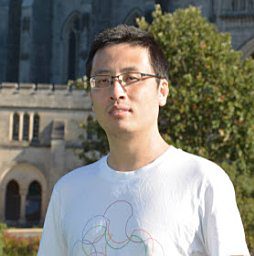
<node id="686158">
  <nid>686158</nid>
  <type>event</type>
  <uid>
    <user id="36625"><![CDATA[36625]]></user>
  </uid>
  <created>1762214296</created>
  <changed>1762214719</changed>
  <title><![CDATA[CMP/AMO Seminar - Dr. Yahui Zhang, Johns Hopkins University - RVB theory of superconductivity in magic angle twisted bilayer graphene]]></title>
  <body><![CDATA[<p><strong>Speaker:</strong> Dr. Yahui &nbsp;Zhang - Johns Hopkins University</p><p><strong>Title:</strong> RVB theory of superconductivity in magic angle twisted bilayer graphene</p><p><strong>Abstract:</strong> TBG superconductor remains mysterious after 7 years. &nbsp;In the first March meeting talk by Pablo, the physics was proposed to be similar &nbsp;to doped Mott insulator in high Tc cuprates. &nbsp;However, theoretical efforts were largely distracted to the topological aspects and symmetry breaking orders based on momentum space Hartree Fock in the last a few years. &nbsp; Only recently the relevance of Mott physics has been finally recognized. &nbsp; In this talk, I will return to the most obvious theory of superconductor based on doping a n=2 Mott insualtor. &nbsp; We use the so-called topological heavy fermion model with f orbital on AA site and itinerant c bands. However, the physics is essentially captured in a f-orbital-only Hubbard model on triangular lattice, so band topology &nbsp;and the c band does not play any significant role other than renormalizing the dispersion. &nbsp; &nbsp; In our theory, there is already preformed pairing of the two localized electrons in the parent n=2 Mott insualtor, which is from &nbsp;an on-site spin interaction mediated by optical phonon. &nbsp; &nbsp;Then at doping n=2-x, we find an unconventional metallic state with small hole pockets (A_{FS}=-x/4) &nbsp;on top of these paired singlets. &nbsp; At lower temperature, a slave boson condenses, and &nbsp;the local pairing of neutral moments (or spinons) induce a secondary &nbsp;pairing for the mobile carriers and opens a smaller superconducting gap on the small Fermi surface. &nbsp; The supercnoductor naturally has two gaps: &nbsp;a pseudogap from pairing of spinons, and a smaller superconductor gap. &nbsp; Above Tc, superconductor gap is killed, but the pseudogap persists. &nbsp; This theory provides, to our knowledge, the first unified explanation of the experimental observation of the pseudogap and two-gap superconductor in TBG.</p><p><strong><img src="https://krieger.jhu.edu/physics/wp-content/uploads/sites/11/2021/12/citations.jpg" alt="Yahui Zhang"></strong></p><p><strong>Short &nbsp;Bio:</strong> Yahui Zhang is an assistant professor at Johns Hopkins University. He got his PhD from MIT in 2019, mentored by T. Senthil. &nbsp;He did his postdoc with Ashvin Vishwanath and Subir Sachdev at Harvard. &nbsp;He is working on theory of strongly correlated electron systems, including morie system, cuprate, bilayer nickelate.</p>]]></body>
  <field_summary_sentence>
    <item>
      <value><![CDATA[Dr. Yahui Zhang, JHU - RVB theory of superconductivity in magic angle twisted bilayer graphene]]></value>
    </item>
  </field_summary_sentence>
  <field_summary>
    <item>
      <value><![CDATA[<p>TBG superconductor remains mysterious after 7 years. &nbsp;In the first March meeting talk by Pablo, the physics was proposed to be similar &nbsp;to doped Mott insulator in high Tc cuprates. &nbsp;However, theoretical efforts were largely distracted to the topological aspects and symmetry breaking orders based on momentum space Hartree Fock in the last a few years. &nbsp; Only recently the relevance of Mott physics has been finally recognized. &nbsp; In this talk, I will return to the most obvious theory of superconductor based on doping a n=2 Mott insualtor. &nbsp; We use the so-called topological heavy fermion model with f orbital on AA site and itinerant c bands. However, the physics is essentially captured in a f-orbital-only Hubbard model on triangular lattice, so band topology &nbsp;and the c band does not play any significant role other than renormalizing the dispersion. &nbsp; &nbsp; In our theory, there is already preformed pairing of the two localized electrons in the parent n=2 Mott insualtor, which is from &nbsp;an on-site spin interaction mediated by optical phonon. &nbsp; &nbsp;Then at doping n=2-x, we find an unconventional metallic state with small hole pockets (A_{FS}=-x/4) &nbsp;on top of these paired singlets. &nbsp; At lower temperature, a slave boson condenses, and &nbsp;the local pairing of neutral moments (or spinons) induce a secondary &nbsp;pairing for the mobile carriers and opens a smaller superconducting gap on the small Fermi surface. &nbsp; The supercnoductor naturally has two gaps: &nbsp;a pseudogap from pairing of spinons, and a smaller superconductor gap. &nbsp; Above Tc, superconductor gap is killed, but the pseudogap persists. &nbsp; This theory provides, to our knowledge, the first unified explanation of the experimental observation of the pseudogap and two-gap superconductor in TBG.</p>]]></value>
    </item>
  </field_summary>
  <field_time>
    <item>
      <value><![CDATA[2025-11-19T14:00:00-05:00]]></value>
      <value2><![CDATA[2025-11-19T15:00:00-05:00]]></value2>
      <rrule><![CDATA[]]></rrule>
      <timezone><![CDATA[America/New_York]]></timezone>
    </item>
  </field_time>
  <field_fee>
    <item>
      <value><![CDATA[]]></value>
    </item>
  </field_fee>
  <field_extras>
      </field_extras>
  <field_audience>
          <item>
        <value><![CDATA[Faculty/Staff]]></value>
      </item>
          <item>
        <value><![CDATA[Postdoc]]></value>
      </item>
          <item>
        <value><![CDATA[Graduate students]]></value>
      </item>
          <item>
        <value><![CDATA[Undergraduate students]]></value>
      </item>
      </field_audience>
  <field_media>
          <item>
        <nid>
          <node id="678524">
            <nid>678524</nid>
            <type>image</type>
            <title><![CDATA[Dr. Yahui Zhang]]></title>
            <body><![CDATA[]]></body>
                          <field_image>
                <item>
                  <fid>262573</fid>
                  <filename><![CDATA[Dr.-Yahui-Zhang.jpg]]></filename>
                  <filepath><![CDATA[/sites/default/files/2025/11/03/Dr.-Yahui-Zhang.jpg]]></filepath>
                  <file_full_path><![CDATA[http://hg.gatech.edu//sites/default/files/2025/11/03/Dr.-Yahui-Zhang.jpg]]></file_full_path>
                  <filemime>image/jpeg</filemime>
                  <image_740><![CDATA[]]></image_740>
                  <image_alt><![CDATA[Dr. Yahui Zhang]]></image_alt>
                </item>
              </field_image>
            
                      </node>
        </nid>
      </item>
      </field_media>
  <field_contact>
    <item>
      <value><![CDATA[]]></value>
    </item>
  </field_contact>
  <field_location>
    <item>
      <value><![CDATA[Howey Building - Room N110]]></value>
    </item>
  </field_location>
  <field_sidebar>
    <item>
      <value><![CDATA[]]></value>
    </item>
  </field_sidebar>
  <field_phone>
    <item>
      <value><![CDATA[]]></value>
    </item>
  </field_phone>
  <field_url>
    <item>
      <url><![CDATA[]]></url>
      <title><![CDATA[]]></title>
            <attributes><![CDATA[]]></attributes>
    </item>
  </field_url>
  <field_email>
    <item>
      <email><![CDATA[]]></email>
    </item>
  </field_email>
  <field_boilerplate>
    <item>
      <nid><![CDATA[]]></nid>
    </item>
  </field_boilerplate>
  <links_related>
      </links_related>
  <files>
      </files>
  <og_groups>
          <item>126011</item>
      </og_groups>
  <og_groups_both>
          <item><![CDATA[School of Physics]]></item>
      </og_groups_both>
  <field_categories>
          <item>
        <tid>1789</tid>
        <value><![CDATA[Conference/Symposium]]></value>
      </item>
          <item>
        <tid>1795</tid>
        <value><![CDATA[Seminar/Lecture/Colloquium]]></value>
      </item>
      </field_categories>
  <field_keywords>
      </field_keywords>
  <field_userdata><![CDATA[]]></field_userdata>
</node>
