Researchers at Georgia Tech's Center for Advanced Communications Policy will use the funding to help older adults access assistive technologies that support independent living.
Principal research scientist Nathan Moon and a team of colleagues at the Center for Advanced Communications Policy (CACP) in Georgia Tech’s Ivan Allen College of Liberal Arts were awarded a three-year, $1.5 million grant from the National Institute on Disability, Independent Living, and Rehabilitation Research. The project is in collaboration with the Center for Inclusive Design and Innovation (CIDI) in the College of Design.
The funding will support the ACCESS for Aging Well with Assistive Technology (AT) 2.0 project, which builds on the researchers’ previous work to help older adults live independently.
“As Americans continue to age and we're growing older as a society, we want to ensure that people can continue to live independently and participate in the communities of their choice,” Moon said. “The tools that we have developed here are intended to do that.”
According to AARP, 75% of adults over 50 want to age in their homes. However, Retirement Living reports only 10% of homes are appropriately equipped to do so. Assistive technologies can help older adults live independently longer, but finding the right solutions and learning how to access them can be difficult.
ACCESS for Aging Well with AT 2.0 addresses those challenges by using machine learning, predictive analytics, and community partnerships to connect people with the tools and resources they need.
The researchers will use the funding to integrate the existing ACCESS for Aging Well website and assistive technology catalog into a single platform that provides assessments, recommendations, and solutions for older adults via machine learning, predictive analytics, expert insight, and state assistive technology program data.
It will foster an active community through online discussion forums, social media, product reviews, and informational articles. The team will also analyze community discussions with AI-based tools to refine recommendations and identify new or innovative ways people may be using assistive technology.
Finally, the funding will help the researchers connect with organizations such as senior centers, rehabilitation centers, and state aging agencies to expand access to assistive technologies and meet older Americans where they are.
The project also supports a significant return on investment.
“For every $1 spent on assistive technology, people save $9,” Moon said. “Assisted living is terribly expensive. We will never replace assisted living or nursing homes, but we do want to give people the choice to age successfully in their communities of choice.”
Using technology to improve lives is a central mission of the Ivan Allen College and Georgia Tech, and researchers at CACP and CIDI collaborate across disciplines to do just that.
“We're using AI and harnessing the cutting edge of technology to make better recommendations based on what we know, but it’s not just technology for technology’s sake. We put the people first and technology follows. It's there to be a support.”
Charles Woods, a privacy rhetoric expert in Georgia Tech's School of Literature, Media, and Communication at the Ivan Allen College of Liberal Arts, shares four major concerns.
Designed for industry professionals, policymakers, educators, students, community leaders, and members of the public, the lunchtime webinar series provided an accessible introduction to the key issues influencing the nuclear energy sector at a time of growing interest in nuclear power as part of the global energy transition.
The series began on Aug. 20 with The New Nuclear, presented by Steven Biegalski, chair of the Nuclear and Radiological Engineering and Medical Physics program. The session examined the evolution of nuclear reactor technology, from today's operating fleet and the AP1000 reactors at Plant Vogtle to emerging small modular reactors and advanced reactor designs.
The second webinar, held Sept. 3, focused on the economics and policy landscape of nuclear power. Laura Taylor, director of EPIcenter and professor of economics at Georgia Tech, joined Stephen Comello, executive vice president and executive director of the Nuclear Scaling Initiative at the EFI Foundation, to discuss the economic drivers, policy considerations, and opportunities influencing nuclear energy development in the United States.
The series concluded on Sept. 17 with a discussion of nuclear fuel, security, and geopolitics. Anna Erickson, Woodruff Professor of Nuclear Engineering, and Rachel Whitlark, associate professor in the Sam Nunn School of International Affairs, explored global nuclear energy growth, fuel supply chains, and the policies needed to support the safe, secure deployment of nuclear technologies worldwide.
Recordings and presentation materials from all three sessions are available on the webinar series webpage. Those who were unable to attend can watch the presentations and access the accompanying slides to learn more about the technologies, policies, and global trends shaping the future of nuclear energy.
View webinar recordings and presentation slides on the EPIcenter website.
]]>
The study is timely, arriving amid widespread public discontent over rising fuel prices, with voter frustrations reflected in a series of national polls blaming the Trump administration.
Although the researchers do not determine how much of the price differences across administrations, if any, are caused by presidents themselves, they argue economists may have been too confident in dismissing the possibility without much direct evidence.
“If economists really think that the president doesn't have influence, the burden of proof is on economists to explain that these differences can't be interpreted as the result of each president's actions," Brewer said.
]]>Since its launch in 2025, SRI has brought together researchers from across campus to advance interdisciplinary space initiatives and create new opportunities for collaboration. In their new roles, Ballantyne and Borowitz will help guide the institute's growth by strengthening both internal research connections and external partnerships across the broader space community.
“David and Mariel bring complementary strengths that will be invaluable as we continue building SRI,” said Jud Ready, executive director of SRI. “David has a deep understanding of the research enterprise at Georgia Tech and a passion for connecting people and ideas across disciplines. Mariel brings extensive experience working across government, industry, and the international space community. Together, they will help us strengthen Georgia Tech's space ecosystem and expand our impact far beyond campus.”
Since joining the Institute in 2008 as a founding faculty member of the Center for Relativistic Astrophysics, Ballantyne has helped advance both space science and academic leadership across campus.
A professor in the School of Physics, he studies the evolution of galaxies and their central black holes, as well as the physics of accretion disks around black holes and neutron stars. He has authored more than 140 peer-reviewed publications and served as associate chair of the School of Physics for nearly a decade.
As associate director, Ballantyne will focus on cultivating connections across Georgia Tech's space research community and identifying opportunities for new interdisciplinary collaborations.
“I view SRI as a catalyst — a mechanism to spark new and transformative areas of space research at Georgia Tech that will grow to national and international prominence,” Ballantyne said. “There is so much innovative space research happening across campus, and one of SRI's most important roles is helping researchers find the connections and collaborations that can spark new ideas and discoveries.”
Ballantyne says he is particularly interested in helping position Georgia Tech as a leader in understanding the opportunities and challenges presented by artificial intelligence in space systems.
“My goal is to be out in the community, learning about the breadth of space research happening across campus and identifying ways SRI can accelerate that work,” he said. “AI technologies are poised to transform space exploration, scientific discovery, national security, and commercial space operations. SRI is uniquely positioned to help Georgia Tech lead those conversations.”
As space activities become increasingly interconnected across government, industry, and academia, strong partnerships are essential to translating research into real-world impact. That collaborative spirit is central to the work of Mariel Borowitz, an associate professor in the Sam Nunn School of International Affairs.
Borowitz, who also serves as director of Georgia Tech’s Center for Space Policy and International Relations, is widely recognized for her expertise in space policy, international cooperation, and the governance of emerging space activities. Her work has connected her with space agencies, private companies, and policymakers around the world, providing a valuable perspective on opportunities for Georgia Tech to expand its engagement with the broader space community.
In her role as associate director, Borowitz will focus on growing SRI's partnerships with industry, government, and the broader space community.
“My focus as associate director will be on building partnerships between Georgia Tech and the broader space community,” Borowitz said. “Georgia Tech has tremendous expertise across science, engineering, policy, economics, and international affairs. By working across those disciplines, we can help address the complex challenges facing the future of space development while creating new opportunities for collaboration and impact.”
Borowitz sees SRI as a powerful mechanism for connecting Georgia Tech's diverse strengths and amplifying their collective impact.
“Real-world challenges and opportunities are inherently interdisciplinary,” she said. “The Space Research Institute allows us to bring together expertise from across Georgia Tech to develop more complete solutions and create new possibilities for the future of space.”
Together, Ballantyne and Borowitz will help advance SRI's mission of connecting researchers, educators, students, industry leaders, and policymakers to address the most pressing opportunities and challenges in space.
“Space exploration has always challenged us to think bigger, work across boundaries, and pursue questions that no single discipline can answer alone,” said Ready, who also serves as a principal research engineer at the Georgia Tech Research Institute. “David and Mariel embody that spirit of collaboration, and their leadership will help us create new opportunities for discovery, innovation, and impact at Georgia Tech and beyond.”
Ahmadi and Brown find that neighborhoods with higher shares of Black residents experience higher energy burdens, even after accounting for factors such as income, renter status, and housing characteristics. In this study, energy burden refers mainly to the share of household income spent on electricity, gas, and water. The authors estimate that an approximately 11 percentage-point increase in a neighborhood’s Black population share is associated with about a 1 percentage-point increase in household energy burden, equal to an average annual increase of about $785 in utility costs. These findings suggest that unequal energy burdens are tied not only to household finances, but also to the lasting effects of segregation and discrimination.
Read Full Story on the EPIcenter Page
]]>When Chevron reported its highest quarterly profit in six years on July 31, 2026, it was just one detail in a larger picture: Analyst firm Wood Mackenzie estimates the global oil and gas industry is on course for a cash windfall of US$495 billion in 2026. That’s profit above and beyond what the industry expected before the U.S.-Israel war with Iran began.
Three separate bills seeking to tax those profits are now in Congress, and President Donald Trump has even said the oil companies are “making too much money.”
As an applied microeconomist, I am often asked how taxes affect economic activity. Economists have long held a more nuanced view of windfall taxes than either side of the current debate suggests. Advocates often make overly optimistic revenue projections, and opponents often overstate how much such a tax might discourage investment. A 1980s U.S. windfall-tax experiment is instructive on both counts.
Read Full Story on The Conversation
]]>Three separate bills seeking to tax those profits are now in Congress, and President Donald Trump has even said the oil companies are “making too much money.”
As an applied microeconomist, I am often asked how taxes affect economic activity. Economists have long held a more nuanced view of windfall taxes than either side of the current debate suggests. Advocates often make overly optimistic revenue projections, and opponents often overstate how much such a tax might discourage investment. A 1980s U.S. windfall-tax experiment is instructive on both counts.
]]>But recent research from Georgia Tech’s School of Economics in the Ivan Allen College of Liberal Arts suggests adding an asterisk to earlier research that makes that conclusion, saying previous studies failed to account for one simple fact: people adapt.
Georgia Tech economist Bobby Harris used a massive database of Fitbit step count data to measure how temperature shapes physical activity and found that extreme heat cuts step counts by 6% when compared to ideal weather. And while residents of the warmest regions cut their activity by an average of only 354 steps on days over 100 degrees, those living in the coldest regions cut theirs by 1,081, according to Harris’ analysis.
To be fair, cold bites, too. On days that stay below freezing, people take roughly 1,000 fewer steps. That’s a 12% drop, enough to pack on a pound over the course of a typical Madison, Wisconsin winter, Harris found.
But as the climate grows warmer, how humanity will respond to warmer temperatures remains a significant concern. In fact, earlier research projected that, by 2050, temperature-driven declines in physical activity could contribute to 500,000 premature deaths a year worldwide and annual productivity losses topping $2.4 billion.
Projections like those typically assume everyone responds to heat the same way, with no capacity to adapt, Harris said.
Read Full Story on the IAC News Page
Meta, the parent company of Facebook and Instagram, will pay $17.1 billion and implement new protections to reduce the harmful effects of social media on young people, settling a lawsuit alleging that the social media giant violated consumer protection laws and targeted teenagers through its addictive features.
The resolution to the 2023 lawsuit imposes daily time limits on platform use for users under 18, silences notifications during school hours, restricts image filters, and adds safety measures, including removing users under 13 and stricter enforcement of teenager-specific settings for users under 18, among other measures.
The settlement has been celebrated by the 47 attorneys general of the represented states as a transformative moment in the oversight of social media. While she believes it is a step in the right direction, Munmun De Choudhury, a professor in Georgia Tech’s School of Interactive Computing, says the work cannot stop with the changes proposed in the settlement.
De Choudhury’s research has pioneered the computational use of social media data for mental health. In 2023, she co-authored a consensus report for the National Academies of Sciences, Engineering, and Medicine on the connection between social media and adolescent health. Several of the recommendations in the report are reflected in the Meta settlement, but De Choudhury sees areas that still need to be addressed at the root of social media’s effects on mental health.
“I think it's a reasonable start. It was necessary, but if you look at the research literature, whether restricting screen time actually improves mental health is not a settled question,” she said. “We need to look at the context, which means not just how much time they're spending on these platforms but also how they're spending that time.”
The $17 billion will be distributed among the states and territories involved in the lawsuit, and, according to De Choudhury, the funds will be a critical part of the settlement achieving its intended outcomes.
“The grassroots portion of this is asking: How do we empower young people and their families with information so that they can make the right decisions for themselves? This money can be used to provide social media literacy efforts and to train parents and teachers to better guide kids. We often hear that adults want to help, but parents and teachers didn’t grow up in the social media era, and given how fast it changes, they don’t always have the right answers,” she said.
Certain portions of the settlement, such as financial penalties and exact time restrictions, are contingent upon Meta’s competitors, TikTok and YouTube, adopting similar measures. De Choudhury says research shows that when one platform becomes more restrictive, users will migrate to another.
“The kids who want to access social media between midnight and 6 a.m., when these platforms won't be available, will go to TikTok or they'll go somewhere else,” she said. “This means that what we end up doing is not mitigating the harm but shifting it elsewhere. And that doesn't help anyone. So, this is welcome if it means the scope of this implementation can be broadened, and it would go a long way.”
De Choudhury implores regulators to consider additional measures to protect children in the future, particularly those that safeguard their data in the age of artificial intelligence.
“All of our data is getting used to train these AI models. This is especially true for a company like Meta, which has its own AI models. We are talking about minors. They can't meaningfully consent to the use of their data to build AI models. So we need to expand the scope of harm here, which is not just the mental health harm that can happen but the impacts of these companies storing and using children’s data,” she said.
A federal “right to be forgotten” that allows individuals to request deletion of their data from social media sites and other online profiles is a step De Choudhury recommends, mirroring the European Union’s policy.
Adults aren’t immune to the dangers of social media, De Choudhury explained, but teenagers are more susceptible to triggers based on their stage of brain development. She hopes the recent settlement sets a precedent for active oversight.
“We have seen lawsuits in the past where specific school systems sued a social media company. We have seen some individual states taking action as well, but the scale of this settlement is something we haven't seen before,” she said.
The changes to the platforms will take effect over the next 12 months, but should Meta fail to do so, Jerry Liu, lecturer in the Scheller College of Business and teacher of legal and ethical aspects of business, says states would not need to relitigate the case, in which Meta did not admit wrongdoing. Rather, they could ask the court to seek enforcement with contempt remedies, like additional financial penalties or sanctions.
The Meta case has drawn comparisons to lawsuits against big tobacco in the 1990s. Liu says both cases invoke similar questions surrounding legality and ethics in business.
“There is a broader, ethical issue with this case, which is drawing the line between making an engaging product versus deliberately designing the product around human vulnerabilities to make a product addictive, particularly for children, and concealing harmful consequences,” he said.
“With big tobacco, the problem wasn't simply that cigarettes were addictive. It was the allegation that the industry knew about the addictive nature of cigarettes, manipulated nicotine levels, and concealed or minimized that knowledge. Similarly, as with Meta and social media, the question is whether the social media companies know that particular design features or algorithmic tools can create unhealthy or compulsive behavior, particularly in children, and whether they have an ethical obligation to disclose that knowledge and redesign the product accordingly.”
The Federal Trade Commission and the Department of Justice retain federal enforcement authority in this case, but Liu said that individuals (including class-action suits) can potentially pursue separate state-law or other claims against Meta.
The Air Quality Index (AQI) measures how clean or polluted the air is. A healthy AQI is between zero and 50, but when wildfire smoke blows in and settles over cities, the AQI can reach levels of 500 or more. Poor air quality changes where and how people spend their time and money, reduces productivity (even for those working indoors), and increases healthcare costs.
“Environmental regulations like the Clean Air Act dramatically improved our air quality over the past 40 years, but as wildfire season becomes the new normal, wildfire smoke is eroding those gains,” Wichman said. According to recent research, wildfire smoke has erased about a quarter of the progress made over previous decades, and more than half in many western states.
Read Full Story on the IAC News Page
]]>The Air Quality Index (AQI) measures how clean or polluted the air is. A healthy AQI is between zero and 50, but when wildfire smoke blows in and settles over cities, the AQI can reach levels of 500 or more. Poor air quality changes where and how people spend their time and money, reduces productivity (even for those working indoors), and increases healthcare costs.
“Environmental regulations like the Clean Air Act dramatically improved our air quality over the past 40 years, but as wildfire season becomes the new normal, wildfire smoke is eroding those gains,” Wichman said. According to recent research, wildfire smoke has erased about a quarter of the progress made over previous decades, and more than half in many western states.
]]>For researchers in Georgia Tech's Cyber-Physical Security (CPSec) Lab, however, the vulnerabilities behind many of these incidents are far from new.
Associate Professor Saman Zonouz leads the CPSec Lab and has studied programmable logic controllers (PLCs) for years. These devices automate critical infrastructure, including water treatment facilities, power grids, manufacturing plants, and transportation systems. The lab’s work has revealed widespread internet exposure and software vulnerabilities that leave many industrial control systems vulnerable to cyberattacks.
"Out of the 16 critical infrastructure sectors defined by the Cybersecurity and Infrastructure Security Agency, four are considered lifelines," Zonouz said. "Of those four, communications, energy, transportation, and water, the water sector is the most vulnerable, which is why it is so often targeted."
PLCs serve as the brains of industrial operations, monitoring sensors and controlling equipment that keep essential services operational.
"Imagine you have a thermostat that controls the temperature of your house. That is a type of controller," Zonouz explained. "The professional version does the same thing in industry."
When these controllers are directly accessible from the internet, attackers can exploit them to disrupt operations, manipulate industrial processes, or interfere with the systems that deliver essential services. Controllers may be intentionally exposed to allow operators to monitor equipment remotely. They can also be unintentionally accessible online because of configuration errors.
However, internet exposure is only part of the problem.
The CPSec Lab maintains a collection of PLCs that researchers reverse engineer to better understand their firmware, communication protocols, and security weaknesses. Their research has found that many controllers contain vulnerabilities that attackers can exploit once they gain access.
"Not only can the attackers see the house they want to rob, but the doors are also left unlocked," Zonouz said.
In 2024, Zonouz and his collaborators presented PLCHound at the ACM Conference on Computer and Communications Security (CCS), introducing an automated system that identifies internet-connected PLCs hidden within massive internet-scale datasets collected by services such as Shodan and Censys. The work was led by Ph.D. student Ryan Pickren. Provost and Executive Vice President for Academic Affairs Raheem Beyah, Assistant Professor Frank Li, and Research Scientist Animesh Chhotaray are co-authors of the study.
Rather than relying on traditional scanning techniques, PLCHound identifies subtle network signatures that reveal industrial devices that prior methods often missed. Using the system, the researchers conducted one of the largest studies of publicly reachable PLCs from major manufacturers.
Their findings showed that previous estimates undercounted the number of internet-accessible industrial controllers by as much as 37 times. Even more concerning, nearly 96% of the identified devices exposed protocols linked to recently disclosed critical vulnerabilities.
The researchers did more than document the problem. After identifying exposed devices, the team launched a large-scale notification campaign, contacting more than 7,000 industrial operators to alert them that their systems appeared vulnerable. The effort enabled many organizations to investigate and address security issues before they could be exploited.
The recent attacks on municipal water systems reinforce concerns researchers have raised for years: many critical infrastructure operators continue to rely on operational technology designed primarily for reliability and performance rather than for cybersecurity.
Improving those defenses, Zonouz said, will require more than simply patching individual vulnerabilities.
The researchers cite the energy sector as a model. Compared with other critical infrastructure sectors, electric utilities generally operate under more mature cybersecurity requirements and undergo routine compliance audits, providing organizations with greater visibility into the devices connected to their networks and the risks they pose.
Implementing those improvements will not be easy. Many municipal water utilities operate with limited budgets and aging infrastructure, leaving little funding available for cybersecurity investments. As attacks on critical infrastructure become more frequent, the researchers argue that gaining visibility into operational technology assets and strengthening oversight are essential first steps to protect the systems communities rely on every day.
The CPSec Lab is a collaborative laboratory within the School of Cybersecurity and Privacy as well as the School of Electrical and Computer Engineering.
]]>For researchers in Georgia Tech's Cyber-Physical Security (CPSec) Lab, however, the vulnerabilities behind many of these incidents are far from new.
]]>Communications Officer II at the School of Cybersecurity and Privacy
]]>It’s a role she knows well.
For more than 11 years, Stoinski has served as president, CEO, and chief scientific officer of the Dian Fossey Gorilla Fund, leading efforts to help the world better understand and protect Rwanda’s mountain gorillas — a species with only about 1,000 left in the wild.
Although she now oversees a multimillion-dollar budget and 400 employees worldwide, she never planned to be a CEO.
“I’m a scientist at my core,” says Stoinski. “Day to day, I function more as a leader and executive, but I still think of myself as a scientist first.”
Her job covers a wide range of responsibilities, including fundraising, public speaking, budgeting, and strategy. One week, she might find herself observing gorilla behavior in Rwanda; the next, she’s back in the U.S., discussing conservation on the popular Armchair Expert podcast.
“I love my job,” she says. “It doesn’t feel like work; it’s a passion.”
One of the reasons Stoinski chose Georgia Tech for her Ph.D. was its connection to Zoo Atlanta.
Her doctoral advisor, the late Terry Maple, emeritus professor in the School of Psychological and Brain Sciences, served as director of Zoo Atlanta, giving students rare access to conservation-focused research.
“The zoo was our lab. I studied elephants, lemurs, gorillas, and golden lion tamarins, both in the zoo and in the wild in Brazil and Africa,” says Stoinski.
She appreciates how Georgia Tech prepared her for the challenges of her career.
“The rigor of a Georgia Tech education is something you need as a scientist,” she says. “I also had the opportunity to do a lot of public speaking and teaching, which are huge parts of my job now.”
After earning her Ph.D., Stoinski spent 14 years with Zoo Atlanta while also working with the Atlanta-based Dian Fossey Gorilla Fund. She became CEO in 2014 and now oversees conservation and research programs in Rwanda and the Democratic Republic of the Congo.
Under her leadership, the Fossey Fund has expanded its footprint, including opening its Ellen DeGeneres Campus in 2022, a 12-acre research and education center in Rwanda.
The site includes labs, classrooms, and a restored landscape, where roughly 250,000 plants from 110 species have been planted to reestablish native ecosystems.
“We host hundreds of students — including groups from Georgia Tech, and support dozens of graduate and postdoctoral researchers, from countries all over the world including many from Africa,” she explains. “Seeing their excitement and commitment gives me lots of hope for the future.”
A Gorilla Story follows the Pablo family of mountain gorillas living on the slopes of Volcanoes National Park in northwestern Rwanda.
“The Pablo group goes back to Dian Fossey’s time,” explains Stoinski. “It’s the largest group of gorillas ever recorded, at one point reaching 65 individuals. An average gorilla family is about 10.”
Due to Rwandan regulations, filming could take place for just one hour each day. Filmmakers and scientists would often have to hike for five to six hours to reach the gorillas.
Because Dian Fossey Gorilla Fund researchers have followed these gorilla families for decades, they were already familiar with the individual gorillas, including six generations of family history, which “makes the story incredibly rich,” says Stoinski.
“You see grief, relationships, alliances — all of it,” she says. “Ultimately, I hope that connection leads people to care and to take action.”
Stoinski’s career is all about taking action — and inspiring others to do the same.
“We need people on the ground doing this work, but we also need people outside of our field to support and be aware of what’s happening to gorillas and the planet’s biodiversity,” she says.
She encourages Tech students to stay informed:
“Even if you’re not going into conservation, take a class, listen, learn,” she says. “Unfortunately, there are real challenges facing the next generation.”
She frequently points out that by helping gorillas, we’re saving ourselves, sharing that gorillas live in the Congo Basin, one of the most important ecosystems on Earth. By dispersing seeds and maintaining forest structure, they help sustain environments critical for climate stability and planetary health.
“Protecting gorillas means protecting those ecosystems, which ultimately support human survival.”
Stoinski maintains strong ties to Georgia Tech through research collaborations and student engagement. Projects over the years have included helping to establish the Center for Geographic Information Systems and Remote Sensing at the University of Rwanda, geospatial mapping, and architectural design and planning.
She invites alumni and students to engage with the work firsthand.
“I encourage more Georgia Tech alumni and students to work with us or come see us. And if you want to meet with a Georgia Tech grad, I lead tours: we can put on our Tech gear and take a photo with the gorillas!”
]]>
Housing and transportation are top priorities for many city mayors, policymakers and public policy researchers—including Brian An, an assistant professor at Georgia Tech’s Jimmy and Rosalynn Carter School of Public Policy. But in February 2021, soon after Winter Storm Uri wreaked havoc in Texas, an eight-hour power outage at his Atlanta home became an epiphany.
“While housing stability had long been on my mind, losing power drove home the importance of another piece of urban infrastructure: reliable access to electricity,” says An, an EPIcenter faculty affiliate and co-director of the Center for Urban Research. “It sparked my interest in studying the intersection of energy and urban policy to help make cities and communities not only socially equitable but also resilient to extreme weather.”
Read Full Story on the EPIcenter News Page
]]>Housing and transportation are top priorities for many city mayors, policymakers and public policy researchers—including Brian An, an assistant professor at Georgia Tech’s Jimmy and Rosalynn Carter School of Public Policy. But in February 2021, soon after Winter Storm Uri wreaked havoc in Texas, an eight-hour power outage at his Atlanta home became an epiphany.
“While housing stability had long been on my mind, losing power drove home the importance of another piece of urban infrastructure: reliable access to electricity,” says An, an EPIcenter faculty affiliate and co-director of the Center for Urban Research. “It sparked my interest in studying the intersection of energy and urban policy to help make cities and communities not only socially equitable but also resilient to extreme weather.”
]]>News Contact: Priya Devarajan, Research Communications Program Manager
]]>“Dingjing’s selection for this honor is a remarkable recognition of the originality, impact, and promise of her scholarship,” says School of Psychological and Brain Sciences Chair Tansu Celikel. “This achievement is especially significant for Georgia Tech as she is the first person from the Institute to receive this distinction and only the third recipient from the state of Georgia.”
Shi obtained her Ph.D. in Quantitative Psychology from the University of Virginia in 2020. After working as an assistant professor at the University of Oklahoma, she joined Georgia Tech in 2025.
“Receiving this award is an honor and a responsibility,” says Shi. “This international recognition of my early work encourages me to keep pushing the scientific boundaries of my field and to continue pursuing research that creates meaningful and lasting real-world impacts.”
As a quantitative methodologist, Shi develops statistical and computational models that focus on reducing dimensionality (the number of attributes, features, or independent directions needed to describe an object, dataset, or mathematical space); improving classification; and enabling technology-based, real-time adaptive assessment in psychological, brain, biomedical, and health-related research. Specifically, her research transforms complex brain imaging outputs (such as MRIs and EEGs), real-time ecological assessments, and multi-sensor wearable streams into compact, information-rich representations, and she designs personalized, adaptive intervention systems to deliver context-aware and dynamically updated support for individuals.
Shi’s work has been funded by federal agencies such as the National Science Foundation, the National Institutes of Health, the Federal Aviation Administration, and the Department of Homeland Security. She was a recipient of the SAS Institute Advanced Statistical Fellowship as well as the Citation Abstract Award from the Society of Behavioral Medicine.
“I’m excited to work at Georgia Tech in the School of Psychological and Brain Sciences because its strong focus on technology and psychological brain sciences aligns perfectly with my research program,” says Shi. “Being part of such a stimulating academic environment, with outstanding colleagues and talented students, makes it an ideal place to contribute, collaborate, and grow as a researcher and educator.”
]]>Communities across Georgia and the nation are navigating a range of economic and energy-related pressures. Gas prices, inflation, and the rapid growth of data centers are shaping the cost of goods and services, influencing everyday household financial decisions.
At the same time, ongoing geopolitical tensions are driving fluctuations in global oil markets and fuel prices. The expansion of AI data centers is also increasing demand for land, power, and water resources. And conflicts involving energy infrastructure in parts of the Middle East and Europe have affected supply stability.
Responding to these challenges requires careful analysis of emerging trends, supported by strong research in policy and economics. Faculty Affiliates of Georgia Tech’s Energy Policy and Innovation Center study these complex, interconnected issues affecting energy systems, costs, and access. They analyze emerging trends, evaluate policy options, and identify practical pathways forward.
Read Full Story on the EPIcenter News Page
]]>Communities across Georgia and the nation are navigating a range of economic and energy-related pressures. Gas prices, inflation, and the rapid growth of data centers are shaping the cost of goods and services, influencing everyday household financial decisions.
]]>FIFA President Gianni Infantino likened the scale of each game to that of a Super Bowl. The success of a tournament that large will rely heavily on technology, affecting everything from the players on the pitch, all the way to viewers at home.
On top of the state-of-the-art technology used at many large events, this World Cup will also see the debut of new technology. At the center of much of it will be electrical and computer engineering.
Experts from the Georgia Tech School of Electrical and Computer Engineering (ECE) weigh in on how the field is enabling the technology behind the world’s largest sporting event.
Read Full Story on the ECE News Page
]]>As an energy economist, I am often asked about what contributes to gas prices and what different policies can do to affect them.
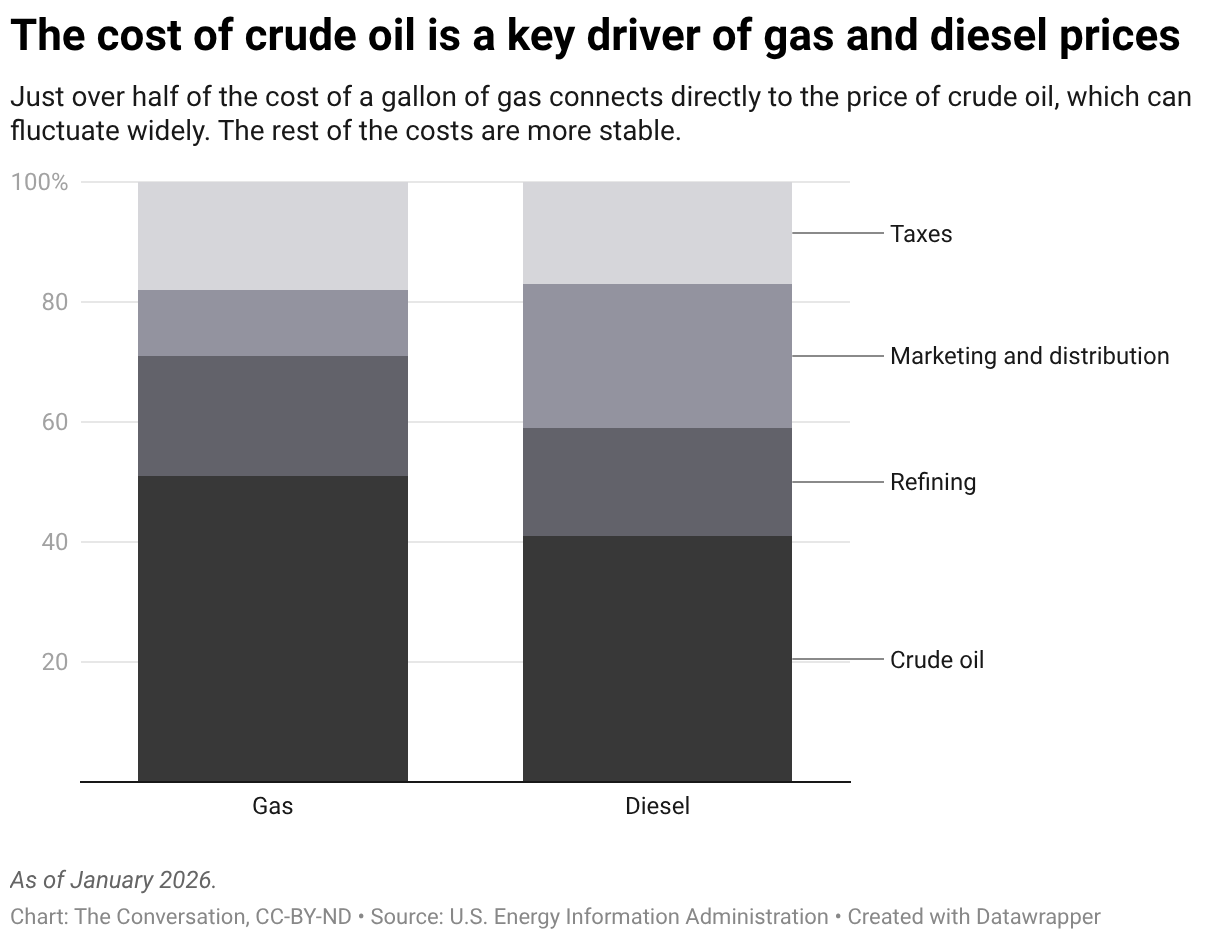
The price of a retail gallon of gas is the sum of four things: the cost of crude oil, refining, distribution and marketing, and taxes.
In nationwide figures from January 2026, crude oil accounted for about 51% of the pump price, refining roughly 20%, distribution and marketing about 11% and taxes about 18%. That mix shifts with conditions: When crude oil prices spike, that can drive more than 60% of the price; when the price drops, taxes and logistics are larger shares of the cost.
Because the price of crude oil is the largest element, most of the price at the pump is derived from the global oil market.
Usually, big swings in crude prices come mainly from shifts in global demand and expectations – not from supply disruptions, according to widely cited research in 2009 by the economist Lutz Kilian.
But what is happening in early 2026 with the war in Iran is one of the exceptions: a classic supply shock. Severe disruptions to shipping through the Strait of Hormuz and attacks on Middle East oil infrastructure have taken millions of barrels a day off the global market.
Most drivers generally can’t quickly reduce how much they drive or how much gas they use when prices rise, so gasoline demand doesn’t change much in the short run. That means a jump in crude costs tends to result in people paying more rather than driving less.
Refining turns crude into gasoline at industrial scale. The U.S. doesn’t have a single gasoline market, though. Roughly a quarter of U.S. gasoline is a cleaner-burning blend of petroleum-derived chemicals called “reformulated gasoline,” which is required in urban areas across 17 states and the District of Columbia to reduce smog.
California uses an even stricter formulation that few out-of-state refineries make. California is also geographically isolated: No pipelines bring gasoline in from other U.S. refining regions.
California’s gasoline prices have long run above the national average, explained in part by higher state taxes and stricter environmental rules. But since a refinery fire in Torrance, California, in 2015 reduced production capacity, the state’s prices have been about 20 to 30 cents a gallon higher than what those factors would indicate.
Energy economist and University of California, Berkeley, professor Severin Borenstein has called this the “mystery gasoline surcharge” and attributes it to the fact that there isn’t as much competition between refineries or gas stations in California as in other states. California’s own Division of Petroleum Market Oversight says the surcharge cost the state’s drivers about $59 billion from 2015 to 2024. It’s not exactly clear who is getting that money, but it could be gas stations themselves or refineries, through complex contracts with gas stations.
The distribution and marketing category covers the costs of everything involved in getting the gasoline from the refinery gate to your tank.
Gasoline moves by pipeline, ship, rail and truck to wholesale terminals, and then by local delivery truck to service stations.
At the retailer’s end, the key factors are station rent and labor, the cost to buy gasoline in bulk to be able to sell it, credit card fees of as much as 6 to 10 cents a gallon at current prices, and franchise fees paid to the national brand, such as Sunoco or ExxonMobil, for permission to put their branding on the gas station.
Most gas station operators net only a few cents per gallon on fuel itself – which is why many gas stations are really convenience stores with pumps out front. Borenstein and some of his collaborators have also documented that retail gas prices rise quickly when wholesale costs climb but fall slowly when wholesale costs drop.
The federal government charges a tax on fuel, of 18.4 cents a gallon for gasoline and 24.3 cents a gallon for diesel. States charge their own taxes, ranging from 70.9 cents a gallon for gas in California to 8.95 cents in Alaska.
When gas prices rise, many politicians start talking about temporarily suspending their state’s gas tax. That does reduce prices, but not as much as politicians – or consumers – might hope. Research on past gas tax holidays has found that consumers get about 79% of the reduction in gas taxes. That means oil companies and fuel retailers keep about one-fifth of the tax cut for themselves rather than passing that savings to the public.
Gas tax holidays also reduce funding for what the taxes are designed to pay for, typically roads and bridges. That pushes road and bridge upkeep costs onto future drivers and general taxpayers.
There is an additional problem, too: Taxes on gasoline are supposed to charge drivers for some of the costs their driving imposes on everyone else – carbon emissions, local air pollution, congestion and crashes. But Borenstein has found that U.S. fuel tax levels are already far below the true cost to society. Removing the tax on drivers effectively raises the costs for everyone else.
The 1920 Jones Act is a federal law that requires cargo moving between U.S. ports to travel on vessels built and registered in the U.S., owned by U.S. citizens, and crewed primarily by U.S. citizens and permanent residents. Of the world’s 7,500 oil tankers, only 54 meet this requirement. Only 43 of these can transport refined fuels such as gasoline.
So, despite significant refining capacity on the Gulf Coast, some U.S. gasoline is exported overseas even as the Northeast imports fuel, in part reflecting the relatively high cost of moving fuel between U.S. ports.
Economists Ryan Kellogg and Rich Sweeney estimate that the law raises East Coast gasoline prices by about a penny and a half per gallon on average, costing drivers roughly $770 million a year. In light of the war’s effect on gas prices, the Trump administration has temporarily suspended the Jones Act requirements – an action more commonly taken when hurricanes knock out Gulf Coast refineries and pipeline networks.
The result of all these factors is that the price that drivers see at the pump mostly reflects the global price of crude, plus a stack of domestic costs, only some of which are inefficient.
Tax holidays give a partial, short-lived rebate. Jones Act waivers trim pennies, though permanent repeal may cause more fundamental changes, such as reduced rail and truck transport of all goods, which could lower costs, emissions and infrastructure damage associated with cargo transportation. Harmonizing fuel blends across states and seasons may lower prices somewhat, but likely at the expense of increased emissions.
Ultimately, the best protection against oil price shocks is a more efficient gas-burning vehicle, or one that doesn’t burn gasoline at all. In the meantime, the best I can offer as an economist is clarity about what that $4.30 actually buys.
This article is republished from The Conversation under a Creative Commons license. Read the original article.
]]>Assistant Professor of Economics, Georgia Institute of Technology
Shelley Wunder-Smith
Director of Research Communications
Georgia Institute of Technology
With more than 150 attendees from industry, academia, and research organizations, the event’s high-level engagement underscored the urgency of critical issues facing the energy sector today, including the surging electricity demand, resiliency of the grid, and evolving supply chains, as well as the value of a dedicated space for candid, solutions-oriented dialogue.
“INTERSECT 2026 demonstrated the power of bringing together leaders who are actively shaping the future of energy,” said Laura Taylor, director of EPIcenter. “What began as a forum to explore emerging ideas has grown into a critical platform for aligning perspectives and advancing actionable solutions across the Southeast.”
This year’s program focused on real-world implementation challenges, including managing large-scale load growth and coordinating infrastructure investments to meet demand reliably and affordably. Panels featuring leaders from utilities, global energy corporations, and research organizations emphasized the importance of aligning strategy across sectors to ensure that the Southeast remains competitive and resilient.
Chris Womack, chairman, president, and CEO of Southern Company, delivered the keynote address, highlighting the unprecedented scale of current energy demands.
“Meeting this moment requires us to think differently — serving growth while ensuring reliability, resilience, and long-term value for our customers and communities,” said Womack.
Launched in 2017, the inaugural INTERSECT conference marked the launch of EPIcenter itself and established Georgia Tech’s commitment to connecting research, industry insight, and policy development. It focused on the need to bridge the gap between rapidly advancing technologies and slower-moving regulatory and market frameworks, a theme that continues to shape its mission today.
As INTERSECT 2026 concluded, participants pointed to a shared takeaway: With its industrial base, growing population, and integrated energy systems, the Southeast is uniquely positioned to lead in the next phase of the energy transition. With AI-driven power demand and grid infrastructure playing a significant role going forward, it is imperative to bring together the right voices to shape policies and strategies that will connect ideas to action.
]]>Eight faculty members received funding for projects that advance Georgia Tech energy research by generating early insights, expanding shared research tools, and exploring solutions related to energy policy, grid reliability, clean energy incentives, and industry‑driven innovation shaping Georgia’s energy future.
By supporting timely, policy-relevant research and engagement that connect Georgia Tech expertise with pressing regional energy challenges, the ACCELERATE program encourages collaboration across the Institute and with external partners, supports graduate student involvement, and amplifies research outputs that inform policy, regulatory, and market decisions.
“ACCELERATE is designed to help early- and mid-career faculty move quickly on ideas that can shape energy policy and practice,” said Laura Taylor, director of EPIcenter. “By supporting both early‑stage collaboration and more developed policy research, the program enables Georgia Tech researchers to engage decision‑makers and stakeholders when it matters most.”
Proposals considered for funding were grounded in policy and behavioral research, including studies that examined how past or potential policies and regulations worked, and analyses of current market and behavioral outcomes that revealed management, policy, or regulatory gaps and opportunities.
Funded projects span a range of disciplines and policy‑focused topics aligned with EPIcenter’s mission, with a strong emphasis on challenges facing Georgia and the Southeast. Collectively, the awards support research development, data creation, stakeholder engagement, and public-facing thought leadership intended to inform energy policy and implementation.
"As electricity demand grows, it is increasingly important to understand how industrial processes could use energy flexibly to enable efficient use of renewable resources like solar and wind,” said Micah Ziegler, assistant professor in the School of Chemical and Biomolecular Engineering and the Jimmy and Rosalynn Carter School of Public Policy. “Support from the EPIcenter ACCELERATE program enables us to ask fundamental questions about how to design flexible systems and supply chains."
Awards ranged from $5,000 to $75,000. Projects that received ACCELERATE funding include:
Measuring the Alignment Between Legislators’ Energy Bill Votes and Their District Characteristics in the Georgia House of Representatives
Faculty Researcher: Clio Andris, Associate Professor, School of City and Regional Planning and School of Interactive Computing
Strengthening Georgia Tech’s National Energy Modeling of Priority Research Areas
Faculty Researcher: Marilyn Brown, Regents' Professor and Brook Byers Professor of Sustainable Systems, Jimmy and Rosalynn Carter School of Public Policy
Protecting Consumers From Price Volatility: Evidence and Policy Lessons From Georgia's Natural Gas Market
Faculty Researcher: Dylan Brewer, Assistant Professor, School of Economics
Can Place-Based Incentives Accelerate the Energy Transition?
Faculty Researcher: Gaurav Doshi, Assistant Professor, School of Economics
The Revolving Door in Utility Regulation
Faculty Researcher: Michelle Graff, Assistant Professor, Jimmy and Rosalynn Carter School of Public Policy
How Do Data Centers Affect Tradeoffs Between Reliability and Decarbonization?
Faculty Researchers: Tony Harding, Assistant Professor, Jimmy and Rosalynn Carter School of Public Policy, and Brian An, Assistant Professor, Jimmy and Rosalynn Carter School of Public Policy
Calculating the Emissions Cost of the Solar Rebound for the United States
Faculty Researcher: Matt Oliver, Associate Professor, School of Economics
Evaluating Long-Duration Flexibility of Industrial Demand in Electric Power Systems
Faculty Researchers: Micah Ziegler, assistant professor, School of Chemical and Biomolecular Engineering and the Jimmy and Rosalynn Carter School of Public Policy, and Constance Crozier, Assistant Professor, H. Milton Stewart School of Industrial and Systems Engineering
ACCELERATE is an annual program open to all Georgia Tech faculty, focusing on policy‑ and decision‑relevant research that advances energy affordability, reliability, resilience, and decarbonization in the region.
More information about EPIcenter’s research areas and programs is available at epicenter.energy.gatech.edu.
]]>Eight faculty members received funding for projects that advance Georgia Tech energy research by generating early insights, expanding shared research tools, and exploring solutions related to energy policy, grid reliability, clean energy incentives, and industry‑driven innovation shaping Georgia’s energy future.
]]>EPIcenter ACCELERATE Program Recipients: Top (Left to Right) - Clio Andris, Marilyn Brown, Dylan Brewer, Gaurav Doshi, Michelle Graff; Bottom (Left to Right) - Tony Harding, Brian An, Matt Oliver, Micah Ziegler, Constance Crozier