<![CDATA[$1.5 Million Grant Expands AI-Powered Tool to Help Older Adults Age in Place]]>35766
Researchers at Georgia Tech's Center for Advanced Communications Policy will use the funding to help older adults access assistive technologies that support independent living.
Principal research scientist Nathan Moon and a team of colleagues at the Center for Advanced Communications Policy (CACP) in Georgia Tech’s Ivan Allen College of Liberal Arts were awarded a three-year, $1.5 million grant from the National Institute on Disability, Independent Living, and Rehabilitation Research. The project is in collaboration with the Center for Inclusive Design and Innovation (CIDI) in the College of Design.
The funding will support the ACCESS for Aging Well with Assistive Technology (AT) 2.0 project, which builds on the researchers’ previous work to help older adults live independently.
“As Americans continue to age and we're growing older as a society, we want to ensure that people can continue to live independently and participate in the communities of their choice,” Moon said. “The tools that we have developed here are intended to do that.”
Assistive Technology Supports Independence
According to AARP, 75% of adults over 50 want to age in their homes. However, Retirement Living reports only 10% of homes are appropriately equipped to do so. Assistive technologies can help older adults live independently longer, but finding the right solutions and learning how to access them can be difficult.
ACCESS for Aging Well with AT 2.0 addresses those challenges by using machine learning, predictive analytics, and community partnerships to connect people with the tools and resources they need.
Expanding Access and Community
The researchers will use the funding to integrate the existing ACCESS for Aging Well website and assistive technology catalog into a single platform that provides assessments, recommendations, and solutions for older adults via machine learning, predictive analytics, expert insight, and state assistive technology program data.
It will foster an active community through online discussion forums, social media, product reviews, and informational articles. The team will also analyze community discussions with AI-based tools to refine recommendations and identify new or innovative ways people may be using assistive technology.
Finally, the funding will help the researchers connect with organizations such as senior centers, rehabilitation centers, and state aging agencies to expand access to assistive technologies and meet older Americans where they are.
Every Dollar Spent on Assistive Technology Saves $9
The project also supports a significant return on investment.
“For every $1 spent on assistive technology, people save $9,” Moon said. “Assisted living is terribly expensive. We will never replace assisted living or nursing homes, but we do want to give people the choice to age successfully in their communities of choice.”
Using technology to improve lives is a central mission of the Ivan Allen College and Georgia Tech, and researchers at CACP and CIDI collaborate across disciplines to do just that.
“We're using AI and harnessing the cutting edge of technology to make better recommendations based on what we know, but it’s not just technology for technology’s sake. We put the people first and technology follows. It's there to be a support.”
]]> dminardi3117924206282026-10-19 14:37:0817924209002026-10-19 14:41:4000newsResearchers at Georgia Tech's Center for Advanced Communications Policy will use the funding to help older adults access assistive technologies that support independent living.]]>2026-10-19T00:00:00-04:002026-10-19T00:00:00-04:002026-10-19 00:00:00Di Minardi Ivan Allen College of Liberal Arts]]>681459681459image<![CDATA[MERCURY--6-.jpg]]>image/jpeg17924207772026-10-19 14:39:3717924207772026-10-19 14:39:37<![CDATA[What Are We Giving Up When We Give Up Data Privacy?]]>35766
Charles Woods, a privacy rhetoric expert in Georgia Tech's School of Literature, Media, and Communication at the Ivan Allen College of Liberal Arts, shares four major concerns.
What’s happening: As people share more personal information through social media, online purchases, health trackers, and location services, Woods warns that many accept data collection without fully understanding how their information is shared and monetized.
Why it's important: Increasing third-party data sharing and privacy slippage between corporate and government organizations threatens our privacy and makes us more susceptible to digital profiling, targeted enforcement, and self-censorship.
Expert insight: "What we need to do in response to the astronomical streams of data being shared online is develop a response to our surveillance apathy,” Woods said.
]]> dminardi3117918154782026-10-12 14:31:1817919019622026-10-13 14:32:4200newsCharles Woods, a privacy rhetoric expert in Georgia Tech's School of Literature, Media, and Communication at the Ivan Allen College of Liberal Arts, shares four major concerns.]]>2026-10-12T00:00:00-04:002026-10-12T00:00:00-04:002026-10-12 00:00:00Di Minardi Ivan Allen College of Liberal Arts]]>681409681409image<![CDATA[MERCURY--4-.jpg]]>image/jpeg17918160962026-10-12 14:41:3617918160962026-10-12 14:41:36<![CDATA[GTRI Cybersecurity Expert Appointed to Georgia Emergency Communications Authority Board]]>35875 Georgia Tech Research Institute (GTRI) cybersecurity researcher Trevor Lewis, Ph.D., has been appointed to the state board that helps safeguard Georgia’s evolving 911 infrastructure. Gov. Brian Kemp appointed Lewis to serve on the Board of Directors of the Georgia Emergency Communications Authority (GECA). Lewis will serve as the board’s cybersecurity subject-matter expert, a position recently created as Georgia expands and modernizes its emergency communications capabilities.
Lewis, a principal research scientist in GTRI’s Cybersecurity, Information Protection, and Hardware Evaluation Research Laboratory (CIPHER), has had a wide-ranging career spanning law enforcement, information technology, and advanced cybersecurity research.
Lewis was sworn in at the Georgia State Capitol on Thursday, Oct. 8. At the ceremony, held in Gov. Brian Kemp's office, Lewis was joined by a large contingent of family members.
Lewis was sworn in by Kemp. With his hand raised, he "solemnly" swore to "discharge and perform all the duties required of a member of the board of directors of the Georgia Emergency Communications Authority, according to the best of my ability and understanding."
Trevor Lewis now holds a key position protecting the people of Georgia. (Photo: Christopher J. Moore, GTRI)
The appointment comes as emergency communications systems increasingly depend on interconnected digital networks, making cybersecurity an integral part of public safety. Georgia law now requires the governor to appoint a cybersecurity subject-matter expert to serve on GECA’s board. House Bill 423, which passed in May 2025, established this requirement and expanded GECA’s responsibilities for developing and implementing Next Generation 911, or NG911, across Georgia.
NG911 represents a significant technological evolution from traditional 911 systems. Georgia law defines it as an Internet Protocol-based system designed to be secure, resilient, redundant, and interoperable. In addition to voice calls, NG911 infrastructure supports other forms of emergency communications and associated data.
That increased capability also creates a larger and more complex digital environment that must be protected from an increasingly broad cybersecurity threat landscape.
The 2025 legislation also directs GECA to establish and operate a network management center in coordination with cybersecurity subject-matter experts to protect the ESInet, core services, and public safety answering points. The authority is also responsible for monitoring network performance and coordinating technical standards intended to create an interconnected and interoperable statewide system.
Lewis brings experience to that mission from both sides of the cybersecurity “battlefield.”
His research at GTRI encompasses offensive and defensive cybersecurity topics, including penetration testing, red teaming, cyber threat emulation, defensive cyberspace operations, and threat hunting, among many others. His work frequently involves approaching systems from an adversary’s perspective to identify weaknesses before a malicious actor can exploit them.
“At GTRI, our team frequently collaborates with government and commercial organizations to simulate cyber-attacker techniques, identify system vulnerabilities, and design strategies to bolster defenses against real threats,” Lewis said in an interview.
Lewis has applied those skills to critical infrastructure and national security challenges. His GTRI work has included cybersecurity research involving electric power systems and other operational technology environments. In one Georgia Tech research effort, Lewis and other GTRI red-team researchers tested the security of electric utility technology by attempting the types of malicious actions a real-world attacker might use. He has also researched ways to detect abnormal cyber activity within electric power systems.
More recently, Lewis has contributed to Georgia Tech research designed to help hospitals identify, track, and mitigate vulnerabilities in network-connected medical devices, another environment in which cybersecurity failures can have consequences extending well beyond information technology systems.
That background is particularly relevant as 911 systems become more interconnected and can carry increasingly diverse forms of digital information.
Lewis also brings prior law enforcement experience to the appointment, giving him a perspective that bridges cybersecurity technology and the operational realities of public safety. Before joining GTRI, Lewis served in law enforcement and later worked in network and security engineering before moving into advanced cybersecurity research.
For Lewis, effective cybersecurity requires understanding not only how systems are intended to work, but how an adversary might attempt to make them fail.
“To excel in cybersecurity, one must master the art of thinking like an adversary,” Lewis said. “Regardless of your chosen cybersecurity specialization, you must constantly challenge assumptions by asking, ‘How can X be broken?’ This mindset uncovers hidden flaws before malicious actors can exploit them.”
Lewis said his work has been particularly meaningful when it helps protect systems whose reliability has real-world consequences. This vital work ties into the tenets of GTRI’s mission to:
Improve the human condition.
Enhance State of Georgia economic development.
Serve national security.
“The greatest fulfillment comes from realizing my contributions to enhancing the security of power grids, critical infrastructure, and national defense systems against genuine cyber threats,” he said.
His new role with GECA extends that mission to another form of critical infrastructure: the communications systems Georgians rely on when they need help most.
]]> cweems8117918078182026-10-12 12:23:3817918078182026-10-12 12:23:3800newsGTRI cybersecurity researcher Trevor Lewis, Ph.D., has been appointed to the state board that helps safeguard Georgia’s evolving 911 infrastructure. Gov. Brian Kemp appointed Lewis to serve on the Board of Directors of the Georgia Emergency Communications Authority (GECA). Lewis will serve as the board’s cybersecurity subject-matter expert, a position recently created as Georgia expands and modernizes its emergency communications capabilities.]]>2026-10-08T00:00:00-04:002026-10-08T00:00:00-04:002026-10-08 00:00:00<![CDATA[EPIcenter Webinar Series Explores the Future of Nuclear Energy]]>36413 The Energy Policy and Innovation Center (EPIcenter), in partnership with Georgia Tech's Nuclear and Radiological Engineering and Medical Physics program, recently hosted a three-part webinar series, Nuclear Energy: A Public Primer, bringing together experts to discuss the science, economics, policy, and geopolitics shaping the future of nuclear power.
Designed for industry professionals, policymakers, educators, students, community leaders, and members of the public, the lunchtime webinar series provided an accessible introduction to the key issues influencing the nuclear energy sector at a time of growing interest in nuclear power as part of the global energy transition.
The series began on Aug. 20 with The New Nuclear, presented by Steven Biegalski, chair of the Nuclear and Radiological Engineering and Medical Physics program. The session examined the evolution of nuclear reactor technology, from today's operating fleet and the AP1000 reactors at Plant Vogtle to emerging small modular reactors and advanced reactor designs.
The second webinar, held Sept. 3, focused on the economics and policy landscape of nuclear power. Laura Taylor, director of EPIcenter and professor of economics at Georgia Tech, joined Stephen Comello, executive vice president and executive director of the Nuclear Scaling Initiative at the EFI Foundation, to discuss the economic drivers, policy considerations, and opportunities influencing nuclear energy development in the United States.
The series concluded on Sept. 17 with a discussion of nuclear fuel, security, and geopolitics. Anna Erickson, Woodruff Professor of Nuclear Engineering, and Rachel Whitlark, associate professor in the Sam Nunn School of International Affairs, explored global nuclear energy growth, fuel supply chains, and the policies needed to support the safe, secure deployment of nuclear technologies worldwide.
Recordings and presentation materials from all three sessions are available on the webinar series webpage. Those who were unable to attend can watch the presentations and access the accompanying slides to learn more about the technologies, policies, and global trends shaping the future of nuclear energy.
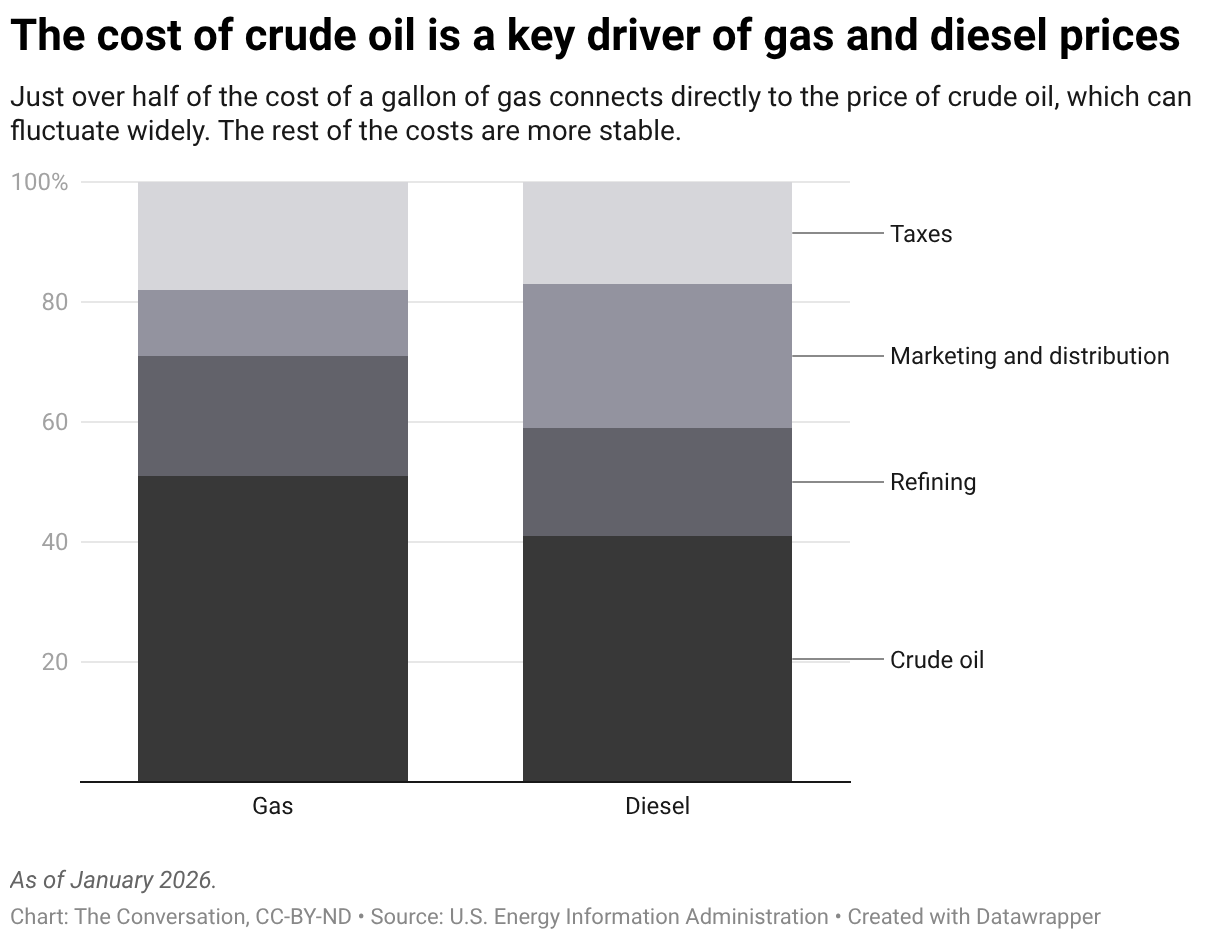
]]> pdevarajan3117910827212026-10-04 02:58:4117910828822026-10-04 03:01:2200newsThe Energy Policy and Innovation Center (EPIcenter), in partnership with Georgia Tech's Nuclear and Radiological Engineering and Medical Physics program, recently hosted a three-part webinar series, Nuclear Energy: A Public Primer, bringing together experts to discuss the science, economics, policy, and geopolitics shaping the future of nuclear power.]]>2026-10-02T00:00:00-04:002026-10-02T00:00:00-04:002026-10-02 00:00:00Gil Gonzalez || Energy Policy and Innovation Center]]>681343681343image<![CDATA[AdobeStock_346733066-Article-LR.jpg]]>image/jpeg17910827302026-10-04 02:58:5017910827302026-10-04 02:58:50<![CDATA[Can Presidents Influence Gas Prices? New Research Fuels the Debate]]>35766 Economists have long dismissed the public perception that presidents influence gas prices as economic illiteracy. New research from Georgia Tech economists Dylan Brewer and Matthew Oliver calls that assumption into question, finding significant differences in average gas prices across administrations.
The study is timely, arriving amid widespread public discontent over rising fuel prices, with voter frustrations reflected in a series of national polls blaming the Trump administration.
Although the researchers do not determine how much of the price differences across administrations, if any, are caused by presidents themselves, they argue economists may have been too confident in dismissing the possibility without much direct evidence.
“If economists really think that the president doesn't have influence, the burden of proof is on economists to explain that these differences can't be interpreted as the result of each president's actions," Brewer said.
]]> dminardi3117906986512026-09-29 16:17:3117907068372026-09-29 18:33:5700newsEconomists have long dismissed the public perception that presidents influence gas prices as economic illiteracy. New research from Georgia Tech economists Dylan Brewer and Matthew Oliver calls that assumption into question, finding significant differences in average gas prices across administrations. ]]>2026-09-29T00:00:00-04:002026-09-29T00:00:00-04:002026-09-29 00:00:00Di Minardi Ivan Allen College of Liberal Arts Georgia Tech]]>681288681288image<![CDATA[MERCURY--3-.jpg]]>Oliver was inspired by the stickers he saw on gas pumps showing then-President Joe Biden pointing at the price saying "I did that." Photo by Whoisjohngalt, via Wikimedia Commons, licensed under CC BY-SA 4.0.]]> image/jpeg17906986562026-09-29 16:17:3617906986562026-09-29 16:17:36<![CDATA[Chronicle of Digital Transformation (September 2026)]]>36164 We are pleased to share our latest bi-weekly update to the Chronicle of Digital Transformation, the broad context of Internet of Things technologies. This update covers major developments over the last two weeks (September 1-15, 2026).
The update is but a very small sample of digital transformation (DT)-related events/perspectives from around the world from a variety of countries on different continents. The Chronicle clearly illustrates that DT has a wide range of meaning across industries and countries and for that matter authors/researchers, thereby complicating the analysis. Current interest in AI and the critical importance of the human factor notwithstanding, DT is also connected more or less strongly to IoT, blockchain, digitization, digitalization, e-commerce, e-learning, e-service, automation, cloud adoption, edge computing, 5G, 6G, Industry 4.0, robotics, cybersecurity, and other forms of computer-based frameworks.
Author: Alain Louchez, CDAIT Co-founder and Director Emeritus.
]]> ayura3117896679072026-09-17 17:58:2717906983862026-09-29 16:13:0600newsChronicle of Digital Transformation, the broad context of Internet of Things technologies -- Perspectives from around the globe, September 1-15, 2026. Author: Alain Louchez, CDAIT Co-founder and Director Emeritus.]]>2026-09-15T00:00:00-04:002026-09-15T00:00:00-04:002026-09-15 00:00:00<![CDATA[Digital Transformation (September 2026)]]><![CDATA[Chronicle of Digital Transformation (August 2026 v2)]]>36164 We are pleased to share our latest bi-weekly update to the Chronicle of Digital Transformation, the broad context of Internet of Things technologies. This update covers major developments over the last two weeks (August 15-31, 2026).
The update is but a very small sample of digital transformation (DT)-related events/perspectives from around the world from a variety of countries on different continents. The Chronicle clearly illustrates that DT has a wide range of meaning across industries and countries and for that matter authors/researchers, thereby complicating the analysis. Current interest in AI and the critical importance of the human factor notwithstanding, DT is also connected more or less strongly to IoT, blockchain, digitization, digitalization, e-commerce, e-learning, e-service, automation, cloud adoption, edge computing, 5G, 6G, Industry 4.0, robotics, cybersecurity, and other forms of computer-based frameworks.
Author: Alain Louchez, CDAIT Co-founder and Director Emeritus.
]]> ayura3117888830752026-09-08 15:57:5517906983682026-09-29 16:12:4800newsChronicle of Digital Transformation, the broad context of Internet of Things technologies -- Perspectives from around the globe, August 15-31, 2026. Author: Alain Louchez, CDAIT Co-founder and Director Emeritus.]]>2026-08-31T00:00:00-04:002026-08-31T00:00:00-04:002026-08-31 00:00:00<![CDATA[Digital Transformation (August 2026 v2)]]><![CDATA[Chronicle of Digital Transformation (August 2026)]]>36164 We are pleased to share our latest bi-weekly update to the Chronicle of Digital Transformation, the broad context of Internet of Things technologies. This update covers major developments over the last two weeks (August 1-14, 2026).
The update is but a very small sample of digital transformation (DT)-related events/perspectives from around the world from a variety of countries on different continents. The Chronicle clearly illustrates that DT has a wide range of meaning across industries and countries and for that matter authors/researchers, thereby complicating the analysis. Current interest in AI and the critical importance of the human factor notwithstanding, DT is also connected more or less strongly to IoT, blockchain, digitization, digitalization, e-commerce, e-learning, e-service, automation, cloud adoption, edge computing, 5G, 6G, Industry 4.0, robotics, cybersecurity, and other forms of computer-based frameworks.
Author: Alain Louchez, CDAIT Co-founder and Director Emeritus.
]]> ayura3117867445352026-08-14 21:55:3517906983502026-09-29 16:12:3000newsChronicle of Digital Transformation, the broad context of Internet of Things technologies -- Perspectives from around the globe, August 1-14, 2026. Author: Alain Louchez, CDAIT Co-founder and Director Emeritus.]]>2026-08-14T00:00:00-04:002026-08-14T00:00:00-04:002026-08-14 00:00:00<![CDATA[Digital Transformation (August 2026)]]><![CDATA[Chronicle of Digital Transformation (July 2026)]]>36164 We are pleased to share our latest bi-weekly update to the Chronicle of Digital Transformation, the broad context of Internet of Things technologies. This update covers major developments over the last two weeks (July 1-15, 2026).
The update is but a very small sample of digital transformation (DT)-related events/perspectives from around the world from a variety of countries on different continents. The Chronicle clearly illustrates that DT has a wide range of meaning across industries and countries and for that matter authors/researchers, thereby complicating the analysis. Current interest in AI and the critical importance of the human factor notwithstanding, DT is also connected more or less strongly to IoT, blockchain, digitization, digitalization, e-commerce, e-learning, e-service, automation, cloud adoption, edge computing, 5G, 6G, Industry 4.0, robotics, cybersecurity, and other forms of computer-based frameworks.
Author: Alain Louchez, CDAIT Co-founder and Director Emeritus.
]]> ayura3117842264802026-07-16 18:28:0017906983302026-09-29 16:12:1000newsChronicle of Digital Transformation, the broad context of Internet of Things technologies -- Perspectives from around the globe, July 1-15, 2026. Author: Alain Louchez, CDAIT Co-founder and Director Emeritus.]]>2026-07-15T00:00:00-04:002026-07-15T00:00:00-04:002026-07-15 00:00:00<![CDATA[Digital Transformation (July 2026)]]><![CDATA[Chronicle of Digital Transformation (July 2026 v2)]]>36164 We are pleased to share our latest bi-weekly update to the Chronicle of Digital Transformation, the broad context of Internet of Things technologies. This update covers major developments over the last two weeks (July 16-31, 2026).
The update is but a very small sample of digital transformation (DT)-related events/perspectives from around the world from a variety of countries on different continents. The Chronicle clearly illustrates that DT has a wide range of meaning across industries and countries and for that matter authors/researchers, thereby complicating the analysis. Current interest in AI and the critical importance of the human factor notwithstanding, DT is also connected more or less strongly to IoT, blockchain, digitization, digitalization, e-commerce, e-learning, e-service, automation, cloud adoption, edge computing, 5G, 6G, Industry 4.0, robotics, cybersecurity, and other forms of computer-based frameworks.
Author: Alain Louchez, CDAIT Co-founder and Director Emeritus.
]]> ayura3117860251722026-08-06 14:06:1217906983052026-09-29 16:11:4500newsChronicle of Digital Transformation, the broad context of Internet of Things technologies -- Perspectives from around the globe, July 16-31, 2026. Author: Alain Louchez, CDAIT Co-founder and Director Emeritus.]]>2026-07-31T00:00:00-04:002026-07-31T00:00:00-04:002026-07-31 00:00:00<![CDATA[Digital Transformation (July 2026 v2)]]><![CDATA[Chronicle of Digital Transformation (June 2026 v2)]]>36164 We are pleased to share our latest bi-weekly update to the Chronicle of Digital Transformation, the broad context of Internet of Things technologies. This update covers major developments over the last two weeks (June 16-30, 2026).
The update is but a very small sample of digital transformation (DT)-related events/perspectives from around the world from a variety of countries on different continents. The Chronicle clearly illustrates that DT has a wide range of meaning across industries and countries and for that matter authors/researchers, thereby complicating the analysis. Current interest in AI and the critical importance of the human factor notwithstanding, DT is also connected more or less strongly to IoT, blockchain, digitization, digitalization, e-commerce, e-learning, e-service, automation, cloud adoption, edge computing, 5G, 6G, Industry 4.0, robotics, cybersecurity, and other forms of computer-based frameworks.
Author: Alain Louchez, CDAIT Co-founder and Director Emeritus.
]]> ayura3117829149512026-07-01 14:09:1117906982452026-09-29 16:10:4500newsChronicle of Digital Transformation, the broad context of Internet of Things technologies -- Perspectives from around the globe, June 16-30, 2026. Author: Alain Louchez, CDAIT Co-founder and Director Emeritus.]]>2026-06-30T00:00:00-04:002026-06-30T00:00:00-04:002026-06-30 00:00:00<![CDATA[Digital Transformation (June 2026 v2)]]><![CDATA[Chronicle of Digital Transformation (June 2026)]]>36164 We are pleased to share our latest bi-weekly update to the Chronicle of Digital Transformation, the broad context of Internet of Things technologies. This update covers major developments over the last two weeks (June 1-15, 2026).
The update is but a very small sample of digital transformation (DT)-related events/perspectives from around the world from a variety of countries on different continents. The Chronicle clearly illustrates that DT has a wide range of meaning across industries and countries and for that matter authors/researchers, thereby complicating the analysis. Current interest in AI and the critical importance of the human factor notwithstanding, DT is also connected more or less strongly to IoT, blockchain, digitization, digitalization, e-commerce, e-learning, e-service, automation, cloud adoption, edge computing, 5G, 6G, Industry 4.0, robotics, cybersecurity, and other forms of computer-based frameworks.
Author: Alain Louchez, CDAIT Co-founder and Director Emeritus.
]]> ayura3117815435512026-06-15 17:12:3117906982192026-09-29 16:10:1900newsChronicle of Digital Transformation, the broad context of Internet of Things technologies -- Perspectives from around the globe, June 1-15, 2026. Author: Alain Louchez, CDAIT Co-founder and Director Emeritus.]]>2026-06-15T00:00:00-04:002026-06-15T00:00:00-04:002026-06-15 00:00:00<![CDATA[Digital Transformation (June 2026)]]><![CDATA[Chronicle of Digital Transformation (May 2026 v2)]]>36164 We are pleased to share our latest bi-weekly update to the Chronicle of Digital Transformation, the broad context of Internet of Things technologies. This update covers major developments over the last two weeks (May 16-31, 2026).
The update is but a very small sample of digital transformation (DT)-related events/perspectives from around the world from a variety of countries on different continents. The Chronicle clearly illustrates that DT has a wide range of meaning across industries and countries and for that matter authors/researchers, thereby complicating the analysis. Current interest in AI and the critical importance of the human factor notwithstanding, DT is also connected more or less strongly to IoT, blockchain, digitization, digitalization, e-commerce, e-learning, e-service, automation, cloud adoption, edge computing, 5G, 6G, Industry 4.0, robotics, cybersecurity, and other forms of computer-based frameworks.
Author: Alain Louchez, CDAIT Co-founder and Director Emeritus.
]]> ayura3117803300622026-06-01 16:07:4217906981382026-09-29 16:08:5800newsChronicle of Digital Transformation, the broad context of Internet of Things technologies -- Perspectives from around the globe, May 16-31, 2026. Author: Alain Louchez, CDAIT Co-founder and Director Emeritus.]]>2026-05-31T00:00:00-04:002026-05-31T00:00:00-04:002026-05-31 00:00:00<![CDATA[Digital Transformation (May 2026 v2)]]><![CDATA[Chronicle of Digital Transformation (May 2026)]]>36164 We are pleased to share our latest bi-weekly update to the Chronicle of Digital Transformation, the broad context of Internet of Things technologies. This update covers major developments over the last two weeks (May 1-15, 2026).
The update is but a very small sample of digital transformation (DT)-related events/perspectives from around the world from a variety of countries on different continents. The Chronicle clearly illustrates that DT has a wide range of meaning across industries and countries and for that matter authors/researchers, thereby complicating the analysis. Current interest in AI and the critical importance of the human factor notwithstanding, DT is also connected more or less strongly to IoT, blockchain, digitization, digitalization, e-commerce, e-learning, e-service, automation, cloud adoption, edge computing, 5G, 6G, Industry 4.0, robotics, cybersecurity, and other forms of computer-based frameworks.
Author: Alain Louchez, CDAIT Co-founder and Director Emeritus.
]]> ayura3117792001652026-05-19 14:16:0517906938902026-09-29 14:58:1000newsChronicle of Digital Transformation, the broad context of Internet of Things technologies -- Perspectives from around the globe, May 1-15, 2026. Author: Alain Louchez, CDAIT Co-founder and Director Emeritus.]]>2026-05-15T00:00:00-04:002026-05-15T00:00:00-04:002026-05-15 00:00:00<![CDATA[Digital Transformation (May 2026)]]><![CDATA[Chronicle of Digital Transformation (April 2026)]]>36164 We are pleased to share our latest bi-weekly update to the Chronicle of Digital Transformation, the broad context of Internet of Things technologies. This update covers major developments over the last two weeks (April 1-14, 2026).
The update is but a very small sample of digital transformation (DT)-related events/perspectives from around the world from a variety of countries on different continents. The Chronicle clearly illustrates that DT has a wide range of meaning across industries and countries and for that matter authors/researchers, thereby complicating the analysis. Current interest in AI and the critical importance of the human factor notwithstanding, DT is also connected more or less strongly to IoT, blockchain, digitization, digitalization, e-commerce, e-learning, e-service, automation, cloud adoption, edge computing, 5G, 6G, Industry 4.0, robotics, cybersecurity, and other forms of computer-based frameworks.
Author: Alain Louchez, CDAIT Co-founder and Director Emeritus.
]]> ayura3117762679632026-04-15 15:46:0317906938662026-09-29 14:57:4600newsChronicle of Digital Transformation, the broad context of Internet of Things technologies -- Perspectives from around the globe, April 1-14, 2026. Author: Alain Louchez, CDAIT Co-founder and Director Emeritus.]]>2026-04-15T00:00:00-04:002026-04-15T00:00:00-04:002026-04-15 00:00:00<![CDATA[Digital Transformation (April 2026)]]><![CDATA[Chronicle of Digital Transformation (April 2026 v2)]]>36164 We are pleased to share our latest bi-weekly update to the Chronicle of Digital Transformation, the broad context of Internet of Things technologies. This update covers major developments over the last two weeks (April 15-30, 2026).
The update is but a very small sample of digital transformation (DT)-related events/perspectives from around the world from a variety of countries on different continents. The Chronicle clearly illustrates that DT has a wide range of meaning across industries and countries and for that matter authors/researchers, thereby complicating the analysis. Current interest in AI and the critical importance of the human factor notwithstanding, DT is also connected more or less strongly to IoT, blockchain, digitization, digitalization, e-commerce, e-learning, e-service, automation, cloud adoption, edge computing, 5G, 6G, Industry 4.0, robotics, cybersecurity, and other forms of computer-based frameworks.
Author: Alain Louchez, CDAIT Co-founder and Director Emeritus.
]]> ayura3117776444142026-05-01 14:06:5417906938442026-09-29 14:57:2400newsChronicle of Digital Transformation, the broad context of Internet of Things technologies -- Perspectives from around the globe, April 15-30, 2026. Author: Alain Louchez, CDAIT Co-founder and Director Emeritus.]]>2026-04-30T00:00:00-04:002026-04-30T00:00:00-04:002026-04-30 00:00:00<![CDATA[Digital Transformation (April 2026 v2)]]><![CDATA[Chronicle of Digital Transformation (March 2026 v2)]]>36164 We are pleased to share our latest bi-weekly update to the Chronicle of Digital Transformation, the broad context of Internet of Things technologies. This update covers major developments over the last two weeks (March 16-31, 2026).
The update is but a very small sample of digital transformation (DT)-related events/perspectives from around the world from a variety of countries on different continents. The Chronicle clearly illustrates that DT has a wide range of meaning across industries and countries and for that matter authors/researchers, thereby complicating the analysis. Current interest in AI and the critical importance of the human factor notwithstanding, DT is also connected more or less strongly to IoT, blockchain, digitization, digitalization, e-commerce, e-learning, e-service, automation, cloud adoption, edge computing, 5G, 6G, Industry 4.0, robotics, cybersecurity, and other forms of computer-based frameworks.
Author: Alain Louchez, CDAIT Co-founder and Director Emeritus.
]]> ayura3117750553512026-04-01 14:55:5117906938202026-09-29 14:57:0000newsChronicle of Digital Transformation, the broad context of Internet of Things technologies -- Perspectives from around the globe, March 16-31, 2026. Author: Alain Louchez, CDAIT Co-founder and Director Emeritus.]]>2026-04-01T00:00:00-04:002026-04-01T00:00:00-04:002026-04-01 00:00:00<![CDATA[Digital Transformation (March 2026 v2)]]><![CDATA[Chronicle of Digital Transformation (March 2026)]]>36164 We are pleased to share our latest bi-weekly update to the Chronicle of Digital Transformation, the broad context of Internet of Things technologies. This update covers major developments over the last two weeks (March 1-15, 2026).
The update is but a very small sample of digital transformation (DT)-related events/perspectives from around the world from a variety of countries on different continents. The Chronicle clearly illustrates that DT has a wide range of meaning across industries and countries and for that matter authors/researchers, thereby complicating the analysis. Current interest in AI and the critical importance of the human factor notwithstanding, DT is also connected more or less strongly to IoT, blockchain, digitization, digitalization, e-commerce, e-learning, e-service, automation, cloud adoption, edge computing, 5G, 6G, Industry 4.0, robotics, cybersecurity, and other forms of computer-based frameworks.
Author: Alain Louchez, CDAIT Co-founder and Director Emeritus.
]]> ayura3117736773532026-03-16 16:09:1317906937652026-09-29 14:56:0500newsChronicle of Digital Transformation, the broad context of Internet of Things technologies -- Perspectives from around the globe, March 1-15, 2026. Author: Alain Louchez, CDAIT Co-founder and Director Emeritus.]]>2026-03-16T00:00:00-04:002026-03-16T00:00:00-04:002026-03-16 00:00:00<![CDATA[Digital Transformation (March 2026)]]><![CDATA[Chronicle of Digital Transformation (February 2026 v2)]]>36164 We are pleased to share our latest bi-weekly update to the Chronicle of Digital Transformation, the broad context of Internet of Things technologies. This update covers major developments over the last two weeks (February 16-28, 2026).
The update is but a very small sample of digital transformation (DT)-related events/perspectives from around the world from a variety of countries on different continents. The Chronicle clearly illustrates that DT has a wide range of meaning across industries and countries and for that matter authors/researchers, thereby complicating the analysis. Current interest in AI and the critical importance of the human factor notwithstanding, DT is also connected more or less strongly to IoT, blockchain, digitization, digitalization, e-commerce, e-learning, e-service, automation, cloud adoption, edge computing, 5G, 6G, Industry 4.0, robotics, cybersecurity, and other forms of computer-based frameworks.
Author: Alain Louchez, CDAIT Co-founder and Director Emeritus.
]]> ayura3117730669792026-03-09 14:36:1917906937132026-09-29 14:55:1300newsChronicle of Digital Transformation, the broad context of Internet of Things technologies -- Perspectives from around the globe, February 16-28, 2026. Author: Alain Louchez, CDAIT Co-founder and Director Emeritus.]]>2026-03-01T00:00:00-05:002026-03-01T00:00:00-05:002026-03-01 00:00:00<![CDATA[Digital Transformation (February 2026 v2)]]><![CDATA[Chronicle of Digital Transformation (February 2026)]]>36164 We are pleased to share our latest bi-weekly update to the Chronicle of Digital Transformation, the broad context of Internet of Things technologies. This update covers major developments over the last two weeks (February 1-15, 2026).
The update is but a very small sample of digital transformation (DT)-related events/perspectives from around the world from a variety of countries on different continents. The Chronicle clearly illustrates that DT has a wide range of meaning across industries and countries and for that matter authors/researchers, thereby complicating the analysis. Current interest in AI and the critical importance of the human factor notwithstanding, DT is also connected more or less strongly to IoT, blockchain, digitization, digitalization, e-commerce, e-learning, e-service, automation, cloud adoption, edge computing, 5G, 6G, Industry 4.0, robotics, cybersecurity, and other forms of computer-based frameworks.
Author: Alain Louchez, CDAIT Co-founder and Director Emeritus.
]]> ayura3117713433562026-02-17 15:49:1617906936702026-09-29 14:54:3000newsChronicle of Digital Transformation, the broad context of Internet of Things technologies -- Perspectives from around the globe, February 1-15, 2026. Author: Alain Louchez, CDAIT Co-founder and Director Emeritus.]]>2026-02-15T00:00:00-05:002026-02-15T00:00:00-05:002026-02-15 00:00:00<![CDATA[Digital Transformation (February 2026)]]><![CDATA[Chronicle of Digital Transformation (January 2026 v2)]]>36164 We are pleased to share our latest bi-weekly update to the Chronicle of Digital Transformation, the broad context of Internet of Things technologies. This update covers major developments over the last two weeks (January 16-31, 2026).
The update is but a very small sample of digital transformation (DT)-related events/perspectives from around the world from a variety of countries on different continents. The Chronicle clearly illustrates that DT has a wide range of meaning across industries and countries and for that matter authors/researchers, thereby complicating the analysis. Current interest in AI and the critical importance of the human factor notwithstanding, DT is also connected more or less strongly to IoT, blockchain, digitization, digitalization, e-commerce, e-learning, e-service, automation, cloud adoption, edge computing, 5G, 6G, Industry 4.0, robotics, cybersecurity, and other forms of computer-based frameworks.
Author: Alain Louchez, CDAIT Co-founder and Director Emeritus.
]]> ayura3117701387922026-02-03 17:13:1217906936332026-09-29 14:53:5300newsChronicle of Digital Transformation, the broad context of Internet of Things technologies -- Perspectives from around the globe, January 16-31, 2026. Author: Alain Louchez, CDAIT Co-founder and Director Emeritus.]]>2026-01-31T00:00:00-05:002026-01-31T00:00:00-05:002026-01-31 00:00:00<![CDATA[Digital Transformation (January 2026 v2)]]><![CDATA[Chronicle of Digital Transformation (January 2026)]]>36164 We are pleased to share our latest bi-weekly update to the Chronicle of Digital Transformation, the broad context of Internet of Things technologies. This update covers major developments over the last two weeks (January 1-15, 2026).
The update is but a very small sample of digital transformation (DT)-related events/perspectives from around the world from a variety of countries on different continents. The Chronicle clearly illustrates that DT has a wide range of meaning across industries and countries and for that matter authors/researchers, thereby complicating the analysis. Current interest in AI and the critical importance of the human factor notwithstanding, DT is also connected more or less strongly to IoT, blockchain, digitization, digitalization, e-commerce, e-learning, e-service, automation, cloud adoption, edge computing, 5G, 6G, Industry 4.0, robotics, cybersecurity, and other forms of computer-based frameworks.
Author: Alain Louchez, CDAIT Co-founder and Director Emeritus.
]]> ayura3117691099932026-01-22 19:26:3317906936122026-09-29 14:53:3200newsChronicle of Digital Transformation, the broad context of Internet of Things technologies -- Perspectives from around the globe, January 1-15, 2026. Author: Alain Louchez, CDAIT Co-founder and Director Emeritus.]]>2026-01-15T00:00:00-05:002026-01-15T00:00:00-05:002026-01-15 00:00:00<![CDATA[Digital Transformation (January 2026)]]><![CDATA[Chronicle of Digital Transformation (December 2025 v2)]]>36164 We are pleased to share our latest bi-weekly update to the Chronicle of Digital Transformation, the broad context of Internet of Things technologies. This update covers major developments over the last two weeks (December 16-31, 2025).
The update is but a very small sample of digital transformation (DT)-related events/perspectives from around the world from a variety of countries on different continents. The Chronicle clearly illustrates that DT has a wide range of meaning across industries and countries and for that matter authors/researchers, thereby complicating the analysis. Current interest in AI and the critical importance of the human factor notwithstanding, DT is also connected more or less strongly to IoT, blockchain, digitization, digitalization, e-commerce, e-learning, e-service, automation, cloud adoption, edge computing, 5G, 6G, Industry 4.0, robotics, cybersecurity, and other forms of computer-based frameworks.
Author: Alain Louchez, CDAIT Co-founder and Director Emeritus.
]]> ayura3117678025022026-01-07 16:15:0217906935892026-09-29 14:53:0900newsChronicle of Digital Transformation, the broad context of Internet of Things technologies -- Perspectives from around the globe, December 16-31, 2025. Author: Alain Louchez, CDAIT Co-founder and Director Emeritus.]]>2025-12-31T00:00:00-05:002025-12-31T00:00:00-05:002025-12-31 00:00:00<![CDATA[Digital Transformation (December 2025 v2)]]><![CDATA[Chronicle of Digital Transformation (December 2025)]]>36164 We are pleased to share our latest bi-weekly update to the Chronicle of Digital Transformation, the broad context of Internet of Things technologies. This update covers major developments over the last two weeks (December 1-15, 2025).
The update is but a very small sample of digital transformation (DT)-related events/perspectives from around the world from a variety of countries on different continents. The Chronicle clearly illustrates that DT has a wide range of meaning across industries and countries and for that matter authors/researchers, thereby complicating the analysis. Current interest in AI and the critical importance of the human factor notwithstanding, DT is also connected more or less strongly to IoT, blockchain, digitization, digitalization, e-commerce, e-learning, e-service, automation, cloud adoption, edge computing, 5G, 6G, Industry 4.0, robotics, cybersecurity, and other forms of computer-based frameworks.
Author: Alain Louchez, CDAIT Co-founder and Director Emeritus.
]]> ayura3117659851912025-12-17 15:26:3117906935562026-09-29 14:52:3600newsChronicle of Digital Transformation, the broad context of Internet of Things technologies -- Perspectives from around the globe, December 1-15, 2025. Author: Alain Louchez, CDAIT Co-founder and Director Emeritus.]]>2025-12-15T00:00:00-05:002025-12-15T00:00:00-05:002025-12-15 00:00:00<![CDATA[Digital Transformation (December 2025)]]><![CDATA[Chronicle of Digital Transformation (November 2025 v2)]]>36164 We are pleased to share our latest bi-weekly update to the Chronicle of Digital Transformation, the broad context of Internet of Things technologies. This update covers major developments over the last two weeks (November 16-30, 2025).
The update is but a very small sample of digital transformation (DT)-related events/perspectives from around the world from a variety of countries on different continents. The Chronicle clearly illustrates that DT has a wide range of meaning across industries and countries and for that matter authors/researchers, thereby complicating the analysis. Current interest in AI and the critical importance of the human factor notwithstanding, DT is also connected more or less strongly to IoT, blockchain, digitization, digitalization, e-commerce, e-learning, e-service, automation, cloud adoption, edge computing, 5G, 6G, Industry 4.0, robotics, cybersecurity, and other forms of computer-based frameworks.
Author: Alain Louchez, CDAIT Co-founder and Director Emeritus.
]]> ayura3117646041052025-12-01 15:48:2517906934732026-09-29 14:51:1300newsChronicle of Digital Transformation, the broad context of Internet of Things technologies -- Perspectives from around the globe, November 16-30, 2025. Author: Alain Louchez, CDAIT Co-founder and Director Emeritus.]]>2025-11-30T00:00:00-05:002025-11-30T00:00:00-05:002025-11-30 00:00:00<![CDATA[Digital Transformation (November 2025 v2)]]><![CDATA[Chronicle of Digital Transformation (November 2025)]]>36164 We are pleased to share our latest bi-weekly update to the Chronicle of Digital Transformation, the broad context of Internet of Things technologies. This update covers major developments over the last two weeks (November 1-15, 2025).
The update is but a very small sample of digital transformation (DT)-related events/perspectives from around the world from a variety of countries on different continents. The Chronicle clearly illustrates that DT has a wide range of meaning across industries and countries and for that matter authors/researchers, thereby complicating the analysis. Current interest in AI and the critical importance of the human factor notwithstanding, DT is also connected more or less strongly to IoT, blockchain, digitization, digitalization, e-commerce, e-learning, e-service, automation, cloud adoption, edge computing, 5G, 6G, Industry 4.0, robotics, cybersecurity, and other forms of computer-based frameworks.
Author: Alain Louchez, CDAIT Co-founder and Director Emeritus.
]]> ayura3117635699472025-11-19 16:32:2717906933952026-09-29 14:49:5500newsChronicle of Digital Transformation, the broad context of Internet of Things technologies -- Perspectives from around the globe, November 1-15, 2025. Author: Alain Louchez, CDAIT Co-founder and Director Emeritus.]]>2025-11-17T00:00:00-05:002025-11-17T00:00:00-05:002025-11-17 00:00:00<![CDATA[Digital Transformation (November 2025)]]><![CDATA[Chronicle of Digital Transformation (October 2025)]]>36164Chronicle of Digital Transformation, the broad context of Internet of Things technologies -- Perspectives from around the globe, April 2022 - October 2025.
Author: Alain Louchez, CDAIT Co-founder and Director Emeritus.
]]> ayura3117631383422025-11-14 16:39:0217906933362026-09-29 14:48:5600newsChronicle of Digital Transformation, the broad context of Internet of Things technologies -- Perspectives from around the globe, April 2022 - October 2025. ]]>2025-11-14T00:00:00-05:002025-11-14T00:00:00-05:002025-11-14 00:00:00<![CDATA[Digital Transformation (April 2025 - October 2025)]]><![CDATA[Georgia Tech's Space Research Institute Names Two Associate Directors]]>35575 The Georgia Tech Space Research Institute (SRI) has appointed David Ballantyne and Mariel Borowitz as associate directors, expanding the institute's leadership team as it continues to strengthen Georgia Tech's position as a leader in space research, education, and engagement.
Since its launch in 2025, SRI has brought together researchers from across campus to advance interdisciplinary space initiatives and create new opportunities for collaboration. In their new roles, Ballantyne and Borowitz will help guide the institute's growth by strengthening both internal research connections and external partnerships across the broader space community.
“David and Mariel bring complementary strengths that will be invaluable as we continue building SRI,” said Jud Ready, executive director of SRI. “David has a deep understanding of the research enterprise at Georgia Tech and a passion for connecting people and ideas across disciplines. Mariel brings extensive experience working across government, industry, and the international space community. Together, they will help us strengthen Georgia Tech's space ecosystem and expand our impact far beyond campus.”
Strengthening Georgia Tech's Research Community
Since joining the Institute in 2008 as a founding faculty member of the Center for Relativistic Astrophysics, Ballantyne has helped advance both space science and academic leadership across campus.
A professor in the School of Physics, he studies the evolution of galaxies and their central black holes, as well as the physics of accretion disks around black holes and neutron stars. He has authored more than 140 peer-reviewed publications and served as associate chair of the School of Physics for nearly a decade.
As associate director, Ballantyne will focus on cultivating connections across Georgia Tech's space research community and identifying opportunities for new interdisciplinary collaborations.
“I view SRI as a catalyst — a mechanism to spark new and transformative areas of space research at Georgia Tech that will grow to national and international prominence,” Ballantyne said. “There is so much innovative space research happening across campus, and one of SRI's most important roles is helping researchers find the connections and collaborations that can spark new ideas and discoveries.”
Ballantyne says he is particularly interested in helping position Georgia Tech as a leader in understanding the opportunities and challenges presented by artificial intelligence in space systems.
“My goal is to be out in the community, learning about the breadth of space research happening across campus and identifying ways SRI can accelerate that work,” he said. “AI technologies are poised to transform space exploration, scientific discovery, national security, and commercial space operations. SRI is uniquely positioned to help Georgia Tech lead those conversations.”
Building Partnerships Beyond Campus
As space activities become increasingly interconnected across government, industry, and academia, strong partnerships are essential to translating research into real-world impact. That collaborative spirit is central to the work of Mariel Borowitz, an associate professor in the Sam Nunn School of International Affairs.
Borowitz, who also serves as director of Georgia Tech’s Center for Space Policy and International Relations, is widely recognized for her expertise in space policy, international cooperation, and the governance of emerging space activities. Her work has connected her with space agencies, private companies, and policymakers around the world, providing a valuable perspective on opportunities for Georgia Tech to expand its engagement with the broader space community.
In her role as associate director, Borowitz will focus on growing SRI's partnerships with industry, government, and the broader space community.
“My focus as associate director will be on building partnerships between Georgia Tech and the broader space community,” Borowitz said. “Georgia Tech has tremendous expertise across science, engineering, policy, economics, and international affairs. By working across those disciplines, we can help address the complex challenges facing the future of space development while creating new opportunities for collaboration and impact.”
Borowitz sees SRI as a powerful mechanism for connecting Georgia Tech's diverse strengths and amplifying their collective impact.
“Real-world challenges and opportunities are inherently interdisciplinary,” she said. “The Space Research Institute allows us to bring together expertise from across Georgia Tech to develop more complete solutions and create new possibilities for the future of space.”
Looking Ahead
Together, Ballantyne and Borowitz will help advance SRI's mission of connecting researchers, educators, students, industry leaders, and policymakers to address the most pressing opportunities and challenges in space.
“Space exploration has always challenged us to think bigger, work across boundaries, and pursue questions that no single discipline can answer alone,” said Ready, who also serves as a principal research engineer at the Georgia Tech Research Institute. “David and Mariel embody that spirit of collaboration, and their leadership will help us create new opportunities for discovery, innovation, and impact at Georgia Tech and beyond.”
]]> adavidson38117901020452026-09-22 18:34:0517901022912026-09-22 18:38:1100newsDavid Ballantyne and Mariel Borowitz join SRI's leadership team to strengthen interdisciplinary research, expand strategic partnerships, and advance Georgia Tech's growing space enterprise.]]>2026-09-22T00:00:00-04:002026-09-22T00:00:00-04:002026-09-22 00:00:00Audra Davidson Research Communications Manager, Space Research Institute]]>681223681223image<![CDATA[Ballantyne-Borowitz.png]]> David Ballantyne, professor in Georgia Tech’s School of Physics, and Mariel Borowitz, associate professor in the Sam Nunn School of International Affairs, have been appointed associate directors of the Space Research Institute (SRI).]]> image/png17901020802026-09-22 18:34:4017901020802026-09-22 18:34:40<![CDATA[Learn More About the Space Research Institute]]><![CDATA[The Hidden Cost of Segregation]]>36413 A new study by EPIcenter affiliate Marilyn A. Brown and coauthor Majid Ahmadi examines how racial segregation affects what households pay for basic utilities. Using detailed data from Atlanta, Georgia, the authors investigate whether predominantly Black neighborhoods face higher energy burdens only because of income and housing differences, or whether segregation itself plays a direct role. Their analysis combines mortgage denial data, housing information, utility costs, and household income to show how long-standing discriminatory housing and lending practices continue to shape energy affordability today.
Ahmadi and Brown find that neighborhoods with higher shares of Black residents experience higher energy burdens, even after accounting for factors such as income, renter status, and housing characteristics. In this study, energy burden refers mainly to the share of household income spent on electricity, gas, and water. The authors estimate that an approximately 11 percentage-point increase in a neighborhood’s Black population share is associated with about a 1 percentage-point increase in household energy burden, equal to an average annual increase of about $785 in utility costs. These findings suggest that unequal energy burdens are tied not only to household finances, but also to the lasting effects of segregation and discrimination.
]]> pdevarajan3117895643842026-09-16 13:13:0417895645772026-09-16 13:16:1700newsA new study by EPIcenter affiliate Marilyn A. Brown and coauthor Majid Ahmadi examines how racial segregation affects what households pay for basic utilities. Using detailed data from Atlanta, Georgia, the authors investigate whether predominantly Black neighborhoods face higher energy burdens only because of income and housing differences, or whether segregation itself plays a direct role. Their analysis combines mortgage denial data, housing information, utility costs, and household income to show how long-standing discriminatory housing and lending practices continue to shape energy affordability today.]]>2026-09-15T00:00:00-04:002026-09-15T00:00:00-04:002026-09-15 00:00:00Gil Gonzalez, Program Coordinator, Energy Policy and Innovation Center]]>681162681162image<![CDATA[hiddencostAdobeStock_669231771-1536x1023.jpeg]]>image/jpeg17895643942026-09-16 13:13:1417895643942026-09-16 13:13:14<![CDATA[Full Story on the EPIcenter Webpage]]><![CDATA[Four Challenges to the U.S. Energy Transition]]>35766 Efficiently transitioning from fossil fuels to renewable energy means looking at so much more than just the technology we use.
Reliable energy is required to keep safe in cold winters and hot summers, making it a matter of national security. There are also vying economic policies to consider, political and financial incentives to navigate, and questions of social and economic inequality.
]]> dminardi3117742908962026-03-23 18:34:5617895642922026-09-16 13:11:3200newsReliable energy is required to keep safe in cold winters and hot summers, making it a matter of national security. There are also vying economic policies to consider, political and financial incentives to navigate, and questions of social and economic inequality. Experts in Georgia Tech’s Ivan Allen College of Liberal Arts examine the challenges we face with the U.S. energy transition, and work to help make it safe, fair, and effective for all.]]>2026-03-23T00:00:00-04:002026-03-23T00:00:00-04:002026-03-23 00:00:00Di Minardi — Ivan Allen College of Liberal Arts]]>679717679717image<![CDATA[MERCURY--1-.jpg]]>image/jpeg17742910642026-03-23 18:37:4417742910642026-03-23 18:37:44<![CDATA[As Oil Profits Skyrocket, Calls for Windfall Taxes Rise]]>36413By Tibor Besedeš, Professor of Economics, Georgia Institute of Technology
When Chevron reported its highest quarterly profit in six years on July 31, 2026, it was just one detail in a larger picture: Analyst firm Wood Mackenzie estimates the global oil and gas industry is on course for a cash windfall of US$495 billion in 2026. That’s profit above and beyond what the industry expected before the U.S.-Israel war with Iran began.
Three separate bills seeking to tax those profits are now in Congress, and President Donald Trump has even said the oil companies are “making too much money.”
As an applied microeconomist, I am often asked how taxes affect economic activity. Economists have long held a more nuanced view of windfall taxes than either side of the current debate suggests. Advocates often make overly optimistic revenue projections, and opponents often overstate how much such a tax might discourage investment. A 1980s U.S. windfall-tax experiment is instructive on both counts.
]]> pdevarajan3117895642022026-09-16 13:10:0217895642022026-09-16 13:10:0200newsWhen Chevron reported its highest quarterly profit in six years on July 31, 2026, it was just one detail in a larger picture: Analyst firm Wood Mackenzie estimates the global oil and gas industry is on course for a cash windfall of US$495 billion in 2026. That’s profit above and beyond what the industry expected before the U.S.-Israel war with Iran began.
Three separate bills seeking to tax those profits are now in Congress, and President Donald Trump has even said the oil companies are “making too much money.”
As an applied microeconomist, I am often asked how taxes affect economic activity. Economists have long held a more nuanced view of windfall taxes than either side of the current debate suggests. Advocates often make overly optimistic revenue projections, and opponents often overstate how much such a tax might discourage investment. A 1980s U.S. windfall-tax experiment is instructive on both counts.
]]>2026-08-12T00:00:00-04:002026-08-12T00:00:00-04:002026-08-12 00:00:00<![CDATA[Read Full Story on The Conversation]]><![CDATA[Warming Climate Could Actually Increase Physical Activity, Georgia Tech Economist Finds]]>36413 Hardly anyone loves exercising in the festering crucible of a brutal summer heatwave. So it stands to reason that as global temperatures rise, the kind of physical activity that’s so crucial for our health and economic productivity could fall.
But recent research from Georgia Tech’s School of Economics in the Ivan Allen College of Liberal Arts suggests adding an asterisk to earlier research that makes that conclusion, saying previous studies failed to account for one simple fact: people adapt.
Georgia Tech economist Bobby Harris used a massive database of Fitbit step count data to measure how temperature shapes physical activity and found that extreme heat cuts step counts by 6% when compared to ideal weather. And while residents of the warmest regions cut their activity by an average of only 354 steps on days over 100 degrees, those living in the coldest regions cut theirs by 1,081, according to Harris’ analysis.
To be fair, cold bites, too. On days that stay below freezing, people take roughly 1,000 fewer steps. That’s a 12% drop, enough to pack on a pound over the course of a typical Madison, Wisconsin winter, Harris found.
But as the climate grows warmer, how humanity will respond to warmer temperatures remains a significant concern. In fact, earlier research projected that, by 2050, temperature-driven declines in physical activity could contribute to 500,000 premature deaths a year worldwide and annual productivity losses topping $2.4 billion.
Projections like those typically assume everyone responds to heat the same way, with no capacity to adapt, Harris said.
The Finding: A study led by economist Bobby Harris at Georgia Tech's Ivan Allen College of Liberal Arts reveals climate change could increase average U.S. physical activity by 893 steps per day by 2099 as people adapt to rising temperatures.
By the Numbers: Fitbit data used in Harris’ study show that warm-climate residents are 50% less sensitive to heat extremes than northern neighbors, cutting 354 steps on hot dayscompared to 1,081 in cooler regions.
Expert Insight: "There are still significant dangers to rising temperatures, but we must better factor adaptive capacity into conversations about climate change,” Harris said.
]]>2026-09-01T00:00:00-04:002026-09-01T00:00:00-04:002026-09-01 00:00:00681107681107image<![CDATA[climate-and-activity-paper-harris--1-.jpg]]>image/jpeg17889710732026-09-09 16:24:3317889710732026-09-09 16:24:33<![CDATA[Read Full Story on IAC News Page]]><![CDATA[What Meta's Settlement Means, and What It Doesn’t, According to Georgia Tech Experts ]]>36418
Meta, the parent company of Facebook and Instagram, will pay $17.1 billion and implement new protections to reduce the harmful effects of social media on young people, settling a lawsuit alleging that the social media giant violated consumer protection laws and targeted teenagers through its addictive features.
The resolution to the 2023 lawsuit imposes daily time limits on platform use for users under 18, silences notifications during school hours, restricts image filters, and adds safety measures, including removing users under 13 and stricter enforcement of teenager-specific settings for users under 18, among other measures.
More Work To Be Done
The settlement has been celebrated by the 47 attorneys general of the represented states as a transformative moment in the oversight of social media. While she believes it is a step in the right direction, Munmun De Choudhury, a professor in Georgia Tech’s School of Interactive Computing, says the work cannot stop with the changes proposed in the settlement.
De Choudhury’s research has pioneered the computational use of social media data for mental health. In 2023, she co-authored a consensus report for the National Academies of Sciences, Engineering, and Medicine on the connection between social media and adolescent health. Several of the recommendations in the report are reflected in the Meta settlement, but De Choudhury sees areas that still need to be addressed at the root of social media’s effects on mental health.
“I think it's a reasonable start. It was necessary, but if you look at the research literature, whether restricting screen time actually improves mental health is not a settled question,” she said. “We need to look at the context, which means not just how much time they're spending on these platforms but also how they're spending that time.”
The $17 billion will be distributed among the states and territories involved in the lawsuit, and, according to De Choudhury, the funds will be a critical part of the settlement achieving its intended outcomes.
“The grassroots portion of this is asking: How do we empower young people and their families with information so that they can make the right decisions for themselves? This money can be used to provide social media literacy efforts and to train parents and teachers to better guide kids. We often hear that adults want to help, but parents and teachers didn’t grow up in the social media era, and given how fast it changes, they don’t always have the right answers,” she said.
Getting Others on Board
Certain portions of the settlement, such as financial penalties and exact time restrictions, are contingent upon Meta’s competitors, TikTok and YouTube, adopting similar measures. De Choudhury says research shows that when one platform becomes more restrictive, users will migrate to another.
“The kids who want to access social media between midnight and 6 a.m., when these platforms won't be available, will go to TikTok or they'll go somewhere else,” she said. “This means that what we end up doing is not mitigating the harm but shifting it elsewhere. And that doesn't help anyone. So, this is welcome if it means the scope of this implementation can be broadened, and it would go a long way.”
Social Media in the AI Age
De Choudhury implores regulators to consider additional measures to protect children in the future, particularly those that safeguard their data in the age of artificial intelligence.
“All of our data is getting used to train these AI models. This is especially true for a company like Meta, which has its own AI models. We are talking about minors. They can't meaningfully consent to the use of their data to build AI models. So we need to expand the scope of harm here, which is not just the mental health harm that can happen but the impacts of these companies storing and using children’s data,” she said.
A federal “right to be forgotten” that allows individuals to request deletion of their data from social media sites and other online profiles is a step De Choudhury recommends, mirroring the European Union’s policy.
Protecting the Vulnerable
Adults aren’t immune to the dangers of social media, De Choudhury explained, but teenagers are more susceptible to triggers based on their stage of brain development. She hopes the recent settlement sets a precedent for active oversight.
“We have seen lawsuits in the past where specific school systems sued a social media company. We have seen some individual states taking action as well, but the scale of this settlement is something we haven't seen before,” she said.
The changes to the platforms will take effect over the next 12 months, but should Meta fail to do so, Jerry Liu, lecturer in the Scheller College of Business and teacher of legal and ethical aspects of business, says states would not need to relitigate the case, in which Meta did not admit wrongdoing. Rather, they could ask the court to seek enforcement with contempt remedies, like additional financial penalties or sanctions.
The Meta case has drawn comparisons to lawsuits against big tobacco in the 1990s. Liu says both cases invoke similar questions surrounding legality and ethics in business.
“There is a broader, ethical issue with this case, which is drawing the line between making an engaging product versus deliberately designing the product around human vulnerabilities to make a product addictive, particularly for children, and concealing harmful consequences,” he said.
“With big tobacco, the problem wasn't simply that cigarettes were addictive. It was the allegation that the industry knew about the addictive nature of cigarettes, manipulated nicotine levels, and concealed or minimized that knowledge. Similarly, as with Meta and social media, the question is whether the social media companies know that particular design features or algorithmic tools can create unhealthy or compulsive behavior, particularly in children, and whether they have an ethical obligation to disclose that knowledge and redesign the product accordingly.”
The Federal Trade Commission and the Department of Justice retain federal enforcement authority in this case, but Liu said that individuals (including class-action suits) can potentially pursue separate state-law or other claims against Meta.
]]> sgagliano3117882245622026-09-01 01:02:4217882262892026-09-01 01:31:2900newsThe social media giant will make changes to its platforms to address allegations of consumer protection law violations and the targeting of teenagers through addictive features. ]]>2026-09-01T00:00:00-04:002026-09-01T00:00:00-04:002026-09-01 00:00:00Steven Gagliano – Institute Communications]]>681023681023image<![CDATA[Meta]]>image/jpeg17882260372026-09-01 01:27:1717882260372026-09-01 01:27:17<![CDATA[How Does Wildfire Smoke Affect the Economy?]]>36413 Wildfires in the United States are getting bigger and the season is getting longer, fueled by hotter and drier weather from climate change. Even when fires are hundreds of miles away, the wildfire smoke can still harm people's health and create economic costs through air pollution, said Casey Wichman, an associate professor in Georgia Tech’s School of Economics.
The Air Quality Index (AQI) measures how clean or polluted the air is. A healthy AQI is between zero and 50, but when wildfire smoke blows in and settles over cities, the AQI can reach levels of 500 or more. Poor air quality changes where and how people spend their time and money, reduces productivity (even for those working indoors), and increases healthcare costs.
“Environmental regulations like the Clean Air Act dramatically improved our air quality over the past 40 years, but as wildfire season becomes the new normal, wildfire smoke is eroding those gains,” Wichman said. According to recent research, wildfire smoke has erased about a quarter of the progress made over previous decades, and more than half in many western states.
]]> pdevarajan3117865613512026-08-12 19:02:3117865615672026-08-12 19:06:0700newsWildfires in the United States are getting bigger and the season is getting longer, fueled by hotter and drier weather from climate change. Even when fires are hundreds of miles away, the wildfire smoke can still harm people's health and create economic costs through air pollution, said Casey Wichman, an associate professor in Georgia Tech’s School of Economics.
The Air Quality Index (AQI) measures how clean or polluted the air is. A healthy AQI is between zero and 50, but when wildfire smoke blows in and settles over cities, the AQI can reach levels of 500 or more. Poor air quality changes where and how people spend their time and money, reduces productivity (even for those working indoors), and increases healthcare costs.
“Environmental regulations like the Clean Air Act dramatically improved our air quality over the past 40 years, but as wildfire season becomes the new normal, wildfire smoke is eroding those gains,” Wichman said. According to recent research, wildfire smoke has erased about a quarter of the progress made over previous decades, and more than half in many western states.
]]>2026-08-12T00:00:00-04:002026-08-12T00:00:00-04:002026-08-12 00:00:00680847680847image<![CDATA[CaseyWichmanSQUARE--40-.png]]> Casey Wichman, Associate Professor, Georgia Tech School of Economics.]]> image/png17865613592026-08-12 19:02:3917865613592026-08-12 19:02:39<![CDATA[Read Full Story on IAC News Page]]><![CDATA[As Water Systems Face Cyberattacks, Georgia Tech Research Points to Solutions]]>36253Recent cyberattacks on municipal water systems across the United States have renewed concerns about the cybersecurity of the operational technology that supports critical infrastructure.
For researchers in Georgia Tech's Cyber-Physical Security (CPSec) Lab, however, the vulnerabilities behind many of these incidents are far from new.
Associate Professor Saman Zonouz leads the CPSec Lab and has studied programmable logic controllers (PLCs) for years. These devices automate critical infrastructure, including water treatment facilities, power grids, manufacturing plants, and transportation systems. The lab’s work has revealed widespread internet exposure and software vulnerabilities that leave many industrial control systems vulnerable to cyberattacks.
"Out of the 16 critical infrastructure sectors defined by the Cybersecurity and Infrastructure Security Agency, four are considered lifelines," Zonouz said. "Of those four, communications, energy, transportation, and water, the water sector is the most vulnerable, which is why it is so often targeted."
PLCs serve as the brains of industrial operations, monitoring sensors and controlling equipment that keep essential services operational.
"Imagine you have a thermostat that controls the temperature of your house. That is a type of controller," Zonouz explained. "The professional version does the same thing in industry."
When these controllers are directly accessible from the internet, attackers can exploit them to disrupt operations, manipulate industrial processes, or interfere with the systems that deliver essential services. Controllers may be intentionally exposed to allow operators to monitor equipment remotely. They can also be unintentionally accessible online because of configuration errors.
However, internet exposure is only part of the problem.
The CPSec Lab maintains a collection of PLCs that researchers reverse engineer to better understand their firmware, communication protocols, and security weaknesses. Their research has found that many controllers contain vulnerabilities that attackers can exploit once they gain access.
"Not only can the attackers see the house they want to rob, but the doors are also left unlocked," Zonouz said.
In 2024, Zonouz and his collaborators presented PLCHound at the ACM Conference on Computer and Communications Security (CCS), introducing an automated system that identifies internet-connected PLCs hidden within massive internet-scale datasets collected by services such as Shodan and Censys. The work was led by Ph.D. student Ryan Pickren. Provost and Executive Vice President for Academic Affairs Raheem Beyah, Assistant Professor Frank Li, and Research Scientist Animesh Chhotaray are co-authors of the study.
Rather than relying on traditional scanning techniques, PLCHound identifies subtle network signatures that reveal industrial devices that prior methods often missed. Using the system, the researchers conducted one of the largest studies of publicly reachable PLCs from major manufacturers.
Their findings showed that previous estimates undercounted the number of internet-accessible industrial controllers by as much as 37 times. Even more concerning, nearly 96% of the identified devices exposed protocols linked to recently disclosed critical vulnerabilities.
The researchers did more than document the problem. After identifying exposed devices, the team launched a large-scale notification campaign, contacting more than 7,000 industrial operators to alert them that their systems appeared vulnerable. The effort enabled many organizations to investigate and address security issues before they could be exploited.
The recent attacks on municipal water systems reinforce concerns researchers have raised for years: many critical infrastructure operators continue to rely on operational technology designed primarily for reliability and performance rather than for cybersecurity.
Improving those defenses, Zonouz said, will require more than simply patching individual vulnerabilities.
The researchers cite the energy sector as a model. Compared with other critical infrastructure sectors, electric utilities generally operate under more mature cybersecurity requirements and undergo routine compliance audits, providing organizations with greater visibility into the devices connected to their networks and the risks they pose.
Implementing those improvements will not be easy. Many municipal water utilities operate with limited budgets and aging infrastructure, leaving little funding available for cybersecurity investments. As attacks on critical infrastructure become more frequent, the researchers argue that gaining visibility into operational technology assets and strengthening oversight are essential first steps to protect the systems communities rely on every day.
]]> John Popham117860355822026-08-06 16:59:4217864657322026-08-11 16:28:5200newsRecent cyberattacks on municipal water systems across the United States have renewed concerns about the cybersecurity of the operational technology that supports critical infrastructure.
For researchers in Georgia Tech's Cyber-Physical Security (CPSec) Lab, however, the vulnerabilities behind many of these incidents are far from new.
Communications Officer II at the School of Cybersecurity and Privacy
]]>673306673306image<![CDATA[Saman Zonouz is a Georgia Tech associate professor and lead researcher for the DerGuard project. ]]>image/jpeg17096601042024-03-05 17:35:0417096600542024-03-05 17:34:14<![CDATA[Alumni Making a Difference: Tara Stoinski]]>36607 As a scientific advisor for the Netflix documentary “A Gorilla Story: Told by David Attenborough,”Tara Stoinski (Ph.D. Psychology 2000) helped translate decades of fieldwork into a poignant story of the historic Pablo gorilla family.
It’s a role she knows well.
For more than 11 years, Stoinski has served as president, CEO, and chief scientific officer of the Dian Fossey Gorilla Fund, leading efforts to help the world better understand and protect Rwanda’s mountain gorillas — a species with only about 1,000 left in the wild.
Although she now oversees a multimillion-dollar budget and 400 employees worldwide, she never planned to be a CEO.
“I’m a scientist at my core,” says Stoinski. “Day to day, I function more as a leader and executive, but I still think of myself as a scientist first.”
Her job covers a wide range of responsibilities, including fundraising, public speaking, budgeting, and strategy. One week, she might find herself observing gorilla behavior in Rwanda; the next, she’s back in the U.S., discussing conservation on the popular Armchair Expert podcast.
“I love my job,” she says. “It doesn’t feel like work; it’s a passion.”
A Helluva Scientist
One of the reasons Stoinski chose Georgia Tech for her Ph.D. was its connection to Zoo Atlanta.
Her doctoral advisor, the late Terry Maple, emeritus professor in the School of Psychological and Brain Sciences, served as director of Zoo Atlanta, giving students rare access to conservation-focused research.
“The zoo was our lab. I studied elephants, lemurs, gorillas, and golden lion tamarins, both in the zoo and in the wild in Brazil and Africa,” says Stoinski.
She appreciates how Georgia Tech prepared her for the challenges of her career.
“The rigor of a Georgia Tech education is something you need as a scientist,” she says. “I also had the opportunity to do a lot of public speaking and teaching, which are huge parts of my job now.”
Leading Global Conservation Efforts
After earning her Ph.D., Stoinski spent 14 years with Zoo Atlanta while also working with the Atlanta-based Dian Fossey Gorilla Fund. She became CEO in 2014 and now oversees conservation and research programs in Rwanda and the Democratic Republic of the Congo.
Under her leadership, the Fossey Fund has expanded its footprint, including opening its Ellen DeGeneres Campus in 2022, a 12-acre research and education center in Rwanda.
The site includes labs, classrooms, and a restored landscape, where roughly 250,000 plants from 110 species have been planted to reestablish native ecosystems.
“We host hundreds of students — including groups from Georgia Tech, and support dozens of graduate and postdoctoral researchers, from countries all over the world including many from Africa,” she explains. “Seeing their excitement and commitment gives me lots of hope for the future.”
Scientific Storytelling
A Gorilla Story follows the Pablo family of mountain gorillas living on the slopes of Volcanoes National Park in northwestern Rwanda.
“The Pablo group goes back to Dian Fossey’s time,” explains Stoinski. “It’s the largest group of gorillas ever recorded, at one point reaching 65 individuals. An average gorilla family is about 10.”
Due to Rwandan regulations, filming could take place for just one hour each day. Filmmakers and scientists would often have to hike for five to six hours to reach the gorillas.
Because Dian Fossey Gorilla Fund researchers have followed these gorilla families for decades, they were already familiar with the individual gorillas, including six generations of family history, which “makes the story incredibly rich,” says Stoinski.
“You see grief, relationships, alliances — all of it,” she says. “Ultimately, I hope that connection leads people to care and to take action.”
Collaborative Conservation
Stoinski’s career is all about taking action — and inspiring others to do the same.
“We need people on the ground doing this work, but we also need people outside of our field to support and be aware of what’s happening to gorillas and the planet’s biodiversity,” she says.
She encourages Tech students to stay informed:
“Even if you’re not going into conservation, take a class, listen, learn,” she says. “Unfortunately, there are real challenges facing the next generation.”
She frequently points out that by helping gorillas, we’re saving ourselves, sharing that gorillas live in the Congo Basin, one of the most important ecosystems on Earth. By dispersing seeds and maintaining forest structure, they help sustain environments critical for climate stability and planetary health.
“Protecting gorillas means protecting those ecosystems, which ultimately support human survival.”
A Lasting Georgia Tech Connection
Stoinski maintains strong ties to Georgia Tech through research collaborations and student engagement. Projects over the years have included helping to establish the Center for Geographic Information Systems and Remote Sensing at the University of Rwanda, geospatial mapping, and architectural design and planning.
She invites alumni and students to engage with the work firsthand.
“I encourage more Georgia Tech alumni and students to work with us or come see us. And if you want to meet with a Georgia Tech grad, I lead tours: we can put on our Tech gear and take a photo with the gorillas!”
]]> ls67117823093412026-06-24 13:55:4117841223922026-07-15 13:33:1200newsWith a career rooted in science, alumna Tara Stoinski is shaping the future of wildlife conservation and gorilla preservation. ]]>2026-06-24T00:00:00-04:002026-06-24T00:00:00-04:002026-06-24 00:00:00Laura Segraves Smith, writer]]>680497680498680499680497image<![CDATA[Tara Stoinksi]]> Tara Stoinksi]]> image/png17823097682026-06-24 14:02:4817823098632026-06-24 14:04:23680498image<![CDATA[Stoinski has studied gorillas for more than three decades and is the author of over 200 scientific publications and books.]]> Stoinski has studied gorillas for more than three decades and is the author of over 200 scientific publications and books.]]> image/jpeg17823106462026-06-24 14:17:2617823113502026-06-24 14:29:10680499image<![CDATA[As president, CEO, and chief scientific officer of the Dian Fossey Gorilla Fund, Stoinski splits her time between the Atlanta headquarters and Rwanda.]]> As president, CEO, and chief scientific officer of the Dian Fossey Gorilla Fund, Stoinski splits her time between the Atlanta headquarters and Rwanda.]]> image/jpeg17823109612026-06-24 14:22:4117823120062026-06-24 14:40:06<![CDATA[Gorilla Power]]><![CDATA[Meet the Expert: Brian An]]>36413 Energy resilience broadens the scope of urban policy
Housing and transportation are top priorities for many city mayors, policymakers and public policy researchers—including Brian An, an assistant professor at Georgia Tech’s Jimmy and Rosalynn Carter School of Public Policy. But in February 2021, soon after Winter Storm Uri wreaked havoc in Texas, an eight-hour power outage at his Atlanta home became an epiphany.
“While housing stability had long been on my mind, losing power drove home the importance of another piece of urban infrastructure: reliable access to electricity,” says An, an EPIcenter faculty affiliate and co-director of the Center for Urban Research. “It sparked my interest in studying the intersection of energy and urban policy to help make cities and communities not only socially equitable but also resilient to extreme weather.”
]]> pdevarajan3117834416092026-07-07 16:26:4917834418632026-07-07 16:31:0300newsEnergy resilience broadens the scope of urban policy
Housing and transportation are top priorities for many city mayors, policymakers and public policy researchers—including Brian An, an assistant professor at Georgia Tech’s Jimmy and Rosalynn Carter School of Public Policy. But in February 2021, soon after Winter Storm Uri wreaked havoc in Texas, an eight-hour power outage at his Atlanta home became an epiphany.
“While housing stability had long been on my mind, losing power drove home the importance of another piece of urban infrastructure: reliable access to electricity,” says An, an EPIcenter faculty affiliate and co-director of the Center for Urban Research. “It sparked my interest in studying the intersection of energy and urban policy to help make cities and communities not only socially equitable but also resilient to extreme weather.”
]]>2026-06-30T00:00:00-04:002026-06-30T00:00:00-04:002026-06-30 00:00:00Story Written by: Silke Schmidt
News Contact: Priya Devarajan, Research Communications Program Manager
]]>680569680569image<![CDATA[Brian-An_IAC-faculty-profile-732x1024.jpg]]> Brian An, EPIcenter Faculty Affiliate and Assistant Professor in Georgia Tech’s Jimmy and Rosalynn Carter School of Public Policy ]]> image/jpeg17834416792026-07-07 16:27:5917834416792026-07-07 16:27:59<![CDATA[Dingjing Shi Earns Rising Star Distinction]]>36607 Assistant Professor Dingjing Shi in the School of Psychological and Brain Sciences has been named an Association for Psychological Science Rising Star. The honor recognizes exceptional early-career researchers whose innovative work has already advanced the field and signals great potential for continued contributions.
“Dingjing’s selection for this honor is a remarkable recognition of the originality, impact, and promise of her scholarship,” says School of Psychological and Brain Sciences ChairTansu Celikel. “This achievement is especially significant for Georgia Tech as she is the first person from the Institute to receive this distinction and only the third recipient from the state of Georgia.”
Shi obtained her Ph.D. in Quantitative Psychology from the University of Virginia in 2020. After working as an assistant professor at the University of Oklahoma, she joined Georgia Tech in 2025.
“Receiving this award is an honor and a responsibility,” says Shi. “This international recognition of my early work encourages me to keep pushing the scientific boundaries of my field and to continue pursuing research that creates meaningful and lasting real-world impacts.”
Foundational Methodology Development
As a quantitative methodologist, Shi develops statistical and computational models that focus on reducing dimensionality (the number of attributes, features, or independent directions needed to describe an object, dataset, or mathematical space); improving classification; and enabling technology-based, real-time adaptive assessment in psychological, brain, biomedical, and health-related research. Specifically, her research transforms complex brain imaging outputs (such as MRIs and EEGs), real-time ecological assessments, and multi-sensor wearable streams into compact, information-rich representations, and she designs personalized, adaptive intervention systems to deliver context-aware and dynamically updated support for individuals.
Shi’s work has been funded by federal agencies such as the National Science Foundation, the National Institutes of Health, the Federal Aviation Administration, and the Department of Homeland Security. She was a recipient of the SAS Institute Advanced Statistical Fellowship as well as the Citation Abstract Award from the Society of Behavioral Medicine.
“I’m excited to work at Georgia Tech in the School of Psychological and Brain Sciences because its strong focus on technology and psychological brain sciences aligns perfectly with my research program,” says Shi. “Being part of such a stimulating academic environment, with outstanding colleagues and talented students, makes it an ideal place to contribute, collaborate, and grow as a researcher and educator.”
]]> ls67117827575752026-06-29 18:26:1517833529992026-07-06 15:49:5900newsCongratulations to Dingjing Shi, for being recognized as an APS Rising Star. The designation is presented to outstanding APS members in the earliest stages of their research career post-PhD. ]]>2026-06-29T00:00:00-04:002026-06-29T00:00:00-04:002026-06-29 00:00:00Laura S. Smith, writer]]>680527680527image<![CDATA[Dingjing Shi]]> Dingjing Shi]]> image/jpeg17827576022026-06-29 18:26:4217833529482026-07-06 15:49:08<![CDATA[EPIcenter Experts in the News: AI, Prices, and the War]]>36413EPIcenter Faculty Affiliates have recently contributed to more than a dozen news broadcasts, public radio interviews, and national media conversations on energy price trends, the war in Iran, and what these mean for everyday Americans.
Communities across Georgia and the nation are navigating a range of economic and energy-related pressures. Gas prices, inflation, and the rapid growth of data centers are shaping the cost of goods and services, influencing everyday household financial decisions.
At the same time, ongoing geopolitical tensions are driving fluctuations in global oil markets and fuel prices. The expansion of AI data centers is also increasing demand for land, power, and water resources. And conflicts involving energy infrastructure in parts of the Middle East and Europe have affected supply stability.
Responding to these challenges requires careful analysis of emerging trends, supported by strong research in policy and economics. Faculty Affiliates of Georgia Tech’s Energy Policy and Innovation Center study these complex, interconnected issues affecting energy systems, costs, and access. They analyze emerging trends, evaluate policy options, and identify practical pathways forward.
]]> pdevarajan3117830210182026-07-02 19:36:5817830212462026-07-02 19:40:4600newsEPIcenter Faculty Affiliates have recently contributed to more than a dozen news broadcasts, public radio interviews, and national media conversations on energy price trends, the war in Iran, and what these mean for everyday Americans.
Communities across Georgia and the nation are navigating a range of economic and energy-related pressures. Gas prices, inflation, and the rapid growth of data centers are shaping the cost of goods and services, influencing everyday household financial decisions.
]]>2026-07-01T00:00:00-04:002026-07-01T00:00:00-04:002026-07-01 00:00:00Priya Devarajan | SEI Communications Program Manager]]>680549680549image<![CDATA[Adobe-Stock-Image-Collage-600x400.png]]>image/png17830210992026-07-02 19:38:1917830210992026-07-02 19:38:19<![CDATA[What It Takes to Deliver a Tech‑Heavy World Cup]]>36413 With an estimated 500,000 visitors coming to the eight games in Atlanta over the next two months, the 2026 World Cup will be one of the biggest sporting events to come to the city since the 1996 Summer Olympic Games.
FIFA President Gianni Infantino likened the scale of each game to that of a Super Bowl. The success of a tournament that large will rely heavily on technology, affecting everything from the players on the pitch, all the way to viewers at home.
On top of the state-of-the-art technology used at many large events, this World Cup will also see the debut of new technology. At the center of much of it will be electrical and computer engineering.
Experts from the Georgia Tech School of Electrical and Computer Engineering (ECE) weigh in on how the field is enabling the technology behind the world’s largest sporting event.
]]> pdevarajan3117823362522026-06-24 21:24:1217823365162026-06-24 21:28:3600newsWith hundreds of thousands of people attending the 104 World Cup games over the next 39 days and billions more watching at home, an immense amount of technology will be needed to ensure a seamless, safe, and enjoyable experience. Experts from ECE explain how electrical and computer engineering are facilitating some of the tournament's newest and most crucial technology.]]>2026-06-24T00:00:00-04:002026-06-24T00:00:00-04:002026-06-24 00:00:00Zachary Winiecki
Dan Watson, Georgia Tech ECE
]]>680512680512image<![CDATA[What-It-Takes-to-Deliver-a-Tech-Heavy-World-Cup.jpeg]]>image/jpeg17823363522026-06-24 21:25:5217823364202026-06-24 21:27:00<![CDATA[Read Full Story on ECE News Page]]><![CDATA[What’s in the Price of a Gallon of Gas?]]>36413 The U.S. Energy Information Administration expects nationwide retail gasoline prices to average near $4.30 a gallon for April 2026 – the highest monthly average of the year. The political response has been familiar. Georgia has suspended its state gas tax, other states are weighing their own tax holidays, and the White House has issued a temporary waiver of a law known as the Jones Act in hopes of moving more domestic fuel to East Coast ports.
As an energy economist, I am often asked about what contributes to gas prices and what different policies can do to affect them.
The price of a retail gallon of gas is the sum of four things: the cost of crude oil, refining, distribution and marketing, and taxes.
In nationwide figures from January 2026, crude oil accounted for about 51% of the pump price, refining roughly 20%, distribution and marketing about 11% and taxes about 18%. That mix shifts with conditions: When crude oil prices spike, that can drive more than 60% of the price; when the price drops, taxes and logistics are larger shares of the cost.
Crude Oil is the Biggest Ingredient
Because the price of crude oil is the largest element, most of the price at the pump is derived from the global oil market.
Usually, big swings in crude prices come mainly from shifts in global demand and expectations – not from supply disruptions, according to widely cited research in 2009 by the economist Lutz Kilian.
Most drivers generally can’t quickly reduce how much they drive or how much gas they use when prices rise, so gasoline demand doesn’t change much in the short run. That means a jump in crude costs tends to result in people paying more rather than driving less.
Refining, Regulations, and the California Puzzle
Refining turns crude into gasoline at industrial scale. The U.S. doesn’t have a single gasoline market, though. Roughly a quarter of U.S. gasoline is a cleaner-burning blend of petroleum-derived chemicals called “reformulated gasoline,” which is required in urban areas across 17 states and the District of Columbia to reduce smog.
California uses an even stricter formulation that few out-of-state refineries make. California is also geographically isolated: No pipelines bring gasoline in from other U.S. refining regions.
Energy economist and University of California, Berkeley, professor Severin Borenstein has called this the “mystery gasoline surcharge” and attributes it to the fact that there isn’t as much competition between refineries or gas stations in California as in other states. California’s own Division of Petroleum Market Oversight says the surcharge cost the state’s drivers about $59 billion from 2015 to 2024. It’s not exactly clear who is getting that money, but it could be gas stations themselves or refineries, through complex contracts with gas stations.
Getting the Gas Into Your Car
The distribution and marketing category covers the costs of everything involved in getting the gasoline from the refinery gate to your tank.
Gasoline moves by pipeline, ship, rail and truck to wholesale terminals, and then by local delivery truck to service stations.
At the retailer’s end, the key factors are station rent and labor, the cost to buy gasoline in bulk to be able to sell it, credit card fees of as much as 6 to 10 cents a gallon at current prices, and franchise fees paid to the national brand, such as Sunoco or ExxonMobil, for permission to put their branding on the gas station.
Most gas station operators net only a few cents per gallon on fuel itself – which is why many gas stations are really convenience stores with pumps out front. Borenstein and some of his collaborators have also documented that retail gas prices rise quickly when wholesale costs climb but fall slowly when wholesale costs drop.
When gas prices rise, many politicians start talking about temporarily suspending their state’s gas tax. That does reduce prices, but not as much as politicians – or consumers – might hope. Research on past gas tax holidays has found that consumers get about 79% of the reduction in gas taxes. That means oil companies and fuel retailers keep about one-fifth of the tax cut for themselves rather than passing that savings to the public.
Gas tax holidays also reduce funding for what the taxes are designed to pay for, typically roads and bridges. That pushes road and bridge upkeep costs onto future drivers and general taxpayers.
There is an additional problem, too: Taxes on gasoline are supposed to charge drivers for some of the costs their driving imposes on everyone else – carbon emissions, local air pollution, congestion and crashes. But Borenstein has found that U.S. fuel tax levels are already far below the true cost to society. Removing the tax on drivers effectively raises the costs for everyone else.
The Jones Act: A Small Number That Adds Up
The 1920 Jones Act is a federal law that requires cargo moving between U.S. ports to travel on vessels built and registered in the U.S., owned by U.S. citizens, and crewed primarily by U.S. citizens and permanent residents. Of the world’s 7,500 oil tankers, only 54 meet this requirement. Only 43 of these can transport refined fuels such as gasoline.
So, despite significant refining capacity on the Gulf Coast, some U.S. gasoline is exported overseas even as the Northeast imports fuel, in part reflecting the relatively high cost of moving fuel between U.S. ports.
The result of all these factors is that the price that drivers see at the pump mostly reflects the global price of crude, plus a stack of domestic costs, only some of which are inefficient.
Tax holidays give a partial, short-lived rebate. Jones Act waivers trim pennies, though permanent repeal may cause more fundamental changes, such as reduced rail and truck transport of all goods, which could lower costs, emissions and infrastructure damage associated with cargo transportation. Harmonizing fuel blends across states and seasons may lower prices somewhat, but likely at the expense of increased emissions.
Ultimately, the best protection against oil price shocks is a more efficient gas-burning vehicle, or one that doesn’t burn gasoline at all. In the meantime, the best I can offer as an economist is clarity about what that $4.30 actually buys.
]]> pdevarajan3117781615712026-05-07 13:46:1117803259772026-06-01 14:59:3700newsGeorgia Tech energy economist Bobby Harris said U.S. gasoline prices are driven mainly by crude oil costs, with refining, distribution and taxes accounting for a smaller and shifting share of what consumers pay at the pump. ]]>2026-05-01T00:00:00-04:002026-05-01T00:00:00-04:002026-05-01 00:00:00Author:
Assistant Professor of Economics, Georgia Institute of Technology
Media Contact:
Shelley Wunder-Smith Director of Research Communications Georgia Institute of Technology
]]>680213680212680210680211680213image<![CDATA[What-s-inthepriceofagallonofgas.jpeg]]> Gas prices were well over $4 a gallon on April 28, 2026, in Brooklyn, N.Y. Spencer Platt/Getty Images]]> image/jpeg17781628982026-05-07 14:08:1817781628982026-05-07 14:08:18680212image<![CDATA[the-cost-of-crude-oil-is-a-key-driver-of-gas-and-diesel-prices.png]]>As of January 2026.
]]> image/png17781620882026-05-07 13:54:4817781620882026-05-07 13:54:48680210image<![CDATA[BobbyHarris-file-20260429-57-ux2drz.jpeg]]> A tanker truck delivers fuel to a gas station. AP Photo/Erin Hooley]]> image/jpeg17781619522026-05-07 13:52:3217781619522026-05-07 13:52:32680211image<![CDATA[BobbyHarris-file-20260318-71-tw0cca.jpeg]]> Suspending the Jones Act allows foreign-based oil tankers to sail between U.S. ports. AP Photo/Eric Gay]]> image/jpeg17781619982026-05-07 13:53:1817781619982026-05-07 13:53:18<![CDATA[Original Article on The Conversation]]><![CDATA[INTERSECT 2026 Marks a Decade of Impact in Advancing the Southeast’s Energy Policy]]>36413 Georgia Tech’s INTERSECT 2026 brought together leading voices in energy on May 18 to explore critical issues in the Southeast’s energy ecosystem. Hosted by the Energy Policy and Innovation Center (EPIcenter), INTERSECT coincided with the center’s 10th anniversary, reflecting its sustained impact in convening cross-sector leaders to advance regional energy innovation.
With more than 150 attendees from industry, academia, and research organizations, the event’s high-level engagement underscored the urgency of critical issues facing the energy sector today, including the surging electricity demand, resiliency of the grid, and evolving supply chains, as well as the value of a dedicated space for candid, solutions-oriented dialogue.
“INTERSECT 2026 demonstrated the power of bringing together leaders who are actively shaping the future of energy,” said Laura Taylor, director of EPIcenter. “What began as a forum to explore emerging ideas has grown into a critical platform for aligning perspectives and advancing actionable solutions across the Southeast.”
This year’s program focused on real-world implementation challenges, including managing large-scale load growth and coordinating infrastructure investments to meet demand reliably and affordably. Panels featuring leaders from utilities, global energy corporations, and research organizations emphasized the importance of aligning strategy across sectors to ensure that the Southeast remains competitive and resilient.
Chris Womack, chairman, president, and CEO of Southern Company, delivered the keynote address, highlighting the unprecedented scale of current energy demands.
“Meeting this moment requires us to think differently — serving growth while ensuring reliability, resilience, and long-term value for our customers and communities,” said Womack.
Launched in 2017, the inaugural INTERSECT conference marked the launch of EPIcenter itself and established Georgia Tech’s commitment to connecting research, industry insight, and policy development. It focused on the need to bridge the gap between rapidly advancing technologies and slower-moving regulatory and market frameworks, a theme that continues to shape its mission today.
As INTERSECT 2026 concluded, participants pointed to a shared takeaway: With its industrial base, growing population, and integrated energy systems, the Southeast is uniquely positioned to lead in the next phase of the energy transition. With AI-driven power demand and grid infrastructure playing a significant role going forward, it is imperative to bring together the right voices to shape policies and strategies that will connect ideas to action.
]]> pdevarajan3117798423132026-05-27 00:38:3317798790352026-05-27 10:50:3500newsGeorgia Tech’s INTERSECT 2026 brought together leading voices in energy on May 18 to explore critical issues in the Southeast’s energy ecosystem. Hosted by the Energy Policy and Innovation Center (EPIcenter), INTERSECT coincided with the center’s 10th anniversary, reflecting its sustained impact in convening cross-sector leaders to advance regional energy innovation. ]]>2026-05-26T00:00:00-04:002026-05-26T00:00:00-04:002026-05-26 00:00:00Priya Devarajan || Research Communications Program Manager]]>680346680347680353680348680354680352680355680356680346image<![CDATA[Intersect 2026 Leadership Group Picture]]> From Left to Right: EPIcenter Director Laura Taylor, Southern Company Chairman and CEO Chris Womack, President Angel Cabrera, EVPR Tim Lieuwen, SEI Executive Director Yuanzhi Tang]]> image/jpeg17798424662026-05-27 00:41:0617798425792026-05-27 00:42:59680347image<![CDATA[Intersect 2026 Keynote - Laura Taylor with Chris Womack]]> EPIcenter Director Laura Taylor with Southern Company Chairman and CEO Chris Womack during the keynote address]]> image/jpeg17798425992026-05-27 00:43:1917798426702026-05-27 00:44:30680353image<![CDATA[IMG_1467.jpg]]> Intersect 2026 Participants]]> image/jpeg17798475032026-05-27 02:05:0317798475032026-05-27 02:05:03680348image<![CDATA[Panel 1 Participants]]> Panel Moderator Marc Miller (ScottMadden) with Panelists Steve Chriss (Walmart), Aaron Mitchell (Georgia Power), and Srimonto Ghosh (Chevron)]]> image/jpeg17798426992026-05-27 00:44:5917798441812026-05-27 01:09:41680354image<![CDATA[IMG_1449.jpg]]> Fireside chat featuring Rich Simmons, Strategic Energy Institute, and Rich Voorberg, QII.]]> image/jpeg17798475622026-05-27 02:06:0217798893462026-05-27 13:42:26680352image<![CDATA[IMG_1514.jpg]]> Moderator Craig Jones (Oglethorpe Power Corporation) with Panelists Lisa Epifani (ClearPath, William Pizer (Resources for the Future) and Brad Townsend (Center for Climate and Energy Solutions)]]> image/jpeg17798473532026-05-27 02:02:3317798482422026-05-27 02:17:22680355image<![CDATA[IMG_1464.jpg]]> Moderator Scott McWhorter (Strategic Energy Institute), with Panelists Neva Espinoza (EPRI), Sherman Knight (Competitive Power Ventures), and Barbara Hampton (Georgia Transmission Corporation)]]> image/jpeg17798476992026-05-27 02:08:1917798482922026-05-27 02:18:12680356image<![CDATA[IMG_1536.jpg]]> Moderator Elaine Johns (Vantage Point Solutions and EnerVision) with Panelists Wayne Gossage (Jefferson Energy Cooperative), Michael Goodroe (Sawnee EMC) and Jeremy Nelms (Flint Energies)]]> image/jpeg17798478492026-05-27 02:10:4917798478492026-05-27 02:10:49<![CDATA[HHL Conference announces Keynote speaker Rick Brennan, Director of Emergency Operations at World Health Organization (WHO)]]>27858WHEN: June 7-9, 2017
WHERE: UN City, Copenhagen
WHAT: Panels and interactive sessions focusing on topics such as:
*As the 2017 conference will be hosted at the United Nations City, it will be free of charge. All attendees must be registered online prior to the event and must present an official form of government-issued photo ID to enter the UN City conference venue.
OVERVIEW:
The HHL Conference is pleased to announce the opening Keynote address from Dr. Richard Brennan, Director of Emergency Operations, Emergencies Programme, World Health Organization (WHO) in geneva, who led the Ebola Response from October 2014 to January 2016 as the Director at the WHO HQ. Dr. Brennan now oversees WHO’s response to health emergencies globally as part of the new Emergencies Programme which brings together several departments to streamline WHO’s role in emergencies globally, from prevention and preparedness to response, and from humanitarian emergencies to disease outbreaks. See full bio here.
Each year the Conference on Health & Humanitarian Logistics (HHL) provides an open forum for the discussion of challenges and new solutions in disaster preparedness and response, long-term development and humanitarian aid, and global health delivery. This neutral platform encourages learning and collaboration within and across institutions; promotes system-wide improvements in organizations and the sector as a whole; identifies important research issues; and establishes priorities in terms of strategies, policies and investments.
Speakers and participants in the event come from across global health and humanitarian sectors, from governments, NGOs, foundations, private industry, and academia, and share diverse perspectives in health and humanitarian challenges. The agenda features keynote addresses, panel discussions, focused interactive workshops, oral presentations, lunchtime group discussions, and interactive poster sessions covering a broad set of research topics and applications.
Submissions were accepted for 3 categories this year: interactive workshops, oral presentations, and posters, which explore challenges and solutions for building efficient and effective supply chains for health and humanitarian challenges. Particular topics of interest include public private partnerships, innovative uses of data or technology, and creating sustainable supply chain systems.More information about these sessions is available here. The final list of presentation, workshop sessions, and posters will be online at the links here as they are confirmed.
Luk Van Wassenhove, Humanitarian Research Group, INSEAD
2017 Speakers and presenters include representatives from:
Bill & Melinda Gates Foundation, Centers for Disease Control & Prevention, (CDC), Central Medical Stores Trust of Malawi, Chemonics International, DHL, Earthquake Reconstruction & Rehabilitation Authority (ERRA) Pakistan, GS1 Nigeria, Global Scientific Solutions for health, Imperial Health Sciences, John Snow Inc., Laerdal Global Health, Logistimo India, Medecins Sans Frontieres, National Medical Stores Uganda, National Primary Health Care Development Agency of Nigeria, Nexleaf Analytics, North Star Alliance, Partnership for Supply Chain Management, UCLA, Vienna University of Economics and Business, UNICEF Supply Division, UN World Food Programme, UPS, World Health Organization, USAID, and more.
]]> Meghan Smithgall114933200902017-04-27 19:08:1017793851342026-05-21 17:38:5400newsThe 9th annual Health & Humanitarian Logistics Conference draws practitioners from across various sectors to discuss supply chain, logistics, and systems design for global health and humanitarian response / long-term development.]]>2017-04-27T00:00:00-04:002017-04-27T00:00:00-04:002017-04-27 00:00:00Meghan Smithgall Center for Health & Humanitarian Systems (CHHS)]]>591033591034591038591035591033image<![CDATA[Rick Brennan]]>image/png14933208092017-04-27 19:20:0914933208092017-04-27 19:20:09591034image<![CDATA[2017 HHL Conference]]>image/png14933209162017-04-27 19:21:5614933209162017-04-27 19:21:56591038image<![CDATA[UN City Copenhagen]]>image/jpeg14933210462017-04-27 19:24:0614933210462017-04-27 19:24:06591035image<![CDATA[Conf flyer image]]>image/jpeg14933209802017-04-27 19:23:0014933209802017-04-27 19:23:00<![CDATA[Registration for HHL Conference ]]><![CDATA[GT Events Calendar Listing]]><![CDATA[When oil prices spike, where does the money go?]]>36413 The market for oil is global, which is why events like the war in Iran affect oil prices – and prices of the wide range of products made from oil – literally everywhere. Federal data shows that the price at the primary crude oil hub in the U.S. was US$66 a barrel in late February 2026 – before the U.S. and Israel attacked Iran – and $101 a barrel on April 13. Similar price increases have reverberated around the globe.
And when its supply changes, its price changes. Economists explain this using a fundamental model of our field: the supply-demand diagram. When there’s less of something to go around, competition among consumers who want it and companies that need it can drive the price up.
Sometimes this process can play out over time, allowing people to adjust their purchasing or activities to dampen price shocks. But when a significant source of the world’s oil is effectively blocked without much advance notice, such as when the the U.S. and Israeli attacks on Iran closed the Strait of Hormuz, prices can rise sharply in a short period of time.
A natural question many people ask when oil prices spike is: Where does all that additional money go, and who benefits from it?
Some people have writtenentirebooks dissecting all the places that money goes when it leaves consumers’ pockets. But ultimately, the bulk of the money heads in the direction of the source of the oil itself – the oil companies.
What they do with the money varies widely, depending on where in the world an oil company is operating and who owns it. What also matters is the business environment – the set of laws and regulations – in which the company operates.
Middle East faces danger
Oil producers in the Middle East face significant new risk because of the war in Iran, including threats to production, processing locations and shipping routes. These risks raise their costs for insurance, security and transportation.
But production costs in the region are relatively low, so higher global oil prices typically still translate into strong profits.
The Permian Basin, the largest oil field in the U.S., is a long way from the Persian Gulf. When global oil prices rise because of the war in Iran, oil companies operating in West Texas effectively get a windfall gain: Prices rise more quickly than costs, at least in the short run.
The immediate effect is more income from higher prices. The money largely goes to company owners – meaning shareholders – through dividends, debt reduction, company-backed purchases of its own stock, and reinvestment in drilling and production. Over time, companies may decide to spend some of that windfall on building more production capacity or pipelines to get more oil and gas to market.
North Sea boosts government revenue
In the North Sea, between the island of Great Britain and Scandinavia, a mix of multinational and government-owned companies produce most of the oil.
In the U.K., private shareholders are the primary beneficiaries of higher profits from increased oil prices, though an additional tax on oil and gas companies’ profits means the government also collects a significant share of the money, which it uses to help pay public expenses.
In Norway, oil revenues flow into the Government Pension Fund Global, the world’s largest sovereign wealth fund, valued at over $2 trillion. Laws govern how much, and for what purposes, money can be withdrawn from the fund, supporting public spending and preserving wealth for future generations. This is a similar model to Alaska’s state-owned program, funded by oil revenue, that pays for government services and sends an annual dividend to every permanent resident.
Russian oligarchs get rich
Russian oil is subject to stringent economic sanctions imposed by major industrial countries as a response to the Russian invasion and occupation of parts of Ukraine. While the U.S. cannot control how much Russia charges for its oil, it can control services needed to move Russian oil around the world. Under current price sanctions, Western shipping, insurance and financing can be used to ship and sell Russian crude oil only if the price is below $60 per barrel.
Russia’s oil industry is dominated by government-controlled companies whose leaders maintain close ties to President Vladimir Putin. The dealings of those shadowy figures are often shrouded in secrecy, but it is likely that they and Putin’s military-industrial complex – not the Russian people – are the main beneficiaries of high oil prices.
What this means for you
Everyday U.S. consumers may not like the idea of their hard-earned cash going into the already deep pockets of any of these groups. But in the short run, there’s not much to do but pay the price. For the long run, however, people around the world are already thinking and talking about, and opting for, sources of energy that don’t depend on fossil fuels.
]]> pdevarajan3117781846192026-05-07 20:10:1917781852002026-05-07 20:20:0000newsThe market for oil is global, which is why events like the war in Iran affect oil prices – and prices of the wide range of products made from oil – literally everywhere. Federal data shows that the price at the primary crude oil hub in the U.S. was US$66 a barrel in late February 2026 – before the U.S. and Israel attacked Iran – and $101 a barrel on April 13. Similar price increases have reverberated around the globe.
Everyday U.S. consumers may not like the idea of their hard-earned cash going into the already deep pockets of any of the oil-producing groups. But in the short run, there’s not much to do but pay the price. For the long run, however, people around the world are already thinking and talking about, and opting for, sources of energy that don’t depend on fossil fuels.
]]>680221680222680223680221image<![CDATA[file-20260415-71-kc4tq8.jpeg]]> In general, when supply of a product is reduced, prices rise. As a result, even when demand remains stable, the quantity consumers buy decreases because of higher prices. Matthew E. Oliver and Tibor Besedeš, CC BY-NC-ND ]]> image/jpeg17781847302026-05-07 20:12:1017781847302026-05-07 20:12:10680222image<![CDATA[file-20260416-63-ul6ilw.jpeg]]> A satellite photo shows damage from the war at Saudi Arabia’s Ras Tanura oil refinery, which must be repaired before full operations can resume. Satellite image (c) 2026 Vantor via Getty Images]]> image/jpeg17781848362026-05-07 20:13:5617781848362026-05-07 20:13:56680223image<![CDATA[file-20260416-63-4z9v13.jpeg]]> Drilling rigs in the North Sea are still operating and shipping oil. AP Photo/James Brooks]]> image/jpeg17781848792026-05-07 20:14:3917781848792026-05-07 20:14:39<![CDATA[Original Article on The Conversation]]><![CDATA[EPIcenter Awards Inaugural Funding to Advance Energy Policy Impact in the Southeast]]>36413 The Energy Policy and Innovation Center (EPIcenter) at Georgia Tech has awarded funding to a new cohort of faculty through its ACCELERATE program, an initiative designed to strengthen Georgia Tech’s thought leadership and real‑world impact in energy policy, decision‑making, and innovation across the Southeast.
Eight faculty members received funding for projects that advance Georgia Tech energy research by generating early insights, expanding shared research tools, and exploring solutions related to energy policy, grid reliability, clean energy incentives, and industry‑driven innovation shaping Georgia’s energy future.
By supporting timely, policy-relevant research and engagement that connect Georgia Tech expertise with pressing regional energy challenges, the ACCELERATE program encourages collaboration across the Institute and with external partners, supports graduate student involvement, and amplifies research outputs that inform policy, regulatory, and market decisions.
“ACCELERATE is designed to help early- and mid-career faculty move quickly on ideas that can shape energy policy and practice,” said Laura Taylor, director of EPIcenter. “By supporting both early‑stage collaboration and more developed policy research, the program enables Georgia Tech researchers to engage decision‑makers and stakeholders when it matters most.”
Proposals considered for funding were grounded in policy and behavioral research, including studies that examined how past or potential policies and regulations worked, and analyses of current market and behavioral outcomes that revealed management, policy, or regulatory gaps and opportunities.
Funded projects span a range of disciplines and policy‑focused topics aligned with EPIcenter’s mission, with a strong emphasis on challenges facing Georgia and the Southeast. Collectively, the awards support research development, data creation, stakeholder engagement, and public-facing thought leadership intended to inform energy policy and implementation.
"As electricity demand grows, it is increasingly important to understand how industrial processes could use energy flexibly to enable efficient use of renewable resources like solar and wind,” said Micah Ziegler, assistant professor in the School of Chemical and Biomolecular Engineering and the Jimmy and Rosalynn Carter School of Public Policy. “Support from the EPIcenter ACCELERATE program enables us to ask fundamental questions about how to design flexible systems and supply chains."
Awards ranged from $5,000 to $75,000. Projects that received ACCELERATE funding include:
Measuring the Alignment Between Legislators’ Energy Bill Votes and Their District Characteristics in the Georgia House of Representatives Faculty Researcher: Clio Andris, Associate Professor, School of City and Regional Planning and School of Interactive Computing
Strengthening Georgia Tech’s National Energy Modeling of Priority Research Areas Faculty Researcher: Marilyn Brown, Regents' Professor and Brook Byers Professor of Sustainable Systems, Jimmy and Rosalynn Carter School of Public Policy
Protecting Consumers From Price Volatility: Evidence and Policy Lessons From Georgia's Natural Gas Market Faculty Researcher: Dylan Brewer, Assistant Professor, School of Economics
Can Place-Based Incentives Accelerate the Energy Transition? Faculty Researcher: Gaurav Doshi, Assistant Professor, School of Economics
The Revolving Door in Utility Regulation Faculty Researcher: Michelle Graff, Assistant Professor, Jimmy and Rosalynn Carter School of Public Policy
How Do Data Centers Affect Tradeoffs Between Reliability and Decarbonization? Faculty Researchers: Tony Harding, Assistant Professor, Jimmy and Rosalynn Carter School of Public Policy, and Brian An, Assistant Professor, Jimmy and Rosalynn Carter School of Public Policy
Calculating the Emissions Cost of the Solar Rebound for the United States Faculty Researcher: Matt Oliver, Associate Professor, School of Economics
Evaluating Long-Duration Flexibility of Industrial Demand in Electric Power Systems Faculty Researchers: Micah Ziegler, assistant professor, School of Chemical and Biomolecular Engineering and the Jimmy and Rosalynn Carter School of Public Policy, and Constance Crozier, Assistant Professor, H. Milton Stewart School of Industrial and Systems Engineering
ACCELERATE is an annual program open to all Georgia Tech faculty, focusing on policy‑ and decision‑relevant research that advances energy affordability, reliability, resilience, and decarbonization in the region.
]]> pdevarajan3117779963822026-05-05 15:53:0217780334732026-05-06 02:11:1300newsThe Energy Policy and Innovation Center (EPIcenter) at Georgia Tech has awarded funding to a new cohort of faculty through its ACCELERATE program, an initiative designed to strengthen Georgia Tech’s thought leadership and real‑world impact in energy policy, decision‑making, and innovation across the Southeast.
Eight faculty members received funding for projects that advance Georgia Tech energy research by generating early insights, expanding shared research tools, and exploring solutions related to energy policy, grid reliability, clean energy incentives, and industry‑driven innovation shaping Georgia’s energy future.
]]>2026-05-05T00:00:00-04:002026-05-05T00:00:00-04:002026-05-05 00:00:00Priya Devarajan || SEI Communications Program Manager]]>680187680187image<![CDATA[ACCELERATE-Program-Funding-Recipients--EPIcenter---1-.jpg]]>
EPIcenter ACCELERATE Program Recipients: Top (Left to Right) - Clio Andris, Marilyn Brown, Dylan Brewer, Gaurav Doshi, Michelle Graff; Bottom (Left to Right) - Tony Harding, Brian An, Matt Oliver, Micah Ziegler, Constance Crozier
]]> image/jpeg17780334352026-05-06 02:10:3517780334352026-05-06 02:10:35<![CDATA[The Potential of Electrified Supply Chains]]>36413 A new study by Georgia Institute of Technology researchers examines whether electrified supply chains can provide a new source of long‑duration demand flexibility for the electric grid, helping integrate variable renewable energy such as wind and solar.
The paper, authored by EPIcenter faculty affiliate Constance Crozier (School of Industrial and Systems Engineering, Georgia Institute of Technology), EPIcenter student affiliate Rina Davila Severiano (School of Industrial and Systems Engineering, Georgia Institute of Technology) and Mark O’Malley explores how electrifying both industrial manufacturing and freight transportation could allow electricity demand to shift over days or even weeks — far longer than the hours‑long flexibility commonly associated with electric vehicle charging or battery storage.
Using a case study of the cement industry along the U.S. East Coast, the authors model a fully electrified supply chain spanning 20 cities, two manufacturing hubs, electric truck fleets and warehouse storage. Their analysis shows that, by adjusting manufacturing schedules and inventory levels, electrified supply chains could shift tens of gigawatt‑hours of electricity demand to better align with renewable availability, particularly wind power, whose output varies over longer timescales. They find that this flexibility can emerge under relatively modest carbon price signals — below $50 per ton of CO₂ — well before grid‑scale battery storage becomes economically viable.
]]> pdevarajan3117775729092026-04-30 18:15:0917775737372026-04-30 18:28:5700newsA new study by Georgia Institute of Technology researchers examines whether electrified supply chains can provide a new source of long‑duration demand flexibility for the electric grid, helping integrate variable renewable energy such as wind and solar.]]>2026-04-26T00:00:00-04:002026-04-26T00:00:00-04:002026-04-26 00:00:00Priya Devarajan | SEI Communications Program Manager]]>680137680137image<![CDATA[PotentialofElextrifiedSupplyChainsAdobeStock_91772254.jpeg]]>image/jpeg17775729172026-04-30 18:15:1717775729172026-04-30 18:15:17<![CDATA[Frontiers of Weatherization]]>36413 A recent review published in Energy Research & Social Science by EPIcenter public policy affiliates – Ryan Anthony, Brian An, Marilyn A. Brown, Michelle Graff, and Daniel C. Matisoff – examines five decades of low-income weatherization program evaluations. The researchers systematically analyzed 17 retrospective, outcome-focused evaluations to identify how assessment methods have shifted from early pre-post energy comparisons to more rigorous causal inference research designs. While the literature consistently finds low-income home retrofit programs, such as the Weatherization Assistance Program (WAP), reduce energy burdens, many earlier evaluations are limited by research designs, including selection-biased control groups and minimal community engagement in the evaluation process.
To address these limitations, the authors recommend that future evaluations prioritize the construction of appropriate control groups or adopt quasi-experimental approaches, such as propensity score matching, to better isolate causal impacts. They also highlight the value of modern difference-in-difference estimators for strengthening causal identification. In addition, the review emphasizes the importance of leveraging available and emerging technologies, such as smart meters, thermostats, and sensors, to provide timely, precise data for evaluating both energy consumption and savings as well as non-energy impacts, like health and safety.
]]> pdevarajan3117775732762026-04-30 18:21:1617775736872026-04-30 18:28:0700newsA recent review published in Energy Research & Social Science by EPIcenter public policy affiliates – Ryan Anthony, Brian An, Marilyn A. Brown, Michelle Graff, and Daniel C. Matisoff – examines five decades of low-income weatherization program evaluations.]]>2026-04-17T00:00:00-04:002026-04-17T00:00:00-04:002026-04-17 00:00:00Gil Gonzalez, Energy Policy and Innovation Center]]>680138680138image<![CDATA[FrontiersofWeatherization-AdobeStock_248626760-LR.jpeg]]>image/jpeg17775733272026-04-30 18:22:0717775733272026-04-30 18:22:07<![CDATA[Georgia Tech Welcomes a Neuroethics Pioneer]]>35575
Artificial intelligence has been touted as the most transformative technology of our time. With only a few years of mainstream use, it’s changed how we work and communicate, generated billions of dollars in investments, and sparked global debate. But according to leading neuroethics expert Karen Rommelfanger, the race isn’t over yet.
“Can you think of a more transformative technology than one that intervenes with the fundamental organ that drives your experience in the world?”
That fundamental organ is the brain.
Technologies interfacing directly with the brain have been reserved for treating severe injury or disease for decades. Now, neurotechnology is expanding into brain-responsive wearables meant to enhance, augment, and monitor everyday life. As these technologies accelerate and AI is incorporated, the question is no longer if neurotechnology will transform society, but how — and who will shape the boundaries.
These are some of the questions on which Karen Rommelfanger has built her career. Trained as a biomedical researcher and neuroscientist, Rommelfanger went on to found the Institute for Neuroethics, the world’s first think and do tank devoted entirely to neuroethics, public engagement, and policy implementation.
“The brain is special; it’s central to who we are,” says Rommelfanger, who was also an inaugural recipient of the Dana Foundation Neuroscience and Society Award. “And that means when you intervene with the brain, there are unique responsibilities. The field of neuroethics addresses things like: How do you ensure mental privacy? How do you protect free will? How do you ensure that people have the power to be narrators of their own lives and their cognitive experience?”
Now, Rommelfanger is joining Georgia Tech’s Institute for Neuroscience, Neurotechnology, and Society (INNS) as a professor of the practice, where she will work to further embed neuroethics into Georgia Tech’s research and technology development ecosystem.
“Georgia Tech is producing the next generation of neurotechnologists, and Karen’s expertise will help ensure we’re preparing them to think about societal impact as deeply as they think about the technical and scientific aspects of their work,” says Christopher Rozell, executive director of INNS. “Her leadership strengthens the Institute in exactly the way this moment in neurotechnology demands.”
“Georgia Tech has many, many ways that it leads in the technology ecosystem. But one of the powerful, unique ways it can lead is through neurotechnology,” says Rommelfanger. “I hope that the INNS, given its unique mandate for neuroscience, neurotechnology, and society, can be a lighthouse for these types of conversations.”
Neuroethics by Design
From institutional review boards to mandatory responsible research conduct training, ethics are a foundational part of scientific research. But designing neurotechnologies raises ethical challenges beyond the scope of typical training. What happens when discoveries leave the lab and enter people’s lives?
That question sits at the core of Rommelfanger’s work. She argues it’s a neurotechnologist’s responsibility to recognize and proactively address the need for unique safeguards for privacy, autonomy, and long-term responsibility. Her solution is to move neuroethics upstream, embedding it directly into the research, design, and deployment of neurotechnology through an approach she calls “neuroethics by design.”
“Neuroethics by design considers ethics as a core criterion where principles can drive innovation with more of a lens toward societal outcomes,” she says — an approach informed by years of advising national-level brain research initiatives and her experience at the intersection of clinical practice and ethics scholarship.
Rather than treating ethics as a compliance checklist or a post hoc review, neuroethics by design integrates ethical thinking throughout the entire innovation lifecycle, from early ideation and research questions to product requirements, governance strategies, and long-term sustainability. She has used the approach for years as an embedded partner for neurotechnology startups in her neuroethics consultancy, Ningen Co-Lab.
After decades as a traditional academic professor and then years advising companies and policymakers with this philosophy, Rommelfanger says Georgia Tech is the right place to scale this work. With its strength in neurotechnology and INNS’s rare focus on neuroscience and society, “I could not think of a better place to launch and pilot this neuroethics by design scaling effort.”
She will work with INNS to help equip researchers, students, and industry partners with practical tools for ethical decision-making. Her vision is not to create neuroethicists as a standalone profession, but to cultivate ethically engaged neurotechnologists and engineers.
Central to her plans at INNS are hands-on training programs that bring ethics out of the abstract and into practice. “I wanted to be a professor of the practice because, while the field does need more scholars, what it really needs most at this point are practitioners.”
Rommelfanger is exploring modular content that can be embedded into existing courses across disciplines, as well as immersive training — such as neuroethics boot camps and problem-solving hackathons — that bring together students, faculty, and professionals to tackle real-world challenges collaboratively.
“No one discipline can solve all the ethical challenges ahead,” says Rommelfanger. She is particularly interested in creating spaces where experts from across science and engineering, policy and law, design and the arts, and philosophy can work side by side with people with lived experience of neurological conditions. “The onus is not on scientists alone, but is a shared responsibility that benefits immensely from dialogue, accountability, and action across diverse communities.”
By situating neuroethics within Georgia Tech’s broader research ecosystem, Rommelfanger hopes INNS can help shift how the field evolves globally.
“It's really difficult to get your arms around something once it's out of the gate,” she says, citing the rapid adoption of AI without proper ethical or policy guidelines. “With neurotechnology, we still have a little bit of time, but not that much time. We are at that moment where we could change the course of global history.”
]]> adavidson38117760936522026-04-13 15:20:5217761023962026-04-13 17:46:3600newsAs brain interfacing tools move out of the lab and into everyday life, Karen Rommelfanger is bringing her global neuroethics expertise to Georgia Tech to prepare the next generation of ethical innovators.]]>2026-04-13T00:00:00-04:002026-04-13T00:00:00-04:002026-04-13 00:00:00Audra Davidson Research Communications Program Manager Institute for Neuroscience, Neurotechnology, and Society (INNS)]]>679924679926679924image<![CDATA[Karen-Rommelfanger.jpg]]> Karen Rommelfanger recently joined Georgia Tech as a professor of the practice, where she will work with the Institute for Neuroscience, Neurotechnology, and Society to embed neuroethics into Georgia Tech’s research and technology development ecosystem. Photo via the Dana Foundation.]]> image/jpeg17761017512026-04-13 17:35:5117761024152026-04-13 17:46:55679926image<![CDATA[BrainMind.JPG]]> Karen Rommelfanger (left) is a leading voice in neuroethics, with years of experience bridging neuroscience, technology development, ethics, and public policy to address the societal impacts of emerging brain technologies.]]> image/jpeg17761019442026-04-13 17:39:0417761019442026-04-13 17:39:04<![CDATA[From Lab to Life: Inside the Institute for Neuroscience, Neurotechnology, and Society (INNS)]]><![CDATA[Karen Rommelfanger: A Neuroscience & Society Champion of Ethics and Inclusion]]><![CDATA[Why Neuroethics Matters in the Age of Brain Technology: A Conversation with Karen Rommelfanger]]><![CDATA[‘Dialogue Across Difference’ Launches Georgia Tech Institute for Technology and Civic Leadership ]]>36418
On April 2, Georgia Tech launched its new Institute for Technology and Civic Leadership with a symposium built around a simple idea. Society benefits when people are willing to listen, especially to those who disagree with them.
“The Institute will serve as a space to share ideas, learn from one another, and discover common ground,” said Amanda Murdie, dean of the Ivan Allen College of Liberal Arts.
“This is especially important in a moment when technology is rapidly altering how we encounter information, form beliefs, and relate to one another.”
“The Institute creates opportunities for students to examine the civic and social implications of technological innovation,” said Aaron Levine, associate dean for research and outreach in the Ivan Allen College of Liberal Arts and interim executive director of the Institute for Technology and Civic Leadership.
“It will support leaders who can approach difficult questions thoughtfully, drawing on evidence, expertise, and an understanding of diverse perspectives.”
The keynote conversation modeled the kind of thoughtful dialogue across deep differences that the new Institute aims to cultivate. George and West do not expect to change each other’s minds.For them, persuasion isn’t the point.
“We don’t often completely change each other’s minds about things, but that’s not the goal,” said George, McCormick Professor of Jurisprudence and director of the James Madison Program in American Ideals and Institutions at Princeton University.
“You can have 100% agreement and be wrong. My goal isn’t to persuade him, but to learn what I can from him.”
Listening with care and humility to someone who is coming from a very different place, George added, can offer new ways of seeing an issue.
For West, that process begins with resisting easy labels.
“We don’t look at the world through the lens of -isms,” said West, who is the Dietrich Bonhoeffer Chair at Union Theological Seminary.
“You try to listen to a particular argument, put forward by a specific person, and to stay in contact with their humanity. Embrace their humanity.”
The two-day event also included panel discussions featuring insights from peer institutions and breakout sessions inviting the campus community to contribute feedback and ideas about the new institute.
The new Institute aims to give students the chance to explore a broad range of ideas about how innovation shapes communities, the economy, and public life. It aims to be a place where people can exchange ideas freely, learn from one another and find common ground — all anchored in open debate, scientific inquiry and evidence-based problem-solving.
It will also serve as a hub for bringing together leaders from government, industry, academia and other sectors to tackle pressing challenges and pursue science- and data-driven solutions.
]]> sgagliano3117755948682026-04-07 20:47:4817755959132026-04-07 21:05:1300newsThe new Institute aims to be a place where people can exchange ideas freely, learn from one another, and find common ground.]]>2026-04-07T00:00:00-04:002026-04-07T00:00:00-04:002026-04-07 00:00:00Megan McRainey Ivan Allen College of Liberal Arts
]]>679887679888679887video<![CDATA[Perspectives on Technology and Civic Leadership An Inaugural Symposium]]> Ivan Allen College of Liberal Arts Dean Amanda Murdie moderates a conversation with Robert George, director of the James Madison Program in American Ideals and Institutions at Princeton University, and Cornel West, Dietrich Bonhoeffer Chair at Union Theological Seminary, on the themes of their recent book "Truth Matters: Fruitful Disagreement in an Era of Rapid Technological Change."]]> 17755948532026-04-07 20:47:3317755948532026-04-07 20:47:33679888image<![CDATA[‘Dialogue Across Difference’ symposium]]> Amanda Murdie, dean of the Ivan Allen College of Liberal Arts at Georgia Tech, moderates a discussion between Robert George and Cornel West, eminent scholars, longtime friends, and coauthors of Truth Matters: A Dialogue on Fruitful Disagreement in an Age of Division. Photo by Joya Chapman.]]> image/jpeg17755953582026-04-07 20:55:5817755953582026-04-07 20:55:58<![CDATA[Institute for Technology and Civic Leadership]]><![CDATA[Temporal Stability of Consumer Preferences for Solar Energy]]>36413 A new study by EPIcenter affiliate Jamal Mamkhezri examines how public preferences for solar‑energy policy have shifted over a six‑year period in New Mexico, offering one of the first long‑term repeated cross‑section analyses of willingness to pay (WTP) for renewable‑energy attributes. Using identical discrete choice experiment (DCE) tasks from surveys conducted in 2017 and 2023, Professor Mamkhezri evaluates how households value increases in Renewable Portfolio Standards (RPS), changes in rooftop versus utility‑scale solar shares, monthly credit‑banking rules, water usage in electricity generation, and smart‑meter information delivery options.
Across more than 1,100 combined respondents, the study uncovers selective temporal stability in energy preferences. Some attributes—such as support for higher RPS targets, reductions in water use, and preferences for online smart‑meter information—remain relatively stable over time. In contrast, others shift considerably: WTP for increasing the rooftop solar share declines by more than 40%, while WTP to protect monthly credit banking rises more than 200%, reflecting heightened awareness of net‑metering debates and rapid growth in rooftop solar adoption.
Importantly, the study reveals that environmental attitudes, measured through New Ecological Paradigm (NEP) scores, once strongly predicted preferences for rooftop solar and smart‑meter technologies in 2017, but these relationships fade or even reverse by 2023—signaling a shift as these technologies transition from niche, identity‑driven goods to mainstream infrastructure. Meanwhile, environmental attitudes continue to robustly shape preferences for RPS increases and water‑use reductions in both survey waves.
]]> pdevarajan3117749845402026-03-31 19:15:4017749847502026-03-31 19:19:1000newsA new study by EPIcenter affiliate Jamal Mamkhezri examines how public preferences for solar‑energy policy have shifted over a six‑year period in New Mexico, offering one of the first long‑term repeated cross‑section analyses of willingness to pay (WTP) for renewable‑energy attributes. Using identical discrete choice experiment (DCE) tasks from surveys conducted in 2017 and 2023, Professor Mamkhezri evaluates how households value increases in Renewable Portfolio Standards (RPS), changes in rooftop versus utility‑scale solar shares, monthly credit‑banking rules, water usage in electricity generation, and smart‑meter information delivery options.]]>2026-03-11T00:00:00-04:002026-03-11T00:00:00-04:002026-03-11 00:00:00Gil Gonzalez, EPIcenter.]]>679805679805image<![CDATA[TemporalStabilityConsumerPreferenceSolar-AdobeStock_427357720-1024x683.jpeg]]>image/jpeg17749845442026-03-31 19:15:4417749845442026-03-31 19:15:44<![CDATA[Full Story on the EPIcenter Webpage]]><![CDATA[The Potential of Data Center Energy]]>36413 A recent review by EPIcenter faculty affiliate Constance Crozier (School of Industrial and Systems Engineering, Georgia Institute of Technology) and Matthew Liska (School of Physics, Georgia Institute of Technology) explores the growing role of data centers in providing flexibility, the ability to shift or reduce electricity use in response to grid conditions, to the electric grid as renewable energy penetration and AI-driven computing demand surge. The authors highlight that data centers, particularly those supporting high-performance computing and AI workloads, are projected to consume nearly 10% of U.S. electricity by the end of the decade, presenting both challenges and opportunities for grid stability.
The paper examines various strategies for enhancing the flexibility of data center energy use. One approach is to use backup power systems, such as uninterruptible power supplies, to support the grid during emergencies. Another method involves rerouting computing jobs to different data centers in other locations to balance energy demand. The authors also discuss implementing smart scheduling techniques that shift workloads to off-peak hours, reducing strain on the grid. Additionally, they highlight adjusting processor speeds by lowering CPU (central processing unit) and GPU (graphics processing unit) clock rates to limit power consumption when needed. Finally, the paper suggests pre-cooling data center equipment to limit the energy required for cooling during peak demand periods. Notably, experimental evidence shows that underclocking GPUs can cut power consumption by 40% with only a 22% performance loss, suggesting technical feasibility for demand-response interventions.
Despite these technical options, the authors find that real-world cost considerations and reliability concerns limit widespread adoption. Data center operators generally do not change their behavior in response to electricity prices, as job revenue far outweighs energy costs under normal conditions. For example, a GPU rented at $2 per hour consumes only $0.04 worth of electricity at average prices, making curtailment unattractive except during extreme price spikes. Surveys indicate that operators are reluctant to compromise reliability or deploy backup systems for ancillary services. Consequently, price-based incentives alone are unlikely to drive meaningful flexibility.
]]> pdevarajan3117749836212026-03-31 19:00:2117749841392026-03-31 19:08:5900newsA recent review by EPIcenter faculty affiliate Constance Crozier (School of Industrial and Systems Engineering, Georgia Institute of Technology) and Matthew Liska (School of Physics, Georgia Institute of Technology) explores the growing role of data centers in providing flexibility, the ability to shift or reduce electricity use in response to grid conditions, to the electric grid as renewable energy penetration and AI-driven computing demand surge. The authors highlight that data centers, particularly those supporting high-performance computing and AI workloads, are projected to consume nearly 10% of U.S. electricity by the end of the decade, presenting both challenges and opportunities for grid stability.]]>2026-03-24T00:00:00-04:002026-03-24T00:00:00-04:002026-03-24 00:00:00Gilbert Gonzalez, EPIcenter]]>679804679804image<![CDATA[PotentialofDatacenterEnergy-AdobeStock_248626760.jpeg]]>image/jpeg17749836732026-03-31 19:01:1317749836732026-03-31 19:01:13<![CDATA[Full Story on the EPIcenter Webpage]]><![CDATA[EPIcenter Launches Georgia Data Center Ordinance Hub ]]>36413 The Energy Policy and Innovation Center (EPIcenter) at Georgia Tech has launched an interactive tool to help communities navigate the dynamic land-use and policy landscape surrounding data center development: the Georgia Data Center Ordinance Hub.
As new data centers continue to be built and proposed in Georgia, counties and municipalities across the state are considering how to guide this growth. EPIcenter’s data center dashboard provides policymakers, planners, researchers, and community stakeholders with a centralized resource to better understand how data center regulations are being developed and applied across Georgia and the U.S.
“Our Data Center Hub provides Georgia communities with a one-stop shop to understand how their neighbors are managing land-use regulations for data centers,” said Laura Taylor, director of EPIcenter. “It brings together clear, accessible information to help jurisdictions plan when data center growth occurs in their area.”
The dashboard is organized around five thematic areas commonly addressed in data center land-use regulations: Site Planning and Building Design, Infrastructure and Utilities, Environmental and Community Protections, Public Safety and Security, and Lifecycle Governance. Within each theme, users can explore specific regulatory topics and access the relevant ordinances enacted by Georgia communities.
To build the dashboard, EPIcenter researchers conducted a comprehensive review of municipal codes across the state.
“We reviewed municipal codes for about 180 cities and counties across Georgia and identified ordinances that specifically address data center development,” said Yang You, EPIcenter’s research associate who developed the project. “In total, we found 19 data center-specific topics that ordinances tend to cover. We analyzed ordinances across jurisdictions and organized their ordinance provisions into topics such as building placement, setbacks, infrastructure, and environmental considerations to make it easier to compare how different jurisdictions regulate data centers.”
You added that the dashboard also incorporates examples from outside of Georgia. By gathering ordinances from other states and pairing them with Georgia-specific examples, EPIcenter aims to provide a clear framework to help communities efficiently address data center land-use regulation.
]]> pdevarajan3117749249522026-03-31 02:42:3217749652502026-03-31 13:54:1000newsThe Energy Policy and Innovation Center (EPIcenter) at Georgia Tech has launched an interactive tool to help communities navigate the dynamic land-use and policy landscape surrounding data center development: the Georgia Data Center Ordinance Hub.
As new data centers continue to be built and proposed in Georgia, counties and municipalities across the state are considering how to guide this growth. EPIcenter’s data center dashboard provides policymakers, planners, researchers, and community stakeholders with a centralized resource to better understand how data center regulations are being developed and applied across Georgia and the U.S.
“Our Data Center Hub provides Georgia communities with a one-stop shop to understand how their neighbors are managing land-use regulations for data centers,” said Laura Taylor, director of EPIcenter. “It brings together clear, accessible information to help jurisdictions plan when data center growth occurs in their area.”
]]>2026-03-30T00:00:00-04:002026-03-30T00:00:00-04:002026-03-30 00:00:00Priya Devarajan || SEI Communications Program Manager]]>679785679793679794679785image<![CDATA[Datacenter-Cooling-TopView.jpeg]]>image/jpeg17749249622026-03-31 02:42:4217749249622026-03-31 02:42:42679793image<![CDATA[DataCenterDashboard-HeaderImage-Final.jpg]]>image/jpeg17749650632026-03-31 13:51:0317749650632026-03-31 13:51:03679794image<![CDATA[DataCenterDashboard-HeaderImage-Final2.jpg]]> Thematic Areas covered by EPIcenter's Datacenter Ordinance Hub]]> image/jpeg17749650632026-03-31 13:51:0317749650632026-03-31 13:51:03<![CDATA[EPIcenter Georgia Datacenter Ordinance Hub]]><![CDATA[Utility Structure, Pricing, and Energy Incentive Programs]]>36413 A recent study by EPIcenter affiliates Brian An and John Kim and researchers at Georgia Tech, Iowa State University, and Clemson University examines how utility-level characteristics—such as ownership structure, electricity pricing, and incentive programs—shape residential electricity consumption in the Southeastern U.S. Using data from 105 electric utilities in Georgia and North Carolina, the authors analyze how governance models (investor-owned, municipal, cooperative), demographic factors, and program offerings interact to influence household energy use.
The study finds that higher electricity rates and greater shares of college-educated residents are associated with lower household consumption, while larger homes, electric heating, and higher incomes drive usage upward. Notably, electric vehicle (EV) incentive programs correlate with increased household electricity demand—even after controlling for public charging infrastructure—suggesting these programs effectively promote EV adoption and at-home charging. In contrast, energy efficiency (EE) and renewable energy (RE) programs show no clear relationship with consumption in multivariate models.
]]> pdevarajan3117720506062026-02-25 20:16:4617720510422026-02-25 20:24:0200newsA recent study by EPIcenter affiliates Brian An and John Kim and researchers at Georgia Tech, Iowa State University, and Clemson University examines how utility-level characteristics—such as ownership structure, electricity pricing, and incentive programs—shape residential electricity consumption in the Southeastern U.S. Using data from 105 electric utilities in Georgia and North Carolina, the authors analyze how governance models (investor-owned, municipal, cooperative), demographic factors, and program offerings interact to influence household energy use. ]]>2026-02-24T00:00:00-05:002026-02-24T00:00:00-05:002026-02-24 00:00:00Priya Devarajan | SEI Communications Program Manager]]>679438679438image<![CDATA[UtilityStructure--Pricing-EPIcenter-02242026-AdobeStock_559085927-1024x684.jpeg]]>image/jpeg17720506332026-02-25 20:17:1317720506332026-02-25 20:17:13<![CDATA[Read Full Story on the EPIcenter Webpage]]><![CDATA[Beyond the Cost of EV Ownership and Adoption]]>36413 A recent study by EPIcenter faculty affiliates Joe F. Bozeman III (School of Civil and Environmental Engineering, Georgia Institute of Technology) and Daniel C. Matisoff (Carter School of Public Policy, Georgia Institute of Technology), along with John D. Kim (Carter School of Public Policy, Georgia Institute of Technology) and co-authors Sanya Carley, David M. Konisky, Jeremy J. Michalek, and Destenie Nock, examines U.S. household electric vehicle (EV) ownership and adoption intent beyond upfront costs, focusing on charging access, travel behavior, housing, and demographics. The study utilizes a nationally representative survey of 2,870 households to examine how these factors shape both current EV ownership rates and consumers’ intentions to purchase or lease an EV in the future.
The study finds that EV ownership remains relatively low among households with “median” characteristics — approximately 1% of household vehicles are electric — but increases substantially when households report access to community charging infrastructure. In contrast, single‑vehicle households and households located in states without Tesla dealerships exhibit significantly lower EV ownership rates. When examining adoption intent, the authors find that access to community and workplace charging, trust in the federal government, more liberal political ideology, younger age, and urban residence are consistently associated with higher stated interest in EV adoption. Notably, single‑vehicle households express significantly greater intent to adopt one in the future, despite being less likely to own an EV today. The analysis also reveals that public transit users show elevated EV adoption intent at earlier stages of consideration, suggesting potential complementarities between transit use and personal vehicle electrification.
]]> pdevarajan3117720500762026-02-25 20:07:5617720510072026-02-25 20:23:2700newsA recent study by EPIcenter faculty affiliates Joe F. Bozeman III (School of Civil and Environmental Engineering, Georgia Institute of Technology) and Daniel C. Matisoff (Carter School of Public Policy, Georgia Institute of Technology), along with John D. Kim (Carter School of Public Policy, Georgia Institute of Technology) and co-authors Sanya Carley, David M. Konisky, Jeremy J. Michalek, and Destenie Nock, examines U.S. household electric vehicle (EV) ownership and adoption intent beyond upfront costs, focusing on charging access, travel behavior, housing, and demographics. The study utilizes a nationally representative survey of 2,870 households to examine how these factors shape both current EV ownership rates and consumers’ intentions to purchase or lease an EV in the future.]]>2026-02-10T00:00:00-05:002026-02-10T00:00:00-05:002026-02-10 00:00:00Priya Devarajan | SEI Communications Program Manager]]>679436679436image<![CDATA[EPIcenterEV_Study-Feb102026AdobeStock_125980820.jpeg]]>image/jpeg17720501152026-02-25 20:08:3517720501152026-02-25 20:08:35<![CDATA[Read Full Story on the EPIcenter Webpage]]><![CDATA[Meet the Expert: Marilyn Brown]]>36413Modeling how the U.S. can meet changing energy needs — today and tomorrow
An illustrious career focused on understanding the nuances of energy policy through analytics has shaped the career of Marilyn Brown, the Regents & Brook Byers Professor of Sustainable Systems at the Jimmy and Rosalynn Carter School of Public Policy at Georgia Tech.
The oil shortages of the 1970s galvanized Marilyn Brown to focus her graduate research on ways to improve energy security and affordability. This focus launched an impactful career for Brown, currently a Regents & Brook Byers Professor of Sustainable Systems at the Jimmy and Rosalynn Carter School of Public Policy at Georgia Tech.
Along the way she was an Associate Professor of Geography at the University of Illinois, a two-term Presidentially appointed regulator of the Tennessee Valley Authority, and the Energy Engineering Division Director and Program Manager of Oak Ridge National Laboratory’s research on energy efficiency, renewable energy, and the electric grid.
Over the years, Brown has authored seven books, 350 publications, and contributed to the 2007 Intergovernmental Panel on Climate Change (IPCC) assessment reports for which the IPCC shared the 2007 Nobel Peace Prize.
Leading local climate impact efforts
Interested in the physical sciences and mathematics early on, Brown worked on understanding the “diffusion” of innovation: how advances propagate in the energy field.
Her current projects focus on both local and national climate-related challenges. This research has been enriched by surveys of energy service providers, utility regulators, manufacturers, consumers, and low-income households.
Understanding the role of influencers and perceived risks and paybacks, helps optimize energy policies and programs. With this premise in mind, Brown has explored the consequences of high energy bills on households living on the edge. She led the first nationwide evaluation of the world’s largest low-income energy efficiency initiative, the Weatherization Assistance Program. The results documented the magnitude of the problem of inefficient housing nationwide, and the particularly high energy burden of low-income households in the South.
]]> pdevarajan3117701460262026-02-03 19:13:4617701470272026-02-03 19:30:2700newsAn illustrious career focused on understanding the nuances of energy policy through analytics has shaped the career of Marilyn Brown, the Regents & Brook Byers Professor of Sustainable Systems at the Jimmy and Rosalynn Carter School of Public Policy at Georgia Tech.
The oil shortages of the 1970s galvanized Marilyn Brown to focus her graduate research on ways to improve energy security and affordability. This focus launched an impactful career for Brown, currently a Regents & Brook Byers Professor of Sustainable Systems at the Jimmy and Rosalynn Carter School of Public Policy at Georgia Tech.
]]>2026-02-03T00:00:00-05:002026-02-03T00:00:00-05:002026-02-03 00:00:00Gil Gonzalez || EPIcenter Program Coordinator]]>679180679180image<![CDATA[Marilyn-A-Brown-DSC_2963-copy300px.jpg]]> Marilyn Brown]]> image/jpeg17701468982026-02-03 19:28:1817701468982026-02-03 19:28:18<![CDATA[Small Modular Reactors and Smart Energy Cities]]>36413 A new study by Georgia Tech researchers Brian An, Daein Kang, John Kim, and Moe Kyaw Thu analyzes how national governments describe Small Modular Reactors (SMRs) in official energy policy documents. Using natural language processing (NLP) on more than 800,000 words extracted from 66 national and international energy plans, the authors assess whether SMRs are framed as narrowly technical innovations or as contributors to broader urban energy transitions. Their findings show that SMR discourse remains dominated by references to reactor design, regulation, and safety, while themes central to modern energy planning—such as resilience, urban–rural equity, cogeneration, and diversified energy services—appear inconsistently and with low prominence.
Perhaps most notably, governance‑related concepts such as community engagement, siting justice, and public trust are largely absent from the dominant keyword clusters revealed through TF‑IDF and LDA analysis. This pattern contrasts with long‑standing evidence that nuclear deployment outcomes hinge on procedural fairness, transparency, and risk communication. As cities face rising electricity demand, climate‑driven outages, growing data center loads, and new siting pressures, the lack of urban‑relevant framing in national SMR strategies may limit the technology’s ability to support equitable and resilient energy systems.
The authors conclude that viewing SMRs chiefly as engineering solutions risks missing their potential contributions to multi‑service energy portfolios and resilience planning. They argue that meaningful integration of SMRs into smart energy cities will require a broader policy architecture—one that explicitly addresses governance, cross‑sectoral applications, spatial justice, and local participation. Expanding future analyses to include state, provincial, and municipal policies will also be essential, given that these levels of government oversee land use, community engagement, and emergency management—factors central to nuclear siting and energy justice.
]]> pdevarajan3117701444052026-02-03 18:46:4517701445602026-02-03 18:49:2000newsA new study by Georgia Tech researchers Brian An, Daein Kang, John Kim, and Moe Kyaw Thu analyzes how national governments describe Small Modular Reactors (SMRs) in official energy policy documents. Using natural language processing (NLP) on more than 800,000 words extracted from 66 national and international energy plans, the authors assess whether SMRs are framed as narrowly technical innovations or as contributors to broader urban energy transitions. Their findings show that SMR discourse remains dominated by references to reactor design, regulation, and safety, while themes central to modern energy planning—such as resilience, urban–rural equity, cogeneration, and diversified energy services—appear inconsistently and with low prominence.]]>2026-01-28T00:00:00-05:002026-01-28T00:00:00-05:002026-01-28 00:00:00Gil Gonzalez || EPIcenter Program Coordinator]]>679179679179image<![CDATA[SMR-AdobeStock_1360249117.jpeg]]>image/jpeg17701444112026-02-03 18:46:5117701444112026-02-03 18:46:51<![CDATA[EPIcenter Student Affiliate Wins School of Economics Paper Prize]]>36413 Afi Ramadhani, a graduate student in economics and a student affiliate of Georgia Tech’s Energy Policy Innovation Center, has won a prize for the best research paper from the School of Economics. The research developed in the paper was supported by EPIcenter’s Graduate Student Summer Research Program.
The prize recognizes outstanding student research produced within the School and highlights the value of EPIcenter’s sustained research support and professional development for graduate students.
Ramadhani’s award-winning paper, titled “Battery Storage and Natural Gas Generator Market Power,” was developed during his participation in EPIcenter’s Summer Research Program for graduate and doctoral students pursuing energy policy research at Georgia Tech. Through the program, he received research mentoring and communications coaching that strengthened his work.
“This award reflects what can happen when students have the time, mentorship, and support to fully develop their ideas,” said Laura Taylor, director of EPIcenter. “Our Summer Research Program is designed to help graduate students advance rigorous energy policy research while also building the skills needed to communicate that work effectively.”
Supporting Graduate Research in Energy Policy
The program supports graduate students whose work contributes to energy policy and innovation. Student affiliates receive funding, mentorship, and access to EPIcenter’s research and communications resources, helping them build their academic profiles and translate complex research for broader audiences.
In addition, they gain valuable opportunities to present their work, participate in EPIcenter programs and events, share their research through EPIcenter’s communications platforms, and build their skills through tailored collaboration and training with EPIcenter staff.
During the summer, Ramadhani worked closely with EPIcenter staff and mentors. The program’s stipend allowed him to spend those months fully focused on his research, rather than taking on teaching or other responsibilities.
"Participating in the program really made my summer productive. I got a lot of good feedback on how to shape the idea into a paper," he said.
Advancing Emerging Scholars
Ramadhani’s recognition reflects EPIcenter’s broader commitment to supporting graduate students whose research addresses critical energy and policy challenges. By pairing research support with mentorship and communications training, the center helps students develop work that earns recognition well beyond the program itself.
]]> pdevarajan3117701383042026-02-03 17:05:0417701385102026-02-03 17:08:3000newsAfi Ramadhani, a graduate student in economics and a student affiliate of Georgia Tech’s Energy Policy Innovation Center, has won a prize for the best research paper from the School of Economics. The research developed in the paper was supported by EPIcenter’s Graduate Student Summer Research Program.]]>2026-02-03T00:00:00-05:002026-02-03T00:00:00-05:002026-02-03 00:00:00Priya Devarajan || SEI Communications Program Manager]]>679177679177image<![CDATA[Afi_headshot.jpg]]>Afi Ramadhani, Ph.D. student at the School of Economics and EPIcenter Student Affiliate]]> image/jpeg17701383162026-02-03 17:05:1617701383162026-02-03 17:05:16<![CDATA[Meet the Expert: Daniel Matisoff]]>36413 As an undergraduate at the University of Pennsylvania, Daniel Matisoff was intrigued by the ability of economic markets to help solve environmental problems. “Learning about the regulatory role of governments in cap-and-trade markets for reducing carbon emissions shaped my career path,” says Matisoff, a professor at the Jimmy and Rosalynn Carter School of Public Policy and EPIcenter faculty affiliate. “It helped me decide to enter academia after earning my PhD in public policy at Indiana University, where I compared voluntary and mandatory emission reduction policies.”
Today, Matisoff continues research activities in this space and also directs a professional master’s program whose graduates help implement environmental policies in the public and private sector. Soon after joining the Georgia Tech faculty in 2009, he began to focus on market transformation through regulation, government subsidies and other financial incentives.
This led to an award-winning 2023 book about the Leadership in Energy and Environmental Design (LEED) certification program. It sparked the construction industry’s green building movement and incentivized early adopters of sustainable technology to create new supply chains. For Matisoff, LEED is a perfect example of using governance as a lever for environmental change.
]]> pdevarajan3117683974252026-01-14 13:30:2517689321202026-01-20 18:02:0000newsPolicies for greening the grid: rooftop solar panels and community solar programs
As an undergraduate at the University of Pennsylvania, Daniel Matisoff was intrigued by the ability of economic markets to help solve environmental problems. “Learning about the regulatory role of governments in cap-and-trade markets for reducing carbon emissions shaped my career path,” says Matisoff, a professor at the Jimmy and Rosalynn Carter School of Public Policy and EPIcenter faculty affiliate. “It helped me decide to enter academia after earning my PhD in public policy at Indiana University, where I compared voluntary and mandatory emission reduction policies.”
Today, Matisoff continues research activities in this space and also directs a professional master’s program whose graduates help implement environmental policies in the public and private sector. Soon after joining the Georgia Tech faculty in 2009, he began to focus on market transformation through regulation, government subsidies and other financial incentives.
]]>2026-01-14T00:00:00-05:002026-01-14T00:00:00-05:002026-01-14 00:00:00Gil Gonzalez Program Coordinator EPIcenter
Written by: Silke Schmidt
]]>679041679041image<![CDATA[Dan-Matisoff-High-Res-Photo-1-768x1151.jpg]]> Dan Matisoff]]> image/jpeg17689320772026-01-20 18:01:1717689320772026-01-20 18:01:17<![CDATA[Georgia Tech Energy Policy and Innovation Center Launches Interactive Dashboard ]]>36413 Georgia Tech’s Energy Policy and Innovation Center (EPIcenter) has collaborated with Dan Matisoff, professor in the Jimmy and Rosalynn Carter School of Public Policy and EPIcenter’s faculty affiliate, to develop a new Sustainable Aviation Fuel (SAF) Data Dashboard, designed to provide clear, accessible insights into the rapidly evolving SAF market.
The interactive dashboard compiles and visualizes data gathered by Matisoff, along with Program and Operations Manager Michael Morley, offering a comprehensive view of SAF production, feedstock availability, and policy trends.
EPIcenter Research Associate Yang You has designed the dashboard to translate complex datasets into policy-relevant insights for decision-makers. By organizing key metrics into interactive visuals, the dashboard helps stakeholders assess market readiness and identify regulatory actions that could accelerate SAF adoption.
Emphasizing the importance of data-driven insights, Matisoff said, “The Department of Energy has a Grand Challenge to produce 3 billion gallons a year of Sustainable Aviation Fuel by 2030, and 35 billion gallons a year by 2050. By compiling and visualizing SAF data, we can help policymakers and researchers understand progress towards these goals, where the key opportunities and bottlenecks are – and how to move forward effectively”.
Why SAF Matters While aviation only accounts for about 3% of global greenhouse gas emissions, it is a rapidly growing share, and decarbonizing this sector is considered one of the most challenging aspects of the energy transition. Produced from renewable feedstocks, sustainable aviation fuel offers a pathway to reduce lifecycle emissions from air travel without requiring major changes to aircraft or infrastructure. However, SAF production and deployment face hurdles related to cost, supply chain development, and policy support.
EPIcenter’s Director Laura Taylor highlighted the dashboard’s role in addressing these challenges: “Sustainable aviation fuel is a cornerstone of decarbonizing air travel, but the market is complex and rapidly evolving. The dashboard provides clarity by organizing the relevant data in a way that’s accessible and actionable for decision-makers.”
“This tool is meant to bridge analysis and action,” said You. “By visualizing SAF production, capacity, and offtake dynamics, the dashboard allows policymakers and stakeholders to see where the market is moving, where gaps remain, and how targeted infrastructure investments or supportive policies could unlock scale.”
The EPIcenter SAF Dashboard is intended as a resource for industry leaders, policymakers, and researchers working to accelerate SAF adoption. By providing transparent, data-driven insights, Georgia Tech aims to support informed decisions that advance innovation and sustainability in aviation.
To explore the dashboard and learn more about Georgia Tech’s work on sustainable aviation fuel, visit EPIcenter’s SAF page.
]]> pdevarajan3117683238402026-01-13 17:04:0017683242352026-01-13 17:10:3500newsGeorgia Tech’s Energy Policy and Innovation Center (EPIcenter) has collaborated with Dan Matisoff, professor in the Jimmy and Rosalynn Carter School of Public Policy and EPIcenter’s faculty affiliate, to develop a new Sustainable Aviation Fuel (SAF) Data Dashboard, designed to provide clear, accessible insights into the rapidly evolving SAF market. ]]>2026-01-13T00:00:00-05:002026-01-13T00:00:00-05:002026-01-13 00:00:00Priya Devarajan || SEI Communications Program Manager]]>678970678970image<![CDATA[SAFDashboard-AdobeStock.jpeg]]>image/jpeg17683240072026-01-13 17:06:4717683240072026-01-13 17:06:47<![CDATA[EPIcenter SAF Dashboard]]><![CDATA[New Stats HelpDesk Empowers Georgia Tech Researchers]]>36607The School of Psychology has launched a new Stats HelpDesk to provide tailored statistical support for students, faculty, and researchers across Georgia Tech. The initiative, led by Academic ProfessionalEunbee Kim, offers statistical guidance throughout the research process from hypothesis formulation to data analysis and reporting.
“We can assist at every stage of statistical analysis and for every School and major on campus,” says Kim.
She emphasizes that students and faculty don’t need a fully formed research design to seek help. In fact, Kim encourages early consultations — preferably before data collection.
“If you want a solid hypothesis and data plan, the best time to come is actually before you start collecting data,” she explains. “The goal is to make statistical support an integral part of the research process rather than a last-minute hurdle.”
Kim earned a Ph.D. in Quantitative Psychology from Georgia Tech in 2024. She proposed the idea for a Stats HelpDesk during the interview for her current position after witnessing people with great research ideas struggle to find accessible, customized statistical guidance.
“Many researchers — not just students but faculty as well — spend hours troubleshooting their data or interpreting output without knowing whether their approach is appropriate,” she says. “I want to bridge that gap.”
The service, which officially began in late September, is staffed solely by Kim. Despite its early phase, she has already supported faculty, graduate students, and undergraduates on projects ranging from senior theses to academic papers.
Liam Hart is a second-year Ph.D. student studying psychology. “I am still learning multilevel modeling but plan to use it for my thesis,” says Hart. “The Stats HelpDesk has been incredibly useful — helping me apply what I’m learning in class to my research — so that I can move forward with my research proposal.”
Consultations are by appointment only and should be set up through the Stats HelpDesk website. Remote and in-person meetings are available on Mondays from noon to 2 p.m. and on Tuesdays (remote only) from 1 – 2 p.m. Currently, the service is free, but a small charge may be added at a later date.
Looking ahead, Kim plans to expand the team to include specialists in areas such as Bayesian modeling, multilevel modeling, and item response theory.
“With more team members, we could allocate questions based on expertise,” she adds. “In the long term, we hope to grow into a collaborative resource that serves institutions beyond Georgia Tech.”
]]> ls67117617587922025-10-29 17:26:3217623476762025-11-05 13:01:1600newsThe Stats HelpDesk is making it easier for Georgia Tech researchers to get expert, personalized support at every stage of their project. ]]>2025-10-29T00:00:00-04:002025-10-29T00:00:00-04:002025-10-29 00:00:00Laura Segraves Smith, writer]]>678496678496image<![CDATA[Eunbee Kim provides personalized statistical guidance to a student during a recent Stats HelpDesk session. ]]> Eunbee Kim provides personalized statistical guidance to a student during a recent Stats HelpDesk session. ]]> image/jpeg17617588262025-10-29 17:27:0617617599552025-10-29 17:45:55<![CDATA[Quantitative Psychology at Georgia Tech]]><![CDATA[Stats HelpDesk website]]><![CDATA[Georgia Tech Study Hopes to Prevent Cislunar Collisions as Moon Missions Increase]]>34760 As more satellites launch into space, the satellite industry has sounded the alarm about the danger of collisions in low Earth orbit (LEO). What is less understood is what might happen as more missions head to a more targeted destination: the moon.
According to The Planetary Society, more than 30 missions are slated to launch to the moon between 2024 and 2030, backed by the U.S., China, Japan, India, and various private corporations. That compares to over 40 missions to the moon between 1959 and 1979 and a scant three missions between 1980 and 2000.
A multidisciplinary team at Georgia Tech has found that while collision probabilities in orbits around the moon are very low compared to Earth orbit, spacecraft in lunar orbit will likely need to conduct multiple costly collision avoidance maneuvers each year. The Journal of Spacecraft and Rockets published the Georgia Tech collision-avoidance study in March.
“The number of close approaches in lunar orbit is higher than some might expect, given that there are only tens of satellites, rather than the thousands in low Earth orbit,” says paper co-author Mariel Borowitz, associate professor in the Sam Nunn School of International Affairs in the Ivan Allen College of Liberal Arts.
Borowitz and other researchers attribute these risky approaches in part to spacecraft often choosing a limited number of favorable orbits and the difficulty of monitoring the exact location of spacecraft that are more than 200,000 miles away.
“There is significant uncertainty about the exact location of objects around the moon. This, combined with the high cost associated with lunar missions, means that operators often undertake maneuvers even when the probability is very low — up to one in 10 million,” Borowitz explains.
The Georgia Tech research is the first published study showing short- and long-term collision risks in cislunar orbits. Using a series of Monte Carlo simulations, the researchers modeled the probability of various outcomes in a process that cannot be easily predicted because of random variables.
“Our analysis suggests that satellite operators must perform up to four maneuvers annually for each satellite for a fleet of 50 satellites in low lunar orbit (LLO),” said one of the study’s authors, Brian Gunter, associate professor in the Daniel Guggenheim School of Aerospace Engineering.
He noted that with only 10 satellites in LLO, a satellite might still need a yearly maneuver. This is supported by what current cislunar operators have reported.
Favored Orbits
Most close encounters are expected to occur near the moon’s equator, an intersection point between the orbit planes of commonly used “frozen” and low lunar orbits, which are preferred by many operators. Other possible regions of congestion can occur at the Lagrangian points, or regions where the gravitational forces of Earth and the moon balance out. Stable orbits in these regions have names such as Halo and Lyapunov orbits.
“Lagrangian points are an interesting place to put a satellite because it can maintain its orbit for long periods with very little maneuvering and thrusting. Frozen orbits, too. Anywhere outside these special areas, you have to spend a lot of fuel to maintain an orbit,” he said.
Gunter and other researchers worry that if operators aren’t coordinated about how they plan lunar missions, opportunities for collision will increase in these popular orbits.
“The close approaches were much more common than I would have intuitively anticipated,” says lead study author Stef Crum.
The 2024 graduate of Georgia Tech’s aerospace engineering doctoral program notes that, considering the small number of satellites in lunar orbit, the need for multiple maneuvers was “really surprising.”
Crum, who is also co-founder of Reditus Space, a startup he founded in 2024 to provide reusable orbital re-entry services, adds that the cislunar environment is so challenging because “it’s incredibly vast.”
His research also examines ways to improve object monitoring in cislunar space. Maintaining continuous custody of these objects is difficult because a target’s position must be monitored over the entire duration of its trajectory.
“That wasn’t feasible for translunar orbits, given the vast volume of cislunar orbit, which stretches multiple millions of kilometers in three dimensions,” he says.
By estimating a satellite’s orbit using observed data and constraining the presumed location and direction of the satellite, rather than continuous tracking (a process known as continuous custody), Crum greatly simplified the process.
“You no longer need thousands of satellites or a set of enormous satellites to cover all potential trajectories,” he explains. “Instead, one or a few satellites are required, and operators can lose custody for a time as long as the connection is reacquired later.”
Since the team started their study, there has been a lot of interest in the moon and cislunar activity — both NASA and China’s National Space Administration are planning to send humans to the moon. In the last two years, India, Japan, the U.S., China, Russia, and four private companies have attempted missions to the moon.
Why the Moon
Spacefaring nations’ intense interest in exploring the lunar surface comes as no surprise given that the moon offers a variety of resources, including solar power, water, oxygen, and metals like iron, titanium, and uranium. It also contains Helium-3, a potential fuel for nuclear fusion, and rare earth metals vital for modern technology. With the recent discovery of water ice, it could be a plentiful source for rocket fuel that can be created from liquifying oxygen and hydrogen needed to launch deep space missions to destinations like Mars. In February, Georgia Tech announced that researchers have developed new algorithms to help Intuitive Machines’ lunar lander find water ice on the moon.
Commercial space companies like Axiom Space and Redwire Space, as well as space agencies, are actively building lunar infrastructure, from satellite constellations to orbital platforms to support communication, navigation, scientific research, and eventually space tourism.
A key project involves the Lunar Gateway, a joint venture of NASA and international space agencies like ESA, JAXA, and CSA, as well as commercial partners. Humanity’s first space station around the moon will serve as a central hub for human exploration of the moon and is considered a stepping stone for future deep space missions.
Getting Ahead of a Gold Rush to the Moon
All this activity underscores the urgency to get out in front of potential crowding issues — something that hasn’t occurred in LEO, where near-miss collisions, or conjunctions, are frequent. LEO, which is 100 to 1,200 miles above the Earth’s surface, is host to more than 14,000 satellites and 120 million pieces of debris from launches, collisions, and wear and tear, reports Reuters.
“Using the near-Earth environment as an example, the space object population has gone from approximately 6,000 active satellites in the early 2020s to an anticipated 60,000 satellites in the coming decade if the projected number of large satellite constellations currently in the works gets deployed. That poses many challenges in terms of how we can manage that sustainably,” observed Gunter. “If something similar happens in the lunar environment, say if Artemis (NASA’s program to establish the first long-term presence on the moon) is successful and a lunar base is established, and there is discovery of volatiles or water deposits, it could initiate a kind of gold rush effect that might accelerate the number of actors in cislunar space.”
For this reason, Borowitz argues for the need to begin working on coordination, either in the planning of the orbits for future missions or by sharing information about the location of objects operating in lunar orbit. She pointed out that spacecraft outfitted for moon missions are expensive, making a collision highly costly. Also, debris from such a scenario would spread in an unpredictable way, which could be problematic for other objects.
Gunter agreed, noting, “If we’re not careful, we could be putting a lot of things in this same path. We must ensure we build out the cislunar orbital environment in a smart way, where we’re not intentionally putting spacecraft in the same orbital spaces. If we do that, everyone should be able to get what they want and not be in each other’s way.”
Borowitz says some coordination efforts are underway with the UN Committee on the Peaceful Uses of Outer Space and the creation of an action team on lunar activities; however, international diplomacy is a time-consuming process, and it can be a challenge to keep pace with advancements in technology.
She contends that the Georgia Tech study could provide baseline data that “could be helpful for international coordination efforts, helping to ensure that countries better understand potential future risks.”
Gunter and Borowitz say that follow-on research for the team could involve looking into the Lunar Gateway orbit and other special orbits to see how crowded that space will likely get, and then do an end-to-end simulation of these orbits to determine the most effective way to build them out to avoid collision risks. Ultimately, they intend to develop guidelines to help ensure that future space actors headed to the moon can operate safely.
]]> Laurie Haigh117528462022025-07-18 13:43:2217580309102025-09-16 13:55:1000newsA Georgia Tech study warns that rising lunar traffic could lead to costly collision avoidance maneuvers, urging better coordination to manage growing risks in cislunar space.]]>2025-07-18T00:00:00-04:002025-07-18T00:00:00-04:002025-07-18 00:00:00News Contact:Laurie Haigh
Writer: Anne Wainscott-Sargent
]]>677453677453image<![CDATA[NASA's Lunar Trailblazer in Orbit Around the Moon (Artist's Concept)]]> NASA's Lunar Trailblazer in Orbit Around the Moon (Artist's Concept). Image furnished by NASA. ]]> image/jpeg17528451892025-07-18 13:26:2917528461492025-07-18 13:42:29<![CDATA[Psychological Fallout: DARPA-Backed Project Addresses Societal Toll of Cyberattacks]]>36253
The United States has prepared for decades to defend itself from every conceivable military conflict on its shores, but it turns out psychological warfare, not missiles, might pose the greatest threat to national security.
This is a challenge Assistant Professor Ryan Shandler will spend the next two years exploring as a recipient of the Young Faculty Award from the Defense Advanced Research Projects Agency (DARPA).
DARPA uses this award to recognize up-and-coming early-career faculty it hopes to continue working with in the future.
Currently, DARPA is concerned with cyberattacks from foreign countries aimed at provoking social unrest and eroding public trust in democratic institutions. In a study released last year by Microsoft, it was estimated that 600 million cyberattacks were launched everyday by criminals and nation-state actors from July 2023 to July 2024.
Tools built by cybersecurity engineers help mitigate the attacks made by criminals and in some cases even help track down stolen money. However, nation-state actors don’t launch cyberattacks to score a payday.
Instead, they attack things like power plants or voting precincts as a show of strength. Exposing these vulnerabilities shows how unsafe life could be, and these actors want nothing more than to cause total panic.
So now instead looking only to hardware and software for the solution to this problem, DARPA is investing in the human dimension of cybersecurity.
This area has long been a focus of Shandler’s research, making him uniquely qualified to confront this previously overlooked vulnerability. His past experiments have already shown how cyberattacks generate severe public anxiety and prompt calls for physical military retaliation.
For this new project, he will track a controlled population of several thousand people by exposing them to simulated cyberattacks. At no point will the participants be made to think the attacks are real. Shandler and his team will then interview the participants to gauge how their experience impacted their perception of security.
“We are looking to see which groups are more susceptible to this kind of cumulative threat. Once we model the risk, the next step will be building countermeasures to defend against it,” he said.
However, creating a defense system that promotes societal resilience will be as challenging as it is revolutionary.
"I'm fortunate to be conducting this research in an interdisciplinary unit like the School of Cybersecurity and Privacy. Tackling a challenge of this scale requires computer scientists and social scientists working side by side,” Shandler said.
“Alone, neither field stands a chance—but together, we stand a real chance of success."
]]> John Popham117575998882025-09-11 14:11:2817579479972025-09-15 14:53:1700newsGeorgia Tech Assistant Professor Ryan Shandler has received a DARPA Young Faculty Award to lead a two-year study on the psychological and societal impacts of cyberattacks. Unlike traditional cybersecurity efforts that focus on technical defenses, this project examines how cyberattacks—especially by nation-state actors—can erode public trust, create anxiety, and destabilize societies. Using controlled simulations with thousands of participants, the research will explore how different groups react to cyber threats and aim to identify ways to build societal resilience against the psychological fallout of such attacks.]]>2025-09-10T00:00:00-04:002025-09-10T00:00:00-04:002025-09-10 00:00:00
Learn More About How SCP Faculty Make the World Safer
]]>John Popham Communications Officer II | School of Cybersecurity and Privacy]]>677976677976image<![CDATA[Ryan-Shandler-2025-2.jpg]]>image/jpeg17575999542025-09-11 14:12:3417575999542025-09-11 14:12:34<![CDATA[School of Cybersecurity and Privacy]]><![CDATA[Biweekly IoT News Digest (August 31, 2025) from the Center for the Development and Application of Internet of Things Technologies]]>36164 A biweekly summary of IoT news, information, special reading suggestions and industry activity from the Center for the Development and Application of Internet-of-Things Technologies (CDAIT). CDAIT fosters interdisciplinary research and education in Internet of Things (IoT)-related domains and bridges sponsors with Georgia Tech researchers and faculty as well as with industry members with similar interests.
]]> ayura3117569045562025-09-03 13:02:3617569046652025-09-03 13:04:2500newsA biweekly summary of IoT news, information, special reading suggestions and industry activity from the Center for the Development and Application of Internet-of-Things Technologies (CDAIT). ]]>2025-08-31T00:00:00-04:002025-08-31T00:00:00-04:002025-08-31 00:00:00<![CDATA[CDAIT Biweekly IoT News Digest - August 31, 2025]]><![CDATA[Wind intermittency and supply-demand imbalance: Evidence from U.S. regional power markets]]>36413 This study examines how short-term variability in wind power—known as wind intermittency—affects real-time electricity system imbalances in U.S. regional power markets. The authors, Victoria Godwin and Matthew E. Oliver of the Georgia Institute of Technology and EPIcenter affiliates, analyze data from four major system operators: Bonneville Power Administration (BPA), New York ISO (NYISO), Southwest Power Pool (SPP), and PJM Interconnection. They focus on Area Control Error (ACE), a real-time metric used by grid operators to measure the mismatch between electricity supply and demand, adjusted for frequency deviations. Maintaining ACE near zero is essential for grid stability.
The authors find that a doubling of hourly wind generation variance increases average hourly ACE by 2% in BPA, 3.7% in NYISO, and 11.4% in SPP—equivalent to 1.2 MW, 1.8 MW, and 9.35 MW increases in system imbalance, respectively. PJM shows no significant effect, likely due to less granular data. They also show that sudden increases in wind generation are more likely to cause oversupply (positive ACE), while sudden drops lead to undersupply (negative ACE), confirming asymmetric operational impacts.
]]> pdevarajan3117558711202025-08-22 13:58:4017558716122025-08-22 14:06:5200newsThis study examines how short-term variability in wind power—known as wind intermittency—affects real-time electricity system imbalances in U.S. regional power markets. The authors, Victoria Godwin and Matthew E. Oliver of the Georgia Institute of Technology and EPIcenter affiliates, analyze data from four major system operators: Bonneville Power Administration (BPA), New York ISO (NYISO), Southwest Power Pool (SPP), and PJM Interconnection. They focus on Area Control Error (ACE), a real-time metric used by grid operators to measure the mismatch between electricity supply and demand, adjusted for frequency deviations. Maintaining ACE near zero is essential for grid stability.]]>2025-08-14T00:00:00-04:002025-08-14T00:00:00-04:002025-08-14 00:00:00Gilbert Gonzalez || EPIcenter
]]>677770677770image<![CDATA[Wind-Power.jpg]]> A Georgia Tech study examines how short-term variability in wind power—known as wind intermittency—affects real-time electricity system imbalances in U.S. regional power markets.]]> image/jpeg17558713032025-08-22 14:01:4317558713032025-08-22 14:01:43<![CDATA[Read Full Story on EPIcenter Website]]><![CDATA[Biweekly IoT News Digest (August 15, 2025) from the Center for the Development and Application of Internet of Things Technologies]]>36164 A biweekly summary of IoT news, information, special reading suggestions and industry activity from the Center for the Development and Application of Internet-of-Things Technologies (CDAIT). CDAIT fosters interdisciplinary research and education in Internet of Things (IoT)-related domains and bridges sponsors with Georgia Tech researchers and faculty as well as with industry members with similar interests.
]]> ayura3117552634362025-08-15 13:10:3617552637772025-08-15 13:16:1700newsA biweekly summary of IoT news, information, special reading suggestions and industry activity from the Center for the Development and Application of Internet-of-Things Technologies (CDAIT). ]]>2025-08-15T00:00:00-04:002025-08-15T00:00:00-04:002025-08-15 00:00:00<![CDATA[CDAIT Biweekly IoT News Digest - August 15, 2025]]><![CDATA[Biweekly IoT News Digest (July 31, 2025) from the Center for the Development and Application of Internet of Things Technologies]]>36164 A biweekly summary of IoT news, information, special reading suggestions and industry activity from the Center for the Development and Application of Internet-of-Things Technologies (CDAIT). CDAIT fosters interdisciplinary research and education in Internet of Things (IoT)-related domains and bridges sponsors with Georgia Tech researchers and faculty as well as with industry members with similar interests.
]]> ayura3117545780092025-08-07 14:46:4917545781862025-08-07 14:49:4600newsA biweekly summary of IoT news, information, special reading suggestions and industry activity from the Center for the Development and Application of Internet-of-Things Technologies (CDAIT). ]]>2025-07-31T00:00:00-04:002025-07-31T00:00:00-04:002025-07-31 00:00:00<![CDATA[CDAIT Biweekly IoT News Digest - July 31, 2025]]><![CDATA[Stress Less, Live More: Lessons From Southern Italy]]>36607 Can a change of scenery — and culture — help students better understand stress and happiness?
This summer, students in Eric Schumacher’sPsychology 3000 – Stress, Anxiety, and Happiness class researched that question during a new study abroad experience in southern Italy.
“The course typically covers how culture affects and interacts with chronic stress,” says Schumacher. “I added the two-week study abroad to provide an immersive cultural comparison of stress and well-being between the U.S. and Italy.”
Seventeen students from across Georgia Tech participated in the inaugural program. The group spent four days in Naples and 10 days on the island of Ischia, exploring locations around the Bay of Naples and the Amalfi Coast.
“This program empowers students to explore the science and culture of stress and well-being provided by the traditional lifestyle of southern Italy,” says Schumacher. “Through the integration of psychological theory with local practices — both modern and in the ancient past — students gain critical insights into health, resilience, and human flourishing in a global context.”
The curriculum blends daily discussions with cultural experiences, studying the importance of family, food, nature, and free time. Students study both ancient and modern Italian relaxation methods, including visits to Roman bathhouses and hot springs, Pompeii, Greek amphitheaters, pasta factories, and cooking classes.
“Studying abroad was such a special experience,” says Haley Armor, a fourth-year literature, media, and communication major. “Ischia offered a unique backdrop for learning about the psychology of stress and happiness. Everything from our day trips to our daily routines felt like it contributed to our understanding of the coursework.”
Students enjoyed the opportunity to learn from southern Italy’s famous laid-back culture:
“The trip showed me just how much unnecessary stress we as Americans often impose on ourselves by never slowing down,” says Kylie McCook, a third-year psychology major. “My favorite experience was visiting Capri and doing a Blue Grotto boat tour. It gave me a chance to have a relaxing and beautiful experience and become closer friends with other students on the trip.”
“I am so thankful for my study abroad experience,” adds Abby Davis, a second-year neuroscience major. "I especially enjoyed the thermal parks and the gorgeous beaches. We were able to learn about the history of some of these places, which was so interesting, especially Pompeii!"
Schumacher considers the program a resounding success and hopes to offer it again in the summer of 2026, citing the two-week length of the program as optimal to allow students time to participate in other summer classes or internship opportunities.
“Encouraging students to engage with unfamiliar environments, both culturally and geographically, significantly deepened their learning experience,” says Schumacher. “Discussing stress management and wellness is valuable in a classroom setting, but experiencing it firsthand — by taking a relaxing swim in the Mediterranean — really brings the concept to life.”
]]> ls67117537916832025-07-29 12:21:2317538101702025-07-29 17:29:3000newsGeorgia Tech’s inaugural summer study abroad program in southern Italy offered students a unique opportunity to research the science and culture of stress and well-being — while soaking in the Mediterranean sun.]]>2025-07-29T00:00:00-04:002025-07-29T00:00:00-04:002025-07-29 00:00:00Laura S. Smith, writer]]>677516677517677516image<![CDATA[Students from Psychology 3000, including Abby Davis, Bailey Benak, and Sarah Peach took their studies global this summer, exploring how culture shapes stress and well-being — one breathtaking view at a time.]]> Students from Psychology 3000, including Abby Davis, Bailey Benak, and Sarah Peach took their studies global this summer, exploring how culture shapes stress and well-being — one breathtaking view at a time.]]> image/jpeg17537933472025-07-29 12:49:0717537933472025-07-29 12:49:07677517image<![CDATA[Students spent two weeks living la dolce vita in southern Italy.]]> Students spent two weeks living la dolce vita in southern Italy.]]> image/png17537934922025-07-29 12:51:3217537934922025-07-29 12:51:32<![CDATA[Stress and Happiness in Italy]]><![CDATA[Other College of Sciences Study Abroad Opportunities]]><![CDATA[Biweekly IoT News Digest (July 15, 2025) from the Center for the Development and Application of Internet of Things Technologies]]>36164 A biweekly summary of IoT news, information, special reading suggestions and industry activity from the Center for the Development and Application of Internet-of-Things Technologies (CDAIT). CDAIT fosters interdisciplinary research and education in Internet of Things (IoT)-related domains and bridges sponsors with Georgia Tech researchers and faculty as well as with industry members with similar interests.
]]> ayura3117526078312025-07-15 19:30:3117526081752025-07-15 19:36:1500newsA biweekly summary of IoT news, information, special reading suggestions and industry activity from the Center for the Development and Application of Internet-of-Things Technologies (CDAIT). ]]>2025-07-15T00:00:00-04:002025-07-15T00:00:00-04:002025-07-15 00:00:00<![CDATA[CDAIT Biweekly IoT News Digest - July 15, 2025]]><![CDATA[Mars Rising as the New Frontier of Science and Strategy]]>35797
More than half a century after the United States won the race to the moon, the White House is setting its sights on a new frontier: Mars. In a move reminiscent of the Apollo era, the administration has proposed landing Americans on the red planet by the end of 2026 — a bold initiative that has reignited national ambition and drawn comparisons to the space race of the 20th century.
At Georgia Tech, researchers are already considering the mission’s implications, from engineering challenges to international diplomacy. While the White House has framed the mission as a demonstration of American leadership, experts say its success will depend on collaboration — across disciplines, sectors, and borders.
“This is more than a space race,” said Christos Athanasiou, an assistant professor in the Daniel Guggenheim School of Aerospace Engineering. “Mars isn’t just the next step for space exploration — it’s a stress test for everything we’ve learned about sustainability, resilience, and engineering under uncertainty.”
Engineering for the Red Planet
For Athanasiou, the Mars mission is a test of human ingenuity, creativity, and endurance. Unlike the moon, Mars is months away by spacecraft, with no quick return option. That distance introduces a host of engineering challenges that must be solved before a single boot touches Martian soil.
“Ensuring astronaut safety on such a long-duration mission requires us to understand how the Earth materials we will be using in our mission behave in extraterrestrial conditions,” he said.
In his recent TEDx talk, Athanasiou emphasized that the mission must also consider its environmental impact. Mars may be barren, but it is not immune to contamination. Athanasiou believes that strategies used for environmental remediation on Earth — such as waste recycling, habitat sustainability, and pollution control — can be adapted to protect the Martian environment.
“If we can build structures that survive Mars using recycled materials, AI, and Earth-born ingenuity, we’ll unlock entirely new ways to live — both out there and back here,” he said.
Reading the Martian Landscape
James Wray, a professor in the School of Earth and Atmospheric Sciences, has spent years analyzing Mars’ surface using data from orbiters and rovers. He sees the planet as both a scientific treasure trove and a logistical puzzle.
“Mars has vast lava plains, dust storms, and steep canyons that pose real risks to human settlement,” Wray said.
But beneath the challenges lies opportunity. Mars is home to significant deposits of water ice, especially near the poles and just below the surface in some mid-latitude regions. That water could be used not only for drinking but also for producing oxygen and rocket fuel — critical resources for long-term habitation and return missions.
“The presence of water ice near the surface is a game changer. It could support life, and more importantly, it could support us,” Wray said.
He also noted that Mars’ thin atmosphere — just 1% the density of Earth’s — complicates everything from landing spacecraft to shielding astronauts from cosmic radiation. “We’ve learned a lot from robotic missions. Now it’s time to apply that knowledge to human exploration.”
Diplomacy Beyond Earth
Lincoln Hines, an assistant professor in the Sam Nunn School of International Affairs, says that the Mars mission could have significant diplomatic implications. “The Mars mission has little to no bearing on space security; it has no military value,” he said. However, he noted that international cooperation could still play a valuable role in reducing the financial burden of such a costly endeavor.
Hines warned that shifting U.S. priorities from the moon to Mars could strain the international partnerships built through the Artemis program. He explained that some countries may view the Mars initiative as a distraction from the more immediate and economically promising lunar goals. Political instability in the U.S., he added, could further erode trust in its long-term commitments. “Countries may lose faith that the United States is a reliable partner to cooperate with for its lunar program if Mars seems to be the new priority,” he said.
He also pointed to existing legal frameworks like the Outer Space Treaty, which prohibits sovereign claims on celestial bodies, and the Rescue Agreement, which obliges nations to assist astronauts in distress. While these agreements provide a foundation, Hines emphasized that they don’t fully address the complexities of future Mars missions.
Establishing international norms for Mars exploration, he said, will be challenging. “Norms are really hard to develop,” Hines explained, noting that countries often hesitate to commit to rules without assurance that others will do the same. Still, he suggested that Mars — with its limited material value — might offer a rare opportunity for cooperation, if nations are willing to engage in good faith.
More than half a century after the United States won the race to the moon, the White House is setting its sights on a new frontier: Mars. In a move reminiscent of the Apollo era, the administration has proposed landing Americans on the red planet by the end of 2026 — a bold initiative that has reignited national ambition and drawn comparisons to the space race of the 20th century.
]]>2025-06-25T00:00:00-04:002025-06-25T00:00:00-04:002025-06-25 00:00:00Siobhan Rodriguez Senior Media Relations Representative Institute Communications]]>677344677344image<![CDATA[mars-news-img-2.jpg]]>image/jpeg17518980742025-07-07 14:21:1417518980742025-07-07 14:21:14<![CDATA[Volcano 'Hidden in Plain Sight' Could Help Date Mars — and its Habitability]]><![CDATA[Biweekly IoT News Digest (June 30, 2025) from the Center for the Development and Application of Internet of Things Technologies]]>36164 A biweekly summary of IoT news, information, special reading suggestions and industry activity from the Center for the Development and Application of Internet-of-Things Technologies (CDAIT). CDAIT fosters interdisciplinary research and education in Internet of Things (IoT)-related domains and bridges sponsors with Georgia Tech researchers and faculty as well as with industry members with similar interests.
]]> ayura3117513763202025-07-01 13:25:2017513764272025-07-01 13:27:0700newsA biweekly summary of IoT news, information, special reading suggestions and industry activity from the Center for the Development and Application of Internet-of-Things Technologies (CDAIT). ]]>2025-06-30T00:00:00-04:002025-06-30T00:00:00-04:002025-06-30 00:00:00<![CDATA[CDAIT Biweekly IoT News Digest - June 30, 2025]]><![CDATA[Biweekly IoT News Digest (June 15, 2025) from the Center for the Development and Application of Internet of Things Technologies]]>36164 A biweekly summary of IoT news, information, special reading suggestions and industry activity from the Center for the Development and Application of Internet-of-Things Technologies (CDAIT). CDAIT fosters interdisciplinary research and education in Internet of Things (IoT)-related domains and bridges sponsors with Georgia Tech researchers and faculty as well as with industry members with similar interests.
]]> ayura3117508825892025-06-25 20:16:2917508827032025-06-25 20:18:2300newsA biweekly summary of IoT news, information, special reading suggestions and industry activity from the Center for the Development and Application of Internet-of-Things Technologies (CDAIT). ]]>2025-06-15T00:00:00-04:002025-06-15T00:00:00-04:002025-06-15 00:00:00<![CDATA[CDAIT Biweekly IoT News Digest - June 15, 2025]]><![CDATA[Six Students Chosen for 2022 BBISS Graduate Fellows Program]]>27338 The second class of Brook Byers Institute for Sustainable Systems (BBISS) Graduate Fellows has been selected. The BBISS Graduate Fellows Program provides graduate students with enhanced training in sustainability, team science, and leadership in addition to their usual programs of study. Each two-year fellowship is funded by a generous gift from Brook and Shawn Byers and is additionally guided by a Faculty Advisory Board. The students apply their skills and talents, working directly with their peers, faculty, and external partners on long-term, large team, sustainability relevant projects. They are also afforded opportunities to organize and host seminar series, develop their professional networks, publish papers and draft proposals, and develop additional skills critical to their professional success and future careers leading research teams.
The 2022 class of Brook Byers Institute for Sustainable Systems Graduate Fellows are:
Oliver Chapman - Ph.D. student, School of Public Policy, Ivan Allen College of Liberal Arts
Megan Conville - Ph.D. student, School of City and Regional Planning, College of Design
Carlos Fernandez - Ph.D. student, George W. Woodruff School of Mechanical Engineering, College of Engineering
Sarah Roney - Ph.D. student, School of Biological Sciences
Olianike Olaomo - Ph.D. student, School of History and Sociology, Ivan Allen College of Liberal Arts
Vishal Sharma - Ph.D. student, School of Interactive Computing, College of Computing
The Faculty Advisory Board for the BBISS Graduate Fellows is composed of the faculty who submitted the students' nominations. Nominations for Class III of the BBISS Graduate Fellows program will open in the Spring 2023. It is expected that 6 to 8 scholars will be selected for next year’s group.
The Faculty Advisory Board for the inaugural class are:
]]> Brent Verrill116566007022022-06-30 14:51:4217502592762025-06-18 15:07:5600newsThe second class of Brook Byers Institute for Sustainable Systems (BBISS) Graduate Fellows has been selected. The BBISS Graduate Fellows Program provides graduate students with enhanced training in sustainability, team science, and leadership in addition to their usual programs of study.]]>2022-06-30T00:00:00-04:002022-06-30T00:00:00-04:002022-06-30 00:00:00Brent Verrill, Research Communications Program Manager]]>659179659179image<![CDATA[2022 BBISS Graduate Fellows]]>image/jpeg16566012982022-06-30 15:01:3816582614752022-07-19 20:11:15<![CDATA[2021 BBISS Graduate Fellows]]><![CDATA[Georgia Tech to Launch State’s First Sustainability Master’s Program]]>27338 The Georgia Institute of Technology is launching a new Master of Science in Sustainable Energy and Environmental Management (MSEEM) — the only graduate degree in Georgia fully dedicated to sustainability issues.
The highly technical, science-based, and interdisciplinary program — approved by the Board of Regents on Feb. 12, 2019 — will prepare students to deliver fact-based policy expertise through robust analytical techniques and a deep understanding of energy and environmental issues and sustainability practices.
“This professionally focused degree will allow Georgia Tech to educate the next generation of sustainability leaders in corporate, government, and non-governmental organizations,” said Rafael L. Bras, provost and executive vice president for Academic Affairs and K. Harrison Brown Family Chair. “Georgia Tech is proud to deliver innovative, affordable, and top-quality education in high-demand areas such as sustainability to meet the needs of our evolving workforce."
When the program begins in the Ivan Allen College of Liberal Arts' School of Public Policy in August 2019, MSEEM students will study topics such as sustainable energy and voluntary environmental commitments, cost-benefit analysis, utility regulation and policy, Earth systems, economics of environmental policy, big data and policy analytics, climate policy, and environmental management.
They also will learn analytical techniques used to estimate and evaluate sustainability metrics, be able to expertly assess the context of energy and environmental problems, and understand environmental ethics and its implications for sustainability practice.
The program will combine professional instruction from the nationally-ranked School of Public Policy with Georgia Tech’s top-notch engineering, business, and planning faculties to educate professionals who can lead organizations toward policies consistent with a sustainable future.
“This unique interdisciplinary program takes an innovative and integrative approach to sustainability that epitomizes the commitment of the School of Public Policy to collaborate across disciplines to educate future policy analysts and leaders and turn ideas into solutions to public problems,” said Kaye Husbands Fealing, professor and chair of the school.
Faculty will be drawn from across the Georgia Tech campus, including from the School of Public Policy, the Scheller College of Business, the H. Milton Stewart School of Industrial and Systems Engineering, the School of Civil and Environmental Engineering, and the School of City and Regional Planning.
Guest lecturers from Atlanta’s corporate community, government agencies, NGOs and research organizations also will participate — helping connect MSEEM students to the state of the practice and to job opportunities.
MSEEM students also will have access to Georgia Tech’s summer Program on Sustainable Development and Climate Change in Venice, Italy. The 5-week, 6-credit program features courses in climate policy and sustainable development and provides a multi-disciplinary learning experience that combines classroom lectures, guest speakers and instructional field trips.
“The world’s energy economy is undergoing transformational change, and as the public and private sectors strengthen their commitment to green practices, the need will increase for well-trained policy experts able to design, implement, and manage responses to sustainability issues. This program will provide such leaders,” said Marilyn A. Brown, Regents’ Professor and Brook Byers Professor of Sustainable Systems in the School of Public Policy.
The MSEEM program is designed to serve a broad range of students interested in sustainability issues. Students can complete the degree on campus or online as a full-time student. Students also have the option to enroll part-time and complete their degree online. The program is designed to serve working professionals and others who want to participate part-time and earn their degree over several years.
In addition to the master’s degree, Georgia Tech is also offering a Certificate in Sustainable Energy and Environmental Management. This 12-credit hour SEEM Certificate can be completed in one or two semesters and can be earned on its own or in combination with the master’s degree.
Applications are being accepted through June 15 for the inaugural class of MSEEM students, who will begin study in August 2019.
A generous philanthropic gift has enabled Georgia Tech to offer five fully funded MSEEM fellowships to the program each year for the first three years of the program.
]]> Brent Verrill115517399022019-03-04 22:51:4217502575342025-06-18 14:38:5400newsThe Georgia Institute of Technology is launching a new Master’s of Science in Sustainable Energy and Environmental Management (MSEEM) — the only graduate degree in Georgia fully dedicated to sustainability issues.
The highly technical, science-based, and interdisciplinary program — approved by the Board of Regents on Feb. 12, 2019 — will prepare students to deliver fact-based policy expertise through robust analytical techniques and a deep understanding of energy and environmental issues and sustainability practices.
“This professionally focused degree will allow Georgia Tech to educate the next generation of sustainability leaders in corporate, government, and non-governmental organizations,” said Rafael L. Bras, provost and executive vice president for Academic Affairs and K. Harrison Brown Family Chair. “Georgia Tech is proud to deliver innovative, affordable, and top-quality education in high-demand areas such as sustainability to meet the needs of our evolving workforce."
]]>2019-04-19T00:00:00-04:002019-04-19T00:00:00-04:002019-04-19 00:00:00Prof. Marilyn Brown, MSEEM Co-Director Assoc. Prof. Daniel Matisoff, MSEEM Co-Director]]>618780618780image<![CDATA[MSEEM Image stock_photo_cropped]]>image/jpeg15517414292019-03-04 23:17:0915517414292019-03-04 23:17:09<![CDATA[Details on Master's in Sustainable Energy and Environmental Management Degree]]><![CDATA[Details on Sustainable Energy and Environmental Management Certificate]]><![CDATA[Climate and Energy Policy Laboratory]]><![CDATA[Biweekly IoT News Digest (May 31, 2025) from the Center for the Development and Application of Internet of Things Technologies]]>36164 A biweekly summary of IoT news, information, special reading suggestions and industry activity from the Center for the Development and Application of Internet-of-Things Technologies (CDAIT). CDAIT fosters interdisciplinary research and education in Internet of Things (IoT)-related domains and bridges sponsors with Georgia Tech researchers and faculty as well as with industry members with similar interests.
]]> ayura3117490733402025-06-04 21:42:2017490734562025-06-04 21:44:1600newsA biweekly summary of IoT news, information, special reading suggestions and industry activity from the Center for the Development and Application of Internet-of-Things Technologies (CDAIT). ]]>2025-05-31T00:00:00-04:002025-05-31T00:00:00-04:002025-05-31 00:00:00<![CDATA[CDAIT Biweekly IoT News Digest - May 31, 2025]]><![CDATA[Biweekly IoT News Digest (May 15, 2025) from the Center for the Development and Application of Internet of Things Technologies]]>36164 A biweekly summary of IoT news, information, special reading suggestions and industry activity from the Center for the Development and Application of Internet-of-Things Technologies (CDAIT). CDAIT fosters interdisciplinary research and education in Internet of Things (IoT)-related domains and bridges sponsors with Georgia Tech researchers and faculty as well as with industry members with similar interests.
]]> ayura3117473263912025-05-15 16:26:3117473265042025-05-15 16:28:2400newsA biweekly summary of IoT news, information, special reading suggestions and industry activity from the Center for the Development and Application of Internet-of-Things Technologies (CDAIT). ]]>2025-05-15T00:00:00-04:002025-05-15T00:00:00-04:002025-05-15 00:00:00<![CDATA[CDAIT Biweekly IoT News Digest - May 15, 2025]]><![CDATA[Meet the Expert: Gaurav Doshi]]>36413Gaurav Doshi, assistant professor in applied economics and a faculty affiliate of the Georgia Tech Energy Policy and Innovation Center researches, among other topics, ways to make the benefits of large electrification projects more transparent.
It’s a chicken and egg situation: Should renewable energy projects launch first hoping that transmission lines to pipe generated power to distant places will follow on their heels? Or should the transmission lines be stood up first as a way to attract investments in renewable energy projects? Which comes before the other? It’s a question that has intrigued Gaurav Doshi, assistant professor at the School of Economics at Georgia Tech, for a while now. His award-winning paper about this research explores the downstream effects of building power lines.
After a bachelor’s and master’s degree in applied economics from the Indian Institute of Technology at Kanpur, Doshi earned his doctorate in the same field from the University of Wisconsin at Madison in 2023. He explored questions about environmental economics as part of his doctoral work.
“Once I started researching energy markets in the U.S., I kept getting deeper and coming up with new questions,” Doshi says. Among the many his work explores: What are the effects of infrastructure policies and how can they help decarbonization efforts? What are some of the unintended consequences policy makers need to think about?
One of his current research projects has roots in his doctoral work. It explores how to quantify the benefits of difficult-to-quantify environmental infrastructure projects. Case in point: Decarbonization will likely lead to more electrification from renewable energy resources and will need power lines to transport this energy to places of demand. The costs for such infrastructure are pretty transparent as part of government project funding. But the benefits are less so, Doshi points out. To develop effective policy, both the costs and benefits need clear visibility. “Otherwise the question arises ‘why should we spend billions of dollars of taxpayer money if we don’t know the benefits?’”
]]> pdevarajan3117471558102025-05-13 17:03:3017471565372025-05-13 17:15:3700newsGaurav Doshi, assistant professor in applied economics and a faculty affiliate of the Georgia Tech Energy Policy and Innovation Center researches, among other topics, ways to make the benefits of large electrification projects more transparent.]]>2025-05-13T00:00:00-04:002025-05-13T00:00:00-04:002025-05-13 00:00:00Written by: Poornima Apte
Contact: Priya Devarajan || SEI Communications Program Manager
]]>677067677067image<![CDATA[Gaurav Doshi]]> Gaurav Doshi, Assistant Professor in Applied Economics, Georgia Tech School of Economics]]> image/jpeg17471556142025-05-13 17:00:1417471557002025-05-13 17:01:40<![CDATA[EPIcenter Announces Selection of Six Students For Inaugural Summer Research Program]]>36413 The Energy Policy and Innovation Center (EPIcenter) at Georgia Tech has announced the selection of six students for its inaugural Summer Research Program. The doctoral candidates, pursuing degrees in electrical and computer engineering, economics, computer science, and public policy, will be on campus working full-time on their dissertation research throughout the summer semester and present their findings in a final showcase.
EPIcenter will provide a full stipend and tuition for the 2025 summer semester to support the students.
“I look forward to hosting a fantastic cohort of early-career energy scholars this summer,” said Laura Taylor, EPIcenter’s director. “The summer research program will not only help the students advance their research while engaging in interdisciplinary dialogue but also offers professional development opportunities to position them for a strong start to their careers.”
The students will work with EPIcenter staff and be provided with on-campus workshops on written and oral communications. Biweekly meetings over the summer will offer the students an opportunity to share their work, progress, and ideas with each other and the EPIcenter faculty affiliates. In addition, the students will have the opportunity to engage with programs and distinguished guests of the center.
For students interested in presenting their research at a conference, EPIcenter also will provide travel grants of up to $600 pursuant to having their paper/presentation posted on the EPIcenter website.
"I applied to the Summer Research Program because its structure and community aligned perfectly with my summer plan on dissertation work in energy policy,” said Yifan Liu. “I aim to finalize key dissertation chapters and engage closely with peers and mentors to prepare me for the job market."
The program offers students an opportunity to promote their work through the EPIcenter communication channels including the website, news feeds, blogs, and the SEI newsletter.
“I am very excited to spend my summer at EPIcenter exploring how battery storage entry affects competition in the electricity market,” said Maghfira “Afi” Ramadhani, one of the student affiliates selected for the summer research program. “Specifically, I look at how the rollout of battery storage in the Texas electricity market impacts renewable curtailment, fossil-fuel generator markup, and generator entry and exit.”
With a variety of backgrounds and perspectives on energy, each of the students in the summer program brings something unique to EPIcenter.
La’Darius Thomas: “My project explores the potential of peer-to-peer energy trading systems in promoting decentralized, sustainable energy solutions. I aim to contribute to the development of energy models that empower individuals and communities to directly participate in electricity markets.”
Niraj Palsule: “I intend to gain interdisciplinary insights interfacing energy transition technology and policy developments by participating in the EPIcenter Summer Research Program.”
John Kim: “I believe the EPIcenter Summer Research Program will deepen my investigation of how environmental hazards disproportionately affect vulnerable communities through research on power outage impacts and lead contamination. This summer, I hope to refine my analysis and complete research on the socioeconomic dimensions of power reliability and environmental resilience.”
Mehmet “Akif” Aglar: "I applied to the EPIcenter Summer Research Program because it offers the chance to work alongside and learn from a community of highly qualified researchers across various fields. I believe the opportunity to present my work, receive feedback, and benefit from the structure the program provides will be invaluable for advancing my research."
About EPICenter
The mission of the Energy Policy and Innovation Center is to conduct rigorous studies and deliver high impact insights that address critical regional, national, and global energy issues from a Southeastern U.S. perspective. EPICenter is pioneering a holistic approach that calls upon multidisciplinary expertise to engage the public on the issues that emerge as the energy transformation unfolds. The center operates within Georgia Tech’s Strategic Energy Institute.
Unless these are the 3 majors across the 13 students, I would maybe just mention one for the second half, like "from electrical engineering to public policy," so it's a bit shortened and brief!
]]>2025-04-30T00:00:00-04:002025-04-30T00:00:00-04:002025-04-30 00:00:00Priya Devarajan || SEI Communications Program Manager]]>677038677038image<![CDATA[2025-Summer-Affiliates.jpg]]> Top (Left to Right): John Kim, Maghfira “Afi” Ramadhani, Mehmet “Akif” Aglar Bottom (Left to Right): La’Darius Thomas, Yifan Liu, Niraj Palsule]]> image/jpeg17465832482025-05-07 02:00:4817465832482025-05-07 02:00:48<![CDATA[Meet the Expert: Daniel Molzahn]]>36413 Daniel Molzahn will readily admit he’s a Cheesehead.
Born and brought up in Wisconsin, the associate professor at the School of Electrical and Computer Engineering attended the University of Wisconsin, Madison, for undergraduate and graduate studies. It was also at Madison that he decided to go into the family business: power engineering.
Molzahn’s grandfather was a Navy electrician in World War II and later completed a bachelor’s in electrical engineering. He eventually was plant director at a big coal plant in Green Bay. Molzahn’s dad was also a power engineer and worked at a utility company, focusing on nuclear power.
It was not uncommon for family vacations to include a visit to a coal mine or a nuclear power plant. Being steeped in everything power engineering eventually seeped into Molzahn’s bones. “I remember seeing all the infrastructure that goes into producing energy and it was endlessly fascinating for me,” he says.
That endless fascination has worked its way into Molzahn’s research today—at the intersection of computation and power systems.
]]> pdevarajan3117465770322025-05-07 00:17:1217465770572025-05-07 00:17:3700newsThe NSF grant winner and associate professor is working to improve the resilience of power grids while also indulging in his other love: history.
Daniel Molzahn will readily admit he’s a Cheesehead.
Born and brought up in Wisconsin, the associate professor at the School of Electrical and Computer Engineering attended the University of Wisconsin, Madison, for undergraduate and graduate studies. It was also at Madison that he decided to go into the family business: power engineering.
Molzahn’s grandfather was a Navy electrician in World War II and later completed a bachelor’s in electrical engineering. He eventually was plant director at a big coal plant in Green Bay. Molzahn’s dad was also a power engineer and worked at a utility company, focusing on nuclear power.
It was not uncommon for family vacations to include a visit to a coal mine or a nuclear power plant. Being steeped in everything power engineering eventually seeped into Molzahn’s bones. “I remember seeing all the infrastructure that goes into producing energy and it was endlessly fascinating for me,” he says.
That endless fascination has worked its way into Molzahn’s research today—at the intersection of computation and power systems.
]]>2025-04-15T00:00:00-04:002025-04-15T00:00:00-04:002025-04-15 00:00:00Written by: Poornima Apte News Contact: Priya Devarajan || SEI Communications Program Manager]]><![CDATA[Bruce Walker Named Founding Director of New Center to Advance Human-AI-Robot Collaboration]]>36607 Imagine a future where robotic guide dogs lead the visually impaired, flying cars navigate the skies, and electric self-driving vehicles communicate effortlessly with pedestrians.
That future is being shaped today at Georgia Tech’s Center for Human-AI-Robot Teaming (CHART). Led byBruce Walker, a professor in the School of Psychology and the School of Interactive Computing, the newly launched Center aims to transform how humans, artificial intelligence, and robots work together. By focusing on the dynamic partnership between humans and intelligent systems, CHART will explore how humans can collaborate more effectively with artificial intelligence systems and robots to solve critical scientific and societal challenges.
“There are wonderful Georgia Tech units like the Institute for People and Technology and the Institute for Robotics and Machines that do an incredible job focusing on using and creating intelligent systems and technology,” says Walker. “CHART adds value to this ecosystem with our emphasis on the interactive partnership between humans, AI technology, and robots and machines with agency.”
Based in the School of Psychology, CHART has built an international and interdisciplinary consortium of researchers and innovators from academia and industry. Its impressive membership includes researchers from five Georgia Tech colleges, 18 universities worldwide, industry, public policy organizations, cities, and NASA.
“With expertise encompassing psychology, design, interactive computing, robotics, aerospace engineering, mechanical engineering, public policy, and business, CHART leverages a wealth of knowledge to help us tackle multifaceted challenges — and we’re adding new members every week,” says Walker.
To help shepherd this growth, CHART’s Steering Committee includes School of Psychology Professor Christopher Wiese and Assistant Professor Mengyao Li and School of Mechanical Engineering Assistant Professor Ye Zhao.
Tomorrow’s technology
Several research programs already underway at CHART showcase its vision of deeply transformative, human-centered research:
Robotic guide dogs
Walker co-leads this research with Sehoon Ha, an assistant professor in the School of Interactive Computing. The project explores the partnership between a robotic guide dog robot and a human as they navigate the physical and social environment. Key concerns include trust, communication, sharing of responsibilities, and how the human-robot team integrates into social settings. The project also addresses practical design issues like ensuring the robot operates quietly to avoid interfering with auditory cues critical for blind users.
Flying cars
This project investigates how humans will interact with emerging flying vehicle technologies. It explores user interfaces, control systems, and human-machine interaction design, including whether traditional steering controls might evolve into joystick-like mechanisms. Broader issues include how flying cars will fit into current infrastructure, impacts on pilot licensing policy and regulation, and the psychology of adopting futuristic technologies.
Pedestrians and self-driving cars
Researchers are exploring how driverless electric vehicles and pedestrians can communicate to keep our future streets safe, including how vehicles signal their intentions to pedestrians. Teams are also implications for safety and public policy, including accident liability and the quiet nature of electric vehicles.
Generative AI in Education
This project examines how students use generative AI like ChatGPT as collaborators in learning. The research explores its effects on outcomes, education policy, and curriculum development.
Meet CHART Founding Director Bruce Walker
Walker is excited about CHART’s future and its role in improving the world.
“We’ve got an ambitious plan and with the caliber of researchers we have assembled from around the world, the possibilities are limitless,” says Walker. “I see Georgia Tech leading the way as a center of gravity in this space.”
His background renders him well-suited to the interdisciplinary nature of the Center. Walker brings a wealth of experience in psychology, human-computer interaction, and related fields, with research interests spanning sonification and auditory displays, trust in automation, technology adoption, human-AI-robot teaming, and assistive technologies. In addition to CHART, he's the director of the Georgia Tech Sonification Lab.
Walker’s academic research has resulted in more than 250 journal articles and proceedings, and he has consulted for NASA, state and federal governments, private companies, and the military. He is also an active entrepreneur, founding startups and working on projects related to COVID diagnosis, skin cancer detection, mental health monitoring, gun safety, and digital scent technology.
Reflecting on the journey ahead, Walker says, “We’ve come out of the gate strong. I look forward to the innovations ahead and continuing to cultivate a community of future leaders in this field.”
]]> ls67117464741162025-05-05 19:41:5617465678242025-05-06 21:43:4400newsGeorgia Tech’s new Center for Human-AI-Robot Teaming (CHART) looks to revolutionize the collaboration between humans, AI, and robots.]]>2025-05-05T00:00:00-04:002025-05-05T00:00:00-04:002025-05-05 00:00:00Laura S. Smith, writer]]>677030677030image<![CDATA[CHART Founding Director Bruce Walker]]> CHART Founding Director Bruce Walker]]> image/jpeg17464741492025-05-05 19:42:2917464741492025-05-05 19:42:29<![CDATA[Christopher Stanzione Named Explore Faculty Director ]]>36607 The College of Sciences is pleased to announce the appointment of Christopher Stanzione as the new faculty director of Explore, Georgia Tech’s science-centered Living Learning Community (LLC) for first-year and transfer students. Stanzione currently serves as associate chair for Undergraduate Studies and principal academic professional in the School of Psychology.
“Chris is deeply committed to student success and consistently excels in teaching, service, and leadership,” says Cameron Tyson, principal academic professional and assistant dean for Academic Programs in the College of Sciences. “We look forward to his impact in this role.”
As faculty director, Stanzione will oversee co-curricular programming, teach Explore courses, and recruit new students. He will also manage the program’s budget, conduct annual assessments, and engage with key stakeholders to support student success, working closely with Program and Operations Manager Kimberly Blaise and Coordinator Zoe Meireles. Stanzione will continue to hold a 50 percent faculty appointment in the School of Psychology.
“I am excited to continue enhancing the unique and personalized curriculum designed to help Explore students understand and engage in research early in their careers, meet research-active faculty and healthcare professionals, and enjoy an active social community,” says Stanzione.
He adds that he’s honored to help acclimate freshmen and transfer students to Georgia Tech. “Finding your place at Tech can be overwhelming. From their first day on campus, I want to help Explore students understand and get engaged with the many opportunities available — and set them up with a great first impression to strengthen their connection with Georgia Tech.”
Stanzione has already begun planning new opportunities for Explore students. One of his goals is to design science-centered international experiences.
“With so many Explore students interested in healthcare careers, I’d love to create an alternative spring break trip combining healthcare shadowing, community service, and research abroad.”
He sees existing campus programs as another great way to expand the program:
“I’d like to work closely with other stakeholders to create programming that integrates academic, research, and well-being support,” he adds. “Georgia Tech’s new Quality Enhancement Plan (QEP), Leaders in Progress and Service, is a great fit for our students. They would really benefit from being immersed in the QEP programming supporting Georgia Tech’s mission of developing leaders who advance technology and improve the human condition.”
Meet Christopher Stanzione
A well-respected educator and administrator, Stanzione has received several awards for teaching excellence, including the Undergraduate Educator Award and the Geoffrey G. Eichholz Faculty Teaching Awardfrom Georgia Tech'sCenter for Teaching and Learning, and the Eric R. Immel Memorial Award for Excellence in Teaching from the College of Sciences. To reduce the financial burden of textbooks, Stanzione and his colleague, Academic Professional Meghan Babcock, led efforts to implement a grant-funded pilot program using Open Educational Resources in General Psychology. His research focus includes studying language and cognitive development in both at-risk and deaf and hard-of-hearing children. Notable administrative accomplishments include launching a new School of Psychology internship program, creating a five-year B.S./M.S. psychology career pathway, and adding minor programs in mental health and well-being and computation and cognition.
In his spare time, Stanzione loves to travel with his husband and walk on the Atlanta BeltLine with their new puppy, Chorizo.
]]> ls67117454199882025-04-23 14:53:0817460385702025-04-30 18:42:5000newsGeorgia Tech's Explore Living Learning Community has a new faculty director dedicated to enhancing student engagement through innovative programming and leadership.]]>2025-04-23T00:00:00-04:002025-04-23T00:00:00-04:002025-04-23 00:00:00Laura Smith, writer]]>676928676928image<![CDATA[Christopher Stanzione, Explore LLC's new faculty director]]> Christopher Stanzione, Explore LLC's new faculty director]]> image/jpeg17455102292025-04-24 15:57:0917455102292025-04-24 15:57:09<![CDATA[Celebrating a Decade of Explore LLC]]><![CDATA[Biweekly IoT News Digest (April 30, 2025) from the Center for the Development and Application of Internet of Things Technologies]]>36164 A biweekly summary of IoT news, information, special reading suggestions and industry activity from the Center for the Development and Application of Internet-of-Things Technologies (CDAIT). CDAIT fosters interdisciplinary research and education in Internet of Things (IoT)-related domains and bridges sponsors with Georgia Tech researchers and faculty as well as with industry members with similar interests.
]]> ayura3117460295012025-04-30 16:11:4117460300242025-04-30 16:20:2400newsA biweekly summary of IoT news, information, special reading suggestions and industry activity from the Center for the Development and Application of Internet-of-Things Technologies (CDAIT). ]]>2025-04-30T00:00:00-04:002025-04-30T00:00:00-04:002025-04-30 00:00:00<![CDATA[CDAIT Biweekly IoT News Digest - April 30, 2025]]><![CDATA[Faculty, Students Pilot AI Crisis Simulation]]>36734
Researchers from Georgia Tech and the Georgia Tech Research Institute (GTRI) recently piloted an in-depth crisis simulation exploring the national security implications of advanced artificial intelligence. Designed by the AI Safety Initiative in collaboration with Model UN at Georgia Tech, the immersive half-day workshop challenged faculty to respond to a series of escalating threats — including a potential biological attack, cyberattacks, and rising global tensions.
Participants represented major governments, corporations, and organizations — including OpenAI and Google DeepMind — and were inundated with simulated press releases and intelligence reports describing the rapid evolution of AI technologies. Their task: to debate and coordinate policy responses in real time.
In one scenario, a preliminary World Health Organization report revealed AI-enabled pathogens spreading across Central Asia. The player representing China quickly moved to close borders and reimpose pandemic-era lockdowns, a move that caused global confusion and economic instability.
“There’s just no way I could have predicted that response,” said Parv Mahajan, the director of the simulation. “But that kind of extreme response tells us so much about how unprepared countries might react.”
Divjot Kaur, who constructed the simulated documents participants received throughout the workshop, agreed. “This valuable information can shed light on the research and work we must put in,” she said.
Some players took advantage of the chaos. The simulation concluded with a discussion about how profit motives might distort information access and accelerate a potential AI arms race.
What stood out most to participants was the range of ideas that emerged during the crisis. “It was great to see the perspectives of diverse disciplines on the future of AI,” said Amaar Alidina, an undergraduate researcher. “Debate provided meaningful insight on topics we wouldn't even have thought of,” Kaur said.
Looking ahead, the AI Safety Initiative hopes to expand the simulation through collaborations with labs and departments across campus.
“The future of our work will depend, in some way or another, on AI," said Mahajan. "And the best way to understand the future is to try and experience it.”
]]> Parv Mahajan117441370492025-04-08 18:30:4917453362732025-04-22 15:37:5300newsIn a simulation from Georgia Tech and GTRI, participants navigated escalating global crises — including AI-enabled biothreats and cyberattacks — to assess how different actors might respond to emerging AI risks.]]>2025-04-07T00:00:00-04:002025-04-07T00:00:00-04:002025-04-07 00:00:00AI Safety Initiative board@aisi.dev
]]>676793676794676793image<![CDATA[DSC04327.jpg]]>image/jpeg17441372812025-04-08 18:34:4117441372812025-04-08 18:34:41676794image<![CDATA[DSC04279.jpg]]>image/jpeg17441372812025-04-08 18:34:4117441372812025-04-08 18:34:41<![CDATA[Thesis on Human-Centered AI Earns Honors from International Computing Organization]]>36319 A Georgia Tech alum’s dissertation introduced ways to make artificial intelligence (AI) more accessible, interpretable, and accountable. Although it’s been a year since his doctoral defense, Zijie (Jay) Wang’s (Ph.D. ML-CSE 2024) work continues to resonate with researchers.
“Throughout my Ph.D. and industry internships, I observed a gap in existing research: there is a strong need for practical tools for applying human-centered approaches when designing AI systems,” said Wang, now a safety researcher at OpenAI.
“My work not only helps people understand AI and guide its behavior but also provides user-friendly tools that fit into existing workflows.”
Wang’s dissertation presented techniques in visual explanation and interactive guidance to align AI models with user knowledge and values. The work culminated from years of research, fellowship support, and internships.
Wang’s most influential projects formed the core of his dissertation. These included:
CNN Explainer: an open-source tool developed for deep-learning beginners. Since its release in July 2020, more than 436,000 global visitors have used the tool.
DiffusionDB: a first-of-its-kind large-scale dataset that lays a foundation to help people better understand generative AI. This work could lead to new research in detecting deepfakes and designing human-AI interaction tools to help people more easily use these models.
GAM Changer: an interface that empowers users in healthcare, finance, or other domains to edit ML models to include knowledge and values specific to their domain, which improves reliability.
GAM Coach: an interactive ML tool that could help people who have been rejected for a loan by automatically letting an applicant know what is needed for them to receive loan approval.
Farsight: a tool that alerts developers when they write prompts in large language models that could be harmful and misused.
“I feel extremely honored and lucky to receive this award, and I am deeply grateful to many who have supported me along the way, including Polo, mentors, collaborators, and friends,” said Wang, who was advised by School of Computational Science and Engineering (CSE) Professor Polo Chau.
“This recognition also inspired me to continue striving to design and develop easy-to-use tools that help everyone to easily interact with AI systems.”
Chau’s group synthesizes machine learning (ML) and visualization techniques into scalable, interactive, and trustworthy tools. These tools increase understanding and interaction with large-scale data and ML models.
Chau is the associate director of corporate relations for the Machine Learning Center at Georgia Tech. Wang called the School of CSE his home unit while a student in the ML program under Chau.
Wang is one of five recipients of this year’s award to be presented at the 2025 Conference on Human Factors in Computing Systems (CHI 2025). The conference occurs April 25-May 1 in Yokohama, Japan.
SIGCHI is the world’s largest association of human-computer interaction professionals and practitioners. The group sponsors or co-sponsors 26 conferences, including CHI.
Wang’s outstanding dissertation award is the latest recognition of a career decorated with achievement.
Months after graduating from Georgia Tech, Forbes named Wang to its 30 Under 30 in Science for 2025 for his dissertation. Wang was one of 15 Yellow Jackets included in nine different 30 Under 30 lists and the only Georgia Tech-affiliated individual on the 30 Under 30 in Science list.
“Georgia Tech attracts many great minds, and I’m glad that some, like Jay, chose to join our group,” Chau said. “It has been a joy to work alongside them and witness the many wonderful things they have accomplished, and with many more to come in their careers.”
]]> Bryant Wine117453318862025-04-22 14:24:4617453321472025-04-22 14:29:0700newsA Georgia Tech alum’s dissertation introduced ways to make artificial intelligence (AI) more accessible, interpretable, and accountable. Although it’s been a year since his doctoral defense, Zijie (Jay) Wang’s (Ph.D. ML-CSE 2024) work continues to resonate with researchers.
]]>2025-04-17T00:00:00-04:002025-04-17T00:00:00-04:002025-04-17 00:00:00Bryant Wine, Communications Officer bryant.wine@cc.gatech.edu]]>676903673947676903image<![CDATA[Jay-Wang-SIGCHI-Dissertation-Award.jpg]]>image/jpeg17453318962025-04-22 14:24:5617453318962025-04-22 14:24:56673947image<![CDATA[Farsight CHI.jpg]]>image/jpeg17149542532024-05-06 00:10:5317149542532024-05-06 00:10:53<![CDATA[Thesis on Human-Centered AI Earns Honors from International Computing Organization]]><![CDATA[Biweekly IoT News Digest (April 15, 2025) from the Center for the Development and Application of Internet of Things Technologies]]>36164 A biweekly summary of IoT news, information, special reading suggestions and industry activity from the Center for the Development and Application of Internet-of-Things Technologies (CDAIT). CDAIT fosters interdisciplinary research and education in Internet of Things (IoT)-related domains and bridges sponsors with Georgia Tech researchers and faculty as well as with industry members with similar interests.
]]> ayura3117448197382025-04-16 16:08:5817449059052025-04-17 16:05:0500newsA biweekly summary of IoT news, information, special reading suggestions and industry activity from the Center for the Development and Application of Internet-of-Things Technologies (CDAIT). ]]>2025-04-15T00:00:00-04:002025-04-15T00:00:00-04:002025-04-15 00:00:00<![CDATA[CDAIT Biweekly IoT News Digest - April 15, 2025]]><![CDATA[Biweekly IoT News Digest (March 31, 2025) from the Center for the Development and Application of Internet of Things Technologies]]>36164 A biweekly summary of IoT news, information, special reading suggestions and industry activity from the Center for the Development and Application of Internet-of-Things Technologies (CDAIT). CDAIT fosters interdisciplinary research and education in Internet of Things (IoT)-related domains and bridges sponsors with Georgia Tech researchers and faculty as well as with industry members with similar interests.
]]> ayura3117434402102025-03-31 16:56:5017434406592025-03-31 17:04:1900newsA biweekly summary of IoT news, information, special reading suggestions and industry activity from the Center for the Development and Application of Internet-of-Things Technologies (CDAIT). ]]>2025-03-31T00:00:00-04:002025-03-31T00:00:00-04:002025-03-31 00:00:00<![CDATA[CDAIT Biweekly IoT News Digest - March 31, 2025]]><![CDATA[Biweekly IoT News Digest (March 17, 2025) from the Center for the Development and Application of Internet of Things Technologies]]>36164 A biweekly summary of IoT news, information, special reading suggestions and industry activity from the Center for the Development and Application of Internet-of-Things Technologies (CDAIT). CDAIT fosters interdisciplinary research and education in Internet of Things (IoT)-related domains and bridges sponsors with Georgia Tech researchers and faculty as well as with industry members with similar interests.
]]> ayura3117422169102025-03-17 13:08:3017422170942025-03-17 13:11:3400newsA biweekly summary of IoT news, information, special reading suggestions and industry activity from the Center for the Development and Application of Internet-of-Things Technologies (CDAIT). ]]>2025-03-17T00:00:00-04:002025-03-17T00:00:00-04:002025-03-17 00:00:00<![CDATA[CDAIT Biweekly IoT News Digest - March 17, 2025]]><![CDATA[Meet the Expert: Matthew Oliver]]>36413 Students in Matthew Oliver’s economics of environment and international energy markets classes likely don’t have a clue about his unusual journey to the lectern: “I was bent on being a rock and roll musician from the time I was 16, and so I ended up dropping out of the University of Memphis after just three semesters,” says Oliver, an associate professor in the School of Economics at the Georgia Institute of Technology. “I was on tour for eight years — and I was starting to feel burned out.”
At a crossroads, Oliver decided to end his musical career — a choice he credits with launching him into academia. “I was 28 and wondering what to do with my life, so I reenrolled in college and discovered economics.” With a longtime love of the environment and growing concern for the climate, says Oliver, “I grew fascinated with solar power and other renewables and the new markets emerging around them.”
Today, his work in energy and environmental economics has implications for policies shaping the energy transition, from subsidies for rooftop solar to the expansion of battery storage.
“The current frontier of energy economics is electricity and renewables, and these are areas I am passionate about,” he says.
PVs and amped up electric use
One of Oliver’s core research thrusts is the solar rebound effect (SRE). This phenomenon involves a quirk of human behavior: When people install solar photovoltaic (PV) panels on the roofs of their homes, they often consume more electricity. “The introduction of solar energy does not perfectly displace grid-supplied energy, but instead reduces demand for grid-supplied energy on a less than one-for-one basis, because the household increases its total electricity consumption,” says Oliver. The bottom line: Solar PV systems may not lead to as much carbon emission reduction as anticipated.
]]> pdevarajan3117412899312025-03-06 19:38:5117412901632025-03-06 19:42:4300newsStudents in Matthew Oliver’s economics of environment and international energy markets classes likely don’t have a clue about his unusual journey to the lectern: “I was bent on being a rock and roll musician from the time I was 16, and so I ended up dropping out of the University of Memphis after just three semesters,” says Oliver, an associate professor in the School of Economics at the Georgia Institute of Technology. “I was on tour for eight years — and I was starting to feel burned out.”
At a crossroads, Oliver decided to end his musical career — a choice he credits with launching him into academia. “I was 28 and wondering what to do with my life, so I reenrolled in college and discovered economics.” With a longtime love of the environment and growing concern for the climate, says Oliver, “I grew fascinated with solar power and other renewables and the new markets emerging around them.”
Today, his work in energy and environmental economics has implications for policies shaping the energy transition, from subsidies for rooftop solar to the expansion of battery storage.
“The current frontier of energy economics is electricity and renewables, and these are areas I am passionate about,” he says.
PVs and amped up electric use
One of Oliver’s core research thrusts is the solar rebound effect (SRE). This phenomenon involves a quirk of human behavior: When people install solar photovoltaic (PV) panels on the roofs of their homes, they often consume more electricity. “The introduction of solar energy does not perfectly displace grid-supplied energy, but instead reduces demand for grid-supplied energy on a less than one-for-one basis, because the household increases its total electricity consumption,” says Oliver. The bottom line: Solar PV systems may not lead to as much carbon emission reduction as anticipated.
]]>676491676491image<![CDATA[matthewoliver.jpeg]]> Matthew Oliver, Associate Professor, School of Economics, Georgia Tech, EPIcenter Faculty Affiliate]]> image/jpeg17412899462025-03-06 19:39:0617412899462025-03-06 19:39:06<![CDATA[Read Story on the EPIcenter Webpage]]><![CDATA[Biweekly IoT News Digest (March 1, 2025) from the Center for the Development and Application of Internet of Things Technologies]]>36164 A biweekly summary of IoT news, information, special reading suggestions and industry activity from the Center for the Development and Application of Internet-of-Things Technologies (CDAIT). CDAIT fosters interdisciplinary research and education in Internet of Things (IoT)-related domains and bridges sponsors with Georgia Tech researchers and faculty as well as with industry members with similar interests.
]]> ayura3117411012952025-03-04 15:14:5517411016332025-03-04 15:20:3300newsA biweekly summary of IoT news, information, special reading suggestions and industry activity from the Center for the Development and Application of Internet-of-Things Technologies (CDAIT). ]]>2025-03-01T00:00:00-05:002025-03-01T00:00:00-05:002025-03-01 00:00:00<![CDATA[CDAIT Biweekly IoT News Digest - March 1, 2025]]><![CDATA[Biweekly IoT News Digest (February 14, 2025) from the Center for the Development and Application of Internet of Things Technologies]]>36164 A biweekly summary of IoT news, information, special reading suggestions and industry activity from the Center for the Development and Application of Internet-of-Things Technologies (CDAIT). CDAIT fosters interdisciplinary research and education in Internet of Things (IoT)-related domains and bridges sponsors with Georgia Tech researchers and faculty as well as with industry members with similar interests.
]]> ayura3117401517122025-02-21 15:28:3217401518462025-02-21 15:30:4600newsA biweekly summary of IoT news, information, special reading suggestions and industry activity from the Center for the Development and Application of Internet-of-Things Technologies (CDAIT). ]]>2025-02-15T00:00:00-05:002025-02-15T00:00:00-05:002025-02-15 00:00:00<![CDATA[CDAIT Biweekly IoT News Digest - February 14, 2025]]><![CDATA[AI in Action: One Student’s Journey to Smarter Sustainability Policy]]>35766
When Ashley Cotsman arrived as a freshman at Georgia Tech, she didn’t know how to code. Now, the fourth-year Public Policy student is leading a research project on AI and decarbonization technologies.
When Cotsman joined the Data Science and Policy Lab as a first-year student, “I had zero skills or knowledge in big data, coding, anything like that,” she said.
But she was enthusiastic about the work. And the lab, led by Associate Professor Omar Asensio in the School of Public Policy, included Ph.D., master’s, and undergraduate students from a variety of degree programs who taught Cotsman how to code on the fly.
She learned how to run simple scripts and web scrapes and assisted with statistical analyses, policy research, writing, and editing. At 19, Cotsman was published for the first time. Now, she’s gone from mentee to mentor and is leading one of the research projects in the lab.
“I feel like I was just this little freshman who had no clue what I was doing, and I blinked, and now I’m conceptualizing a project and coming up with the research design and writing — it’s a very surreal moment,” she said.
Cotsman, right, presenting a research poster on electric vehicle charging infrastructure, another project she worked on with Asensio and the Data Science and Policy Lab.
The authors, including Celina Scott-Buechler at Stanford University, Lucrezia Nava at University of Exeter, David Reiner at University of Cambridge Judge Business School and Asensio, aim to understand how favorability toward decarbonization technologies vary by industry and over time.
“There are thousands of reports, and they are often long and filled with technical jargon,” Cotsman said. “From a policymaker’s standpoint, it’s difficult to get through. So, we are trying to create a scalable, efficient, and accurate way to quickly read all these reports and get the information.”
How is it done?
The team trained a GPT-4 model to search, analyze, and see trends across 95,000 mentions of specific technologies over 25 years of sustainability reports. What would take someone 80 working days to read and evaluate took the model about eight hours, Cotsman said. And notably, GPT-4 did not require extensive task-specific training data and uniformly applied the same rules to all the data it analyzed, she added.
So, rather than fine-tuning with thousands of human-labeled examples, “it’s more like prompt engineering,” Cotsman said. “Our research demonstrates what logic and safeguards to include in a prompt and the best way to create prompts to get these results.”
The team used chain-of-thought prompting, which guides generative AI systems through each step of its reasoning process with context reasoning, counterexamples, and exceptions, rather than just asking for the answer. They combined this with few-shot learning for misidentified cases, which provides increasingly refined examples for additional guidance, a process the AI community calls “alignment.”
The final prompt included definitions of favorable, neutral, and opposing communications, an example of how each might appear in the text, and an example of how to classify nuanced wording, values, or human principles as well.
It achieved a .86 F1 score, which essentially measures how well the model gets things right on a scale from zero to one. The score is “very high” for a project with essentially zero training data and a specialized dataset, Cotsman said. In contrast, her first project with the group used a large language model called BERT and required 9,000 lines of expert-labeled training data to achieve a similar F1 score.
“It’s wild to me that just two years ago, we spent months and months training these models,” Cotsman said. “We had to annotate all this data and secure dedicated compute nodes or GPUs. It was painstaking. It was expensive. It took so long. And now, two years later, here I am. Just one person with zero training data, able to use these tools in such a scalable, efficient, and accurate way.”
Through the Federal Jackets Fellowship program, Cotsman was able to spend the Fall 2024 semester as a legislative intern in Washington, D.C.
Why does it matter?
While Cotsman’s colleagues focus on the results of the project, she is more interested in the methodology. The prompts can be used for preference learning on any type of “unstructured data,” such as video or social media posts, especially those examining technology adoption for environmental issues. Asensio and the Data Science and Policy team use the technique in many of their recent projects.
“We can very quickly use GPT-4 to read through these things and pull out insights that are difficult to do with traditional coding,” Cotsman said. “Obviously, the results will be interesting on the electrification and carbon side. But what I’ve found so interesting is how we can use these emerging technologies as tools for better policymaking.”
While concerns over the speed of development of AI is justifiable, she said, Cotsman’s research experience at Georgia Tech has given her an optimistic view of the new technology.
“I’ve seen very quickly how, when used for good, these things will transform our world for the better. From the policy standpoint, we’re going to need a lot of regulation. But from the standpoint of academia and research, if we embrace these things and use them for good, I think the opportunities are endless for what we can do.”
]]> dminardi3117392161402025-02-10 19:35:4017393891882025-02-12 19:39:4800newsWhen Ashley Cotsman arrived as a freshman at Georgia Tech, she didn’t know how to code. Now, the fourth-year Public Policy student is leading a research project on AI and decarbonization technologies.]]>2025-02-10T00:00:00-05:002025-02-10T00:00:00-05:002025-02-10 00:00:00Di Minardi
Ivan Allen College of Liberal Arts
]]>676251676251image<![CDATA[pics (3).jpg]]>image/jpeg17392172092025-02-10 19:53:2917392172092025-02-10 19:53:29<![CDATA[Biweekly IoT News Digest (January 31, 2025) from the Center for the Development and Application of Internet of Things Technologies]]>36164 A biweekly summary of IoT news, information, special reading suggestions and industry activity from the Center for the Development and Application of Internet-of-Things Technologies (CDAIT). CDAIT fosters interdisciplinary research and education in Internet of Things (IoT)-related domains and bridges sponsors with Georgia Tech researchers and faculty as well as with industry members with similar interests.
]]> ayura3117388051922025-02-06 01:26:3217388054422025-02-06 01:30:4200newsA biweekly summary of IoT news, information, special reading suggestions and industry activity from the Center for the Development and Application of Internet-of-Things Technologies (CDAIT). ]]>2025-01-31T00:00:00-05:002025-01-31T00:00:00-05:002025-01-31 00:00:00<![CDATA[CDAIT Biweekly IoT News Digest - January 31, 2025]]><![CDATA[Solar Rebound: The Behavioral Economics Behind Increased Electricity Use]]>36413 The "solar rebound effect" is a phenomenon where households with residential solar photovoltaic (PV) systems end up consuming more electricity in response to greater solar energy generation. This outcome arises because the cost savings from generating their own electricity lead to increased usage. A recent study by Matthew E. Oliver from the Georgia Institute of Technology and his co-authors, Juan Moreno-Cruz from the University of Waterloo and Kenneth Gillingham from Yale University, delves into this effect, providing crucial insights for policymakers and researchers.
The study, titled "Microeconomics of the Solar Rebound under Net Metering," explores how different net metering policies influence the solar rebound effect. Net metering allows households to sell excess electricity generated by their solar panels back to the grid, often at the retail rate. This policy makes solar PV systems more financially attractive but also impacts household behavior.
The authors developed a theoretical framework to understand the solar rebound. They found that under classic net metering, the rebound is primarily an income effect. Households feel wealthier due to the savings on their electricity bills and thus consume more electricity. However, under net billing, where excess electricity is compensated at a lower rate, a substitution effect also comes into play. This means households might change their consumption patterns based on the relative costs of electricity from the grid versus their solar panels.
The study also incorporates behavioral economics concepts like moral licensing and warm glow effects. Moral licensing occurs when people justify increased consumption because they feel they are already doing something good, like generating green energy. Warm glow refers to the positive feelings from contributing to environmental sustainability, which can either increase or decrease consumption depending on the household's values.
One of the key takeaways from the study is the importance of the regulatory environment. Policymakers need to carefully design net metering policies to balance promoting solar adoption while accounting for the possibility that rebound effects may offset the desired outcomes of grid resilience and reduced greenhouse gas emissions. For instance, switching from net metering to net billing might reduce the rebound effect, leading to better environmental outcomes.
The welfare analysis conducted by the authors shows that the solar rebound's impact on social welfare depends on various factors, including the cleanliness of the electricity grid and the external costs of electricity production. In cleaner grids, the rebound might be less detrimental, while in grids reliant on fossil fuels, it could negate some of the environmental benefits of solar adoption.
This research underscores the complexity of energy policy and the need for nuanced approaches that consider both economic and behavioral factors. By understanding the solar rebound effect, stakeholders can make more informed decisions to promote sustainable energy use.
For more detailed insights, you can explore the full study by Matthew E. Oliver and his co-authors. Their work provides a robust foundation for future empirical research and policy development in the field of renewable energy.
This article was written with the assistance of Microsoft Copilot (Jan. 27, 2025) and edited by Georgia Tech EPIcenter's Gilbert X. Gonzalez and Matthew E. Oliver.
]]> pdevarajan3117382731402025-01-30 21:39:0017382735982025-01-30 21:46:3800newsA recent study by Matthew E. Oliver from the Georgia Institute of Technology and his co-authors, Juan Moreno-Cruz from the University of Waterloo and Kenneth Gillingham from Yale University, delves into the solar rebound effect, providing crucial insights for policymakers and researchers.]]>2025-01-30T00:00:00-05:002025-01-30T00:00:00-05:002025-01-30 00:00:00News Contact: Priya Devarajan || SEI Communications Program Manager
]]>676171676171image<![CDATA[AdobeStock_108593017-solarrebound-LR.jpg]]> A recent study by Matthew E. Oliver from the Georgia Institute of Technology and his co-authors, Juan Moreno-Cruz from the University of Waterloo and Kenneth Gillingham from Yale University, delves into the solar rebound effect.]]> image/jpeg17382732362025-01-30 21:40:3617382736752025-01-30 21:47:55<![CDATA[With Recent Funding, Sea Level Sensor Project in Savannah Moves into New Phase]]>28137 The rising sea levels along Georgia’s Savannah coast and an uptick in more severe storms during hurricane season are bellwethers to looming ecological challenges stemming from climate change.
Ongoing research to study sea level rise led by Georgia Tech researchers, a coalition of universities, Savannah and Chatham County government leaders, and local community groups is creating what could be a national model for coastal regions across the country facing similar challenges.
Launched in 2018 with a Georgia Smart Communities Challenge Grant, the data collected from the sea level sensors is used to inform city and county planners and emergency responders on resource deployment following major weather events.
Now in its fourth year, the sea sensor project is now slated to receive $5 million from Congress. It is secured by U.S. Sens. Jon Ossoff and Raphael Warnock, and U.S. Rep. Earl L. “Buddy” Carter to expand the network of sensors — currently 50 are deployed off Chatham County’s coast — to blanket Georgia’s 11-county coastal region.
“With this new funding, we are recognizing a new phase of our project which has evolved,” said Kim Cobb, former director of Georgia Tech’s Global Change Program and a professor who studies climate, oceanography, and weather in the School of Earth and Atmospheric Sciences.
Cobb and Russell J. Clark, senior research scientist in the School of Computer Science at Georgia Tech’s College of Computing, co-lead the project. Allen Hyde, assistant professor in the School of History and Sociology in Georgia Tech’s Ivan Allen College of Liberal Arts, leads a National Science Foundation project focused on youth disaster resilience as part of the effort.
The funding will support expansion of building out more hyperlocal flood forecasting models, resilience planning tools for underserved communities, and further development of a K-12 education curriculum, paid internships, and other workforce development programs.
Georgia Tech and its partners — which includes Savannah State University, the University of Georgia, and the University of South Carolina — is using these low-cost sensors to gain real-time data that over time will help inform the policies on infrastructure design and retrofitting, Cobb said. It will also further expand first responders and emergency planners’ ability to forecast extreme rainfall and storm surge events on a neighborhood-by-neighborhood specific basis.
“It's going to translate into a saved lives and saved infrastructure,” Cobb said.
A National Model Hub researchers say the data being collected from the sensors and additional information gleaned from the sensor expansion has immediate applications in terms of flood disasters and hurricanes. Those findings over the long-term could also help frame the national dialogue and help inform policy as leaders in Washington shape it to tackle rising sea levels and climate change.
The award is part of a broader federal push, including a $12 billion funding package, to help Georgia and other states along the Eastern Seaboard, as well as the West and Gulf coasts, develop resiliency and flooding plans and protocols to mitigate damage from future floods.
Cobb said this new funding allows the Hub to further efforts in its research that further expands education and workforce development — particularly in underserved minority communities — as components of the broader strategy.
“Our project started out anchored on the sensors and trying to provide real-time data to emergency planners and emergency response responders, but it’s no longer just a small team of people who are interested in sensors or physical scientists, engineers and researchers on the science and technology side,” she said, explaining the research team of some 30 people also includes policy and planning experts, along with community advocates.
“We're trying to think about solutions in the context of history, geography, — the history of people, cultures, and economies down on the coast,” Cobb said. “There’s no waving a magic wand and making this all right, especially for the most vulnerable communities.”
Community Voice In broad terms, the project touches flooding, infrastructure, property, and pollution. But this newer phase brings in aspects that go beyond scientific modeling of risk, said Dean Hardy, an assistant professor in the University of South Carolina’s Department of Geography.
It’s what he calls the “human dimension” phase.
“There are disaster plans, there's resiliency plans, and there's community level thinking. But what we need is systemic change,” said Hardy, whose research expertise is in geography and integrative conservation, which marries preservation and social and community goals with public policy.
“So, what I hope partially comes out of this is not just a bunch of scientific publications or better scientific understanding of these issues, but capacity-building with community organizations that leads to the capacity for self-determination.”
That acknowledgement is important to marginalized communities, said Dawud Shabaka, interim director of Harambee House, in Savannah. The organization, which is involved in the sensor project, promotes and advocates for civic engagement from the coastal city’s Black residents and youth.
Shabaka noted that the engagement component, particularly local high school and middle school students working on the sensors and coding, has allowed the participants to see themselves not only as budding scientists, but as future community leaders.
“When you’re dealing with or managing or mitigating an issue that’s affecting society, it’s got to involve research and dialogue with the community. This project is allowing us to recognize that the community themselves are the subject matter experts,” said Shabaka. “Having the students involved at an early age, benefits society as a whole and lets them know that the work they’re doing is having a much wider impact. This is the type of community engagement that needs to happen to make people feel like they’re worthwhile.”
]]> Péralte Paul116504752682022-04-20 17:21:0817380100242025-01-27 20:33:4400newsThe rising sea levels along Georgia’s Savannah coast and an uptick in more severe storms during hurricane season are bellwethers to looming ecological challenges stemming from climate change.]]>2022-04-20T00:00:00-04:002022-04-20T00:00:00-04:002022-04-20 00:00:00Péralte C. Paul peralte.paul@comm.gatech.edu 404.316.1210]]>657468657469657498657468image<![CDATA[Savannah Coast]]>image/png16504754762022-04-20 17:24:3616504754762022-04-20 17:24:36657469image<![CDATA[Sea Sensor Box]]>image/png16504787092022-04-20 18:18:2916504787092022-04-20 18:18:29657498image<![CDATA[Student Researcher]]>image/png16505871122022-04-22 00:25:1216505871402022-04-22 00:25:40<![CDATA[Students Are Advised About Financial Theft Through Cyber Fraud]]>34932
Across higher education, cybercriminals are using email phishing scams, malicious web links, and other techniques to gain access to student credentials, often resulting in unauthorized changes to their financial information stored on file with their college or university. This can lead to the theft of their financial aid refunds or other payments from their institution. Victims may not realize their accounts have been compromised until they receive unexpected bills or notice discrepancies.
“As part of our ongoing commitment to strengthen our defenses against cyberthreats, OIT implemented stronger two-factor authentication (2FA) methods available to students, faculty, and staff at the Institute last summer,” said Jennifer Rhodes, Georgia Tech’s interim chief information security officer. “We encourage students to use 2FA methods such as Duo Mobile, YubiKeys, and passkeys to keep their accounts safe and to implement the use of 2FA as soon as they begin their enrollment.”
“It is also important that students periodically review their banking information saved on the student portal — including the full account, routing, or debit card numbers — saved for direct deposit,” said Georgia Tech Bursar Gloria Kobus. “Students should do so to ensure there have been no changes to the information that they did not approve.”
Protect Your Accounts
The offices encourage students to also take the following steps to keep their accounts safe:
To check Institute balances, make payments, or sign up for electronic student aid refunds, visit the Office of the Bursar’s Student Payments Instructions webpage. Regularly verify your personal information on file.
Do not engage with suspicious emails by replying to the sender, opening attachments, or visiting links in the message. Report these emails by forwarding them as an attachment to OIT’s Security Operations Center (SOC) at phishing@gatech.edu. Microsoft Outlook application users can also employ its “Report” feature.
Pay special attention to website URLs. Malicious actors may use part of a trusted site domain, such as gatech.edu, in their URLs. Do not click on links that you are unsure of. Instead, visit websites by typing the URLs directly into your browser.
Choose strong passwords and keep them secure. Do not change your campus password through an emailed link; instead, only do so at Passport, at passport.gatech.edu.
Do not approve 2FA requests you did not initiate. If you receive repeated 2FA approval requests that were not initiated by you, report this activity to the SOC at soc@gatech.edu. If you ever believe your Georgia Tech accounts have been compromised, contact the SOC immediately.
“We want our students to understand the importance of protecting their online accounts from the moment they begin their first semester,” said Rhodes. “Though cyberthreats will likely always be around, personal awareness and vigilance are top defenses against them.”
]]> Courtney Hill117370471822025-01-16 17:06:2217370482222025-01-16 17:23:4200news
The Office of the Bursar, Office of Information Technology, and Office of Scholarships and Financial Aid partner to warn students about financial fraud against their Institute accounts — including financial aid refund theft — and how to protect them from cyber compromise.
]]>2025-01-07T00:00:00-05:002025-01-07T00:00:00-05:002025-01-07 00:00:00675768675768image<![CDATA[A Georgia Tech student reads outdoors ]]>image/jpeg17333220522024-12-04 14:20:5217333220822024-12-04 14:21:22<![CDATA[Two-Factor Authentication at Georgia Tech]]><![CDATA[Cybersecurity Awareness at Georgia Tech]]><![CDATA[Biweekly IoT News Digest (January 15, 2025) from the Center for the Development and Application of Internet of Things Technologies]]>36164 A biweekly summary of IoT news, information, special reading suggestions and industry activity from the Center for the Development and Application of Internet-of-Things Technologies (CDAIT). CDAIT fosters interdisciplinary research and education in Internet of Things (IoT)-related domains and bridges sponsors with Georgia Tech researchers and faculty as well as with industry members with similar interests.
]]> ayura3117369559742025-01-15 15:46:1417369562432025-01-15 15:50:4300newsA biweekly summary of IoT news, information, special reading suggestions and industry activity from the Center for the Development and Application of Internet-of-Things Technologies (CDAIT). ]]>2025-01-15T00:00:00-05:002025-01-15T00:00:00-05:002025-01-15 00:00:00<![CDATA[CDAIT Biweekly IoT News Digest - January 15, 2025]]><![CDATA[Biweekly IoT News Digest (December 31, 2024) from the Center for the Development and Application of Internet of Things Technologies]]>36164 A biweekly summary of IoT news, information, special reading suggestions and industry activity from the Center for the Development and Application of Internet-of-Things Technologies (CDAIT). CDAIT fosters interdisciplinary research and education in Internet of Things (IoT)-related domains and bridges sponsors with Georgia Tech researchers and faculty as well as with industry members with similar interests.
]]> ayura3117364473442025-01-09 18:29:0417364476502025-01-09 18:34:1000newsA biweekly summary of IoT news, information, special reading suggestions and industry activity from the Center for the Development and Application of Internet-of-Things Technologies (CDAIT). ]]>2024-12-31T00:00:00-05:002024-12-31T00:00:00-05:002024-12-31 00:00:00<![CDATA[CDAIT Biweekly IoT News Digest - December 31, 2024]]><![CDATA[Reflecting on President Carter's Legacy]]>36009cwhittle9117361799102025-01-06 16:11:5017361799822025-01-06 16:13:0200newsPresident Jimmy Carter’s decades in public life will be warmly remembered around the world for his determined commitment to peace, human rights, public health, and more. We reflect on his legacy.]]>2024-12-29T00:00:00-05:002024-12-29T00:00:00-05:002024-12-29 00:00:00675937675937image<![CDATA[carter.jpg]]>image/jpeg17361799172025-01-06 16:11:5717361799172025-01-06 16:11:57<![CDATA[]]><![CDATA[Biweekly IoT News Digest (December 16, 2024) from the Center for the Development and Application of Internet of Things Technologies]]>36164 A biweekly summary of IoT news, information, special reading suggestions and industry activity from the Center for the Development and Application of Internet-of-Things Technologies (CDAIT). CDAIT fosters interdisciplinary research and education in Internet of Things (IoT)-related domains and bridges sponsors with Georgia Tech researchers and faculty as well as with industry members with similar interests.
]]> ayura3117344490872024-12-17 15:24:4717344492522024-12-17 15:27:3200newsA biweekly summary of IoT news, information, special reading suggestions and industry activity from the Center for the Development and Application of Internet-of-Things Technologies (CDAIT). ]]>2024-12-16T00:00:00-05:002024-12-16T00:00:00-05:002024-12-16 00:00:00<![CDATA[CDAIT Biweekly IoT News Digest - December 16, 2024]]><![CDATA[ Researchers Say AI Copyright Cases Could Have Negative Impact on Academic Research]]>36530 Deven Desai and Mark Riedl have seen the signs for a while.
Two years since OpenAI introduced ChatGPT, dozens of lawsuits have been filed alleging technology companies have infringed copyright by using published works to train artificial intelligence (AI) models.
Academic AI research efforts could be significantly hindered if courts rule in the plaintiffs' favor.
Desai and Riedl are Georgia Tech researchers raising awareness about how these court rulings could force academic researchers to construct new AI models with limited training data. The two collaborated on a benchmark academic paper that examines the landscape of the ethical issues surrounding AI and copyright in industry and academic spaces.
“There are scenarios where courts may overreact to having a book corpus on your computer, and you didn’t pay for it,” Riedl said. “If you trained a model for an academic paper, as my students often do, that’s not a problem right now. The courts could deem training is not fair use. That would have huge implications for academia.
“We want academics to be free to do their research without fear of repercussions in the marketplace because they’re not competing in the marketplace,” Riedl said.
Desai is the Sue and John Stanton Professor of Business Law and Ethics at the Scheller College of Business. He researches how business interests and new technology shape privacy, intellectual property, and competition law. Riedl is a professor at the College of Computing’s School of Interactive Computing, researching human-centered AI, generative AI, explainable AI, and gaming AI.
Desai and Riedl say they want to offer solutions that balance the interests of various stakeholders. But that requires compromise from all sides.
Researchers should accept they may have to pay for the data they use to train AI models. Content creators, on the other hand, should receive compensation, but they may need to accept less money to ensure data remains affordable for academic researchers to acquire.
Who Benefits?
The doctrine of fair use is at the center of every copyright debate. According to the U.S. Copyright Office, fair use permits the unlicensed use of copyright-protected works in certain circumstances, such as distributing information for the public good, including teaching and research.
Fair use is often challenged when one or more parties profit from published works without compensating the authors.
Any original published content, including a personal website on the internet, is protected by copyright. However, copyrighted material is republished on websites or posted on social media innumerable times every day without the consent of the original authors.
In most cases, it’s unlikely copyright violators gained financially from their infringement.
But Desai said business-to-business cases are different. The New York Times is one of many daily newspapers and media companies that have sued OpenAI for using its content as training data. Microsoft is also a defendant in The New York Times’ suit because it invested billions of dollars into OpenAI’s development of AI tools like ChatGPT.
“You can take a copyrighted photo and put it in your Twitter post or whatever you want,” Desai said. “That’s probably annoying to the owner. Economically, they probably wanted to be paid. But that’s not business to business. What’s happening with Open AI and The New York Times is business to business. That’s big money.”
OpenAI started as a nonprofit dedicated to the safe development of artificial general intelligence (AGI) — AI that, in theory, can rival human thinking and possess autonomy.
These AI models would require massive amounts of data and expensive supercomputers to process that data. OpenAI could not raise enough money to afford such resources, so it created a for-profit arm controlled by its parent nonprofit.
Desai, Riedl, and many others argue that OpenAI ceased its research mission for the public good and began developing consumer products.
“If you’re doing basic research that you’re not releasing to the world, it doesn’t matter if every so often it plagiarizes The New York Times,” Riedl said. “No one is economically benefitting from that. When they became a for-profit and produced a product, now they were making money from plagiarized text.”
OpenAI’s for-profit arm is valued at $80 billion, but content creators have not received a dime since the company has scraped massive amounts of copyrighted material as training data.
The New York Times has posted warnings on its sites that its content cannot be used to train AI models. Many other websites offer a robot.txt file that contains instructions for bots about which pages can and cannot be accessed.
Neither of these measures are legally binding and are often ignored.
Solutions
Desai and Riedl offer a few options for companies to show good faith in rectifying the situation.
Spend the money. Desai says Open AI and Microsoft could have afforded its training data and avoided the hassle of legal consequences.
“If you do the math on the costs to buy the books and copy them, they could have paid for them,” he said. “It would’ve been a multi-million dollar investment, but they’re a multi-billion dollar company.”
Be selective. Models can be trained on randomly selected texts from published works, allowing the model to understand the writing style without plagiarizing.
“I don’t need the entire text of War and Peace,” Desai said. “To capture the way authors express themselves, I might only need a hundred pages. I’ve also reduced the chance that my model will cough up entire texts.”
Leverage libraries. The authors agree libraries could serve as an ideal middle ground as a place to store published works and compensate authors for access to those works, though the amount may be less than desired.
“Most of the objections you could raise are taken care of,” Desai said. “They are legitimate access copies that are secure. You get access to only as much as you need. Libraries at universities have already become schools of information.”
Desai and Riedl hope the legal action taken by publications like The New York Times will send a message to companies that develop AI tools to pump the breaks. If they don’t, researchers uninterested in profit could pay the steepest price.
The authors say it’s not a new problem but is reaching a boiling point.
“In the history of copyright, there are ways that society has dealt with the problem of compensating creators and technology that copies or reduces your ability to extract money from your creation,” Desai said. “We wanted to point out there’s a way to get there.”
]]> Nathan Deen117322145052024-11-21 18:41:4517339430832024-12-11 18:51:2300newsTwo years since OpenAI introduced ChatGPT, dozens of lawsuits have been filed alleging technology companies have infringed copyright by using published works to train artificial intelligence (AI) models.
Academic AI research efforts could be significantly hindered if courts rule in the plaintiffs' favor.
Desai and Riedl are Georgia Tech researchers raising awareness about how these court rulings could force academic researchers to construct new AI models with limited training data. The two collaborated on a benchmark academic paper that examines the landscape of the ethical issues surrounding AI and copyright in industry and academic spaces.
]]>2024-11-21T00:00:00-05:002024-11-21T00:00:00-05:002024-11-21 00:00:00Nathan Deen
Communications Officer
School of Interactive Computing
]]>675713675713image<![CDATA[006_Deven Desai + Mark Riedl_86A8863.jpg]]>image/jpeg17322145652024-11-21 18:42:4517322145652024-11-21 18:42:45<![CDATA[College of Sciences Celebrates New Haley Fellows]]>36607 Five College of Sciences students have been selected to receive the Herbert P. Haley Fellowship. The scholarship recognizes and rewards significant accomplishments and outstanding academic achievements of graduate students at Georgia Tech.
Haley scholars receive a one-time merit award of up to $4,000 thanks to the generosity of the late Marion Peacock Haley. Haley’s estate established the merit-based graduate fellowships in honor of her late husband, Herbert P. Haley (ME 1933).
Gleaton specializes in engineering psychology. Since 2020, she has served as president, secretary, webmaster, and treasurer of the Human Factors and Ergonomics Society student chapter and held multiple leadership positions in the Psychology Graduate Student Council. She was recognized by Georgia Tech’s Center for Student Engagement as part of the 2023 Celebrating Student Leadership Project.
“My research focuses on how to reduce the disuse of assistive technologies and improve user outcomes through enhanced instruction and training,” says Gleaton. “These technologies, from mobility aids to smart devices like wearables and conversational agents, help people perform tasks more easily. I hope my work fosters the successful adoption of assistive technology — and supports individuals aging in place, improving health, and gaining greater independence.”
A third-year Ph.D. student studying mathematics, Havrilla focuses on both theoretical and applied topics in generative machine learning. He has published several papers in academic journals and is an active attendee/presenter in the Society for Industrial and Applied Mathematics student chapter seminar series. Outside of Georgia Tech, Alex co-founded CarperAI, an open-source research group studying reinforcement learning from human feedback (RLHF) for large language models.
"My theoretical work triesto understand how well models generalize depending on model size and the amount and makeup of training data. My applied research improves the mathematical reasoning abilities of generative models through synthetic data generation," says Havrilla. "I love the interplay between both theory and application. Knowing the theory helps give me a more principled understanding of what is done in practice, and knowing the practice helps me decide what are the most relevant questions to study theoretically.”
As part of the Rosenzweig Lab, Lindsey investigates the evolution of multicellularity and cell differentiation. He also assists Team Phoenix Supercomputing via Georgia Tech’s Vertically Integrated Projects program, which engages undergraduate and graduate students in long-term, large-scale, multidisciplinary project teams led by faculty. Lindsey trains the Team Phoenix Supercomputing to compete in high-performance computing (HPC) competitions while equipping them with fundamental skills necessary for HPC research.
“My research has largely focused on a small group of freshwater green algae known informally as the ‘volvocine algae’,” says Lindsey. “The varying levels of developmental and sexual complexity make these organisms a useful model system for investigating major evolutionary questions. I infer the phylogenetic relationships of this group and perform ancestral-state reconstructions of key traits thought necessary for the evolution of differentiated, multicellularity.”
McKaig has two first-author publications and has presented her research nationally and internationally. She participated in the International Space Station (ISS) analog experiment at Jules’ Undersea Lodge in Key Largo and NASA outreach for the Atlanta Science Festival. On campus, she was the 2023 President of ExplOrigins, a group of young scientists interested in the origins and evolution of life, the exploration of our solar system, and the search for habitable planets beyond Earth.
“My research focuses on detecting signs of life and characterizing microbes in very salty environments,” says McKaig. “I am interested in life at the fringe of habitability, where the environmental conditions are harsh, but adequate for living things to exist. By learning about life in the extremes on Earth, we can make predictions about what life may look like if it exists on other planets or moons, and how we might be able to detect such life forms. In my lab work, I explore the applications that nanopore instrumentation may have in the search for extraterrestrial life.”
Stellmach is a Ph.D. student in chemistry. She is heavily involved in the Student Polymer Network, serving as secretary, vice president, and president. As an adamant supporter of reducing the gender gap in STEM fields, Kellie frequently invites female researchers to Georgia Tech to share their science research and assists with outreach events through the Girls Excelling in Math and Science (GEMS) program.
"My research focuses on the chemical recycling of polymers back to their monomers, a process that enables plastic waste to be recycled in a circular fashion,” says Stellmach. “I'm particularly interested in this area of research because it combines the challenge of developing new chemical methods with the potential for significant environmental impact. By improving the efficiency of recycling processes, my work aims to reduce plastic waste and support a more sustainable future."
]]> ls67117260780012024-09-11 18:06:4117333461022024-12-04 21:01:4200newsThe College of Sciences congratulates the five graduate scholars who won Herbert P. Haley Fellowships for the 2024-2025 school year. The award may be held in conjunction with other funding, assistantships, or fellowships, if applicable. ]]>2024-09-17T00:00:00-04:002024-09-17T00:00:00-04:002024-09-17 00:00:00Writer: Laura S. Smith Communications Officer II College of Sciences
laura.smith@cos.gatech.edu
]]>674958674948674949674955674956674957674958image<![CDATA[Congratulations to the 2024 - 2025 Haley Fellows!]]> Congratulations to the 2024 - 2025 Haley Fellows!]]> image/jpeg17260819412024-09-11 19:12:2117260819412024-09-11 19:12:21674948image<![CDATA[Emily Gleaton]]> Emily Gleaton]]> image/jpeg17260792772024-09-11 18:27:5717260792772024-09-11 18:27:57674949image<![CDATA[Alex Havrilla]]> Alex Havrilla]]> image/jpeg17260794452024-09-11 18:30:4517260794452024-09-11 18:30:45674955image<![CDATA[Charles “Ross” Lindsey]]> Charles “Ross” Lindsey]]> image/jpeg17260807872024-09-11 18:53:0717260807872024-09-11 18:53:07674956image<![CDATA[Jordan McKaig]]> Jordan McKaig]]> image/jpeg17260808762024-09-11 18:54:3617260808762024-09-11 18:54:36674957image<![CDATA[Kellie Stellmach ]]> Kellie Stellmach ]]> image/jpeg17260809662024-09-11 18:56:0617260809662024-09-11 18:56:06<![CDATA[Six Sciences Graduate Scholars Join the Ranks of Haley Fellows]]><![CDATA[Biweekly IoT News Digest (November 30, 2024) from the Center for the Development and Application of Internet of Things Technologies]]>36164 A biweekly summary of IoT news, information, special reading suggestions and industry activity from the Center for the Development and Application of Internet-of-Things Technologies (CDAIT). CDAIT fosters interdisciplinary research and education in Internet of Things (IoT)-related domains and bridges sponsors with Georgia Tech researchers and faculty as well as with industry members with similar interests.
]]> ayura3117331577132024-12-02 16:41:5317331579502024-12-02 16:45:5000newsA biweekly summary of IoT news, information, special reading suggestions and industry activity from the Center for the Development and Application of Internet-of-Things Technologies (CDAIT). ]]>2024-11-30T00:00:00-05:002024-11-30T00:00:00-05:002024-11-30 00:00:00<![CDATA[CDAIT Biweekly IoT News Digest - November 30, 2024]]><![CDATA[Biweekly IoT News Digest (November 15, 2024) from the Center for the Development and Application of Internet of Things Technologies]]>36164 A biweekly summary of IoT news, information, special reading suggestions and industry activity from the Center for the Development and Application of Internet-of-Things Technologies (CDAIT). CDAIT fosters interdisciplinary research and education in Internet of Things (IoT)-related domains and bridges sponsors with Georgia Tech researchers and faculty as well as with industry members with similar interests.
]]> ayura3117321105412024-11-20 13:49:0117321106702024-11-20 13:51:1000newsA biweekly summary of IoT news, information, special reading suggestions and industry activity from the Center for the Development and Application of Internet-of-Things Technologies (CDAIT). ]]>2024-11-15T00:00:00-05:002024-11-15T00:00:00-05:002024-11-15 00:00:00<![CDATA[CDAIT Biweekly IoT News Digest - November 15, 2024]]><![CDATA[Public Policy Study Probes Link Between Cannabis, Mental Health Prescriptions]]>35575 Researchers have long known about the relationship between cannabis use and mental health. But how that practice has affected prescriptions for drugs to treat mental health disorders has been less clear, until now.
A new study from Georgia Tech’s School of Public Policy, recently published in JAMA Network Open, shows that commercially insured patients living in states with legal cannabis sales filled fewer prescriptions for benzodiazepine-class anti-anxiety drugs, but turned in scripts for antipsychotic and antidepressants at rates higher than residents of states without legal cannabis access.
In one way, the news could be good: benzodiazepines are commonly misused, with sometimes fatal results. But the increase in antipsychotic and antidepressant prescriptions is uncharted territory, said Ashley Bradford, the lead researcher on the study and an assistant professor in the School of Public Policy.
“Does this reflect a social benefit with fewer people feeling anxious, or a social harm with fewer people treating their anxiety effectively and more people experiencing psychosis and depression?” Bradford said. “We can’t say. What we can say is that physicians and patients seem to be responding to cannabis access in clinically meaningful ways.”
The researchers analyzed prescription data from more than 10 million commercially insured patients and five classes of psychotropic drugs – benzodiazepines, antidepressants, antipsychotics, barbiturates, and sleep medications. They then used a synthetic control method to compare prescription fill rates in states with medical and recreational cannabis laws to those without.
They found that in states where medical cannabis laws were in place, the prescription fill rate for benzodiazepines fell by 12.4% compared to states that did not allow any form of legal marijuana. Legal recreational marijuana caused a bigger drop: 15.2%.
However, in states with medical cannabis laws, the antidepressant prescriptions fill rate increased by 3.8% while fill rates for antipsychotics rose by 2.5%. Recreational cannabis availability resulted in an 8.8% increase in the antidepressant prescription fill rate, according to the study.
The impact of legal cannabis on barbiturates and sleeping medications was insignificant.
"This study suggests that cannabis laws may be significantly associated with the population-level use of prescription drugs to treat mental health disorders, although the associations vary by drug class and state,” the authors wrote in the paper. "Our results suggest that additional research is needed to assess whether changes in dispensing of (mental health drugs) are associated with differences in health care outcomes."
Previous studies focused primarily on the impact of medical and, to a lesser extent, recreational laws on prescription dispensing in the Medicaid and Medicare populations. This work reveals that commercially insured patients seem to respond to legal cannabis access in similar ways to those on Medicare and Medicaid.
The study also demonstrates the impact of different state laws, Bradford said. She said that the results suggest that researchers could identify which aspects of cannabis policies lead to socially optimal outcomes and help policymakers in each state tailor their laws to the outcomes they most care about.
“It’s important to remember that these results don’t tell us anything about the mental health outcomes of people who may be using cannabis instead of anxiety medications, or why prescriptions for these other drugs are increasing,” she said. “So, there’s room for a lot of future research here.”.
The study, published Sept. 5, 2024, in JAMA Network Open, is available at https://doi.org/10.1001/jamanetworkopen.2024.32021.
]]> adavidson38117303015512024-10-30 15:19:1117317034492024-11-15 20:44:0900newsNew research from Georgia Tech looks into the complex relationship among legal cannabis access and prescription fill rates for anxiety drugs, antidepressants, and antipsychotics.]]>2024-10-15T00:00:00-04:002024-10-15T00:00:00-04:002024-10-15 00:00:00Michael Pearson Ivan Allen College of Liberal Arts]]>675320675320image<![CDATA[AdobeStock_357021250.jpeg]]> Legal cannabis access has a complex impact on prescription fill rates for mental health medications, new research from the School of Public Policy shows.]]> image/jpeg17290091822024-10-15 16:19:4217290091822024-10-15 16:19:42<![CDATA[Future of AI and Policy Among Key Topics at Inaugural School of Interactive Computing Summit]]>32045 This month, the future of artificial intelligence (AI) was spotlighted as more than 120 academic and industry researchers participated in the Georgia Tech School of Interactive Computing’s inaugural Summit on Responsible Computing, AI, and Society.
With looming questions about AI's growing roles and consequences in nearly every facet of modern life, School of IC organizers felt the time was right to diverge from traditional conferences that focus on past work and published research.
“Presenting papers is about disseminating work that has already been completed. Who gets to be in the room is determined by whose paper gets accepted,” said Mark Riedl, School of IC professor.
“Instead, we wanted the summit talks to speculate on future directions and what challenges we as a community should be thinking about going forward.”
The two-day summit, held at Tech’s Global Learning Center Oct. 28-30, convened to discuss consequential questions like:
Is society ready to accept more responsibility as greater advancements in technologies like AI are made?
Should society stop to think about potential consequences before these advancements are implemented on its behalf, and what could those consequences be?
What policies should be enacted for these technologies to mitigate harms and augment societal benefits?
A highlight of the summit’s opening day was MeredithRingelMorris's keynote address. As director of human-AI interaction research at Google DeepMind, she presented a possible future in which humans could use AI to create a digital afterlife.
In her remarks, Morris discussed AI clones, which are AI avatars of specific human beings with high autonomy and task-performing capabilities. Someone could leave such an agent behind as a memory for loved ones to enjoy once they are gone, and future generations could access it to learn more about an ancestor.
On the other hand, it could easily lead to loved ones experiencing extended grief because they have trouble moving on from losing a family member.
These AI capabilities are in development and will soon be publicly available. As industry and academic researchers continue to develop them, the public needs to learn about their eminent impacts.
“There’s a lot that needs to be done in educating people,” Morris said. “It’s hard for well-intentioned and thoughtful system designers to anticipate all the harm. We must be prepared some people are going to use AI in ways we don’t anticipate, and some of those ways are going to be undesirable. What legal and education structures can we create that will help?”
In addition to Morris’s keynote, the summit’s first day included 20 talks about future and emerging technologies in AI, sustainability, healthcare, and other fields.
The second day featured eight talks on translating interventions and safeguards into policy.
Day-two speakers included:
OrlyLobel, Warren Distinguished Professor of Law and director of the Center for Employment and Labor Policy at the University of California-San Diego. Lobel worked on President Obama’s policy team on innovation and labor market competition, and she advises the Federal Trade Commission (FTC).
SorelleFriedler, Shibulal Family Professor of Computer Science at Haverford College. She worked in the Office of Science and Technology Policy (OSTP) under the Biden-Harris Administration and helped draft the AI Bill of Rights.
JakeMetcalf,researcher and program director for AI on the Ground at the think tank Data & Society. The organization produces reports on data science and equity for the US Government.
DivyanshKaushik, Vice President of Beacon Global Strategies, has given testimony to the US Senate on AI research and development.
Kaushik earned a Ph.D. in machine learning from Carnegie Mellon University before beginning his career in policy. He highlighted the importance of policymakers fostering relationships with academic researchers.
“Policymakers think about what could go wrong,” Kaushik said. “Academia can offer evidence-based answers.”
The summit also hosted a doctoral consortium, which allowed advanced Ph.D. students to present their research to experts and receive feedback and mentoring.
“Being an interdisciplinary researcher is challenging,” said Shaowen Bardzell, School of IC chair.
“We wanted the next generation to be in the room listening to the experts share their visions and also to provide our own experiences when possible on how to navigate the challenges and rewards of doing work in the intersection of AI, healthcare, sustainability, and policy.”
]]> Ben Snedeker117314298142024-11-12 16:43:3417315978742024-11-14 15:24:3400newsWith looming questions about AI's growing roles and consequences in nearly every facet of modern life, School of Interactive Computing organizers felt the time was right to diverge from traditional conferences focusing on past work and published research and establish an annual forward-thinking conference to address societal impacts of AI-driven technologies.]]>2024-11-12T00:00:00-05:002024-11-12T00:00:00-05:002024-11-12 00:00:00Nathan Deen Georgia Tech School of Interactive Computing Communications Officer nathan.deen@cc.gatech.edu]]>675637675595675637image<![CDATA[ Meredith Ringel Morris, Google DeepMind director of human-AI interaction research speaking at the School of Interactive Computing’s inaugural Summit on Responsible Computing, AI, and Society.]]>image/jpeg17315956002024-11-14 14:46:4017315956002024-11-14 14:46:40675595image<![CDATA[School of IC's Josiah Hester (left) and Cindy Lin discuss AI's future impact on sustainability. ]]> School of IC's Josiah Hester (left) and Cindy Lin discuss AI's future impact on sustainability. Photo by Terence Rushin/College of Computing.]]> image/jpeg17314299832024-11-12 16:46:2317314299832024-11-12 16:46:23<![CDATA[Biweekly IoT News Digest (October 31, 2024) from the Center for the Development and Application of Internet of Things Technologies]]>36164 A biweekly summary of IoT news, information, special reading suggestions and industry activity from the Center for the Development and Application of Internet-of-Things Technologies (CDAIT). CDAIT fosters interdisciplinary research and education in Internet of Things (IoT)-related domains and bridges sponsors with Georgia Tech researchers and faculty as well as with industry members with similar interests.
]]> ayura3117304760672024-11-01 15:47:4717313761552024-11-12 01:49:1500newsA biweekly summary of IoT news, information, special reading suggestions and industry activity from the Center for the Development and Application of Internet-of-Things Technologies (CDAIT). ]]>2024-10-31T00:00:00-04:002024-10-31T00:00:00-04:002024-10-31 00:00:00<![CDATA[CDAIT Biweekly IoT News Digest - October 31, 2024]]><![CDATA[Public Policy Study Probes Link Between Cannabis, Mental Health Prescriptions]]>34600 Researchers have long known about the relationship between cannabis use and mental health. But how that practice has affected prescriptions for drugs to treat mental health disorders has been less clear, until now.
A new study from Georgia Tech’s School of Public Policy, recently published in JAMA Network Open, shows that commercially insured patients living in states with legal cannabis sales filled fewer prescriptions for benzodiazepine-class anti-anxiety drugs, but turned in scripts for antipsychotic and antidepressants at rates higher than residents of states without legal cannabis access.
In one way, the news could be good: benzodiazepines are commonly misused, with sometimes fatal results. But the increase in antipsychotic and antidepressant prescriptions is uncharted territory, said Ashley Bradford, the lead researcher on the study and an assistant professor in the School of Public Policy.
“Does this reflect a social benefit with fewer people feeling anxious, or a social harm with fewer people treating their anxiety effectively and more people experiencing psychosis and depression?” Bradford said. “We can’t say. What we can say is that physicians and patients seem to be responding to cannabis access in clinically meaningful ways.”
The researchers analyzed prescription data from more than 10 million commercially insured patients and five classes of psychotropic drugs – benzodiazepines, antidepressants, antipsychotics, barbiturates, and sleep medications. They then used a synthetic control method to compare prescription fill rates in states with medical and recreational cannabis laws to those without.
They found that in states where medical cannabis laws were in place, the prescription fill rate for benzodiazepines fell by 12.4% compared to states that did not allow any form of legal marijuana. Legal recreational marijuana caused a bigger drop: 15.2%.
However, in states with medical cannabis laws, the antidepressant prescriptions fill rate increased by 3.8% while fill rates for antipsychotics rose by 2.5%. Recreational cannabis availability resulted in an 8.8% increase in the antidepressant prescription fill rate, according to the study.
The impact of legal cannabis on barbiturates and sleeping medications was insignificant.
"This study suggests that cannabis laws may be significantly associated with the population-level use of prescription drugs to treat mental health disorders, although the associations vary by drug class and state,” the authors wrote in the paper. "Our results suggest that additional research is needed to assess whether changes in dispensing of (mental health drugs) are associated with differences in health care outcomes."
Previous studies focused primarily on the impact of medical and, to a lesser extent, recreational laws on prescription dispensing in the Medicaid and Medicare populations. This work reveals that commercially insured patients seem to respond to legal cannabis access in similar ways to those on Medicare and Medicaid.
The study also demonstrates the impact of different state laws, Bradford said. She said that the results suggest that researchers could identify which aspects of cannabis policies lead to socially optimal outcomes and help policymakers in each state tailor their laws to the outcomes they most care about.
“It’s important to remember that these results don’t tell us anything about the mental health outcomes of people who may be using cannabis instead of anxiety medications, or why prescriptions for these other drugs are increasing,” she said. “So, there’s room for a lot of future research here.”.
The study, published Sept. 5, 2024, in JAMA Network Open, is available at https://doi.org/10.1001/jamanetworkopen.2024.32021.
]]> mpearson34117290091632024-10-15 16:19:2317302153222024-10-29 15:22:0200newsNew research from Georgia Tech looks into the complex relationship among legal cannabis access and prescription fill rates for anxiety drugs, antidepressants, and antipsychotics.]]>2024-10-15T00:00:00-04:002024-10-15T00:00:00-04:002024-10-15 00:00:00Michael Pearson Ivan Allen College of Liberal Arts]]>675320675320image<![CDATA[AdobeStock_357021250.jpeg]]> Legal cannabis access has a complex impact on prescription fill rates for mental health medications, new research from the School of Public Policy shows.]]> image/jpeg17290091822024-10-15 16:19:4217290091822024-10-15 16:19:42<![CDATA[Honoring the Legacy of Robert Bell: Diplomat, Scholar, and Leader]]>34600 Robert G. Bell spent a lifetime in public service. He served in the U.S. Air Force, worked on defense and nuclear policy at the White House, served as a civilian official with NATO and on the Senate Committees on Foreign relations and Armed Services, and then brought all of his experience to bear as a professor of the practice in the Sam Nunn School of International Affairs.
A central figure in the post-Cold War effort to control the proliferation of weapons of mass destruction, Bell tracked Iraqi compliance with U.N.-mandated weapons inspections following the first Gulf War, closely followed North Korea’s growing ICBM program, and worked to win ratification of an arms control agreement with Russia.
Through it all, he brought a pragmatic approach to international security issues that served him well as a presidential aid, a NATO official, a consultant, and, ultimately, a distinguished professor of the practice in the Nunn School.
“The debates have become much more partisan, and the choices tend to be articulated in much more extreme black or white terms than I think the truth supports,” Bell told Air and Space Forces Magazine for a 1999 profile. “Usually, the decisions are quite tough and there is merit on both sides. The challenge is to get it right in a way that balances competing interests.”
Bell passed away suddenly in September, leaving behind a lifetime legacy of public service. He was buried in Academy Cemetery at the U.S. Air Force Academy, from which he graduated in 1969.
“Bob was the ‘baker’s dozen’ of a colleague, teacher, and mentor — always giving something extra,” said Nunn School Professor Vicki Birchfield, who also directs the EU and transatlantic study abroad programs. Birchfield noted Bell frequently lined up high-profile NATO visitors for study-abroad students and hosted them at his home.
“People often say no one is irreplaceable, but it is difficult to imagine anyone with the stature and range of fascinating professional experiences, from inside the White House and Pentagon to his various roles at NATO, who could match Professor Bell. His commanding intellect, wisdom, and joie de vivre will be deeply missed,” Birchfield said.
A Legacy of Service Across Government, NATO, and Academia
Bell's storied career spanned five decades, encompassing high-level roles in U.S. government, NATO, and private consulting. He was commissioned as an Air Force officer in 1969 and served nine years in air traffic control and communications fields. He later earned master’s and Ph.D. degrees from the Fletcher School of Law and Diplomacy.
In 1981, Bell went to work for the Senate Committees on Foreign Relations and Armed Services, with part of that time spent working for Armed Services Committee Chair Sen. Sam Nunn of Georgia.
He left the Senate in 1993 to go to work on President Bill Clinton’s National Security Council as a special assistant for national security affairs and the NSC senior director for defense policy and arms control.
In was this position that solidified his reputation as a key player in shaping post-Cold War defense strategies. Bell's leadership contributed to the 1997 Presidential Directive that shifted U.S. nuclear policy toward arms control and deterrence.
In 1999, he began serving as NATO’s assistant secretary general for defense investment, where he worked with the defense industry and directed activities related to arms control, air defense, funding, and resources policy, among other things.
He left NATO in 2003 and spent until 2010 in consulting before returning to public service in 2010 as the senior civilian representative of the U.S. defense secretary to NATO, where he worked on coordinating U.S. Department of Defense policies and programs across the continent.
'Simply Star-Struck'
In 2017, Bell joined the Nunn School, where he offered students an unparalleled perspective on the inner workings of NATO. He was later appointed one of the Nunn School’s first diplomats in residence.
Birchfield recounted the incredible work Bell did for students on Georgia Tech study-abroad programs.
“The students and I were simply star-struck witnessing the respect and admiration he enjoyed from all of the high-level speakers he had lined up,” Birchfield said, “Not only did he arrange for senior-level U.S. diplomats to speak with us, but he seemed to have deep connections to many of the other national delegations to NATO as well. While Finland and Sweden were still waiting on full membership, he had the defense advisors from both countries address our group about their momentous decision to join.”
Another colleague, Nunn School Professor Alasdair Young, said Bell was always gracious with his time and insight.
“Every time I asked him, which was multiple times, he agreed to talk to my Transatlantic Relations course about how NATO really works,” said Young.
Gen. Philip Breedlove, IE 1977, who served as a distinguished professor of the practice with Bell, said Georgia Tech was fortunate to become the beneficiary of Bell's talent and effort.
“Bob began his service to this country wearing the uniform of our U.S. military and transitioned to diplomat. His devotion to his country was evident in everything he did,” Breedlove said.
A Robert G. Bell Memorial Scholarship fund has been established in the Sam Nunn School. If you would like to donate in Bell’s memory, make out a check to the Georgia Tech Foundation and write “For the Robert G. Bell Memorial Scholarship” in the memo line. You can mail checks to: Georgia Tech Foundation, Inc., 760 Spring Street NW, Suite 400, Atlanta, GA 30308.
You can also give online. In the designation box, please click on the first option, “Make a Special Gift to Georgia Tech,” then type in, “For the Robert G. Bell Memorial Scholarship.”
]]> mpearson34117291932072024-10-17 19:26:4717291941772024-10-17 19:42:5700news"It is difficult to imagine anyone with the stature and range of fascinating professional experiences, from inside the White House and Pentagon to his various roles at NATO, who could match Professor Bell," a colleague said.]]>2024-10-17T00:00:00-04:002024-10-17T00:00:00-04:002024-10-17 00:00:00Michael Pearson Ivan Allen College of Liberal Arts]]>675351675352675351image<![CDATA[Robert G. Bell]]> Robert G. Bell, Sam Nunn School of International Affairs distinguished professor of the practice, during his time as NATO Assistant Secretary General for Defense Investment. (Image used under CC by 2.0 license courtesy of Security & Defence Agenda via Flickr)
]]> image/jpeg17291932162024-10-17 19:26:5617291932162024-10-17 19:26:56675352image<![CDATA[Robert Bell with students crop.jpg]]> Robert G. Bell used his experience and connections at NATO to enrich the education of Nunn School students such as these, pictured during a study-abroad visit to NATO headquarters in Brussels.]]> image/jpeg17291939992024-10-17 19:39:5917291939992024-10-17 19:39:59<![CDATA[Counter WMD Official Shares How She Prepares for America’s Worst Day]]>36253
Even though artificial intelligence (AI) is not advanced enough to help the average person build weapons of mass destruction, federal agencies know it could be possible and are keeping pace with next generation technologies through rigorous research and strategic partnerships.
It is a delicate balance, but as the leader of the Department of Homeland Security (DHS), Countering Weapons of Mass Destruction Office (CWMD) told a room full of Georgia Tech students, faculty, and staff, there is no room for error.
“You have to be right all the time, the bad guys only have to be right once,” said Mary Ellen Callahan, assistant secretary for CWMD.
"Assistant Secretary Callahan's contributions were remarkable in so many ways,” said Tien. “Most importantly, I love how she demonstrated to our students that the work in the fields of cybersecurity, privacy, and homeland security is an honorable, interesting, and substantive way to serve the greater good of keeping the American people safe and secure. As her former colleague at the U.S. Department of Homeland Security, I was proud to see her represent her CWMD team, DHS, and the Biden-Harris Administration in the way she did, with humility, personality, and leadership."
While the thought of AI-assisted WMDs is terrifying to think about, it is just a glimpse into what Callahan’s office handles on a regular basis. The assistant secretary walked her listeners through how CWMD works with federal and local law enforcement on how to identify and detect the signs of potential chemical, biological, radiological, or nuclear (CBRN) weapons.
“There's a whole cadre of professionals who spend every day preparing for the worst day in U.S. history,” said Callahan. “They are doing everything in their power to make sure that that does not happen.”
CWMD is also researching ways to implement AI technologies into current surveillance systems to help identify and respond to threats faster. For example, an AI-backed bio-hazard surveillance systems would allow analysts to characterize and contextualize the risk of potential bio-hazard threats in a timely manner.
The report was a multidisciplinary effort that was created in collaboration with the White House Office of Science and Technology Policy, Department of Energy, academic institutions, private industries, think tanks, and third-party evaluators.
During his introduction of assistant secretary, SCP Chair Michael Bailey told those seated in the Coda Atrium that Callahan’s career is an incredible example of the interdisciplinary nature he hopes the school’s students and faculty can use as a roadmap.
“Important, impactful, and interdisciplinary research can be inspired by everyday problems,” he said. "We believe that building a secure future requires revolutionizing security education and being vigilant, and together, we can achieve this goal."
While on campus Tuesday, Callahan gave a special guest lecture to the students in “CS 3237 Human Dimension of Cybersecurity: People, Organizations, Societies,” and “CS 4267 - Critical Infrastructures.” Following the lecture, she gave a prepared speech to students, faculty, and staff.
Lastly, she participated in a moderated panel discussion with SCP J.Z. Liang Chair Peter Swire and Jerry Perullo, SCP professor of practice and former CISO of International Continental Exchange as well as the New York Stock Exchange. The panel was moderated by Tien.
]]> John Popham117278005012024-10-01 16:35:0117291019442024-10-16 18:05:4400newsFederal agencies, particularly the Department of Homeland Security’s Countering Weapons of Mass Destruction (CWMD) Office, are actively researching how artificial intelligence can be used to detect and mitigate chemical, biological, radiological, and nuclear (CBRN) threats.
Led by Assistant Secretary Mary Ellen Callahan, CWMD works closely with federal and local law enforcement and partners in academia, government, and the private sector to explore how AI could enhance surveillance systems and accelerate responses to potential WMD threats. While AI is not yet advanced enough to facilitate weapon creation for malicious actors, Callahan emphasized the importance of being vigilant, as the consequences of a single error could be catastrophic. The agency’s multidisciplinary efforts were showcased in a report that highlights both the risks and opportunities AI presents in managing CBRN threats.
]]>2024-10-01T00:00:00-04:002024-10-01T00:00:00-04:002024-10-01 00:00:00John Popham, Communications Officer II
School of Cybersecurity and Privacy | Georgia Institute of Technology
]]>675182675182image<![CDATA[Mary Ellen Callahan visit_86A3520-Enhanced-NR.jpg]]> DHS Assistant Secretary for CWMD, Mary Ellen Callahan, speaks to students on the Georgia Tech campus in September. Photo by Terence Rushin, College of Computing]]> image/jpeg17278005362024-10-01 16:35:3617278005362024-10-01 16:35:36<![CDATA[Biweekly IoT News Digest (October 15, 2024) from the Center for the Development and Application of Internet of Things Technologies ]]>35301 A biweekly summary of IoT news, information, special reading suggestions and industry activity from the Center for the Development and Application of Internet-of-Things Technologies (CDAIT). CDAIT fosters interdisciplinary research and education in Internet of Things (IoT)-related domains and bridges sponsors with Georgia Tech researchers and faculty as well as with industry members with similar interests.
]]> jmckinney38117290013692024-10-15 14:09:2917290022282024-10-15 14:23:4800newsA biweekly summary of IoT news, information, special reading suggestions and industry activity from the Center for the Development and Application of Internet-of-Things Technologies (CDAIT). ]]>2024-10-15T00:00:00-04:002024-10-15T00:00:00-04:002024-10-15 00:00:00<![CDATA[CDAIT Biweekly IoT News Digest - October 15, 2024]]><![CDATA[‘Humanizing STEM': Event Highlights Crucial Role of Liberal Arts in Today’s World ]]>34600
Are empathy and ethics as crucial as algorithms and equations? At the Ivan Allen College of Liberal Arts’ Humanizing STEM event on Sept. 20, scholars and practitioners across disciplines answered with a resounding yes, presenting compelling arguments on how the humanities enrich STEM fields and lead to more thoughtful and inclusive innovation.
“If you've recently seen Oppenheimer or paid attention to some of the discussions around that, you know that it’s still true that the liberal arts provide the foundation for the adaptability necessary to succeed in our society and are essential to our mission of developing leaders who advance technology to improve the human condition,” said Paul Kohn, Georgia Tech’s vice provost for enrollment management.
As University Businessrecently noted, the Ivan Allen College and Georgia Tech have taken a national leadership role in stressing the value of integrating humanities, social sciences, and STEM disciplines in research and teaching, and in pairing that talk with action. Faculty and students from the College are working with their STEM colleagues on projects related to art, artificial intelligence, computing, engineering, and more.
Efforts such as the recent Humanizing STEM symposium, attended by university officials from across the country, seek to continue that discussion, said Interim Dean Richard Utz.
"This event marks a crucial step in our mission to show the world how Georgia Tech is leading in integrating the liberal arts with STEM. These conversations show how we can drive meaningful, human-centered technological advancements across disciplines,” Utz said.
Throughout the day, speakers emphasized the importance of human-centered approach in STEM education and innovation.
For instance, former Atlanta Regional Commission head Douglas Hooker, ME 1978, MS TSP 1985, said a public policy curriculum teaches students how to evaluate technological innovation in ways that spark positive change.
“Public policy is a tool we should be employing more frequently, with more authenticity and more honesty,” he said. “From the micro to the macro, public policy compels us to place humans at the center of all of our STEM considerations."
Hooker’s call for authenticity in policymaking aligned with the broader message of the event — that STEM professionals must consider the social and ethical impacts of their work to create meaningful change.
Paula Tkac, an economist at the Federal Reserve Bank of Atlanta, talked about how economics can drive innovation in STEM fields.
“Economics is a toolkit for anything you want to do. It can help you figure out how to take the effort and passion you're throwing into the things you want to do and show you how you can scale and turn ideas into action, problem-solving into real change,” Tkac said.
And Tina Lu, first vice president of the Modern Language Association, discussed her research bridging Chinese technological history and language, and the importance of language education to global innovation.
“Without meeting people in other languages, there's no connecting with people where they are,” Lu said. That means connections not just through space, but also connections through time. What are languages? It's listening, it's understanding, it's bringing people together.”
Other speakers included Linda Adler-Kassner, associate vice chancellor of teaching and learning at the University of California, Santa Barbara; Paige Alexander, chief executive officer at The Carter Center; Jim Grossman, executive director of the American Historical Association, and Gen. Philip Breedlove, distinguished professor of the practice in Georgia Tech’s Sam Nunn School of International Affairs.
Kelly Ritter, chair of the School of Literature, Media, and Communication was one of seven IAC respondents during the event. She spoke about how the School contributes to the College’s interdisciplinary and multidisciplinary efforts, noting LMC has faculty from traditional literature and writing backgrounds but also from computer science, engineering, architecture, visual arts, history, psychology, philosophy, and others.
“One of the things we aim to address is how the humanities can inform, improve, and advance principles of critical systems,” Ritter said.
The Sept. 20 event was the kickoff for a year-long series of events at Georgia Tech celebrating “The Year of the Liberal Arts.” Upcoming events include a discussion on the future of war, a conference on public policy and child well-being, poetry readings, and more.
]]> mpearson34117272896952024-09-25 18:41:3517272907232024-09-25 18:58:4300newsLearn more about the 2024 Humanizing STEM symposium.]]>2024-09-25T00:00:00-04:002024-09-25T00:00:00-04:002024-09-25 00:00:00Michael Pearson Ivan Allen College of Liberal Arts]]>675111675111image<![CDATA[utz humanizing stem c.jpg]]> Richard Utz, interim dean of the Ivan Allen College of Liberal Arts, delivers introductory remarks during the Humanizing STEM 2024 event, held Sept. 20, 2024 at the Historic Academy of Medicine.]]> image/jpeg17272897092024-09-25 18:41:4917272897092024-09-25 18:41:49<![CDATA[Humanizing STEM: How Georgia Tech and the Ivan Allen College Are Redefining Interdisciplinary Learning]]>34600 When Faisal Alamgir and Franziska Tsufim, an engineer and a humanist, challenged engineering students to translate complex equations into short plays, they weren’t just asking them to simplify technical jargon. They were asking them to bridge a gap between the sciences and the humanities long seen as nearly impassable.
This partnership between an engineer and a humanist — Alamgir, a professor in the School of Materials Science and Engineering, and Tsufim, a former postdoctoral researcher in the School of Literature, Media, and Communication in Georgia Tech’s Ivan Allen College of Liberal Arts — culminated with students performing interpretations of their equations. The event showcased how creativity can deepen understanding and communication in STEM fields.
This deep integration of storytelling and science is an example of precisely what this month’s Ivan Allen College’s Humanizing STEM event aims to celebrate and encourage: the power of the liberal arts and STEM fields to enhance one another.
Scheduled for Sept. 20 at the Historic Academy of Medicine Theater (just a note: registration ends soon), the event will feature TEDx-style presentations by seven noted speakers and responses from Ivan Allen College faculty discussing how integrating STEM, humanities, and social sciences can lead to more innovative, ethical, and inclusive solutions for today’s global challenges.
“Students come to Georgia Tech eager to solve complex problems, knowing no single discipline holds all the answers,” said Steve McLaughlin, provost and executive vice president for Academic Affairs. “By integrating humanities, social sciences, and STEM fields, we are preparing our students to be the problem-finders and problem-solvers of tomorrow, equipped not just with technical skills, but with empathy, cultural awareness, and a commitment to working on the most important problems for the greater good.”
Among the speakers are Linda Adler-Kassner, associate vice chancellor of teaching and learning at UC Santa Barbara, where she is known for her work in integrating teaching and learning across disciplines; Jim Grossman, executive director of the American Historical Association; and Tina Lu, first vice president of the Modern Language Association.
Each speaker will be followed by an Ivan Allen College school chair or ROTC commander who will relate how the work done by their faculty boosts belonging, learning, and research on the Georgia Tech campus.
One of many examples of such work includes Brian Magerko’s groundbreaking work with EarSketch and LuminAI at the intersection of cognition and creativity. Another is our collaboration with the College of Computing on the innovative two-course computing capstone required of all students seeking degrees in Computer Science or Computational Media.
That program allows students to advance and demonstrate not just their technical know-how, but also their proficiency in professional and technical communication appropriate to the software industry.
“Looking ahead, we’re excited about the potential of our new Minor in the Applications of Artificial Intelligence and Machine Learning, which blends rigorous technical training with critical discussions about ethics and policy,” said Interim Dean Richard Utz. “Programs such as these don’t only prepare students to excel in their fields. They also empower them to shape the future in ways that are socially responsible and inclusive.”
Utz said the goal is not just to celebrate the Ivan Allen College’s impressive track record in fostering collaboration between the liberal arts and STEM fields. It is also an effort to engage the academic community, policymakers, and business leaders,” he said, Ultimately it’s about emphasizing the importance of a human-centered approach to technology.”
“As our world becomes increasingly complex, the need for well-rounded problem solvers has never been greater,” Utz said. “By combining the strengths of STEM and of the liberal arts, we can prepare a new generation of leaders who will be ready to address the challenges of tomorrow – not just as experts, but as empathetic, creative, and ethical human beings.”
]]> mpearson34117258879112024-09-09 13:18:3117258881942024-09-09 13:23:1400newsThe Ivan Allen College of Libera Arts' Humanizing STEM event will celebrate the power of the liberal arts and STEM fields to enhance one another.]]>2024-09-09T00:00:00-04:002024-09-09T00:00:00-04:002024-09-09 00:00:00Michael Pearson Ivan Allen College of Liberal Arts]]>674891674891image<![CDATA[Humanizing STEM]]> The Ivan Allen College's Humanizing STEM event is scheduled for Sept. 20, 2024.]]> image/jpeg17258879692024-09-09 13:19:2917258879692024-09-09 13:19:29<![CDATA[Integrating Humanities and STEMM: Symposium Explores the Future of Interdisciplinary Higher Education]]><![CDATA[Humanizing Science and Engineering for the Twenty-First Century]]><![CDATA[Salimah LaForce appointed as new member to Census Scientific Advisory Committee]]>35301Salimah LaForce, a senior research scientist in the Center for Advanced Communications Policy, has been appointed as one of five members of the Census Scientific Advisory Committee for the U.S. Census Bureau. Each member of the committee serves a three-year term advising on ways to improve censuses, surveys, operations, and programs. ]]> jmckinney38117250312512024-08-30 15:20:5117250312512024-08-30 15:20:5100newsCensus Scientific Advisory Committee provides advice and recommendations on the design and implementation of Census Bureau programs and surveys.]]>2024-08-30T00:00:00-04:002024-08-30T00:00:00-04:002024-08-30 00:00:00<![CDATA[Hoffmann Named H. Bruce McEver Professor in Engineering and the Liberal Arts]]>34600 Professor Michael Hoffmann, whose innovative work on “wicked problems” has important implications for liberal arts scholars, social scientists, and engineers alike, has been named the H. Bruce McEver Professor in Engineering and the Liberal Arts, effective Aug. 1.
As McEver Professor, Hoffmann will be responsible for encouraging, cultivating, and supporting interdisciplinary exchanges among liberal arts and engineering scholars at Georgia Tech and beyond.
“I’m honored to be named the H. Bruce McEver Professor in Engineering and the Liberal Arts,” said Hoffmann. “This is a unique opportunity to further explore the intersections of engineering and the liberal arts and to advance holistic and innovative education across disciplines at Georgia Tech.”
The endowed professorship is supported by a generous gift from H. Bruce McEver, IE 1966, a longtime advisory board member and supporter of the Ivan Allen College of Liberal Arts. Professors Emeriti Steven Usselman of the School of History and Sociology and Kenneth Knoespel of the School of Literature, Media, and Communication previously held the position.
With a background that spans philosophy, public policy, and engineering, Hoffmann has consistently demonstrated a commitment to interdisciplinary research and education.
His National Science Foundation-supported work on wicked problems — issues that are difficult to define, much less solve, because of their complexity and how people view them in different ways — led to the development of the Reflect! platform for deliberating on wicked problems.
Hoffmann also is an ethicist at the NSF-funded National AI Institute for Adult Learning and Online Education (AI-ALOE), where he leads the “User-Engaged Design for Human Well-being” team.
As McEver Professor, Hoffmann will collaborate with faculty across the Georgia Tech campus to extend the Reflect! platform. While the current iteration is meant for use by culturally similar groups, Hoffmann plans to spend the next three years expanding its utility to culturally dissimilar groups. This will help a broader range of users understand and manage conflicts arising from different viewpoints, emotions, and identities.
Hoffmann also plans to develop a new engineering ethics class, in which students will combine their technical prowess with deliberative expertise to seek solutions to the United Nations’ Sustainable Development Goals. That work will be done in collaboration with stakeholders in communities worldwide where technologies proposed by engineering students would be deployed.
Hoffmann’s appointment to this position reinforces the Ivan Allen College’s commitment to integrating the humanities, social sciences, and STEM disciplines, said Interim Dean Richard Utz.
“Effective problem-solving requires interdisciplinary collaboration, ensuring that scientific advancements are communicated clearly and policy decisions are equitable and accountable to all," Utz said. “Michael’s work to overcome the difficulties inherent in solving wicked problems exemplifies the value liberal arts disciplines can provide to our colleagues in the sciences and engineering.”
Cassidy R. Sugimoto, School chair and Tom and Marie Patton Chair in the School of Public Policy, agreed, saying that Hoffmann’s scholarship exemplifies the School's dedication to interdisciplinary work.
“Michael’s ability to bridge the gap between technical and liberal arts disciplines aligns perfectly with our School's mission. His contributions will enhance our curriculum and expand the scope of research opportunities for our students,” Sugimoto said. “He is an excellent choice for this appointment.”
]]> mpearson34117231446812024-08-08 19:18:0117235608622024-08-13 14:54:2200newsProfessor Michael Hoffmann of the School of Public Policy is the next H. Bruce McEver Professor in Engineering and the Liberal Arts, effective Aug. 1.]]>2024-08-08T00:00:00-04:002024-08-08T00:00:00-04:002024-08-08 00:00:00Michael Pearson Ivan Allen College of Liberal Arts]]>674540674540image<![CDATA[Professor Michael Hoffmann]]> Professor Michael Hoffmann's research and teaching spans philosophy, public policy, and engineering. He will be the next H. Bruce McEver Professor in Engineering and the Liberal Arts. ]]> image/jpeg17231446922024-08-08 19:18:1217231446922024-08-08 19:18:12<![CDATA[Tech Researchers Embark on Disability in STEM Study]]>28153 Cassie Mitchell and Robert “Trey” Quinn have a few questions they’d like to ask you, and there really are no wrong answers.
They’re launching a new study focused on disability in the STEM fields of work — science, technology, engineering, and mathematics, which they hypothesize are a good fit for people with physical disabilities. Technology has made the work more accessible. Plus, the pay is good. However, there are challenges for working people with disabilities that even a great salary can’t overcome.
“We envision a scenario in which people with disabilities can get into the workforce and provide for their needs,” said Mitchell, associate professor in the Wallace H. Coulter Department of Biomedical Engineering.
Quinn, one of Mitchell’s former students, graduated in May with his master’s in computer science. He was well-known on campus for the sign attached to the back of his wheelchair, which said “THWG” — or “To Hell With Georgia” — a nod to the famous Georgia Tech-University of Georgia rivalry Quinn shares with his older sister, who attended UGA.
“The overall objective with this data-enabled study is to highlight the factors in academia and industry that have historically inhibited the successful inclusion of disabled people in STEM work,” said Quinn, who took the lead role in this study, which will gather data from both non-disabled and disabled people.
“We want to get a more complete picture of the current landscape, of the educational environment and the workplace,” said Mitchell, principal investigator of the Laboratory for Pathology Dynamics.
Increasing the Sample Size
The study is part of the Science Leadership award Mitchell’s lab received in October 2022. This program, supported by the Chan Zuckerberg Initiative and the National Academies of Sciences, Engineering, and Medicine, supports early-career biomedical researchers who have a record of promoting diversity, equity, and inclusion. The award includes a $1.15 million grant over five years.
Mitchell, an internationally recognized Paralympian, developed a neurological condition as a teen that resulted in quadriplegia. She’s always made it a point in her lab to include students from diverse backgrounds and disabilities.
“There is almost no data out there about the inclusion of disabled people in the workforce, only tiny sample sizes,” Mitchell said. “So we wanted to go after a larger sample size. Because if we are not reaching appropriate inclusion — and the few existing studies show that we’re not — then we want to know why.”
Quinn added, “Stable and high-paying careers in STEM fields seem like a viable option for people with disabilities to both achieve and maintain financial independence.”
Grappling With the Disability Tax
For a person with significant disability, even a good-paying job may not be enough to offset the “disability tax.” Quinn defines the tax as “the extra time and money that living with a disability takes.”
For example, some people need a monthly disability check to cover common living expenses. But often, a more valuable government benefit is a health plan that covers “the thousands of dollars per month in personal support and care services,” Quinn explained. “You often only qualify for this if you’re on government disability benefits and making less than a certain amount of money per month.”
Also, policies vary by state, so individuals can easily fall through the cracks due to the complexities of various programs. And private or employer-funded healthcare plans typically can’t compete with government plans, which cover these expensive personal support services.
For many people with disabilities, it comes down to a choice between working or government-supported services.
“There doesn’t seem to be a middle ground,” said Mitchell, who estimates approximately 60% of her income supports her medical and disability needs. “And that’s after insurance.”
The researchers hope their study provides momentum that will result in something close to full accessibility.
“This study will illuminate the challenges, even if it doesn’t solve them,” said Mitchell. “And while we’re focusing on STEM, this kind of study can be extrapolated to other fields as well. Whether you’re in science or not, I think people understand we’re asking important societal questions.”
]]> Jerry Grillo117211433122024-07-16 15:21:5217212472502024-07-17 20:14:1000newsCassie Mitchell and Robert Quinn are examining the factors that affect the inclusion of people with disabilities in STEM fields, aiming to understand the challenges they face with the ultimate goal of improving accessibility and financial independence for disabled individuals.]]>2024-07-16T00:00:00-04:002024-07-16T00:00:00-04:002024-07-16 00:00:00Jerry Grillo]]>674358674358image<![CDATA[Trey Quinn and Cassie Mitchell]]>
Robert "Trey" Quinn and Cassie Mitchell have collaborated on a new study of disability in the STEM fields of work.
]]> image/jpeg17211429652024-07-16 15:16:0517211431332024-07-16 15:18:53<![CDATA[VIP Tackles Grid Resilience with Real-Time Power Outage Tracker ]]>35766
Georgia Tech's new GROWER VIP is creating the country's most comprehensive real-time power outage tracker for research use. The database will help researchers explore questions about the causes and effects of power outages and how policy interventions can help strengthen grid resilience.
Why now?
This understanding is urgent in the wake of increasingly extreme climate change-driven weather events and natural disasters, as well as the federal government’s investment of more than $15 billion in grid modernization under the Inflation Reduction Act and Bipartisan Infrastructure Law.
The database will help researchers learn more about the causes of outages and their societal impacts, such as on housing prices, business activity, public health, and crime. It will also help them obtain greater insight into which communities experience the most frequent and longest outages and what can be done to help.
How does it work?
Utility companies report real-time power outages, but the data is fractured across different service territories and states.
Users can’t download data directly, making the information difficult to use for research and evaluation.
Because of this, it's hard for researchers and agencies to understand the extent and scope of problems with the energy grid.
To address these challenges, the GROWER team developed algorithms and web scrapers. They use Amazon Web Services to crawl the utility websites every 15 minutes and collect the power outage data for many states in one place.
Who’s Involved?
The Grid Resilience, Outage, Weather, and Emergency Response (GROWER) Lab is a Vertically Integrated Project launched in 2024 by faculty and students in the Ivan Allen College of Liberal Arts and the College of Engineering.
Brian Y. An, an assistant professor in the School of Public Policy, and Constance Crozier, an assistant professor in the School of Industrial and Systems Engineering, lead the project alongside John Kim, the lab manager and a public policy Ph.D. student. The group includes 15 students in computer science, city and regional planning, business, public policy, and industrial systems and engineering programs.
What’s Next?
The GROWER team has already begun applying findings from the dataset to research questions.
They are writing a paper based on data showing that racial and ethnic minorities experience more frequent and longer power outages than other groups and have also begun examining the effects of power outages on crime and medical emergencies.
This summer, they will partner with the Oak Ridge National Laboratory to provide technical assistance to the Department of Energy Grid Deployment Office, which is the lead federal agency administering grid modernization grants.
“It is incredibly rewarding to connect with research groups in and out of Georgia Tech who share this vision with us,” An said. “We’re excited to conduct robust research that will inform real-word policy making across the country."
]]> dminardi3117174254772024-06-03 14:37:5717180341632024-06-10 15:42:4300newsThe database will help researchers explore questions about the causes and effects of power outages and how policy interventions can help strengthen grid resilience. ]]>2024-06-03T00:00:00-04:002024-06-03T00:00:00-04:002024-06-03 00:00:00Di Minardi Ivan Allen College of Liberal Arts]]>674122674122image<![CDATA[GROWER.png]]> Students in the GROWER VIP on a site visit to Cobb EMC, a non-profit electric utility company, this spring.]]> image/png17174260562024-06-03 14:47:3617174265702024-06-03 14:56:10<![CDATA[EPICenter Hosts Lightning Talks for Research and Ideas Exchange]]>36413 On April 12, the Energy, Policy, and Innovation Center (EPICenter) hosted its second round of the “Friday Lightning Talk Series” at the Scholars Event Network space in the Price Gilbert Library.
Eight multidisciplinary participants from Georgia Tech, including postdoctoral students, graduate students, research faculty, and research associates from public policy, economics, electrical and computer engineering, industrial and systems engineering, and EPICenter, presented an overview of an energy-related research project during the session.
Laura Taylor, chair of the School of Economics and interim director of EPICenter, introduced the organization’s new faculty affiliate program through which affiliates, their students, and postdocs present and share research ideas and receive feedback from the audience.
Topics covered during the session included understanding the social costs of natural gas deregulation, managing EV charging during emergencies, exploring whether daylight saving time saves energy, the green energy workforce, the effects of community solar on household energy use, the Atlanta Energyshed project, clean hydrogen production in Georgia, and household responses to grid emergencies.
The interactive session was well attended with over 25 attendees asking thought-provoking questions and providing suggestions on future areas to explore.
The first round was held on March 1 and was such a success that this second round had a full slate of presenters and a full house of audience members. The agendas for both lightning round talks are available below, along with links to presentation slides.
A unit of the Strategic Energy Institute of Georgia Tech, EPICenter’s mission is to conduct rigorous research and deliver high-impact insights that address the energy needs of the southeastern U.S., while keeping a national and global perspective. EPICenter calls upon broad, multidisciplinary expertise to engage the public and create solutions for critical emerging issues as our nation’s energy transformation unfolds.
]]> pdevarajan3117147490092024-05-03 15:10:0917147491062024-05-03 15:11:4600newsOn April 12, the Energy, Policy, and Innovation Center (EPICenter) hosted its second round of the “Friday Lightning Talk Series” at the Scholars Event Network space in the Price Gilbert Library.]]>2024-05-03T00:00:00-04:002024-05-03T00:00:00-04:002024-05-03 00:00:00Priya Devarajan || SEI Communications Program Manager]]>673940673940image<![CDATA[EPICenter Lightning Talks Image]]> Audience at the EPICenter Lightning Talks (Round 2) held at the Georgia Tech Library]]> image/jpeg17147485912024-05-03 15:03:1117147489152024-05-03 15:08:35<![CDATA[World Travels Lead Graduate to New M.S. in Global Development ]]>35766 What do Rwanda, Brazil, and Puerto Rico have in common? They are all places Ana Santos traveled on her journey to — and through — Georgia Tech's new M.S. in Global Development.
After two years in the Peace Corps in Rwanda and a year as a Fulbright Scholar in Brazil, Santos joined the first cohort of master's students in Georgia Tech's Global Development program.
"I wanted to go to the next level in my career, so I knew this was the right time for me to do my master's degree," Santos said. As the one-year curriculum winds down and Santos prepares for graduation, she reflects on her experience and what she plans to do next.
Preparing for a Changing World
Santos said she chose Georgia Tech because the blend of technical skills and theoretical knowledge was unlike any other program she was considering.
"A lot of global development work in the modern era is very data-based, and you need computer skills to succeed," Santos said. "For example, monitoring, reporting, and evaluating, known as MRE, is a growing field in global development. This program taught me the computer skills to work with data for global development, including statistical analysis, empirical research methods, and geographic information systems."
Santos put those skills to the test in her spring capstone course in Puerto Rico. The Urban Planning Studio, led by Assistant Professor Albert Fuentes in the Sam Nunn School of International Affairs, traveled to the U.S. territory for one week over spring break.
There, the team combined research, data analysis, and fieldwork — such as talking with community leaders, government officials, industry leaders, and legal aid organizations — to understand the impact of the recent natural disasters in Puerto Rico and what the recovery effort has been like in the public sector. Now, they are finalizing a written report for their clients at the Center for New Economy in Puerto Rico.
12 Months, One Degree
The M.S. in Global Development combines courses from the School of Economics, the Sam Nunn School of International Affairs, and the School of City and Regional Planning.
Students take five required courses and can choose from over 50 electives to complete their curriculum. Classes range from econometric analysis to urban ecological design to big data and security and can be tailored based on personal interests and future plans.
"One of the things that made the program the best option for me was that it could be done in one academic year," Santos said. "I wanted to study what was most relevant for me and the skills I needed and then re-enter the workforce as soon as possible. And this one-year program enabled me to do that."
Santos hopes to work in U.S. foreign assistance after graduation, but says leaving Georgia Tech and the Global Development program is bittersweet.
"I would love to stay. I'm having a great time, and I'm sorry I couldn't take every single class that was offered," she said. "But I've learned a lot for such a short amount of time."
Ready to embark on your own journey in global development? Explore Georgia Tech's program today!
]]> dminardi3117129477462024-04-12 18:49:0617147488122024-05-03 15:06:5200newsWhat do Rwanda, Brazil, and Puerto Rico have in common? They are all places Ana Santos traveled on her journey to — and through — Georgia Tech's new M.S. in Global Development.]]>2024-04-29T00:00:00-04:002024-04-29T00:00:00-04:002024-04-29 00:00:00Di Minardi
Ivan Allen College of Liberal Arts
]]>673700673700image<![CDATA[Santos.png]]>image/png17129477592024-04-12 18:49:1917129477592024-04-12 18:49:19<![CDATA[IAC Grad Combines Passion for Data Science and International Affairs]]>35766 Classrooms are critical learning environments in college, but experiences outside of them can be just as impactful. Just ask Tyler Quillen, who found his passion for data visualization — a skill typically associated with STEM disciplines — through his research assistantship at the Sam Nunn School of International Affairs.
Quillen will complete his B.S. in International Affairs this spring and said participating in the inaugural cohort of the GTDC: Pathways to Policy program in Washington also helped solidify his aspirations to work in data visualization after graduation.
"Going into college, I had no idea what I wanted to do," Quillen said. “Coming to Tech and working as a researcher showed me my interest in data science, which I had never had exposure to previously. And that was further reinforced going to D.C., where it was such a great experience working on deeper data science and getting to see what it's really like to be in my field."
Merging STEM and Humanities
How exactly does data science tie into the liberal arts, and why is it such a critical skill for success?
"It's how you communicate to people," Quillen said. "People are often visual learners, so being able to show a piece of data concisely and how it's changed over time is a huge part of communicating to people on a variety of issues. It's a skill I really value having and is critical for informing people of the point of the research."
During the Pathways to Policy program, Quillen and his classmates worked full-time while taking classes at night. The internships vary based on interest, and Quillen split his time between two organizations at the National Defense University, conducting research at the College of International Security Affairs and creating data visualizations at the Near East South Asia Center for Strategic Studies. The visualizations he worked on used economic, societal, and political data to help the organization track trends in the region and inform where they could best focus and direct their work in the future.
Quillen says international affairs is an “often misunderstood” field, so communicating data is an essential part of making an impact.
"The average American voter votes primarily on domestic issues and doesn't pay attention to many international issues. I'm biased because I'm an international affairs major, but I think that's a shame," Quillen said. "Creating good data visualizations is a huge part of informing the public about various issues and is why I respect the Center for Strategic International Studies. They do a great job of making interactive data displays to inform the average person about issues in international affairs and show that information in a way that's easy for anybody to understand."
Turning Passion Into a Career
The aptly named GTDC: Pathways to Policy emphasizes just that — that there are many different ways to have an impact and create change in the policy sphere. Quillen's research journey at Georgia Tech and semester in Washington helped him discover a unique interdisciplinary passion for data visualization and international affairs that he will take into his career.
After graduation, Quillen wants to move back to Washington and land a full-time job at the Center for Strategic International Studies, something he hopes the alumni networking and internship experiences on the GTDC program will help him achieve.
"I never would have known about this without doing the research at Tech, and then it's just been further reinforced over time as I've gotten more experiences and exposure to the field," Quillen said. “I feel very lucky that I had the opportunities that I did to get exposed to all this."
]]> dminardi3117129467782024-04-12 18:32:5817143986172024-04-29 13:50:1700newsTyler Quillen found his passion for data visualization — a skill typically associated with STEM disciplines — through his research assistantship at the Sam Nunn School of International Affairs.]]>2024-04-29T00:00:00-04:002024-04-29T00:00:00-04:002024-04-29 00:00:00Di Minardi
Ivan Allen College of Liberal Arts
]]>673699673699image<![CDATA[Quillen.png]]>image/png17129474582024-04-12 18:44:1817129474582024-04-12 18:44:18<![CDATA[Will Caitlin Clark's Star Power Raise WNBA Salaries? ]]>35766 The 2024 women's basketball NCAA tournament championship game boasted more viewers than the men's final for the first time in history. Yet, NCAA star Caitlin Clark will earn an average of only $84,000 a year as the number one WNBA draft pick this summer. In contrast, the number one pick in last year's NBA draft, Victor Wembanyama, is earning about $13 million per year.
As Clark becomes a household name, she elevates a question WNBA players, fans, and advocates have asked for decades: why is there such a significant pay disparity between men's and women's basketball?
Mary McDonald, a professor of sociology and Homer C. Rice Chair of Sports and Society in the School of History and Sociology, explains how racism, sexism, cultural narratives, and under-investment all have helped perpetuate the long-standing wage gap between the NBA and WNBA. She also discusses how a confluence of changes, including Clark's star power and a new bargaining agreement in 2025, may affect it.
WNBA Players Earn Less Than 1% of Their Male Counterparts
McDonald begins with a statistic: while women across all occupations make roughly 84 cents on the dollar compared to men, Black women make only 64 cents when compared to white men.
"This racialized gendered devaluing of labor is important to highlight given the WNBA's predominantly Black playing force," McDonald says. In sports, the wage gap is even more pronounced, she says, pointing to estimates from economist David Berri that WNBA players earn less than 1% of what NBA players make.
"There is much more at play than simple market economics," she says. "A legacy of exclusion, a complicit sports media, and differing levels of investment by NBA owners have disadvantaged the women's game and ability to earn a fair wage."
Anticipated Changes in 2025
WNBA players like WNBA Player’s Association President Nneka Ogwumike of the Seattle Storm have not only argued the need to build the basketball-related revenue pie but also to provide WNBA players with a larger percentage of the resulting revenue, McDonald explains. The NBA founded the WNBA in 1997 and still owns 42% of the league. However, NBA players receive 50% of the NBA basketball-related revenue while WNBA players receive only an estimated 10% of the WNBA pot.
But this may change in 2025 when the current WNBA collective bargaining agreement expires and the players negotiate a new contract, McDonald says. Importantly, this is also when the WNBA's current TV rights deal expires, she adds. Based upon their long-standing advocacy, the players will likely continue to ask for what NBA players receive in the form of 50% of the basketball-related revenues from both the teams and the league.
"Receiving 50% of total basketball revenue would greatly elevate player salaries. Before scaling for rookie and veteran salary differences, this translates into an average of over $500,000 per player per year. And this is based on 2022 figures — the pot of money available in 2025 will likely be much larger, especially with a new TV deal on the horizon," McDonald says. “The open question is: Will WNBA owners realize the opportunity they have to grow the league and the game by investing in player salaries and improving travel and working conditions?”
Caitlin Clark, ESPN, and Social Media
Although basketball experts have long known about Clark, "her national exposure during Iowa's 2022-23 national championship runner-up season last year certainly elevated her status, cultural visibility, and marketability," McDonald says.
Clark's rise occurred at the same time as two other important factors: ESPN increasing coverage and promotion of the Women's NCAA tournament and players' ability to use social media to bypass the legacy media gatekeepers and narrate their own "fresh and appealing" storylines, McDonald says. Both of these factors have generated greater interest in women's sports.
"Clark's celebrity has helped to generate new public interest in the pay of WNBA players, as did the 2022 detainment of Phoenix Mercury player Brittany Griner in a Russian prison for nearly ten months," McDonald says. "That story had people questioning why stars like Griner have to play overseas in the offseason to earn greater salaries than they receive in the WNBA."
The Takeaway
Clark is entering the WNBA in a period of league expansion and increased media attention. As revenues expand and WNBA players continue their work to gain more leverage in the next round of collective bargaining, McDonald anticipates compensation increases for WNBA players in the coming years.
"The new TV contract in 2025 — which will likely exceed $100 million compared to the existing $65 million deal — will provide greater exposure for the league and its players," McDonald explains. "This, in addition to public pressure generated by WNBA players' advocacy — now including Clark's advocacy — and social media activism, all bolster the push for what WNBA players have desired and fought for since the league's inception: better marketing, more media exposure, higher salaries, and improved working conditions."
]]> dminardi3117140744642024-04-25 19:47:4417141379032024-04-26 13:25:0300newsAs Caitlin Clark becomes a household name, she elevates a question WNBA players, fans, and advocates have asked for decades: why is there such a significant pay disparity between men's and women's basketball? ]]>2024-04-25T00:00:00-04:002024-04-25T00:00:00-04:002024-04-25 00:00:00Di Minardi
Ivan Allen College of Liberal Arts
]]>673854673854image<![CDATA[BasketballCourt.png]]>image/png17140754132024-04-25 20:03:3317140754132024-04-25 20:03:33<![CDATA[Fears, Promises, and Emerging Tech ]]>35766 When Gloria Calhoun decided to pursue a Ph.D. after a career in telecommunications, she initially planned to explore how the system of overhead telephone wires was moved underground. However, when she began studying how the overhead network was built in the first place, she was surprised to find little information on the topic.
"You would almost think that all those wires and poles just appeared by magic," Calhoun said.
As a student in the School of History and Sociology, Calhoun researches how the emergence of telecommunications infrastructures shaped the wire and cable industries. While digging into the history of overhead wires, she was struck by the way people created narratives about the "fears" and "promises" of emerging telegraph and telephone infrastructures — and how much they resembled the competing narratives around artificial intelligence (AI) today.
Fears, Promises, and Public Discourse
"Your viewpoints on the fears and promises of technology are often shaped by what you stand to gain or lose, so they vary from person to person and by time and place," Calhoun said. "With telecom infrastructure, some people's wildest hopes were realized, while others' worst fears came true. Some made lots of money from the networks, and others died building them."
The fears and promises around emerging technologies range from high expectations to deep skepticism. For example, telegraph technology promised to send messages quickly, annihilating time and space in communication, Calhoun explained. But others worried about how the wires degraded urban environments and how people could use the telegraph to distort the free flow of market information. With AI, the discourse is similar. We hope the technology will eliminate mundane tasks or solve problems we haven't yet cracked. However, concerns remain: Can we prevent bias in AI algorithms? Will job replacement disrupt the labor market?
Technology Doesn't Appear in Isolation
Just like telegraph debates raged through newspapers in the 1800s, the release of OpenAI's ChatGPT language learning model in 2022 unleashed a blizzard of opinions in the media, with even some prominent AI researchers changing their minds about the technology.
What factors cause this range of opinions? Calhoun explains that the technology's use, its physical presence, its symbolic meanings, and its interactions with other technologies can all affect how we perceive it.
New technology is unpredictable because people often co-opt it in ways their inventors didn't intend or anticipate. Its physical presence also affects how we perceive it — even if it's invisible, "which can sometimes seem like a good thing, as for urban aesthetics, but can also make it feel more sinister," Calhoun said.
Symbolic meanings also vary, with a typical example being railroads, Calhoun explained. Were they a symbol of progress or a machine in the garden, as the historian Leo Marx famously phrased it? And finally, just as technology is often used in unintended ways, it also interacts with other tech in surprising ways. For example, low-voltage telecommunications lines aren't hazardous alone but can be lethal if crossed with high-voltage power lines, Calhoun said.
In a nutshell, "There is no blank slate. Technology doesn't appear in isolation or operate in a vacuum. We don't go overnight from inventing new technology to having it fully deployed and understood," Calhoun said. "People's perceptions change as their wants, desires, and expectations change."
The Regulatory Challenge
And then what? Fear and promises anticipate, but regulation reacts, Calhoun said. And often, there is a lag between the two.
"No matter how obvious it might be that somebody needs to do something, it's often not at all obvious who that somebody is or what they need to do," she said.
Calhoun explained that the main challenge for regulators is balancing competing stakeholder interests and dealing with a technology that evolves as they try to regulate it. For example, city leaders in Montreal tried to move the wires underground for 30 years. The overhead system was dangerous, with wires blocking firefighters from reaching burning buildings and deteriorating poles posing a safety hazard.
"And they hemmed and hawed and dithered, and finally, the fire insurance underwriters said, 'If you don't move these wires underground, we will no longer offer casualty insurance in the city center.' And that finally moved them to start doing something about it," Calhoun said. "That's a long way of saying that when the consequences of doing nothing outweigh the consequences of change, even with all the uncertainties the change may bring, that's when it usually starts to happen."
Kranzberg's Law
Mel Kranzberg, the founder of the History and Sociology of Technology and Science program at Georgia Tech, published Kranzberg's Laws in 1986. The first states, "Technology is neither good nor bad, nor is it neutral."
"That view was evolving then, and it's the same thing we're still discussing here," Calhoun said. As narratives of fears and promises play out with AI, it's impossible to label the tech itself as good or evil "Because the social component of it is not the technology but the use. Technologies are human productions, and humans are neither all good nor all bad. So you have to focus on how we use it more than the technology itself."
From telegraphs and telephones to social media and artificial intelligence, deploying new technologies involves a learning process of trial and error. Most people will use it for good — "or at least try to," Calhoun said — and just like telegraph infrastructure, AI will be another lesson to look back on and dissect when the next society-changing creation comes along. But the history of technology has already taught us at least one thing, she said.
"New tech does not simply follow a predetermined path. It increases the range of possible paths but does not dictate which we follow or what will happen next. That's up to us."
]]> dminardi3117099251022024-03-08 19:11:4217127972822024-04-11 01:01:2200newsWhat can the history of telecom infrastructure teach us about AI?]]>2024-04-09T00:00:00-04:002024-04-09T00:00:00-04:002024-04-09 00:00:00Di Minardi
Ivan Allen College of Liberal Arts
]]>673594673594image<![CDATA[UndergroundQuestion.png]]> Gloria Calhoun studies the "underground question." As telecommunications infrastructure grew, Americans began to question whether they wanted their cities to look like the image on the left or the right, she says.]]> image/png17121524642024-04-03 13:54:2417126790642024-04-09 16:11:04<![CDATA[The Challenges of Regulating Artificial Intelligence]]>36418 In 1950, Alan Turing asked, “Can machines think?” More than 70 years later, advancements in artificial intelligence are creating exciting possibilities and questions about its potential pitfalls.
A recent executive order issued by President Joe Biden seeks to establish "new standards for AI safety and security" while addressing consumer privacy concerns and promoting innovation. Georgia Tech experts have examined the key elements of the order and offer their thoughts on its scope and what comes next.
A Precautionary Tale
The order calls for the development of standards, tools, and tests to ensure the safe use of AI. From voice scams and phishing campaigns to larger-scale threats, the technology’s potential dangers have been widely documented. But Margaret Kosal, associate professor in the Ivan Allen College of Liberal Arts, says that additional context is often needed to dispel hysteria.
"No one is going to be hooking up AI to launch nuclear weapons, but AI capabilities may enable targeting, or enable the command and control and the decision-making time to be compressed,” she said.
The order will create an AI Safety and Security Board tasked with addressing critical threats. Companies developing foundation models that "pose a serious risk to national security, national economic security, or national public health and safety” will be required to notify the federal government when training the model and required to share the results of all red-team safety tests — a simulated cyberattack to test a system's defenses.
Since the launch of ChatGPT in 2022, a CNBC report details a 1,267% rise in phishing emails. Srijan Kumar, assistant professor in the College of Computing, attributes the increase to the technology's availability and an inability to rein in "bad actors."
He says these scams will only continue to get more sophisticated and personalized. They “can be created by knowing what you might be willing to fall prey to versus what I might fall prey to,” said Kumar, whose systems have influenced misinformation detection on sites like X (formerly Twitter) and Wikipedia. “AI is not going to autonomously do all of those bad things, but this order can ensure there are consequences for people who misuse it.”
A Delicate Balance
Building an AI platform requires large amounts of data regardless of its intended application. Two primary goals of the executive order are protecting privacy and advancing equity.
To protect personal data, the order tasks Congress with evaluating how agencies collect and use commercially available information and address algorithmic discrimination.
Acknowledging that everyone should be allowed to have their voice represented in the outputs of AI data sets, Deven Desai, associate professor in the Scheller College of Business, noted, "There are people who don't want to be part of data sets, which is their right, but this means their voices won't be reflected in the outputs.”
The order also includes sections to address intellectual property concerns among inventors and creators, though legal challenges will likely set new precedents in the years ahead.
When that time comes, Kosal says that defining “theft” in the context of AI becomes the true challenge and that, ultimately, money will play a significant role. "If you spit out a Harry Potter book and read it yourself, nobody will care. It's when you start selling it to make money, and you don't share proceeds with the original people, then it becomes an issue," she said.
What Does AI-Generated Mean?
The order instructs the Department of Commerce to develop guidelines for content authentication and watermarking to label AI-generated content. Desai questions what it means for something to be truly created by AI.
An important distinction lies between using AI to assist a writer in organizing their thoughts and using the technology to generate content. He likens the trend to the music industry in the 1980s.
"Synthesizers really changed people's ability to generate music and, for a while, people thought that was horrible. They can just program the music. They're not. I am still the human responsible for that music, or that article in this case, so what is the point of the label?" he asks.
As AI assistance becomes commonplace in content creation, trusting the source of information is increasingly important. Recently, articles published on Sports Illustrated's website featured AI-generated content provided by a third-party company that had used a machine to write the content and create fake bylines. Sports Illustrated, which may not have known of the problem, ran the material without disclosure to readers. CEO Ross Levinsohn was ousted shortly after the story broke.
“Perhaps if the third party had disclosed its use of AI software, SI would have been able to assess how much AI was used and then chosen not to run the material, or to run it with a disclaimer that AI helped write the material,” Desai said. "Of course, even if they label the content as AI-generated, a reader still won't know exactly how much of the content came from AI or a human.”
AI and the Workforce
As AI systems and models become more sophisticated, workers may become more concerned about being replaced. To counteract these concerns, the order calls for a study to examine AI’s potential impact on labor markets and investments in workforce training efforts.
Kumar compares the rise of AI to similar technological innovations throughout history and sees it as an opportunity for workers and industries to adapt. "It's less a matter of AI replacing workers and more of reskilling people to use the new technology. It's no different from when assembly lines in the auto industry were created."
Promoting Innovation and Competition
The power to harness the full potential of AI has initiated a race to the top. Desai believes that part of the executive order providing resources to smaller developers can help level the playing field.
"There is a possibility here for markets to open up. Current players using models that weren't built with transparency in mind might struggle, but maybe that's OK."
The issue of reliability and transparency comes into focus for Desai, especially as it relates to government usage of AI. The order calls on agencies to "acquire specified AI products and services faster, more cheaply, and more effectively through more rapid and efficient contracting."
When taxpayer dollars are at stake, government can’t afford to trust a technology it doesn’t fully understand — a topic Desai has explored elsewhere. "You can’t just say, ‘We don’t know how it works, but we trust it.’ That’s not going to work. So that’s where there may be a slowdown in the government’s ability to use private sector software if they can’t explain how the thing works and to show that it doesn’t have discriminatory issues.”
What's Next
Promoting and policing the safe use of AI cannot be done independently. Georgia Tech experts agree that participation on a global scale is necessary. To that end, the European Union will unveil its comprehensive EU AI Act, which includes a similar framework to the president's executive order.
Due to the evolving nature of AI, the executive order or the EU's actions will not be all-encompassing. Law often lags behind technology, but Kosal points out that it's crucial to think beyond what currently exists when crafting policy.
Experts also agree that AI cannot be regulated or governed through a single document and that this order is likely the first in a series of policymaking moves. Kosal sees tremendous opportunity with the innovation surrounding AI but hopes the growing fear of its rise does not usher in another AI winter, in which interest and research funding fade.
]]> sgagliano3117050011532024-01-11 19:25:5317127832202024-04-10 21:07:0000newsAs innovation surrounding artificial intelligence continues, Georgia Tech experts offer their thoughts on the scope of the recent executive order and the challenges ahead in regulating AI.]]>2024-01-11T00:00:00-05:002024-01-11T00:00:00-05:002024-01-11 00:00:00Steven Gagliano - Institute Communications]]>672744672744image<![CDATA[Artificial Intelligence and Policy]]>image/jpeg17050030022024-01-11 19:56:4217050030022024-01-11 19:56:42<![CDATA[AI: Am I...The Future of Artificial Intelligence at Georgia Tech]]><![CDATA[Civic Data Analysis Finds New Opportunity for Federal Energy Efficiency Initiatives ]]>35766 A new study by Associate Professor Omar Isaac Asensio and a team of students in Georgia Tech’s School of Public Policy finds that federal housing policies accelerate energy efficiency participation among low- and moderate-income households — even when those policies don’t directly address energy efficiency.
The research, published in Nature Sustainability, shows how community development block grants from the U.S. Department of Housing and Urban Development (HUD) generated an average of 5% to 11% energy savings in economically burdened households in Albany. The savings equate to the cost of roughly two months of groceries per household per year.
"These housing participants who didn't come in thinking about energy efficiency saved anywhere from $75 to $482 per year in energy bills," Asensio said. "Those are meaningful savings that really impact people. So, we ended up finding very significant hidden social benefits from these policies that were previously unknown."
https://youtu.be/eWqOFj9qRxw
The findings are surprising because HUD grants do not specifically target energy efficiency or sustainability measures in exchange for governmental assistance. Instead, they are given at the discretion of the local government to residents facing housing emergencies such as deteriorating roofs or broken HVAC systems in the hot summer. Because of the high amount of deferred maintenance in these homes, the fixes have a spillover effect of significantly reducing energy use — for example, by adopting more efficient technologies and bringing structures up to building codes — and saving money for people who receive them.
The multidisciplinary research team in Asensio’s Data Science & Policy Lab, including current and former Public Policy students Olga Churkina and Becky D. Rafter and industrial engineering alumna Kira E. O'Hare, also found that the cost-effectiveness of housing-based interventions rivals standalone energy efficiency policies, offering a promising alternative for reaching marginalized communities.
"For decades, we’ve struggled to get meaningful participation with conventional policies in these lower and moderate-income communities, including among renters and people in multi-family homes,” Asensio said. "Using housing block grants as an entry strategy to drive efficiency is an important policy innovation.”
With support from the National Science Foundation, ESRI, Inc., and the Georgia Smart Communities Challenge, Asensio and his co-authors spent nearly four years collecting, cleaning, and combining Albany's previously siloed city data into one community analytics repository. They linked records for 5.9 million utility bills per month from 2004 to 2019, allowing them to see long-run impacts of policy intervention, energy consumption, and payments by household — an uncommonly granular level of data.
"Overall, HUD-funded block grants in Albany reduced electricity use by 4.72 million kilowatt hours over the study period versus the control group," the researchers wrote. "The reduction in non-baseload emissions is equivalent to 3.70 million pounds of coal not being burned or the carbon sequestered by 3,695 acres of forest."
Asensio's research is timely because the Southeast has some of the country's highest energy-burdened households. In the U.S., spending over 6% of net income on energy is considered a burden. In Albany, renters' and homeowners' energy costs can surpass ten or even 20% of household budgets, Asensio said, and many housing applicants are elderly and on fixed incomes.
Unlike conventional energy initiatives that are reliant on self-selection, housing programs can provide a more equitable and localized strategy. That's because "most of the standalone policies for energy efficiency have two main outcomes," Asensio said. "First, the programs generally attract more affluent and informed homeowners, in which case, questions arise as to whether this might be a good use of public funds. Second, when these policies are restricted to certain income eligibility limits, we don't get enough participation from lower-income residents for a long list of reasons. So, reaching low- and moderate-income households has become a fundamental challenge."
In contrast, housing block grants naturally target a broader range of residents with high energy burdens and help circumvent the problem of low participation. Rather than trying to market an energy-saving offer to people who aren't interested or are distrustful of the government, HUD grants have long waiting lists.
"There are thousands and thousands of communities that look very much like Albany within and outside of major metro areas,” Asensio said. "This is a relatively untapped opportunity for driving energy efficiency within households who may not necessarily have an awareness of or interest in energy efficiency measures.”
The paper, “Housing Policies and Energy Efficiency Spillovers in Low and Moderate Income Communities,” was published online in Nature Sustainability on March 18. It is available at https://doi.org/10.1038/s41893-024-01314-w. This work was partially supported by awards from the National Science Foundation (Award No. 1945332), ESRI, Inc., the Georgia Smart Communities Challenge, and the Institute for the Study of Business in Global Society at Harvard Business School.
]]> dminardi3117107255082024-03-18 01:31:4817111173242024-03-22 14:22:0400newsA new study from the School of Public Policy finds that federal housing policies accelerate energy efficiency participation among low- and moderate-income households — even when those policies don’t directly address energy efficiency. ]]>2024-03-18T00:00:00-04:002024-03-18T00:00:00-04:002024-03-18 00:00:00Di Minardi Ivan Allen College of Liberal Arts]]>672444672444image<![CDATA[230830-SY-FacultyHeadshots-SYP_2894_OmarAsensio.jpeg]]> Omar Asensio, GT Energy Research Faculty and HBS visiting fellow, Institute for the Study of Business in Global Society]]> image/jpeg17010913552023-11-27 13:22:3517010913552023-11-27 13:22:35<![CDATA[Carter Center and Georgia Institute of Technology Commemorate New Joint Fellowship]]>27513ATLANTA (Feb. 23, 2024) — The Carter Center and Georgia Institute of Technology today commemorated the new joint Governance and Technology Fellowship.
The Center’s Democracy Program and Georgia Tech’s Institute for People and Technology are supporting one fellowship during the spring 2024 academic semester for a doctoral candidate researching the intersection of technology and democratic governance.
“I am thrilled to visit Georgia Tech again and celebrate our strong partnership,” said Carter Center CEO Paige Alexander. “There is an important relationship between technology and democracy. Together, we are committed to promoting secure and transparent technologies that reinforce democratic principles.”
The fellow, Daniel Nkemelu, who is from Nigeria, is working closely with the Carter Center’s Democracy Program director, data scientist, and members of the digital threats to democracy initiative.
The fellowship builds on the institutions’ long collaboration, including with Michael Best, executive director of the Institute for People and Technology, who played an important role in establishing this fellowship.
“From social media platforms to computer-based voting machines, technologies today are profoundly impacting democracies across the globe,” said Georgia Tech President Ángel Cabrera. “This new fellowship and our ongoing partnership with The Carter Center express a shared commitment to strong democracies supported by secure technologies.”
The fellowship began in January. It aims to advance the fellow’s research agenda and give access to experts in democratic elections and participatory democracy. The fellow will also connect the Carter Center’s Democracy Program with Georgia Tech’s Institute for People and Technology research.
The Carter Center Waging Peace. Fighting Disease. Building Hope.
A not-for-profit, nongovernmental organization, The Carter Center has helped to improve life for people in over 80 countries by resolving conflicts; advancing democracy, human rights, and economic opportunity; preventing diseases; and improving mental health care. The Carter Center was founded in 1982 by former U.S. President Jimmy Carter and former First Lady Rosalynn Carter, in partnership with Emory University, to advance peace and health worldwide.
About the Georgia Institute of Technology The Georgia Institute of Technology, or Georgia Tech, is one of the top public research universities in the U.S., developing leaders who advance technology and improve the human condition. The Institute offersbusiness, computing, design, engineering, liberal arts,andsciences degrees. Its more than 47,000 undergraduate and graduate students, representing 50 states and more than 148 countries, study at the main campus in Atlanta, at campuses in Europe and Asia, and through distance and online learning.
As a leading technological university, Georgia Tech is an engine of economic development for Georgia, the Southeast, and the nation, conducting more than $1.2 billion in research annually for government, industry, and society.
]]> Walter Rich117087021602024-02-23 15:29:2017087813242024-02-24 13:28:4400newsThe Carter Center and Georgia Institute of Technology today commemorated the new joint Governance and Technology Fellowship.]]>2024-02-23T00:00:00-05:002024-02-23T00:00:00-05:002024-02-23 00:00:00Walter Rich]]>673195673198673195image<![CDATA[Carter Center Fellow from Georgia Tech]]> Pictured left-to-right: Georgia Tech President Ángel Cabrera, Daniel Nkemelu, and Carter Center CEO Paige Alexander.]]> image/jpeg17087210122024-02-23 20:43:3217087210122024-02-23 20:43:32673198image<![CDATA[IPaT-Carter Center-2]]> Pictured left-to-right: Daniel Nkemelu, Paige Alexander, and Michael Best, executive director of IPAT]]> image/jpeg17087812952024-02-24 13:28:1517087812942024-02-24 13:28:14<![CDATA[Celebrating 100 Years of Psychology at Georgia Tech]]>35575 Since the early days of the Institute, Georgia Tech students have explored aspects of the mind, brain, and behavior through psychology. What started as one or two courses in business psychology has since erupted into dynamic, nationally ranked psychology research and academic programs that serve hundreds of students annually.
“Beginning with just a few courses in applied psychology, psychology at Georgia Tech has evolved into one of the most dynamic and distinctive psychology schools globally,” says Tansu Celikel, professor and chair of the School of Psychology. “Our educational and research endeavors are designed to meet the needs of our students and the society as we explore the causal interplay between the mind, brain, behavior and technology.”
Though psychology courses had been taught at the Institute prior, it was in 1924 that psychology became a core requirement for three of Tech’s then 12 degree programs, solidifying it as a staple of the Georgia Tech curriculum.
To commemorate the past century of psychology at Georgia Tech, we’re taking a deep dive into its storied history at the Institute.
]]> adavidson38117073262802024-02-07 17:18:0017078387612024-02-13 15:39:2100newsSince the early days of the Institute, Georgia Tech students have explored aspects of the mind, brain, and behavior through psychology. To commemorate 100 years of psychology at Georgia Tech, we’re taking a deep dive into its storied history. ]]>2024-02-09T00:00:00-05:002024-02-09T00:00:00-05:002024-02-09 00:00:00Audra Davidson, Communications Officer II
College of Sciences at Georgia Tech
]]>673000673000image<![CDATA[Historical people and places in the School of Psychology. (Credit: Audra Davidson)]]>image/jpeg17073262872024-02-07 17:18:0717075121372024-02-09 20:55:37<![CDATA[More on the history of the School of Psychology]]><![CDATA[New Minor in the Science of Mental Health and Well-Being Launches in the School of Psychology]]><![CDATA[Thirty Years of Computing, Liberal Arts, and Sciences]]><![CDATA[Rajiv Shah Advocates 'Big Bets' Approach to Problem-Solving ]]>36418 Dr. Rajiv Shah's book, Big Bets: How Large-Scale Change Really Happens, examines the inner workings of large-scale change from the perspective of the president of the Rockefeller Foundation and the former United States Agency for International Development ambassador. Shah shared his advice to Tech students and faculty during a conversation with President Ángel Cabrera Tuesday.
Shah noted that too often, many people settle for "good enough" in problem-solving and stop short of seeking comprehensive solutions.
Drawing on his expertise after leading the U.S. response to the 2010 earthquake in Haiti, the Ebola outbreak in West Africa, and working to increase access to immunizations worldwide, Shah outlined the framework of a "big bet." It begins with identifying innovative solutions and building broad alliances to transform the lives of large numbers of people.
"If there's one message I hope people take away from the book, it's that these problems are actually solvable," he said. "If 50% of the world's global birth cohort is not getting vaccinated and immunized from simple diseases, it may take 20 years and $30 billion, but we're going to solve the problem of universal childhood immunization. If an Ebola pandemic is ravaging West Africa and threatening the rest of the world, we're not going to settle for what we can do. We're going to really study the issue, invent new solutions, and engineer new solutions."
Georgia Tech's mission to advance technology and improve the human condition was on display throughout the Covid-19 pandemic as testing infrastructure and contingency plans were created and implemented. Cabrera and Shah discussed how such crises give way to creativity in developing solutions and how the Institute can use the same ambition to lead the world through the next decade's problems.
"Coming to Georgia is so exciting because what's happening in the state is very much the epicenter of clean technology and jobs — power, manufacturing, science, and technology all coming together to shape the future. The question is, are you going to shape a future that solves the problems we face? Or are we going to shape a future that just serves the human desire for luxury and optimizing for those who have plenty? That's a set of judgments that's in your hands," he said. "To me, this is a great institution to be a part of because you have the position to be problem solvers."
Before the public conversation, Shah participated in a faculty roundtable discussion about combating climate change — a primary goal of the Rockefeller Foundation.
When thinking of their own "big bets" or those that have a global impact, Shah encouraged students to simplify the problem they are trying to solve and apply what they've learned at Georgia Tech to change the world for the better.
"I'm a big believer that you all, especially students, can be change agents within whatever institutions you go to when you leave this great one, and I hope the book offers a bit of a playbook for how to do that," he said. "Asking simple questions is a gift we all tend to lose as we grow up professionally, but I hope you will retain it."
]]> sgagliano3117072583582024-02-06 22:25:5817074919652024-02-09 15:19:2500newsRockefeller Foundation President Rajiv Shah joined Georgia Tech President Ángel Cabrera for a discussion about his book Big Bets: How Large-Scale Change Really Happens, and students’ pivotal role in finding solutions to global issues.]]>2024-02-07T00:00:00-05:002024-02-07T00:00:00-05:002024-02-07 00:00:00Steven Gagliano - Institute Communications]]>672991672992672993672991image<![CDATA[Rockefeller Foundation President Rajiv Shah joined Georgia Tech President Ángel Cabrera to discuss his book, 'Big Bets.' ]]>image/jpeg17072586822024-02-06 22:31:2217072586822024-02-06 22:31:22672992image<![CDATA[Rajiv Shah Faculty Roundtable ]]> Rockefeller Foundation President Rajiv Shah participates in a faculty roundtable discussion at Georgia Tech about combating climate change. ]]> image/jpeg17072588552024-02-06 22:34:1517072588552024-02-06 22:34:15672993image<![CDATA[Rockefeller Foundation President Rajiv Shah meets Shannon Yee touring the The Kendeda Building for Innovative Sustainable Design.]]> Rockefeller Foundation President Rajiv Shah meets Associate Professor Shannon Yee while touring the Kendeda Building for Innovative Sustainable Design.]]> image/jpeg17072594602024-02-06 22:44:2017072594602024-02-06 22:44:20<![CDATA[Conversations With Cabrera]]><![CDATA[EPICenter Faculty Affiliates Examine How Economists Contribute to Our Understanding of Pollution’s Health Impact ]]>36413Faculty Dylan Brewer, Daniel Dench, and Laura Taylor
Determining the quality and accuracy of the evidence linking air pollution to human health has been a challenge for research in this area.
Each academic discipline has a unique lens through which they view and solve a problem, which may result in different conclusions being drawn from the same data. While studies that involve randomization across populations can provide evidence and are widely used in medical research, exposures to everyday air pollution cannot be randomized by a researcher.
Many existing studies exploring the health impacts of air pollution rely on establishing correlations between pollutants and health outcomes. However, correlations do not imply causation and can lead to bad policy. In this study, the EPICenter affiliates reviewed methodological contributions made by economists to determine if using statistical methods to the study of the health effects of air pollution can contribute to more robust and reliable findings.
To understand the difficulty researchers face, consider a typical air pollution study that collects health data of residents living near a pollution source, such as a coal-fired power plant. The data would be used to see if there is an increased incidence of adverse health outcomes such as asthma, chronic obstructive pulmonary disease, or cardiopulmonary disease. However, many factors can create a confounding effect on the final results if the researcher doesn’t take them into consideration. For instance, the power plant may have been built in a low-income location, or lower-income households may have moved near the power plant to take advantage of lower rent or property prices. This may conflate the effect of income and air pollution on health.
Simple schematic documenting the path of air pollution from emissions to outcomes. This review discusses the challenges of measuring how emissions of pollutants (step 1) disperse through the air (step 2) to become eventual exposures (step 3) and health outcomes (step 4).
Economists promote the use of natural experiments to overcome confounding factors. Natural experiments mimic familiar laboratory experiments. For instance, in the power plant example, random variation in wind direction would result in some households being randomly more exposed to air pollution, regardless of income. By taking advantage of this randomization, researchers can compare differences in a particular health outcome between those more exposed and less exposed, while overcoming confounding effects such as income, and move one step closer toward improving our understanding of the relationship between air pollution and adverse health outcomes.
The authors conclude by emphasizing the need for creating multidisciplinary teams, including economists, air-quality modelers, and public health and medical researchers. “While one may not think of economists as a natural contributor to this line of research, the analytical framework honed by economists over decades can contribute important expertise to the design of these types of studies,” Taylor concluded, “and result in better evidence for policymakers.”
]]> pdevarajan3117071679012024-02-05 21:18:2117071684342024-02-05 21:27:1400newsThe Energy, Policy, and Innovation Center faculty affiliates Dylan Brewer, Daniel Dench, and Interim Director Laura Taylor published an article titled "Advances in Causal Inference at the Intersection of Air Pollution and Health Outcomes." The authors compare the methods used in the epidemiology literature with the causal inference framework used in economics in analyzing the effect of air pollution on health outcomes.]]>2024-02-05T00:00:00-05:002024-02-05T00:00:00-05:002024-02-05 00:00:00Priya Devarajan | SEI Communications Program Manager
Authored by: Sharon Murphy, Strategic Energy Institute
]]>672967672967image<![CDATA[DylanBrewerarticle-picture.png]]>Simple schematic documenting the path of air pollution from emissions to outcomes. This review discusses the challenges of measuring how emissions of pollutants (step 1) disperse through the air (step 2) to become eventual exposures (step 3) and health outcomes (step 4).]]> image/png17071679422024-02-05 21:19:0217071679422024-02-05 21:19:02<![CDATA[Annual Reviews Article Link]]><![CDATA[The Energy, Policy, and Innovation Center Launches EPICenter Faculty Affiliate Program]]>36413 The study of energy is multidimensional and can be approached through disciplines such as economics and public policy, engineering, science, and even architecture and urban planning. The Energy, Policy, and Innovation Center at Georgia Tech (EPICenter) seeks to create bridges between faculty and students whose work may be enhanced through complementary research or knowledge in disciplines across campus and has named the first class of faculty affiliates in the EPICenter program.
Thirteen Georgia Tech faculty have been appointed as EPICenter Affiliates, representing the study of energy through the lenses of economics, public policy, electrical engineering, civil and environmental engineering, and industrial and systems engineering. The affiliates will act as an informal advisory committee to help guide EPICenter and connect Georgia Tech energy researchers to each other and to policy and decision-makers throughout the Southeast.
EPICenter Interim Director Laura Taylor envisions the Faculty Affiliate program to lead to more enrichment opportunities for students, and more awareness of the research intersections of energy technology, economics, and public policy.
About Energy at Georgia Tech The Georgia Institute of Technology is renowned for its world-class academic programs such as engineering, business, computer science, and city and regional planning. There is a depth of excellence at Georgia Tech that few universities can match thanks in large part to the faculty, many of whom are the foremost experts in their fields. U.S. News & World Report recently ranked Georgia Tech third in the nation for energy and fuels research.
]]> pdevarajan3117069019112024-02-02 19:25:1117069020132024-02-02 19:26:5300newsThirteen Georgia Tech faculty have been appointed as EPICenter Fellows, representing the study of energy through the lenses of economics, public policy, electrical engineering, civil and environmental engineering, and industrial and systems engineering. ]]>2024-01-29T00:00:00-05:002024-01-29T00:00:00-05:002024-01-29 00:00:00Priya Devarajan || Communications Program Manager | SEI]]><![CDATA[The Challenges of Regulating Artificial Intelligence - Cloned]]>27513 In 1950, Alan Turing asked, “Can machines think?” More than 70 years later, advancements in artificial intelligence are creating exciting possibilities and questions about its potential pitfalls.
A recent executive order issued by President Joe Biden seeks to establish "new standards for AI safety and security" while addressing consumer privacy concerns and promoting innovation. Georgia Tech experts have examined the key elements of the order and offer their thoughts on its scope and what comes next.
A Precautionary Tale
The order calls for the development of standards, tools, and tests to ensure the safe use of AI. From voice scams and phishing campaigns to larger-scale threats, the technology’s potential dangers have been widely documented. But Margaret Kosal, associate professor in the Ivan Allen College of Liberal Arts, says that additional context is often needed to dispel hysteria.
"No one is going to be hooking up AI to launch nuclear weapons, but AI capabilities may enable targeting, or enable the command and control and the decision-making time to be compressed,” she said.
The order will create an AI Safety and Security Board tasked with addressing critical threats. Companies developing foundation models that "pose a serious risk to national security, national economic security, or national public health and safety” will be required to notify the federal government when training the model and required to share the results of all red-team safety tests — a simulated cyberattack to test a system's defenses.
Since the launch of ChatGPT in 2022, a CNBC report details a 1,267% rise in phishing emails. Srijan Kumar, assistant professor in the College of Computing, attributes the increase to the technology's availability and an inability to rein in "bad actors."
He says these scams will only continue to get more sophisticated and personalized. They “can be created by knowing what you might be willing to fall prey to versus what I might fall prey to,” said Kumar, whose systems have influenced misinformation detection on sites like X (formerly Twitter) and Wikipedia. “AI is not going to autonomously do all of those bad things, but this order can ensure there are consequences for people who misuse it.”
A Delicate Balance
Building an AI platform requires large amounts of data regardless of its intended application. Two primary goals of the executive order are protecting privacy and advancing equity.
To protect personal data, the order tasks Congress with evaluating how agencies collect and use commercially available information and address algorithmic discrimination.
Acknowledging that everyone should be allowed to have their voice represented in the outputs of AI data sets, Deven Desai, associate professor in the Scheller College of Business, noted, "There are people who don't want to be part of data sets, which is their right, but this means their voices won't be reflected in the outputs.”
The order also includes sections to address intellectual property concerns among inventors and creators, though legal challenges will likely set new precedents in the years ahead.
When that time comes, Kosal says that defining “theft” in the context of AI becomes the true challenge and that, ultimately, money will play a significant role. "If you spit out a Harry Potter book and read it yourself, nobody will care. It's when you start selling it to make money, and you don't share proceeds with the original people, then it becomes an issue," she said.
What Does AI-Generated Mean?
The order instructs the Department of Commerce to develop guidelines for content authentication and watermarking to label AI-generated content. Desai questions what it means for something to be truly created by AI.
An important distinction lies between using AI to assist a writer in organizing their thoughts and using the technology to generate content. He likens the trend to the music industry in the 1980s.
"Synthesizers really changed people's ability to generate music and, for a while, people thought that was horrible. They can just program the music. They're not. I am still the human responsible for that music, or that article in this case, so what is the point of the label?" he asks.
As AI assistance becomes commonplace in content creation, trusting the source of information is increasingly important. Recently, articles published on Sports Illustrated's website featured AI-generated content provided by a third-party company that had used a machine to write the content and create fake bylines. Sports Illustrated, which may not have known of the problem, ran the material without disclosure to readers. CEO Ross Levinsohn was ousted shortly after the story broke.
“Perhaps if the third party had disclosed its use of AI software, SI would have been able to assess how much AI was used and then chosen not to run the material, or to run it with a disclaimer that AI helped write the material,” Desai said. "Of course, even if they label the content as AI-generated, a reader still won't know exactly how much of the content came from AI or a human.”
AI and the Workforce
As AI systems and models become more sophisticated, workers may become more concerned about being replaced. To counteract these concerns, the order calls for a study to examine AI’s potential impact on labor markets and investments in workforce training efforts.
Kumar compares the rise of AI to similar technological innovations throughout history and sees it as an opportunity for workers and industries to adapt. "It's less a matter of AI replacing workers and more of reskilling people to use the new technology. It's no different from when assembly lines in the auto industry were created."
Promoting Innovation and Competition
The power to harness the full potential of AI has initiated a race to the top. Desai believes that part of the executive order providing resources to smaller developers can help level the playing field.
"There is a possibility here for markets to open up. Current players using models that weren't built with transparency in mind might struggle, but maybe that's OK."
The issue of reliability and transparency comes into focus for Desai, especially as it relates to government usage of AI. The order calls on agencies to "acquire specified AI products and services faster, more cheaply, and more effectively through more rapid and efficient contracting."
When taxpayer dollars are at stake, government can’t afford to trust a technology it doesn’t fully understand — a topic Desai has explored elsewhere. "You can’t just say, ‘We don’t know how it works, but we trust it.’ That’s not going to work. So that’s where there may be a slowdown in the government’s ability to use private sector software if they can’t explain how the thing works and to show that it doesn’t have discriminatory issues.”
What's Next
Promoting and policing the safe use of AI cannot be done independently. Georgia Tech experts agree that participation on a global scale is necessary. To that end, the European Union will unveil its comprehensive EU AI Act, which includes a similar framework to the president's executive order.
Due to the evolving nature of AI, the executive order or the EU's actions will not be all-encompassing. Law often lags behind technology, but Kosal points out that it's crucial to think beyond what currently exists when crafting policy.
Experts also agree that AI cannot be regulated or governed through a single document and that this order is likely the first in a series of policymaking moves. Kosal sees tremendous opportunity with the innovation surrounding AI but hopes the growing fear of its rise does not usher in another AI winter, in which interest and research funding fade.
]]> Walter Rich117062136312024-01-25 20:13:5117062136312024-01-25 20:13:5100newsAs innovation surrounding artificial intelligence continues, Georgia Tech experts offer their thoughts on the scope of the recent executive order and the challenges ahead in regulating AI.]]>2024-01-11T00:00:00-05:002024-01-11T00:00:00-05:002024-01-11 00:00:00Steven Gagliano - Institute Communications]]>672744672744image<![CDATA[Artificial Intelligence and Policy]]>image/jpeg17050030022024-01-11 19:56:4217050030022024-01-11 19:56:42<![CDATA[AI: Am I...The Future of Artificial Intelligence at Georgia Tech]]><![CDATA[Improving Mental Health Care, with the Help of an AI Teammate]]>35599While increasing numbers of people are seeking mental health care, mental health providers are facing critical shortages. Now, an interdisciplinary team of investigators at Georgia Tech, Emory University, and Penn State aim to develop an interactive AI system that can provide key insights and feedback to help these professionals improve and provide higher quality care, while satisfying the increasing demand for highly trained, effective mental health professionals.
A new $2,000,000 grant from the National Science Foundation (NSF) will support the research.
The research builds on previous collaboration between Rosa Arriaga, an associate professor in the College of Computing and Andrew Sherrill, an assistant professor in the Department of Psychiatry and Behavioral Sciences at Emory University, who worked together on a computational system for PTSD therapy.
Arriaga and Christopher Wiese, an assistant professor in the School of Psychology will lead the Georgia Tech team, Saeed Abdullah, an assistant professor in the College of Information Sciences and Technology will lead the Penn State team, and Sherrill will serve as overall project lead and Emory team lead.
The grant, for “Understanding the Ethics, Development, Design, and Integration of Interactive Artificial Intelligence Teammates in Future Mental Health Work” will allocate $801,660 of support to the Georgia Tech team, supporting four years of research.
“The initial three years of our project are dedicated to understanding and defining what functionalities and characteristics make an AI system a 'teammate' rather than just a tool,” Wiese says. “This involves extensive research and interaction with mental health professionals to identify their specific needs and challenges. We aim to understand the nuances of their work, their decision-making processes, and the areas where AI can provide meaningful support.In the final year, we plan to implement a trial run of this AI teammate philosophy with mental health professionals.”
While the project focuses on mental health workers, the impacts of the project range far beyond. “AI is going to fundamentally change the nature of work and workers,” Arriaga says. “And, as such, there’s a significant need for research to develop best practices for integrating worker, work, and future technology.”
The team underscores that sectors like business, education, and customer service could easily apply this research. The ethics protocol the team will develop will also provide a critical framework for best practices. The team also hopes that their findings could inform policymakers and stakeholders making key decisions regarding AI.
“The knowledge and strategies we develop have the potential to revolutionize how AI is integrated into the broader workforce,” Wiese adds. “We are not just exploring the intersection of human and synthetic intelligence in the mental health profession; we are laying the groundwork for a future where AI and humans collaborate effectively across all areas of work.”
Collaborative project
The project aims to develop an AI coworker called TEAMMAIT (short for “the Trustworthy, Explainable, and Adaptive Monitoring Machine for AI Team”). Rather than functioning as a tool, as many AI’s currently do, TEAMMAIT will act more as a human teammate would, providing constructive feedback and helping mental healthcare workers develop and learn new skills.
“Unlike conventional AI tools that function as mere utilities, an AI teammate is designed to work collaboratively with humans, adapting to their needs and augmenting their capabilities,” Wiese explains. “Our approach is distinctively human-centric, prioritizing the needs and perspectives of mental health professionals… it’s important to recognize that this is a complex domain and interdisciplinary collaboration is necessary to create the most optimal outcomes when it comes to integrating AI into our lives.”
With both technical and human health aspects to the research, the project will leverage an interdisciplinary team of experts spanning clinical psychology, industrial-organizational psychology, human-computer interaction, and information science.
“We need to work closely together to make sure that the system, TEAMMAIT, is useful and usable,” adds Arriaga. “Chris (Wiese) and I are looking at two types of challenges: those associated with the organization, as Chris is an industrial organizational psychology expert — and those associated with the interface, as I am a computer scientist that specializes in human computer interaction.”
Long-term timeline
The project’s long-term timeline reflects the unique challenges that it faces.
“A key challenge is in the development and design of the AI tools themselves,” Wiese says. “They need to be user-friendly, adaptable, and efficient, enhancing the capabilities of mental health workers without adding undue complexity or stress. This involves continuous iteration and feedback from end-users to refine the AI tools, ensuring they meet the real-world needs of mental health professionals.”
The team plans to deploy TEAMMAIT in diverse settings in the fourth year of development, and incorporate data from these early users to create development guidelines for Worker-AI teammates in mental health work, and to create ethical guidelines for developing and using this type of system.
“This will be a crucial phase where we test the efficacy and integration of the AI in real-world scenarios,” Wiese says. “We will assess not just the functional aspects of the AI, such as how well it performs specific tasks, but also how it impacts the work environment, the well-being of the mental health workers, and ultimately, the quality of care provided to patients.”
Assessing the psychological impacts on workers, including how TEAMMAIT impacts their day-to-day work will be crucial in ensuring TEAMMAIT has a positive impact on healthcare worker’s skills and wellbeing.
“We’re interested in understanding how mental health clinicians interact with TEAMMAIT and the subsequent impact on their work,” Wiese adds. “How long does it take for clinicians to become comfortable and proficient with TEAMMAIT? How does their engagement with TEAMMAIT change over the year? Do they feel like they are more effective when using TEAMMAIT? We’re really excited to begin answering these questions.
]]> sperrin6117043801192024-01-04 14:55:1917054187332024-01-16 15:25:3300newsAn interdisciplinary team of investigators at Georgia Tech, Emory University, and Penn State aim to develop an interactive AI system that can provide key insights and feedback to help these professionals improve and provide higher quality care, while satisfying the increasing demand for highly trained, effective mental health professionals.]]>2024-01-04T00:00:00-05:002024-01-04T00:00:00-05:002024-01-04 00:00:00Written by Selena Langner
Contact: Jess Hunt-Ralston
]]>643611672671672672643611image<![CDATA[Artificial Intelligence]]>image/jpeg16119266162021-01-29 13:23:3616119266162021-01-29 13:23:36672671image<![CDATA[Rosa Arriaga]]>image/jpeg17043803852024-01-04 14:59:4517043803852024-01-04 14:59:45672672image<![CDATA[Christopher Wiese]]>image/jpeg17043803852024-01-04 14:59:4517043803852024-01-04 14:59:45<![CDATA[Recycling Habits Are Hard to Break, New Research Shows ]]>35766 New research from Dylan Brewer, an assistant professor at Georgia Tech's School of Economics, and Samantha Cameron, an alumna of the School and Ph.D. student at the University of California-Davis, suggests that pausing recycling programs may not have long-term effects on recycling habits.
Their new paper, published in the Journal of Policy Analysis and Management, is "the first empirical test of the hypothesis that recycling habits will degrade if recycling programs are not maintained," the researchers said.
Brewer and Cameron examined a natural experiment in New York City, where the government paused the recycling program from 2002 to 2004. By comparing recycling rates in New York City to rates in Massachusetts and New Jersey, where recycling continued uninterrupted, the researchers found that "from 2006 to 2008, [NYC] recycling rates were unaffected by the pause. The finding of a quick rebound in recycling is consistent with persistent skills and habits in recycling."
Recycling is often unprofitable, so this is a valuable insight for policymakers weighing the management and continuity of recycling programs during economic fluctuations.
While cities maintain recycling programs during unprofitable periods for many reasons — it preserves environmental benefits and can prepare for future program profitability despite potential short-term financial strains — Brewer and Cameron's study shows that continuing programs over concerns that workers and people using the service will lose their recycling skills may be unfounded.
Still, there are some caveats. NYC is unique in many ways, including a 1989 law making recycling mandatory. However, a closer look by the researchers showed that law enforcement did not heavily influence the return to recycling. Instead, habit and skill retention, pause duration, continuous waste collection programs — NYC still collected paper, metal, and organic material during the pause — and the simplicity of recycling processes played pivotal roles. Still, the researchers recommend further exploration to understand habit persistence in recycling behaviors across diverse settings.
"Our results are relevant to policymakers considering whether to discontinue an unprofitable arm of a municipal recycling program," Brewer and Cameron conclude. "This natural experiment suggests that recycling rates can recover quickly, at least when the pause is short, and other municipal waste services continue. The quick recovery implies that policymakers need not be concerned that recycling rates will take a long time to rebuild."
“Habit and Skill Retention in Recycling” was published in the Journal of Policy Analysis and Management in November 2023. It is available at https://doi.org/10.1002/pam.22554
]]> dminardi3117048338592024-01-09 20:57:3917048340132024-01-09 21:00:1300newsAfter a two-year pause, New York City residents returned to their previous recycling habits within a year of the program's restart.]]>2024-01-09T00:00:00-05:002024-01-09T00:00:00-05:002024-01-09 00:00:00Di Minardi
Ivan Allen College of Liberal Arts
]]>672703672703image<![CDATA[recycling.jpg]]>image/jpeg17048339582024-01-09 20:59:1817048339582024-01-09 20:59:18<![CDATA[What Does the Future Have in Store for Me?]]>36009 As a kid, you may have looked to a not-so-technical device to predict your future: the Magic 8 Ball. This all knowing sphere told us whether we would pass the big math test or if our crush liked us back. Here we have Georgia Tech’s own version of the classic kid’s toy: a panel of faculty, staff, and alumni experts in a range of areas, including Marilyn Brown, Regents' Professor and Brook Byers Professor of Sustainable Systems in the School of Public Policy; Sybrina Atwaters, EE 94, M.S. HSTS 2009, Ph.D. HSTS 2014; and Donald Beamer, ECON 2005, who will answer our now more complicated questions and tell us what they think our world will look like in the next 20 years and beyond.
]]> cwhittle9117048165312024-01-09 16:08:5117048198992024-01-09 17:04:5900newsAs a kid, you may have looked to a not-so-technical device to predict your future: the Magic 8 Ball. Here we have Georgia Tech’s own version of the classic kid’s toy: a panel of experts who will answer our questions about what the world will look like in the next 20 years and beyond.]]>2024-01-08T00:00:00-05:002024-01-08T00:00:00-05:002024-01-08 00:00:00672698672698image<![CDATA[future 8 ball.jpg]]>image/jpeg17048166292024-01-09 16:10:2917048166292024-01-09 16:10:29<![CDATA[What Does the Future Have in Store for Me?]]><![CDATA[How the Pandemic is Shaping U.S. Security Policy]]>28153The Covid-19 pandemic was one of the most serious crises since the end of World War II, taking a staggering human and economic toll across the planet. As the world gets up again, groggily, like a punch-drunk fighter, it’s become increasingly clear that this coronavirus changed everything in our society. And it’s forcing leadership to consider new and evolving paths forward.
In the U.S., one of the more challenging and complicated post-pandemic deliberations is around national security and how to respond to the next infectious disease run amok. Georgia Institute of Technology researcher Margaret Kosal addresses the issue in her study, “How Covid-19 is Reshaping U.S. National Security Policy,” published recently in the journal Politics and the Life Sciences.
The study was inspired, in part, by Kosal’s participation in National Academy of Sciences (NAS) committees focused on reducing bioterrorism and chemical terrorism.
In the wake of the pandemic, the U.S. is actively changing part of its national security enterprise. Kosal researched Department of Defense documents, among other sources, and noted that recent trends are moving policy in a different direction. Directing the national response to infectious disease is a task that has moved from public health into the domain of national security.
It’s a process called securitization. And based on Kosal’s findings, the current trend, “turns the securitization debate on its head.” That is, instead of treating an emerging infectious disease, like Covid-19, as a national security problem, there has been a noticeable shift to treat biological weapons and bioterrorism as a public health problem.
It’s not quite the “public healthization” of biodefense programs, according to Kosal, “but rather, it is an intermingling of the two, especially in the context of critical aspects of politics and warfare.”
And that presents a potentially confusing problem for national defense and security where clarity and specificity are most important. The use of biological weapons, or an act of bioterrorism, “are fundamentally political decisions, choices of warfare,” Kosal said. “But a disease is not something that depends on political will, and it isn’t influenced by power.”
An emerging infectious disease like Covid-19 is clearly a public health issue and should be treated as such, falling under the purview of the National Institutes of Health or Centers for Disease Control, she added, then emphasized, “but biological weapons and bioterrorism should not be treated like infectious diseases. They are different in very important ways.”
The Danger of Bad Information
Complicating any national security discussion, according to Kosal, are misinformation and disinformation, and the resultant erosion of confidence in institutions, “including but not limited to governments,” she wrote. “This is a missing aspect of the current discussions about
U.S. policies to reduce biological threats, whether from states or terrorists, in the wake of the Covid-19 pandemic.”
The pandemic revealed a significant weakness in governments’ ability to adequately address the problem of misinformation and disinformation, a failure that manifested in conspiracy theories and the flouting of public health recommendations.
Kosal cited numerous articles and studies that demonstrate how a global crisis opened the door to distortion of the facts, as extremist groups worked to leverage fears and anxieties, usually to broaden the appeal of their own narratives. Some of the more radical included: an al-Qaeda faction that claimed Covid, “is a hidden soldier sent by God to fight his enemies; a leader of Boko Haram faction who told followers the pandemic was, “divine punishment for the world.”
Kosal observed, too, that economic hardships and other impacts of the pandemic have made it easier for extremist groups to exploit the fragility of weak governments, while gaining followers and resources, and putting a halt to peace-building efforts in some regions. Technology, like the content-generating algorithms used in social media, has helped spread wrong information, too.
“The misinformation and disinformation problem is serious because it leads to this loss of confidence in government,” Kosal said. “That confidence is crucial in the context of disease and in responding to bioterrorism.”
Ultimately, she hopes her study will have an impact on defense policymakers who are helping to form and clarify our nation’s security plans.
“I’d really like to see more recognition of the political piece,” she said. “It’s critically important for our counter proliferation efforts and for our efforts to reduce the threat of these weapons more broadly.”
Placing extremist ideologies and manufactured weapons in a public health context, she argued, lessens the emphasis on the political will and the importance of the relevant strategic choices necessary to address a potential conflict.
And the nature of conflict, she said, “is all about people and power. Diseases don’t care really care about those things.”
]]> Jerry Grillo116993641202023-11-07 13:35:2017043779582024-01-04 14:19:1800newsIn the wake of the pandemic, the U.S. is changing its national security policy.]]>2023-11-07T00:00:00-05:002023-11-07T00:00:00-05:002023-11-07 00:00:00Writer: Jerry Grillo]]>672285672285image<![CDATA[Kosal]]>image/jpeg16993639472023-11-07 13:32:2716993639872023-11-07 13:33:07<![CDATA[What Secrets Do Our Voices Keep? ]]>35766In Georgia Tech's new Voice + Research Lab, interdisciplinary researchers explore the voices' myriad roles in music, marketing, technology, culture, medicine, and more.
Unless we're sick and lose it — or are once again shocked by how different it sounds on a recording versus in our heads — most of us don't think about our voices too often. They're such a familiar and integral aspect of our lives that we take them for granted.
However, it's precisely because of this prominent role in our lives that one group of Georgia Tech researchers is studying the voice. At the new Voice + Research Lab, Andrea Jonsson and her colleagues explore our voices not for the secrets that we tell but for the secrets that our voices keep.
"I branded it 'Voice Plus' to evoke the question of 'Voice plus what? Technology, history, culture?' It can be so many different things," said Jonsson, an associate professor of French at the School of Modern Languages. "The lab will be an innovation hub for theories and methodologies around the voice."
From accents and cultural questions in language studies to vocal range and timbre analyses in the School of Music or sound and marketing in the Scheller College of Business, the jumping-off points are endless, Jonsson says.
She explains why it's important to approach the voice with an interdisciplinary lens, how voice and technology intersect, and how voice studies can help students develop new perspectives and better navigate the world around them.
Why is it essential to study voices across disciplines?
AJ: We talk about sound and pitch and volume, but we also use voice metaphorically. There are human voices, but there are also literary and narrative voices. And we're also digitizing voices. Now, we have deep fakes and many ways to recreate the human voice. But none of it is really quite right, not quite yet. So, it brings in many different disciplines.
I study the cultural and media studies side, but there's also a technology side, with voice recordings, autotune, and the software you need to make music. We can also talk about voices through a linguistics lens — word choice, accents, and dialects. Or you can take a film studies approach. You can explore dialogue, who talks to whom in the movie, and how they say it. What do they say? There's also speech pathology and gender dysmorphia, where someone's voice does not connect to their gender identity, so they need therapy or surgery. In that way, studying voices connects with the medical field as well.
The voice is such a cultural and personal part of a person; you have to consider background, history, culture, and language. It's just so wide-ranging. It's a many-headed point of query.
How do voice and technology intersect?
AJ: We've mentioned music recording and deep fakes. But another example I researched is train announcers in France.
For 30 years, one person recorded arrivals, departures, and so on in a robotic voice. Now they've spliced her voice like we've done with Siri and Alexa. The original woman created all the sounds but no longer records them. Her name was Simone, and now they call her E-mone because she's an electronic version. So it was interesting to explore that and think about how many atmospheric voices there are in public transport and areas where you need information — places where you're not necessarily being told anything that you'll remember, but it's said in a certain way.
I'm also working on a book on intimacy and vulnerability in women's voices in French pop culture. All the chapters are on amplified voices, meaning anyone using a microphone. So, I have content on pop music, podcasts, ASMR, stand-up comedians, etc. Many stand-up comedians use social media and voice filters, which is interesting.
Voice and technology will be a rich field for me moving forward. I didn't see that coming, but that's why it's exciting.
How can voice studies help students succeed?
AJ: Voice is one of those areas that causes you to think about things you haven't thought about before. It's a way to engage with theory, philosophy, and critical thinking that is not necessarily about the content.
You can talk about a song, you can talk about the chord progressions, the text, the words, but then once you talk about the voice — What is it about the voice? What is it about the timbre, the cadence? — it takes away the supremacy of the visual.
Many lenses we look through are visual, and unfortunately, that can be harmful to people. We can get ageism, racism, sexism — all the isms. And you still have that with voices, but the voice doesn't say anything about what you look like, right? Maybe sometimes, but it's just a different point of reference to start from, and it opens up different questions that are not as harmful. It can prompt a deeper, more humanist way of thinking that students might not have thought about before. It gets them to think outside the box.
It's also vital to understand how our voices work and how they're heard and interpreted across socioeconomic class, race, ethnicity, and gender, because it's always going to come down to that.
What's interesting about interdisciplinary voice studies is that the voice is very material. It's linked to the somatic body, but it's also not. It's also out and acoustic, so it's both. And this prompts questions of "Where does the voice come from? What is it about me that makes me speak this way?" It does help us understand ourselves.
For example, many people don't think about it, but there are different registers. You don't talk to your friends the same way you talk to your boss at work. Often, students don't understand that and might come across as rude or less poised or mature because of how they speak, which can cause them to be written off. So, understanding what you sound like and how you code-switch in different cultural, social, or professional settings will help anyone professionally.
Get Involved! The Voice + Research Lab is looking for collaborators. Jonsson invites any interested students or faculty members to reach out to learn more.
]]> dminardi3117024152732023-12-12 21:07:5317043017462024-01-03 17:09:0600newsIn Georgia Tech's new Voice + Research Lab, interdisciplinary researchers explore the voices' myriad roles in music, marketing, technology, culture, medicine, and more.]]>2023-12-12T00:00:00-05:002023-12-12T00:00:00-05:002023-12-12 00:00:00Di Minardi
Ivan Allen College of Liberal Arts
]]>672557672557image<![CDATA[AndreaJonsson.jpg]]> Andrea Jonsson at the Voice + launch event.]]> image/jpeg17024155982023-12-12 21:13:1817024155982023-12-12 21:13:18<![CDATA[Remembering Paul Baker]]>35128 Dear friends of CACP,
It is with deep sorrow and great sadness that we, as the Director and former Director of CACP, share with you the news that our friend and colleague Paul Manuel Aviles Baker passed away on Thursday, Dec. 14, 2023.
Dr. Baker was with the Center for Advanced Communications Policy for over twenty years and played an important part in its growth and operations. Paul served as the Senior Director of Research and Strategic Innovation and the Chief Operating Officer of the Center for the Development and Application of Internet of Things Technologies (CDAIT). He was active in domestic and international research covering accessible technologies, social media innovation diffusion, workforce inclusion, and applied usability research. Dr. Baker’s transdisciplinary research resulted in new insights into public policy, improvements in the lives of people with disabilities, and the professional growth of all who collaborated with him. Paul served on numerous boards and academic committees. He participated in academic scholarship that resulted in widely cited research papers. Dr. Baker was also part of many collaborative policy networks.
He found time to mentor both students and junior researchers while simultaneously contributing to or leading numerous impactful research projects for both government and industry. We may never know the true impact Paul has had on the lives of those he impacted because Paul often worked behind the scenes to help ensure others had the opportunities and recognition they deserved. He liked to joke that he was bald because of wearing so many hats. He loved every minute of it. This is a difficult time for all of us especially for his family, but know that Paul cared deeply for his friends and colleagues.
Formal announcements from Ivan Allen College will be forthcoming. In the interim, we wanted to share with those who cared for him, as much as his CACP family. His passion for life will be missed.
]]> jjohnson607117030800822023-12-20 13:48:0217042144122024-01-02 16:53:3200newsIt is with deep sorrow and great sadness that we, as the Director and former Director of CACP, share with you the news that our friend and colleague Paul Manuel Aviles Baker passed away on Thursday, Dec. 14, 2023.]]>2023-12-20T00:00:00-05:002023-12-20T00:00:00-05:002023-12-20 00:00:00<![CDATA[ Georgia Tech Experts Shed Light on Israel-Hamas War ]]>36418In the month following Hamas' attacks in Israel, the war between the two sides has continued to escalate. As casualties increase, humanitarian concerns grow, and calls for a cease-fire mount, the situation remains volatile.
Since the war began with the killing of an estimated 1,200 Israelis and the taking of more than 200 hostages by Hamas, the Gazan death toll is estimated to have surpassed 11,000, and over 1.6 million residents have been displaced. Israel has rejected cease-fire calls to this point, but a deal with Hamas resulted in a four-day pause in fighting in exchange for the release of 50 hostages. Israel has begun to release about 150 Palestinian prisoners — primarily women and children — and is allowing up to 300 aid trucks into Gaza. An additional two-day pause was also brokered, including the release of an additional 20 Israeli hostages.
The deal offers hope that “there are lines of communication open, which, as we've just seen in the U.S.-China context, is important in and of itself between hostile or adversarial actors,” said Rachel Whitlark, political scientist and associate professor of international affairs in the Ivan Allen College of Liberal Arts.
“It's not clear that the current developments signal anything about what might happen with the additional hostages being held by Hamas or those being held by Palestinian Islamic Jihad. And the deal will likely allow Israel to continue its military campaign to rid itself of a neighbor committed to its destruction, perhaps more aggressively given that these hostages have been released.”
Identifying an End Goal
The temporary peace will be welcomed in the region that has seen nonstop violence since Oct. 7, but when the fighting resumes, the pressure on Israel to identify an end goal will increase, explains Lawrence Rubin, associate professor in the Sam Nunn School of International Affairs.
"What happens the day after you topple Hamas? But also, what happens if Israel doesn’t eliminate Hamas?" said Rubin, who recently traveled to the Middle East for the IISS Manama Dialogue. “Another sticking point is that many Arab leaders are publicly unwilling to discuss any post-conflict scenario until the fighting stops. Leaders in Egypt and Jordan, for example, face populations who would view discussions about their countries’ participation in a post-conflict Gaza as allowing Israel to complete its destruction of Gaza. Arab leaders don’t want to be held responsible for cleaning up Israel’s military operation.”
Hamas' relationship with the Jewish state complicates any large-scale political compromise with the organization.
"Hamas is not an entity that even believes in a two-state solution. It is bent on Israel’s destruction and is unlikely to relinquish power. Israel has vowed to eliminate Hamas. A long-term political compromise at this stage seems highly unlikely,” Rubin said.
Israeli Prime Minister Benjamin Netanyahu recently reiterated the intent to "destroy Hamas," and said Israel would maintain “overall military responsibility” in Gaza until it can ensure that there is no resurgence of terrorism in the region. U.S. Secretary of State Antony Blinken affirmed the administration's position that Gaza cannot continue to be run by Hamas following the war. He also shared that conversations took place prior to the hostage deal, directing Israeli leaders to minimize harm to Palestinian civilians and increasing aid into Gaza.
Whitlark explains that the U.S. has effectively used its modest tools of persuasion and diplomatic pressure to attempt to modify behavior in the war, yet faces additional challenges in its handling of multiple conflicts around the globe.
"The Biden administration is juggling tensions both within the Democratic Party and with the Israeli government,” she said. “They are trying to manage the mounting civilian casualties in the conflict and the divisions in Congress, and among Democrats in particular, over U.S. support for Israel. This aid to Israel is also tied up with aid to Ukraine, another democracy that was attacked by a neighbor, that the U.S. is working hard to assist in its military campaign. Further, the administration had been putting significant pressure on Netanyahu to try to gain additional humanitarian aid, humanitarian pauses, and accept a deal to get some of the hostages released. Meanwhile, as we understand from the president's Washington Post op-ed last week, he is working for the longer-term future for a lasting peace, protecting democracies from encroaching aggression, and regional and global stability."
In an interview with a Lebanese television outlet, Ghazi Hamad, a Hamas leader, stated the group's intention to repeatedly attack Israel "a second, a third, a fourth time" while expressing the organization's belief that their actions are justified as victims of occupation. Along with the targeted attack on perceived military infrastructure, the Israel Defense Forces (IDF) claimed to have killed dozens of Hamas commanders, according to The Guardian. Israel's ground operation began in northern Gaza in late October, and in addition to the mounting pressure to reduce civilian casualties, there could be major economic ramifications of a drawn-out war.
“Israel’s operational time has lasted longer than many would have expected, but it is still working on borrowed time. As international pressure on Israel mounts, U.S. leaders will continue to push harder for ways to reduce a rising civilian death toll,” Rubin said.
A Second Battle: Misinformation
As Israeli forces operate in Gaza City, the IDF recently gained control of Al-Shifa Hospital, which it asserts was being used to house a Hamas command center in underground tunnels. An initial raid of the compound revealed duffel bags filled with weapons, ammunition, and other military equipment, but Hamas continues to deny claims that the hospital is being used as a front and asserts that the IDF planted the evidence.
With many claims unable to be independently verified, Rubin says a "misinformation problem" exists as the war goes on, and the world is watching it play out through social media and the internet. “It's almost to the extent that it doesn't even matter that we've seen the truth when it comes out because people won't believe it, and there's denial about it," he said.
He also noted that Hamas understands the value of disinformation and its ability to pit the U.S. against itself. The unfolding hostage deal will not end this conflict, Rubin says, predicting the information battle will continue until the physical fighting resumes.
Looking Ahead
In terms of further escalation in the region, Rubin observed that Iran does not seem eager to jump into the fray. Hezbollah, a terrorist group based in Lebanon, has launched several attacks, but to this point, no second front has been opened in Northern Israel. That said, Whitlark notes that a recent meeting between an Iranian leader and Hezbollah's leadership reminds the international community that a broader conflict remains a possibility if the war between Israel and Hamas continues to escalate.
*The below story was originally posted Oct. 17, 2023.
Attacks carried out by Hamas in Israel, along with subsequent strikes in Gaza and a declaration of war from Israeli Prime Minister Benjamin Netanyahu, have resulted in global unrest. Georgia Tech experts offer their thoughts on the conflict, what comes next, and what role the United States will play.
What Happened?
On the Jewish Sabbath, which coincided with the holiday of Simchat Torah, 3,000 Hamas militants crossed into Israel and executed a coordinated attack on Israeli civilians and military personnel by land, sea, and air, killing an estimated 1,400.
At the latest count, nearly 200 hostages were taken, including Americans and people from other countries. The attacks caught Israel Defense Forces (IDF) by surprise in what Lawrence Rubin, associate professor in the Sam Nunn School of International Affairs, described as one of the biggest intelligence failures since the 1973 Arab-Israeli War.
"It is too early to make a definitive assessment as to why this intelligence failure occurred. However, it’s clear that there was a heavy reliance on technology and a certain amount of complacency in thinking that the threat from Hamas was contained and the greater Palestinian threat was in the West Bank. Israel had also been much more focused on the Iranian nuclear threat," said Rubin, author of Islam in the Balance: Ideational Threat in Arab Politics.
Following Netanyahu's vow to "avenge this dark day" and win the ensuing war despite an inevitable "unbearable price," Israel quickly launched counterstrikes in Gaza, which have killed and wounded thousands. The conflict has escalated to a level not seen in the region in decades.
What's Next?
As Israel contemplates its next strategic move, Jenna Jordan, associate professor and associate chair of the Nunn School, said a ground invasion into Gaza could play into Hamas' goals of undermining diplomatic efforts in the Middle East and gaining support among the Palestinian people and the broader international community.
"A ground invasion could result in major civilian casualties in Gaza, creating a humanitarian crisis. Hamas anticipated that a massive retaliatory response would change the tide of sentiment to their favor, mobilizing new recruits, support, and allies. Hamas seeks to appear as the most committed group fighting for and protecting the Palestinian people. These highly visible operations are a way for the group to demonstrate that they are more resolved and a stronger advocate for the Palestinian cause than Fatah and the Palestinian Authority," she said.
Jordan, author of Leadership Decapitation: Strategic Targeting of Terrorist Organizations, explained that Hamas, which rose to power in Gaza and the West Bank in 2006 after winning 44.5% of the seats in the Palestinian Legislative Council, has already achieved an important strategic objective by seizing the attention of the international community and placing Israel in a strategic conundrum.
"Israel is under pressure to respond with force given the scale of the attack, as is every nation in the wake of a major terrorist attack," she said. "The U.S. faced a similar decision in the aftermath of 9/11 and launched a very long and costly ground invasion into Iraq starting in 2003. This fueled the rise of Al Qaeda in Iraq, and eventually ISIS. It is imperative that Israel considers whether its counter operations will backlash and create more support for extremism in the region.”
The possibility that Iran will intervene is the biggest wild card and could carry the greatest risk for regional conflict and escalation, according to Rubin. An Axios report states that Iran plans to intervene should a ground operation in Gaza occur and this could take the form of supporting Hezbollah operations against Israel if it opens a second front. Rubin warns this would bring the conflict to an entirely different level.
U.S. Involvement
The United States has offered its unwavering support for Israel, but President Joe Biden warned that invading Gaza would be a "big mistake." He announced plans to visit Israel before traveling to Jordan to meet with his Majesty King Abdullah, Egyptian President Sisi, and Palestinian Authority President Mahmoud Abbas.
Following the attacks on Oct. 7, the U.S. positioned an aircraft carrier, the USS Ford, in the eastern Mediterranean Sea as a deterrent, and a second carrier was deployed to the region on Oct. 15.
As the U.S. continues to support the Ukrainian war effort against Russia, Rubin explained that the new conflict could shift the nation's focus further away from China. Should this conflict continue, it may erode previous efforts at bringing the Saudis and Israelis together to normalize relations, which already had plenty of challenges to begin with, Rubin said.
National Trauma and Negotiations
An IDF spokesperson called the Hamas attacks Israel's 9/11. Rubin speculated that it might be worse than that for Israel because the attacks have conjured images of pogroms and the Holocaust. He said Israel's small population exacerbates the sense of national trauma and could decrease the likelihood of a non-military response.
“Almost everyone in Israel, particularly Jewish Israelis, knows someone who was killed, wounded, or kidnapped. Combined with the effect of having women and children held hostage, with reports of rape circulating on social media, this will reduce Israel’s willingness to compromise,” Rubin said.
Whether Hamas can withstand Israel's efforts to restrict the flow of resources into Gaza and likely attacks on its leadership remains to be seen, explained Jordan. President Biden said on 60 Minutes that he supports the elimination of Hamas entirely, but Jordan noted that organizations such as Hamas — with popular support, a bureaucratized organizational structure, and a strong ideological foundation — are extraordinarily resilient.
“It’s important to remember that ideology can become more entrenched in the face of violence and heavy-handed counterreactions on the part of the state fighting that particular group," she said.
On Campus
Jordan and Rubin, along with Associate Professor Rachel Whitlark and Lawrence Silverman, U.S. ambassador to Kuwait from 2016 to 2019, will host a virtual discussion titled Israel and Hamas at War on Wednesday, Oct. 18, at noon.
The following resources and services are available to members of the Georgia Tech community:
Through a partnership with Christie Campus Health, sponsored by the University System of Georgia, students can access 24/7 assistance by calling 404.894.2575 to get immediate assistance from a counselor. Students can also visit the GT Wellness Hub webpage for more self-care resources.
Advocacy and assistance: If you are concerned about a student who may be in distress or believe that a student may need personal support, the Dean of Students Office accepts third party referrals from faculty and staff.
]]> sgagliano3116975612462023-10-17 16:47:2617011846062023-11-28 15:16:4600newsAs the war unfolds, Tech experts offer their thoughts on what happened, what comes next, and how the U.S. will be involved.]]>2023-10-17T00:00:00-04:002023-10-17T00:00:00-04:002023-10-17 00:00:00To reach the experts cited in this article, contact Georgia Tech Media Relations. ]]>Steven Gagliano - Institute Communications ]]>672066672066image<![CDATA[Israel Map]]>image/jpeg16975613762023-10-17 16:49:3616975613762023-10-17 16:49:36<![CDATA[How the Pandemic is Shaping U.S. Security Policy]]>36009 The Covid-19 pandemic was one of the most serious crises since the end of World War II, taking a staggering human and economic toll across the planet. As the world gets up again, groggily, like a punch-drunk fighter, it’s become increasingly clear that this coronavirus changed everything in our society. And it’s forcing leadership to consider new and evolving paths forward.
In the U.S., one of the more challenging and complicated post-pandemic deliberations is around national security and how to respond to the next infectious disease run amok. Georgia Institute of Technology researcher Margaret Kosal addresses the issue in her study, “How Covid-19 is Reshaping U.S. National Security Policy,” published recently in the journal Politics and the Life Sciences.
The study was inspired, in part, by Kosal’s participation in National Academy of Sciences (NAS) committees focused on reducing bioterrorism and chemical terrorism.
In the wake of the pandemic, the U.S. is actively changing part of its national security enterprise. Kosal researched Department of Defense documents, among other sources, and noted that recent trends are moving policy in a different direction. Directing the national response to infectious disease is a task that has moved from public health into the domain of national security.
It’s a process called securitization. And based on Kosal’s findings, the current trend, “turns the securitization debate on its head.” That is, instead of treating an emerging infectious disease, like Covid-19, as a national security problem, there has been a noticeable shift to treat biological weapons and bioterrorism as a public health problem.
It’s not quite the “public healthization” of biodefense programs, according to Kosal, “but rather, it is an intermingling of the two, especially in the context of critical aspects of politics and warfare.”
And that presents a potentially confusing problem for national defense and security where clarity and specificity are most important. The use of biological weapons, or an act of bioterrorism, “are fundamentally political decisions, choices of warfare,” Kosal said. “But a disease is not something that depends on political will, and it isn’t influenced by power.”
An emerging infectious disease like Covid-19 is clearly a public health issue and should be treated as such, falling under the purview of the National Institutes of Health or Centers for Disease Control, she added, then emphasized, “but biological weapons and bioterrorism should not be treated like infectious diseases. They are different in very important ways.”
The Danger of Bad Information
Complicating any national security discussion, according to Kosal, are misinformation and disinformation, and the resultant erosion of confidence in institutions, “including but not limited to governments,” she wrote. “This is a missing aspect of the current discussions about
U.S. policies to reduce biological threats, whether from states or terrorists, in the wake of the Covid-19 pandemic.”
The pandemic revealed a significant weakness in governments’ ability to adequately address the problem of misinformation and disinformation, a failure that manifested in conspiracy theories and the flouting of public health recommendations.
Kosal cited numerous articles and studies that demonstrate how a global crisis opened the door to distortion of the facts, as extremist groups worked to leverage fears and anxieties, usually to broaden the appeal of their own narratives. Some of the more radical included: an al-Qaeda faction that claimed Covid, “is a hidden soldier sent by God to fight his enemies; a leader of Boko Haram faction who told followers the pandemic was, “divine punishment for the world.”
Kosal observed, too, that economic hardships and other impacts of the pandemic have made it easier for extremist groups to exploit the fragility of weak governments, while gaining followers and resources, and putting a halt to peace-building efforts in some regions. Technology, like the content-generating algorithms used in social media, has helped spread wrong information, too.
“The misinformation and disinformation problem is serious because it leads to this loss of confidence in government,” Kosal said. “That confidence is crucial in the context of disease and in responding to bioterrorism.”
Ultimately, she hopes her study will have an impact on defense policymakers who are helping to form and clarify our nation’s security plans.
“I’d really like to see more recognition of the political piece,” she said. “It’s critically important for our counter proliferation efforts and for our efforts to reduce the threat of these weapons more broadly.”
Placing extremist ideologies and manufactured weapons in a public health context, she argued, lessens the emphasis on the political will and the importance of the relevant strategic choices necessary to address a potential conflict.
And the nature of conflict, she said, “is all about people and power. Diseases don’t care really care about those things.”
]]> cwhittle9116999038772023-11-13 19:31:1716999039642023-11-13 19:32:4400newsIn the wake of the pandemic, the U.S. is changing its national security policy.]]>2023-11-07T00:00:00-05:002023-11-07T00:00:00-05:002023-11-07 00:00:00Writer: Jerry Grillo]]>672371672371image<![CDATA[kosal covid.jpg]]>image/jpeg16999038852023-11-13 19:31:2516999038852023-11-13 19:31:25<![CDATA[CACP Graduate Research Assistants present at the HFES 67th International Annual Meeting ]]>35128The Human Factors and Ergonomics Society (HFES) is the world's largest scientific association for professionals in the Human Factors and Ergonomics Field. The field of Human Factors studies how to improve outcomes by reducing human error, increasing productivity, and enhancing safety and comfort based on what we know about human abilities and limitations. The Society’s 67th International Annual Meeting was held in Washington, DC, from October 22-27, 2023. The meeting was an opportunity for networking, and education and attended by more than 1,500 academicians, researchers, students, practitioners, and other professionals.
Emily Gleaton and Emily Parcell presented a poster titled “Understanding User Perspectives: What is the Meaning of Technology Mastery?” This study is the first of a three-part study that aims to understand and define technology mastery so that a scale can be developed to assess how users interact with technology. Ultimately, researchers and product designers might use such a scale to create new training materials and optimize user interfaces by understanding technology mastery in facilitating conditions and barriers.
Jenny Egan-Erickson presented a symposium titled “Workspaces Reexamined: Implications for Design, Management, and Employee Wellbeing” alongside members of Georgia Tech’s College of Architecture. The purpose of the symposium was to introduce a new, person-centered framework for how to think about human-physical space interactions, as well as new directions in measurement. Three empirical examinations were presented alongside the framework: a qualitative examination, an agent-based modeling project, as well as Jenny’s quantitative investigation of the work-from-home environment.
]]> jjohnson607116989280872023-11-02 12:28:0716989372922023-11-02 15:01:3200newsGraduate Research Assistants with CACP, Emily Gleaton, Emily Parcell and Jenny Egan-Erickson attended the Human Factors and Ergonomics Society (HFES) conference held in Washington D.C. on October 23-27, 2023. It is the world’s largest scientific association for professionals in the Human Factors and Ergonomics field. ]]>2023-11-02T00:00:00-04:002023-11-02T00:00:00-04:002023-11-02 00:00:00<![CDATA[HFES 67th International Annual Meeting]]><![CDATA[Georgia Tech Celebrates the Launch of GTDC in Washington, D.C.]]>34600It’s rare that a student gets the opportunity to be in the room with a senator. But Georgia Tech’s first cohort of GTDC students were able to celebrate the Washington, D.C. launch of the program with three — Senators Raphael Warnock and Jon Ossoff and former Senator Sam Nunn.
Insight into the people and organizations who make decisions that impact the lives of all Americans is a key aspect of the GTDC: Pathways to Policy program. The inaugural GTDC semester and the 13 students pioneering the program were celebrated with an Oct. 24 event in Washington, D.C.
GTDC: Pathways to Policy, a partnership of the School of Public Policy and the Sam Nunn School of International Affairs, gives Georgia Tech students from any major the opportunity to spend an immersive, transformative semester in Washington, D.C. Students engage in courses, internships, research opportunities, and extracurricular activities, including with Georgia Tech alumni. The program educates and equips students for policy-related careers in government agencies, the private sector, and NGOs, where they can help solve national and global challenges.
The launch event brought together GTDC students with not only Senators Warnock, Ossoff, and Nunn, but also Georgia Tech leaders and a large group of Georgia Tech alumni who live and work in the D.C. area.
In his remarks, Warnock praised the Georgia Tech graduates and students who had worked for his office and said he looked forward to working with more.
“It has been my experience that it’s a good idea to hire Georgia Tech grads,” Sen. Warnock said. “They are indeed among the most conscientious and industrious individuals working on the Hill. And I’m thrilled that there will be more opportunities for Georgia Tech students to gain insight into what is happening in Washington D.C.”
Ossoff emphasized that Georgia Tech is well respected worldwide and plays a key role in research and innovation related to national security, energy, and healthcare and that its students and graduates have much to contribute.
“I think it’s crucial that young people and students have access to Congress and the Federal Government and understand how those collaborations work,” Ossoff said.
Former Senator and Georgia Tech Distinguished Professor Sam Nunn explained to the students that working and learning in D.C. would have a huge impact.
“I was 23 years old when I first came to D.C. out of law school … and I can assure you, from my perspective, your year will be transformative indeed,” Nunn told the students. “It will enlighten you in terms of both the opportunities and the challenges of public service in a way that no textbook can really adequately explain.”
The event drew a sizable group of Georgia Tech alumni, and connecting alumni who live and work in D.C. with GTDC students is another key aspect of the GTDC program. In her remarks, Kaye Husbands Fealing, dean and Ivan Allen Jr. Chair of the Ivan Allen College of Liberal Arts, pointed out that D.C. alumni were eager to help students interested in exploring careers in public service.
“When I meet with alumni to talk about GTDC, here’s the response I typically get: ‘What do you need? How can we help? What can we do to embrace, and talk with, and lead, and guide, and mentor the students who are at Georgia Tech working at the intersection of STEM, policy, social science and more’ … That’s exactly why this room is packed this evening,” Husbands Fealing said.
Georgia Tech President Ángel Cabrera also addressed the crowd.
"Educating and supporting graduates with expertise in technology and policy is vital to solving global challenges," Cabrera said. “We are so excited about this program. We need to fill every member of Congress’ office, every committee, with people who understand technology, who understand science, and who can bring that knowledge to make better policy.”
Though the GTDC students have only been in D.C. since August, many are already reporting they have taken much from the experience.
"This program is extremely beneficial in so many ways! Not only does it provide an opportunity to live and work in such a beautiful place, but it also allows you to establish professional connections and mentorships, cultivate personal relationships with the other GTDC students, understand varying pathways to success, and learn concrete skills to take to future endeavors," said GTDC participant Parker Alderman.
]]> mpearson34116982415392023-10-25 13:45:3916983519402023-10-26 20:25:4000newsStudents, alumni, Georga Tech leaders, and political luminaries gathered in Washington to celebrate the program’s launch.]]>2023-10-25T00:00:00-04:002023-10-25T00:00:00-04:002023-10-25 00:00:00Megan McRainey Ivan Allen College of Liberal Arts]]>672169672169image<![CDATA[Former U.S. Sen. Sam Nunn speaks to students at the GTDC launch event in Washington.]]> Former U.S. Sen. Sam Nunn speaks to students at the GTDC launch event in Washington on Oct. 25, 2023.]]> image/jpeg16982415482023-10-25 13:45:4816982415482023-10-25 13:45:48<![CDATA[Alternate Fuel Success Stories Highlighted at Clean Cities Georgia Transportation Summit]]>36413 The Georgia Tech Energy, Policy, and Innovation Center, in partnership with Clean Cities Georgia, Atlanta Gas Light, Georgia Chamber of Commerce, Georgia Power, and Southface Institute, hosted the 2023 Clean Cities Georgia Transportation Summit in September. The event highlighted the successes and benefits of all forms of clean transportation in Georgia and across the nation and provided an opportunity for more than 100 attendees to network and build public-private partnerships. The summit also honored the 30th anniversary of the Department of Energy’s (DOE) National Clean Cities Network, and Clean Cities Georgia, which was the first coalition founded in 1993.
Tim Lieuwen, executive director of the Georgia Tech Strategic Energy Institute, Ian Skelton, natural gas vehicles director of Atlanta Gas Light, and Frank Norris, executive director of Clean Cities Georgia, provided the welcome and opening remarks followed by a panel of executives from UPS, Chevron, and the DeKalb County Fleet Management who discussed the benefits of adopting clean fuels for businesses.
“I am excited that Georgia Tech continues to play an integral role in convening industry and community in the local region and helping to build strong relationships that will positively impact the regional and national energy landscape,” said Lieuwen, Regents’ Professor and David S. Lewis Jr. Chair in the Daniel Guggenheim School of Aerospace Engineering. “Events like this tap into the regional expertise within academia, businesses, nongovernmental organizations, and research facilities, which speaks to the vision of EPICenter.”
The daylong summit consisted of panels discussing use cases for alternate fuels available in the market: natural gas/renewable natural gas, electric vehicle (EV) applications, propane and renewable propane, biofuels and sustainable aviation fuels, and current and future hydrogen applications. Panelists shared processes and considerations that led to the successful implementation of alternate fuels within their organization, including choosing locations, procurement, state and regional policies, incentives, effects on the community, improvements in current processes, reduced carbon footprint, and scalability while shifting from fossil to alternate fuels.
Panelists from Cobb, DeKalb, and Henry counties shared successful implementations of alternate fuel vehicles in their respective localities that included propane, renewable natural gas and EVs and showcased some of their alternate fuel vehicles during the summit. Workforce development and infrastructure concerns included training new electricians, aging line men in the region, and future proofing charging stations. Transformer supply chain issues were also brought to the forefront during discussions throughout the day.
Representatives from the Office of Energy Efficiency and Renewable Energy and the U.S. Environmental Protection Agency spoke to the audience on how to work with their respective agencies to get federal funding in this area. The event ended with a 30-year review of Clean Cities Georgia, a nonprofit that started as the first initiative of the DOE to focus on strategies to reduce petroleum consumption in transportation. There are now nearly 100 coalitions across the country.
The event was part of National Drive Electric Week, which took place during the last week of September. Presentations and other details from the summit can be accessed through the 2023 Clean Cities Georgia summit webpage.]]> pdevarajan3116976467252023-10-18 16:32:0516976544192023-10-18 18:40:1900newsThe Georgia Tech Energy, Policy and Innovation Center in partnership with the Clean Cities Georgia, Atlanta Gas Light, Georgia Chamber, Georgia Power, and Southface Institute, hosted the 2023 Clean Cities Georgia Transportation Summit this September. The event highlighted the successes and benefits of all forms of clean transportation both within Georgia and the nation, and provided an opportunity for the 100+ attendees to network and build public-private partnerships.]]>2023-10-18T00:00:00-04:002023-10-18T00:00:00-04:002023-10-18 00:00:00Priya Devarajan || Research Communications Program Manager ]]>672090672093672094672091672092672090image<![CDATA[0A6A6882-newstory.jpg]]> Attendees at the 2023 Clean Cities Ga Transportation Summit]]> image/jpeg16976536212023-10-18 18:27:0116976536212023-10-18 18:27:01672093image<![CDATA[Panel discussion at the 2023 Clean Cities Georgia Transportation Summit]]> Panel discussion at the 2023 Clean Cities Georgia Transportation Summit]]> image/jpeg16976541002023-10-18 18:35:0016976541882023-10-18 18:36:28672094image<![CDATA[Georgia Tech Students present their work at the 2023 Clean Cities Georgia Transportation Summit]]> Georgia Tech Students present their work at the 2023 Clean Cities Georgia Transportation Summit]]> image/jpeg16976541982023-10-18 18:36:3816976542952023-10-18 18:38:15672091image<![CDATA[IMG_3235-newstory.jpg]]> Alternate Fuel Vehicle Lineup at the 2023 Clean Cities Georgia Transportation Summit]]> image/jpeg16976536902023-10-18 18:28:1016976536902023-10-18 18:28:10672092image<![CDATA[Dekalb County RNG Vehicle at the 2023 Clean Cities Georgia Transportation Summit]]> Dekalb County RNG Vehicle at the 2023 Clean Cities Georgia Transportation Summit]]> image/jpeg16976539362023-10-18 18:32:1616976540862023-10-18 18:34:46<![CDATA[Nobel Prize Highlights Timeliness of Gender Equity Research]]>35766Harvard University Professor Claudia Goldin received the 2023 Nobel Prize in Economics on Monday for her research on women's equity in the workforce.
The Nobel committee’s decision to give Goldin the award highlights the urgency of the topic, one that several faculty members in the Ivan Allen College of Liberal Arts have also dedicated their careers to studying. Explore their recent work on gender equity in STEM, academia, music, and more, and meet some of our esteemed experts in the field.
Ivan Allen College Research on Women in the Workforce
"When science is representative of the full population, the benefits of science will also extend to the fullest," writes Cassidy R. Sugimoto, professor and Tom and Marie Patton Chair of the School of Public Policy. In her new book, Equity for Women in Science, she explores the systemic barriers preventing the advancement of women in science and lays out 26 recommendations to help combat them.
In one of the largest academic studies evaluating parenthood's impact on scholarly productivity, a team of researchers, including Sugimoto, found that many moms in academia continue to take a bigger career hit than their male counterparts.
A study by Whitney Buser, a senior academic professional in the School of Economics, explores the nature and causes of gender bias in student teaching evaluations. "Eliminating or reducing gender bias in teaching evaluations could have an enormous impact on women and their ability to thrive in academia," she says.
With Taylor Swift's chart-topping dominance and Beyoncé's headline-making tour, it might seem like women command the music industry. However, a new book by School of Literature, Media, and Communication Professor Philip Auslander shares how that's far from true, even as it celebrates the accomplishments of women in popular music.
Economists have long known that trade liberalization policies can reduce the wage gap between women and men in the workforce. A study by Professor Tibor Besedes, Assistant Professor Seung Hoon Lee, and Ph.D. student Tongyang Yang in the School of Economics unpacks that effect in detail by examining the impacts of the U.S. decision to grant China Permanent Normal Trade Relations status in 2000.
Faculty Experts in the Field
Interested in learning more? The Ivan Allen College is proud to spotlight some of our long-time faculty experts on gender equity studies.
Husbands Fealing received the 2021 Outstanding Women Of Color Impact Award for her efforts to advance diversity in the workplace for women. She is serving a second three-year term as an appointed member of the National Science Foundation (NSF) Committee on Equal Opportunities in Science and Engineering, where she advises the NSF on ways to broaden opportunities for women, minorities, and disabled people in science, engineering, and related fields.
Mary Frank Fox is the Dean's Distinguished Professor in the School of Public Policy and a pioneer in the study of women in science. As an academic subject, the study of women in science was nonexistent when Fox was in college. Over the course of her career, she brought acceptance and national recognition to the issue through her research and articles in 60 different scientific and scholarly journals, books, and collections.
Fox also helped bring the ADVANCE program, which seeks to increase representation of women and minority faculty in STEM fields, to Georgia Tech. She was the Ivan Allen College ADVANCE professor from the program’s founding until 2020.
In this role, McDonald joins faculty members from each college to "advocate for holistic approaches as catalysts to increase the representation, full participation, and advancement of women and minority faculty in STEM fields at Georgia Tech and beyond." This ties into her research, where McDonald focuses on inequality in American culture and sport, whether it be by gender, race, class, or sexuality.
Michael Best is a professor at the Sam Nunn School of International Affairs and the School of Interactive Computing. He co-founded the EQUALS Global Partnership for Gender Equality in the Digital Age, a coalition of government, industry, and academic organizations dedicated to promoting gender balance in the technology sector. In 2019, the group published a 340-page report on Taking Stock: Data and Evidence on Gender Equality in Digital Access, Skills and Leadership, which Best presented at the United Nations Commission on the Status of Women.
]]> dminardi3116969680762023-10-10 20:01:1616970435622023-10-11 16:59:2200newsThe Nobel committee’s decision to award a researcher on women's equity in the workforce highlights the urgency of the topic, one that several faculty members in the Ivan Allen College of Liberal Arts have also dedicated their careers to studying. ]]>2023-10-10T00:00:00-04:002023-10-10T00:00:00-04:002023-10-10 00:00:00Di Minardi
Ivan Allen College of Liberal Arts
]]>672002672002image<![CDATA[Nobel Prize Museum]]> The Nobel Prize Museum in Stockholm, Sweden.]]> image/png16969683302023-10-10 20:05:3016969687102023-10-10 20:11:50<![CDATA[SGA Leaders See Opportunity as Georgia Tech Reaches ‘Inflection Point’ ]]>36418 With enrollment numbers reaching record highs and campus infrastructure changing rapidly, the new leaders of the undergraduate Student Government Association (SGA) see an opportunity to amplify the voice of their fellow students entering the Institute's next generation.
President Aanjan Sikal and Executive Vice President Harrison Baro take their respective offices at an "inflection point" in Georgia Tech's history as transformative projects are completed and a growing student body creates the need for additional resources.
"It truly does feel like there is something brewing," Sikal said. "Especially with Scheller Tower and the George Tower coming up in Tech Square, with Art Square and Science Square now as well; it definitely feels like we are preparing ourselves, and with this enrollment growth we want to make access expandable to everyone."
Sikal, a fourth-year industrial engineering student, previously served as the vice president of academic affairs under Rohan Sohani, who he credits with igniting conversations with Tech leadership regarding the stress that growth has placed on campus services such as housing, dining, registration, and infrastructure. Deciding to run for president, Sikal aimed to keep that conversation going and secure students' place at the table as critical decisions are made.
"We want to make sure that for every decision that Georgia Tech makes, there are students on those decision boards and committees who are making those decisions along with the administration. We want student involvement in every level of Georgia Tech," he said.
Sikal also notes that while some solutions take time to come to fruition, finding and executing short-term solutions will be a key part of their administration. Both Sikal and Baro see SGA as an organization that exists to embody the opinion of the collective student body, and Baro emphasized the importance of creating an open forum for students to participate in an ongoing dialogue where ideas can be shared with SGA leaders.
"At the end of the day, this is an institution, and our goal as student government is always looking at how we can improve the student experience on campus and not only help everyone be a successful student, but also a successful member of the community. We want to make sure they understand that Georgia Tech is not just a place to get a degree, it's a place to call home, and it's a place that you should feel safe, welcome, and accepted," Baro, a third-year environmental engineering student, said.
"Whether it's funding organizations that can share pieces of their personality with other students or funding an organization to go and compete and represent Georgia Tech, I just want people to leave Georgia Tech having this love for their alma mater, and I think student government fits perfectly into that puzzle," Sikal said.
The pair praised Institute leadership for their willingness to engage with SGA and value students’ voice. To ensure the strong relationship continues, they have prioritized setting up meetings with faculty members and administrators early in their tenure to continue building bridges.
When he arrived on campus, Baro was intrigued by the inner workings of a college campus. His various roles within SGA have given him new insight into the "city within a city" that is Georgia Tech.
"We get to see the student side as students ourselves and talking to our fellow classmates about things that we would like to see happen. From the administrative side, we get a more nuanced approach to the complexities of each situation and understand that cost-benefit analysis from both sides,” he said.
The newly renovated John Lewis Student Center was the vision of past SGA leaders, and to Sikal and Baro, the space represents the impact that their administration will have during this period in Tech's history.
"We're a moment in time, but what we do now can be carried from year to year and should be carried on because, if you move on and forget about what happened the year before, everything that we work toward and advocate for is lost,” Sikal said. “The continuation of ideas is extremely important to make Georgia Tech what it is."
Sikal and Baro continue to gather feedback from the campus community, and while there are challenges that come with the position, they feel a renewed excitement on campus that has them eager to see what the future holds.
]]> sgagliano3116957617152023-09-26 20:55:1516959126462023-09-28 14:50:4600newsThe new leaders of the undergraduate Student Government Association begin their terms at a critical moment in Georgia Tech’s history and want to bring students to the table. ]]>2023-09-28T00:00:00-04:002023-09-28T00:00:00-04:002023-09-28 00:00:00Steven Gagliano - Communications Officer
Institute Communications
]]>671845671845image<![CDATA[Georgia Tech Undergraduate Student Government Association VP Harrison Baro and President Aanjan Sikal]]> Georgia Tech Undergraduate Student Government Association VP Harrison Baro and President Aanjan Sikal. Submitted photo. ]]> image/png16957622322023-09-26 21:03:5216957622322023-09-26 21:03:52<![CDATA[Student Government Association Website]]><![CDATA[Lecture Series Highlights Georgia’s Role as 2024 Battleground State ]]>36418 Georgia and its 16 electoral votes will be highly sought-after in the 2024 presidential election. This will put Georgia at the forefront of the national conversation as the campaign cycle ramps up, cementing its status as a battleground state.
Helping to examine the state’s place in the national landscape, the Ivan Allen College of Liberal Arts hosted the Atlanta Journal-Constitution's Greg Bluestein at the Bill Moore Student Success Center on Sept. 14 as part of the Meg and Sam Flax Lecture Series on Public Policy. Bluestein has covered Georgia politics for more than 20 years and has documented the state's shift from Republican stronghold to its current battleground status.
He believes Georgia could be the center of attention for years to come. Starting with the 2024 election cycle, he urged everyone, especially students, to take advantage of this unique learning opportunity.
"Georgia is going to remain the center of the white-hot national spotlight for the next decade,” he said. “Students here at Georgia Tech who are studying public policy or whatever it may be can see how what they're doing is implemented on a national scale."
Why Georgia?
Bluestein explained how independent voters and those continuing a "split-ticket" trend across the state have decided recent elections, primarily the 2020 presidential election, a race that helped decide control of the U.S. Senate, and the most recent gubernatorial race. With this trend likely to continue, Bluestein, who wrote a book chronicling the events surrounding the 2020 election in Georgia, told the audience how that has affected candidates' view of the state heading into the future.
"Every Republican and most Democrats say there is really no path to victory for any Republican candidate without winning Georgia. So, whether you like it or not, we're about to be the center of national attention, even more than we already are, which is hard to believe."
Addressing the students in the audience, he went on, "That's the beauty of where you are. You'll have a chance in the coming months and years to work for candidates, campaigns, and causes. Be directly involved if you want. Cover them for the media. But also go to their rallies and events –– candidates you like and candidates you don't like. You'll be on the ground level to be able to see these candidates up close and personal."
Politics on Campus
Like any campus around the country, Georgia Tech's student body is made up of Republicans, Democrats, independent voters, and those who stay out of the political fray. While politics can involve disagreement, the Institute has received recent praise for its efforts to protect freedom of expression for all on campus.
Associate Professor Richard Barke believes the Institute’s policies and efforts in this regard empower students to seek out differing viewpoints and to learn from one another.
“Any institution of higher learning has an obligation, both legal and intellectual, to encourage diverse political views to be held, discussed, and respected. It also must do something that no other institution can do: challenge students to test ideas, whether their own or those of others. At Georgia Tech we take these duties seriously,” he said. “Our students learn how political processes work, not which political values are superior or which outcomes should be dictated by individual preferences. They can, and do, use this knowledge to analyze and promote policies across the political spectrum.”
Second-year public policy student Luis Salazar attended Thursday's seminar and sees events such as this as a way to engage with his fellow Yellow Jackets about real-world issues.
"This is a place to come together, and the Institute's reputation makes it the perfect place for professionals and experts to interact with students who want to be involved in the political process. I appreciate how Tech facilitates these debates and conversations," he said.
Countless questions remain unanswered for both parties ahead of 2024, but Bluestein emphasized that, as candidates vie for the approval of young voters, students will have the power to make their voices heard.
"You'll be in the middle of it here at Georgia Tech. Smart candidates will come to college campuses to try to attract young voters, not just to vote but to work on their campaigns. Students and faculty here will have a chance to ask questions that other folks might not be asking about, whether it be about higher education funding, student policies, student debt relief, or any other issues that are top of mind,” he said.
The first true litmus test for the state in the upcoming election will take place on March 12 during Georgia's primary elections.
]]> sgagliano3116947404512023-09-15 01:14:1116950388632023-09-18 12:07:4300newsThe Ivan Allen College of Liberal Arts recently hosted a discussion examining Georgia’s rise to becoming one of the most intriguing political battlegrounds for 2024 and beyond. ]]>2023-09-18T00:00:00-04:002023-09-18T00:00:00-04:002023-09-18 00:00:00Steven Gagliano - Communications Officer
Institute Communications
]]>671711671711image<![CDATA[The Atlanta Journal-Constitution's Greg Bluestein speaks at the Bill Moore Student Success Center. ]]> The Atlanta Journal-Constitution's Greg Bluestein speaks during Thursday's seminar at the Bill Moore Student Success Center. ]]> image/jpeg16947424002023-09-15 01:46:4016947424002023-09-15 01:46:40<![CDATA[USG Political Activity Policy]]><![CDATA[The Georgia Tech School of Physics hosted the 2023 iPoLS meeting, August 1-4 2023.]]>30957Over 200 participants from physics, biology and engineering departments around the US and the world recently attended the annual International Physics of Living Systems (PoLS). The meeting, held in the Marcus Nanotechnology Building Aug 1-4 was hosted by the Georgia Tech PoLS group. PoLS is a burgeoning research area in physics which seeks to discover principles of life across scales, from molecules to ecosystems. Within the last decades, an increasing number of physicists have been drawn to the area; this student-focused meeting, now seeks to connect researchers for intellectual and networking purposes to help develop the field. The PoLS Student Research Network (SRN) of which Georgia Tech is a node, is funded by the National Science Foundation.]]> Shaun Ashley116922100142023-08-16 18:20:1416923036182023-08-17 20:20:1800newsPhysics of Living Systems 2023 International Physics of Living Systems (iPoLS) Network Annual Meeting.]]>2023-08-16T00:00:00-04:002023-08-16T00:00:00-04:002023-08-16 00:00:00flavio.fenton@physics.gatech.edu
daniel.goldman@physics.gatech.edu
]]>671413671413image<![CDATA[ipols2023.jpg]]>image/jpeg16922107402023-08-16 18:32:2016922107402023-08-16 18:32:20<![CDATA[ ‘Barbenheimer’ and What We Can Learn From It]]>35797 The simultaneous releases of Barbie and Oppenheimer in U.S. theaters over the weekend generated an enormous buzz among movie fans enchanted by the seemingly dichotomous nature of the releases, film critics eager to dig into the art of both movies, and cultural critics interested in the baggage and promise inherent in both films. We asked some of our experts on pop culture, representations of technology in media, and feminism to weigh in on the blockbuster event of the summer. Here’s what Professor Carol Colatrella, Regents’ Professor Lisa Yaszek, and Assistant Professor Ida Yoshinaga had to say:
There’s been so much media excitement over the premieres of these two movies in contrast to the opening of other highly anticipated blockbusters this summer, such as Mission Impossible: Dead Reckoning, Spider-Man: Across the Spider Verse, or The Flash. Why?
Yaszek: Because the Atomic Bomb and the Atomic Blonde are two cultural icons central to the modern American imagination! Oppenheimer and the Manhattan Project ushered in the era of truly world-changing technosciences and catapulted the U.S. into a position of global leadership. Barbie was the first mass-produced doll that invited girls to imagine adult roles for themselves outside of motherhood, emerging in tandem with the beginning of the sexual revolution, the revival of feminism, and the start of modern conversations about sex and gender. These are two the key ways we define ourselves as Americans! It doesn’t matter if you know the details of Oppenheimer’s specific role in the creation of nuclear weapons, or if you ever actually played with Barbie and her pals. Everyone knows that “Oppenheimer” is shorthand for our complex feelings about the promises and perils of modern technologies that both sustain and threaten to end civilization as we know it, and everyone knows that “Barbie” is shorthand for our complex feelings about new social and sex roles that somehow both radically depart from — and yet also still echo — more conservative ones from earlier eras.
Yoshinaga: In the financial context of the ongoing WGA and SAG-AFTRA strikes as well as most of those other franchise films not meeting with summer box-office expectations, I think some industry watchers are hailing Barbenheimer’s killer opening weekend as a sign of hope for the entertainment industry. Barbie has enjoyed the largest open for a female-director-led movie in history, and Oppenheimer drew a respectable box office take as well. Both Barbie and Oppenheimer, drawing strongly on the last century’s sociopolitical context, promise some intellectual engagement, some critical thinking, some historical insight of who we are as a society.
Colatrella: That audiences connect the films — one representing the story of Barbie as documenting varying and shifting views on feminism and the other documenting varying and shifting views about the atomic bomb — resonates with contemporary concerns about women’s independence and with our wartime concerns about developing and using weapons and other technologies that have unforeseen consequences. It is interesting to me that Barbie incorporates the doll’s creator as a character and that Oppenheimer acknowledges the protagonist’s technological contributions and his subsequent restraint in using what he helped create. The films present revisionist histories demonstrating the force and fluctuations of political ideologies over time.
Colatrella: It’s great to see a film that celebrates feminism as a force enhancing gender equity, personal development for women and men (Kenough!), mother-daughter bonding, and community decision-making in BarbieWorld. In developing my book Toys and Tools in Pink, I met with Lego marketing and production executive in Billund, Denmark, and was impressed with their commitment to design construction and building toys that could appeal to girls as powerfully as Barbie does. They valued that children’s toys could contribute to collaborative play.
Yoshinaga: In the growing landscape of feminist directors, writer-director Greta Gerwig has carved out an intelligent, sensitive approach to portraying women on film—from the delightfully twee Frances Ha, which she co-scripted with director (and frequent filmmaking partner) Noah Baumbach, to the critically lauded Little Women and autobiographical, regionalist Lady Bird, all of which display her signature style of gentle observational humor, gender role insight, and quiet yet powerfully accumulating ethics. By making the screen story postmodern and feminist, she’s now viewed as having successfully “cracked” Barbie, a complex and potentially sexist/problematic IP that other skilled female comedy writers, including Diablo Cody and Amy Schumer, had not been able to pitch effectively.
Yaszek: First and foremost, we should all see the Barbie movie now because it promises a bit of hope and fun in a moment when our news cycle has become an endless loop of doom and gloom clickbait headlines. Having said that, I also think we can double or even triple our pleasure by having some serious fun with the Barbie film. The history of Barbie is one of changing ideas about sex and gender. The doll debuted in 1959, just as the feminist revival was taking off and women were beginning to challenge simple gender binaries that suggested men were naturally suited to paid labor in the rough and tumble world of the public sphere while women were naturally suited to unpaid nurturing and caretaking in the home. With her many different careers and a Dream Home that originally was all dressing room and no kitchen, Barbie seemed to capture the excitement and possibility of the early Women’s Liberation Movement. In a toy market flooded with baby dolls that demanded their owners act like little mothers, Barbie offered kids whole new imaginative play possibilities and, of course, whole new ways to think about sex and gender beyond the simple, pseudo-Darwinian binaries popular for much of American history. So I think it’s no surprise that while Barbie is always popular, she’s having a real moment right now, as we once again grapple with expanding sex and gender ideals.
Why should the Georgia Tech community, especially, see Oppenheimer?
Yaszek: I think members of the Georgia Tech community can use Oppenheimer’s life story as a kind of test case for thinking through technoscientific and ethical dilemmas they might encounter in their own lives. Oppenheimer’s role in the Manhattan Project was to supervise the translation of abstract concepts from theoretical physics into practical applications — in this case, the creation of a working nuclear bomb. Along the way, he had to negotiate some serious moral and ethical issues, including his own excitement at seeing the work progress and misgivings about what would happen if these weapons were really used. While most of our graduates are unlikely to be in that exact position, our students often do go on to work at the intersection between pure science and applied technology and as such, may well grapple with ethical questions and unseen social impacts in relation to their work. It’s always instructive to see and hear stories that engage the issues we face in our own lives; they are virtual laboratories for testing certain courses of action before we act on them in the real world. And they give us ways to keep asking and exploring important questions about the impact of our actions on the world, long after the story itself is over.
Yoshinaga: One of my colleagues who teaches at a private aeronautical university — a Florida science-and-tech school with much less race and gender diversity in its student population than Georgia Tech — taught a section of her science-fiction studies course about the Manhattan Project. And some of her young undergraduates responded by claiming that the bombing of Hiroshima and Nagasaki was “fake news.” This is the kind of dangerous misinformation trend that we faculty and researchers need to address, discuss, and teach/write about. Oppenheimer’s focus on scientific ethics in the context of both U.S. and global geopolitical history does just that.
Colatrella: I want to see it to better understand the man and the historical forces contributing to and judging his work. But I’d also like to read the 2005 biography American Prometheus by Kai Bird and Martin J. Sherwin because I wonder if having more women on the Los Alamos team would have made a difference.
What’s your most lasting memory about Barbie and her friends, or about the nuclear age, of the postwar era?
Colatrella: When I was young, I enjoyed playing with Barbies with cousins and friends; we would sew outfits for our dolls and imagine what decisions they would make about romance, education, and work. When my daughter was growing up, I bought her a Barbie Dreamhouse because I always wanted to have one, and I was reluctant to let it go until I could give it to the daughter of a Georgia Tech alumna who had been one of my students.
Yoshinaga: When I was a very young child, my parents couldn’t afford to buy me a Barbie doll, so I went without one for much of my early years. Besides, I’d always asked for mythology books! So it was my uncle who finally got me a classic Barbie, but by that time, I was in my late elementary-school era and didn’t know what to do with it. I was reading a lot of Marvel comics by then, so I would put Barbie into action-sequence fights with my little brother’s GI Joe. When it comes to the postwar era, I’m too young to remember the nuclear-attack drills and propaganda of the 1950s and ‘60s. Still, all the sci-fi dystopias I saw in the movie theaters involved a nuclear apocalypse as the start of the end of the world. So I always believed a mushroom cloud was just around the corner. There was also a sense that we were the “good” empire and the Soviets were “evil”; that we were helpless, caught between this global battle of geopolitical giants that might end up incinerating all of humanity.
Yaszek: I remember getting in a tussle with my mom over Barbie versus Stephie, the crafty country mom from the Sunshine family of dolls. My mom was a good second-wave feminist, very earnestly devoted to making sure her kids escaped the grip of the American beauty myth, and she thought Stephie, with her trim but realistic proportions and cute but modest clothes, was the role model for us girls. But all I wanted was the Barbie doll with the diamond jewelry and the pink satin jumpsuit! I felt that way in part because I was and still am a big fan of shine and sparkle, but also in part because Stephie’s clothes only seemed appropriate for one role, that of a crafty country mom, while I could imagine Barbie’s clothes taking her anywhere — from paid work as anything from a teacher to astronaut to working on her car in Barbie’s Dream Garage to dinner and dancing, depending on her hairstyle and accessories. To my mom’s credit, she did give in and get me the Barbie of my dreams. Plus, it turned out that my little sister, who was teething, loved chewing on the Sunshine family dolls, so everyone was happy in the end.
Interested in more?
Here are some suggestions for pop culture books, films, and TV series to extend your 'Barbenheimer' experience:
The atomic age and women’s roles in it:
Yaszek recommends:
Caroline Herzenberg and Ruth Howes’s Their Day in the Sun: Women of the Manhattan Project
Martha Ackman’s The Mercury 13: The True Story of Thirteen Women and the Dream of Space Flight
The writings of postwar science fiction luminary Judith Merril. Her short story “That Only A Mother” is one of the most often-anthologized stories in science fiction history, and her novel Shadow on the Hearth was adapted for television as part of the prestigious Motorola story hour as “Atomic Attack!”
Yoshinaga recommends:
WGN America network’s Manhattan, which focuses on the wives and families of the scientists behind the bomb
Feminism and the cultural importance of Barbie
Colatrella recommends:
Her book, Toys and Tools in Pink: Cultural Narratives of Gender, Science, and Technology, as well as her forthcoming Feminism’s Progress: Gender Politics in British and American Literature and Television since 1830
Yoshianaga recommends:
Superstar: The Karen Carpenter Story, a once-banned filmed in part with Barbie dolls by Todd Haynes, a filmmaker of stylish LGBTQIA+-themed movies
Yaszek recommends:
Breanne Fahs’ Burn It Down! Feminist Manifestos for the Revolution to better understand the centuries long history of feminist thinking
The National Women’s History Museum’s online exhibits on the four major waves of modern feminist activism.
Her own The Future is Female! volumes
]]> Siobhan Rodriguez116904724122023-07-27 15:40:1216904730202023-07-27 15:50:2000newsFrom examining the hubub over "Barbenheimer" to dishing on their earliest memories of Barbie and nuclear-war culture, Ivan Allen experts discuss 'Barbie' and ''Oppenheimer.']]>2023-07-27T00:00:00-04:002023-07-27T00:00:00-04:002023-07-27 00:00:00Michael Pearson Ivan Allen College of Liberal Arts]]>671264671264image<![CDATA[Barbenheimer image.png]]> Ivan Allen experts reflect on 'Barbenheimer.' (Designed with Midjourney)]]> image/png16904724632023-07-27 15:41:0316904724632023-07-27 15:41:03<![CDATA[Biweekly IoT News Digest (July 17) from the Center for the Development and Application of Internet of Things Technologies]]>36164 A biweekly summary of IoT news, information, special reading suggestions and industry activity from the Center for the Development and Application of Internet-of-Things Technologies (CDAIT). CDAIT fosters interdisciplinary research and education in Internet of Things (IoT)-related domains and bridges sponsors with Georgia Tech researchers and faculty as well as with industry members with similar interests.
]]> ayura3116896182422023-07-17 18:24:0216896184662023-07-17 18:27:4600newsA biweekly summary of IoT news, information, special reading suggestions and industry activity from the Center for the Development and Application of Internet-of-Things Technologies (CDAIT). ]]>2023-07-17T00:00:00-04:002023-07-17T00:00:00-04:002023-07-17 00:00:00<![CDATA[CDAIT Biweekly IoT News Digest - July 17]]><![CDATA[Biweekly IoT News Digest (June 30) from the Center for the Development and Application of Internet of Things Technologies]]>36164 A biweekly summary of IoT news, information, special reading suggestions and industry activity from the Center for the Development and Application of Internet-of-Things Technologies (CDAIT). CDAIT fosters interdisciplinary research and education in Internet of Things (IoT)-related domains and bridges sponsors with Georgia Tech researchers and faculty as well as with industry members with similar interests.
]]> ayura3116881333922023-06-30 13:56:3216881335612023-06-30 13:59:2100newsA biweekly summary of IoT news, information, special reading suggestions and industry activity from the Center for the Development and Application of Internet-of-Things Technologies (CDAIT). ]]>2023-06-30T00:00:00-04:002023-06-30T00:00:00-04:002023-06-30 00:00:00<![CDATA[CDAIT Biweekly IoT News Digest - June 30]]><![CDATA[Georgia Tech Researchers to Lead Pioneering Space Wargaming Series]]>35797 Space is, thankfully, a peaceful place. But that lack of conflict high overhead also obscures how little scholars down here know about the ways a conflict in orbit might play out, much less how to deter it.
Georgia Tech space policy expert Mariel Borowitz thinks she has a way to help clear up some of that confusion. Under a new $1.3 million grant from the U.S. Department of Defense, Borowitz plans to help lead a major series of public space wargaming exercises. They’re meant to tease out how current U.S. deterrence strategies might fall short when it comes to stopping a conflict in space and what can be done to improve them.
“When it comes to conflict in space, the stakes are enormously high and the challenges are extremely complex,” said Borowitz, an associate professor in the Sam Nunn School of International Affairs, a unit of the Ivan Allen College of Liberal Arts. “This project will better equip us to understand whether existing deterrence models can help hold the line in space or whether another model is necessary to prevent a potentially devastating outbreak in orbit.”
Jon Lindsay, an associate professor in the Nunn School with a joint appointment in the School of Cybersecurity and Privacy, will work with Borowitz on the project, as will U.S. Space Force Lt. Col. Brian Stewart — a Nunn School Ph.D. graduate who now teaches at the U.S. Air Force Academy. Jacquelyn Schneider — a Hoover Fellow at The Hoover Center at Stanford University — rounds out the team.
A central theme of the project will be trying to understand how the concept of integrated deterrence applies to conflict in space. Integrated deterrence essentially boils down to a country using everything at its disposal to prevent conflict from escalating too far, from applying diplomatic and economic pressure to bringing the military into the mix.
Using such means to deter conflict in a global hotspot on the ground is tricky enough. Look no further than Ukraine for contemporary evidence of that.
But when that hotspot is space, conflict doesn’t just threaten stability in one part of the planet. It could quickly become a serious threat to civilian communications, commerce, and military operations across the globe. Despite the high stakes, trying to understand how to tamp down such conflict is something government officials and scholars are only beginning to tackle.
Much of the work in this space focuses on improving military technology to sense what adversaries are doing and improving the ability of militaries to destroy incoming attacks quickly. But this project highlights how no complex problem can be solved without considering both technological and human factors — a core competency of the Nunn School and the Ivan Allen College of Liberal Arts.
“We understand entanglement from a technological standpoint, but we need to better understand how these entanglements affect perceptions and decisions, which ultimately shape deterrence,” Borowitz said. “And we need to have more clarity on how decisions to separate military and civilian systems or choices to integrate different sectors within the space domain more closely might affect deterrence, before billions of dollars are spent on these efforts.”
Borowitz and her colleagues have already staged versions of space conflict scenarios in the classroom at Georgia Tech. They are now broadening the scope and preparing for the first exercises, which could come as soon as September.
The team plans to hold wargaming sessions across the globe over the next few years, including at Georgia Tech and the Air Force Academy and in Washington, Brussels, Taiwan, and Tokyo. The sessions will include national security figures, scholars, students, and international partners.
The project is expected to generate a significant dataset of use to scholars, as well as a book, game design materials, and other assets to help other researchers continue the work, Borowitz said
]]> Siobhan Rodriguez116878056112023-06-26 18:53:3116878069052023-06-26 19:15:0500newsUnder a new $1.3 million grant from the U.S. Department of Defense, Mariel Borowitz plans to help lead a major series of public space wargaming exercises. They’re meant to tease out how current U.S. deterrence strategies might fall short when it comes to stopping a conflict in space and what can be done to improve them.]]>2023-06-26T00:00:00-04:002023-06-26T00:00:00-04:002023-06-26 00:00:00Michael Pearson Ivan Allen College of Liberal Arts]]>671037671037image<![CDATA[Space Wargaming Series.jpeg]]> Mariel Borowitz and Jon Lindsay of the Sam Nunn School of International Affairs will help lead a series of public wargaming exercises to test the limits of U.S. deterrence strategies in space.]]> image/jpeg16878056222023-06-26 18:53:4216878056222023-06-26 18:53:42<![CDATA[Ivan Allen Researchers: Helping Us Prepare for the Next Pandemic]]>34600 The Covid-19 state of emergency may have ended, but Ivan Allen College of Liberal Arts researchers continue to probe the pandemic for lessons that can help us prepare for the next catastrophic wave of illness. Researchers from four Ivan Allen College units recently published research on various aspects of the pandemic response, from the importance of community responses and government emergency policies, to how information and communication technologies were affected by the pandemic.
One of these researchers, Salimah LaForce of the Center for Advanced Communications Policy (CACP), said it’s clear that Covid-19 changed many aspects of our lives, and we need to continue studying those changes to prepare for an ever-more uncertain future.
“The Covid-19 pandemic ushered in a sea change for how we engage,” LaForce said. “It’s changed how we work and how we receive health services, even attitudes about the same. I think and hope, in some cases, that those changes are here to stay. So it’s exceedingly important that we continue to evaluate the technology-mediated ways in which we engage with one another and our systems to understand the intended and unanticipated outcomes, and to develop strategies and policies to mitigate, if not eliminate, negative consequences.
Here’s a roundup of some of the pandemic-related research recently published by Ivan Allen College faculty:
How Ivan Allen College Researchers Helped Make Covid-19 Tests Better
Sarah Farmer and Amanda Peagler, research scientists, Center for Advanced Communications Policy
Farmer and Peagler wrote this paper with authors from Georgia Tech and Emory University whose work involves evaluating Covid-19 tests under a federal grant. It details the characteristics of successful tests and the team’s evaluation process as part of the Rapid Acceleration of Diagnostics (RADx) initiative. Georgia Tech and CACP’s HomeLab were crucial partners in that effort.
The researchers found three main characteristics led to the success of these diagnostic tests. They found that tests using samples from the nose were more likely to be approved because it is easier to process those samples than those taken from saliva or breath. They also found that tests using signals such as color changes or fluorescence to indicate results were more successful than tests using other methods. Finally, the most successful tests came from companies that considered manufacturing and human factors early in the design process — a particularly crucial consideration for Farmer, Peagler, and their colleagues in CACP.
“The pandemic accelerated a shift in diagnostic testing. Previously, testing mainly occurred in clinics, hospitals, and labs. Now, testing happens where the patient is, in places such as clinics, schools, workplaces, and homes,” Farmer said. “Anyone can do these tests instead of just trained professionals. It’s more important than ever to make the tests easy to use for all kinds of users and in all kinds of environments.
“Now we need to make sure tests are more accessible, improve accuracy and speed, and incorporate detection of additional viruses such as flu and RSV. The knowledge we’ve gained can help in other areas of testing for different health conditions,” Farmer said. “We hope this work will help us be ready for future pandemics.”
Understanding the Impacts of Covid-19 Policies on Financial Stress
Brian Y. An,assistant professor, School of Public Policy
In this study, An’s team looked at how policies meant to rein in Covid-19 affected financial stress. They analyzed data from more than 100 countries and found thatstrict public health policies with stringent mobility restrictions, such as lockdowns and travel restrictions, increased household financial worries. However, economic measuressuch as wage supports or in-kind transfers that families could quickly use helped reduce financial stress. They also found more significant financial impactsfor younger adults and variations in how effective the policies were in curbing Covid-19 based on a country’s social safety net and poverty rates. Overall, An says the study offers guidance for policymakers as they consider lessons learned from the Covid-19 pandemic and prepare for the next inevitable surge of disease.
“Despite government help, our study reinforces how many households worldwide faced financial stress due to job losses, healthcare emergencies, and school closures as governments tried to slow the spread of Covid-19,” An said. “This impact on financial security is significant, affecting mental and physical health and policy attitudes, and it’s important for policymakers to understand that. Research like this helps achieve that goal.”
Tailoring Virus-Fighting Communications Strategies to Racial and Ethnic Groups
Michael L. Best, Sam Nunn School of International Affairs
This paper overviews the initialwork of The Georgia Community Engagement Alliance (CEAL) Against Covid-19 Disparities Project. Georgia CEAL is a broad research and action alliance led by a Community Coalition Board and includes experts from Georgia Tech, the Morehouse School of Medicine, and Emory University. Georgia Tech’s role is to partner with community advocates in designing, developing, and deploying social media monitoring and response platforms that target Georgia’s Black and Hispanic communities.
The paper details initial findings highlighting the importance of tailoring communication strategies to cultural, racial, and ethnic groups to overcome barriers and address community-specific health needs.
“Georgia CEAL is an amazing network of community-based organizations, public health experts, and academic researchers across the state of Georgia working urgently to address pandemic misinformation and mistrust and promote Covid testing and vaccination among diverse racial and ethnic populations,” said Best, the Georgia Tech site lead for the study. “Covid’s impact, particularly on at-risk and marginalized populations, is still significant even as we leave the emergency phase of the pandemic. Building social scientific and technical methods that help community leaders empower community members to respond effectively to this and other respiratory ailments will continue to grow in importance.”
Salimah LaForce, research scientist, Center for Advanced Communications Policy
This book chapter, part of the Springer book Social Vulnerability to Covid-19, was produced as part of LaForce’s involvement with the NSF-funded CONVERGE Covid-19 Working Group for Public Health and Social Sciences Research called “Technological Innovations in Response to Covid-19.” The chapter focuses on the social implications of the rapid adoption of communications technologies during the pandemic, including “privacy, trust, ethics, and potential effects on socially vulnerable populations.”
One part of the chapter addressed the effects of fast-paced technological advancements on students during the pandemic. It discussed how the transition to online learning placed a heavy burden on caregivers who were unable to offer sufficient assistance due to work schedules, lack of familiarity with technology, and other related challenges.
“When we add an ever-increasing reliance on technology, digital inequity, and a pandemic that forced a massive, overnight migration to online education, inevitably, some students were left behind,” LaForce said. “This was despite law and policy already in place to prevent the expansion of educational disparities and the homework gap. In fact, they were magnified. So, my question was, how can technology be both the problem and the solution? And how can we effectively implement education technology solutions that areappropriate for all students and their supporters?”
]]> mpearson34116869216332023-06-16 13:20:3316877929742023-06-26 15:22:5400newsA look at some recent research on Covid-19 policies from Ivan Allen College of Liberal Arts faculty.]]>2023-06-16T00:00:00-04:002023-06-16T00:00:00-04:002023-06-16 00:00:00Michael Pearson Ivan Allen College of Liberal Arts]]>670986670986image<![CDATA[Ivan Allen College of Liberal Arts faculty continue to research the Covid-19 pandemic looking for ways public policy can help reduce suffering from the next pandemic.]]> Ivan Allen College of Liberal Arts faculty continue to research the Covid-19 pandemic looking for ways public policy can help reduce suffering from the next pandemic. From left. Brian Y. An, Sarah Farmer, Michael Best, Amanda Peagler, and Salimah LaForce.]]> image/jpeg16869216402023-06-16 13:20:4016869223322023-06-16 13:32:12<![CDATA[Biweekly IoT News Digest (June 15) from the Center for the Development and Application of Internet of Things Technologies]]>36164 A biweekly summary of IoT news, information, special reading suggestions and industry activity from the Center for the Development and Application of Internet-of-Things Technologies (CDAIT). CDAIT fosters interdisciplinary research and education in Internet of Things (IoT)-related domains and bridges sponsors with Georgia Tech researchers and faculty as well as with industry members with similar interests.
]]> ayura3116869225952023-06-16 13:36:3516869407622023-06-16 18:39:2200newsA biweekly summary of IoT news, information, special reading suggestions and industry activity from the Center for the Development and Application of Internet-of-Things Technologies (CDAIT). ]]>2023-06-15T00:00:00-04:002023-06-15T00:00:00-04:002023-06-15 00:00:00<![CDATA[CDAIT Biweekly IoT News Digest - June 15]]><![CDATA[Biweekly IoT News Digest (May 31) from the Center for the Development and Application of Internet of Things Technologies]]>36164 A biweekly summary of IoT news, information, special reading suggestions and industry activity from the Center for the Development and Application of Internet-of-Things Technologies (CDAIT). CDAIT fosters interdisciplinary research and education in Internet of Things (IoT)-related domains and bridges sponsors with Georgia Tech researchers and faculty as well as with industry members with similar interests.
]]> ayura3116856495612023-06-01 19:59:2116856497022023-06-01 20:01:4200newsA biweekly summary of IoT news, information, special reading suggestions and industry activity from the Center for the Development and Application of Internet-of-Things Technologies (CDAIT). ]]>2023-05-31T00:00:00-04:002023-05-31T00:00:00-04:002023-05-31 00:00:00<![CDATA[CDAIT Biweekly IoT News Digest - May 31]]><![CDATA[Shemyakina to Lend Expertise to the State Department Through Jefferson Science Fellowship ]]>36324 Olga Shemyakina, associate professor in the School of Economics, has been selected for the National Academies of Sciences, Engineering, and Medicine Jefferson Science Fellowship. She is one of nine fellows chosen from around the country this year, including Jean Lynch-Stieglitz, an ADVANCE Professor at the Georgia Tech College of Sciences.
The Jefferson Science Fellows Program aims to build science, technology, and engineering expertise in the U.S. Department of State and the U.S. Agency for International Development (USAID). The fellows bring up-to-date knowledge to the offices to help the agencies make policy decisions in these rapidly changing fields.
Shemyakina was selected for her research expertise in the impacts of armed conflict on population. Her work uses large-scale datasets to examine the effects of violent conflict, and the economic and political instability that often follows, on households in fragile settings and developing countries. She also studies the relationship between armed conflict and food security.
Over the next year, she will work at the Office of Advanced Analytics in the Bureau of Conflict and Stabilization Operations in Washington, where she expects to help with issues related to fragile and conflict-affected economies.
"I hope to positively impact the area that I have been working on for most of my research career," Shemyakina said. "I'm looking forward to applying my knowledge to real-world problems and learning more about foreign policy in the area."
]]> mm479116849392652023-05-24 14:41:0516849413392023-05-24 15:15:3900newsOlga Shemyakina, associate professor in the School of Economics, has been selected for the National Academies of Sciences, Engineering, and Medicine Jefferson Science Fellowship. She is one of nine fellows chosen from around the country this year, including Jean Lynch-Stieglitz, an ADVANCE Professor at the Georgia Tech College of Sciences.]]>2023-05-24T00:00:00-04:002023-05-24T00:00:00-04:002023-05-24 00:00:00Michael Pearson]]>670863670863image<![CDATA[OlgaShemyakina.png]]>image/png16849412392023-05-24 15:13:5916849412392023-05-24 15:13:59<![CDATA[Biweekly IoT News Digest (May 15) from the Center for the Development and Application of Internet of Things Technologies]]>36164 A biweekly summary of IoT news, information, special reading suggestions and industry activity from the Center for the Development and Application of Internet-of-Things Technologies (CDAIT). CDAIT fosters interdisciplinary research and education in Internet of Things (IoT)-related domains and bridges sponsors with Georgia Tech researchers and faculty as well as with industry members with similar interests.
]]> ayura3116841716972023-05-15 17:28:1716841815482023-05-15 20:12:2800newsA biweekly summary of IoT news, information, special reading suggestions and industry activity from the Center for the Development and Application of Internet-of-Things Technologies (CDAIT). ]]>2023-05-15T00:00:00-04:002023-05-15T00:00:00-04:002023-05-15 00:00:00<![CDATA[CDAIT Biweekly IoT News Digest - May 15]]><![CDATA[Biweekly IoT News Digest (May 1) from the Center for the Development and Application of Internet of Things Technologies]]>36164 A biweekly summary of IoT news, information, special reading suggestions and industry activity from the Center for the Development and Application of Internet-of-Things Technologies (CDAIT). CDAIT fosters interdisciplinary research and education in Internet of Things (IoT)-related domains and bridges sponsors with Georgia Tech researchers and faculty as well as with industry members with similar interests.
]]> ayura3116829474522023-05-01 13:24:1216829476602023-05-01 13:27:4000newsA biweekly summary of IoT news, information, special reading suggestions and industry activity from the Center for the Development and Application of Internet-of-Things Technologies (CDAIT). ]]>2023-05-01T00:00:00-04:002023-05-01T00:00:00-04:002023-05-01 00:00:00<![CDATA[CDAIT Biweekly IoT News Digest - May 1]]><![CDATA[Biweekly IoT News Digest (April 17) from the Center for the Development and Application of Internet of Things Technologies]]>36164 A biweekly summary of IoT news, information, special reading suggestions and industry activity from the Center for the Development and Application of Internet-of-Things Technologies (CDAIT). CDAIT fosters interdisciplinary research and education in Internet of Things (IoT)-related domains and bridges sponsors with Georgia Tech researchers and faculty as well as with industry members with similar interests.
]]> ayura3116818290962023-04-18 14:44:5616818304262023-04-18 15:07:0600newsA biweekly summary of IoT news, information, special reading suggestions and industry activity from the Center for the Development and Application of Internet-of-Things Technologies (CDAIT). ]]>2023-04-17T00:00:00-04:002023-04-17T00:00:00-04:002023-04-17 00:00:00<![CDATA[CDAIT Biweekly IoT News Digest - April 17]]><![CDATA[Biweekly IoT News Digest (March 15) from the Center for the Development and Application of Internet of Things Technologies ]]>36164 A biweekly summary of IoT news, information, special reading suggestions and industry activity from the Center for the Development and Application of Internet-of-Things Technologies (CDAIT). CDAIT fosters interdisciplinary research and education in Internet of Things (IoT)-related domains and bridges sponsors with Georgia Tech researchers and faculty as well as with industry members with similar interests.
]]> ayura3116801016512023-03-29 14:54:1116808023692023-04-06 17:32:4900newsA biweekly summary of IoT news, information, special reading suggestions and industry activity from the Center for the Development and Application of Internet-of-Things Technologies (CDAIT). ]]>2023-03-15T00:00:00-04:002023-03-15T00:00:00-04:002023-03-15 00:00:00<![CDATA[CDAIT Biweekly IoT News Digest - March 15]]><![CDATA[Biweekly IoT News Digest (March 31) from the Center for the Development and Application of Internet of Things Technologies]]>36164 A biweekly summary of IoT news, information, special reading suggestions and industry activity from the Center for the Development and Application of Internet-of-Things Technologies (CDAIT). CDAIT fosters interdisciplinary research and education in Internet of Things (IoT)-related domains and bridges sponsors with Georgia Tech researchers and faculty as well as with industry members with similar interests.
]]> ayura3116808006382023-04-06 17:03:5816808008332023-04-06 17:07:1300newsA biweekly summary of IoT news, information, special reading suggestions and industry activity from the Center for the Development and Application of Internet-of-Things Technologies (CDAIT). ]]>2023-03-31T00:00:00-04:002023-03-31T00:00:00-04:002023-03-31 00:00:00<![CDATA[CDAIT Biweekly IoT News Digest - March 31]]><![CDATA[Kosal Talks Biotechnology and Security in SIPRI Video Series on Emerging Technology Risks ]]>34600 Margaret E. Kosal, associate professor in the Sam Nunn School of International Affairs, is featured in a new video series on biosecurity risks and emerging technology produced by the Stockholm International Peace Research Institute (SIPRI).
The series features international experts from fields such as genetics, bioethics, international security, and microbiology and is part of SIPRI’s efforts to develop a bio-risk assessment toolkit for academics and researchers in the life sciences.
Kosal, who earned a Ph.D. in chemistry, focuses her research on reducing the threat of weapons of mass destruction and understanding the role of emerging technologies for security. She was the only expert chosen from the Western hemisphere.
In her interview, Kosal discusses the key security challenges related to biosecurity and the importance of addressing them.
“We need to start thinking about groups of technologies, about how these things converge, and so that, I would say, is one of the biggest challenges,” she said.
Kosal’s involvement in the workshop and series illustrates the commitment of the Nunn School and Ivan Allen College of Liberal Arts to impactful global engagement and interdisciplinary work bridging the social sciences and technology.
Kosal emphasized the value of collaborative efforts such as SIPRI’s workshop in establishing global norms and reducing the risks surrounding emerging technologies.
“It’s the culmination of these different efforts that build up as we go back, some of us go back to teaching, some go back to positions in governments or if they have chances to influence political actors. There’s a great value in this kind of work.”
]]> mpearson34116802987722023-03-31 21:39:3216807070132023-04-05 15:03:3300newsNunn School Associate Professor Margaret E. Kosal is featured in a Stockholm International Peace Research Institute video series on biosecurity risks and emerging technology.]]>2023-04-02T00:00:00-04:002023-04-02T00:00:00-04:002023-04-02 00:00:00Michael Pearson Ivan Allen College of Liberal Arts]]>670456670456image<![CDATA[White hand holding a smartphone with an opaque digital screen in front.]]>image/png16807069152023-04-05 15:01:5516807069152023-04-05 15:01:55<![CDATA[Discover New Research at the Disability, Entrepreneurship, and the Gig Economy: A Research Summit]]>35128 Join researchers from Georgia Tech’s NIDILRR-funded project, “Contingent Employment of Individuals with Disabilities,” as they present their findings from a multi-year research project.
This event is free for all to attend!
Virtually on Zoom via RESNA Learn. Thursday, March 30 from 10 a.m. to 5 p.m.
]]> jjohnson607116802015212023-03-30 18:38:4116802019122023-03-30 18:45:1200newsMillions of American workers, including people with disabilities, have contingent or, alternatively, "non-traditional" work arrangements that differ from standard work arrangements characterized by permanent jobs with traditional employer-employee relationships.]]>2023-03-30T00:00:00-04:002023-03-30T00:00:00-04:002023-03-30 00:00:00<![CDATA[Disability, Entrepreneurship, and the Gig Economy Research Summit Registration]]><![CDATA[It’s Tough Being a Mom in Academia, New Research Confirms ]]>34600 In one of the largest academic studies to date evaluating the impact of parenthood on scholarly productivity, a team of researchers, including School of Public Policy Chair Cassidy R. Sugimoto, has found that many moms in academia continue to take a bigger career hit than their male counterparts.
The study found that single mothers with academic careers are 15.3% less productive in terms of publishing output when compared with women who reported they equally share parenting roles with a non-academic partner. Men in such relationships were 5.6% more productive, while women who reported being secondary caregivers were 8.9% more productive. Parenting engagement also led to fewer citations in future years.
The findings come despite responses from men and women in academia in which both partners say they are doing roughly equal amounts of work caring for children, says Sugimoto, the School’s Tom and Marie Patton Chair.
“When we asked which of these tasks you are in charge of when you’re sharing responsibilities, we found that women were more likely to be leading all of the tasks and activities except for dropping children off at school and coaching sporting events,” Sugimoto said.
Sugimoto was a co-author of the paper published in December 2022 in Scientific Reports. Gemma E. Derrick of the University of Bristol was the lead author. Other co-authors were Pei-Ying Chen, Thed van Leeuwen, and Vincent Larivière.
Survey Insights on Academic Caregiving
The results are based on an analysis of 10,445 survey responses from published academics worldwide. The researchers found that women academics were nearly eight times as likely — 30.6% to 3.9% — to report serving as primary caregivers. However, 57.1% of men in academics and 52% of women reported parenting roles were equally divided. But the researchers’ analysis of time and task reporting showed that even women in self-described dual parenting relationships or who described themselves as secondary caregivers still turned out to be handling the majority of caregiving duties.
“These asymmetries between labor and credit show that even in the perception of equality between parents, women carry a higher burden of labor,” the researchers wrote.
The research also found discrepancies in the impact of parental leave. Men who took leave after the birth of a child were more likely to take shorter amounts of leave, but because they often perform fewer childcare tasks, they ended up being more productive at work. On the other hand, women took longer leaves but were often recovering from childbirth and consumed with even more childcare tasks, further reducing the time available to catch up on research work. She said they also miss out on other crucial aspects of their job.
“It’s not just not having time in the lab to produce knowledge. It’s also not having opportunities to be on the circuit to disseminate and amplify your knowledge,” Sugimoto said.
Sugimoto, a mother herself, said she benefitted from a highly engaged partner when her children were young.
“And I see that across the board for highly successful women in academics, that they typically have a partner who is disproportionately engaged relative to the population. And I don’t think that’s a success story.”
She said that success in an academic career “should not depend on who you have children with,” she said.
Policy Changes to Support Women Researchers
The research suggests a variety of policies that could be changed or implemented to better support the needs of women researchers, Sugimoto said. They include:
Reimagining the ideal worker to allow for more seamless integration between work and family life.
Providing resources to support scholar parents, such as lactation rooms, on-campus childcare, childcare subsidies, and travel accommodations for scholars traveling with children.
Changing policies that grant equal amounts of parental leave to men and women, or a single allotment of leave that couples must share; because of disparate attention to childcare, such policies tend to favor men over women.
“When I was a new Ph.D. and putting myself on the market, people told me to hide it, don’t tell anyone you have babies because it will be seen as a liability,” Sugimoto said. “I was explicit that I didn’t want to go to an institution that didn’t recognize me as a mother, and I hope through this research, we can begin to build a fair and equitable system that recognizes, supports, and respects the contributions of women who are both scholars and mothers.”
The paper, “The Relationship Between Parenting Engagement and Academic Performance” was published in Scientific Reports in December 2022. It is available at https://doi.org/10.1038/s41598-022-26258-z
]]> mpearson34116801276642023-03-29 22:07:4416801283772023-03-29 22:19:3700newsParenthood impacts moms' academic careers more than dads', a large-scale scholarly study co-authored by School of Public Policy Chair Cassidy R. Sugimoto finds.]]>2023-03-29T00:00:00-04:002023-03-29T00:00:00-04:002023-03-29 00:00:00Michael Pearson Ivan Allen College of Liberal Arts]]>670352642976670352image<![CDATA[Working mothers in academia face challenges balancing parenting and research, the new study finds.]]>image/jpeg16801280352023-03-29 22:13:5516801280352023-03-29 22:13:55642976image<![CDATA[Cassidy Sugimoto]]>image/jpeg16107228022021-01-15 15:00:0216305936442021-09-02 14:40:44<![CDATA[Child Well-Being Workshop Highlights Need for Interdisciplinary Research, Organizers Say]]>34600 If there’s one thing that came out of the recent Atlanta Workshop on Public Policy and Child Well-Being co-sponsored by the Ivan Allen College of Liberal Arts, it’s that more such interdisciplinary efforts are needed in the effort to understand and reduce child abuse and neglect.
“It illuminated that we desperately need more research on public policies and children,” said co-organizer Lindsey Rose Bullinger of the School of Public Policy at Georgia Tech. “There are too many unanswered questions. And it brought policy-focused researchers together to share their important research in a way that isn’t often done.”
The conference, also sponsored by the School of Public Policy and the School of Economics, was held March 10-11.
It brought together researchers from four countries and provided a platform for sharing policy-focused research on child well-being across various disciplines. The keynote speaker was Lisa A. Gennetian, Pritzker Professor of Early Learning Policy Studies at Duke University's Sanford School of Public Policy.
The conference facilitated conversations on topics such as prevention of adverse childhood experiences, promotion of child well-being, child welfare, child health, parenting behaviors, pregnancy-related and birth outcomes, food insecurity, housing insecurity, and education.
It featured a wide range of papers and presentations from established researchers and emerging scholars in a variety of fields. Just a few highlights:
Doctoral student Katherine Engel from American University presented her research on the intriguing link between birth month, family income, and early childhood development in a paper titled "Baby Bump? Birth Month, Family Income, and Early Childhood Development."
Tara Watson from Williams College explored the impact of social security on child well-being in her paper "Does Old Age Social Security Help Children?"
Valentina Duque from American University discussed the effects of public housing on children's education with her study "The Effects of Public Housing on Children: Evidence from National Experiment in Colombia."
Cody Vaughn of the University of Wisconsin - La Crosse presented "Medicaid Generosity and Food Hardship Among Children”; the paper delves into the relationship between healthcare policy and food security.
Georgia Tech scholars also presented their research at the conference.
Mayra Pineda-Torres, assistant professor in the School of Economics, shared her study titled "Improvements in Schooling Opportunities and Teenage Fertility." The study examined the relationship between educational access and adolescent pregnancy rates. School of Economics Postdoctoral Fellow Erdal Asker presented work on "The Impact of School Spending on Civic Engagement: Evidence from School Finance Reforms."
Olga Shemyakina, associate professor in the School of Public Policy, served as a discussant on Duque’s presentation.
The event also provided an opportunity to increase collaboration and engagement among researchers, aligning with the Ivan Allen College's goal of promoting interdisciplinary work, said Daniel Dench, an assistant professor in the School of Economics who co-organized the event with Bullinger.
“Bringing together experts from the many dimensions of child well-being; education, poverty, income support, foster care, maternal and infant well-being, etc., was a unique experience. It allowed for cross-pollination of ideas across content areas and disciplines,” Dench said.
]]> mpearson34116801120572023-03-29 17:47:3716801123622023-03-29 17:52:4200newsThe conference drew an international and interdisciplinary group of researchers to discuss a variety of approaches to improving child welfare through public policy.]]>2023-03-29T00:00:00-04:002023-03-29T00:00:00-04:002023-03-29 00:00:00Michael Pearson Ivan Allen College of Liberal Arts]]>670343670343image<![CDATA[Atlanta Workshop on Public Policy and Child Well-Being]]> Participants in the Atlanta Workshop on Public Policy and Child Well-Being pose for a photo during the conference.]]> image/jpeg16801120662023-03-29 17:47:4616801120662023-03-29 17:47:46<![CDATA[Will Roper (PHYS '01, '02) Joins Defense Innovation Board]]>34528 Will Roper, a Georgia Tech alumnus and a distinguished professor of the practice in the Sam Nunn School of International Affairs, has joined the Defense Innovation Board, an advisory panel for the U.S. Secretary of Defense.
The board provides top Defense Department leaders with “independent advice and recommendations on innovative means to address future challenges through the prism of three focus areas: people and culture, technology and capabilities, and practices and operations,” according to its website.
“I’m excited to return to the Pentagon and help our nation’s military leaders navigate innovation against today’s and tomorrow’s threats,” said Roper, who will continue in his Nunn School role. “The status quo can have tremendous inertia in the government. Good ideas must go hand-in-hand with good execution plans to disrupt it.”
Roper (Physics 2001, M.S. Physics 2002) spent 16 years in various defense-related positions, most recently as former assistant secretary of the U.S. Air Force for acquisition, technology, and logistics. In addition to his work in the Nunn School, where he focuses on mentoring students and continuing to shape the discussion at the intersection of international security and technology, he now serves on the boards of several businesses, including technology firms, and as an Honorary Group Captain in the U.K. Royal Air Force.
During his time at the Pentagon, Roper helped develop cutting-edge military technology for the United States — from hypersonic weapons to the first artificial intelligence co-pilot. While working as the Air Force’s and Space Force’s top weapons buyer, he forged closer ties with Silicon Valley, placing more than 2,300 venture-backed companies on defense contracts. He also championed digital transformation technology to speed up innovation, crediting such technology with helping produce and fly the first “6th-generation fighter” flight demonstrator years ahead of schedule.
Other members joining the board along with Roper include Adm. Michael Mullen, former chairman of the Joint Chiefs of Staff; former U.S. Rep. Mac Thornberry — a former chair of the Armed Services Committee; former CIA official Susan Gordon; and LinkedIn founder Reid Hoffman. Businessman and former New York Mayor Michael Bloomberg chairs the committee.
The board recently met with Defense Department officials, including Defense Secretary Lloyd Austin, who tasked the panel to work on accelerating experimentation and technology adoption, strengthening private-sector ties, focusing on the “innovation workforce,” and advising on the National Defense Science and Technology Strategy.
Roper is one of several current or former Nunn School faculty to hold defense-related positions. In May, President Joe Biden appointed Roper’s colleague, Adm. James “Sandy” Winnefeld, to the President’s Intelligence Advisory Board. Early in his administration, Biden also tapped then Distinguished Professor of the Practice Elizabeth Sherwood-Randall to serve as his homeland security advisor.
]]> jhunt7116663807822022-10-21 19:33:0216777870102023-03-02 19:56:5000newsWill Roper, a Georgia Tech alumnus and a distinguished professor of the practice in the Sam Nunn School of International Affairs, has joined the Defense Innovation Board, an advisory panel for the U.S. Secretary of Defense. ]]>2022-10-21T00:00:00-04:002022-10-21T00:00:00-04:002022-10-21 00:00:00Michael Pearson
Ivan Allen College of Liberal Arts
michael.pearson@iac.gatech.edu
]]>662436662436image<![CDATA[Will Roper]]>image/jpeg16663810522022-10-21 19:37:3216663810522022-10-21 19:37:32<![CDATA[Research Out Front: Experts Look Ahead to 2023 and Beyond]]>34528 What differentiates how people are able to hold their attention on a task? How do people acquire new skills? These are tough questions that Georgia Tech cognitive scientist Alex Burgoyne is trying to find good answers to.
For decades, schools, companies, and federal agencies have tried to use standardized tests to determine whether someone will be a success before they are hired or assigned. But Burgoyne says there are better ways to figure out if a candidate is likely to be a good fit.
“We’re looking at more fluid abilities like problem-solving, working memory, and how people can control their attention,” explains Alexander Burgoyne, a cognitive scientist in the School of Psychology.
Burgoyne and his fellow researchers are taking a closer look at the Armed Services Vocational Aptitude Battery, better known as the ASVAB. With the U.S. Navy, Burgoyne and his colleagues are using modeling to determine if pilots, air traffic controllers, and flight officers are hitting the mark during their training. The ASVAB, which is highly focused on acquired math and verbal skills, may not measure more specific skills necessary for success.
“Air traffic controllers, for example, need to be able to maintain focus for long periods of time. Whether or not they can make change for a $10 bill is less important for their day-to-day jobs,” he says.
Burgoyne says his work also addresses adverse impact in employment and selection practices. Acquired knowledge tests like the ASVAB often have stratified results that make it harder for applicants from minority communities to succeed.
“The military has a duty to improve their selection procedures to reduce inequities, and they can all better predict who will do well in certain types of training,” he says.
Burgoyne is conducting testing with naval trainees at Naval Air Station Pensacola in Florida, but Fortune 500 companies have also been in contact with him about this cognitive ability research.
Because every failed personnel search or newly assigned team member who can’t pass training costs an organization valuable time, money, and resources, says Burgoyne, “Every company that is hiring must worry about whether they have equitable selection measures in place.” He says it’s a systemic issue and currently a hot topic of conversation.
In the next year, Burgoyne and his colleagues in the Attention and Working Memory Labat Georgia Tech will continue identifying how to measure different levels of memory capacity and mental focus, as a better determinant for successful performance in a variety of settings.
As we kick off a new year, experts at Georgia Tech are working to understand how some of the world's most pressing concerns will play out over the next 12 months. Hear from six young, pioneering Georgia Tech researchers who are tackling some of the world’s most complicated issues and working on solutions — ranging from feeding an ever-growing population to controlling wheelchairs via wireless brain wave patches.
]]>2023-01-05T00:00:00-05:002023-01-05T00:00:00-05:002023-01-05 00:00:00Steven Norris Senior Director of Social Media and Media Relations Georgia Tech
See the full story here. Writers: Benjamin Hodges and Steven Norris Layout: Brice Zimmerman and Steven Norris Design: Mark Ziemer Editing: Brigitte Espinet
]]>664425664426664425image<![CDATA[As we transition to a new year, researchers across the globe are looking ahead to the world’s most pressing concerns. Georgia Tech researchers share what they will be watching during the next 12 months and beyond.]]>image/png16729471982023-01-05 19:33:1816729471982023-01-05 19:33:18664426image<![CDATA[Alexander Burgoyne, cognitive scientist in the School of Psychology at Georgia Tech]]>image/jpeg16729473622023-01-05 19:36:0216729473962023-01-05 19:36:36<![CDATA[Biweekly IoT News Digest (February 28) from the Center for the Development and Application of Internet of Things Technologies]]>36164 A biweekly summary of IoT news, information, special reading suggestions and industry activity from the Center for the Development and Application of Internet-of-Things Technologies (CDAIT). CDAIT fosters interdisciplinary research and education in Internet of Things (IoT)-related domains and bridges sponsors with Georgia Tech researchers and faculty as well as with industry members with similar interests.
]]> ayura3116775952112023-02-28 14:40:1116775953272023-02-28 14:42:0700news2023-02-28T00:00:00-05:002023-02-28T00:00:00-05:002023-02-28 00:00:00<![CDATA[CDAIT Biweekly IoT News Digest - February 28]]><![CDATA[Study Links Child Tax Credit Payments to Reduced Child Abuse, Neglect]]>34600 School of Public Policy Assistant Professor Lindsey Rose Bullinger’s latest study finds that the child tax credit payments received by millions of American families in the fall of 2021 may have helped reduce child abuse and neglect-related visits to emergency rooms. It’s the first paper examining the role of such unconditional payments in reducing child abuse and neglect. Read the full story at https://iac.gatech.edu/georgia-tech-tax-credit-child-abuse-neglect-study.]]> mpearson34116764993962023-02-15 22:16:3616769896432023-02-21 14:27:2300newsThe study examined hospital visits before and after the payments.]]>2023-02-16T00:00:00-05:002023-02-16T00:00:00-05:002023-02-16 00:00:00Michael Pearson Ivan Allen College of Liberal Arts]]>665851665851image<![CDATA[Lindsey Rose Bullinger]]>image/jpeg16764992132023-02-15 22:13:3316765659622023-02-16 16:46:02<![CDATA[Biweekly IoT News Digest (February 15) from the Center for the Development and Application of Internet of Things Technologies]]>36164 A biweekly summary of IoT news, information, special reading suggestions and industry activity from the Center for the Development and Application of Internet-of-Things Technologies (CDAIT). CDAIT fosters interdisciplinary research and education in Internet of Things (IoT)-related domains and bridges sponsors with Georgia Tech researchers and faculty as well as with industry members with similar interests.
]]> ayura3116764748842023-02-15 15:28:0416764749132023-02-15 15:28:3300news2023-02-15T00:00:00-05:002023-02-15T00:00:00-05:002023-02-15 00:00:00<![CDATA[CDAIT Biweekly IoT News Digest - February 15]]><![CDATA[CEISMC researcher named 2022 Fellow by the American Association for the Advancement of Science ]]>36247 Marion Usselman, principal research scientist at Georgia Tech’s Center for Education Integrating Science, Mathematics, and Computing (CEISMC) has been recognized as a Fellow by the American Association for the Advancement of Science (AAAS), the world’s largest multidisciplinary scientific society.
“I am incredibly honored and humbled to receive this award from an organization I have belonged to and admired since 1978,” said Usselman. “It is really nice to see that helping all types of students learn the joys of pondering and understanding the natural and engineered world is so valued by the scientific community.”
Usselman is being honored for her distinguished contributions to gender equity in universities and major contributions to curriculum and teacher professional development during her 26-year tenure at CEISMC. She is among more than 500 scientists, engineers and innovators spanning 24 scientific disciplines who have been elected as 2022 Fellows and among three Georgia Tech faculty in this year’s class.
“This is a truly well-deserved recognition of Dr. Usselman’s impressive track record of ground-breaking research on, and implementation of highly innovative K-12 STEAM curricula and pedagogy,” said CEISMC Executive Director Lizanne DeStefano. “Spanning computer science, engineering, mathematics and the sciences, Marion’s scholarship has focused on integrating cutting edge STEAM content with student-centered pedagogy in ways that engage diverse learners and maximize learning outcomes. For more than two decades, she has worked to translate the excitement and innovation of Georgia Tech research and innovation into public school classrooms throughout Georgia. Kudos to AAAS for celebrating her accomplishment!”
Usselman, who earned a Ph.D. in Biophysics from the Johns Hopkins University, joined academia in the bench sciences, first as a postdoctoral fellow at her doctorate alma mater, and then as a research fellow at Harvard Medical School. She chose to leave that aspect of the discipline so she could pursue her interests in improving education and access in the science, technology, engineering, and mathematics (STEM) fields at all levels, first at the University of North Carolina, Charlotte, before arriving at the Institute in 1996.
“Throughout my career, I have had several opportunities to lead teams of talented individuals as we developed an extensive research and implementation programs focused on multiple dimensions of STEM educational reform, primarily but not exclusively at the K-12 level,” explained Usselman, who also serves as CEISMC’s associate director for development and educational innovation. “These research thrusts generally began with small-scale, topic-focused projects and have grown into large, well-funded and multi-collaborator programs tasked by sponsors with developing rigorously tested models of STEM educational reform for national dissemination.”
Gender Equity in STEM
One of the first projects Usselman worked on focused on issues of gender equity in STEM as program manager for the multi-institutional National Science Foundation-funded project, Integrating Gender Equity and Reform (inGEAR). Usselman and her colleagues conducted an in-depth institutional self-assessment to examine the factors, including the structure of the educational programs and content delivery, that influenced the academic paths of women and minorities who chose to enroll at Georgia Tech and their career trajectories, particularly in engineering.
“At that time, women made up approximately 28% of undergraduates at Georgia Tech,” she said. “While doing the self-study, it became apparent that women actually did better than men at Tech in fields that were very male dominated. At that point I realized that equity did not require that equal numbers of people enroll in the field. Equity means that those of equal talent feel equally at home in the field.”
The impact of this NSF project and subsequent educational studies guided Usselman’s research endeavors to address the same issues in the K-12 space. “My team has spent the last 15-20 years designing curricular exemplars, based on well-established research on how people learn and factors that encourage a sense of belonging and identity,” said Usselman. “Our view is that good reform-based teaching that centers on diverse students’ motivational and multicultural needs is the primary driver of success in supporting and expanding all students’ access to careers in the STEM fields, particularly in engineering and computer science.”
University-K-12 Partnerships
A surefire way to pique K-12 students’ interests in the sciences and promote their career awareness is by surrounding them with role models. In 2000, Usselman conceived an idea and wrote a grant for NSF’s then new Graduate STEM Fellows in K-12 Education (GK-12) program that would bring Georgia Tech graduate students into high school classrooms as teaching interns with the goals of increasing graduate student leadership and teaching skills, improving K-12 STEM education, and developing and exploring the nature of partnerships between the Institute and K-12 schools. With $3.8 million in NSF funds, the Student and Teacher Enhancement Partnership (STEP) program placed 130 graduate teaching interns in local schools between 2001 and 2010.
During that time, Usselman, a co-principal investigator on the grant, met her now CEISMC colleague, Senior Research Associate Douglas Edwards, when she visited his engineering classroom in 2003 at Westlake High School. He was one of the teachers to receive a Graduate STEM Fellow.
“I have enjoyed being Marion’s collaborator, colleague, and friend over the past 20 years,” said Edwards. “Our collaboration led to the first and only Engineers Without Borders high school chapter to ever exist. When I think of her, I think of Mary McLeod Bethune’s quote, ‘our children must never lose their zeal for building a better world.’”
Innovative Curricula Implementation
Lessons learned from STEP about university-K-12 partnerships played an integral role in developing one of the more recent large and comprehensive partnerships, which included engineering-focused curriculum developed at Georgia Tech.
A collaboration between CEISMC, the Woodruff School of Mechanical Engineering, and the Griffin-Spalding County School System, AMP-IT-UP was a seven-year, $7.5 million NSF grant that introduced middle school students to STEM Innovation and Design courses that incorporated scientific practices and mathematical foundations into lessons that were tied to design challenges.
“Students who took the semester-long course during at least two of their years in middle school showed very significant gains in math and science Milestone test scores, as well as higher engagement and lower levels of math and science anxiety,” said Usselman, who served as principal investigator on the grant.
One of the key elements of making these types of partnerships work is the variety of experiences of the curriculum developers, researchers and educators involved. Jeff Rosen was a technology teacher at Wheeler High School when he first met Usselman in 2002. He became involved in the effort led by her and a colleague for Georgia Tech to become an Affiliate Partner of FIRST LEGO League, an international K-12 robotics competition program. Over their five-year collaboration, they doubled the number of students participating every year, with expansion plans that were directed specifically to attract underrepresented populations. Usselman recruited him to CEISMC in 2007 as a program director.
“From that time forward, Marion and I have worked on numerous curriculum development grants that at the heart were always targeting ways to support science learning for all students and to help overcome the stigma about who can or should do STEM,” said Rosen, who served as a co-principal investigator on the AMP-IT-UP grant. “Her science background and personal desire to make STEM applicable to all has been the cornerstone of the vision for a number of large National Science Foundation’s grants and she makes this work valued and enjoyable.”
Technology-Based Pedagogy
With curricular innovations comes the exploration of using some type of technology that can greatly impact the results of any intervention. For example, Georgia Tech School of Music Chair Jason Freeman and Georgia Tech Professor of Digital Media Brian Magerko partnered with Usselman and her team in 2013 when they were developing a new grant proposal around EarSketch, a web-based digital audio workstation they created in 2011. They wanted to study EarSketch’s impact on student learning and engagement when art and music are integrated in computer science high school courses. The project was funded by a $3 million NSF grant in 2014.
“I’ve been told that Marion has ‘the golden touch’ with funding proposals, in that a crazy high percentage of proposals she is involved in get funded,” said Freeman. “That’s probably true, but it misses the point of what makes Marion so incredible. These projects get funded because Marion has an uncanny ability to identify the big, pressing challenges in our educational system and figure out how, as researchers, we can tackle those problems to make a real, lasting impact. She is also an incredible mentor who is able to step into each project in just the right way, giving her colleagues the support they need while also trusting them to innovate in their own unique ways.”
CEISMC has continued to work for over a decade now on EarSketch-focused projects, that have included a $2.5 million NSF grant in 2016 in which CEISMC researchers created an introductory high school computer science course under the umbrella of a new framework called Student-Centered Computing (SCC). This course includes a year-long project, in which students can develop digital technology and programming skills as they research and design solutions for problems of their choice.
During a pilot of the course implemented by schools in Fulton and Gwinnet counties in 2017-2019, 14 classes with three teachers reached over 350 students. Participants showed increases in cognitive engagement, student agency, and an increase in their intent to continue in computing careers. With such success, two middle school courses were created, and the team is currently developing an SCC version of the Advanced Placement Computer Science Principles course.
“The ongoing SCC program has provided online professional development for over 150 teachers, with implementation in schools across Georgia,” said Usselman. “With generous support from Google, we’re now working to improve the user experience and to raise awareness of its availability nationally.”
By all accounts, Usselman has led an extraordinary career with a commitment to creating an educational system that is accessible to all learners with different perspectives, skills, and interests. Her research contributions have and continue to emphasize the importance of developing a highly skilled and diverse workforce of the future by increasing inquiry and experiential learning in K-12 schools, integrating STEM fields within the classroom, researching the barriers to transformative educational reform, and working with high needs and underserved schools and student populations.
—Joëlle Walls, CEISMC Communications
]]> jwalls37116750858072023-01-30 13:36:4716752773802023-02-01 18:49:4000news2023-01-31T00:00:00-05:002023-01-31T00:00:00-05:002023-01-31 00:00:00665257665257image<![CDATA[Marion Usselman elected as a 2022 Fellow by the American Association for the Advancement of Science.]]>image/jpeg16751052772023-01-30 19:01:1716751784982023-01-31 15:21:38<![CDATA[Researchers Find that to Achieve Long-term Sustainability, Urban Systems Must Tackle Social Justice and Equity]]>28137 Inclusivity and understanding past policies and their effects on underserved and marginalized communities must be part of urban planning, design, and public policy efforts for cities.
An international coalition of researchers — led by Georgia Tech — have determined that advancements and innovations in urban research and design must incorporate serious analysis and collaborations with scientists, public policy experts, local leaders, and citizens. To address environmental issues and infrastructure challenges cities face, the coalition identified three core focus areas with research priorities for long-term urban sustainability and viability. Those focus areas should be components of any urban planning, design, and sustainability initiative.
The researchers found that the core focus areas included social justice and equity, circularity, and a concept called “digital twins.” The team — which consists of 13 co-authors and scholars based in the U.S., Asia, and Europe — also provided guidance and future research directions for how to address these focus areas. They detailed their findings in the Journal of Industrial Ecology, published in January 2023.
“Climate change has certainly increased the amount and intensity of extreme weather events and because of that, it makes our decision making today critical to the manner in which our economy and our day to day lives can operate,” said Joe F. Bozeman III, the lead author and an assistant professor in Georgia Tech’s School of Civil and Environmental Engineering. He is also the director of Tech’s Social Equity & Environmental Engineering Lab and has a courtesy appointment in the School of Public Policy. “Our quality of life can be negatively affected if we don't make good decisions today.”
Three core areas of focus to achieve urban sustainability
The researchers’ first core focus area, justice and equity, addresses innovations and trends that disproportionately benefit middle and high-income communities. Trends like IoT, “smart cities,” and the urban “green movement” are part of a broader push by cities to become more sustainable and resilient. But communities of color and low-income neighborhoods — the same areas often home to environmental contaminations, infrastructure challenges, and other hazards — have often been overlooked.
The researchers’ findings showed a consistent trend with marginalized communities across several countries, including Canada, the Netherlands, India, and South Africa. They call for mandatory equity analyses which incorporate the experiences and perspectives of these marginalized communities, and, more importantly, ensure members of those communities are actively engaged in decision-making processes.
“Planning, professional, and community stakeholders,” the researchers write in the paper, “should recognize that working together gets cities closer to harmonizing the technological and social dimensions of sustainability.”
The second focus area, circularity, addresses resource consumption of staple commodities including food, water, and energy; the waste and emissions they generate; and the opportunities to increase conservation of those resources by boosting efficiencies.
“What we mean by circularity is basic reuse, remanufacturing, and recycling efforts across the entire urban system — which not only includes cities and under resourced areas within those cities — but also rural communities that supply and take resources from those city hubs,” Bozeman said. The idea is aligned with the circular economy concept which addresses the need to move away from the resource-wasteful and unsustainable cycle of taking, making, and throwing away.
Instead, the researchers argue, cities should look for ways to improve efficiency and maximize local resource use. That has potential benefits not only for urban areas, but rural communities, too. One example, Bozeman said, is the Lifecycle Building Center in Atlanta. It takes old building supplies and sells them locally for reuse.
“By doing that, they’re at the beginning stages of creating an economic system, a regional engine where we share resources between cities and rural areas,” he said. “We can start creating an economic framework, not only where both sides can make money and get what they need, but something that can actually turn into a sustainable economic engine without having to rely on another state or another country's import or export economic pressures.”
To strengthen circularity and make it more robust, the researchers call for more expansive metrics beyond measuring recycling rates and zero waste efforts, to include other parts of the supply chain that may yield new ideas and solutions.
The third focus area, digital twins, addresses the development of automated technologies in smart buildings and infrastructure, such as traffic lights to respond to weather and other environmental factors.
“Let's say there's a heavy rain event and that the rainwater is being stored into retainment,” said Bozeman. “An automated system can open another valve where we can store that water into a secondary support system, so there's less flooding, and that can happen automatically, if we utilize the concept of digital twins.”
Creating a new urban planning model
The research came about as part of the mission of the Sustainable Urban Systems Section of the International Society for Industrial Ecology, which aims to be a conduit for scientists, engineers, policymakers, and others who want to marry environmental concerns and economic activity. Bozeman is a board member of the Sustainable Urban Systems Section.
“In that role, part of we do is set a vision and foundation for how other researchers should operate within the city and urban system space,” he said.
For urban sustainability, engineers and policy makers must come to the table and make collective decisions around social justice and equity, circularity, and the digital twins concepts.
“I think we're at a really critical decision point when it comes to engineers and others being able to do work that is forward looking and human sensitive,” said Bozeman. “Good decision making involves addressing social justice and equity and understanding its root causes, which will enable cities to create solutions that integrate cultural dynamics.”
]]> Péralte Paul116742454582023-01-20 20:10:5816752042942023-01-31 22:31:3400news2023-01-20T00:00:00-05:002023-01-20T00:00:00-05:002023-01-20 00:00:00Péralte C. Paul peralte.paul@comm.gatech.edu 404.316.1210]]>664937664937image<![CDATA[Joe Bozeman III Portrait]]>image/jpeg16742456782023-01-20 20:14:3816742457242023-01-20 20:15:24<![CDATA[Biweekly IoT News Digest (January 31) from the Center for the Development and Application of Internet of Things Technologies]]>36164 A biweekly summary of IoT news, information, special reading suggestions and industry activity from the Center for the Development and Application of Internet-of-Things Technologies (CDAIT). CDAIT fosters interdisciplinary research and education in Internet of Things (IoT)-related domains and bridges sponsors with Georgia Tech researchers and faculty as well as with industry members with similar interests.
]]> ayura3116751770722023-01-31 14:57:5216751771052023-01-31 14:58:2500news2023-01-31T00:00:00-05:002023-01-31T00:00:00-05:002023-01-31 00:00:00<![CDATA[CDAIT Biweekly IoT News Digest - January 31]]><![CDATA[Biweekly IoT News Digest (January 17) from the Center for the Development and Application of Internet of Things Technologies]]>36164 A biweekly summary of IoT news, information, special reading suggestions and industry activity from the Center for the Development and Application of Internet-of-Things Technologies (CDAIT). CDAIT fosters interdisciplinary research and education in Internet of Things (IoT)-related domains and bridges sponsors with Georgia Tech researchers and faculty as well as with industry members with similar interests.
]]> ayura3116739791022023-01-17 18:11:4216739791342023-01-17 18:12:1400news2023-01-17T00:00:00-05:002023-01-17T00:00:00-05:002023-01-17 00:00:00<![CDATA[CDAIT Biweekly IoT News Digest - January 17]]><![CDATA[Biweekly IoT News Digest (January 3) from the Center for the Development and Application of Internet of Things Technologies]]>36164 A biweekly summary of IoT news, information, special reading suggestions and industry activity from the Center for the Development and Application of Internet-of-Things Technologies (CDAIT). CDAIT fosters interdisciplinary research and education in Internet of Things (IoT)-related domains and bridges sponsors with Georgia Tech researchers and faculty as well as with industry members with similar interests.
]]> ayura3116727618002023-01-03 16:03:2016727618692023-01-03 16:04:2900news2023-01-03T00:00:00-05:002023-01-03T00:00:00-05:002023-01-03 00:00:00<![CDATA[CDAIT Biweekly IoT News Digest - January 3]]><![CDATA[Biweekly IoT News Digest (December 15) from the Center for the Development and Application of Internet of Things Technologies]]>36164 A biweekly summary of IoT news, information, special reading suggestions and industry activity from the Center for the Development and Application of Internet-of-Things Technologies (CDAIT). CDAIT fosters interdisciplinary research and education in Internet of Things (IoT)-related domains and bridges sponsors with Georgia Tech researchers and faculty as well as with industry members with similar interests.
]]> ayura3116711127172022-12-15 13:58:3716711127452022-12-15 13:59:0500news2022-12-15T00:00:00-05:002022-12-15T00:00:00-05:002022-12-15 00:00:00<![CDATA[CDAIT Biweekly IoT News Digest - December 15]]><![CDATA[Biweekly IoT News Digest (November 30) from the Center for the Development and Application of Internet of Things Technologies]]>36164 A biweekly summary of IoT news, information, special reading suggestions and industry activity from the Center for the Development and Application of Internet-of-Things Technologies (CDAIT). CDAIT fosters interdisciplinary research and education in Internet of Things (IoT)-related domains and bridges sponsors with Georgia Tech researchers and faculty as well as with industry members with similar interests.
]]> ayura3116698616582022-12-01 02:27:3816699028472022-12-01 13:54:0700news2022-11-30T00:00:00-05:002022-11-30T00:00:00-05:002022-11-30 00:00:00<![CDATA[CDAIT Biweekly IoT News Digest - November 30]]><![CDATA[Biweekly IoT News Digest (November 15) from the Center for the Development and Application of Internet of Things Technologies]]>36164 A biweekly summary of IoT news, information, special reading suggestions and industry activity from the Center for the Development and Application of Internet-of-Things Technologies (CDAIT). CDAIT fosters interdisciplinary research and education in Internet of Things (IoT)-related domains and bridges sponsors with Georgia Tech researchers and faculty as well as with industry members with similar interests.
]]> ayura3116672260912022-10-31 14:21:3116685662072022-11-16 02:36:4700news2022-11-15T00:00:00-05:002022-11-15T00:00:00-05:002022-11-15 00:00:00<![CDATA[CDAIT Biweekly IoT News Digest - November 15]]><![CDATA[Biweekly IoT News Digest (October 31) from the Center for the Development and Application of Internet of Things Technologies]]>36164 A biweekly summary of IoT news, information, special reading suggestions and industry activity from the Center for the Development and Application of Internet-of-Things Technologies (CDAIT). CDAIT fosters interdisciplinary research and education in Internet of Things (IoT)-related domains and bridges sponsors with Georgia Tech researchers and faculty as well as with industry members with similar interests.
Will Roper, a Georgia Tech alumnus and a distinguished professor of the practice in the Sam Nunn School of International Affairs, has joined the Defense Innovation Board, an advisory panel for the U.S. Secretary of Defense.
The board provides top Defense Department leaders with “independent advice and recommendations on innovative means to address future challenges through the prism of three focus areas: people and culture, technology and capabilities, and practices and operations,” according to its website.
“I’m excited to return to the Pentagon and help our nation’s military leaders navigate innovation against today’s and tomorrow’s threats,” said Roper, who will continue in his Nunn School role. “The status quo can have tremendous inertia in the government. Good ideas must go hand-in-hand with good execution plans to disrupt it.”
Roper (Physics 2001, M.S. Physics 2002) spent 16 years in various defense-related positions, most recently as former assistant secretary of the U.S. Air Force for acquisition, technology, and logistics. In addition to his work in the Nunn School, where he focuses on mentoring students and continuing to shape the discussion at the intersection of international security and technology, he now serves on the boards of several businesses, including technology firms, and as an Honorary Group Captain in the U.K. Royal Air Force.
During his time at the Pentagon, Roper helped develop cutting-edge military technology for the United States — from hypersonic weapons to the first artificial intelligence co-pilot. While working as the Air Force’s and Space Force’s top weapons buyer, he forged closer ties with Silicon Valley, placing more than 2,300 venture-backed companies on defense contracts. He also championed digital transformation technology to speed up innovation, crediting such technology with helping produce and fly the first “6th-generation fighter” flight demonstrator years ahead of schedule.
Other members joining the board along with Roper include Adm. Michael Mullen, former chairman of the Joint Chiefs of Staff; former U.S. Rep. Mac Thornberry — a former chair of the Armed Services Committee; former CIA official Susan Gordon; and LinkedIn founder Reid Hoffman. Businessman and former New York Mayor Michael Bloomberg chairs the committee.
The board recently met with Defense Department officials, including Defense Secretary Lloyd Austin, who tasked the panel to work on accelerating experimentation and technology adoption, strengthening private-sector ties, focusing on the “innovation workforce,” and advising on the National Defense Science and Technology Strategy.
Roper is one of several current or former Nunn School faculty to hold defense-related positions. In May, President Joe Biden appointed Roper’s colleague, Adm. James “Sandy” Winnefeld, to the President’s Intelligence Advisory Board. Early in his administration, Biden also tapped then Distinguished Professor of the Practice Elizabeth Sherwood-Randall to serve as his homeland security advisor.
]]> mpearson34116662855492022-10-20 17:05:4916666291982022-10-24 16:33:1800newsWill Roper is a Georgia Tech alumnus and distinguished professor of the practice ion the Sam Nunn School of International Affairs.]]>2022-10-20T00:00:00-04:002022-10-20T00:00:00-04:002022-10-20 00:00:00Michael Pearson Ivan Allen College of Liberal Arts]]>656211656211image<![CDATA[Will Roper]]>image/jpeg16469222562022-03-10 14:24:1616469222562022-03-10 14:24:16<![CDATA[CEISMC Researchers Complete National NSF Study on Retention of Early Career K-12 STEM Teachers]]>36247 Retaining early career teachers in underserved schools has been the subject of a five-year National Science Foundation (NSF) grant in which researchers from the Center for Education Integrating Science, Mathematics, and Computing (CEISMC) examined the self-efficacy and social networks of teachers participating in the NSF Robert Noyce Teacher Scholarship Program.
Now in its 20th year, the Noyce program provides funding to universities for scholarships, stipends, and programmatic support to recruit and prepare highly qualified K-12 science and math teachers in high-need school districts.
The exploratory study was conceived by Meltem Alemdar, CEISMC’s associate director for educational research and evaluation, who had served as an external evaluator on four different Noyce projects over several years.
The researchers, which included co-principal investigators Jessica Gale, CEISMC senior research scientist, and Christopher Cappelli, former CEISMC senior research scientist now at the Centers for Disease Control and Prevention, recruited about 160 Noyce Fellows in 50 programs across 30 states to participate in the national study.
A new survey was developed using an innovative methodology called social network analysis in which patterns of social ties among network individuals were quantitatively measured. Teachers completed the Teacher Personal Network Survey that asked about their school support structures, personal networks, and attitudes of self-efficacy as related to their Noyce program participation. Follow-up telephone interviews were conducted with a smaller sample of participants.
“Some of our results showed that teachers who have more connected networks are more likely to remain in high-need schools,” said Alemdar. “Additionally, our results showed the importance of expanding teachers’ networks and the significance of receiving unique types of support from the various people within teachers’ networks.”
Other compelling findings include:
Noyce Teachers’ Self-Efficacy and Retention: Although self-efficacy was not significantly correlated with retention, correlations were found between teaching self-efficacy and several Noyce program characteristics. This study found positive relationships between Noyce teachers’ teaching self-efficacy and several Noyce program characteristics: mentorship, high-need pre-service teaching experience, professional learning community participation, being observed by Noyce faculty, and job-finding assistance.
Sources of Self-Efficacy:Although teaching self-efficacy is associated with many benefits for teachers and students, little is known about how it develops in the early years of a teacher’s career. Teachers with less experience reported lower self-efficacy for classroom management and instruction and identified more negative enactive experiences. In interviews, teachers described how sources combined or interacted to influence their self-efficacy. Science teachers reported significantly more negative mastery experiences than mathematics teachers in the sample. Findings contribute to better understandings of the sources of self-efficacy with implications for how best to support teachers in different disciplines and at different stages of their careers.
Noyce Program Characteristics and Retention: This study identified a set of nine characteristics of Noyce programs that were positively correlated with retention. This indicates that when a teacher was exposed to these program characteristics, there was an overall increase in the likelihood that they would remain in a high-need school. Qualitative analysis revealed that teachers identified three major categories of support provided by Noyce programs as increasing their likelihood of retention in high-need schools: support from Noyce faculty, support from the Noyce teacher network, and training and support offered by Noyce programs.
—Joëlle Walls and Angelica Jones, CEISMC Communications
]]> jwalls37116635911732022-09-19 12:39:3316666146142022-10-24 12:30:1400news2022-09-19T00:00:00-04:002022-09-19T00:00:00-04:002022-09-19 00:00:00Joëlle Walls, CEISMC Communications ]]>661284661284661689661690661284image<![CDATA[Cover of Research in Practice publication]]>image/jpeg16635944532022-09-19 13:34:1316635944532022-09-19 13:34:13661689image<![CDATA[Meltem Alemdar, CEISMC's associate director for educational research and evaluation, has served as an external evaluator on four different Noyce projects over several years. ]]>image/png16645383582022-09-30 11:45:5816645386532022-09-30 11:50:53661690image<![CDATA[Jessica Gale, CEISMC's senior research scientist, is one of the co-principal investigators of this national NSF-funded study.]]>image/png16645385882022-09-30 11:49:4816645418172022-09-30 12:43:37<![CDATA[ Roper Joins Defense Innovation Board]]>35797 Will Roper, a Georgia Tech alumnus and a distinguished professor of the practice in the Sam Nunn School of International Affairs, has joined the Defense Innovation Board, an advisory panel for the U.S. Secretary of Defense.
The board provides top Defense Department leaders with “independent advice and recommendations on innovative means to address future challenges through the prism of three focus areas: people and culture, technology and capabilities, and practices and operations,” according to its website.
“I’m excited to return to the Pentagon and help our nation’s military leaders navigate innovation against today’s and tomorrow’s threats,” said Roper, who will continue in his Nunn School role. “The status quo can have tremendous inertia in the government. Good ideas must go hand-in-hand with good execution plans to disrupt it.”
Roper (Physics 2001, M.S. Physics 2002) spent 16 years in various defense-related positions, most recently as former assistant secretary of the U.S. Air Force for acquisition, technology, and logistics. In addition to his work in the Nunn School, where he focuses on mentoring students and continuing to shape the discussion at the intersection of international security and technology, he now serves on the boards of several businesses, including technology firms, and as an Honorary Group Captain in the U.K. Royal Air Force.
During his time at the Pentagon, Roper helped develop cutting-edge military technology for the United States — from hypersonic weapons to the first artificial intelligence co-pilot. While working as the Air Force’s and Space Force’s top weapons buyer, he forged closer ties with Silicon Valley, placing more than 2,300 venture-backed companies on defense contracts. He also championed digital transformation technology to speed up innovation, crediting such technology with helping produce and fly the first “6th-generation fighter” flight demonstrator years ahead of schedule.
Other members joining the board along with Roper include Adm. Michael Mullen, former chairman of the Joint Chiefs of Staff; former U.S. Rep. Mac Thornberry — a former chair of the Armed Services Committee; former CIA official Susan Gordon; and LinkedIn founder Reid Hoffman. Businessman and former New York Mayor Michael Bloomberg chairs the committee.
The board recently met with Defense Department officials, including Defense Secretary Lloyd Austin, who tasked the panel to work on accelerating experimentation and technology adoption, strengthening private-sector ties, focusing on the “innovation workforce,” and advising on the National Defense Science and Technology Strategy.
Roper is one of several current or former Nunn School faculty to hold defense-related positions. In May, President Joe Biden appointed Roper’s colleague, Adm. James “Sandy” Winnefeld, to the President’s Intelligence Advisory Board. Early in his administration, Biden also tapped then Distinguished Professor of the Practice Elizabeth Sherwood-Randall to serve as his homeland security advisor.
]]>662423662423image<![CDATA[ Roper Joins Defense Innovation Board]]>image/jpeg16663659682022-10-21 15:26:0816663659682022-10-21 15:26:08<![CDATA[Biweekly IoT News Digest (October 15) from the Center for the Development and Application of Internet of Things Technologies]]>36164 A biweekly summary of IoT news, information, special reading suggestions and industry activity from the Center for the Development and Application of Internet-of-Things Technologies (CDAIT). CDAIT fosters interdisciplinary research and education in Internet of Things (IoT)-related domains and bridges sponsors with Georgia Tech researchers and faculty as well as with industry members with similar interests.
]]> ayura3116658717292022-10-15 22:08:4916658717472022-10-15 22:09:0700news2022-10-15T00:00:00-04:002022-10-15T00:00:00-04:002022-10-15 00:00:00<![CDATA[CDAIT Biweekly IoT News Digest - October 15]]><![CDATA[Researchers to Study Connection Between Online Misinformation and Real-World Violence]]>36319 It is well known that predators lurk on the internet seeking to harm others through misinformation, bullying, and hate speech. What is not understood, however, is how online abuse and harassment like this spread via misinformation can lead to real, physical violence in communities.
To understand and counter this phenomenon, faculty with Georgia Tech’s College of Computing is leading a two-year study on the impact of online violence-provoking misinformation and hate speech toward minority populations.
Realizing the implication on public health and safety, the Center of Disease Control and Prevention (CDC) is funding the study through a $678,000 grant. Georgia Tech’s Srijan Kumar is the principal investigator of the CDC grant while Munmun DeChoudhury is co-PI.
“The conversations we have and the information we consume on the web really shape our behavior not just online, but in the real-world,” said Kumar, an assistant professor with the School of Computational Science and Engineering. “We need systematic evaluations and an all-hands-on-deck approach to study what sort of societal impact harmful online content has on health, equity, integrity, and safety.”
Inspiration for this study comes from the researchers’ observations of prevalent hate speech and calls for racially motivated violence on the internet and social media. This issue became more prominent during the Covid-19 pandemic.
In their grant proposal, the researchers say more than 11,000 incidents of physical violence and online aggression against Asians were reported during the pandemic. They also state that misinformation about Covid-19 led to destruction of property and over 800 deaths.
To understand the connection between virtual misinformation and physical violence, the study has four stated goals:
Identify health misinformation that promotes community violence
Map and measure prevalence of violence-provoking health misinformation across social media platforms
Establish the causal impact of such misinformation on consumers’ reactions and intention to engage in harm
Design mitigation and intervention strategies to reduce the prevalence of such misinformation
According to the group, social media is often “ground-zero” for health misinformation where it spreads at exceptional speed and scale. That is why the team intends to study hate speech and misinformation on social media platforms Twitter and Reddit.
“The very use of these platforms is impacting us in different ways. Sometimes these impacts are good, sometimes they are bad,” said De Choudhury, an associate professor with the School of Interactive Computing. “As we think about our wellbeing and the role of these online platforms, we cannot ignore the very fact that misinformation on those platforms is affecting our wellbeing in negative ways.”
The group selected Twitter and Reddit specifically due to their prominence in networking and wide range of demographically diverse users, a fact supported by Pew Internet Research statistics.
Diversity of the two social media platforms make them the ideal ecosystem for what the group intends to observe: anti-Asian and Anti-Black violence-provoking misinformation.
Given the correlation of Covid-19 misinformation spread and increase of discrimination and violence toward Asian and Black communities during the pandemic, the researchers believe their findings will make meaningful impact for people affected by this public health issue.
For example, the group points out that misinformation masquerading as medical racism further targeted Black communities. As a result, this both degraded trust in institutions and diminished vaccine efficacy during the Covid-19 pandemic.
Purdue University Assistant Professor Laura Schwab-Reese, an expert in community and behavioral health, joins Kumar and De Choudhury the research group. Together, they will collaborate with the non-profit Anti-Defamation League during the study. Backed with CDC funding, the team will develop tools to study and find solutions to violence-provoking health misinformation.
For example, the researchers will start by developing algorithms to detect health misinformation and violence-provoking hate speech targeting minorities. These algorithms will rely on the latest machine learning methodologies and social media data sets.
From there, the group can build an interactive dashboard that maps the spread of violence-provoking misinformation online and offers analytic capabilities on the visualized data for end users. This will provide quantitative insight about the causal relationship between misinformation exposure and violent attitudes toward targeted communities.
Finally, the team will provide an intervention design plan to mitigate the impact of the misinformation. This will include presenting exploratory evaluation of interventions, and even creating new social media-based intervention tools that can interrupt misinformation.
By leveraging computing methods and interdisciplinary collaboration, the group is poised to make online and physical communities safer places for all.
“The reason we are partnering with the Anti-Defamation League and public health researchers is because community engagement is paramount in this work,” De Choudhury said. “One of the unique things about this study is that the computational techniques and interventions we will develop will be informed by the communities who are targeted by these incidents.”
]]> Bryant Wine116655824322022-10-12 13:47:1216655824322022-10-12 13:47:1200news2022-10-12T00:00:00-04:002022-10-12T00:00:00-04:002022-10-12 00:00:00Bryant Wine, Communications Officer bryant.wine@cc.gatech.edu]]>662016662016image<![CDATA[Srijan and Munmun 2022]]>image/jpeg16655821822022-10-12 13:43:0216655821822022-10-12 13:43:02<![CDATA[Biweekly IoT News Digest (October 3) from the Center for the Development and Application of Internet of Things Technologies]]>36164 A biweekly summary of IoT news, information, special reading suggestions and industry activity from the Center for the Development and Application of Internet-of-Things Technologies (CDAIT). CDAIT fosters interdisciplinary research and education in Internet of Things (IoT)-related domains and bridges sponsors with Georgia Tech researchers and faculty as well as with industry members with similar interests.
]]> ayura3116648096252022-10-03 15:07:0516648097092022-10-03 15:08:2900news2022-10-03T00:00:00-04:002022-10-03T00:00:00-04:002022-10-03 00:00:00<![CDATA[CDAIT Biweekly IoT News Digest - October 3]]><![CDATA[Celebrating Inclusive Excellence: Alex Montañez Strives to Leave a Mark on the World]]>35832 At the Georgia Tech Research Institute (GTRI), we advance technology and provide innovative solutions. To achieve such a broad mission, GTRI needs people with varying skill sets and abilities to support the needs of our sponsors and our organization. That is how Alex Montañez, an artist and graduate of the Savannah College of Art and Design (SCAD), ended up at a research institute.
Alex hopes to leave a mark on the world, contributing his talents to a great cause. While reflecting on adversity and victories in his life, Alex remembers many people who positively impacted him along the journey.
Seeking Art and Finding the Navy
Growing up, Alex had no idea that his choices would lead him to GTRI. After his mother’s passing when he was 11, Alex was sent to Puerto Rico to live with various family members. The first few years were difficult. He could understand Spanish but didn’t speak it or really know how to read or write it. Through this tumultuous time in his life, Alex sought art as a form of escape. He started small with places and objects and gradually advanced to drawing video game characters and attempting to make his own concepts.
“When I was in high school, I surprised my art teacher with some of the knowledge that I had acquired through books and my observations of my surroundings,” Alex explained. “Art became a form of expression and way for me to communicate how I felt.”
After high school, he hoped to attend college and learn about automotive design. However, his extended family had no real means to help him. Due to personal family reasons, he had little to no opportunity for higher education.
Alex was at a point in his life where he was unsure of what tomorrow would bring, and it felt like no options were available. He reached out to an old friend of his mother who was a Navy Recruiter. She offered plenty of options to choose from, but due to time constraints given to him by his extended family, Alex had to pick a job that would grant him an opportunity to leave as soon as possible. He opted to become a steelworker, S.W. for short, thinking that metal fabrication would put him one step closer to becoming an automotive designer.
However, his eight years of contract service did not turn out exactly as he expected. Alex was deployed to Iraq in 2004. There, he supported a variety of construction tasks, including reinforcing vehicles, creating functioning shower facilities, rapidly building bridges, and completing repairs for tactical operations. Alex also engaged in a lot of humanitarian relief, eventually earning him a humanitarian ribbon. After Hurricane Katrina struck the United States in late August 2005, Alex aided in the relief efforts distributed through Mississippi and Louisiana. While deployed to Africa, he not only helped build homes and schools for the local residents, but also built relations with the community while upholding the Navy’s traditions and values. While this is not where he had anticipated life taking him, Alex looks back on this time in his life with gratitude.
“I met amazing people that helped me become the person that I am today,” said Alex
Seabees are known for their “Can Do” motto and comradery. During his time serving with the NMCB 74, he met one of his closes friend and brother at arms, Andrew (Andy) Rhead, while playing chess. Alex won three games in a row and never allowed his friend a rematch.
“Another one of my military friends, William Anderson, was the one who got me into the digital field (of art),” said Alex. “If it weren't for Will, I probably wouldn't have had the direction on what I wanted to pursue and wouldn’t be where I'm now.”
Returning to His Artistic Roots
Upon completing his service, Alex opted to utilize the G.I. Bill to pursue a college education. Initially, he enrolled in the now-closed ITT Technical Institute, but the game design program was shut down before Alex had a chance to complete it. This left him scrambling with half his G.I. Bill already used up.
Alex found a path forward at The Art Institute, where he met Phillip Hall, an animation instructor at the time. In 2014, Alex completed his bachelor’s degree in Media Arts and Animation and was ready to finally see his dream of working in art and animation come to fruition. But then, interview after interview ended with no job offer. Everyone loved his portfolio, but without any relevant work experience, nobody was willing to take a chance on the new artist. Alex reached out to his old professor and friend Philip for advice. He wanted to know what he was doing wrong.
Phillip explained he had been in a similar situation. He understood the frustration of wanting to put his skills to use, only to be stopped by the lack of work experience. Alex was at a crossroads in his life, and his upcoming choices would shape the course of his future.
Phillip’s solution had been more education. He took a risk by enrolling in a master’s program where he focused on refining his skills and pushing his limits. Afterward, Phillip landed a small job as an animator, and there he grew his network and met people who saw his potential. Eventually, he got to work on box office films like ‘Hotel Transylvania’ and award-winning games likes ‘Red Dead Redemption 2.’ This story resonated with Alex.
“I felt that pursuing a master’s was the most reasonable course of action for me as well,” shared Alex. “But at that time, I wasn't even able to be able to afford it. I had nearly used up all my G.I. Bill due to a combination of getting my bachelor’s at the Art Institute of Virginia Beach and situation with ITT Tech.”
A veterans' advocate recommended a vocational rehabilitation program that assists service members with disabilities in achieving a higher educational level. Alex signed up for the military program, and with his impressive portfolio and letters of recommendation from professors, he received the scholarship and soon enrolled at SCAD.
As he entered his master’s program, Alex was facing conflicting feelings. He had finally found a path forward and a way to express it, but there was also unrest in his personal life. He recently had ankle surgery, a serious relationship had abruptly ended, and he had just moved to a new city where he didn’t know anyone.
“I was ultimately alone, and I was definitely at my low point,” said Alex. “It was a very difficult journey for me to even make it to the start of my education.”
At first, people didn’t believe in him. But Alex pushed himself, and little by little, people started recognizing his talents and expertise. By the end of this time at SCAD, Alex was leading workshops and was well known around campus as the go-to guru with ZBrush and Maya.
During Alex’s final year at SCAD, he attended an event called BeeConnect. There, he met Megan Denham, a senior research associate at GTRI’s Information and Communication Laboratory (ICL). Megan saw Alex’s passion and talent. She thought those skills, combined with his prior military experience, would make Alex a great fit at GTRI. And she was right! Alex joined GTRI in February of 2020 as a temporary employee, with a way to join full-time once he completed his master’s degree in May of that same year.
Finding a New Community at GTRI
Almost as soon as Alex started at GTRI, the organization responded to the Covid-19 pandemic with work-from-home policies. Even though Alex didn’t get an opportunity to work side by side with fellow coworkers, he wanted to finish his degree and join the team full-time. It was April when tragedy struck once more, as Alex found out his little sister had passed away.
“It was tough,” Alex said. “I had spoken to her about getting together for the holiday a few weeks prior, and she expressed how proud she was because I never gave up on my dreams, and it gave her courage to keep moving forward.”
What kept Alex going through this difficult time were the words his sister gave him, the drive his friends and family instilled in him, and the GTRI community (that he knew so little about) showing him a level of understanding and compassion.
Alex did graduate with his Master of Fine Arts (MFA) in Visual Effects in May 2020, and he started his permeant role at GTRI in the fall. While his current title is Research Associate I, a better descriptor may be 3D Environment/Character Modeler.In ICL, he works on texture design, rigging, and animation in both the 2D and 3D space. He also has experience in motion tracking and motion capture, and he’s moving into learning coding languages such as Python and C++ to aid in his designs.
“My main goal is to do something in my life where I can leave my name chiseled,” said Alex. “Whether in a game or a film, I want proof that I was alive. I overcame these insane hurdles. I want to show that I managed to get here and make my family in heaven proud as they watch from above.”
At GTRI, Alex offers his expertise to research teams, and his background in the military offers him a clear perspective on the importance of GTRI’s national security-focused work. Alex has faced intense adversity at every step of his life. Thankfully, at many stages, friends and mentors have come along to guide and support Alex. In 2021, Alex’s GTRI coworkers had the opportunity to play that role in his life. Only a few months after his sister passed away, Alex too found himself in an isolated hospital bed with an early strand of the virus.
“I’ve been through some tough times in my life, but being in a room where you don’t have the strength to physically move, nurses and doctors are coming in and out of the room in what looked like hazmat suits, and hearing them say they may have to put you on a ventilator… it tore me up inside” shared Alex.
Through what was explained to him as an experimental treatment, Alex was able to recover. But he returned home weak and barely able to walk. Some of his GTRI colleagues, including Megan Denham, Victoria Razin, and Leigh McCook, delivered a get-well basket and ensured Alex felt supported through his recovery.
“It was that kind of dedication, kindness, humility, and overall humanity from these individuals that instilled the drive to work that much more at GTRI. It made me want to give back,” said Alex. “It reminded me that I started working because Megan sold me on the idea that I'll be able to give back with my skills.”
Alex’s current goal is to continue growing in his field and learning new skills. To help his coworkers on future projects, he would love to collaborate on opportunism that could open up doors for GTRI in the VFX experimental film and VR/AR field.
“I would even like to dive into a project that would incorporate aspects of what a service dog is or even create a game to drive a story about people with a service dog,” said Alex. “When it comes to GTRI, I’ve seen and worked on projects that have the potential to be even greater. It makes you feel like anything is possible with the right minds and passion.”
Writer: Katrina Heitz Photographer: Sean McNeil GTRI Communications Georgia Tech Research Institute Atlanta, Georgia USA
The Georgia Tech Research Institute (GTRI) is the nonprofit, applied research division of the Georgia Institute of Technology (Georgia Tech). Founded in 1934 as the Engineering Experiment Station, GTRI has grown to more than 2,800 employees, supporting eight laboratories in over 20 locations around the country and performing more than $700 million of problem-solving research annually for government and industry. GTRI's renowned researchers combine science, engineering, economics, policy, and technical expertise to solve complex problems for the U.S. federal government, state, and industry.
]]> Michelle Gowdy116644545102022-09-29 12:28:3016644545102022-09-29 12:28:3000news2022-09-29T00:00:00-04:002022-09-29T00:00:00-04:002022-09-29 00:00:00(Interim) Director of Communications
Michelle Gowdy
Michelle.Gowdy@gtri.gatech.edu
404-407-8060
]]>661654661654image<![CDATA[GTRI Research Associate Alex Montañez ]]>image/jpeg16644539952022-09-29 12:19:5516644539952022-09-29 12:19:55<![CDATA[Student Evaluations Reveal Bias Against Female Professors]]>36123 Despite earning more than half of all doctoral degrees conferred in the U.S., women are significantly underrepresented in faculty positions at colleges and universities. This is particularly true in tenure-track and tenured positions, with women making up just over a third of all full professors. Women are also less likely to receive tenure or be promoted to full professor, a situation known as the academic “leaky pipeline,” where women’s representation continues to decline the further they advance in their careers.
]]> Catherine Barzler116638712052022-09-22 18:26:4516642139712022-09-26 17:39:3100news2022-09-22T00:00:00-04:002022-09-22T00:00:00-04:002022-09-22 00:00:00Catherine Barzler, Senior Research Writer/Editor]]>661210661210image<![CDATA[Buser Gender Bias long]]>image/jpeg16632645872022-09-15 17:56:2716635976252022-09-19 14:27:05<![CDATA[Researchers to Lead Paradigm Shift in Pandemic Prevention with NSF Grant]]>36319 One lesson learned from the Covid-19 pandemic is that human behavior is a difficult variable to consider when predicting and preventing disease outbreaks. This challenge is magnified even more considering how different scientific fields conduct, interpret, and present research.
To overcome these challenges, Georgia Tech researchers form the core of an interdisciplinary, interorganizational team which seeks to prevent disease outbreaks by integrating the study of human behavior with computational data-driven models.
Calling themselves BEHIVE (BEHavioral Interaction and Viral Evolution), the group recently received a $1 million National Science Foundation (NSF) grant toward multidisciplinary team formation and novel outbreak prevention research.
“Our goal is to bring together all these terrific researchers from different disciplines to help bring a paradigm shift in the science of pandemic prediction and prevention,” said B. Aditya Prakash, associate professor with Georgia Tech’s School of Computational Science and Engineering (CSE).
“While epidemic forecasting is compared to weather forecasting, there is an important difference. Unlike weather, our actions and behavior can change the course of an epidemic.”
Prakash is the principal investigator of the $1 million NSF grant. Fellow BEHIVE members include:
Pinar Keskinocak, William W. George Chair and Professor in the H. Milton Stewart School of Industrial and Systems Engineering at Georgia Tech
Thomas Kingsley, Assistant Professor of Medicine and Biomedical Informatics at Mayo Clinic
Shinobu Kitayama, Robert B. Zajonc Collegiate Professor of Psychology at the University of Michigan
Ramesh Raskar, Associate Professor at the Massachusetts Institute of Technology Media Lab
Liliana Salvador, Assistant Professor at the University of Georgia’s Department of Infectious Diseases
Joshua Weitz, Professor and Tom and Marie Patton Chair in the School of Biological Sciences and Co-Director of the Interdisciplinary Ph.D. in Quantitative Biosciences (QBioS) at Georgia Tech
Prakash emphasized BEHIVE’s primary goal to use its interdisciplinary organization to bridge research methodologies between hard and soft sciences.
He explained that human behavior was underutilized in epidemic science before Covid-19, largely due to data scarcity and underdeveloped computational technologies. Behavioral dynamics encountered during the pandemic, such as social distancing, mask wearing, and vaccine hesitancy, has provided new research and data that now can be considered in models and simulations.
Here, BEHIVE will develop high fidelity computational models by designing new artificial intelligence and machine learning techniques that bridge human behavior knowledge and traditional epidemiological theory and models.
“It is still an open question of how we can best incorporate human behavior knowledge into the study of pandemics. That is the challenge,” Prakash said. “Our main idea is to better integrate knowledge from psychology and the humanities into pandemic science using novel computational methods.”
BEHIVE originated when team members met through various workshops held in 2020 and 2021. Prakash was an invited organizer of the National Symposium on Predicting Emergence of Virulent Entities by Novel Technologies (PREVENT).
PREVENT reported that interdisciplinary collaboration was an obstacle in predicting and preventing pandemics. For example, some vocabularies often don’t mean the same thing across disciplines, so a consistent methodology to establish a common language must be developed.
BEHIVE is custom built to solve these challenges PREVENT revealed. Along with a wealth of knowledge learned through past epidemics, each BEHIVE researcher brings to the group experience working across interdisciplinary lines.
Prakash’s lab led several high-profile Covid-19 forecasting initiatives, including collaboration with the Center for Disease Control and Prevention (CDC).
Weitz teamed with fellow Georgia Tech researchers with the College of Science, College of Computing, and the Wallace H. Coulter Department of Biomedical Engineering to create a predoctoral training program that integrates computational modeling and data analytics into bioscience.
Keskinocak, Prakash, and Weitz together are also faculty in the Institute for Data Engineering and Science (IDEaS), one of Georgia Tech’s ten interdisciplinary research institutes. IDEaS connects research centers and efforts in foundational areas such as machine learning, high-performance computing, and algorithms.
BEHIVE’s $1 million grant is funded through NSF’s Predictive Intelligence for Pandemic Prevention (PIPP) initiative. This program supports high-risk, high-payoff convergent research that aims to identify, model, predict, track, and mitigate the effects of future pandemics.
PIPP is a two-phased initiative in which NSF selects to fund 25 to 30 project teams, including BEHIVE, for eighteen months through phase one. However, this does not necessarily limit PIPP’s influence to chosen project teams within academia.
BEHIVE intends to partner with industry, governmental, and non-profit organizations to expand its interdisciplinary, interorganizational network.
BEHIVE’s nucleus of Georgia Tech researchers connects the group with the CDC, Georgia Department of Public Health, and numerous hospitals across the state. BEHIVE’s other researchers also serve in leading roles at non-profits, such as the Pathcheck Foundation, and top hospitals like the Mayo Clinic.
Along with developing interdisciplinary methodologies, new disease prevention models, and partnering with external organizations, BEHIVE hopes to develop educational training programs. This would ensure their effort last generations to bring about the necessary paradigm change to prevent future pandemics.
“Our initial projects and research the next eighteen months will help us get a sense of research gaps and enlarge our perspective” Prakash said. “We’re approaching PIPP as a science, and we want to lay the foundation of the science by bringing in many people from different fields for the future.”
]]> Bryant Wine116638735342022-09-22 19:05:3416641975252022-09-26 13:05:2500news2022-09-22T00:00:00-04:002022-09-22T00:00:00-04:002022-09-22 00:00:00Bryant Wine, Communications Officer bryant.wine@cc.gatech.edu]]>661466661466image<![CDATA[BEHIVE Group]]>image/jpeg16638732572022-09-22 19:00:5716638732572022-09-22 19:00:57<![CDATA[Application Open: 2023 Student IoT Innovation Capacity Building Challenge ]]>36164 The Center for the Development and Application of Internet of Things Technologies (CDAIT), and cosponsors School of Public Policy, GT VentureLab, and Verizon, are pleased to announce the 2023 Student IoT Innovation Capacity Building Challenge call for project proposals from eligible Georgia Tech students. The Challenge is a CDAIT initiative to advance the development of innovation, applications, policy, and activities, broadly, in the area of Internet of Things (IoT) technologies and applications, computing at the edge, and cloud technologies. CDAIT seeks to stimulate projects involving rapid response innovative/exploratory research, hardware/software projects, policy and applications, and efforts to advance ideas into prototyping and early commercialization phases.
]]> ayura3116638610372022-09-22 15:37:1716638610912022-09-22 15:38:1100news2022-09-22T00:00:00-04:002022-09-22T00:00:00-04:002022-09-22 00:00:00<![CDATA[2023 Student IoT Innovation Capacity Building Challenge ]]><![CDATA[CACP & CDAIT staff present at Georgia Digital Government Summit 2022]]>36164 CACP and CDAIT were well represented at the Georgia Digital Government Summit 2022, held 12 September 2022, at the Atlanta Marriott Marquis. CDAIT’s Paul M.A. Baker moderated a panel on digital accessibility; CACP’s Salimah LaForce spoke on accessible emergency alerts, and Nathan Moon spoke on inclusive workforce development. ]]> ayura3116636379122022-09-20 01:38:3216636857222022-09-20 14:55:2200news2022-09-19T00:00:00-04:002022-09-19T00:00:00-04:002022-09-19 00:00:00<![CDATA[Georgia Digital Government Summit]]><![CDATA[Call for Applications: ARRT Postdoctoral Fellows]]>35301 The Advanced Rehabilitation Research Training: Inclusive Technology and Policy Design Research Fellowships (ARRT) Project is accepting applications for an ARRT Postdoctoral Fellow in Technology Policy and Rehabilitation Research. The two year program, housed at Georgia Tech in Atlanta, has a planned Jan. 1, 2023 start date. The research focus will be in the area of advanced disability and accessible technology policy, responsive to NIDILRR’s domains of community participation and employment with a cross-cutting focus on technology for access and with specializations in information and communications technology (ICT) policy, as it pertains to issues of accessibility and usability for individuals with disabilities.]]> jmckinney38116636176372022-09-19 20:00:3716636176372022-09-19 20:00:3700news2022-09-19T00:00:00-04:002022-09-19T00:00:00-04:002022-09-19 00:00:00<![CDATA[Call for Applications - ARRT Postdoctoral Fellows]]><![CDATA[Biweekly IoT News Digest (September 15) from the Center for the Development and Application of Internet of Things Technologies]]>36164 A biweekly summary of IoT news, information, special reading suggestions and industry activity from the Center for the Development and Application of Internet-of-Things Technologies (CDAIT). CDAIT fosters interdisciplinary research and education in Internet of Things (IoT)-related domains and bridges sponsors with Georgia Tech researchers and faculty as well as with industry members with similar interests.
]]> ayura3116632538542022-09-15 14:57:3416632538712022-09-15 14:57:5100news2022-09-15T00:00:00-04:002022-09-15T00:00:00-04:002022-09-15 00:00:00<![CDATA[CDAIT Biweekly IoT News Digest - September 15]]><![CDATA[Biweekly IoT News Digest (August 31) from the Center for the Development and Application of Internet of Things Technologies]]>36164 A biweekly summary of IoT news, information, special reading suggestions and industry activity from the Center for the Development and Application of Internet-of-Things Technologies (CDAIT). CDAIT fosters interdisciplinary research and education in Internet of Things (IoT)-related domains and bridges sponsors with Georgia Tech researchers and faculty as well as with industry members with similar interests.
]]> ayura3116619747202022-08-31 19:38:4016619857042022-08-31 22:41:4400news2022-08-31T00:00:00-04:002022-08-31T00:00:00-04:002022-08-31 00:00:00<![CDATA[Biweekly IoT News Digest (August 15) from the Center for the Development and Application of Internet of Things Technologies]]>36164 A biweekly summary of IoT news, information, special reading suggestions and industry activity from the Center for the Development and Application of Internet-of-Things Technologies (CDAIT). CDAIT fosters interdisciplinary research and education in Internet of Things (IoT)-related domains and bridges sponsors with Georgia Tech researchers and faculty as well as with industry members with similar interests.
]]> ayura3116606003442022-08-15 21:52:2416606003952022-08-15 21:53:1500news2022-08-15T00:00:00-04:002022-08-15T00:00:00-04:002022-08-15 00:00:00<![CDATA[CDAIT Biweekly IoT News Digest - August 15]]><![CDATA[Design Considerations for an Accessible Internet of Things: CXO Tech Magazine]]>36164 An article was recently published in CXO Tech Magazine from CDAIT team members Paul Baker and Adina Martinez titled, "Design Considerations for an Accessible Internet of Things". A snippet of the article is below:
In terms of broader application, however, it is useful to think of IoT as a source of information-driven applications that are interoperable with a variety of software platforms and use contexts. But how does this relate to accessibility? Too frequently, the design of technology takes a top-down approach. While this is fine for a lot of use-cases, from the standpoint of a number of end-users, particularly in consumer markets, this runs the risk of generating cool devices that draw attention and industry buzz, but may not actually meet the needs of a large segment of potential consumers – people with disabilities, and the aging. From a strategic standpoint, products with great usability can achieve great penetration, develop deep consumer loyalty and serve social sustainability objects in the process. But how does one take steps toward making products accessible and, ultimately, usable?
]]> ayura3116600481772022-08-09 12:29:3716600482152022-08-09 12:30:1500news2022-08-09T00:00:00-04:002022-08-09T00:00:00-04:002022-08-09 00:00:00<![CDATA[Design Considerations for an Accessible Internet of Things]]><![CDATA[Biweekly IoT News Digest (August 1) from the Center for the Development and Application of Internet of Things Technologies]]>36164 A biweekly summary of IoT news, information, special reading suggestions and industry activity from the Center for the Development and Application of Internet-of-Things Technologies (CDAIT). CDAIT fosters interdisciplinary research and education in Internet of Things (IoT)-related domains and bridges sponsors with Georgia Tech researchers and faculty as well as with industry members with similar interests.
]]> ayura3116593695992022-08-01 15:59:5916593696272022-08-01 16:00:2700news2022-08-01T00:00:00-04:002022-08-01T00:00:00-04:002022-08-01 00:00:00<![CDATA[CDAIT Biweekly IoT News Digest - August 1]]><![CDATA[Registration open for the ARRT virtual scoping workshop, "Inclusivity at the Edge": Policy Design for Digital Technologies - August 3, 2022]]>35301 Registration is now open for the ARRT Project’s virtual scoping workshop: “Inclusivity at the Edge”: Policy Design for Digital Technologies, which will explore use of digital technologies to address disability issues. Wednesday, August 3, 2022 from 10:00 AM - 3:30 PM EDT.]]> jmckinney38116583441532022-07-20 19:09:1316583442012022-07-20 19:10:0100news2022-07-20T00:00:00-04:002022-07-20T00:00:00-04:002022-07-20 00:00:00<![CDATA[Information - ARRT Virtual Workshop]]><![CDATA[ARRT Virtual Workshop Registration]]><![CDATA[Six Students Chosen for 2022 BBISS Graduate Fellows Program]]>34528 The second class of Brook Byers Institute for Sustainable Systems (BBISS) Graduate Fellows has been selected. The BBISS Graduate Fellows Program provides graduate students with enhanced training in sustainability, team science, and leadership in addition to their usual programs of study. Each two-year fellowship is funded by a generous gift from Brook and Shawn Byers and is additionally guided by a Faculty Advisory Board. The students apply their skills and talents, working directly with their peers, faculty, and external partners on long-term, large team, sustainability relevant projects. They are also afforded opportunities to organize and host seminar series, develop their professional networks, publish papers and draft proposals, and develop additional skills critical to their professional success and future careers leading research teams.
The 2022 class of Brook Byers Institute for Sustainable Systems Graduate Fellows are:
Oliver Chapman - Ph.D. student, School of Public Policy, Ivan Allen College of Liberal Arts
Meaghan Conville - Ph.D. student, School of City and Regional Planning, College of Design
Carlos Fernandez - Ph.D. student, George W. Woodruff School of Mechanical Engineering, College of Engineering
Sarah Roney - Ph.D. student, School of Biological Sciences
Olianike Olaomo - Ph.D. student, School of History and Sociology, Ivan Allen College of Liberal Arts
Vishal Sharma - Ph.D. student, School of Interactive Computing, College of Computing
The Faculty Advisory Board for the BBISS Graduate Fellows is composed of the faculty who submitted the students' nominations. Nominations for Class III of the BBISS Graduate Fellows program will open in the Spring 2023. It is expected that 6 to 8 scholars will be selected for next year’s group.
The Faculty Advisory Board for the inaugural class are:
]]> jhunt7116579153542022-07-15 20:02:3416579155072022-07-15 20:05:0700newsThe second class of Brook Byers Institute for Sustainable Systems (BBISS) Graduate Fellows has been selected. The BBISS Graduate Fellows Program provides graduate students with enhanced training in sustainability, team science, and leadership in addition to their usual programs of study.]]>2022-06-30T00:00:00-04:002022-06-30T00:00:00-04:002022-06-30 00:00:00Brent Verrill, Research Communications Program Manager]]>659179659179image<![CDATA[2022 BBISS Graduate Fellows]]>image/jpeg16566012982022-06-30 15:01:3816582614752022-07-19 20:11:15<![CDATA[2021 BBISS Graduate Fellows]]><![CDATA[Biweekly IoT News Digest (July 15) from the Center for the Development and Application of Internet of Things Technologies]]>36164 A biweekly summary of IoT news, information, special reading suggestions and industry activity from the Center for the Development and Application of Internet-of-Things Technologies (CDAIT). CDAIT fosters interdisciplinary research and education in Internet of Things (IoT)-related domains and bridges sponsors with Georgia Tech researchers and faculty as well as with industry members with similar interests.
]]> ayura3116578924532022-07-15 13:40:5316578924722022-07-15 13:41:1200news2022-07-15T00:00:00-04:002022-07-15T00:00:00-04:002022-07-15 00:00:00<![CDATA[CDAIT Biweekly IoT News Digest - July 15]]><![CDATA[Machine Monitoring App, Stethoscope Patch Win Second Annual CDAIT IoT Challenge]]>34600 Two teams of computing and engineering students tied for first place in the second annual Student IoT Innovation Capacity Building Challenge. The event, which concluded in June, is organized by the Center for the Development and Application of Internet of Things Technologies (CDAIT) and co-sponsored by the School of Public Policy and Georgia Tech’s Venture Lab.
One team took first place in commercialization for its work to create an application that uses machine learning to detect malfunctions in industrial equipment and alert users when something might be wrong. The second team won first place in technology development for its work to create a soft stethoscope patch to help caregivers better monitor the hearts and lungs of patients.
CDAIT awarded each team $6,000 in scholarships to divide among participants. Each team’s faculty sponsor also received $2,000 in recognition of their support.
The Intelligent Acoustic Monitoring at the Edge team, which developed the equipment monitoring application, consisted of Nathaniel DeVol, a graduate student in the School of Mechanical Engineering, and Elizabeth McGrath, a Computer Engineering student. Christopher Saldana, Ring Family Professor in the George W. Woodruff School of Mechanical Engineering, was the team’s faculty advisor.
The Soft Stethoscope Patch team consisted of three Ph.D. students: team lead Sung Hoon (Josh) Lee, who is studying electrical engineering; Bryan Starbuck, a robotics student; and Maria Sattar, who is pursuing a degree in Mechanical Engineering. W. Hong Yeo, an associate professor in the Woodruff School, was the team’s faculty advisor.
“Both of these projects were creative, novel, and well-executed and represented two very different approaches to developing IoT systems,” said Jonathan Goldman, a CDAIT board member and a principal at Georgia Tech’s VentureLab. “The Intelligence Acoustics Team targeted a holy grail market for IoT: using acoustic signatures to monitor the health of manufacturing assets. The wearable patch team comes out of Hong Yeo’s lab and is an embodiment of his platform for stretchy flexible electronics with many applications. We look forward to seeing how these projects develop.”
You can view presentation recordings and find more information about the projects on the challenge’s website.
CDAIT, a partner-funded center of IoT excellence, fosters the development of interdisciplinary Internet of Things research and education that bridges industry partners with Georgia Tech researchers, faculty, and others. It seeks to stimulate creativity, productivity gains, and revenue generation while addressing critical societal issues such as inclusivity, privacy, trust, ethics, regulation, and policy.
]]> mpearson34116566139602022-06-30 18:32:4016566139602022-06-30 18:32:4000newsCDAIT awarded each team $6,000 in scholarships to divide among participants. Each team’s faculty sponsor also received $2,000 in recognition of their support.]]>2022-06-30T00:00:00-04:002022-06-30T00:00:00-04:002022-06-30 00:00:00Michael Pearson Ivan Allen College of Liberal Arts]]>659198659198image<![CDATA[CDAIT IoT Challenge Results]]>image/jpeg16566137072022-06-30 18:28:2716566137072022-06-30 18:28:27<![CDATA[Biweekly IoT News Digest (June 30) from the Center for the Development and Application of Internet of Things Technologies]]>36164 A biweekly summary of IoT news, information, special reading suggestions and industry activity from the Center for the Development and Application of Internet-of-Things Technologies (CDAIT). CDAIT fosters interdisciplinary research and education in Internet of Things (IoT)-related domains and bridges sponsors with Georgia Tech researchers and faculty as well as with industry members with similar interests.
]]> ayura3116566031072022-06-30 15:31:4716566031372022-06-30 15:32:1700news2022-06-30T00:00:00-04:002022-06-30T00:00:00-04:002022-06-30 00:00:00<![CDATA[CDAIT Biweekly IoT News Digest - June 30]]><![CDATA[Biweekly IoT News Digest (June 15) from the Center for the Development and Application of Internet of Things Technologies]]>36164 A biweekly summary of IoT news, information, special reading suggestions and industry activity from the Center for the Development and Application of Internet-of-Things Technologies (CDAIT). CDAIT fosters interdisciplinary research and education in Internet of Things (IoT)-related domains and bridges sponsors with Georgia Tech researchers and faculty as well as with industry members with similar interests.
]]> ayura3116553028522022-06-15 14:20:5216554778412022-06-17 14:57:2100news2022-06-15T00:00:00-04:002022-06-15T00:00:00-04:002022-06-15 00:00:00<![CDATA[CDAIT Biweekly IoT News Digest - June 15]]><![CDATA[Biweekly IoT News Digest (May 31) from the Center for the Development and Application of Internet of Things Technologies]]>36164 A biweekly summary of IoT news, information, special reading suggestions and industry activity from the Center for the Development and Application of Internet-of-Things Technologies (CDAIT). CDAIT fosters interdisciplinary research and education in Internet of Things (IoT)-related domains and bridges sponsors with Georgia Tech researchers and faculty as well as with industry members with similar interests.
]]> ayura3116540106092022-05-31 15:23:2916540106542022-05-31 15:24:1400news2022-05-31T00:00:00-04:002022-05-31T00:00:00-04:002022-05-31 00:00:00<![CDATA[CDAIT Biweekly IoT News Digest - May 31]]><![CDATA[Joe Hagerman Named Director of the Energy, Policy, and Innovation Institute (EPICenter)]]>27338 Joe Hagerman assumed the leadership role for EPICenter on March 1st. Hagerman joins Georgia Tech from Oak Ridge National Laboratory (ORNL) where he served as Section Head for Building Technologies Research, managing a team of about eighty scientists and engineers who focused on innovating building materials and systems at all scales of the building sector to ensure affordable, efficient, resilient, and low-carbon buildings. EPICenter was created to provide an unbiased and interdisciplinary framework for stimulating innovation in energy science, technology, and policy for the Southeast region. EPICenter operates as a division of the Strategic Energy Institute at the Georgia Institute of Technology.
Prior to ORNL, Hagerman has worked in a range of roles at the intersection of science, technology, and policy in the public and private sector. These include Deputy Chief Scientist of the National Rural Electric Cooperative Association (NRECA), and Senior Policy Advisory at the US Department of Energy’s Energy Efficiency and Renewable Energy office (EERE). While at EERE, Joe oversaw the development and negotiation of energy efficiency standards which, if fully enacted and enforced over their full 30-year terms, will save approximately 20 quads (quadrillion BTUs, or 660 gigawatt-years) of energy.
Joe’s career is dedicated to service. He joined Mississippi State University as a lecturer instructing architecture design studios, engaging in building research, and leading community design initiatives throughout MS and the Delta, such as the (unsuccessful) preservation of Fielder’s Pharmacy in Meridian, MS, which factored prominently in the Freedom Summer Project of 1964 (depicted in the film “Mississippi Burning”). After graduate school, as a project manager at the Federation of American Scientists (FAS), Hagerman helped address environmental and energy injustices in energy-efficient, affordable construction through the FAS’ public-policy platform.
“I don’t think there could be a better time to be at Georgia Tech than right now,” says Hagerman. “We all understand the urgency that we feel to push towards a clean energy transition that is just and equitable. I see EPICenter and Georgia Tech as a foundational partner and catalyst to support this work in all the communities we serve throughout Georgia and the Southeast. I am excited by the opportunities and breadth I see for EPICenter to be a conduit with the Colleges across Georgia Tech, particularly the Ivan Allen College, to leverage sound science, innovative technologies, and informed policy to bring about an energy transition that results in a decarbonized future for everyone, not just those with the means to afford it.”
Joe has a Bachelor of Architecture from Mississippi State University (MSU), and a Master of Science in Civil Engineering from Columbia University. Joe is a Grid Wise Architecture Council (GWAC) Member Emeritus, and a recipient of the Secretary of Energy Honor Award and two DOE Distinguished Service Awards. He is a recipient of the 2005 Metropolis Next Generation Award, and the Rafael Viñoly Fellowship from 2005-2006.
---
EPICenter’s mission is to serve as a regional “think-act-serve” center and resource, accelerating the adoption of a variety of reliable, affordable, and increasingly low-carbon energy options in the Southeastern United States. EPICenter will enable viable, affordable, and market-based carbon reduction solutions by performing impactful objective studies, developing innovative partnerships, and fostering regional demonstrators and pilots. The Center serves Georgia Tech’s mission, in part, by emphasizing regional contributions which enhance U.S. energy leadership and competitiveness.
]]> Brent Verrill116536801622022-05-27 19:36:0216536831902022-05-27 20:26:3000newsJoe Hagerman assumed the leadership role for EPICenter on March 1st. Hagerman joins Georgia Tech from Oak Ridge National Laboratory (ORNL) where he served as Section Head for Building Technologies Research.]]>2022-05-27T00:00:00-04:002022-05-27T00:00:00-04:002022-05-27 00:00:00Brent Verrill, Research Communications Program Manager]]>658579658579image<![CDATA[Joseph Hagerman Portrait]]>image/jpeg16536831402022-05-27 20:25:4016536831402022-05-27 20:25:40<![CDATA[EPICenter Website]]><![CDATA[South and West Lead the Nation in Multidimensional Poverty, Georgia Tech Researcher Finds]]>35797 New research from Associate Professor Shatakshee Dhongde in Georgia Tech’s School of Economics finds that people living in California, Texas, and Florida were more likely than other U.S. residents to experience multiple forms of deprivation, such as lack of access to healthcare or affordable housing. These multiple deprivations combined to push many into a state of poverty that has not been picked up in official income-based measures.
Dhongde's paper, written with co-author Robert Haveman at the University of Wisconsin-Madison, is her latest in a series of work on the topic and the first to break down multidimensional poverty on a state-by-state level over more than a decade.
"This is important because there was much variation across states in how the Great Recession and the following recovery affected the multidimensional poor," Dhongde said. "Now we can apply those lessons to Covid recovery efforts to help ensure the policies are as effective as possible and reaching the people who need it the most."
Geographic and demographic breakdown
Analyzing data from 2008 to 2019, the researchers found that multidimensional poverty increased across the United States during the Great Recession from 2008 to 2010 and gradually declined through 2019.
The analysis showed that poverty among adults aged 18 to 65 was most widespread in the South and West. At the peak of the Great Recession in 2010, 20% of adults in Florida — more than two million people, according to census reports — were experiencing at least two measures of deprivation. In Texas, 22% of adults, totaling nearly 3.5 million people, were multidimensionally poor. However, the highest rate of multidimensional poverty was in California, where more than 5.5 million adults — nearly one in every four — were multidimensionally poor in 2010.
In the North, New York stood out as an exception with a high rate of multidimensional poverty. At the same time, states such as Iowa, Minnesota, North Dakota, and Vermont had some of the lowest multidimensional poverty rates, at 5% to 6% of the population.
According to the researchers, the high multidimensional poverty rate in California, Texas, and Florida is partially explained by their large Hispanic populations. Hispanics living in the United States are significantly more likely to experience two or more measures of poverty than other demographic groups, Dhongde and Haveman found. On average, they wrote, white people in the United States had the lowest multidimensional poverty rate at 10.4 percent, Black people and Asians had moderate rates at 14.8 and 16.5 percent, respectively, and Hispanics experienced the highest multidimensional poverty rates at 34.7 percent.
Little overlap with income deprivation
Surprisingly, the researchers found that having an income below the poverty line and experiencing multidimensional poverty (living with at least two of the six alternative deprivations) did not significantly overlap. According to the research, 13% of adults were multidimensional poor, and about 12.5% were income poor. However, there was a small overlap between the two groups; only 5.5% were both income poor and multidimensional poor.
Of the six deprivations studied, most multidimensional poor lacked health insurance and a high school education. They also faced a severe housing cost burden. “This underscores our argument that income poverty often fails to capture deprivation in other dimensions affecting the quality of life,” Dhongde and Haveman wrote.
Less surprisingly, “among individuals who were not income poor, deprivation was highest when individuals had incomes just above the poverty threshold,” the researchers found. They recommend expanding policies to help individuals living just above the poverty line as well as those below it to help reduce multidimensional poverty in the U.S.
Translating these lessons to Covid-19
The researchers also noted that immigrants were four times more likely to be multidimensionally poor than those born in the United States, and that multidimensional poverty rates were highest among children and young adults, single-parent families, and immigrants. Dhongde and Haveman speculate that these population groups are also the most likely to be socially and economically affected by the Covid-19 pandemic.
“In coming years, as the country recovers from the pandemic, it will be even more important to monitor multidimensional poverty in conjunction with income poverty in order to get a better idea of the impact on the quality of life experienced by a country’s population,” they wrote.
Spatial and Temporal Trends in Multidimensional Poverty in the United States over the Last Decade was published in Social Indicators Research: https://doi.org/10.1007/s11205-022-02902-z.
The article is the latest in Dhongde's body of literature on the topic, which includes studies on multidimensional poverty during the Covid pandemic, during the Great Recession, among senior citizens, and across racial and ethnic groups. Her work has been featured on NPR, in US News and World Report, Public Health Post, How Stuff Works, and many other outlets.
]]>658557658557image<![CDATA[South and West Lead the Nation in Multidimensional Poverty, Georgia Tech Researcher Finds]]>image/png16535941952022-05-26 19:43:1516535941952022-05-26 19:43:15